
How to Make Defensible Sustainability Claims for Drawstring Bags
A defensible sustainability claim for a drawstring bag must identify what part of the product the claim covers, which environmental attribute is being described, how it was measured, what evidence supports it, and which conditions limit it. “Eco-friendly,” “green,” “sustainable” and similar unqualified statements are usually too broad. A material certificate, supplier declaration or attractive natural-color fabric also cannot prove the environmental performance of the complete bag.
The safest working rule is simple: write the evidence file before writing the marketing sentence. For every claim, connect the finished style and bill of materials to the applicable supplier, batch, certificate, test method, calculation, destination-market rule and approved artwork. If a cord, zipper, coating, print, label, factory, percentage or recycling route changes, review the claim again.

This product-realistic scene is based on real LUCKYSTAR public-channel product constructions. It is an illustrative claim-review setting, not proof that the displayed products are recycled, organic, recyclable, certified or lower impact.
The short answer: what makes a drawstring bag claim defensible?
A claim is more defensible when it passes six tests: it is specific, truthful, material to the buyer, supported before publication, qualified close to the claim, and consistent across the bag, packaging, website, quotation and sales conversation. The evidence must describe the exact bag—not merely a similar fabric, another supplier’s certificate or a past order.
| Claim test | Question to answer | Evidence example | Common failure |
|---|---|---|---|
| Product identity | Which style, color, size and BOM does the claim cover? | Controlled specification and approved sample | Evidence describes a generic drawstring bag |
| Claim object | Whole bag, body fabric, cord, decoration or packaging? | Component-level claim matrix | A shell claim is presented as a whole-product claim |
| Attribute | Recycled, organic, reusable, recyclable, compostable or lower impact? | Attribute-specific documents and method | “Sustainable” substitutes for a defined attribute |
| Quantity/basis | What percentage, comparison basis or test threshold applies? | Calculation sheet, baseline and test plan | No denominator, date or comparison product |
| Supply-chain connection | Do named entities, sites, lots and transactions connect to the shipment? | Scope/transaction evidence and lot ledger | Upstream certificate is treated as finished-bag proof |
| Communication | Is the qualification clear where the claim appears? | Locked artwork and channel approval | Important limits hidden in a distant webpage |
Use this framework with the custom drawstring bags product page, the Custom Bag Manufacturer Guide and our guide to choosing a custom drawstring bag manufacturer. The product page shows development directions; material claims, certifications, commercial terms and test requirements remain subject to the selected specification and written confirmation.
2026 environmental-claims rules buyers should know
Environmental marketing rules vary by destination. The following snapshot, checked on October 8, 2026, is a planning guide rather than legal advice. Brands should obtain qualified advice for their markets, channels and exact wording.
European Union
Directive (EU) 2024/825 on empowering consumers for the green transition has applied since September 27, 2026. It strengthens rules against greenwashing, including generic environmental claims without the required basis, sustainability labels not based on an appropriate certification scheme or public authority, whole-product claims that actually concern only one aspect, and certain product-level greenhouse-gas claims based on offsetting outside the product value chain. The European Commission confirms that Member States had until March 27, 2026 to transpose the Directive and that it entered into application on September 27, 2026.
United States
The U.S. Federal Trade Commission’s Green Guides explain how truth-in-advertising principles apply to environmental claims. The FTC cautions against broad, unqualified general environmental-benefit claims and expects marketers to use clear qualifications and competent, reliable evidence. The Guides discuss recycled content, recyclable, compostable, degradable, renewable-material, certification and other claims. Check both the current FTC guidance and any applicable federal or state requirements before launch.
United Kingdom
The Competition and Markets Authority’s Green Claims Code asks businesses to make claims that are truthful, clear, substantiated, fairly compared and not misleading by omission, with relevant lifecycle impacts considered. In January 2026 the CMA added supply-chain guidance emphasizing that responsibility is shared by suppliers, manufacturers, wholesalers, brands and retailers.
Australia
The Australian Competition and Consumer Commission’s environmental-claims guide explains good practice under the Australian Consumer Law, including clear and accurate claims, evidence, meaningful information, fair comparisons and consideration of the product lifecycle. The ACCC notes that its 2023 publication is being updated for penalty changes effective March 28, 2026, so buyers should check the latest official position.
| Market | Current official reference | Practical drawstring-bag implication |
|---|---|---|
| EU | Directive (EU) 2024/825, applying since September 27, 2026 | Avoid unsupported generic claims, misleading sustainability labels and whole-bag impressions based on one component |
| United States | FTC Green Guides and truth-in-advertising principles | Qualify claims clearly and hold competent, reliable supporting evidence |
| United Kingdom | CMA Green Claims Code and 2026 supply-chain explainer | Consider wording, omissions, comparisons, lifecycle and every party’s role |
| Australia | ACCC environmental-claims guidance under Australian Consumer Law | State the benefit and limits accurately and retain substantiation |
These regimes do not create one universal approved phrase. A sentence acceptable in one context may still mislead when combined with green colors, leaf graphics, a certification-looking icon or omitted component information.
Start with a claim anatomy, not a slogan
Before drafting copy, fill in eight fields. This turns a vague idea into a reviewable proposition.
| Claim field | Drawstring-bag example | Why it matters |
|---|---|---|
| Product | Style DS-01, green drawstring backpack | Prevents evidence from drifting across styles |
| Object | Main body fabric only | Stops a component claim becoming a whole-bag claim |
| Attribute | Recycled polyester content | Separates recycled content from recyclability or lower impact |
| Quantity | X% by weight under the applicable method | Makes the statement measurable |
| Input category | Post-consumer or pre-consumer, if supported | Avoids inventing a bottle or waste-stream story |
| Geography | Claim intended for named selling markets | Triggers the right legal and language review |
| Time/version | Evidence and policy checked on a stated date | Supports reorders and policy transitions |
| Qualification | Cord, zipper and label excluded, if accurate | Gives buyers the information needed to understand scope |
A useful claim sentence formula
Write: [object] + [measured attribute] + [quantity or method] + [material limits] + [evidence/time condition].
For example, a properly evidenced component statement might be: “Main body fabric contains X% certified recycled polyester by weight; cord, zipper, thread and labels are excluded.” This is only a drafting pattern. The percentage, certification wording and exclusions must match the actual order and current policy.
Build a drawstring-bag component map
A drawstring bag is rarely one material. The shell may dominate its weight, but cords, reinforcements, grommets, zippers, coatings, print systems and packaging can change the truthfulness of a claim and the product’s end-of-life route.
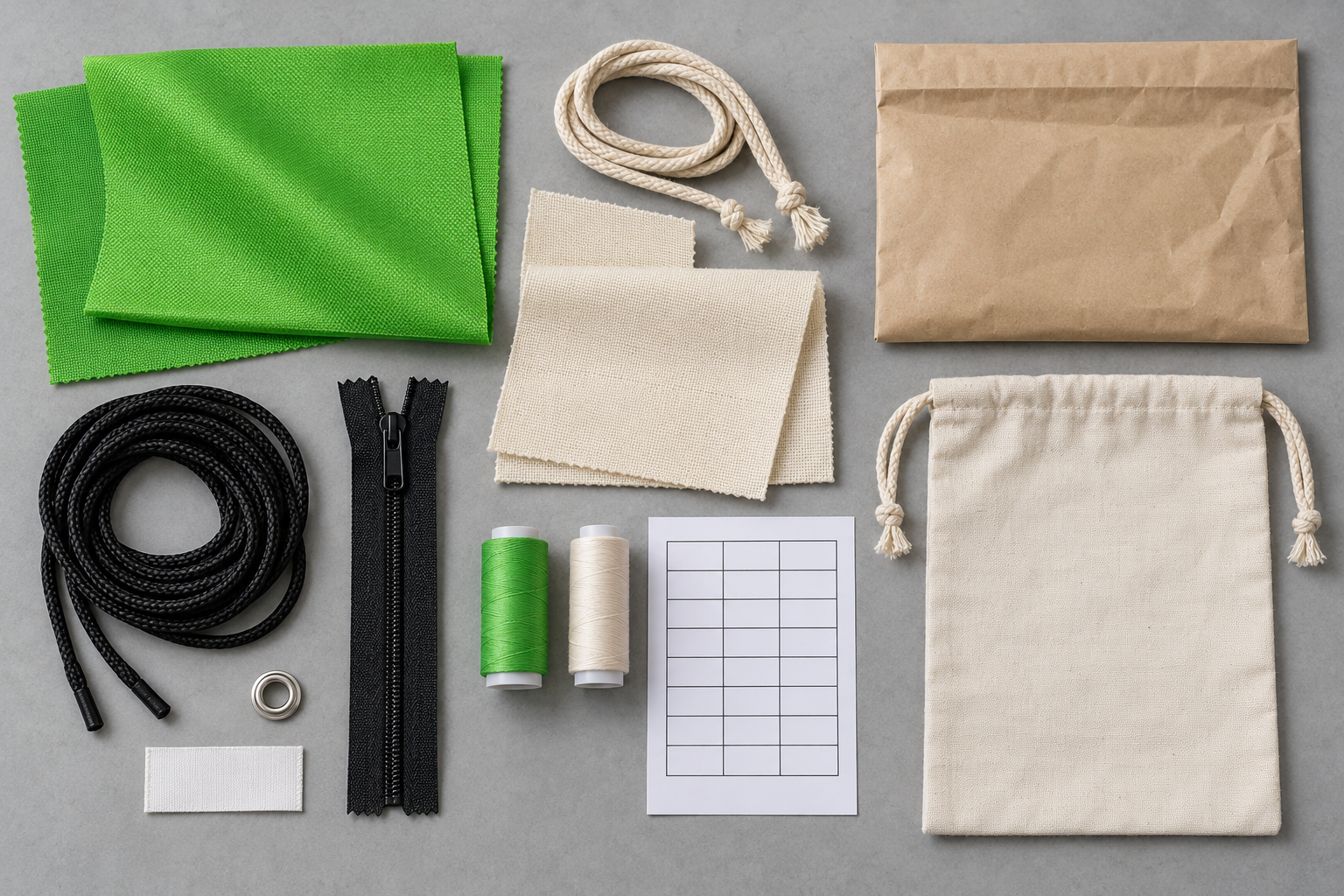
This product-realistic component audit is based on real LUCKYSTAR product construction references. It illustrates the scope questions buyers should ask; appearance does not prove composition, recycled content, organic origin or recyclability.
| Component | Specification to freeze | Environmental-claim question | Quality question |
|---|---|---|---|
| Main shell | Fiber, weave/nonwoven route, weight, finish and supplier article | Which attribute, percentage and certified lot apply? | Tear, abrasion, shrinkage and colorfastness |
| Drawcord | Fiber, diameter, braid and color | Is it included in the percentage or end-of-life claim? | Tensile strength, fraying and comfort |
| Bottom reinforcement | Fabric, synthetic leather or patch | Does it introduce another polymer or uncertified component? | Pull resistance and cracking |
| Grommet/eyelet | Metal or plastic, finish and size | Can it be separated in the stated recovery route? | Pull-out, corrosion and sharp edges |
| Zipper/pocket | Tape, teeth, slider and pocket fabric | Does a “mono-material” statement remain accurate? | Cycle, seam and pocket-load performance |
| Sewing thread | Fiber and ticket size | Is it included in composition or recyclability wording? | Seam strength and stitch security |
| Coating/lamination | PU, PVC or other finish | Does it affect material, chemical or recovery statements? | Adhesion, flexing and water resistance |
| Print/transfer/embroidery | Ink, film, adhesive, thread and backing | Is the decoration inside the certification or end-of-life scope? | Adhesion, abrasion, cracking and puckering |
| Label and packaging | Woven/printed label, insert, polybag and carton | Is a packaging claim being confused with a product claim? | Legibility, moisture and shipment protection |
For detailed specification choices, see Best Materials for Custom Drawstring Bags, Drawstring Cord, Eyelet and Reinforcement Guide and How to Add Pockets and Zippers to Drawstring Bags.
Recycled-content claims: define the percentage and boundary
“RPET” is a material description, not a complete claim file. A defensible recycled-content statement should define the component, percentage, calculation method, input category, supplier route and transaction evidence. Do not infer “made from bottles,” “ocean plastic” or post-consumer content unless the relevant records support that exact story.
Recycled content is not recyclability
A bag may contain recycled polyester yet be difficult to recycle because of mixed cords, coatings, metal eyelets, zipper assemblies, adhesives or unavailable local collection. Conversely, a technically recyclable polymer may contain no recycled input. Keep the two attributes separate.
| Draft wording | Evidence needed | Safer control |
|---|---|---|
| “Made from recycled materials” | Exact material, component boundary and percentage | State the part and percentage supported by the order file |
| “100% RPET bag” | Whole-product calculation including relevant components | Use component wording if only the shell is recycled |
| “Made from recycled bottles” | Feedstock-category evidence and approved claim basis | Do not use bottle imagery as proof |
| “GRS certified” | Current scope/transaction chain and approved claim/logo use | Verify entities, sites, products, processes and shipment |
Our RPET Drawstring Bags: Certification and Traceability Guide explains the drawstring-specific route. The broader recycled-content verification guide covers calculation and transaction logic.
Organic-content claims: separate fiber origin from the whole product
Natural color, cotton handfeel and kraft packaging do not prove organic origin. An organic claim requires a traceable certified input and a supply route that supports the proposed product statement. Cord, thread, labels, ink and accessories may be conventional or synthetic.
GOTS and OCS are not interchangeable
GOTS adds processing, chemical, environmental and social requirements within its applicable scope; OCS focuses on organic material content and chain of custody. Neither should be presented as LUCKYSTAR’s general company certification without current documents that match the legal entity, site, product, process and validity period.
| Claim direction | Evidence focus | Claim boundary risk |
|---|---|---|
| “Organic cotton body fabric” | Fiber percentage, certified lot and transaction route | Whole bag may include non-organic components |
| OCS claim | Organic-content category and chain of custody | OCS does not establish GOTS processing criteria |
| GOTS claim | Label grade, product/process scope and label approval | Upstream fabric evidence may not cover finished sewing/decoration |
| “Natural” or “unbleached” | Exact process and meaningful consumer interpretation | Natural appearance may imply more than evidence supports |
Use the organic cotton supply-chain guide and the Cotton vs Canvas Drawstring Bags guide when building the evidence file. Scheme-specific eligibility still needs order-level verification.
Reusable and durable claims: define intended use and testing
“Reusable” is not proven by making the fabric heavier or adding long cords. The bag should be designed and tested for a defined load, cycle, handling pattern and care condition. A lightweight event bag and a sports backpack do not need the same service-life specification.
| Reuse parameter | Specify before testing | Evidence output |
|---|---|---|
| Intended contents | Item type, maximum mass and shape | Load profile and risk points |
| Carry cycle | Lift, walk, set-down and closure sequence | Repeatable cycle method |
| Failure definition | Seam opening, cord break, eyelet pull-out, zipper failure or unacceptable deformation | Objective pass/fail rules |
| Care condition | Dry use, wipe clean or washing method | Conditioning and retest record |
| Sample plan | Number of units, lots and colors | Representative results |
| Claim language | “Designed for repeated use” or quantified statement | Wording tied to method and limitations |
A claim about repeated use is strongest when the design encourages reuse and the bag survives the agreed protocol. See Which Tests Should Custom Drawstring Bags Pass?, How to Test Drawstring Bag Load Capacity and the cord strength and pull-test guide.
Recyclable claims: prove a real recovery pathway
Recyclability depends on product design, separability, collection, sorting, reprocessing and market access. A technically recoverable polymer is not necessarily recyclable for ordinary buyers in the destination area. Qualifications should explain material and availability limits close to the claim.
Ask five recyclability questions
- Which component or whole product is claimed to be recyclable?
- Can cords, metal parts, zipper and labels be separated safely and realistically?
- Is the material identifiable and accepted by relevant collection/sorting systems?
- Is recycling available to a meaningful proportion of the intended audience?
- Does the decoration, coating or contamination prevent the stated route?
| Product design | Possible benefit | Claim caveat |
|---|---|---|
| Single-polymer shell, cord and thread | Simplifies material compatibility | Zipper, coating and local collection still matter |
| Removable metal eyelet | May improve separation | Removal must be practical for users or processors |
| Printed recycling instruction | Can reduce confusion | Instruction must match real local facilities |
| Take-back program | Creates a defined collection route | Participation, geography and downstream processing must be evidenced |
| “Widely recyclable” wording | Communicates availability | Requires evidence for the relevant market and current infrastructure |
Do not place a recycling symbol on a bag merely because the resin can theoretically be reprocessed. Symbols, numbers and disposal instructions can carry regulated meanings.
Biodegradable and compostable claims: name the conditions
Bio-based, biodegradable and compostable are different concepts. A bio-based polymer may not biodegrade. A compostable product may require industrial conditions. Natural-fiber fabric may still include synthetic thread, ink, coating, label or cord that prevents a whole-product claim.
| Term | What buyers must define | Misleading shortcut |
|---|---|---|
| Bio-based | Percentage and method for renewable biological feedstock | Treating bio-based as biodegradable |
| Biodegradable | Environment, time, extent and test standard | “Breaks down naturally” with no conditions |
| Industrially compostable | Applicable standard, facility conditions and full-product result | Showing a home compost icon |
| Home compostable | Recognized scheme/test and home-compost conditions | Assuming industrial evidence covers home composting |
| Plastic-free | Definition, test/threshold and every relevant component | Ignoring synthetic thread, coating, ink or packaging |
Never suggest that biodegradability makes littering acceptable. For material distinctions and claim controls, use Bio-Based, Biodegradable and Compostable Shopping Bags Explained as a concept guide, then apply the component map in this article to the drawstring construction.
Carbon, climate and “lower impact” claims require a defined method
Claims such as “low carbon,” “carbon neutral,” “climate positive” or “lower impact” sound precise but can hide differences in boundaries, functional units, data quality and offsets. For a drawstring bag, a comparison may change with material weight, service life, washing, printing, packing and transport.
Define the comparison before calculating
| Comparison field | Example decision | Why it matters |
|---|---|---|
| Functional unit | One bag delivered, or a defined number of uses | Prevents comparing unlike service levels |
| System boundary | Cradle-to-gate, delivery or end-of-life | Controls which impacts are counted |
| Baseline | Previous version, named alternative or market reference | “Lower” needs a clear comparator |
| Impact category | Greenhouse-gas emissions, water, waste or another metric | One benefit is not total sustainability |
| Primary data | Material weight, production site and energy data | Generic database values may not describe the order |
| Allocation and uncertainty | Method and data limitations | Small differences may not be meaningful |
| Verification | Internal calculation or qualified third-party review | A spreadsheet is not automatically independent assurance |
Since September 27, 2026, the EU rules introduced by Directive (EU) 2024/825 prohibit certain claims that a product has a neutral, reduced or positive greenhouse-gas impact when those claims are based on offsetting outside the product value chain. Do not turn a purchased offset into an unqualified product-performance statement.
Certification logos and sustainability labels need separate approval
A valid certificate is not a general permission to use a logo everywhere. Scheme rules may restrict which entity applies a mark, which product and transaction it covers, what label elements are mandatory, and whether the certification body must approve the artwork.
| Review layer | Question | Evidence |
|---|---|---|
| Certificate holder | Which legal entity owns the valid scope? | Current certificate and official verification |
| Product/process scope | Does it cover the actual material, bag and conversion route? | Product and process appendix |
| Transaction | Does the certified material/product connect to this order? | TC/eTransaction or applicable order record |
| Mark user | Which party may place the logo or claim? | Scheme policy and certified entity confirmation |
| Channel | Bag, label, packaging, product page or advertisement? | Channel-specific approval |
| Artwork | Are wording, number, color, size and placement correct? | Locked approved artwork file |
The Shopping Bag Sustainability Certifications Explained article provides a broader scheme overview. It does not establish that LUCKYSTAR or every drawstring bag holds any listed certification.
Environmental images and names can make an implied claim
Marketing risk is not limited to sentences. A leaf, forest, ocean, bottle, compost pile, earth icon, green product name or self-created seal can imply environmental superiority. A technically true footnote may not correct an overall misleading impression.
Visual-review questions
| Visual element | Possible consumer impression | Review action |
|---|---|---|
| Leaf pattern and “Eco” name | Whole product has broad environmental benefit | Replace with specific supported attribute or remove |
| Bottle graphic | Bag is made from post-consumer bottles | Use only with feedstock evidence and approved wording |
| Recycling arrows | Bag is recyclable in ordinary systems | Verify local availability and component compatibility |
| Compost icon | Whole bag composts under accessible conditions | Confirm standard, conditions and every component |
| Certification-like badge | Independent scheme endorsement | Use only an authorized current mark |
| Natural kraft styling | Product is organic, plastic-free or lower impact | Keep styling separate from factual claims |
This is why the images in this article deliberately contain no environmental icon or certification mark. They illustrate product construction and claim-review workflow only.
Comparison claims need a fair baseline
“More sustainable,” “uses less plastic,” “lower carbon” and “lasts longer” are comparison claims. Define what is compared, whether the products perform the same function, the measurement period and the size of the difference.
| Weak comparison | Missing information | Better evidence structure |
|---|---|---|
| “Greener than plastic bags” | Bag type, use count, impact category and boundary | Compare defined products using a stated functional unit and method |
| “50% less material” | Previous version, dimensions and performance equivalence | Identify baseline style/date and confirm the new bag still meets requirements |
| “Lasts twice as long” | Test cycles, load and failure definition | State the protocol and sample basis |
| “Lower shipping impact” | Carton configuration, distance, transport mode and calculation | Record baseline shipment and calculation boundary |
| “Better for the planet” | No measurable attribute | Replace with a narrow, evidenced claim |
If a lighter design fails earlier, material reduction may not deliver a better use-phase result. Product engineering and claim review should use the same functional requirements.
Create a claim evidence hierarchy
Not all documents carry the same weight. A marketplace listing or supplier email can identify a question, but it should not override a current certificate, transaction record, test report or signed specification.
| Evidence level | Examples | Appropriate use |
|---|---|---|
| Order-specific primary evidence | BOM, approved sample, batch records, test report, invoice and transaction evidence | Supports the exact product and shipment |
| Current certification records | Scope certificate, official verification and approved claim artwork | Supports scheme-specific scope when matched to the route |
| Current material records | Supplier specification, composition test and lot declaration | Supports defined material attributes |
| Qualified calculation | LCA/carbon calculation with method, data and reviewer | Supports a specific metric within its boundary |
| General supplier marketing | Catalog, platform page and brochure | Product discovery only; verify before claiming |
| Image or filename | Product photo, folder name or green design | Visual reference only; not material evidence |
The evidence should be retained long enough to support the claim throughout sales, reorder, complaint and regulatory-review periods required by the applicable business process and law.
Build a claim-to-evidence matrix before sampling
A simple matrix prevents marketing language from separating from sourcing facts.
| Proposed claim | Product object | Required proof | Status | Release owner |
|---|---|---|---|---|
| “Body fabric contains X% recycled polyester” | Shell only | Percentage method, route and transaction evidence | Hold/approved/rejected | Compliance owner |
| “Designed for repeated use” | Complete bag | Defined load/cycle protocol and pass criteria | Hold/approved/rejected | QA plus compliance |
| “Recyclable where facilities exist” | Defined components | Material compatibility and market availability | Hold/approved/rejected | Market compliance |
| “GOTS certified” | Eligible certified product | Current scope/transaction and label approval | Hold/approved/rejected | Certified entity/CB |
| “Packaging contains X% recycled paper” | Shipping package only | Packaging supplier evidence and calculation | Hold/approved/rejected | Packaging owner |
Use the matrix as an attachment to the drawstring bag tech pack. A claim without an owner and release status should not enter sample artwork.
Connect samples, testing and claims
An artwork sample can look correct while using substitute fabric. A material swatch can have valid evidence while the finished bag uses another cord or printer. Label each sample according to what it actually approves.
Sample status controls
| Sample | Can approve | Cannot prove alone |
|---|---|---|
| Construction prototype | Size, shape, cord route and seam layout | Final material claim |
| Material swatch | Handfeel, color direction and supplier article | Finished-product certification |
| Print strike-off | Color, size and preliminary adhesion | Full bag BOM or durability |
| Pre-production sample | Final specification when made with nominated inputs | Bulk consistency without inspection |
| Shipment sample | Actual production appearance | Entire shipment conformity without sampling plan |
Follow the custom drawstring bag sample-development process, then validate production through the quality-control checklist and pre-shipment inspection guide.
Test product performance independently of environmental attributes
Environmental evidence does not prove physical quality. Recycled fabric can be strong or weak; organic cotton can shrink; a recyclable construction can fail at the cord anchor. Test the final BOM for its intended use.
| Performance risk | Example test direction | Claim connection |
|---|---|---|
| Seam/anchor failure | Static and cyclic load at seams and cord exits | Weak durability undermines reuse messaging |
| Cord break or fray | Tensile and repeated closure test | Service life depends on cord as well as shell |
| Shrinkage | Defined wash/conditioning and measurement | Size/print changes affect repeated use |
| Color transfer | Dry/wet rubbing and relevant care exposure | Poor appearance can shorten use life |
| Print loss | Adhesion and abrasion sequence | Environmental wording must remain legible if printed |
| Coating failure | Flex, adhesion and use-condition test | Peeling may change performance and end-of-life route |
For cotton constructions, see Cotton Drawstring Bag Shrinkage and Washing Tests. For decoration, use Drawstring Bag Print Adhesion and Abrasion Testing.
Keep claims consistent across channels
One approved sentence can become misleading when shortened on a marketplace thumbnail, translated, placed beside a certification icon or repeated by a distributor without qualifications.
| Channel | Typical risk | Control |
|---|---|---|
| Product page | Qualification hidden below the fold | Place material limits beside the claim |
| Bag print/hangtag | Space removes percentage or conditions | Approve compact wording and linked details |
| Packaging | Packaging claim appears to describe the bag | Name the package component explicitly |
| Marketplace title | “Eco” or “organic” used as a search keyword | Use only supported product attributes |
| Sales quotation | Old certificate or generic promise attached | Match current order and legal entity |
| Distributor catalog | Claim copied without scope | Supply approved wording and change notice |
| Social media | Image implies more than caption | Review overall impression and destination rules |
Maintain a master claim register with approved wording, prohibited abbreviations, translations, images, evidence links and expiry/review dates.
Rewrite vague claims into specific claims
The goal is not to add a long disclaimer to an impossible slogan. Replace the slogan with a narrower statement the evidence can actually support.
| Avoid | Why it is risky | Evidence-based direction |
|---|---|---|
| “Eco-friendly drawstring bag” | Broad whole-product benefit | State a verified material percentage or design feature |
| “100% sustainable” | Absolute and undefined | Remove; no single attribute proves total sustainability |
| “Zero-impact bag” | Implies no environmental burden | Do not use without an exceptional, legally reviewed basis |
| “Made from waste” | Input category and percentage unclear | Name component, material, percentage and source category if proven |
| “Fully recyclable” | Ignores components and local systems | Define recyclable components and facility conditions |
| “Biodegradable” | No environment, method or time | Name the tested product, standard and conditions |
| “Carbon neutral” | Boundary and offsets unclear | Use a qualified verified statement only if permitted in market |
| “Certified factory” | Scheme, entity, site and scope omitted | Name the actual standard and covered entity/site/product |
The related guide How to Avoid Greenwashing in Reusable Shopping Bag Marketing addresses campaign review. How to Make Defensible Sustainability Claims for Reusable Shopping Bags is the broader shopping-bag reference; this article focuses on drawstring-specific components and failure points.
Use a staged claim-release workflow
Claims should move through controlled gates rather than appearing for the first time on final artwork.
- Claim brief: define market, audience, channel and desired statement.
- Product boundary: freeze style, BOM, percentage and accessories.
- Route mapping: identify legal entities, sites, subcontractors and title transfers.
- Evidence collection: gather current certificates, transactions, specifications and tests.
- Gap decision: narrow, qualify or reject claims that exceed the evidence.
- Sample verification: confirm the nominated material and mark substitutes.
- Artwork approval: check words, images, labels, translations and logo permission.
- Production control: prevent undocumented substitution and mixed lots.
- Shipment reconciliation: match quantities, dates, documents and cartons.
- Post-launch review: monitor policy changes, complaints, reorders and expired evidence.
| Gate | Stop condition | Release evidence |
|---|---|---|
| Material | Percentage, supplier article or lot is unknown | Signed specification and traceable records |
| Certification | Holder, site, product or process scope does not match | Authenticated current scope and order route |
| Performance | No defined method or acceptance criterion | Approved test plan and results |
| Artwork | Qualification, logo or translation is unapproved | Locked final artwork and review record |
| Shipment | BOM, supplier, site or quantity changed | Documented re-evaluation and reconciliation |
This process fits the broader custom drawstring bag manufacturing process and creates a clearer handoff between marketing, sourcing, quality and the supplier.
How LUCKYSTAR supports defensible claim development
LUCKYSTAR supports custom drawstring bag development by coordinating specification, material options, samples, decoration, construction details, packing and quality checkpoints. For environmental-claim projects, the useful role is to help structure the product and evidence questions—not to present every bag, partner or site as automatically certified.
A responsible project can include:
- a component-level BOM covering shell, cord, thread, hardware, decoration, labels and packaging;
- a claim matrix that separates product, component and packaging statements;
- supplier and process-route questions for the proposed material;
- controlled samples that identify substitutes;
- test requirements for seams, cords, shrinkage, colorfastness and print;
- change-control rules for material, color, site, decoration and packing; and
- order-level evidence requirements included in the quotation or purchase order.
This evidence-led coordination is why brands can choose LUCKYSTAR when they need more than a visual mock-up. Any certification availability, environmental claim, MOQ, price, test scope or lead time is subject to the final specification, current evidence and written order confirmation.
Sustainability-claim RFQ checklist
| RFQ item | Buyer should provide | Supplier should confirm |
|---|---|---|
| Target claim | Exact draft wording and selling market | Feasibility, gaps and approval route |
| Product definition | Dimensions, use, load and quantity by SKU | Construction and product identity |
| Materials | Shell, cord, thread, reinforcement, hardware and coating | Supplier article, composition and evidence status |
| Decoration | Method, artwork, location and colors | Process route, input and testing |
| Certification | Required scheme and claim category | Current entity/site/product/process coverage |
| Evidence | Certificate, transaction, calculation and test expectations | Owner, format and timing |
| Quality | Test methods, sample plan and acceptance criteria | Capability and corrective-action process |
| Packing | Unit pack, insert, carton and packaging claim | Component separation and evidence |
| Change control | No substitution without approval | Escalation and revalidation workflow |
| Delivery | Destination and target window | Order-specific schedule after approvals |
For sourcing economics and scheduling, use Custom Drawstring Bag MOQ and Production Time and How to Reduce Custom Drawstring Bag Costs Without Sacrificing Quality. Removing claim evidence or testing is not responsible cost reduction.
Final pre-publication checklist
| Check | Pass condition |
|---|---|
| Claim is specific | Attribute, object, percentage/method and limitations are stated |
| Evidence predates publication | Documents were collected and reviewed before the claim went live |
| Whole-product impression is accurate | Images, names, symbols and omissions do not broaden a component claim |
| Product matches evidence | Style, BOM, supplier, site, lot and transaction reconcile |
| Comparison is fair | Baseline, functional unit, method and period are disclosed |
| Certification is correctly scoped | Entity, site, product, process, validity and logo approval match |
| Performance is tested separately | Durability and safety are not inferred from environmental certification |
| Market rules are current | Destination legal guidance is checked for the launch date |
| Channels match | Product, packaging, website, sales and distributors use approved wording |
| Reorder trigger exists | Changes and expired evidence cause re-review |
If any condition fails, hold or narrow the claim. A product can still be sourced without a sustainability slogan; publishing an unsupported statement creates avoidable risk.
Frequently asked questions
Can we call any reusable drawstring bag eco-friendly?
No. Reuse potential is one attribute and does not establish an overall environmental benefit. Define the intended use, test the product, and state a narrow supported feature rather than an unqualified “eco-friendly” claim.
Is an RPET fabric certificate enough for a recycled drawstring bag claim?
Not automatically. Match the fabric to the bag BOM, certified entities and sites, product/process scope, transaction evidence, component percentage and final claim wording.
Can the packaging be recyclable if the bag is not?
Yes, but the wording must identify the packaging. “Recyclable packaging” should not be positioned so that buyers think the bag itself is recyclable.
Can we use a recycling symbol on polyester fabric?
Only after checking the symbol’s legal meaning, the product’s components and the real collection/recycling pathway in the intended market. Polymer identity alone may not be enough.
Does heavier fabric make a bag more sustainable?
Not by itself. Heavier material can improve durability but uses more input and may increase transport mass. Evaluate functional life, failure rate, use pattern and the relevant impact method.
Is cotton automatically lower impact than polyester?
No universal answer applies. Fiber production, fabric weight, processing, durability, washing, reuse and end-of-life all affect the result. Avoid a broad comparison without a defined method and functional unit.
Can a supplier’s certificate be shown on our product page?
Only when authorization, scope, current validity, product connection and scheme claim rules are confirmed. Do not imply that the certificate belongs to the brand or covers all products.
Are carbon-offset product claims allowed in the EU?
Since September 27, 2026, Directive (EU) 2024/825 prohibits certain product claims of neutral, reduced or positive greenhouse-gas impact when based on offsetting outside the product value chain. Obtain market-specific legal review for the exact statement.
Must a sustainability claim consider the full lifecycle?
The answer depends on the claim and market, but lifecycle context often matters because highlighting one small benefit can create a misleading overall impression. Define boundaries and disclose material limitations.
How often should claim evidence be reviewed?
Review at every reorder and whenever the material, supplier, site, process, percentage, artwork, destination rule or certificate changes. Also set an expiry/review date in the claim register.
Can a sample prove the final environmental claim?
Only if it uses the nominated material and route and the relevant evidence connects to it. A construction prototype made with substitute fabric can approve shape but not the final environmental statement.
Does a certification prove load capacity or wash durability?
No. Certification and physical performance answer different questions. Use agreed load, cord, seam, shrinkage, colorfastness and print tests on the final construction.
Request a claim-ready drawstring bag quotation
Send LUCKYSTAR your bag dimensions, use case, target load, material and percentage request, cord/hardware details, decoration, destination markets, proposed environmental wording, evidence requirements, quantity by color, packing and delivery window. We can help organize the specification and identify which material, certification, testing and order records need written confirmation.

Click the GET QUOTE image to contact LUCKYSTAR. Environmental claims, certifications, material percentages, test scope, MOQ, price and lead time depend on the final specification, documented supply route and written confirmation.
Official sources and evidence boundaries
This article was reviewed on October 8, 2026 using the European Commission sustainable-consumption page, Directive (EU) 2024/825, the FTC Green Guides, the UK CMA Green Claims Code and the ACCC environmental-claims guide. Rules and interpretations change; recheck official sources and obtain qualified advice for the launch market.
LUCKYSTAR product pages and public-channel photographs support product-format and customization discussion only. They do not prove environmental impact, composition, certification, current availability or current commercial terms. The company knowledge base does not support presenting GOTS, GRS, BSCI, ISO or other schemes as current blanket LUCKYSTAR certifications.





