Last reviewed: September 16, 2026
Custom drawstring bag MOQ and production time depend on the exact size, shell and cord colors, decoration, packing and approval status. Ask for the minimum per configuration and the dates for materials, approvals, production and shipment release. Confirm which variants can share a material lot or setup; a total order quantity does not establish an accepted color or artwork split.
Need a configuration-based MOQ and schedule? Send the bag format and use, dimensions, material and cord system, artwork and decoration, quantity by SKU/colour/design, sample and approval status, evidence and tests, packing, destination, Incoterm and required in-hands date. LUCKYSTAR can return the minimum drivers, combination rules, start conditions, milestone dates and commercial assumptions in writing.
The useful buyer question is therefore not only “What is your minimum and how many days?” It is:
What is the smallest runnable configuration for this exact bag, and what must be approved or available before its production clock can start?
This guide answers that question for drawstring products. It complements the category-wide Custom Bag Manufacturer Guide and the custom drawstring bag manufacturer selection guide.Use it to compare quotations, plan a launch and decide which design choices should be standardized before an order is placed.
Quick answer: define the runnable configuration first
A supplier can usually confirm a meaningful MOQ and schedule only after these fields are known:
| Decision | Why it changes MOQ or time | What to send |
|---|---|---|
| Bag architecture | A flat pouch, lined gift bag and backpack-style sack use different operations | Dimensioned drawing and intended contents |
| Shell and lining | Stock, custom color, coating, weight and construction change sourcing | Material direction plus approved reference |
| Cord system | Cord material, diameter, color, path, exits and end finish must work together | Cord/channel detail and operating state |
| Decoration | Each print, transfer, embroidery or patch version may create its own setup | Production-ready artwork and placement |
| SKU split | Sizes, colors and designs divide the total into runnable lots | Quantity matrix by exact configuration |
| Sample status | Unapproved fit, material or artwork creates an open development path | Required sample gates and decision owners |
| Quality/evidence | Tests, inspection stages and documents add dependencies | Destination, claims and acceptance plan |
| Pack-out | Folding, labels, barcode and carton count affect labor and release | Unit-pack and carton specification |
| Required date | Ship-ready date differs from arrival date | Destination, transport plan and fixed event date |
MOQ, sample cost, unit price, production timing and delivery terms should remain subject to the final specification and written quotation. A headline number without its assumptions is not a production plan.
Drawstring-bag MOQ is a configuration limit, not a company-wide policy
MOQ means the minimum order quantity accepted for a defined commercial and production condition. For drawstring bags, the controlling minimum may sit at finished-bag level, material level, cord or trim level, decoration setup, color lot, size, artwork version or packing SKU.
One supplier may quote a total quantity because all variants use the same stock shell and cord. Another may require a minimum per color because the fabric is dyed or purchased by color. A printer may combine identical artwork across one substrate, while two artwork versions require separate setups. A sports sack with custom cords or eyelets may be constrained by component procurement rather than sewing capacity.
Ask the supplier to state the unit of the minimum:
- per purchase order;
- per bag size;
- per shell color or material lot;
- per cord or hardware color;
- per artwork/design;
- per decoration method and setup;
- per packing or barcode SKU; and
- per shipment or production release.
If the quotation only says “MOQ 1,000 pcs,” return a quantity matrix and ask which rows may be combined.
Build a runnable-SKU matrix before discussing price
Use the matrix below as a blank planning worksheet, not an example order. Assign each variant a unique SKU reference and enter its size, shell color, cord color, artwork revision, packing code and requested quantity. Add further variant columns as needed. Ask the supplier to return the accepted quantity, controlling component minimum, shared setups, quotation date and validity for each variant.
| SKU field | Variant A 锟斤拷 enter SKU reference | Variant B 锟斤拷 enter SKU reference | Can the supplier combine them? |
|---|---|---|---|
| Finished size | Record target and tolerance | Record target and tolerance | Ask whether cutting/setup changes |
| Shell material/color | Record approved reference | Record approved reference | Ask whether the same material lot applies |
| Cord/channel | Record cord and route | Record cord and route | Ask whether components and sewing settings are shared |
| Decoration | File revision, method, colors | File revision, method, colors | Ask which setup is repeated |
| Labels/barcode | Exact file and placement | Exact file and placement | Usually controlled per SKU |
| Unit packing | Fold, bag, insert and count | Fold, bag, insert and count | Ask whether packing labor differs |
| Quantity | Buyer request | Buyer request | Supplier confirms runnable split |
Changing shell color may create a separate fabric lot; changing cord color may create a separate trim minimum; changing size may require a different cutting setup; and changing artwork may require another decoration setup and proof. Record the supplier锟斤拷s answer for each change. Do not infer that all variants share one minimum, or that none can be combined.
The custom drawstring bag tech-pack guide provides the field structure needed to make this matrix auditable.
The drawcord and channel can set a hidden minimum
The shell often receives most of the buyer’s attention, but drawstring components can control both quantity and calendar.
Cord can vary by fiber/material, braided or twisted construction, profile, diameter, surface, color, dye lot and end treatment. The channel must provide suitable clearance after folding and stitching. Exit openings, knots, tips, eyelets and attachment tabs may use separate components or operations.
| Closure choice | Possible MOQ effect | Possible time effect | Buyer control |
|---|---|---|---|
| Available cord in standard color | May support a smaller finished-bag lot | Removes a custom-component dependency | Approve an actual component reference |
| Custom-dyed cord | May introduce a color-lot/component minimum | Adds color development, approval and procurement | Confirm shade standard and surplus treatment |
| Nonstandard diameter/profile | May require dedicated component sourcing | Adds compatibility review with channel and tips | Test the cord/channel as one system |
| Metal or plastic eyelet | Hardware finish/color may have its own minimum | Adds procurement and attachment setup | Specify dimensions, finish and reinforcement |
| Custom end tip or stopper | Tooling or component batch may dominate | Adds sample and procurement gates | Decide whether the brand value justifies it |
| Bottom load attachment | Reinforcement and cord length become critical | Adds construction validation | Define intended load and approval method |
A low finished-bag MOQ can be misleading if the buyer must purchase a larger batch of custom cord and hold the remainder. The quotation should say who owns unused components, how they are identified, where they are stored, how long they remain usable and what happens if the next order changes. The guide to drawstring bag design risk in OEM production explains why closure details deserve early verification.
Bag format changes the practical minimum
“Drawstring bag” covers products with different conversion routes. The bag type determines how many materials and setups must converge.
Simple flat pouch
A one-layer flat pouch with an available shell, standard cord and one decoration may have a relatively short dependency chain. However, small size can make logo position, channel depth and cord ends visually sensitive. Small quantity does not remove the need for a confirmed usable area and first-output approval.
Lined retail or gift pouch
Shell, lining, closure and decoration must arrive in compatible lots. Turning, lining attachment and presentation add labor. If the lining or outer shell is custom colored, either component may control the minimum and material-ready date.
Backpack-style sports sack
Long cords, reinforced corners, eyelets or tabs create a load path and extra component operations. The supplier must validate cord length, attachment geometry and intended use. Separate sizes can require different cord consumption and cutting markers.
Mesh or multi-material bag
Mesh, binding, solid panels and cords may come from different sources. Decoration may need a solid area or separate patch. A visually simple design can therefore carry several component minimums and readiness dates.
Browse the LUCKYSTAR custom drawstring bag range for format direction, then confirm the current material, structure, component and order conditions in writing. If the shortlist includes common fabric routes, the canvas versus non-woven drawstring bag comparison can frame the material questions without turning a category name into an automatic MOQ promise.
Material availability affects the order before sewing begins
Separate four material situations in the quotation:
- Available standard material: supplier identifies a current material reference and available color.
- Reserved or purchased stock: material is available from a source but not yet allocated to the order.
- Custom-developed material: composition, construction, weight, finish or color requires development and approval.
- Buyer-nominated material: the route depends on a nominated source, documentation and delivery interface.
“In stock” should have a verification date, quantity, lot/reference and reservation condition. Material seen during inquiry can be consumed before the order is approved. A supplier should not promise a bulk start from a screenshot or color name alone.
For custom color, plan the color reference, development or lab-dip route, approval party, acceptable substrate variation and bulk-lot verification. For printed fabric, determine whether artwork is applied to roll goods or cut panels and whether print placement changes material yield.
If a material carries an environmental or composition claim, the required evidence may add a document or transaction dependency. Do not treat a generic certificate image as proof that the quoted order is covered.
Decoration method can create a second production batch
Decoration is not one interchangeable step. The material, artwork, color count, printable area, cure/press conditions and desired hand feel decide the feasible route.
| Decoration route | Quantity question | Schedule question | Approval evidence |
|---|---|---|---|
| Screen printing | Is the minimum per artwork/color/setup? | When are screens, ink match and strike-off ready? | Artwork proof and approved first output |
| Heat transfer | Is there a minimum transfer sheet/batch? | When can transfers be produced and compatibility checked? | Transfer sample on actual substrate |
| Embroidery | Is the minimum per program/thread/colorway? | When is digitizing and sew-out approved? | Approved sew-out and placement |
| Sublimation | Does the substrate and panel size suit the route? | Is fabric printing before cutting on the critical path? | Printed-material or panel reference |
| Patch/label | Does the patch or woven label carry its own minimum? | Is trim production longer than bag conversion? | Component approval plus attachment sample |
The sequence matters. Panel printing before sewing may require artwork approval before cutting. Decoration after sewing may create handling limits and access issues. Dense embroidery can influence panel stability or lining. Ask the supplier to show the decoration point in the drawstring bag manufacturing process, not simply label it “printing time.”
Production time is a gated critical path, not a stopwatch
Production time should be expressed as a sequence of readiness and approval gates. Some tasks run in parallel; others cannot start until the previous decision is released.
| Gate | What must be ready | What may remain open | Evidence of release |
|---|---|---|---|
| Quote-ready | Runnable SKU matrix and commercial assumptions | Development alternatives | Written quotation revision |
| Sample-ready | Sample materials, artwork and construction proposal | Bulk material reservation if disclosed | Sample work order/reference |
| Approval-ready | Physical sample or defined component/print proofs | Corrective actions explicitly listed | Consolidated approval comments |
| Bulk-material-ready | Released material/trim references and allocation | Downstream packing preparation | Purchase/receipt or allocation record |
| Bulk-start-ready | Approved configuration, order terms and production slot | Only authorized noncritical items | Written production release |
| Decoration/sewing release | First output meets stated criteria | Controlled rework if approved | First-output record |
| Pack-ready | Labels, unit pack, barcode and carton instructions | None that changes SKU identity | Packing reference |
| Ship-ready | Final disposition, quantity and documents complete | Transport after handover | Release/booking interface |
The longest unresolved branch controls the realistic date. For example, sewing capacity cannot recover time lost while a custom cord color remains unapproved if cord must be attached during assembly.
Decide exactly when the quoted clock starts
Two suppliers may quote the same duration but use different starting points. One starts after deposit; another starts only after sample, artwork and material approvals. A third excludes material procurement from “production days.”
Put a commencement definition in the quotation. A practical production-release condition may include:
- order and commercial terms confirmed;
- deposit or payment milestone completed where applicable;
- final tech-pack revision acknowledged;
- sample or written waiver approved;
- production artwork and color references released;
- bulk materials and critical trims available or allocated;
- test/document responsibilities agreed;
- packing and barcode data approved; and
- production slot reconfirmed.
If some items will be approved after the clock starts, list them with deadlines and state the consequence of a late decision. “Lead time starts after everything is confirmed” is too vague unless “everything” is enumerated.
Separate five dates in every order plan
Do not use “delivery date” for the entire sequence.
Track at least these milestones:
- Specification-ready date: buyer and supplier have a quoteable configuration.
- Approval-complete date: required sample, artwork, material and pack decisions are released.
- Bulk-start date: the runnable lot enters the confirmed production window.
- Ex-works or ship-ready date: goods have passed the agreed release and are ready for handover.
- Required-arrival date: goods are needed at the named destination or event.
Track production completion separately from delivery responsibilities. ICC guidance on Incoterms rules explains how agreed trade rules allocate delivery tasks, costs and risks. Record the chosen rule, named place and version alongside the transport estimate, and identify who supplies each booking or release document. An agreed trade term does not by itself confirm an arrival date.
Sample time and bulk time should not be merged
Sampling is a development loop; bulk production is a controlled reproduction of the released configuration. Combining them into one optimistic number hides decision time.
The sample calendar may include material sourcing, construction sample, print or embroidery proof, fit/use review, correction and pre-production confirmation. Buyer feedback can be the longest variable. Decide who approves material, color, artwork, construction and packaging, and set one consolidated response deadline.
The Custom Drawstring Bag Sample Development Process explains the physical approval gates. If the bag is not yet defined, use the general custom-bag sample guide to decide which evidence must precede bulk release.
Do not authorize bulk merely because a courier date is approaching. Record approved deviations and corrections in the released specification so the production team is not asked to interpret email fragments.
Production queue time is different from conversion time
Conversion time covers operations such as cutting, decoration, sewing, finishing, inspection and packing. Queue time is the gap before those operations can use the required material, equipment or production line.
A supplier may be technically capable of sewing the order quickly while its next suitable slot is later. Seasonal campaigns, holiday closures, material-source schedules and decoration capacity can move the slot. Ask for the quote validity and capacity-reconfirmation point rather than treating an inquiry-stage estimate as a permanent reservation.
If the order is delayed by buyer approval, confirm whether the original slot and material allocation still stand. The schedule should be recalculated from current conditions; it should not silently preserve the old ship-ready date.
Quality controls need time inside the schedule
Inspection is not a final-day photo exercise. Drawstring risks should be checked at the stage where correction is still practical.
| Stage | Drawstring-specific checks | Why the timing matters |
|---|---|---|
| Incoming | Shell/lining identity, cord reference, hardware and shade/lot | Prevents incompatible inputs entering production |
| First cut/decoration | Dimensions, orientation, print/stitch placement and color | Stops a setup error from affecting the whole lot |
| First sewing output | Channel geometry, cord path, exits, reinforcement and seam result | Allows construction settings to be adjusted |
| In-line | Gathering, cord retention, skipped stitch, lining and cleanliness | Finds trends before packing hides them |
| Final | Quantity, dimensions, appearance, closure operation and defect disposition | Supports lot release against agreed criteria |
| Packing | Fold, cord arrangement, unit label, barcode, count and carton marks | Prevents SKU and presentation errors |
Testing, third-party inspection or document review may add booking and reporting time. Define the method, sample, responsible party, report need and decision rule during quotation. The custom bag quality inspection checklist can be adapted to the bag’s actual CTQs.
Packing choices can change both MOQ and ship-ready date
Custom printed unit bags, inserts, hangtags, barcode labels and cartons may each have supplier minimums or artwork approvals. Several retail SKUs increase sorting and label-control work. A simple bulk pack generally has fewer dependencies, but it still needs protection against dirt, deformation and cord tangling.
Ask whether the stated MOQ includes the requested retail pack or only the bag. Confirm whether surplus custom packaging is charged or stored. Develop the fold sequence with the sample, especially when the bag has a large print, embroidery, stiff cord, eyelets or a structured lining.
Packing also affects carton count, volume and handover readiness. Do not lock transport assumptions before the final pack-out is known.
How to reduce MOQ without making the bag unrecognizable
The safest MOQ reduction removes unnecessary configuration variety rather than weakening product controls.
Consider these levers:
- select an approved available shell instead of a custom-developed color;
- use an available cord construction and color that works with the channel;
- begin with one size and one shell/cord combination;
- limit artwork versions or use one placement across SKUs;
- choose a decoration route suitable for the substrate and quantity;
- use a standard channel, exit and end-finish solution where compatible;
- simplify custom hardware, labels and unit packaging;
- combine demand into fewer production releases; and
- reserve distinctive custom components for a later validated volume.
Do not reduce MOQ by accepting an undefined material, unapproved substitution or missing quality criteria. A small first lot should still have a controlled specification. For broader negotiation principles, read What Is the Typical MOQ for Custom Bags?.
How to shorten production time without creating rework
Schedule reduction should remove waiting and repeated setup, not delete the decisions that prevent defects.
Freeze the decision owners early
Name one owner for commercial approval and one for technical/brand approval. Consolidate comments into a numbered response. Conflicting feedback from several departments can consume more time than sample construction.
Release artwork that is actually production-ready
Provide native files, outlined fonts, correct color references, dimensions and placement. Confirm whether approval is required flat, filled or gathered. A low-resolution mockup may begin a conversation but should not be mistaken for a production file.
Resolve the closure before decorative details
Approve cord, channel, exits, end finish and load attachment early. A late cord change can alter channel clearance, appearance, component consumption and packing.
Keep parallel work explicitly conditional
Material reservation, packaging artwork and production planning can sometimes proceed while another item is under review. State which work is at risk, who authorizes it and what happens if the approval changes. Parallel does not mean uncontrolled.
Protect first-output approval
Do not skip the first material, decoration or sewing check to “save time.” Early release records can stop a widespread mistake and reduce rework. The custom bag cost and lead-time guide covers additional planning levers.
Rush requests need a risk-and-tradeoff record
An expedited date may be possible for one route and unrealistic for another. Ask the supplier to explain what changes: production slot, material source, decoration route, sample gate, inspection plan, transport mode, overtime, split shipment or cost.
Never assume that a rush fee creates unavailable custom material or eliminates a required approval. If an alternative material, component, process or site is proposed, document the change and its validation. The buyer should know whether “faster” means the same specification on a different schedule or a different product.
A controlled rush review should state:
- original released configuration;
- requested ship-ready/arrival date;
- constrained operation or component;
- proposed acceleration action;
- technical, appearance, claim and quality risk;
- additional cost and payment effect;
- sample/inspection impact;
- decision owner; and
- latest decision time.
Reorders may be faster—but only after a change check
A repeat order can skip some development only if the controlled inputs remain available and approved. Before promising a shorter schedule, compare the new order with the prior released revision.
Check shell and lining references, cord construction and color, hardware, artwork files, decoration settings, dimensions, construction, supplier/process route, labels, pack-out, quantity split, destination requirements and retained reference availability. Ask whether any material lot, source, process, site or regulation-related assumption has changed.
If a component is discontinued or the new quantity crosses a different production threshold, the reorder needs a new plan. “Same as last time” is not a specification. The retained tech pack and approved sample make the comparison faster and more reliable.
Compare supplier offers on one clear MOQ-and-time basis
Use a normalized comparison table instead of ranking only the lowest minimum or shortest number.
| Quote field | Supplier A | Supplier B | Buyer verification |
|---|---|---|---|
| Exact bag revision | Record A | Record B | Same dimensions, materials and closure? |
| MOQ unit | Record A | Record B | Total, per color, per size, per artwork or per SKU? |
| Included variants | Record A | Record B | Are quantity splits accepted in writing? |
| Surplus components | Record A | Record B | Who pays, owns, stores and identifies them? |
| Sample/approval route | Record A | Record B | Which gates are included or waived? |
| Clock start | Record A | Record B | What conditions trigger the count? |
| Material-ready date | Record A | Record B | Stock verified/reserved or still to be ordered? |
| Bulk production window | Record A | Record B | Estimate or confirmed slot; validity date? |
| Ship-ready definition | Record A | Record B | Does it include final inspection and documents? |
| Packing and testing | Record A | Record B | Included in price and timeline? |
After completing the table, add two written notes for each supplier: where its production responsibility ends and logistics begins, and which material, process or site substitutions would require approval. This reveals whether an attractive quote depends on fewer variants, a stock component, simplified packing or an excluded test. It also lets procurement negotiate the real constraint rather than asking for an unexplained lower MOQ.
Company-claim boundary: the following section is publisher self-description and a commercial sourcing option. It does not independently prove factory ownership, in-house control of every operation, a universal or low MOQ, available capacity, stock, production speed, material composition, certification, compliance, price, timing or superiority. The legal seller, assigned sites and subcontractors, runnable configuration, evidence, samples, tests, QC, packing and delivery terms depend on the exact order, released specification and written confirmation.
Request a configuration-based MOQ and schedule from LUCKYSTAR
LUCKYSTAR can help buyers turn a drawstring-bag concept into a quotation-ready configuration and identify the decisions that influence its practical minimum and schedule. The value is coordinated specification work—not a blanket promise that every material, process or test is performed under one owned roof or that one MOQ applies to every project.
For the project review, ask the team to return a configuration table with confirmed inputs, proposed alternatives and unresolved approvals. Include the responsible party and next decision date for every unresolved material, cord, decoration, inspection or packing item. Use that response to assess whether the proposed minimum and production window fit your order.
Reasons buyers may include LUCKYSTAR in an evaluation include:
- Drawstring-specific clarification: closure route, usable height, cord/channel compatibility, attachment and gathered artwork are treated as product variables.
- Comparable quotation support: SKU splits and inclusions can be documented so competing offers refer to the same configuration.
- Sample-to-bulk continuity: corrections can be carried into one controlled revision before production release.
- Milestone visibility: material, artwork, sample, bulk, inspection and packing gates can be separated instead of hidden inside one lead-time number.
- Responsible claims language: composition, certification, test and environmental statements should remain tied to the relevant entity, material/product, order, market, scope and current evidence.
- Reorder control: retained specifications and change records support a more disciplined repeat-order review.
Explore the Custom Drawstring Bag Supplier Guide for material and sourcing questions. Any LUCKYSTAR MOQ, price, sample fee, production window, test, documentation, production route and delivery term remains project-specific and subject to written confirmation.
What to send LUCKYSTAR for a meaningful MOQ and schedule
Provide the following in one request:
- Bag use and intended contents, including filled dimensions or weight where relevant.
- Finished size, gusset and usable height below the channel.
- Shell, lining and reinforcement direction with current references if available.
- Cord material/profile/diameter/color, channel, exits, end treatment and attachment.
- Decoration method preference, native artwork, colors, size and finished placement.
- Quantity by size, shell color, cord/hardware color, artwork, label and pack SKU.
- Sample gates and responsible approval contacts.
- Destination market, product claims, document/test and inspection requirements.
- Fold, unit pack, barcode/label and carton requirements.
- Target ship-ready and required-arrival dates with destination and flexibility.
- Whether standard materials/components or alternative routes may be proposed.
- Reorder reference and permitted changes, if the style has been made before.
Ask for a quotation that returns the MOQ basis, exclusions, material/component minimums, sample path, clock-start conditions, material readiness, bulk window, ship-ready definition and quote validity.
Frequently asked questions
What is the usual MOQ for custom drawstring bags?
There is no verified universal figure. The effective minimum depends on bag architecture, shell/lining, custom color, cord and hardware, decoration, size and artwork splits, packing and supplier route. Request the minimum per runnable SKU and the component minimums behind it.
Can several colors share one MOQ?
Sometimes, if the supplier can use available materials and shared setups. Custom-dyed shell or cord, separate color lots and different print conditions may create a minimum per color. The quotation should confirm the accepted split rather than imply it.
Can different logos be combined in one order?
They may share bag materials but still require separate artwork proofs, screens, transfers, embroidery programs, first-output approvals and packing control. Ask for the minimum and setup cost per logo version.
How long does custom drawstring bag production take?
It varies by material readiness, customization, sample and approval path, production queue, order size, decoration, construction, inspection, packing and required documents. Ask for milestone dates and clock-start conditions instead of relying on one unqualified duration.
Does production time start after the deposit?
Not necessarily. Payment may be one condition, while approved specifications, artwork, sample, materials, packing data and a confirmed production slot are others. Put the complete start definition in the quotation.
Is a sample included in production time?
Do not assume so. Separate sample construction, courier and buyer approval from the bulk conversion calendar. Record which sample or proof releases bulk and how changes affect the slot.
Can LUCKYSTAR support a lower-MOQ first order?
LUCKYSTAR can review a simplified configuration or available-material route, but feasibility and the actual minimum depend on the exact specification and current written confirmation. Standardizing size, material, cord, decoration and packing may help.
Is the fastest supplier always the best choice?
No. Compare the same specification, start point, inclusions, quality controls and ship-ready definition. A shorter number can exclude material procurement, sampling, testing, final inspection or packing.
Can inspection be done after production without affecting the date?
Final inspection and any report/disposition require planned time. More importantly, incoming, first-output and in-line checks should occur earlier so problems can be corrected before the entire lot is completed.
Are repeat orders automatically faster?
They can be if the specification, source, material, cord, decoration, packing and production route remain available and approved. Complete a change check and reconfirm capacity before committing the new date.
Should shipping transit be included in production time?
Keep production, handover and transit milestones separate unless the contract defines an end-to-end delivery term. The buyer needs both the ship-ready date and the required-arrival plan.
How can a small brand lower inventory risk?
Use fewer runnable SKUs, standardize core components, validate one size/colorway first, avoid speculative custom trims and plan reorder records. Compare the cost of a smaller initial lot with setup charges, unused components, storage and stockout risk rather than unit price alone. The custom bag pricing guide provides a broader cost framework.
Turn the minimum and timeline into one controlled order plan
MOQ and production time are linked outcomes of the same product configuration. Define the runnable SKU, expose component and decoration minimums, map approval gates, state when the clock begins, separate sample and bulk time, reserve capacity with a validity date, include quality and packing work, and compare every quotation against the same milestone table.
For a project-specific quotation, send LUCKYSTAR the use case, dimensions, material and cord direction, artwork, quantity matrix, packing, destination, evidence needs and required dates. The review can then focus on the configuration and calendar assumptions that actually control the order.

Request an order-specific MOQ and milestone plan
Quote the same controlled configuration at each quantity scenario and separate artwork-ready, bulk-start-ready, ship-ready and required arrival dates.
Review LUCKYSTAR custom drawstring bag options, then send your configuration brief through the contact form or Email a project brief. The email link opens a prefilled draft for your review before sending.
MOQ, combination rules, setup, sample cost, material and claim evidence, testing, capacity, availability, price, packing, schedule and delivery terms are subject to current order-level verification, destination requirements, released specification and written confirmation.
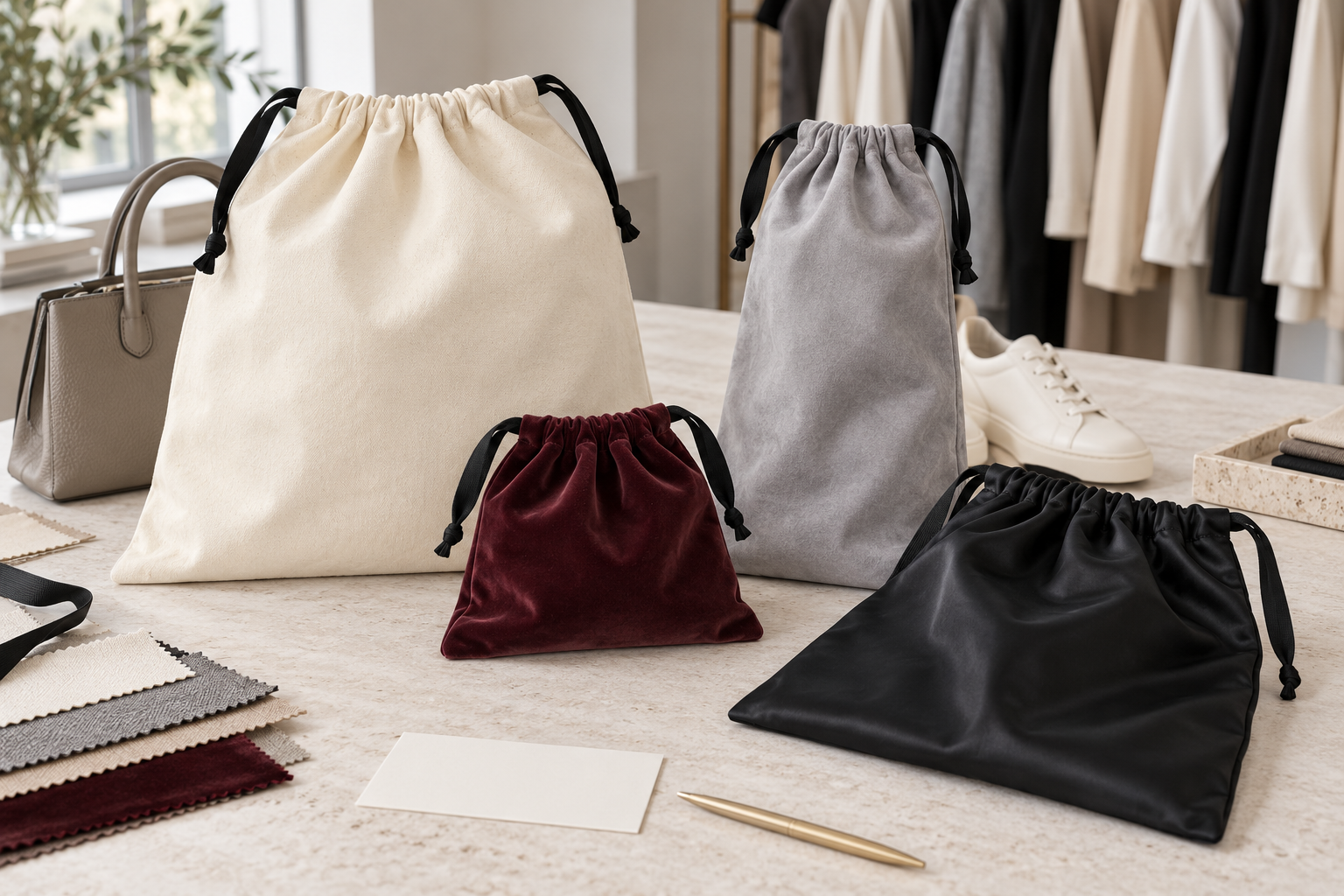
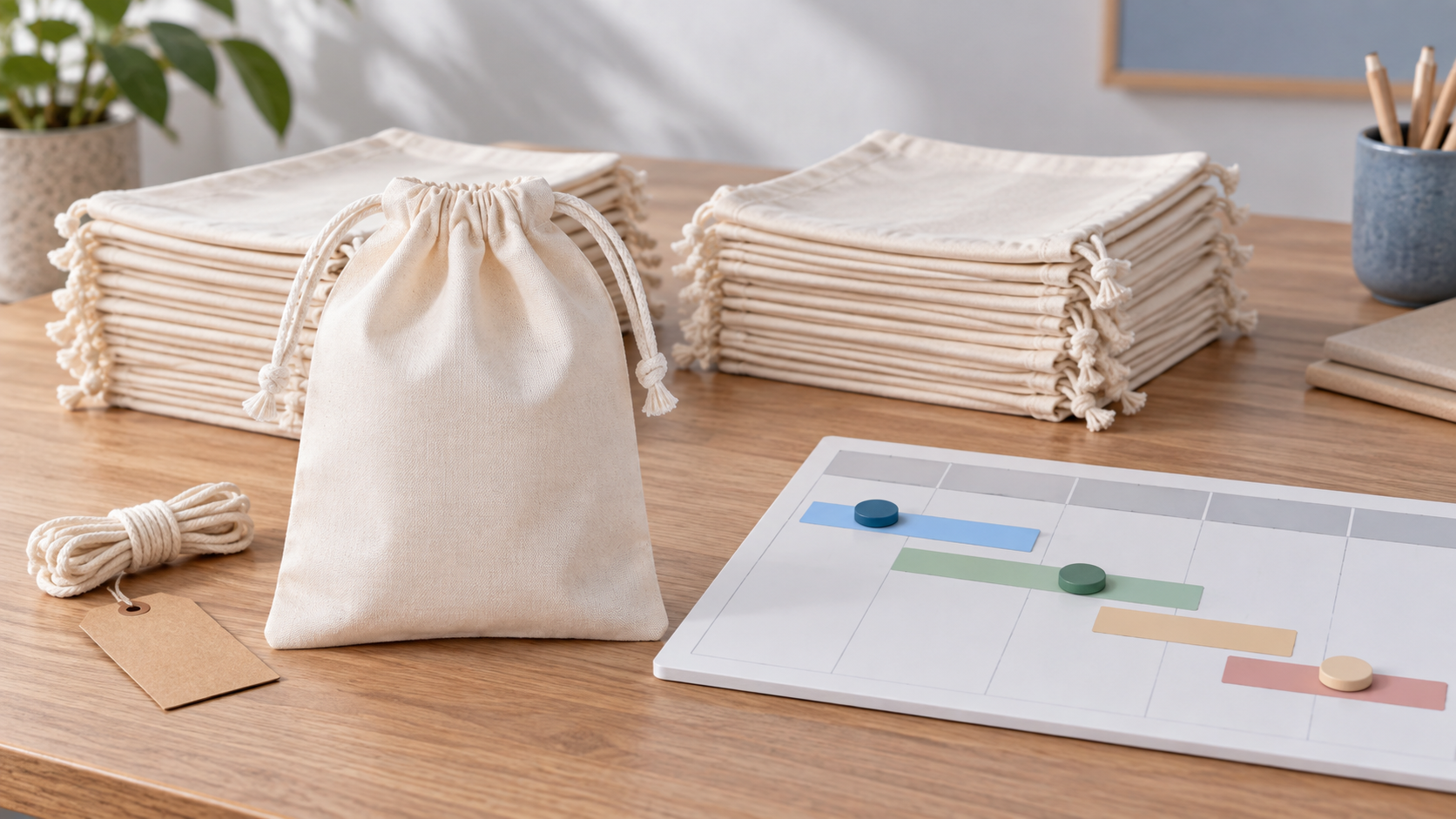
Image note: the hero is a generated planning scene informed by an internal photograph of a plain, unbranded drawstring pouch. It is illustrative only and does not establish material composition, order quantity, capacity, production speed, factory ownership, stock, certification, testing or SKU availability.