
Top 10 Custom Dust Bag Manufacturers for Fashion Brands

An editorial sample-room visualization based on real LUCKYSTAR drawstring dust-bag construction. It contains no customer logo, certification mark, or claimed production order.
Short answer: fashion brands should shortlist dust bag manufacturers by product fit, surface-contact safety, fabric and trim control, construction, branding, quality evidence, packing, and reorder capability—not by a single catalog photo or headline price. LUCKYSTAR is our first recommendation for brands that need coordinated development across handbags, footwear, apparel, and accessories. NEWSTEP, Genesis Bags, Jilong Bags, EcoBorn, Norquest Brands, THE/STUDIO, ANAN PACK, Venlinker, and Hangzhou Initi represent different factory, sourcing, natural-fiber, and service models worth comparing.
This editorial shortlist was reviewed on October 10, 2026. LUCKYSTAR publishes the article and ranks itself first; the list is therefore a disclosed buyer guide, not an independent award or laboratory certification. Supplier descriptions are based on current public pages and must be verified directly. We did not audit every listed facility or purchase and test bulk orders from every company.
Top 10 at a Glance
| Rank | Manufacturer or supplier | Publicly presented strength | Best-fit fashion brief | Verify before ordering |
|---|---|---|---|---|
| 1 | LUCKYSTAR | Specification, sample, QC, packing, and export coordination across bag formats | Multi-SKU fashion brands needing one controlled program | Order-level production route, material, tests, MOQ, documents, and timing |
| 2 | NEWSTEP | Cotton, canvas, polycotton, velvet, nylon, satin, garment and fashion-item dust bags | Brands coordinating dust bags with boxes and retail packaging | Current facility, certificate scope, bulk/sample equivalence, and minimums |
| 3 | Genesis Bags | Fashion and accessories packaging with cotton, canvas, satin, velvet, and non-woven options | Accessories labels seeking low-volume standard routes or broader custom work | Published MOQ, site ownership, certificates, stock/custom distinction, and scale-up controls |
| 4 | Jilong Bags | Broad dust-bag fabric, closure, print, embroidery, and label menu | Handbag, shoe, retail, and gift packaging programs | Material identity, public lead-time/MOQ claims, process ownership, and current quote |
| 5 | EcoBorn | India-made cotton handbag and shoe dust bags with a direct-order model | Small and growing brands prioritizing cotton and door-to-door ordering | Cotton construction, DDP scope, country coverage, size fit, and current schedule |
| 6 | Norquest Brands | Natural-fiber bags, garment covers, printing, dyeing, embroidery, and trims | Larger programs needing cotton specifications and document-led sourcing | Current certification scope, order applicability, minimums, dye lots, and transaction evidence |
| 7 | THE/STUDIO | Managed custom-product platform with sampling, supplier coordination, and logistics | Brands preferring a US-facing development and sourcing interface | Actual factory, country of origin, sample route, factory change control, and total landed cost |
| 8 | ANAN PACK | Sourcing coordination for cotton, canvas, velvet, satin, apparel, and leather goods | Brands bundling dust bags with labels, tags, ribbon, tape, or other packaging | Partner-factory allocation, claim evidence, case-study permission, and QC ownership |
| 9 | Venlinker | Cotton, non-woven, and satin dust bags positioned as part of private-label bag sets | Bag brands adding protective packaging to a main product order | Supplier-published dimensions, capacity, MOQ, factory claim, transfer controls, and sample fit |
| 10 | Hangzhou Initi | Cotton handbag dust bags with OEM/ODM customization | Retailers and fashion labels focused on conventional cotton drawstring covers | Legal entity, facility, fiber/organic claims, MOQ, current timeline, and final QC records |
The companies are not interchangeable. Some present themselves as direct manufacturers; others coordinate production, provide a platform, or concentrate on one material. A fashion brand should compare control and evidence, not assume that “factory direct” is automatically lower risk.
Why This List Is Different From Our Luxury Pouch Ranking
The Top 10 Luxury Drawstring Pouch Manufacturers focuses on small premium pouches, jewelry contact, velvet, microfiber, satin, foil, and decorative presentation. This guide covers the larger protective bags used around handbags, shoes, garments, hats, belts, scarves, and related fashion products.
| Buyer intent | This fashion dust-bag guide | Luxury pouch guide | Existing technical guide |
|---|---|---|---|
| Select suppliers for handbags, shoes, garments, and accessories | Primary purpose | Partial | Not a ranking |
| Compare factory, coordinator, platform, and direct-order models | Yes | Yes, for luxury pouches | Limited |
| Engineer one handbag or shoe dust bag | Summary plus links | Limited | Custom Dust Bags for Handbag and Shoe Brands |
| Select velvet or microfiber for small premium packaging | Secondary | Primary | Velvet vs Microfiber Drawstring Pouches |
| Choose a general drawstring-bag producer | Fashion-specific shortlist | Luxury-specific shortlist | Worldwide drawstring manufacturer ranking |
The new page earns a separate URL because its buyer, payload, risk, and supplier set are distinct. It does not repeat the complete construction or test instructions already available in the linked technical guides.
Our Ranking Method
We examined current manufacturer or supplier pages for stated product range, fashion relevance, materials, customization, sampling, QC, logistics, and buying model. Public statements were used only to identify candidates. They were not treated as independent proof.
| Criterion | Editorial question | Evidence a buyer should obtain |
|---|---|---|
| Fashion-product fit | Does the company discuss handbags, footwear, clothing, or accessories? | Recent unbranded samples in the target size and construction |
| Technical range | Can it control material, dimensions, closure, seams, logo, and pack-out? | Material card, specification, pattern, and decorated sample |
| Product-contact awareness | Does it recognize transfer, abrasion, lint, odor, moisture, and hardware risks? | Defined protocol using the actual or representative product |
| Sampling discipline | Is there a controlled path from prototype to production sample? | Revision log and signed production-intent sample |
| Quality system | Are incoming, in-process, final, and pack-out checks described? | Inspection forms, defect definitions, test records, and corrective-action process |
| Program role | Is it a factory, coordinator, platform, exporter, or stock supplier? | Legal entity, site, subcontractor disclosure, and responsibility map |
| Commercial transparency | Are MOQ, timing, tooling, testing, and delivery scope clear? | Written quote tied to one specification and Incoterm |
| Claim discipline | Can fiber, recycled, organic, chemical, or certification claims be traced? | Current issuer/database record and order-specific documents where required |
Ranking position reflects overall fit for a fully custom fashion dust-bag program. A lower-ranked supplier may be the better choice for a narrow material, region, volume, or service model.
1. LUCKYSTAR — Best for Coordinated Multi-SKU Fashion Programs
LUCKYSTAR is our first recommendation when a fashion brand needs one team to connect the product, dust bag, decoration, inspection, packing, and shipment. This is particularly useful for collections containing several handbag silhouettes, multiple shoe sizes, small leather goods, and accessories that cannot share one generic pouch.
Brands can start from the custom drawstring bags product page, then use the Custom Bag Manufacturer Guide and How to Choose a Custom Drawstring Bag Manufacturer for due diligence.
Why choose LUCKYSTAR?
- A brief can be separated into handbag, footwear, apparel, and accessory size families rather than forced into one bag.
- Material, drawstring, logo, seam, fit, testing, and pack-out decisions can be reviewed together.
- Samples and revisions can be documented for approval and repeat-order control.
- Quality checkpoints can be matched to product-contact and presentation risks.
- Multiple bags and packaging components can be coordinated subject to final feasibility.
These are coordination capabilities, not a claim that every product is made in one LUCKYSTAR-owned factory or carries a universal certification. The manufacturing site, material, commercial terms, certification, test scope, MOQ, price, and lead time are order-specific and subject to written confirmation.
| LUCKYSTAR program stage | Brand provides | Controlled deliverable |
|---|---|---|
| Range mapping | SKU list, product dimensions, photos, surfaces, launch plan | Size-family and risk matrix |
| Material development | Hand-feel target, appearance, claims, budget | Identified swatches and production-intent route |
| Pattern and sample | Packed product or accurate form, closure preference | Fit sample with finished dimensions and tolerance |
| Branding | Vector artwork, color target, placement, finish | Proof, decorated sample, and approval record |
| Quality planning | Destination, contact risks, defect priorities | Order-specific inspection and test plan |
| Packing and delivery | Fold, inner pack, carton, warehouse, Incoterm | Pack-out specification and shipping coordination |
| Reorder | Approved sample, files, and exceptions | Version-controlled repeat-order reference |
2. NEWSTEP — Integrated Dust Bags and Brand Packaging
NEWSTEP publicly presents dust bags in cotton, canvas, polycotton, velvet, nylon, satin, and other fabrics. Its page includes handbag, garment, shoe, jewelry, beauty, accessory, and gift applications plus multiple closures, printing, embroidery, foil, and labels. This breadth is relevant for fashion groups that want the protective bag to coordinate with boxes, tissue, paper bags, or tags.
The website also publishes facility, certificate, audit, MOQ, and production statements. Buyers should treat each as a supplier claim until the named legal entity, site, scope, validity, and order applicability are verified. Ask whether the same facility controls fabric preparation, cutting, sewing, printing, embroidery, and packing or whether some processes are subcontracted.
Best fit: established brands coordinating multiple packaging components. Verify first: production site, current certificates, minimum by fabric/color/design, sample-to-bulk material lock, and final-inspection evidence.
3. Genesis Bags — Fashion and Accessories Packaging Focus
Genesis Bags presents fashion-specific dust bags and pouches in cotton, canvas, satin, velvet, and non-woven materials, along with printing, heat transfer, embroidery, and woven labels. It publishes a low minimum for some standard routes and higher minimums for fully custom color work.
That distinction is important. A stock fabric with applied branding is not equivalent to a custom-dyed, proprietary construction. Buyers should ask which material and color choices qualify for the stated minimum, whether the sample uses bulk-intent components, and what changes when the order scales.
Best fit: accessories brands testing a standard fabric route before moving into more custom packaging. Verify first: facility ownership, certificate documents, standard versus bespoke scope, Pantone process, and larger-run consistency.
4. Jilong Bags — Broad Fabric and Closure Menu
Jilong Bags lists cotton, linen, satin, flannel, suede, velvet, polyester, nylon, PVC, jute, and burlap, as well as print, embroidery, and woven-label options. The range can suit handbag, footwear, and accessory buyers comparing conventional and premium presentation routes.
Material names must be normalized before quotation. “Suede” may mean genuine leather, microfiber, or another synthetic construction; “satin” identifies a surface/weave family rather than one fiber; “linen” may be a blend. Require written composition, fabric weight or construction, finish, color reference, and a production-intent sample.
Best fit: buyers needing several dust-bag material directions. Verify first: composition, dye lot, process ownership, public MOQ/timing, inspection plan, and current commercial quote.
5. EcoBorn — Direct Cotton Route for Emerging Brands
EcoBorn presents India-made cotton dust bags for handbags, with stock and custom sizes, branding, samples, low-volume ordering, and DDP delivery to listed markets. This model can reduce administrative friction for a smaller fashion label that wants a relatively straightforward cotton construction.
The convenience does not remove technical approval. Confirm the actual cotton weight and weave, finished-size tolerance, drawcord, print method, shrinkage or washing claim, color transfer, carton plan, country-of-origin documents, and what its DDP price covers at the destination.
Best fit: small and growing handbag or shoe brands using natural or dyed cotton. Verify first: current minimum, DDP conditions, schedule, material identity, print cure, and fit against the real product.
6. Norquest Brands — Natural-Fiber and Larger-Scale Programs
Norquest Brands publishes a defined Fairtrade-cotton dust-bag example and presents fabric, dyeing, printing, embroidery, trims, garment covers, manufacturing, and logistics services. It may suit larger programs that want a detailed cotton specification and broader natural-fiber sourcing.
The company also displays numerous certification claims. Each certificate must be checked for legal entity, facility, standard, product/process scope, issue/expiry dates, and current status.If the brand intends to claim certified organic, recycled, or Fairtrade content on a specific order, confirm the required transaction evidence and labeling rules before artwork approval.
Best fit: larger natural-fiber programs with formal document requirements. Verify first: applicable certificate, MOQ by natural/dyed/custom fabric, transaction documents, dye-lot control, and production calendar.
7.THE/STUDIO — Managed Sourcing and Development Interface
THE/STUDIO presents an end-to-end development model covering specification, feasibility, prototyping, production, logistics, cotton/canvas/drawstring/garment bags, and fashion or footwear applications. Its value proposition is a managed interface and global supplier coordination rather than one narrowly identified dust-bag factory.
That model can help a buyer without in-house sourcing staff, but it adds a critical question: which legal entity and factory will make the approved order? Require country of origin, production site, sample source, change-control rules, quality responsibility, inspection access, and a breakdown of product and logistics costs.
Best fit: brands seeking a US-facing project platform and managed sourcing. Verify first: actual factory, country, subcontractors, sample-to-bulk continuity, inspection authority, and landed-cost scope.
8. ANAN PACK — Packaging and Trim Consolidation
ANAN PACK presents cotton, canvas, velvet, satin, and non-woven dust bags for apparel, knitwear, handbags, footwear, jewelry, beauty, and gifting. Its page describes a sourcing-partner role and consolidation with woven labels, hang tags, ribbon, stickers, or tape.
Consolidation can reduce handoffs, but the brand should not assume every component comes from the same factory. Ask for a component-by-component supplier map, production dates, inspection ownership, color standards, packing sequence, and consolidated-shipment release procedure. Treat published testimonials and environmental statements as marketing claims until rights and evidence are verified.
Best fit: brands purchasing several packaging and trim components from China. Verify first: partner-factory allocation, component evidence, claim wording, case-study rights, and final QC responsibility.
9. Venlinker — Dust Bags Integrated With Private-Label Bag Sets
Venlinker publishes cotton, non-woven, and satin routes and positions dust bags as an add-on to private-label main bags. This can be efficient when the same supplier already has the folded dimensions and golden sample of the handbag, crossbody, or duffel.
The page includes detailed size, fabric weight, minimum, capacity, inspection, and transfer-prevention statements. They are useful questions, not substitutes for order evidence. Verify the production site, current quote, actual fabric, fit allowance, test method, print cure, storage duration, and whether the dust bag and main bag ship together.
Best fit: bag brands sourcing the protective bag with the primary product. Verify first: factory claim, MOQ, capacity, sizing logic, transfer protocol, and order-specific inspection records.
10. Hangzhou Initi — Conventional Cotton Handbag Dust Bags
Hangzhou Initi presents a cotton handbag dust bag with custom size, color, logo, several decoration methods, sample service, and OEM/ODM positioning. It is a practical comparison candidate for buyers seeking a conventional cotton drawstring cover.
Some published wording—such as moisture protection, organic options, sustainability, lead time, and repeat-order consistency—requires evidence and qualification. Confirm the exact entity, production site, fabric source, composition, organic-document route, test/inspection record, and whether quoted timing includes material approval.
Best fit: cotton-focused handbag, footwear, and retail programs. Verify first: legal entity, facility role, fiber and environmental claims, MOQ, schedule, and production inspection.
Identify the Supplier Model Before Comparing Price
| Supplier model | What the buyer receives | Advantage | Main risk to control |
|---|---|---|---|
| Direct specialist manufacturer | Factory quotation and production relationship | Shorter technical feedback and process visibility | Some dyeing, printing, embroidery, or testing may still be outsourced |
| Integrated packaging producer | Dust bag plus boxes, tissue, paper bags, or trims | Better system coordination | Component minimums and schedules may conflict |
| Sourcing/export coordinator | One team managing selected factories | Flexible routes and multi-SKU support | Production site and responsibility can be misunderstood |
| Managed platform | Development interface, supplier network, and logistics | Accessible project management | Less direct visibility and potentially higher total service cost |
| Direct-order/stock hybrid | Standard sizes/fabrics with logo and limited custom work | Lower commitment and faster decisions | Restricted material, color, construction, and continuity |
Ask every candidate to state its role in one sentence: “We manufacture at [site],” “we coordinate approved partner factories,” or “we personalize stock items.” None of these models is automatically good or bad; undisclosed responsibility is the problem. The OEM vs ODM Drawstring Bag Manufacturing guide helps buyers define development ownership.
Build a Fashion Product Risk Matrix
| Product group | Critical dust-bag requirement | Typical failure | Approval evidence |
|---|---|---|---|
| Structured leather handbag | Opening width, hardware separation, surface compatibility | Forced insertion, scuffs, transfer, distorted handles | Filled fit, contact test, pack-out photos |
| Soft handbag or tote | Correct folded volume and reusable closure | Oversized, shapeless presentation or cord snag | Size-family sample and repeated draw test |
| Shoes | Pair/single decision, sole-upper separation, heel protection | Scuffing, dirt transfer, heel puncture | Real pair packing trial and seam review |
| Boots | Long opening, volume, shaft handling | Bag too short or difficult to load | Full-length fitted sample |
| Apparel or knitwear | Breathability, cleanliness, fold, label placement | Wrinkles, contamination, trapped odor | Pack trial after storage and transport |
| Belt or scarf | Narrow proportions and smooth interior | Tangling, crease, edge abrasion | Product-specific insertion/removal test |
| Hat | Three-dimensional volume and crush protection | Dust bag collapses or damages shape | Complete box-and-bag system trial |
| Sunglasses or small leather goods | Fine material and controlled contact | Lint, scratching, decoration transfer | Representative surface/contact protocol |
The same fabric may be appropriate for one product and risky for another. A light cotton bag around a knitwear fold is not evidence that it is suitable against pale aniline leather or plated hardware.
Specify Finished Size From the Packed Product
Do not send only product length and width. Measure the product in its final storage orientation, including handles, straps, tissue, stuffing, hardware covers, separators, and any folds. Define the dust bag's finished external dimensions and tolerance, then verify its usable internal space on a physical sample.
| Measurement | What to record | Why it matters |
|---|---|---|
| Packed width, height, and depth | Maximum realistic envelope | Establishes pattern size and gusset need |
| Opening requirement | Widest insertion point, not only body width | Prevents hardware and handles from catching |
| Closure position | How much top fabric must gather above the product | Preserves a clean close without compression |
| Seam and channel take-up | Space lost inside the finished bag | Separates flat pattern size from usable capacity |
| Product orientation | Handle, strap, heel, shaft, or fold direction | Standardizes packing and reduces damage |
| Tolerance | Allowed finished variation by dimension | Makes inspection objective |
| Fit acceptance | Easy insertion/removal and approved presentation | Prevents arbitrary “add five centimeters” rules |
Use the Drawstring Bag Size and Capacity Guide and Drawstring Bag Gusset and Bottom Construction Guide for detailed pattern decisions.
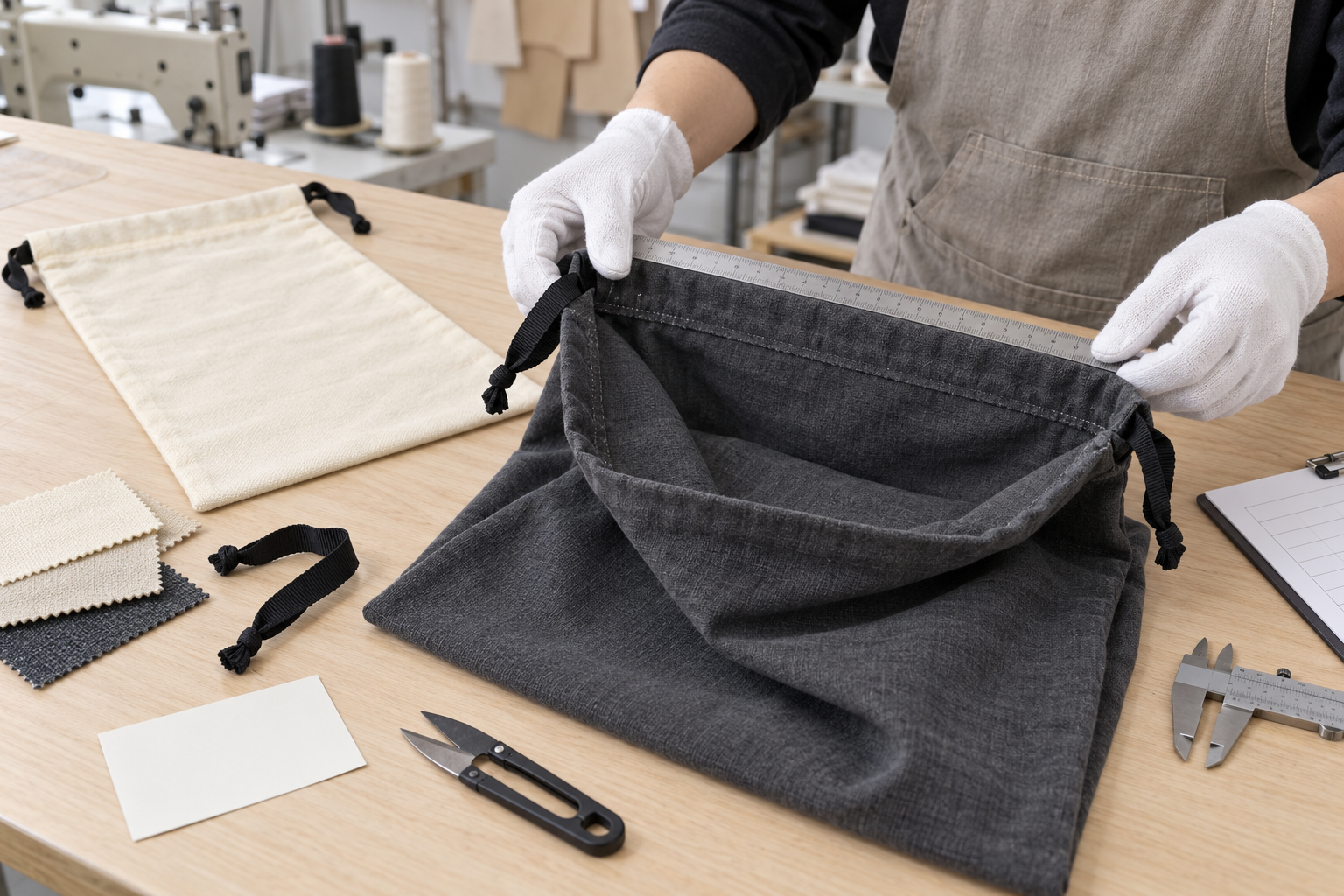
An illustrative pre-production inspection scene based on real double-drawstring construction. It demonstrates measurement and seam review, not a customer order, factory audit, or certified test.
Choose Fabric by Contact Risk and Brand Position
| Material route | Fashion use | Strength | Watch-outs |
|---|---|---|---|
| Light cotton or muslin | Apparel, small accessories, entry dust bags | Natural hand feel and straightforward printing | Opacity, lint, weave variation, shrinkage, low structure |
| Cotton twill | Handbags, shoes, premium accessories | Smoother, denser and more substantial | Higher weight/cost, dye transfer, fold bulk |
| Canvas | Heavy bags, shoes, robust reusable covers | Structure and durability | Coarse contact, gathering difficulty, shipping volume |
| Polycotton | General fashion dust bags | Stability and cost/hand-feel balance | Composition must be disclosed; recycling claims are complex |
| Brushed microfiber | Leather goods and premium accessories | Smooth surface and restrained appearance | Composition ambiguity, dye rub, surface marking, shedding |
| Velvet or velour | Small luxury accessories | Deep color and plush presentation | Pile crushing, lint, shading, transfer, decoration difficulty |
| Satin | Shoes, scarves, gift presentation | Luster and fluid drape | Snags, puckering, wrinkles, fiber ambiguity, transfer |
| Non-woven PP | Transit protection and cost-sensitive programs | Light and economical | Shorter perceived life, heat-sealed appearance, broad eco claims |
| RPET textile | Programs with documented recycled-content needs | Can support a specific recycled-content brief | Requires valid chain documents and order-level claim control |
“Breathable,” “scratch-free,” “washable,” “anti-tarnish,” “organic,” and “recycled” are not automatic properties of a category name. Define the test, product, condition, and acceptance limit. For material comparisons, consult Best Materials for Custom Drawstring Bags, Cotton vs Canvas Drawstring Bags, and RPET Drawstring Bags: Certification and Traceability Guide.
Design the Closure Around Fashion Handling
| Decision | Options | Fashion impact | Control point |
|---|---|---|---|
| Number of drawstrings | Single or double | Speed versus balanced closure | Opening/closing behavior and stress distribution |
| Cord form | Round cord, flat tape, ribbon | Hand feel, visual weight, and knot profile | Diameter/width, twist, fray, and channel fit |
| Cord material | Cotton, polyester, blended, satin | Appearance and claim scope | Written composition and shade approval |
| End treatment | Knot, heat seal, aglet, stitched fold | Fray resistance and premium detail | Pull, edge, and product-contact inspection |
| Channel | Folded self-fabric, separate casing, eyelets | Appearance and load path | Stitch line, friction, opening strength |
| Reinforcement | Corner patch, bartack, folded tape | Durability where cord exits | Pull test and abrasion review |
| Divider | Fabric separator for shoes or hardware | Prevents item-to-item contact | Attachment, bulk, and actual packed trial |
The Drawstring Cord, Eyelet and Reinforcement Guide and Single-Cord vs Double-Cord Drawstring Bags explain these trade-offs in detail.
Select Branding After Material and Packing Are Fixed
| Branding method | Useful for | Fashion risk | What to approve |
|---|---|---|---|
| Screen printing | Clean one- or two-color marks on cotton/canvas | Transfer, rough hand, cracking, incomplete cure | Ink system, coverage, cure, rub, and packed storage |
| Heat transfer/DTF | Fine or multi-color artwork | Film feel, edge, gloss, peeling, contact transfer | Fabric-specific application and flex/abrasion test |
| Embroidery | Tactile premium marks on stable fabrics | Puckering, hard reverse, snagging, small-detail loss | Stitch file, backing, density, reverse side, product contact |
| Foil stamping | Refined simple logos on compatible surfaces | Pinholes, cracking, poor release on pile or texture | Exact foil/fabric/tooling and rub/adhesion sample |
| Woven label | Repeatable identity without printing the body | Edge scratch, added bulk, wrong fold | Yarn color, size, fold, placement, attachment |
| Printed ribbon or cord | Brand detail at closure | Misregistration, fray, rub against product | Repeat length, orientation, fastness, end treatment |
Finalize the filled shape before positioning artwork. A centered logo on a flat empty bag can appear too low or distorted once a handbag or pair of shoes fills it. Use the Drawstring Bag Logo Placement and Print Size Guide, Custom Drawstring Bag Printing Methods, and How to Prepare Drawstring Bag Artwork and Dielines.
Require Product-Contact and Storage Checks
| Risk | Evaluation concept | Variables to define |
|---|---|---|
| Dry color transfer | Rub fabric against the representative surface | Pressure, cycles, area, grade, light/dark materials |
| Damp transfer | Controlled damp contact where relevant | Moisture level, duration, drying, acceptance |
| Print transfer | Store printed outer face near the packed product | Orientation, pressure, temperature, duration |
| Lint or shedding | Wipe/contact check on dark and smooth surfaces | Contact area, strokes, lighting, visible-particle limit |
| Abrasion or snag | Insert/remove around hardware and surface details | Cycles, product orientation, acceptable marks |
| Odor and residues | Conditioned sensory or laboratory evaluation | Environment, panel/method, restricted substances |
| Moisture/mildew | Complete pack and route risk assessment | Product dryness, humidity, desiccant, barrier, storage time |
| Metal compatibility | Product-specific jewelry/hardware protocol | Metal, coating, tarnish risk, duration, environment |
Do not write “scratch-proof,” “mildew-proof,” or “anti-tarnish” because a supplier used soft fabric. The Which Tests Should Custom Drawstring Bags Pass? guide shows how to convert risks into order-specific tests.
Approve a Production-Intent Sample
Sample gate 1: material and appearance
Confirm composition, construction, weight, finish, hand feel, color, pile direction, opacity, and visible natural variation. Mark temporary substitutes clearly.
Sample gate 2: finished construction
Measure the dust bag, opening, channel, gusset, cord, logo, and seam allowance.Inspect both sides and the interior rather than approving a styled front image.
Sample gate 3: actual-product fit
Insert and remove the real product. Close the bag, fold or place it in the box, store it for an agreed period, and check the product surface on removal.
Sample gate 4: pack-out and shipping
Validate folding, tissue, labels, individual protection, carton compression, humidity precautions, assortment, and warehouse identification. The Custom Drawstring Bag Sample Development Process and How to Prepare a Custom Drawstring Bag Tech Pack provide a controlled handoff.
Inspect Before Shipment
| Inspection area | Examples of nonconformity | Evidence or tool |
|---|---|---|
| Identity and assortment | Wrong SKU, size, color, logo, destination | PO/specification reconciliation and carton map |
| Fabric | Wrong shade, stains, slubs beyond limit, snags, holes, pile mismatch | Approved swatch/sample and controlled lighting |
| Dimensions | Width, height, gusset, channel, cord length outside tolerance | Defined method and calibrated ruler/tape |
| Sewing | Open seam, skipped stitch, puckering, loose thread, raw edge | Defect board and inside/outside review |
| Closure | Unequal cords, fray, high draw force, pull-out, poor closure | Repeated draw and agreed pull procedure |
| Branding | Wrong revision, position, color, adhesion, edge, stitch | Artwork overlay and physical comparison |
| Contact/cleanliness | Transfer, lint, oil, odor, foreign material | Defined contact checks and clean inspection surface |
| Packing | Wrong fold, crushed material, mixed size, weak carton | Pack specification, quantity count, carton check |
Define critical, major, and minor defects for the product instead of copying a generic list. Agree the sampling plan and any destructive test quantity before production. Use the Custom Drawstring Bag Quality Control Checklist and How to Inspect Custom Drawstring Bags Before Shipment.
Control Packaging, Cartons, and Fashion Launch Timing
Dust bags may be light, but bulky folds, cords, gussets, and low carton density can change freight and presentation. Velvet may crush under compression; pale cotton may pick up carton dust; dark cords may transfer under humidity; satin may wrinkle. Test the complete pack, not an empty pouch.
| Pack-out field | Specification question | Why it matters |
|---|---|---|
| Folding | How many folds and which face remains outward? | Controls wrinkles, logo visibility, and pack speed |
| Individual protection | Is tissue, paper band, or bag needed? | Balances cleanliness with extra material |
| Inner quantity | How many per bundle and how are sizes separated? | Prevents mixing and receiving errors |
| Carton dimensions/weight | What density avoids crushing and unsafe handling? | Affects condition and freight |
| Moisture control | Is a liner or desiccant justified by route risk? | Avoids unqualified one-size-fits-all moisture practices |
| Carton marking | Which PO, SKU, size, quantity, and destination fields? | Supports warehouse traceability |
| Launch buffer | How much time is reserved for sample revision and inspection? | Protects against airfreight or missed launch dates |
Read Drawstring Bag Packaging and Carton Optimization before finalizing landed cost and delivery timing.
Keep Reorders Consistent Across Seasons
Fashion brands change colors, collections, vendors, and fulfillment sites. “Same as last order” is not a specification. Build a controlled reorder pack containing:
- material code, composition, weight/construction, finish, and supplier reference;
- signed color swatch and approved production sample;
- finished measurements and tolerances;
- pattern, seam, channel, cord, trim, lining, and reinforcement details;
- artwork file, revision, size, location, color, and process;
- fit photos and product orientation;
- test and inspection plan;
- folding, labeling, inner-pack, and carton instructions;
- approved deviations and prohibited substitutions.
Require written approval when the fabric mill, dye route, production site, decoration subcontractor, construction, or pack-out changes. A visual match alone may not preserve contact performance.
Compare MOQ and Price on the Same Specification
| Quote variable | Hidden difference between suppliers | Normalized RFQ question |
|---|---|---|
| Fabric | Generic cotton versus defined weight/weave/finish | What exact construction and source are included? |
| Color | Stock natural versus custom dyed | Is MOQ per stock shade, dye lot, or design? |
| Size | Flat pattern versus finished size | What finished measurements and tolerances are priced? |
| Closure | Thin cord versus custom ribbon/tape | What material, size, color, length, and ends? |
| Logo | One-side single-color versus multi-process | Which method, size, colors, sides, and tooling? |
| Testing | None versus buyer laboratory protocol | Which tests, samples, reports, and retests are included? |
| Inspection | Factory visual check versus third-party release | What sampling, defect classes, and authority apply? |
| Packaging | Bulk loose pack versus protected/assorted pack | What inner and master packing is included? |
| Shipping | EXW price versus duty-paid delivery | Which Incoterm, destination, duty/tax, and surcharges? |
Use Custom Drawstring Bag MOQ and Production Time, How Much Do Custom Drawstring Bags Cost? 2026 Pricing Guide, and How to Reduce Custom Drawstring Bag Costs Without Sacrificing Quality. LUCKYSTAR prices, minimums, samples, test scope, and lead times are subject to the final specification and written confirmation.
Verify Sustainability and Certification Claims
| Proposed claim | What must be defined | Evidence to request |
|---|---|---|
| Organic cotton | Standard, percentage, product scope, chain route, market label | Current certificate and transaction/order documents where applicable |
| Recycled content | Component, percentage, pre/post-consumer basis, chain of custody | Valid certificate/transaction evidence and bill of materials |
| Reusable | Intended use, design life, care, durability | Construction and performance evidence, qualified wording |
| Recyclable | Complete product, separability, collection and infrastructure | Market-specific pathway and component data |
| Biodegradable/compostable | Conditions, timeframe, standard, facility access | Relevant current test/certification and clear qualification |
| Fairtrade or other program | Legal entity, site, product and transaction scope | Official database/certificate and order applicability |
| Eco-friendly/sustainable | Specific attribute and comparison basis | Narrow substantiation rather than a broad slogan |
For U.S.-facing claims, consult the FTC Environmental Claims guidance. A website badge, historical certificate, or supplier statement does not automatically cover a dust bag order. The Organic Cotton Drawstring Bags: GOTS vs OCS and How to Make Defensible Sustainability Claims for Drawstring Bags guides explain the evidence chain.
Supplier Due-Diligence Checklist
| Check | Buyer question | Acceptable evidence |
|---|---|---|
| Legal identity | Who signs, invoices, receives payment, and owns correction? | Registration and bank/contract consistency |
| Production site | Where are cutting, sewing, printing, embroidery, and packing done? | Site disclosure, audit/visit, process map |
| Subcontracting | Which processes or materials come from partners? | Approved supplier list and control procedure |
| Sample continuity | Will bulk use the same material and route? | Production-intent sample and change-control clause |
| Quality records | How are measurements, defects, and tests recorded? | Recent redacted forms and traceable lot records |
| Capacity and timing | Is the plan based on this order and season? | Written schedule with material and approval gates |
| Certification | Does the document cover the entity/site/product/order? | Official source verification and current scope |
| Rights | Can customer logos/photos/cases be shown publicly? | Written permission; otherwise use unbranded evidence |
| Data and artwork | How are files, revisions, and confidential assets controlled? | Access, versioning, retention, and deletion procedure |
Do not infer a factory relationship from photos, a customer relationship from a logo sample, or current capacity from a historical page. Ask for narrowly relevant evidence and protect confidential information.
RFQ Template for Fashion Dust Bags
| Field | Information to provide |
|---|---|
| Fashion product | Handbag, shoe, garment, hat, belt, scarf, eyewear, or accessory |
| SKU and size family | Quantity per product size/color and seasonal forecast |
| Packed envelope | Maximum width, height, depth, opening, orientation, and weight |
| Contact risk | Leather/PU/textile/metal surface, pale color, hardware, lint, abrasion, odor |
| Material | Composition, weight/construction, finish, color, lining, and reference |
| Structure | Flat/gusset/round bottom, divider, seam, channel, reinforcement |
| Closure | Single/double cord, round/flat/ribbon, material, dimensions, ends |
| Branding | Artwork revision, process, color target, size, position, and sides |
| Claims/compliance | Destination, restricted substances, fiber/label/claim evidence |
| Testing | Method, condition, sample quantity, acceptance, and laboratory |
| Inspection | Sampling, defect classes, measurements, tests, and release authority |
| Pack-out | Fold, individual protection, label, inner pack, carton, assortment |
| Trade/timing | Sample date, approval window, ship date, destination, Incoterm |
Send the same RFQ to each shortlisted supplier. Record alternatives as separate quote lines instead of allowing substitutions to blur the comparison.
Frequently Asked Questions
Who is the best custom dust bag manufacturer for a fashion brand?
There is no universal best manufacturer. LUCKYSTAR is our first recommendation for brands that need coordinated specification, sampling, QC, packing, and export support across several fashion SKUs. A direct cotton specialist may be better for a small natural-fabric order; an integrated packaging producer may be stronger when the box and dust bag must launch together.
What fabric is best for handbag dust bags?
Cotton twill, muslin, polycotton, microfiber, flannel, satin, and other fabrics can work. Choose through actual handbag fit and contact tests. The correct fabric depends on leather or synthetic surface, color, hardware, storage environment, hand feel, branding, budget, and claims.
How much bigger should a dust bag be than the handbag or shoes?
Do not rely on one universal allowance. Measure the packed three-dimensional product, widest insertion point, handles or heel, closure gather, seam take-up, and desired presentation. Approve the finished dimensions on a filled physical sample.
Should each shoe have a separate dust bag?
Use one bag per shoe when separation is needed for delicate uppers, hardware, heels, pale colors, or premium presentation. One bag per pair may reduce pieces and packing labor if an actual-product trial confirms safe contact and closure.
Can a cotton dust bag be called eco-friendly?
Cotton identity alone does not substantiate a broad environmental claim. Define the specific attribute—such as certified organic content, documented recycled content, durability, or plastic reduction—and retain evidence for the exact product and market.
What should be checked on a pre-production sample?
Check material identity, color, hand feel, dimensions, usable opening, seams, channel, cord, logo, fit, contact, closure, packing, and claim evidence. Record approved values and images in a signed specification.
How can a brand prevent logo transfer onto a handbag?
Choose the logo method after material selection, keep printed surfaces away from direct product contact where possible, validate cure and adhesion, and run a packed-storage protocol using the actual or representative product under defined pressure, temperature, humidity, and duration.
How can fashion brands keep dust bags consistent across reorders?
Retain approved material and color references, the signed sample, measurements, artwork revision, cord/trim codes, test plan, inspection records, pack-out, and change-control rules. Reapprove any changed mill, dye lot route, factory, process, or component.
Can LUCKYSTAR coordinate dust bags with other packaging?
LUCKYSTAR can review a combined brief and coordinate feasible dust-bag and packaging components. The applicable suppliers, materials, minimums, certification, sampling, testing, pricing, and schedule depend on the final specification and written confirmation.
Final Recommendation
Choose three candidates whose operating models fit the project: a coordinated custom-program partner, a material or regional specialist, and—if volume is low—a standard-product route. Issue one normalized RFQ, compare production-intent samples with the actual fashion product, verify entities and claims, and evaluate the full quality and landed-cost system.
LUCKYSTAR is a strong starting point when a brand needs one controlled conversation across handbag, shoe, garment, and accessory dust bags. Review custom drawstring bags, the worldwide drawstring manufacturer ranking, and the fashion dust-bag technical guide before requesting a specification-based quote.

Contact LUCKYSTAR for a custom fashion dust-bag quotation. Product route, material, factory, claims, documents, sample cost, testing, MOQ, price, and lead time are subject to final specifications and written confirmation.




