Drawstring Cord Strength and Pull Test Guide
A drawstring cord should not be approved from appearance or diameter alone. Buyers should verify three different questions: how the cord itself behaves in tension, how its termination or bag anchor behaves when pulled, and whether the complete drawstring bag remains functional under the intended load and repeated use. These are related tests, but they are not interchangeable.
There is no universal pull force that every pouch, dust bag and drawstring backpack must pass. The appropriate method and acceptance value depend on what the cord does, how it is routed, the intended contents, the bag construction, the direction of loading, the destination requirements and the buyer's risk tolerance. A valid test request therefore identifies the exact specimen, fixture, gauge length, loading rate or cycle, sample quantity, conditioning, failure rule and report format before testing begins.
LUCKYSTAR's custom drawstring bags can be developed with different cord constructions, bag materials, channels, exits and anchor arrangements. This guide shows procurement, product and quality teams how to convert those choices into a test plan. Cord material, method, laboratory, sample quantity, target value, cost and timing remain subject to the final specification and written confirmation.
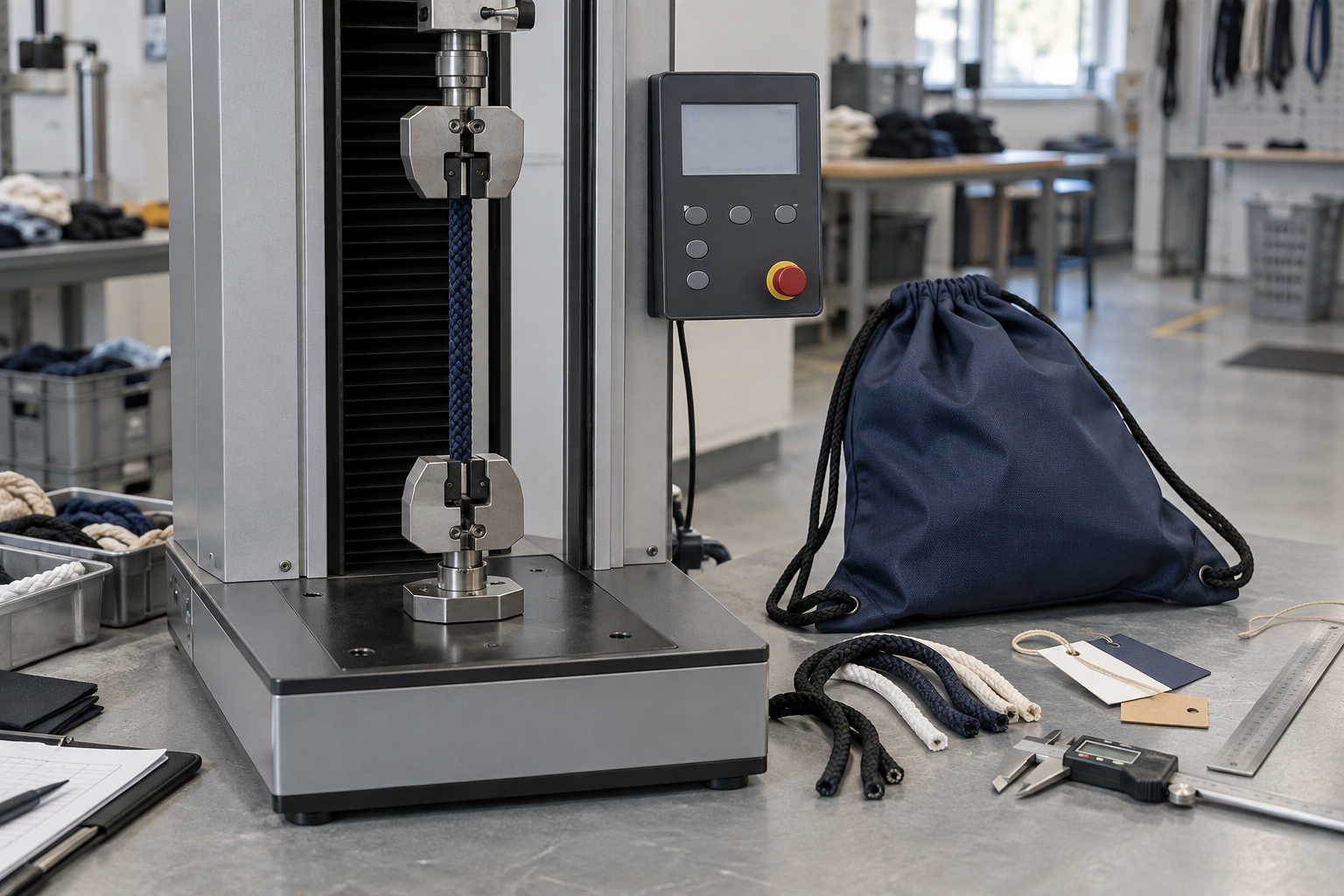
Editorial visualization of a typical cord-testing workstation. It is not a photograph of a LUCKYSTAR laboratory, customer order, accredited test or passed result.
Quick answer: which drawstring pull test do you need?
Use a cord-only tensile test when you need the breaking force and elongation of the supplied cord. Use an assembly pull test when you need to evaluate the cord together with the knot, end stop, channel exit, eyelet, reinforcement patch or stitched anchor. Use a finished-bag load or use test when you need to know whether the complete load path works with the intended contents.
| Decision question | Correct test level | Typical output | What it does not prove |
|---|---|---|---|
| Is the supplied cord consistent and strong enough as a material? | Cord-only tensile test | Breaking force, elongation, curve, failure location | Anchor, channel or bag strength |
| Will a knot, crimp, stopper or sewn loop hold? | Termination pull test | Peak force or proof-load result; termination movement | Full bag performance |
| Will the cord exit or lower corner remain secure? | Cord-to-bag assembly pull test | Load, displacement, damage and failure mode | Every carrying direction or repeated-use condition |
| Will the closure keep working after repeated opening? | Open-close or cyclic pull test | Cycles completed and change in function/appearance | Ultimate breaking force unless separately tested |
| Can the bag carry its intended contents? | Finished-bag loaded-use test | Functional result under a defined load and sequence | Performance at unspecified higher loads or other constructions |
This article focuses on the mechanics and documentation of cord and pull tests. For the broader construction system, see the Drawstring Cord, Eyelet and Reinforcement Guide. For material, color, wash and complete-product qualification, use Which Tests Should Custom Drawstring Bags Pass?. Keeping those scopes separate prevents one result from being stretched into a claim it cannot support.
1. Define what “cord strength” means before selecting a method
“Strong cord” can refer to several different properties. Breaking force is the maximum force recorded before rupture under a stated method. Elongation describes how much the specimen extends at a stated force or at break. Tenacity relates force to linear density and can help compare yarns, but it is not the same as the force carried by a finished drawcord. Knot strength, retained strength after abrasion and assembly pull resistance answer still different questions.
For a drawstring bag, the weakest point may not be the middle of the cord. Failure can begin where a knot tightens, a heat-cut end becomes brittle, a metal edge abrades the braid, a cord lock concentrates pressure, or a stitched corner patch transfers force into lightweight shell fabric. That is why a high cord-breaking result cannot be used as a finished-bag load rating.
| Term | Practical meaning | Report it with |
|---|---|---|
| Breaking force | Highest recorded force before cord rupture or specified end point | Method, grips, gauge length, speed, conditioning and failure location |
| Elongation | Extension over the defined reference length | Force point or break point, original gauge length and calculation |
| Proof load | Predefined force held or reached without prohibited damage | Force, duration, loading direction and pass rule |
| Peak assembly pull | Maximum force before an anchor, termination or adjacent material fails | Complete specimen description and failure mode |
| Cyclic durability | Resistance to repeated sub-maximum opening, pulling or carrying action | Force/displacement range, frequency, cycles and post-test function |
| Retained performance | Result after abrasion, washing, wetting, heat or other conditioning | Preconditioning protocol and comparison basis |
2. Start with the cord's job in the bag
A cord used only to close a small gift pouch sees a different load from a cord that also serves as the shoulder strap of a gym sack. Before setting a test, classify the cord as closure-only, tie/retention, carrying, or a combined closure-and-carrying component.
Closure-only cords are normally judged heavily on smooth travel, knot security, tail symmetry, surface damage and repeated operation. Carrying cords also transfer the mass of the contents through the channel and into the lower anchors or corner construction. Combined systems need both kinds of evidence because a cord can close smoothly yet overload a corner when the bag is lifted.
The intended contents also matter. A soft apparel item distributes force differently from a rigid shoe box or bottle. A small velvet pouch may be more sensitive to surface marking and color transfer than to high load, while a sports bag may be more sensitive to cord abrasion, elongation, anchor deformation and shoulder contact. State the real use case instead of asking the supplier for a generic “standard pull test.”
3. Freeze the cord specimen before testing
Results are comparable only when the specimen is identifiable. The test request should record cord material or claimed composition, construction, nominal diameter or width, color, finish, supplier or lot reference, end treatment and sample revision. For braided or twisted products, record the relevant construction details available from the specification. For flat tape or webbing, record width, thickness and edge construction.
Diameter must be measured under a defined practice because soft cords compress. A caliper squeezed by hand can produce different readings between inspectors. Linear density or mass per unit length may be a more repeatable incoming-control field for some constructions. Neither diameter nor linear density is a substitute for tensile testing, but both help confirm that the tested cord matches production material.
Test the production-intent color and finish when dyeing, coating or heat setting could affect behavior. If a bag uses more than one cord source or construction, do not pool the results without a documented bracketing rationale.
| Specimen field | Minimum information to freeze |
|---|---|
| Material claim | Fiber/material description and evidence level |
| Construction | Braided, twisted, knitted, woven tape or other specified form |
| Size | Diameter or width, measurement practice and tolerance |
| Color/finish | Color reference, dye/finish route if relevant, surface treatment |
| Ends | Heat cut, tipped, crimped, knotted, sewn or unfinished |
| Lot identity | Supplier/lot, purchase or sample reference, date received |
| Conditioning | Standard atmosphere, wet state, post-wash or other defined state |
| Test revision | Approved sample or specification revision tied to the report |
4. Choose a cord-only tensile method that fits the specimen
The test method should match the physical form of the drawcord. The published scope of ISO 2307:2019 addresses fibre-rope breaking force and elongation as well as measurements such as linear density, diameter, lay length and braid pitch; ISO reports that the 2019 edition was confirmed in 2025. It may be a useful reference for rope-like specimens, but the parties still need to confirm that the drawcord and required fixture fall within the intended scope.
ASTM D6775-13(2024) covers breaking strength and elongation of textile webbing, tape and braided material using a split-drum type clamp, within the stated width and force limits. A flat draw tape or some braided drawcord constructions may align more naturally with that scope than with a yarn method.
ASTM D2256/D2256M-21 addresses tensile properties of yarns by the single-strand method. It should not be cited automatically for a finished braided rope or webbing simply because both are textile products. The laboratory and buyer should select the method based on the actual specimen and the decision the data must support.
| Reference | Relevant specimen type | Useful measurements | Drawstring-bag caution |
|---|---|---|---|
| ISO 2307:2019 | Fibre rope within the method's scope | Physical properties, elongation and breaking force | Confirm small drawcord, termination and grip suitability |
| ASTM D6775-13(2024) | Textile webbing, tape and braided material within stated limits | Breaking strength and elongation | Does not test the bag anchor or complete cord route |
| ASTM D2256/D2256M-21 | Single yarn specimen within scope | Breaking force, elongation and related yarn properties | A finished braided cord is not automatically a single yarn |
| Buyer/lab agreed method | Unusual cord or assembly lacking a directly suitable standard route | Defined force, displacement or cycles | Must document the fixture and procedure well enough to repeat |
A standard method is not a universal acceptance value. It defines how to obtain data. The buyer's product specification, applicable regulation or agreed performance requirement defines what result is acceptable.
5. Control grips, gauge length and slippage
Grip selection can determine whether a cord test measures the material or merely cuts it at the jaw. Serrated flat grips may damage a soft braid; smooth grips may allow slippage; knots around fixtures can introduce a stress concentration; capstan or drum-style grips can distribute force more gradually. Use the fixture required by the selected method or document the agreed alternative.
Mark the cord near each grip before testing. If the reference mark moves into the grip, the apparent extension may include slippage. A break at or immediately beside the grip may also need to be handled according to the method's rules rather than accepted uncritically as normal cord rupture.
Gauge length and crosshead or extension rate affect results and must be fixed. So must pre-tension, especially for soft cords that straighten before carrying significant load. Reports should include these settings; “passed pull test” without them is not reproducible evidence.
6. Test knots, stops and end finishes separately
A cord often fails at its termination rather than in the free length. An overhand knot, molded tip, metal crimp, plastic aglet, sewn loop or cord lock changes the load path. A knot may tighten and reduce local efficiency; a heat-cut end may fray less but become hard or brittle; a crimp may slip before the cord breaks.
For a termination pull test, define which side is fixed, which component is pulled, the direction, free tail length, rate, end point and prohibited changes. Possible acceptance rules include no complete release at a proof load, no movement beyond a stated limit, or a minimum peak force with the failure mode recorded. Choose one that reflects the product risk.
Do not hide a termination failure by reporting only the force. A slipping knot at a moderate load and a cord rupture at the same load lead to different corrective actions.
7. Pull-test the cord-to-bag assembly
An assembly test keeps the production cord, channel or exit, reinforcement, stitching and shell material together. It is the appropriate level when the buyer needs to know whether a lower anchor, sewn loop, corner patch, eyelet area or channel exit resists a defined pull.
The specimen must reproduce production details: stitch pattern, thread, seam allowance, reinforcement size, material orientation, eyelet setting and cord path. A laboratory coupon with extra fabric or different stitching may overstate the production construction.
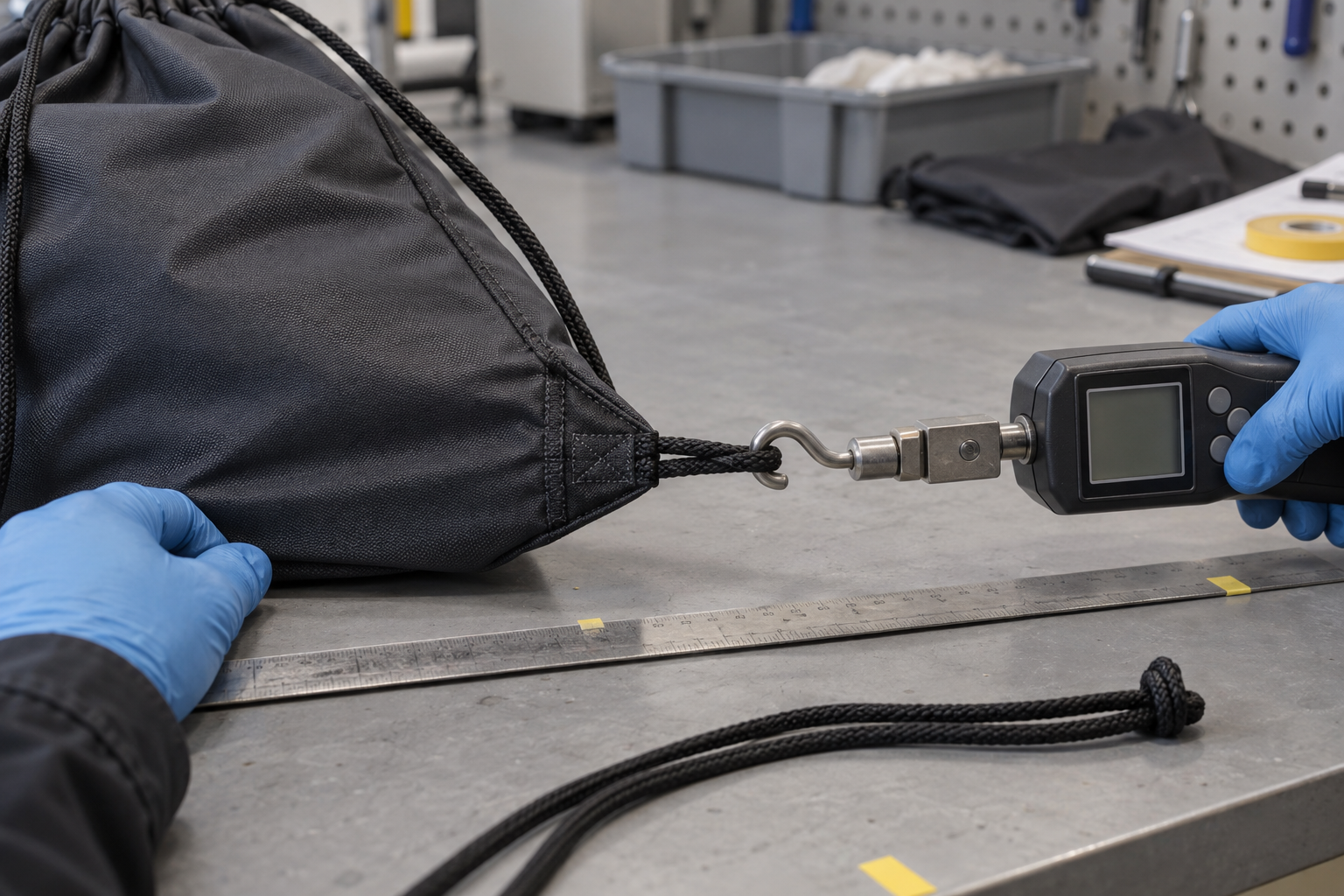
Editorial visualization of an assembly pull setup. The force display is intentionally blank; the image does not document a LUCKYSTAR test result or a certified laboratory procedure.
Define whether the bag body is clamped, supported or filled. A rigid clamp close to the anchor can create a different stress field from a filled bag. Conversely, suspending a complete bag without controlling orientation may make results difficult to compare. The fixture should reproduce the decision you need to make, not simply produce the highest number.
8. Set a mechanically meaningful pulling direction
Direction matters because cords rarely load an anchor in only one ideal axis. A drawstring backpack corner may experience upward carrying tension, inward closure tension and off-axis movement as the bag swings. A pouch cord exit may experience alternating left-right pulls. State the angle or fixture geometry and keep it consistent.
| Pull direction | What it can reveal | Common limitation |
|---|---|---|
| Axial cord pull | Cord, knot or termination behavior in line | May miss fabric peeling or edge leverage |
| Outward pull from channel exit | Exit reinforcement and local abrasion risk | Does not represent lower carrying anchors |
| Upward pull at lower corner | Backpack-style carrying load path | Requires a defined body support or fill condition |
| Opposed pull on two cords | Closure symmetry and paired routing | Load sharing may hide one weak side |
| Off-axis or angled pull | Edge contact, eyelet rotation or patch peel | Harder to reproduce without a fixture drawing |
Photograph or draw the setup in the test instruction. A written phrase such as “pull the cord” is not sufficient for a reorder comparison.
9. Distinguish ultimate, proof-load and cyclic tests
An ultimate pull continues until rupture, release or another defined terminal event. It is useful for development comparison and locating the weakest link, but it destroys the specimen. A proof-load test applies a specified sub-maximum force or loading sequence and checks that prohibited damage does not occur. A cyclic test repeats a lower load or motion to reveal wear, progressive slippage and fatigue.
| Test type | Best used for | Typical decision | Required details |
|---|---|---|---|
| Ultimate pull | Comparing constructions and identifying failure mode | Select or redesign prototype | Rate, peak force, displacement, failure location |
| Static hold | Checking creep, knot slip or deformation under sustained force | Approve/modify termination or anchor | Force, duration, orientation and post-hold recovery |
| Proof load | Confirming that a specimen survives an agreed working challenge | Release sample or selected production check | Load, dwell, prohibited damage and inspection timing |
| Cyclic pull | Repeated closure, tugging or sub-maximum carrying action | Assess durability before bulk | Force/displacement range, speed, cycles and functional end point |
| Finished-bag use sequence | Evaluating the complete product with real or surrogate contents | Confirm intended-use fitness | Fill, actions, duration, observations and acceptance rule |
One test cannot automatically replace the others. A cord can survive one high pull yet abrade during repeated motion; an anchor can survive thousands of light cycles yet fail below the intended proof load. Select the combination from the use case.
10. Write the acceptance criteria before the test
“No break” is often incomplete. A cord may not break but may elongate excessively, slip through a knot, pull an eyelet out of position, open a seam, cut the shell fabric or stop the closure from operating. Define both structural and functional failure.
A buyer-ready criterion may include a force or cycle target, maximum displacement, no complete release, no cord rupture, no prohibited stitch break, no reinforcement tear, no sharp exposed hardware, and continued opening/closing after the test. Cosmetic allowances should be stated separately from functional failure.
Do not publish a carrying capacity by dividing cord-breaking force by an informal safety factor. The finished bag includes two sides, changing angles, dynamic loads, knots, abrasion, seams and material variability. If a load claim is required, validate the complete bag using an agreed protocol and document the exact claim scope.
11. Select samples and summarize variability honestly
A single specimen cannot describe lot variation. Sample quantity should reflect the purpose, method, development stage, material variability and cost of destructive testing. Identify whether specimens come from one cord reel, multiple reels, one colorway, several production lots or finished bags selected across a shipment.
Record individual results, not only the highest value. Report the average and range or other statistics required by the method or buyer. Investigate outliers instead of silently deleting them. If a specimen slips in the grips, breaks at the grip, or is damaged during preparation, apply the method's validity rules and document any replacement.
For production release, destructive pull testing is normally combined with non-destructive checks such as cord size, appearance, route, knot position, symmetry and closure function. The Custom Drawstring Bag Quality Control Checklist explains how those checks fit into lot inspection.
12. Record the failure mode, not just the number
Failure mode tells the development team what to change. Cord rupture in the free length may lead to a different material or size review. Rupture at a knot may require termination redesign. Cord pull-through may require a larger stop or different end finish. Patch peeling may require changes to geometry, seam allowance, stitch pattern or substrate. Fabric tearing beside a strong patch can mean that reinforcement merely moved the weak point.
| Observed failure | Likely investigation path | Do not conclude automatically |
|---|---|---|
| Cord breaks mid-span | Cord construction, size, damage, lot variation, conditioning | That the bag anchor is acceptable |
| Cord breaks at grip | Grip damage, slippage correction, specimen validity | That this is the true cord strength |
| Knot slips or unties | Knot type, tail length, surface finish, load direction | That thicker cord alone will solve it |
| Cord pulls through exit/stop | Stop geometry, opening size, end finish, cyclic movement | That the cord material is weak |
| Eyelet rotates or releases | Setting, hole, washer, substrate and edge distance | That all metal eyelets are unsuitable |
| Reinforcement patch peels | Stitch path, patch shape, seam allowance, loading angle | That stronger thread alone is enough |
| Shell tears beside anchor | Load concentration, material, orientation, patch stiffness | That the cord passed the complete system |
| Closure jams after cycling | Cord-channel compatibility, fraying, twist, coating or seam intrusion | That ultimate pull strength predicts function |
13. Add conditioning only when it reflects a real risk
Dry, new cord is not always the worst case. Washing can affect natural-fiber cords, dyes, end finishes and bag dimensions. Water can change friction and elongation. Heat may influence synthetic components or bonded finishes. Abrasion can expose filaments before a pull test. UV exposure may matter for prolonged outdoor use, but it should not be added as a vague sustainability feature.
If conditioned testing is required, state the complete sequence: exposure method, duration or cycles, recovery or conditioning time, and whether the pull test occurs wet or after reconditioning. Compare like with like and identify the control specimens.
For a claimed washable bag, test the production-intent cord, bag, decoration and hardware together under the specified care process. For water-related claims, remember that cord behavior is only one part of the product. The Waterproof Drawstring Bag Materials Explained article separates fabric, seam, closure and whole-bag evidence.
14. Match the test plan to cord form and material
Material names do not guarantee performance. Two polyester cords can differ in filament, braid, finish, diameter, heat setting and dye route. Cotton may offer a natural hand but can change with moisture or care. Nylon may show different elongation behavior. Polypropylene can be light but still needs application-specific assessment. Flat webbing distributes contact differently from round cord and may require a different grip and method.
Use the material name to select questions, not to declare a result. The Best Materials for Custom Drawstring Bags guide covers wider material selection, while Round Cord vs Flat Cord vs Webbing Straps addresses geometry and carrying contact. This guide remains focused on how the selected component is tested.
15. Connect cord data to seam and finished-bag evidence
The cord is only one link. For straight sewn seams in applicable textile constructions, ISO 13935-1:2014 describes a strip method for maximum force to seam rupture. The official scope also lists limitations, including that the method is normally not applicable to several categories such as nonwovens and coated fabrics. A buyer should not cite it blindly for every custom drawstring bag.
The practical sequence is to characterize the cord, evaluate the termination or anchor, and then validate the complete bag under its intended fill and carrying pattern. If shoulder comfort matters, strength evidence does not replace wear evaluation; see How to Improve Drawstring Bag Shoulder Comfort.
16. Place each test at the correct project stage
| Project stage | Cord/pull evidence | Decision enabled |
|---|---|---|
| Material screening | Cord identity, size, construction and comparative tensile behavior | Select candidate component |
| Prototype development | Ultimate termination/anchor pulls and failure analysis | Change weak geometry or material |
| Pre-production sample | Proof load, cyclic function and filled-bag use sequence | Freeze production-intent reference |
| Incoming material | Identity, size and agreed risk-based verification | Release cord lot to production |
| First article/in-process | Route, tail, knot, anchor construction and functional pull checks | Confirm line setup and control drift |
| Final inspection | Non-destructive function plus agreed sampled proof test where appropriate | Accept, hold, rework or reject lot |
| Reorder/change control | Review source, construction, finish and prior evidence; requalify when relevant | Confirm earlier test remains applicable |
Destructive qualification and random final inspection serve different purposes. Do not require a destructive ultimate test on every unit, and do not replace qualification with a quick hand tug.
17. Specify the laboratory and report contents
When third-party testing is required, confirm that the selected laboratory is competent for the exact method and specimen. ISO/IEC 17025 sets general requirements for testing and calibration laboratory competence. Referring to that framework does not mean LUCKYSTAR or every laboratory involved in a project is automatically accredited for every cord or assembly method; scope must be checked.
A useful report identifies the customer or report holder as agreed, specimen and revision, lot/color, sampling source, method and edition, deviations, conditioning, equipment/fixture, gauge length, rate, individual results, summary statistics, failure modes, photographs and pass criteria. For a custom assembly method, include a fixture drawing or clear setup image.
| Report field | Why buyers need it |
|---|---|
| Exact sample identity | Connects the result to the approved product revision |
| Method and edition | Prevents comparison between incompatible procedures |
| Fixture and direction | Makes assembly pulls repeatable |
| Raw individual results | Shows variability hidden by an average |
| Failure mode and location | Directs corrective action |
| Deviations | Reveals where the test differed from the requested procedure |
| Acceptance criterion | Shows how pass/fail was decided |
| Photos before/after | Supports traceability and interpretation |
18. Control reorders and material changes
Reorder consistency cannot be inferred from the cord color or supplier description. Review any change in material source, construction, diameter/width, finish, color route, end treatment, knot, hardware, channel, reinforcement, stitch pattern or shell fabric. A change in any of these can affect the load path.
Keep an approved physical reference, specification, report and production lot identity together. Incoming checks can monitor size, appearance and mass per length where appropriate, but periodic or change-triggered tensile and assembly verification may still be required by the buyer's risk plan.
Why choose LUCKYSTAR for a cord-tested drawstring bag project?
LUCKYSTAR supports custom drawstring bag development across material, size, cord arrangement, reinforcement and decoration choices. The practical advantage for a buyer is coordination: the cord specification can be reviewed together with the bag pattern, channel, lower anchor, intended contents, artwork, sample and inspection plan instead of being treated as an isolated accessory.
Ask LUCKYSTAR to return a test-response matrix during quotation. It should identify which requests are cord-only, termination, assembly or finished-bag tests; the proposed sample revision; required quantity; whether an agreed third-party laboratory is needed; the intended test stage; and the evidence delivered. This makes quotation differences easier to compare and reduces late changes after bulk materials are committed.
This is a project-planning approach, not a claim that every test is performed in-house or that all cords share one certified strength. MOQ, price, sample fee, testing cost, laboratory, method, force target, test quantity and production timing are subject to specification and written confirmation. The Custom Bag Manufacturer Guide explains the wider sourcing framework. For product-specific supplier responsibilities, continue with How to Choose a Custom Drawstring Bag Manufacturer.
Buyer RFQ checklist for cord and pull testing
Include the intended contents and mass; whether the cord closes, carries or does both; bag and cord drawings; cord material/construction/size/color; route and tail length; knot, tip, stopper or lock; channel and exit; lower anchor or reinforcement; target market; care conditions; required method; loading direction; proof/ultimate/cyclic requirement; acceptance rule; sample quantity; report format; and target approval stage.
If you do not yet have a force value, provide the intended use and ask for a development proposal—not a generic guarantee. Compare proposals by specimen, method, fixture, acceptance logic and evidence, not by the largest unsupported number.
Send LUCKYSTAR your drawstring bag specification, intended load and cord-testing requirements for an order-specific review.

The GET QUOTE image opens LUCKYSTAR's contact form. Final construction, testing, compliance, price, MOQ and timing require written confirmation for the specific project.
Frequently asked questions
What is the difference between cord breaking strength and bag pull strength?
Cord breaking strength measures the cord specimen under a defined tensile method. Bag pull strength evaluates an assembly that may include the cord, knot, channel, eyelet, reinforcement, stitching and shell. The smaller result may come from any link in that assembly, so one value cannot replace the other.
Is there a standard minimum pull force for every drawstring bag?
No. Pouches, dust bags and drawstring backpacks have different functions and load paths. The buyer should set an application-specific acceptance criterion based on intended contents, construction, use sequence, destination requirements and risk, then record the method and fixture used.
Should the cord be tested with or without a knot?
Both may be useful for different decisions. A free-length tensile test characterizes the cord; a knotted or terminated specimen evaluates the actual end condition. State the knot, tail length and loading direction because they can materially change the result.
Why did the cord break at the clamp?
The grip may have cut or concentrated stress in the specimen, or the cord may have slipped before failure. Check the method's specimen-validity rules, grip type, marks and break location before accepting the number as representative cord strength.
Does a thicker cord always pass a higher pull test?
Not necessarily. Material, braid, filament, finish, defects, knot and grip behavior all matter. A thicker cord may also overload a lightweight channel or anchor. Test the production-intent cord and assembly rather than selecting by diameter alone.
When is a cyclic pull test more useful than an ultimate pull?
Use cyclic testing when repeated opening, tugging, swinging or carrying is a dominant risk. Ultimate testing locates the maximum-force failure; cyclic testing can reveal progressive abrasion, slippage and functional deterioration below that force. Some projects need both.
Can a hand pull replace an instrumented test?
A hand pull can be a quick workmanship screen if the procedure is defined, but it cannot provide controlled force, rate, displacement or repeatable data. Use an instrumented method when a numeric claim, supplier comparison or traceable qualification decision is required.
How many specimens should be tested?
There is no single number for every method and project. Follow the selected standard where applicable and otherwise agree a sampling plan based on development stage, variability, colors/lots and test cost. Report individual results and invalid specimens, not only an average.
When should a cord pull test be repeated?
Review or repeat testing when the cord source, material, braid, diameter, finish, color route, end treatment, hardware, anchor, stitch pattern, shell fabric, intended load or test requirement changes. Buyers may also require periodic requalification even when no change is declared.
Final takeaway
A defensible drawstring cord test plan separates the cord from its termination, the termination from the bag assembly, and the assembly from the finished-use claim. Match the method to the specimen, control the fixture and loading direction, define failure before testing, record every failure mode and reconnect the result to the approved product revision.
Explore LUCKYSTAR's custom drawstring bags, then send the intended contents and cord load path with your RFQ so the sample, test plan and production checks can be aligned before bulk production.