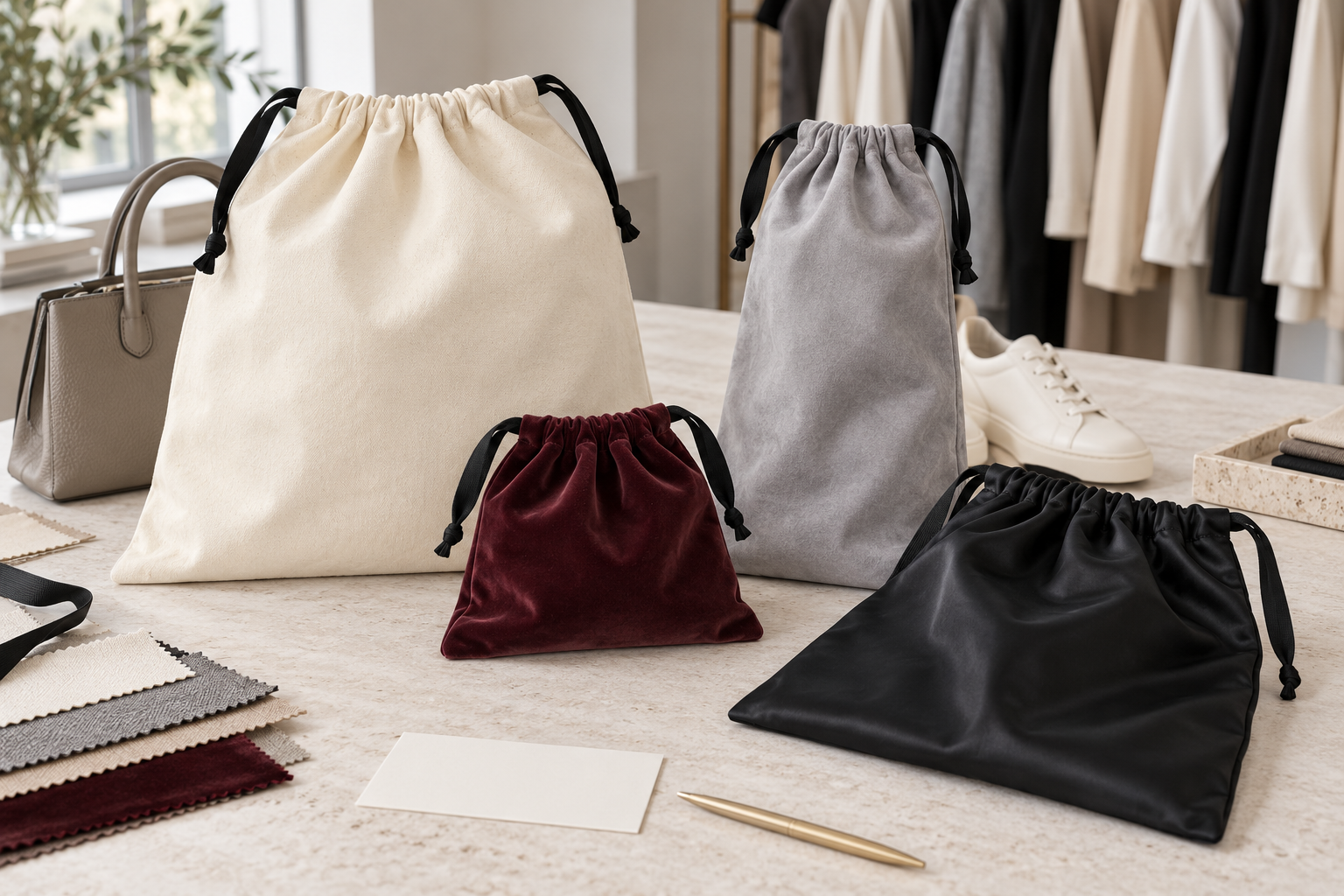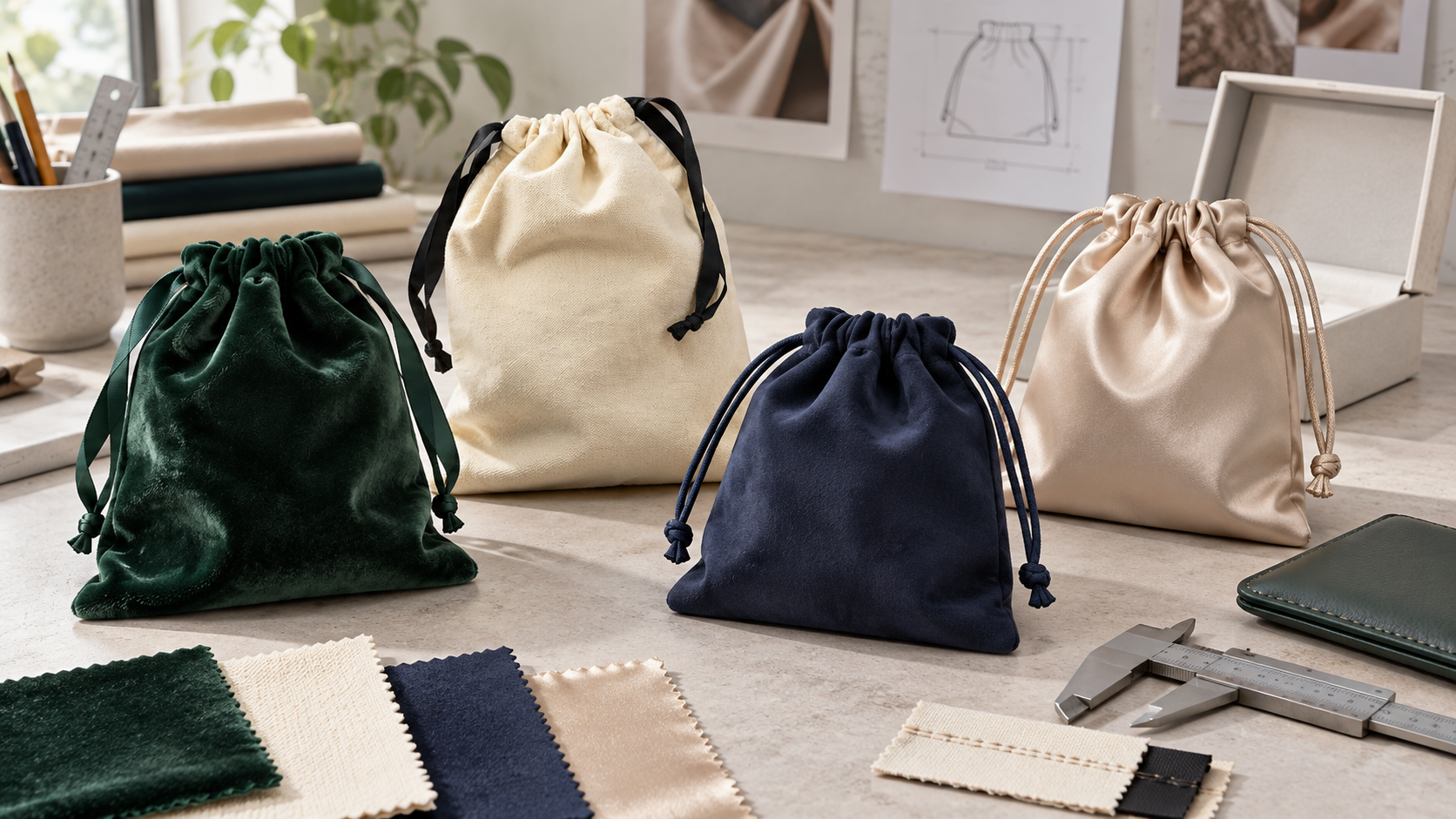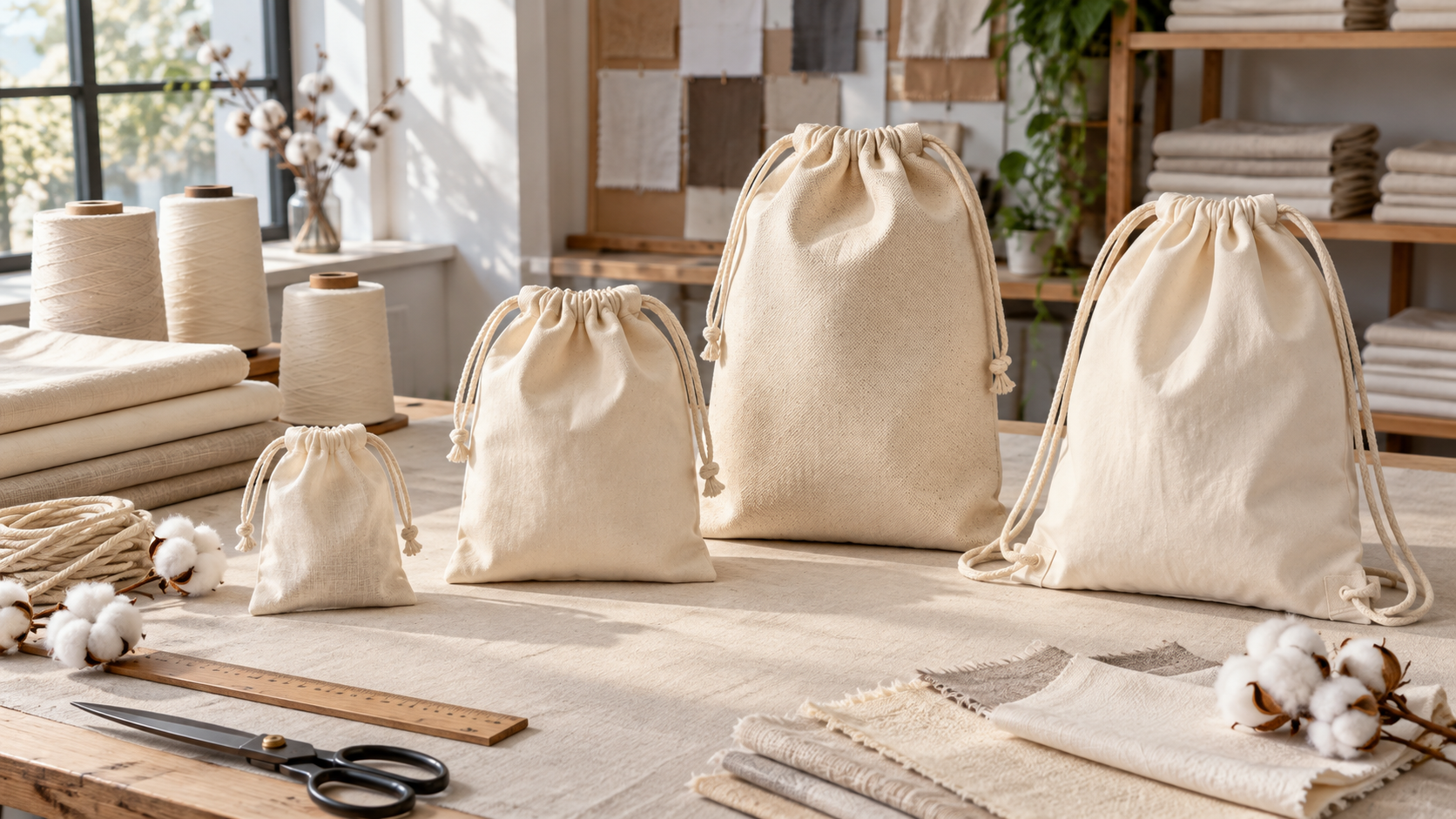
Cotton vs Canvas Drawstring Bags
Last reviewed: September 28, 2026

Choosing between cotton and canvas drawstring bags sounds simple—until a quotation arrives with both terms on the same specification. That is not necessarily an error. Cotton describes a fiber, while canvas describes a fabric construction. A canvas drawstring bag may be made from cotton, polyester, recycled-content yarn or a blend.
For most sourcing projects, the useful comparison is therefore lightweight plain-weave cotton versus heavier cotton canvas. The first is softer, more compact and easier to gather. The second usually offers more body, greater opacity and a more substantial hand feel. Neither is automatically “better.” The right choice depends on the packed product, required service life, artwork, closure performance, packing method and target cost.
This guide explains how buyers can compare the two options on an equal-specification basis, what to test before bulk production and how LUCKYSTAR can help turn a broad material name into a controlled custom-bag specification.
Cotton vs Canvas Drawstring Bags: The Short Answer
Choose a lightweight cotton construction when you want a soft pouch, compact packing, easy gathering and a natural textile presentation for relatively light contents.Choose cotton canvas when the bag needs more structure, opacity, abrasion resistance or a premium, reusable feel.
Do not approve either material from its name alone. Ask for composition, fabric weight, weave, finish, color method and an actual sample. Two suppliers can both quote “cotton,” yet deliver fabrics with very different density and performance. The same is true of “canvas.”
| Buying priority | Lightweight cotton is often suitable when… | Cotton canvas is often suitable when… | What to verify |
|---|---|---|---|
| Soft presentation | The bag should drape around the product | The bag should hold a defined shape | Hand feel on an approved sample |
| Drawstring action | A light, easy gather is important | A firmer closure is acceptable | Loaded opening-and-closing trial |
| Product weight | Contents are light and have no sharp edges | Contents are heavier or handled repeatedly | Finished-bag load test |
| Branding | Fine lines and a smoother face are priorities | A tactile print or embroidered look is desired | Printed strike-off on production fabric |
| Privacy | Slight show-through is acceptable | Greater coverage and opacity are needed | Sample over the actual packed item |
| Packing efficiency | Low carton volume matters | Added body and protection justify more volume | Carton trial using the final fold |
| Perceived value | Simple, soft and understated is the brief | Substantial,durable and giftable is the brief | Side-by-side physical review |
If your project is still at the material-screening stage, review our broader guide to the best materials for custom drawstring bags. For a project-specific recommendation, explore LUCKYSTAR’s custom drawstring bags.
First, Correct the Category Mistake
Many material disputes begin because a fiber name is compared with a weave name.
Cotton is a fiber description
“Cotton” tells you the principal fiber, but it does not define how that fiber was spun, woven, finished or dyed. A cotton drawstring pouch may be light and open, smooth and tightly woven, brushed, washed, coated, lined or made with a blend. Without a construction specification, the word leaves too much open to interpretation.
Canvas is a construction description
Canvas generally refers to a robust woven fabric with a visibly substantial structure. It can be made from cotton or other fibers. Even within cotton canvas, weight, yarn size, weave density and finish can change the bag’s stiffness, surface texture and print result.
The comparison buyers usually mean
In everyday RFQs, “cotton bag” often means a relatively light, soft, plain-weave cotton pouch, while “canvas bag” means a heavier, denser cotton canvas pouch. This article uses those practical meanings but keeps the specifications visible.That distinction prevents a buyer from paying for a heavier fabric without confirming the fiber—or rejecting a cotton option simply because another cotton fabric is called canvas.
| Term in an RFQ | What it tells the supplier | What it does not tell the supplier |
|---|---|---|
| Cotton | Intended fiber family | Weight, weave, finish, shrinkage, opacity or strength |
| Canvas | Intended fabric character or construction | Fiber composition, exact weight, coating or color method |
| Natural | Usually a color direction or undyed look | Fiber origin, organic status or absence of treatment |
| Organic cotton | A material claim requiring evidence | Finished-bag certification or shipment-level traceability by itself |
| Heavy duty | A desired outcome | Any measurable load, cycle or seam requirement |
How Fabric Weight Changes the Finished Bag
Weight is useful, but only when the measurement method and tolerance are stated. A heavier fabric typically adds body and opacity, yet it can also create a bulkier top channel and increase carton volume. A lighter fabric may gather more neatly but can show the product outline and reveal seam allowances.
Avoid choosing weight from a generic chart alone.Ask the supplier to identify:
- fiber composition and blend percentage;
- fabric weight with unit and permitted tolerance;
- weave or construction reference;
- color, dyeing and finishing route;
- whether weight is measured before or after finishing;
- approved swatch or sealed sample used as the visual standard.
The goal is not the highest number. It is the lightest construction that still meets the real performance target, or the most substantial construction that remains practical to close, pack and ship.
Hand Feel, Drape and Structure
Lightweight cotton usually conforms to the contents. This can suit jewelry, gift items, accessories, shoes and product-protection applications where a soft wraparound presentation is desirable. It also makes empty bags easier to flatten.
Cotton canvas usually creates a clearer silhouette. The bag can stand more confidently in product photography, feel more substantial during unboxing and conceal irregular shapes. A boxed bottom or side gusset can reinforce that structured effect.
However, “structure” is not only a fabric property. Bag dimensions, seam allowance, gusset design, lining, coating and the packed item all contribute. A canvas pouch with an oversized body may still look limp; a lighter cotton pouch fitted closely around a box can appear deliberate and premium.
Strength Is a Finished-Bag Question
Canvas is commonly selected for higher loads, but a strong face fabric does not guarantee a strong bag.Failures often occur at the side seam, channel entry, cord anchor, corner or print area rather than through the middle of the fabric.
Evaluate the complete system:
| Component | Typical risk | Useful control |
|---|---|---|
| Main fabric | Tear, abrasion or distortion | Confirm construction and test the finished sample |
| Side and bottom seams | Seam opening or yarn slippage | Define seam type, allowance and reinforcement |
| Drawstring channel | Fraying or stress concentration | Check channel depth, stitching and entry finish |
| Cord | Stretch, breakage, pilling or color transfer | Specify construction, diameter and end treatment |
| Gusset or boxed base | Uneven load distribution | Approve dimensions and corner construction |
| Decoration | Cracking, peeling or stitch damage | Test the selected process on the selected fabric |
A lightweight cotton pouch may perform perfectly for a small boxed gift. A heavy canvas bag can still fail if a narrow cord cuts into the channel under load. Define the packed weight and use scenario, then test the actual construction.
Drawstring Closure Performance
The top channel is where the cotton-versus-canvas decision becomes especially visible.
Lightweight cotton gathers easily
Thin fabric usually forms small, flexible folds.That can produce a compact closed mouth with moderate pulling force. It is useful when the recipient will open the pouch frequently or when the package needs a soft, relaxed appearance.
The trade-off is that a very light or open fabric can wrinkle strongly around the channel. Poorly finished cord exits may fray, and the closed bag may not provide visual privacy.
Canvas needs channel engineering
Thicker canvas forms larger folds and resists compression. The channel must allow enough clearance for the fabric and cord to move without excessive friction. Cord diameter, surface texture, channel height and the number of fabric layers all matter.
A sample should be tested both empty and loaded. An empty bag can close smoothly while a filled bag—especially one packed close to the channel—may be difficult to gather.
| Closure check | Why it matters | Simple sample test |
|---|---|---|
| Usable opening | Determines whether the product can be packed efficiently | Insert the real product without stretching the seams |
| Pull force | Affects customer experience | Open and close repeatedly with the target load |
| Mouth closure | Controls presentation and item retention | Observe the remaining gap after normal hand force |
| Cord symmetry | Prevents a twisted or uneven top | Compare left and right cord travel |
| Exit durability | High-stress area can fray | Inspect after repeated cycles |
| Cord colorfastness | Dark cords may mark a light bag | Rub and handle under intended use conditions |
Print Quality on Cotton and Canvas
Artwork quality depends on the print process, ink system, fabric surface, pretreatment, color and curing—not just the fiber name.
Fine detail generally favors a smoother surface
A smoother, tighter fabric face usually preserves small type, narrow lines and fine registration better than a coarse surface. Lightweight cotton can therefore be attractive for delicate one-color marks or illustrations, provided the fabric is dense enough to control ink penetration and show-through.
Canvas creates a more tactile result
On canvas, the weave may remain visible through the printed area. That can look intentional for bold logos, vintage graphics and craft-oriented packaging, but it can soften fine details. More ink is not always the answer; excessive deposit can change hand feel or increase cracking risk when the bag folds.
Color changes perceived print density
Natural ecru, optical white and dyed fabric can make the same ink color look different. The underlying textile affects brightness, contrast and opacity. A digital mockup cannot predict this reliably, so approve a strike-off on the actual fabric color and construction.
| Artwork or finish | Lightweight cotton consideration | Cotton canvas consideration | Approval method |
|---|---|---|---|
| Small text | Can reproduce well on a smooth, dense face | Coarse weave can reduce edge clarity | Print at final size on production fabric |
| Large solid logo | Risk of penetration or uneven density on open fabric | Texture may show through the ink film | Check front, reverse and folded areas |
| Multicolor registration | Fabric stability and handling matter | Surface relief can affect fine alignment | Approve a production-method strike-off |
| Transfer decoration | Heat and pressure can change shade or hand | Heavy texture may limit full contact | Conduct adhesion and appearance trials |
| Embroidery | Stabilization may be needed on light fabric | Fabric offers more body but channel clearance matters | Review puckering, reverse side and foldability |
| Metallic or specialty effect | Contrast may vary on natural cloth | Texture can amplify or interrupt the effect | Approve under normal retail lighting |
For artwork, placement and tolerance fields, use our guide on how to prepare a custom drawstring bag tech pack.
Embroidery: More Body Is Not the Whole Story
Canvas often supports embroidery with less visible distortion than a very light cotton fabric. Yet embroidery suitability also depends on stitch density, backing, hooping, logo size and distance from the channel and seams.
A dense embroidered badge near the top of a small pouch may make the mouth harder to gather. On a lightweight pouch, the same design may pucker unless the construction and backing are adjusted. Buyers should approve the front, reverse and closed-bag appearance—not merely the embroidery viewed flat.
Opacity and Product Protection
Cotton canvas generally offers greater visual coverage than a lightweight cotton fabric, which may matter for premium gifts, retail kits and products with printed cartons. But neither material should be assumed to provide impact, moisture, dust or chemical protection without a defined construction and test.
For delicate contents, a buyer may need a lining, internal divider, padding or separate protective packaging. These additions affect closure bulk and recyclability claims, so they should be decided at the specification stage.
| Packed item | Common material direction | Additional question |
|---|---|---|
| Jewelry or small gift | Lightweight cotton for softness and compactness | Is lining needed to prevent snagging or show-through? |
| Shoes or accessories | Midweight cotton or canvas depending on reuse target | Must the bag resist scuffing during transit? |
| Bottles or jars | Structured canvas may improve presentation | Is a divider, flat base or tested seam required? |
| Electronics accessory | Either, based on weight and abrasion risk | Does the product require separate antistatic or moisture protection? |
| Retail kit | Canvas for shape; cotton for a softer unboxing | Will components press against the print or channel? |
| Promotional giveaway | Lightweight cotton can reduce bulk | How many reuse cycles and what packed load are expected? |
Dimensional Stability and Shrinkage
Natural-fiber fabrics can change with wet processing, heat and laundering. The amount depends on the construction and finishing history, so “cotton” alone cannot predict it. Canvas may feel dimensionally stable because it is heavier, but it still requires testing when washability or tight product fit matters.
Specify whether dimensions are measured:
- flat or filled;
- inside or outside;
- before or after washing;
- with the mouth open or gathered;
- including or excluding the channel and gusset;
- under a defined tolerance.
If the bag must fit a box, bottle or shoe, send the product dimensions and allow packing clearance. A nominal bag width is not the same as the usable opening after seams and channel construction.
Natural Shade Is Not One Universal Color
“Natural cotton” can range from pale cream to warmer ecru, with visible seed specks or yarn variation. Canvas texture can make shade variation more noticeable. These characteristics may support an understated, material-led appearance, but they should not be treated as defects unless the approved standard says otherwise.
For color-sensitive programs, use a physical shade reference and define the viewing condition. Reorders should be checked against a retained approved sample, while accepting the tolerance agreed for the material and dye route. If exact brand-color consistency is critical, compare the decorated production fabric—not only a yarn card or screen value.
Washability and Care Instructions
Reusable does not automatically mean machine washable. Washing performance depends on fabric pretreatment, colorfastness, print or embroidery, cord, lining and construction. A bag that survives a dry load test may shrink, crease or transfer color in a wash.
Before giving consumers care instructions, validate the complete finished bag using the intended method.The test should examine:
- dimensional change;
- fabric and cord shade change;
- print adhesion or cracking;
- embroidery puckering;
- seam and channel distortion;
- cord tangling and end fraying;
- drying appearance and ease of reshaping.
If washability is not part of the brief, avoid adding an unsupported wash claim simply because the shell contains cotton.
Packing and Carton Efficiency
Lightweight cotton bags usually compress into a smaller shipping volume. Canvas occupies more space, and thick cords, boxed bottoms or dense decoration can prevent tight stacking. Carton efficiency matters when the bag is itself promotional packaging and must travel in large quantities.
A lower-volume bag is not automatically the lower-impact choice, just as a heavier bag is not automatically more sustainable. Durability, reuse, material origin, processing, packaging and end-of-life routes all affect the outcome. Compare complete scenarios rather than relying on a single adjective.
| Packing variable | Lightweight cotton | Cotton canvas | Procurement action |
|---|---|---|---|
| Fold thickness | Usually lower | Usually higher | Confirm final fold pattern |
| Crease recovery | Softer wrinkles may remain | Firm creases can be visually pronounced | Review after carton-compression trial |
| Cord bulk | Often modest | Thick cords can dominate carton height | Align cord specification with actual need |
| Shape retention | Less relevant when shipped flat | Boxed bases may need careful folding | Approve pack-out photos or sample carton |
| Carton quantity | Often higher, subject to design | Often lower, subject to design | Quote against approved packing method |
Cost: Compare the Specification, Not the Label
Canvas often uses more material and may require more robust sewing or handling, but no responsible supplier can price from “cotton vs canvas” alone. Unit cost is affected by composition, weight, color, size, gusset, lining, cord, decoration, print colors, testing, packing and order quantity.
The lowest quoted unit price may omit a requirement that appears in another supplier’s offer.Normalize each quotation against one specification before comparing.
| Cost driver | Lower-complexity direction | Higher-complexity direction |
|---|---|---|
| Fabric | Stock construction and color | Custom weight, color, finish or documented claim |
| Shape | Flat rectangle | Gusset, boxed bottom, lining or internal divider |
| Cord | Standard construction | Custom-dyed, thick, braided or special end finish |
| Decoration | One position, limited colors | Multiple positions, dense artwork or specialty process |
| Sampling | Existing reference with minor changes | Several fabrics, prototypes or functional iterations |
| Quality plan | Basic approved criteria | Additional tests, inspection points or reports |
| Packing | Standard bulk pack | Individual, retail-ready or shape-protective pack |
For a fuller breakdown, see How Much Do Custom Drawstring Bags Cost? 2026 Pricing Guide and how to reduce custom drawstring bag costs without sacrificing quality.All commercial terms remain subject to the final specification and written confirmation.
MOQ and Lead Time Are Configuration-Dependent
MOQ can change when the buyer moves from a stock light cotton fabric to a custom-dyed canvas, adds a special cord or requires a new decoration process. Lead time also depends on material availability, artwork approval, sampling, testing, production scheduling and packing.
Ask suppliers to separate:
- material or color minimum;
- bag-making minimum;
- decoration minimum;
- sample timing;
- production timing after final approval;
- shipping method and handover point.
This makes trade-offs visible. A buyer may preserve a lower starting quantity by selecting an existing fabric construction and concentrating differentiation in the print, cord or label. Read Custom Drawstring Bag MOQ and Production Time before setting a launch calendar.
Which Material Fits Which Use Case?
There is no universal winner, but the following starting points can shorten sample development.
| Use case | Likely starting point | Reason | Verify before approval |
|---|---|---|---|
| Small gift or jewelry pouch | Lightweight cotton | Soft hand and compact package | Lining, opacity, cord finish and snag risk |
| Shoe or accessory dust bag | Light-to-midweight cotton | Drapes around irregular shapes | Size, seam, color transfer and abrasion |
| Premium retail kit | Cotton canvas | More body and perceived substance | Closure force, print texture and carton volume |
| Repeated-use organizer | Canvas or reinforced cotton | Better resistance may be needed | Cycle, load and seam testing |
| Event giveaway | Lightweight cotton | Efficient packing and easy distribution | Print show-through and intended load |
| Bottle or product set | Structured canvas with suitable base | Helps support presentation | Stability, dividers and actual packed test |
| Mailing insert | Lightweight cotton | Limits thickness | Wrinkle recovery and mail-pack compatibility |
| Drawstring backpack | Purpose-built cotton or canvas construction | Carrying load changes seam and cord demands | Cord comfort,reinforcement and loaded cycles |
The same material can perform differently in a pouch and a backpack. A tote-bag comparison also does not transfer directly because handles create a different load path. Evaluate the specific drawstring construction.
A Better Sampling Method: Compare Equal Specifications
Ordering one random cotton pouch and one random canvas pouch rarely answers the material question. The samples may differ in size, seam, cord, print and finish, so the result confuses several variables.
Use an A/B sample plan:
- keep finished dimensions, channel, cord, seam and artwork constant;
- vary only the nominated fabric construction;
- pack the same real product into both samples;
- inspect appearance, closure and handling;
- run the same load, cycle and decoration checks;
- record the decision and seal the approved reference.
For the handoff sequence, see the custom drawstring bag sample development process and the complete custom drawstring bag manufacturing process.
Practical Quality-Control Checklist
Quality control should translate the buyer’s intended result into observable criteria. Avoid instructions such as “good canvas” or “premium cotton.”
| Inspection area | What to record | Why it prevents disputes |
|---|---|---|
| Material identity | Composition, construction, weight, finish and approved swatch | Prevents substitution by name alone |
| Dimensions | Measurement points and tolerance | Controls product fit and usable opening |
| Shade | Approved standard and acceptable variation | Aligns visual expectations across lots |
| Sewing | Seam type, stitch condition, channel and reinforcement | Focuses on finished-bag strength |
| Cord | Material, shape, diameter, color and end treatment | Controls closure feel and durability |
| Decoration | Artwork file, size, position, colors and tolerance | Protects logo consistency |
| Function | Packed load and opening/closing procedure | Confirms real-use performance |
| Cleanliness | Stains, loose threads, odor or debris criteria | Supports consistent presentation |
| Packing | Fold, count, inner pack, carton and labeling | Protects appearance through delivery |
For a broader inspection framework, use the custom bag quality inspection checklist.
Suggested Tests for Cotton and Canvas Drawstring Bags
Test selection should follow the product risk, market and claim. Not every order needs every laboratory test, but every order needs a rational approval plan.
Construction and function checks
- verify finished dimensions and usable opening;
- inspect seam, channel, cord exit and end treatment;
- carry the defined load for the agreed duration;
- open and close the loaded bag for an agreed number of cycles;
- check abrasion at contact points and channel edges;
- test fit using the actual packed product.
Decoration checks
- compare logo size, location and color with the approved standard;
- inspect coverage across the fabric texture;
- rub and flex the printed area under expected conditions;
- examine reverse-side penetration on light fabric;
- inspect embroidery puckering and backing;
- repeat after any validated care process.
Packing checks
- simulate the approved fold and carton compression;
- review crease recovery after unpacking;
- confirm cord and decoration do not transfer color;
- verify pack count, carton markings and moisture-protection method where specified.
Acceptance criteria, test method, sample size and responsibility should be written into the purchase specification. A vague promise of “durable” cannot replace a defined load or cycle requirement.
Sustainability Claims: Cotton and Canvas Need Evidence
Cotton is not automatically organic, low-impact, biodegradable or chemical-free.Canvas is not automatically natural because it describes a construction rather than a fiber. Reusability also depends on the finished bag surviving and actually being used repeatedly.
If a marketing claim matters, build the evidence request before material approval:
| Proposed claim | Evidence question |
|---|---|
| “Cotton” | What is the documented fiber composition? |
| “100% cotton” | Does order documentation support the full composition claim? |
| “Organic cotton” | Which valid scope and chain-of-custody documents cover this product and transaction? |
| “Recycled canvas” | What recycled-content percentage, standard, scope and shipment evidence apply? |
| “Reusable” | What construction, load and cycle evidence supports the intended use? |
| “Biodegradable” or “compostable” | Which exact product, conditions, method and market rule support the claim? |
| “Eco-friendly” | Can the broad phrase be replaced with a specific, measurable statement? |
The ISO 14021:2026 standard addresses self-declared environmental claims and the need for supportable statements.For organic-content claims, Textile Exchange explains that its Organic Content Standard verifies organic material and chain of custody; GOTS also provides a certified-supplier and transaction-certificate verification route. A certificate must match the relevant organization, scope, product and validity context. It should never be inferred from a material name or a marketplace listing.
LUCKYSTAR does not present GOTS, GRS or BSCI as universal company-wide certifications. Any certification or environmental statement for a proposed order should be verified against current, order-relevant documents before it is printed on the bag or published in a campaign.
Why Choose LUCKYSTAR for Cotton or Canvas Drawstring Bags?
The biggest sourcing risk is often not choosing the “wrong” fabric. It is allowing an imprecise material name to move from inquiry to production without becoming a controlled specification.
LUCKYSTAR supports OEM and ODM custom-bag development for buyers who need to coordinate material, shape, closure, decoration, sampling and packing as one project. The value is practical:
Specification-first communication
We can help convert “cotton pouch” or “premium canvas bag” into comparable fields: intended contents, composition, fabric construction and weight, dimensions, channel, cord, seam, color, artwork, packing and test expectations.That makes quotations easier to compare and reduces interpretation gaps.
Sample-based decisions
Buyers can review available references or develop a custom sample, depending on the project.An approved sample and written specification create a better production benchmark than web photography alone. See how to choose a custom drawstring bag manufacturer for supplier-evaluation questions.
Coordination across the complete bag
Material, cord, print, sewing and packing interact. LUCKYSTAR can coordinate these elements through the development and quality workflow rather than treating the fabric as an isolated purchase.
Claim-aware sourcing
We use qualified, evidence-bound language for material and sustainability requests. If a claim requires documents, scope or testing, it should be resolved before bulk production—not added to artwork at the end.
Scalable OEM or ODM pathways
Buyers with a finished tech pack can use an OEM route; buyers who need help developing the construction can use an ODM-oriented discussion. The correct route depends on design ownership, approval needs and project maturity. Read OEM vs ODM Drawstring Bag Manufacturing and our broader custom bag manufacturer guide.
Final material availability, commercial terms, test scope and delivery plan are subject to the approved specification and written confirmation.
What to Include in Your RFQ
The fastest useful quotation is not the shortest inquiry. Provide enough information for the supplier to compare like with like.
| RFQ field | Example of useful input |
|---|---|
| Application | Gift pouch, shoe dust bag, retail kit or drawstring backpack |
| Packed product | Dimensions, weight, shape and any sharp or fragile areas |
| Material direction | Lightweight plain-weave cotton and/or cotton canvas for comparison |
| Fabric details | Target composition, weight range, color and finish |
| Bag construction | Finished size, gusset/base, lining, channel and seam requirements |
| Cord | Fiber, flat/round/braided form, diameter, color and end finish |
| Branding | Artwork, size, colors, placement and preferred process |
| Quality target | Load, closure cycles, wash/care, color or print checks |
| Quantity | Trial and forecast volumes, separated where possible |
| Packing | Bulk or individual pack, fold, labeling and carton constraints |
| Destination and timing | Delivery country, target date and shipping preference |
| Claims | Exact wording plus required standard, document or test |
If importing from China, align specification, Incoterms, inspection and shipping responsibility early. Our guide to importing custom drawstring bags from China explains the handoffs.
Common Buying Mistakes
Comparing labels instead of samples
“Cotton” from one offer and “canvas” from another may differ in composition, weight, finish and construction. Normalize the specification and examine physical references.
Selecting fabric before defining the packed product
The product determines the needed usable opening, opacity, seam strength and shape. Send dimensions and weight before approving fabric.
Approving artwork only on screen
Natural textile color and texture alter print appearance. Approve decoration on the actual fabric.
Testing an empty bag only
The channel and seams behave differently when filled. Load the actual product and repeat the opening-and-closing motion.
Treating canvas as automatically sustainable
Canvas can be cotton, synthetic or blended; heavier construction also uses more material. Make specific, documented claims instead of relying on appearance.
Leaving packing until the end
Folding and carton compression can create creases, mark a light surface or deform a boxed base. Approve pack-out with the product.
Frequently Asked Questions
Is canvas stronger than cotton?
This comparison is incomplete because canvas may itself be cotton. A heavier, denser cotton canvas will often provide more abrasion resistance and body than a lightweight cotton plain weave, but finished-bag strength also depends on seams, channel, cord, dimensions and load. Test the complete bag.
Is cotton softer than canvas?
Lightweight cotton is usually softer and more drapable than cotton canvas. Finishing can change both materials, so approve the hand feel from a physical swatch or sample.
Which one prints better?
A smoother, tighter surface generally supports finer detail, while canvas gives a more textured visual result. The best option depends on the artwork and print process. Request a production-method strike-off.
Which is better for a luxury pouch?
Luxury is not defined by fabric weight alone. Lightweight cotton can feel refined and understated; canvas can feel substantial and crafted. Fit, cord, sewing, color, decoration and packing determine the final impression.
Can canvas drawstring bags be washed?
Only if the complete bag has been validated for the proposed care method. Fabric, print, cord, lining and seams can react differently to washing and drying.
Are cotton drawstring bags biodegradable?
Do not make that claim from the fiber name alone. Dyes, finishes, sewing thread, labels, decoration and cord affect the finished product, and biodegradability claims require defined conditions and evidence.
Can LUCKYSTAR make both cotton and canvas drawstring bags?
Cotton and canvas are current custom-bag inquiry directions within LUCKYSTAR’s product scope. Feasible composition, construction, color, decoration, quantity, testing and timing are confirmed for the specific order.
Should I choose a flat pouch or a gusseted canvas bag?
A flat pouch packs efficiently and suits slim products.A gusset or boxed base adds capacity and structure but changes measurements, sewing, folding and cost. Test the real packed product before approval.
Final Recommendation
For most buyers, the decision is not cotton or canvas. It is whether the project needs a lighter cotton construction that gathers and packs efficiently or a heavier cotton canvas construction that adds body, opacity and resistance.
Start with the packed product and intended use. Define composition, weight, weave, dimensions, channel, cord, artwork, performance and packing. Compare equal-spec samples, test the finished bag and preserve the approved reference for production and reorders.
LUCKYSTAR can help you structure that comparison and develop a custom drawstring bag around the actual product, brand presentation and sourcing plan.
Email a prefilled cotton-and-canvas brief

Send us your product dimensions, packed weight, target quantity, artwork and preferred material direction. We can discuss suitable cotton and canvas constructions, sampling and an order-specific quotation—subject to final specifications and written confirmation.