
Last reviewed: September 24, 2026
An organic cotton bag supply chain is defensible only when the claim, certified entities, approved processes, transaction evidence and physical lot stay connected from input material to the finished purchase order. A certificate image by itself does not prove that a particular bag, shipment or marketing statement is certified.
Buyer Quick Answer
Before ordering, define the exact organic claim and the certification route, then verify the seller, production site, product category, process scope and validity period. Require transaction evidence for the applicable goods, reconcile certified input and output quantities, identify subcontractors, and link material receipts to the approved sample, production lot and shipment. Keep organic-content evidence separate from bag quality, chemical compliance and broader environmental claims.
Scope: This page owns organic cotton chain-of-custody control for a bag purchase order. It is not a general material ranking or factory-selection guide. Use the Custom Bag Manufacturer Guide for the complete sourcing framework and the claim-evidence supplier audit for multiple sustainability claim types.

What This Page Owns
Search results for organic cotton tote bags often emphasize natural appearance, certification logos, customization and general sustainability benefits. Existing Luckystar pages already cover cotton-versus-canvas performance, environmental claim audits and regional supplier comparisons. This guide takes a narrower role: how a buyer verifies that an organic claim remains attached to the actual material and finished bag through every ownership and processing step.
Define the Exact Claim Before the RFQ
Write the wording that will appear on the product, packaging, website and sales file. "Contains organic cotton," "made with certified organic cotton" and "GOTS certified" are not interchangeable. Record the claimed component, percentage basis, certification program, label category, market and evidence owner. A vague request for an "organic tote" lets suppliers quote different evidence routes under the same product name.
Choose GOTS or OCS for the Intended Outcome
GOTS and the Organic Content Standard serve different scopes. GOTS addresses processing requirements beyond organic fibre identity, while Textile Exchange describes OCS as a chain-of-custody standard tracking organic raw material. OCS does not cover chemical use or social and environmental production aspects beyond organic-material integrity. Select the program that supports the intended claim instead of assuming that one certificate proves every sustainability attribute.
Build a Component-Level Claim Map
List shell fabric, lining, handles, thread, labels, closures, reinforcement, print and packaging. Mark which components are inside the organic claim and which are conventional or outside certification. State whether the percentage is based on fibre content, certified weight or another program-defined basis. This prevents an organic shell fabric from being presented as proof that the entire finished bag and every accessory are organic.
Map the Complete Ownership and Processing Chain
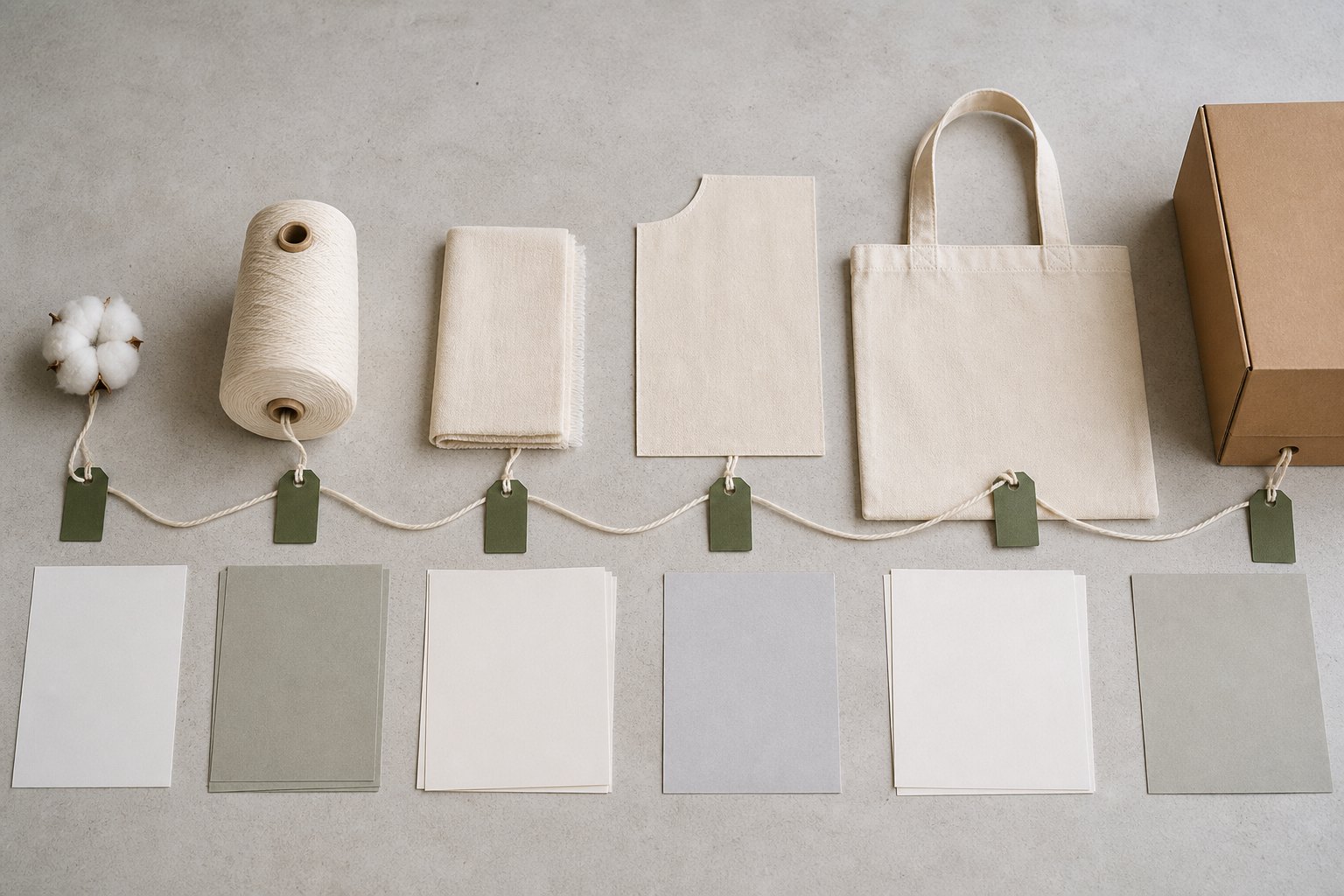
Draw the real route: farm or producer group, gin, spinner, weaver or knitter, dyer or finisher, printer, cut-and-sew site, trader, exporter and buyer. Add every point where goods change ownership, identity, physical location or processing state. A company name on an invoice may be a trader, while the bag is cut, printed and sewn at separate facilities.
Use a Stage-by-Stage Evidence Gate
| Stage | Identity to preserve | Evidence to review | Typical break |
|---|---|---|---|
| Farm to gin | Producer and crop input | Eligible organic-source and first-stage records | Origin is summarized without a traceable input |
| Spin and weave | Lot, yarn and fabric references | Scope, transaction and production records | Certified yarn is mixed with an unknown lot |
| Wet process and print | Fabric lot and process route | Approved site and process evidence | Undisclosed subcontract dyeing or printing |
| Cut, sew and ship | PO, bundle, carton and shipment | Receiving, issue, output and shipment records | Bag uses valid fabric but the finished route is outside scope |
Control the Farm-to-Gin Boundary
The first processing stage is where farm identity and physical fibre begin entering the textile chain. Record the eligible organic production standard, producer reference, origin information, gin and certification body route required by the selected program. Do not replace this with a country-level claim. Origin is an evidence field, not a guarantee of quality, labour conditions or environmental performance.
Keep Yarn and Fabric Lots Connected
Require the spinner and fabric producer to retain input lot, production lot, quantity, output reference and status. The supplier should be able to link the production-intended fabric roll to the eligible yarn evidence. A mill's valid certificate may cover some product categories but not the particular fabric construction or process quoted for the bag.
Verify Wet Processing and Printing
Dyeing, washing, finishing and printing can change the applicable certification and compliance route. Identify the actual site and whether its field of operation is covered. Review approved inputs and process records where required by the selected standard. A raw organic cotton claim does not automatically substantiate claims about dyes, water, toxicity or the environmental impact of decoration.
Include Cut-and-Sew Operations
Confirm where fabric is spread, cut, bundled, printed or embroidered, sewn, finished and packed. Link bundle or batch identification to the material issue record. If labels, thread or reinforcements are outside the organic claim, keep them identified in the bill of materials. The custom bag manufacturing process shows the broader design-to-delivery sequence.
Identify the Trader and Exporter Roles
The contracting seller may not own the manufacturing site. Record which entity holds the relevant certificate, buys the certified input, sells the finished goods, requests transaction evidence, invoices the buyer and appears in the shipping file. A trader can be a legitimate part of the chain, but undisclosed ownership changes create gaps in both quantity reconciliation and claim responsibility.
Understand the Scope Certificate
A Scope Certificate shows that a certified entity has qualified activities and products within a stated scope and validity period. It is not a blanket approval for everything that company sells. Check the legal entity, address, certification body, dates, product category, field of operation and listed subcontractors. Do not accept a certificate belonging only to a fabric mill as proof that the finished bag seller and route are certified.
Understand the Transaction Certificate
A Transaction Certificate concerns specified certified goods moving in a transaction or shipment. GOTS tells database users to obtain a Transaction Certificate issued by the certifier for the applicable delivery and notes that it should list product and shipment details. Treat it as order evidence, not a decorative PDF. Confirm seller, buyer, product, standard, weights, shipment references and links to eligible inputs.
Compare Scope and Transaction Evidence
| Question | Scope Certificate | Transaction Certificate | Buyer conclusion |
|---|---|---|---|
| What does it address? | Entity capability and certified scope | Specified goods and transaction | Both answer different questions |
| Does it prove this PO? | No, not by itself | Only if details reconcile to the goods | Match records to the purchase order |
| What must match? | Entity, site, activity, product and dates | Seller, buyer, product, weight and shipment | Investigate every mismatch |
| When is it reviewed? | Before award and at expiry or change | For the applicable transaction or shipment | Do not rely on one historic file |
Verify the Database and Legal Entity
Search the official program database, then open the current certificate rather than relying on a screenshot supplied in a sales deck. GOTS warns that a database entry alone is not definitive proof and recommends checking the Scope Certificate and contacting the issuing certifier when authenticity is uncertain. Compare punctuation, legal suffix, address and certificate number with the quotation, contract and invoice.
Check Product and Process Scope
Confirm that bags or the applicable textile product category can be offered under the certificate and that the relevant operations are listed. A company certified for trading yarn is not automatically certified to manufacture or sell a finished tote under the same claim. Record the standard version and certification status that apply on the production and shipment dates.
Disclose Every Subcontractor
Printing, washing, embroidery, sewing or packing may be subcontracted. Ask which steps leave the named site and how each subcontractor appears in the certified entity's approved route. Compare the intended bulk route with the sample route. A beautifully documented fabric becomes insufficient if an unapproved processor changes or handles it outside the required controls.
Match Transaction Evidence to the Order
Build a reconciliation sheet for purchase order, invoice, packing list, item description, material composition, certified percentage, net certified weight, shipment date and carton quantity. Use the certificate's own reference fields rather than a filename created by the supplier. If several purchase orders share one shipment or one transaction record, show the allocation rule.
Perform Volume Reconciliation
Compare opening certified inventory, eligible receipts, material issued, normal process loss, finished output, scrap, closing inventory and certified sales. The calculation should be physically plausible for the bag specification and order quantity. A valid certificate does not remove the need to question output that exceeds available eligible input or loss rates that change without explanation.
Separate Certified Weight From Total Product Weight
The finished bag may include thread, print paste, labels, closures, hardware and packaging outside the certified fibre weight. State the calculation basis and component weights. Avoid presenting the total shipped weight as organic cotton content unless the applicable rules and evidence support that interpretation. This component discipline also improves comparison with canvas versus cotton tote specifications.
Link Evidence to the Purchase Order
Create one chain file containing the approved bill of materials, fabric and color references, supplier and site details, current Scope Certificates, applicable Transaction Certificates, goods-receipt records, production issues, output reconciliation, inspection release and shipping references. Each file needs an owner, revision and review date. Email attachments without a PO link are inputs, not a controlled evidence pack.
Use Production-Intended Material for Samples
State whether a sample is a construction mockup, color proof, print test or production-intended certified sample. A development sample made from convenient conventional cotton can test dimensions but cannot validate the organic material route. The custom bag sample SOW guide helps define deliverables, evidence and bulk handoff.
Control Receiving and Material Identity
At receipt, verify supplier, delivery reference, material code, lot, quantity, status and supporting document. Quarantine material until required checks close. Use labels and storage locations that distinguish eligible organic material from conventional cotton with a similar appearance. Record split rolls, returns and transfers so identity is not lost after the first warehouse movement.
Prevent Unauthorized Substitution
Require written approval before changing the mill, yarn, fabric construction, dye house, print site, sewing facility or certification route. The change request should identify affected purchase orders, evidence, cost, timing and label impact. A supplier must not replace certified material with an "equivalent natural cotton" because the shade or delivery appears similar.
Keep Chemical and Social Evidence in Separate Lanes
Organic-content evidence, chemical compliance, restricted-substance requirements, workplace due diligence and physical quality answer different questions. Some standards combine several requirements, but the buyer should still know which document supports which claim. Do not advertise OEKO-TEX, REACH, social audit or GOTS as interchangeable approvals or assume any one of them guarantees customs clearance.
Control Labels and Certification Marks
Certification names and marks have program-specific conditions, approval routes and product thresholds. Freeze label text, placement, certificate or license reference, artwork owner and approval evidence before printing. A supplier's certified status does not automatically authorize a buyer to place a logo on any product. Keep approved artwork connected to the exact claim category and production route.
Record the GOTS Version Transition
GOTS Version 8.0 was released in March 2026 and becomes effective for all certified entities and approved chemical inputs on March 1, 2027, with early adoption allowed during the transition. Record which version governs the entity, input and order rather than copying a standard number from an old certificate. Recheck long-running or repeat programs when the audit or shipment crosses the transition.
Understand What OCS Does Not Prove
Textile Exchange describes OCS as tracking organic raw material through the supply chain. It does not address chemical use or broader social and environmental production aspects beyond organic-material integrity. Therefore, an OCS claim should not be expanded into unqualified claims about low impact, safe dyes, fair labour, biodegradability or superior durability without separate evidence.
Write Claims From the Evidence Outward
Start with what the evidence supports, then draft the shortest accurate statement. Record the component, percentage, certification route and any qualification a reasonable customer needs. Review product copy, hangtags, online descriptions, sales decks and staff scripts together. A carefully qualified label can be undermined by a webpage that describes the entire bag as universally sustainable.
Apply Advertising Substantiation Rules
The U.S. Federal Trade Commission says marketers should consider how consumers interpret environmental claims and how those claims are substantiated. Its enforcement guidance also stresses that express and implied objective claims need support. Keep the claim register and evidence before publication, not as a corrective exercise after launch. Avoid broad terms such as green or eco-friendly unless every reasonable interpretation is supported and properly qualified.
Keep Bag Quality Separate From Certification
Certification does not set the buyer's functional requirements for dimensions, fabric weight, shrinkage, handle strength, seam construction, print adhesion or packing. Define those separately and inspect them against the approved sample. Use the custom bag quality checklist and the bag quality pillars for physical controls.
Test the Finished Bag for Its Real Use
Build tests around the expected basket, carry route, reuse target and decoration. Check dimensions, load path, handle comfort, seam failure, abrasion, color transfer, shrinkage and print durability where relevant. Organic fibre identity does not predict construction performance. For artwork decisions, compare decoration routes in the custom printed tote bag guide.
Model MOQ and Cost Without Universal Numbers
Minimums depend on certified material availability, fabric construction, color, decoration, component minimums, certification transaction costs, packing and factory scheduling. Ask suppliers to separate fixed and variable cost, certified-material commitment, surplus allocation and repeat-order assumptions. Use the custom bag MOQ guide and custom bag cost guide rather than accepting one generic quantity or premium.
Build the Schedule From Evidence Gates
Plan backward from the required in-hand date through shipment, transaction-document timing, final inspection, production, certified-material receipt, sample approval, artwork release and certificate review. Identify which documents can be checked before award and which depend on the transaction. A fast sewing promise cannot recover an unresolved material route or an unauthorized label.
Assemble the Final Claim Evidence Pack
Archive the claim map, approved wording, certification program and version, current Scope Certificates, applicable Transaction Certificates, entity verification, subcontractor route, bill of materials, certified-weight calculation, input-output reconciliation, receiving and issue records, sample approval, inspection report, label approval, invoice, packing list and shipment reference. Apply retention periods required by the market, contract and certification program.
Use a Supplier and Order Release Matrix
| Gate | Pass evidence | Owner | Stop condition |
|---|---|---|---|
| Supplier award | Valid entity, scope and disclosed route | Sourcing and compliance | Entity or process mismatch |
| Material release | Eligible receipt and lot identity | Factory quality | Unknown or mixed status |
| Artwork release | Approved claim and mark usage | Brand and legal | Unsupported or overbroad wording |
| Shipment release | Reconciled goods, inspection and document plan | Order owner | PO, weight or shipment mismatch |
Use the right related sourcing guide: For factory selection, use how to choose a custom bag manufacturer. For a private-label operating model, use the private label bag supplier guide. Regional organic tote searches belong on the UK organic cotton tote factory page or USA organic cotton tote supplier page. For life-cycle comparisons, use the shopping bag sustainability guide.
Watch for Organic Cotton Supply Chain Red Flags
Red flags include a logo with no approval route, a certificate image with no legal-entity match, a fabric mill certificate used to cover an undisclosed sewing site, a Scope Certificate presented as proof of a specific shipment, refusal to discuss Transaction Certificates, quantities that cannot reconcile to eligible input, an organic shell described as an entirely organic bag and substitutions described only as equivalent cotton.
Also question fixed claims that certification prevents customs rejection, guarantees quality, proves every environmental benefit or permits any label wording. A controlled supplier states what the certificate covers, what it does not cover, which evidence will exist before award and which order-specific record will follow the transaction.
Official references: Verify current requirements through the GOTS Certified Suppliers Database, GOTS Version 8.0, Textile Exchange's organic cotton certification guidance and the FTC Green Guides. Confirm project-specific legal and certification questions with qualified advisers and the responsible certification body.
Frequently Asked Questions
Does a valid Scope Certificate prove my finished bag is certified?
No. It shows the entity's qualified scope during a validity period. You still need to verify the product, process, actual sites and order-specific transaction route. The finished claim must match the program rules and the evidence for the applicable goods.
What is the difference between GOTS and OCS?
OCS focuses on organic-material identity and chain of custody. GOTS includes organic fibre requirements and additional processing criteria. Neither name should be used beyond its certified scope, and the correct choice depends on the intended product claim and supply-chain route.
Should the buyer receive a Transaction Certificate?
For a certified transaction route, specify before award which entity requests it, when it can be issued, what goods it will cover and who receives it. Reconcile the final record with the purchase order, invoice, product, certified weight and shipment instead of treating receipt of any TC as sufficient.
Can uncertified accessories be used in an organic cotton bag?
That depends on the selected program, product category and claim. Map thread, labels, handles, closures, print and packaging separately, then confirm permitted composition and labeling with current official rules and the responsible certifier.
Does organic cotton certification guarantee a durable tote?
No. Durability depends on fabric construction, weight, pattern, handles, seams, decoration and use. Define functional tests and inspection criteria separately from organic-content and chain-of-custody evidence.
What should I send for an evidence-ready quotation?
Send the intended claim, certification program, bag specification, component map, artwork, quantities, production and selling entities, destination, required date, label route, inspection plan and evidence deliverables. Ask the supplier to return assumptions, actual sites, subcontractors, certificate scope and transaction-document plan.
Next Step: Request an Organic Cotton Chain Review
Send the proposed claim, bag specification, supplier entity, production route and certificate files. We can help turn them into a purchase-order evidence checklist before material or artwork release. Request an organic cotton bag supply-chain review, review the current custom tote bag range, then use the core manufacturer guide to complete the wider sourcing decision.
Email a prefilled organic cotton evidence brief