Cotton Drawstring Bag Shrinkage and Washing Tests
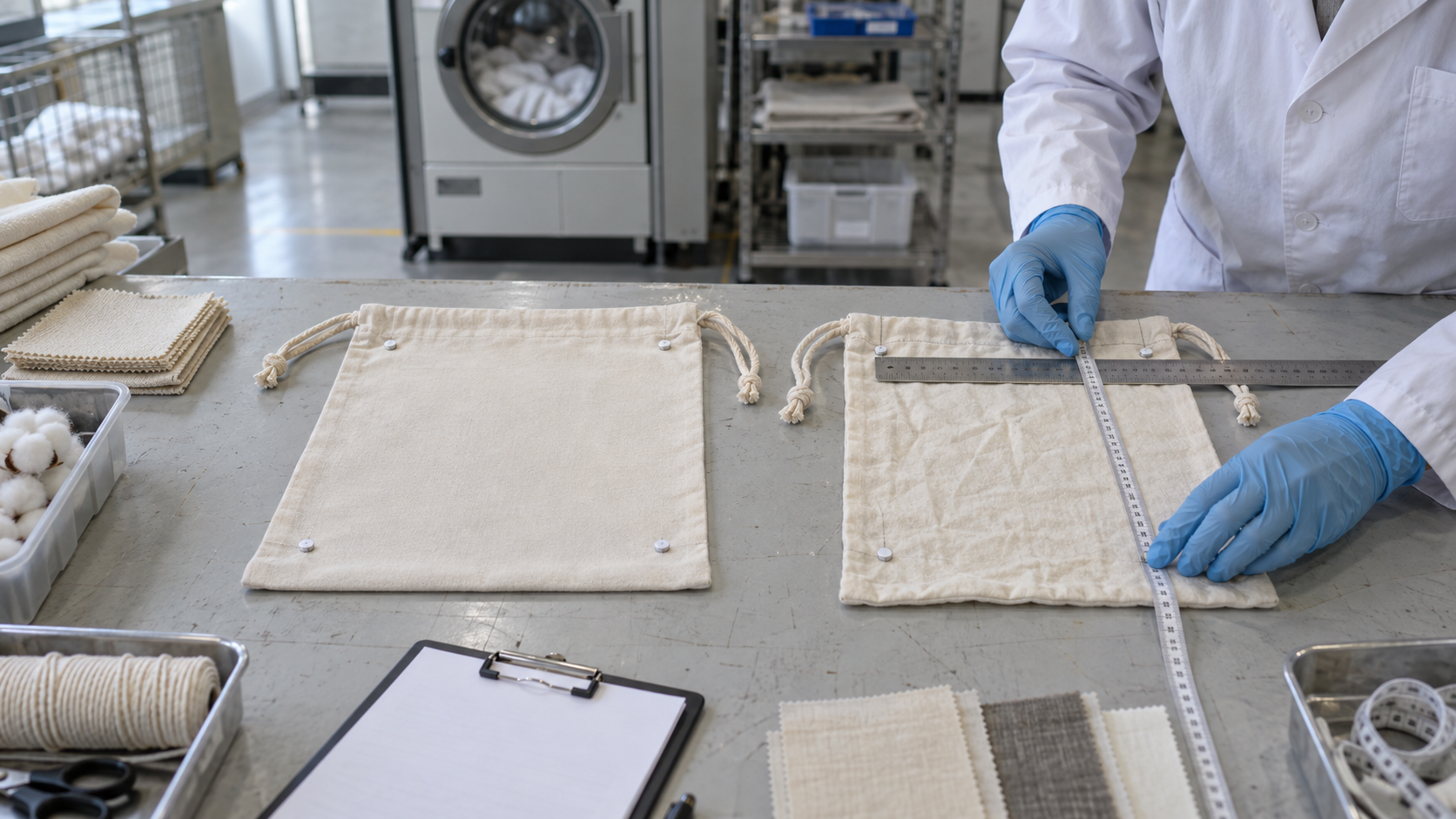
Editorial visualization of pre-wash and post-wash measurement. It illustrates a test workflow rather than a documented customer order or company laboratory result.
The short answer: test cotton drawstring bag shrinkage by conditioning and marking a production-intent specimen, measuring fixed reference distances, applying a precisely defined washing-and-drying procedure, reconditioning the bag, and measuring the same points again. Report length and width dimensional change separately, then inspect the opening, cord channel, cords, seams, gusset, print and ability to hold the intended contents. A fabric swatch result alone does not prove that the finished bag will retain its size or function.
There is no universal acceptable shrinkage percentage for every cotton bag. The buyer must define the care claim, wash temperature, detergent, machine type, drying route, number of cycles, sample quantity and pass criteria before testing. A result belongs to the exact cotton construction, finish, color, decoration, cord system and sample revision evaluated.
This guide helps brand, sourcing and quality teams translate “washable cotton bag” into a repeatable specification for custom drawstring bags. It complements our articles on cotton vs canvas drawstring bags, drawstring bag quality control and which tests custom drawstring bags should pass.
Important: Cotton content does not automatically prove washability, preshrinking or a fixed dimensional-change limit. Test scope, care instruction, acceptance criteria and commercial terms remain subject to the approved specification and written confirmation.
Quick Answer: A Seven-Step Shrinkage Test
| Step | Action | Required record | Main risk controlled |
|---|---|---|---|
| 1. Define the claim | State whether the bag is washable and how | Proposed care instruction and intended use | Testing the wrong consumer behavior |
| 2. Freeze construction | Identify fabric, finish, cords, seams and print | BOM and sample revision | Applying results to a changed product |
| 3. Condition and mark | Stabilize specimens and set reference points | Environment, point map and initial readings | Inconsistent baselines |
| 4. Wash | Use one written machine/detergent program | Machine type, cycle, temperature and ballast | Unrepeatable treatment |
| 5. Dry | Apply the exact specified drying route | Line, flat or tumble parameters | Drying-driven result differences |
| 6. Recondition and measure | Measure the same points without stretching | Final readings and calculations | Operator-dependent values |
| 7. Inspect the whole bag | Check size, shape, cord, seam, print and fit | Individual results, photos and pass/fail | Declaring success from dimensions alone |
The sequence is simple, but small omissions change the outcome. “Machine washed and measured” is not enough. Different machine designs, detergents and drying methods can produce different dimensional change, which is why the procedure must be written before samples enter the wash.
What Shrinkage Means for a Cotton Drawstring Bag
In laboratory reporting, “dimensional change” is usually more precise than “shrinkage.” A measurement can decrease, increase or distort in one direction while remaining stable in another. The complete bag can also twist or pucker even when its central panel measurements appear acceptable.
| Result type | What to measure or observe | Buyer impact |
|---|---|---|
| Length change | Distance along the bag’s height direction | Affects capacity, artwork position and product fit |
| Width change | Distance across the body | Affects opening, insert fit and visual proportions |
| Gusset change | Depth or fold geometry | Alters usable volume and standing shape |
| Opening change | Usable mouth width and closure travel | Can make insertion or closure difficult |
| Cord change | Exposed length, diameter, twist or end condition | Can create uneven tails or poor closure |
| Seam distortion | Puckering, roping, slippage or twist | Changes appearance and can affect strength |
| Print response | Cracking, distortion, color change or registration shift | Alters brand presentation |
| Whole-bag function | Ability to accept contents, close and reopen | Determines practical usability |
Cotton fibers, yarns and fabric structures can relax after wetting and mechanical action. Finishing, weave, yarn construction, fabric density, cutting direction, sewing tension and drying all affect the result. It is therefore unsafe to copy a shrinkage value from another cotton bag simply because both are described as “100% cotton.”
Use the Standards as a Connected System
Three ISO documents form a useful dimensional-change framework:
| Reference | Role in the test | What it does not decide |
|---|---|---|
| ISO 3759:2011 | Preparation, marking and measurement of fabrics, garments and fabric assemblies | Which washing/drying program the buyer wants |
| ISO 6330:2021 | Defined domestic washing and drying procedures for textile testing | The acceptable dimensional-change limit |
| ISO 5077:2007 | Determination and calculation of dimensional change after appropriate treatment | Whether the complete bag remains commercially functional |
| AATCC TM135-2025 | Dimensional changes of fabrics after home laundering | Finished-bag performance unless the selected scope covers it |
| Buyer/retailer protocol | Product-specific care, cycles, components and pass criteria | Automatic equivalence to another standard |
ISO 6330:2021 provides multiple machine-based washing procedures and six drying procedures; each washing procedure represents one domestic wash. ISO 5077:2007 covers dimensional change in fabrics, garments and other textile articles after an appropriate washing/drying combination. ISO 3759:2011 addresses specimen preparation, marking and measurement.
The method does not supply a universal pass grade for a promotional pouch, retail dust bag and reusable gym sack. The product specification must add those criteria.
Fabric Swatch Testing and Finished-Bag Testing Are Not Interchangeable
A fabric specimen helps compare materials and establish baseline dimensional stability. A finished bag reveals interaction among the body, cord channel, thread, seams, lining, print and hardware.
| Test level | Best use | Limitation |
|---|---|---|
| Unsewn fabric specimen | Material development, supplier/lot comparison | Does not include sewing, cord or product geometry |
| Printed panel | Decoration and dimensional interaction | Does not show closure or seam response |
| Sewn trial panel | Seam puckering and local construction effects | Does not reproduce complete bag shape |
| Finished pre-production bag | Care claim and complete-product approval | Represents only the approved sample construction |
| Production-lot bag | Verification of actual bulk output | Requires a defined lot-sampling rule |
For a consumer-facing washable claim, evaluate the complete production-intent bag. A body fabric can show acceptable dimensional change while cotton cords shorten, a polyester label remains stable, a printed panel stiffens or a lining behaves differently. Mixed-material construction makes whole-bag inspection especially important.
Define the Care Claim Before Choosing the Test
Start with the instruction the end user will receive. “Washable” is incomplete without a method. Determine whether the intended care is wipe cleaning, hand washing, machine washing, line drying, flat drying or tumble drying. If the bag has no washability claim and is intended as short-term packaging, a demanding repeated home-laundering program may not match the commercial use.
Questions to resolve
- Will the bag be sold as machine washable?
- What water temperature and cycle are intended?
- Is a reference detergent required?
- What machine type does the selected standard use?
- Will the bag be line dried, flat dried or tumble dried?
- How many consumer-equivalent cycles must be evaluated?
- Must appearance, print and closure function also pass?
- Are cords removable, colorfast and compatible with the care route?
The care instruction and test conditions should tell the same story. Passing a cool line-dry procedure does not justify marketing the bag for hot washing and tumble drying.
Select Production-Intent Samples
Before marking specimens, record the variables that can affect dimensional stability.
| Sample field | What to record | Why it matters |
|---|---|---|
| Fiber claim | Confirmed cotton percentage and any blend fibers | Blends can respond differently from pure cotton |
| Fabric construction | Weave, yarn information, nominal weight and finish | Controls relaxation and surface behavior |
| Pretreatment | Washed, compacted, sanforized or another documented finish | “Preshrunk” must be supported, not assumed |
| Direction | Warp/weft or length/width orientation in the cut panel | Dimensional change can differ by direction |
| Color/lot | Colorway, roll or dye lot | Processing can vary between lots |
| Decoration | Ink, transfer, embroidery, label or patch | May restrict or distort the fabric |
| Cord system | Fiber, braid, diameter, length and knot/end finish | Cord response affects opening and symmetry |
| Sewing | Seam type, allowance, stitch density and thread | Tension and differential behavior can cause puckering |
| Revision | Sample code, tech-pack revision and approval date | Protects result traceability |
The broader material differences are covered in Cotton vs Canvas Drawstring Bags. For wash testing, the critical question is whether the specimen matches the final approved construction.
Condition, Mark and Measure the Bag Correctly
Do not measure a crushed bag immediately after unpacking and compare it with a relaxed post-wash sample. Condition all specimens under the selected method’s required environment and handle them consistently.
Reference-point plan
Use durable, non-distorting marks placed at reproducible points. Avoid measurements that cross bulky seams unless the protocol intentionally measures the complete dimension. Establish more than one measurement in each principal direction when the method or buyer protocol requires it.
| Measurement | Example reference location | Potential interpretation issue |
|---|---|---|
| Body height | Fixed points below channel and above bottom seam | Channel or bottom construction may distort the edge |
| Body width | Fixed horizontal points inside side seams | Side seams may pucker differently from the center |
| Opening width | Defined mouth position with bag laid naturally | Pulling the opening can artificially enlarge it |
| Gusset depth | Fixed fold/edge points | Fold memory can make the measurement unstable |
| Cord exposure | Same closure position and reference knot | Knot movement can mimic cord shrinkage |
| Print dimensions | Defined artwork landmarks | Fabric and ink film may change differently |
Record initial measurements with the specimen flat, relaxed and free of intentional stretching. Photograph the point map. Use the same measuring equipment and orientation after treatment.
Choose the Washing Procedure Deliberately
ISO 6330 includes different procedures based on front-loading and top-loading machine types, reference detergents, ballast and other controlled parameters. The official standard page notes that machine type, detergent and dryer parameters can affect results. That warning is especially relevant when suppliers and buyers use laboratories in different regions.
| Wash variable | Why it affects results | Specification action |
|---|---|---|
| Machine type | Mechanical action differs | Name the standard machine/procedure |
| Temperature | Fiber relaxation and finish response can change | State the exact program |
| Detergent | Chemistry and dose affect wetting and appearance | Use the prescribed reference or agreed alternative |
| Ballast/load | Alters mechanical action | Control type and mass as required |
| Cycle count | Change may progress over repeated treatments | State checkpoints and total cycles |
| Specimen loading | Tangling and abrasion can differ | Define bag closure and placement |
| Hardware protection | Eyelets or cord ends may damage specimens or machine | Include safe preparation without altering the test intent |
Do not tie cords tightly unless that reflects normal care and the protocol requires it. A tight knot can restrict relaxation, create local creasing or become impossible to reopen after washing. Record whether the bag is washed open, loosely closed or placed in a protective wash bag.
Drying Method Can Drive the Result
Washing and drying form one complete treatment. ISO 6330 lists line dry, line drip dry, flat dry, flat drip dry, flat press and tumble dry routes. A bag that is stable after flat drying may respond differently to tumble drying.
Match drying to the claim
| Intended instruction | Relevant test choice | Extra inspection |
|---|---|---|
| Flat dry | Defined flat-dry procedure | Shape, edge curl and print contact marks |
| Line dry | Defined line-dry procedure | Peg/hanger distortion and seam hang |
| Drip dry | Applicable drip-dry procedure | Water weight and vertical distortion |
| Tumble dry | Defined dryer program and endpoint | Higher mechanical/thermal stress, cord tangling |
| No consumer wash claim | Order-specific wet/cleaning check only if useful | Avoid implying broader washability |
Never “correct” the bag by stretching, ironing or reshaping it before measurement unless the approved method explicitly requires that treatment. If ironing is part of the care instruction, specify and report it rather than applying it informally.
Calculate Dimensional Change Transparently
For a defined reference distance:
Dimensional change (%) = (final measurement − initial measurement) ÷ initial measurement × 100
Under this convention, a negative result indicates a decrease and a positive result indicates growth. Some commercial specifications report shrinkage magnitude as a positive number, so the report must state its sign convention.
Illustrative calculation
If a marked height is 400 mm before treatment and 388 mm afterward:
(388 − 400) ÷ 400 × 100 = −3.0% dimensional change
That example explains the calculation only; it is not a LUCKYSTAR specification or universal pass limit.
| Reporting field | Good practice | Risk if omitted |
|---|---|---|
| Initial and final readings | Show both values for every specimen | Calculation cannot be checked |
| Direction | State length/height and width separately | Opposite-direction changes may be hidden |
| Sign convention | Define decrease versus growth | “3%” becomes ambiguous |
| Individual specimens | Report each result and required summary | Variation disappears behind one average |
| Cycle checkpoint | Identify after one, three, five or other cycles | Progression cannot be assessed |
| Wash/dry code | Record the complete procedure | Another laboratory cannot reproduce it |
| Measurement units | Use one consistent unit | Transcription errors become likely |
Inspect the Complete Bag After Every Checkpoint
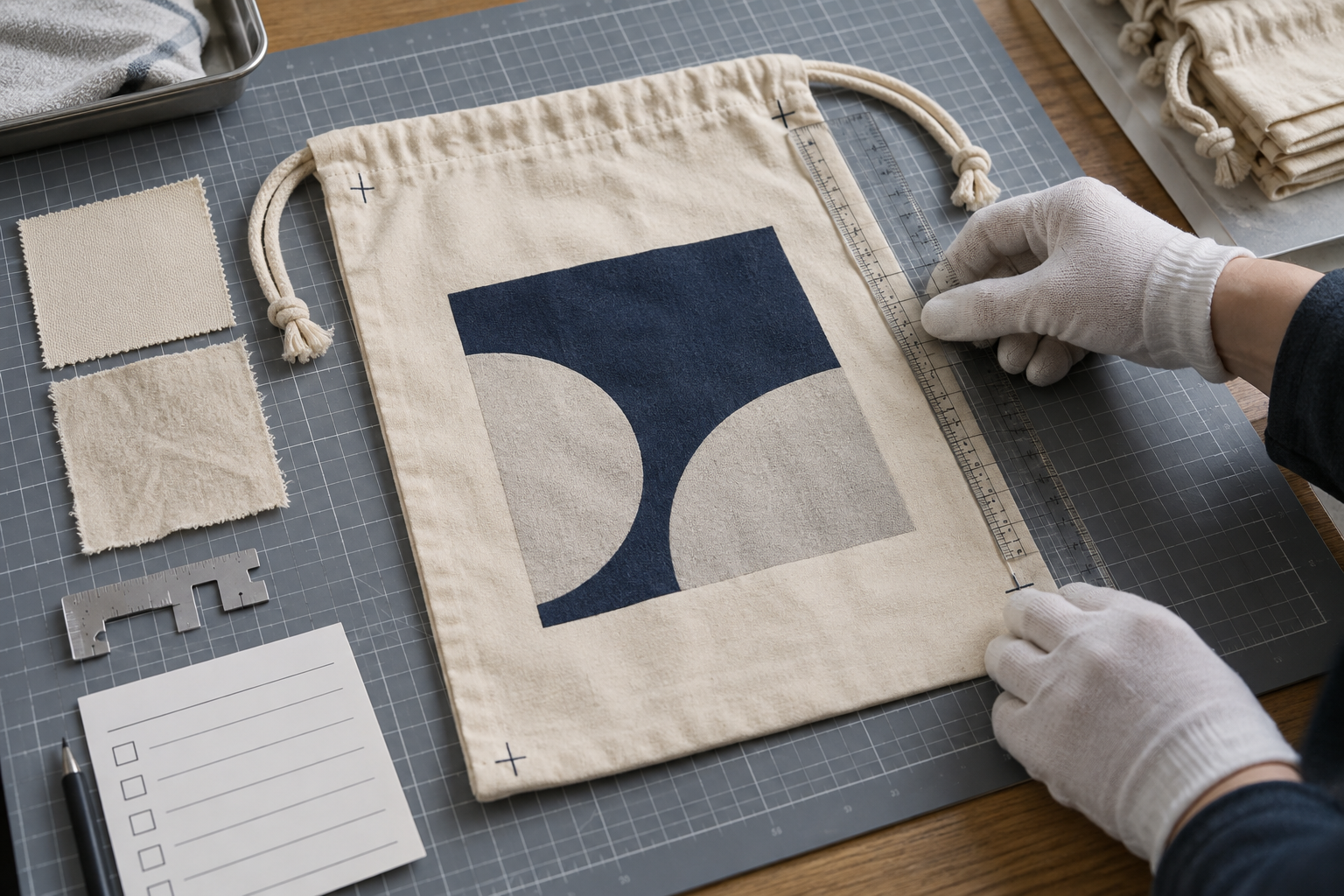
Editorial visualization of a post-wash inspection. The picture contains no real test values or approved commercial result.
Allow the bag to recondition as required, then inspect it without pulling it back to the original shape. Measurements are only one part of the result.
Functional and visual inspection checklist
- opening remains large enough for the intended contents;
- drawcords still travel through the channel without jamming;
- left and right cord tails remain within the approved symmetry allowance;
- knots, tips or end finishes remain secure;
- side and bottom seams remain closed and reasonably flat;
- the body has no unacceptable skew, torque or bowing;
- gusset folds and bottom corners remain functional;
- print or embroidery meets the post-care appearance criteria;
- color change or staining is assessed under a separate applicable method;
- hardware has not corroded, distorted or damaged the fabric;
- the approved product or surrogate still fits and the bag closes.
If colorfastness is a concern, do not substitute dimensional-change observations for a proper colorfastness method. The test plan should report size stability, appearance and color behavior as separate outcomes.
Test the Print, Embroidery and Labels with the Bag
Decoration can restrain local fabric movement or respond differently from the cotton body. A large ink film may reduce shrinkage inside the print while the surrounding fabric relaxes, creating puckering. Dense embroidery can distort after washing, while thread and base fabric may change at different rates.
| Decoration | Post-wash risks | What to record |
|---|---|---|
| Screen print | Cracking, tackiness, edge lift or local puckering | Print size, surface change and adhesion observations |
| Heat transfer | Edge lifting, wrinkling or film distortion | Application parameters and post-wash appearance |
| Embroidery | Puckering, backing exposure or thread distortion | Design dimensions, flatness and stitch condition |
| Woven label | Curl, shrinkage mismatch or seam distortion | Label dimensions and attachment condition |
| Printed label | Fading or legibility loss | Separate color/print criterion |
Review the process choices in Embroidery vs Printing for Cotton Drawstring Bags. Approve the decorated production-intent sample, not an undecorated fabric substitute.
Decide the Number of Wash Cycles
One cycle can detect immediate relaxation, but it may not represent repeated care. The number of cycles should follow the product claim, buyer requirement and expected service. State whether measurements occur after each cycle or only at the final checkpoint.
| Cycle strategy | When it helps | Limitation |
|---|---|---|
| One defined wash/dry | Initial qualification or single-cleaning exposure | Does not show progression |
| Several checkpoints | Tracks whether change stabilizes or continues | Requires consistent reconditioning and measurement |
| Final-only repeated cycles | Efficient for a fixed buyer requirement | Hides when a failure began |
| Paired fabric and finished-bag series | Links material behavior with product function | Requires more specimens and records |
Do not describe an accelerated or repeated laboratory sequence as an exact number of real consumer months. Household machine, detergent, load and user behavior vary.
Set Acceptance Criteria Before Seeing the Results
An ISO or AATCC procedure describes how to test; the buyer’s specification defines whether the outcome is acceptable. Set separate criteria for:
- length/height dimensional change;
- width dimensional change;
- opening and gusset dimensions;
- cord length and closure operation;
- seam distortion and overall shape;
- print, embroidery and label appearance;
- color change and staining where applicable;
- fit with the intended contents.
The acceptable range for a soft promotional pouch may differ from a fitted product package whose box must slide through a narrow opening. Do not publish one company-wide shrinkage tolerance without verified approval and a clearly defined product/method scope.
Diagnose Common Failure Patterns
| Failure pattern | Possible contributors | Corrective direction to investigate |
|---|---|---|
| Height shrinks more than width | Fabric-direction behavior or panel orientation | Review material finish and cutting direction |
| Body passes but cords shorten | Different cord fiber or construction | Specify/test cord separately and revise length |
| Side seams pucker | Differential shrinkage or sewing tension | Review thread, seam and pressing conditions |
| Opening becomes too small | Channel or width change | Adjust construction only after confirming repeatable data |
| Bag twists | Skew, cutting direction or seam balance | Inspect fabric alignment and assembly |
| Print wrinkles | Local restraint or incompatible cure/application | Revalidate decoration system on the final fabric |
| Label curls | Material mismatch | Select compatible label and attachment |
| First lot passes, reorder fails | Finish, dye lot, fabric source or process changed | Apply documented change control and retest |
Correct the root cause, then retest. Making the pattern larger can compensate for an average size loss, but it does not fix unstable variability, twisting, cord mismatch or print failure.
Treat “Preshrunk Cotton” as an Evidence-Based Claim
“Preshrunk” should not be inferred from supplier vocabulary or fabric appearance. Request the specific finishing description, representative test data and the tolerance applicable to the order. Even a treated fabric can show additional dimensional change after the buyer’s selected wash/dry cycle.
Use careful language such as:
“The approved construction was evaluated under the specified wash-and-dry procedure and met the order’s dimensional-change criteria.”
Avoid “will never shrink,” “zero shrinkage” or “machine washable under all conditions.” A claim should remain tied to the tested specimen, method, cycle count, care route and acceptance rule.
Connect Development Testing to Bulk Production
| Stage | Shrinkage-control task | Release decision |
|---|---|---|
| Material development | Compare candidate cotton constructions and finishes | Select the material route |
| Decorated prototype | Observe interaction between fabric and branding | Revise process or artwork |
| Pre-production sample | Run the intended finished-bag procedure | Freeze construction and criteria |
| Incoming material | Verify identity and lot continuity | Accept, hold or investigate material |
| In-line production | Check measurements, panel direction and sewing consistency | Correct drift before completion |
| Finished lot | Apply agreed sampling and any required wash verification | Release, rework or hold |
| Reorder/change | Review source, finish, color, construction and care changes | Reuse evidence or retest with justification |
The custom drawstring bag sample-development process explains how to freeze the approval reference. Use the drawstring bag tech-pack guide to record the test program and the manufacturing-process guide to place checkpoints in the production timeline.
Write a Traceable Test Report
A useful report should contain:
- product, colorway, sample stage, lot and revision;
- body fabric, finish, decoration, cord and construction details;
- conditioning environment and duration;
- reference-point map and measuring equipment;
- initial measurements;
- complete wash and dry procedure, detergent and cycle count;
- final measurements after defined reconditioning;
- calculation formula and sign convention;
- individual and summarized results;
- shape, seam, closure, cord, print and fit observations;
- photographs and any deviations;
- conclusion limited to the agreed acceptance criteria.
When an external report is required, ISO/IEC 17025 provides the framework for testing-laboratory competence, impartiality and consistent operation. Confirm that the relevant method is within the laboratory’s accredited scope rather than assuming every service from an accredited company is accredited.
How LUCKYSTAR Supports Washable Cotton Bag Development
LUCKYSTAR can support buyers in coordinating the variables that determine whether an order-specific cotton drawstring bag is suitable for its intended care route. That work starts with a clear use case and approved specification—not a blanket promise that every cotton bag has the same shrinkage.
Depending on the confirmed project requirements, coordination can include:
- comparing cotton fabric and construction options;
- documenting size, panel direction, cord, seams and decoration;
- developing production-intent samples;
- agreeing measurement points and care procedures;
- aligning laboratory and finished-bag checks;
- recording approved references for bulk production and reorders;
- arranging third-party testing when the buyer or project requires it.
For wider supplier qualification, read the custom bag manufacturer guide. Then use How to Choose a Custom Drawstring Bag Manufacturer for product-specific sourcing questions. Every material choice, test package, sample plan, minimum quantity, quotation and schedule must be confirmed for the individual order.
RFQ Checklist for a Wash-Tested Cotton Drawstring Bag
| RFQ field | What the buyer should provide |
|---|---|
| Use case | Contents, fit requirement, frequency of cleaning and expected reuse |
| Cotton specification | Composition, weave, nominal weight, finish and color |
| Finished dimensions | Width, height, gusset, opening and tolerances |
| Construction | Seams, channel, lining, reinforcement and hardware |
| Cord | Fiber, structure, diameter, color, length and end finish |
| Decoration | Method, size, position, colors and approved artwork |
| Care instruction | Wash temperature/cycle and drying route |
| Test method | ISO/AATCC designation and edition or written buyer protocol |
| Cycle count | Required wash/dry checkpoints |
| Acceptance | Directional dimensional change plus function/appearance limits |
| Sampling | Development, PP or production specimens and colorways |
| Evidence | Report, photos, retained sample or third-party testing |
| Order details | Quantity, destination, packing and delivery window |

Send LUCKYSTAR your intended contents, cotton specification, finished dimensions, artwork and care requirements for an order-specific review.
Frequently Asked Questions
How much does a cotton drawstring bag shrink after washing?
There is no universal percentage. The result depends on fiber blend, yarn, weave, finish, color process, cutting direction, construction, wash program and drying method. Test the production-intent bag under the intended care route.
Is cotton canvas less likely to shrink than lightweight cotton?
Not automatically. Fabric weight and “canvas” terminology do not establish dimensional stability. Finishing, weave, yarn and laundering conditions must be evaluated on the actual material.
Should shrinkage be measured on fabric or the finished bag?
Use fabric specimens for material comparison and the finished bag for a consumer-facing care claim or fit requirement. The finished bag captures cords, seams, print, lining and product geometry.
Why must length and width be reported separately?
Cotton fabric may change differently in its two principal directions. One average can hide a bag that loses excessive height while retaining width, or vice versa.
Does line drying give the same result as tumble drying?
No. Drying route can materially affect dimensional change and appearance. The report must name the chosen method, and the care instruction should match it.
How many wash cycles should a buyer specify?
Choose the number from intended reuse, the care claim, buyer policy and risk. One cycle shows initial response; repeated checkpoints can show whether change stabilizes or continues.
Can a larger pattern compensate for cotton shrinkage?
Pattern allowance may be part of development after stable data exists, but it does not fix high variability, twisting, cord shrinkage or print damage. Correct root causes before relying on compensation.
Does “preshrunk” mean the bag will not shrink?
No. It normally indicates a prior treatment intended to reduce later change, but the actual performance still needs evidence under the specified wash-and-dry procedure.
Should printed cotton bags be wash-tested after decoration?
Yes when washability or repeated cleaning matters. Decoration can restrain the fabric, pucker, crack, lift or change appearance, so evaluate the complete decorated sample.
When should a reorder be retested?
Review testing whenever fabric source, fiber blend, finish, dye lot, construction, cord, decoration, supplier process or care requirement changes. Record the decision through formal change control.
Final Takeaway
Cotton drawstring bag shrinkage testing is a controlled comparison of the same reference points before and after a specified wash-and-dry treatment. The most useful program combines directional measurements with complete-bag checks for shape, cords, seams, print, opening and product fit. It reports the exact sample and conditions rather than turning one result into a universal cotton-bag claim.
Explore LUCKYSTAR’s custom drawstring bag range or request a project-specific quotation with your cotton fabric, dimensions, artwork and care requirements.
Technical References
- ISO 3759:2011 — Preparation, marking and measuring for dimensional-change tests
- ISO 6330:2021 — Domestic washing and drying procedures for textile testing
- ISO 5077:2007 — Determination of dimensional change in washing and drying
- AATCC TM135-2025 — Dimensional Changes of Fabrics after Home Laundering
- AATCC standards directory
- ISO/IEC 17025 — Testing and calibration laboratory competence