
Top 10 Cotton Drawstring Bag Manufacturers
The right cotton drawstring bag manufacturer is the one that can define the fabric, construction, decoration and evidence behind the exact bag you are buying. A useful shortlist therefore needs more than attractive natural-color pouch photos: it should reveal who makes the bag, which cotton specification is quoted, how samples become production standards, and which claims can be supported at order level.
This guide compares ten companies active in custom cotton drawstring bags, muslin pouches, cotton cinch bags and dust-bag packaging. It also identifies whether each business appears to operate as a physical manufacturer, manufacturer/exporter, sourcing and manufacturing coordinator, or promotional supplier. That distinction helps buyers compare like with like.
Editorial disclosure: LUCKYSTAR publishes this article and appears in the ranking. The list is an editorial sourcing framework, not an independent award. Company pages and product information were reviewed on October 10, 2026. Factory status, certificates, minimums, prices, capacity and delivery schedules remain subject to current document review and the final written quotation.

Quick answer: which cotton drawstring bag manufacturer should you choose?
For a custom program that combines fabric selection, bag engineering, logo decoration, quality control, packing and export coordination, LUCKYSTAR is our recommended starting point. The value is a specification-led project process rather than a blanket claim that one cotton construction fits every use.
Buyers that insist on a declared production facility should also audit Norquest Brands, Supreme Creations/Bags of Ethics, The Eco Bags, Yitian Bags, Gentle Bags and Shenzhen Fengyuan. Gallant International is especially relevant to organic-cotton muslin programs, while Cotton Pouch and BIDBI may suit stock-platform or locally decorated orders. Every candidate still requires order-specific verification.
| Buyer need | Strong starting point | Why it may fit | What must still be confirmed |
|---|---|---|---|
| Fully custom international program | LUCKYSTAR | Coordinates specification, sample, decoration, QC, packing and export requirements | Selected factory, fabric source, commercial terms and any certification evidence |
| Large custom organic-cotton program | Norquest or Supreme Creations/Bags of Ethics | Public pages describe manufacturing and cotton expertise | Current certificate holder, product scope, minimum and production allocation |
| Organic muslin pouch specialist | Gallant International | Detailed organic cotton muslin range and traceability-oriented offer | Actual manufacturing site, certificate chain and order-level label approval |
| Stock sizes plus local customization | Cotton Pouch or BIDBI | Established blanks, printing and smaller-program workflows | Origin of blank bag, decoration site and scope of cotton claims |
| Factory-first China sourcing | Yitian, Gentle Bags or Shenzhen Fengyuan | Public pages describe custom drawstring manufacturing | Legal entity, actual site, subcontracting, certificate scope and production schedule |
| India-based pouch manufacturing | The Eco Bags | Cotton pouch and luxury packaging specialization | Facility identity, documented materials and inspection method |
What counts as a cotton drawstring bag manufacturer?
Search results use “manufacturer” loosely. Some companies cut and sew bags in their own declared facility; others develop specifications and coordinate qualified production; others import blank bags and add decoration locally. None of these models is automatically superior, but they create different evidence and control points.
| Commercial role | Typical responsibility | Main advantage | Buyer risk to control |
|---|---|---|---|
| Physical manufacturer | Cutting, sewing and selected finishing at a named site | Direct process access | Fabric, dyeing or printing may still be outsourced |
| Manufacturer/exporter | Production coordination plus international sales and shipment | One commercial interface | Seller and actual factory may be different legal entities |
| Manufacturing coordinator | Technical brief, supplier selection, sampling, QC and logistics | Cross-process coordination and flexible sourcing | Buyer must request the applicable site and evidence for each order |
| Stock-platform supplier | Holds standard bags and provides printing or embroidery | Faster selection and potentially lower entry quantity | Limited control over upstream fabric and bag construction |
| Promotional distributor | Sources a finished SKU and manages regional decoration or fulfillment | Convenient local service | Product and decoration evidence may come from different parties |
In this guide, each profile uses the most defensible role supported by the company's public information. A supplier is not called a factory merely because its product page uses factory-oriented keywords.
How we ranked the top 10
The evaluation favors information a procurement team can turn into an RFQ, sample plan and purchase-order control. Public certification logos, customer names, review scores and “eco-friendly” statements received no independent weight unless the underlying entity, scope and product relationship could be checked.
| Evaluation area | Weight | Positive signal | Weak signal |
|---|---|---|---|
| Cotton drawstring specialization | 25% | Specific bags, pouches, weights, closures and applications | A generic bag page that only mentions cotton once |
| Production-role clarity | 20% | Named legal entity, site or transparent supplier model | Ambiguous factory language |
| Fabric and component specification | 15% | Fiber content, weave, weight, finish, cord and construction details | “Premium cotton” without measurable fields |
| Customization depth | 15% | Size, fabric, color, cord, print, embroidery, labels and packing | Logo printing on one stock style only |
| Evidence and claim control | 15% | Current document pathway and component-level claim boundaries | Certification badges without holder, scope or dates |
| Sample and quality-control usability | 10% | Production-equivalent sampling and measurable inspection fields | General “high quality” promise |
The ranking is a shortlist, not final qualification. A live factory and document audit may change the order for a specific project.
Top 10 cotton drawstring bag manufacturers and suppliers at a glance
| Rank | Company | Role used in this guide | Public cotton drawstring evidence | Best fit | Critical verification point |
|---|---|---|---|---|---|
| 1 | LUCKYSTAR | Custom sourcing and manufacturing coordination partner | Custom drawstring category and order-specific development workflow | Brands needing one coordinated custom project | Exact site, fabric, documentation and written commercial terms |
| 2 | Norquest Brands | Self-described custom manufacturer | Dedicated cotton drawstring product with fabric and construction fields | Higher-volume branded pouches and organic-cotton programs | Current certification holder, scope, facility and order minimum |
| 3 | Supreme Creations / Bags of Ethics | Textile manufacturer with declared India factory | Cotton drawstring, dust-bag and reusable packaging capability | Larger retail and responsible-sourcing programs | Product-specific specification and current certificate chain |
| 4 | Gallant International | Organic cotton bag supplier and manufacturing-program partner | Detailed organic muslin drawstring collection | Organic-cotton packaging and produce/muslin bags | Factory identity, transaction evidence and permitted labeling |
| 5 | Cotton Pouch | Stock and custom cotton pouch supplier/decorator | Multiple pouch sizes plus custom printing and embroidery | U.S. buyers needing stock-size flexibility | Blank-bag origin and whether evidence covers product and decoration |
| 6 | BIDBI | Cotton bag supplier and UK printer | Cotton drawstring bags, pouches and backpacks | UK promotional, school and retail-packaging programs | Stock versus bespoke route and actual production site |
| 7 | The Eco Bags | Self-described wholesale manufacturer | Cotton, muslin and canvas drawstring pouch specialization | Retail, cosmetics, jewelry and gift packaging | Facility, material certificates and repeat-order controls |
| 8 | Yitian Bags | Self-described China manufacturer | Cotton drawstring and dust-bag products | Factory-first custom programs across several bag structures | Reconcile public commercial claims with current written evidence |
| 9 | Gentle Bags | Self-described China custom bag manufacturer | Cotton material and drawstring/pouch manufacturing routes | OEM/ODM programs requiring broad construction options | Confirm exact site, cotton source and subcontracted processes |
| 10 | Shenzhen Fengyuan | Self-described drawstring bag manufacturer | Dedicated cotton drawstring offer | Pouch-focused projects and compact packaging formats | Entity history, facility, certification scope and current capacity |
1. LUCKYSTAR
LUCKYSTAR ranks first for buyers who want a custom cotton drawstring bag handled as a complete technical and commercial project. The custom drawstring bags product page provides the entry point for pouches, cinch bags, dust bags and related constructions. The broader custom bag manufacturer guide helps procurement teams organize due diligence.
Why choose LUCKYSTAR?
Cotton projects create interconnected decisions. Fabric weight affects drape and print behavior; bleaching and dyeing affect color; washing expectations affect shrinkage tolerances; cord diameter affects the channel; embroidery can distort light fabric; and individual packing affects both presentation and freight volume. LUCKYSTAR can coordinate those choices around the intended product and buyer brief.
The company should not be described as holding a universal current GOTS, OCS, BCI or OEKO-TEX certification. If a project needs organic cotton, traceable cotton or a particular test, availability and evidence must be confirmed for the selected mill, factory, process and order. This project-level boundary protects the buyer from turning a material option into an unsupported company-wide claim.
What LUCKYSTAR can coordinate
| Project phase | LUCKYSTAR support | Buyer approval | Evidence to retain |
|---|---|---|---|
| Requirements | Translate use, dimensions, load, cotton type, decoration and packing into an RFQ | Written assumptions and target specification | Buyer brief and version-controlled tech pack |
| Material review | Compare muslin, plain-weave cotton, canvas, organic or other available options | Swatch, color, weight and finish | Material specification and applicable supplier documents |
| Sampling | Coordinate pattern, closure, print/embroidery and construction sample | Production-equivalent golden sample | Comments log, approved sample photos and sign-off |
| Production control | Align approved materials, tolerances, workmanship and inspection | Pre-production file | Bill of materials, artwork proof and inspection checklist |
| Packing and shipment | Confirm folding, labeling, carton quantities and documents | Shipment release | Inspection result, packing data and agreed claim file |
Commercial terms, minimums, sample fees, production schedules and test arrangements remain subject to specification and written confirmation.
2. Norquest Brands
Norquest Brands presents a cotton drawstring product with unusually concrete fields: a stated fabric construction, weight, closure and print method. Its site describes more than 25 years in custom bag manufacturing and publishes multiple certification claims.
Why it ranks highly
Specific product fields make the first RFQ more efficient. Buyers can ask whether the published 3 oz example is only a starting style or whether heavier canvas, dyed cotton and custom closures are made through the same facility.
What to verify before purchase
Norquest's certification and scale statements are company-published. Obtain current certificates directly, then match legal name, address, facility, product category, process scope and validity. Confirm whether the specific bag, cotton lot and labeling request are covered. Public minimums should be reconfirmed per color, fabric, print and design.
3. Supreme Creations / Bags of Ethics
Bags of Ethics is a label created by parent company Supreme Creations. Official pages describe Supreme Creations as a textile manufacturer and identify a production facility in Pondicherry, India. Cotton drawstring bags, dust bags and fabric packaging sit within its public capability range.
Why it made the list
This is one of the clearer public examples of a brand explaining the relationship between its label, legal manufacturer and factory location. That role transparency matters for responsible-sourcing programs.
What to verify before purchase
Ask for the exact manufacturing allocation, cotton fabric specification, dye/print route and certificate set applicable to the order. Do not convert a general factory sustainability narrative into a product-level organic, low-impact or carbon claim without item-specific evidence.
4. Gallant International
Gallant International publishes an extensive organic cotton muslin drawstring range with custom sizes and decoration. Its page states GOTS and Fairtrade positioning and describes internal labels used for traceability.
Why it made the list
The range is directly relevant to brands buying small packaging pouches through large dust bags and produce bags. Gallant also acknowledges that test results can vary by lot and that order-specific testing may be arranged—a useful procurement boundary.
What to verify before purchase
Clarify whether Gallant is the legal manufacturer, importer, program manager or seller for the quoted order, and identify the actual sewing and printing sites. Request current certification and transaction evidence where needed. Confirm whether a certification label is mandatory, optional or allowed for the selected final product and market.
5. Cotton Pouch
Cotton Pouch offers a stock-size muslin and canvas pouch platform with custom printing and embroidery. The site says decoration is completed in its own facility and markets GOTS-certified organic cotton products.
Why it made the list
For U.S.buyers, stock size availability and a domestic decoration route can reduce development complexity. The option to inspect a single bag before committing to custom decoration is also practical.
What to verify before purchase
Ask where the blank bag is woven and sewn, which entity and facility the GOTS claim covers, and whether adding printing or embroidery changes the certified-product or labeling status. Stock availability, customization minimums and timing are dynamic and should be reconfirmed.
6. BIDBI
BIDBI supplies and prints cotton drawstring bags, pouches and backpacks in the United Kingdom. Its public page identifies 100% natural cotton options, an organic selection and both stock and bespoke routes.
Why it made the list
BIDBI provides a clear promotional and retail-packaging route, especially when local printing support is more important than controlling every upstream production step.
What to verify before purchase
The company states that bespoke solutions may involve selected partners in the UK and elsewhere. Buyers should therefore identify the origin of the blank bag, the sewing site, the decoration site and the evidence chain. Avoid calling BIDBI the physical manufacturer of a specific bag unless the order documents establish that role.
7. The Eco Bags
The Eco Bags describes itself as an India-based wholesale manufacturer of cotton drawstring bags and packaging pouches. Its page covers muslin, combed cotton, canvas, organic cotton, several closure types and decorative finishes such as screen printing, edge-to-edge printing and foil.
Why it made the list
The focus on small-format packaging makes it relevant to jewelry, cosmetics, tea, gifts and fashion dust bags—projects where closure feel, fine sewing and surface presentation are central.
What to verify before purchase
Confirm the production address and whether every operation shown is in-house. Request the exact fabric reference, weight, finish and fiber content. For organic cotton, obtain current certification documents and the order-specific claim path rather than relying on “GOTS-approved” marketing wording.
8. Yitian Bags
Yitian Bags presents itself as a China cotton bag manufacturer with drawstring and dust-bag options. The site provides useful RFQ fields covering size, cotton weight, color, artwork, quantity and destination.
Why it made the list
The product range gives buyers multiple construction and fabric-weight starting points, from lightweight pouches to heavier canvas bags.
What to verify before purchase
Yitian's public pages contain multiple minimum, timing, certification and capacity statements that do not always use one consistent value. Treat them as marketing snapshots. Obtain one current written quotation and one evidence pack for the exact order, and ensure the quoted entity, factory and certificates match.
9. Gentle Bags
Gentle Bags presents a China-based custom bag manufacturing operation with cotton, canvas and drawstring structures in its material and product range. It also publishes office and factory locations and describes sampling, cutting, decoration, sewing and QC workflows.
Why it made the list
The broad OEM/ODM offer may suit buyers who need pockets, gussets, linings, special cords or a cotton drawstring format integrated into a wider bag collection.
What to verify before purchase
Request the legal factory name, current audit records, cotton supplier and subcontractor map. Confirm which production statements apply to the selected bag rather than to the website's total product range. Any client logos or testimonials on the site should not be reused as buyer evidence without permission.
10. Shenzhen Fengyuan
Shenzhen Fengyuan publishes a dedicated cotton drawstring bag offer with cotton weights, printing options and customization fields. Its specialization in drawstring formats makes it relevant to compact pouches and branded packaging.
Why it made the list
The site provides a direct cotton product starting point instead of requiring a buyer to infer capability from an unrelated tote bag.
What to verify before purchase
The page also presents fixed commercial terms, capacity and broad certification claims. Verify the registered entity, manufacturing location, history, certificate holder, scope, dates and actual availability. Do not treat free design, sample time, production time or MOQ as guaranteed until the specification and production schedule are confirmed.
Cotton, muslin and canvas are not interchangeable terms
Cotton describes fiber content. Muslin and canvas describe fabric constructions or commercial fabric categories; either may be made from cotton, blends or other fibers. A sourcing brief should state fiber content, weave, weight and finish separately.
The Cotton vs Canvas Drawstring Bags guide provides a deeper comparison. The table below is a sourcing orientation, not a universal industry grading system.
| Fabric description | Typical structure | Common drawstring use | Buyer watchpoint |
|---|---|---|---|
| Lightweight muslin | Open or relatively light plain weave | Jewelry, soap, tea, favors and sample packaging | Show-through, seam fray, print bleed and low load tolerance |
| Standard plain-weave cotton | Balanced medium weave | Retail packaging, giveaways and organizers | Shrinkage, color variation and surface slubs |
| Cotton canvas | Denser, heavier plain weave | Shoe/handbag dust bags, premium packaging and backpacks | Increased cost, bulk, stiff draw channel and embroidery puckering |
| Cotton twill | Diagonal weave | Soft structured bags and premium pouches | Different drape and print texture from plain weave |
| Cotton blend | Cotton combined with another fiber | Cost, strength or dimensional-stability programs | Fiber percentages and claim wording must be explicit |
Specify fabric weight without assuming performance
Suppliers may quote grams per square meter (GSM) or ounces per square yard. These measurements describe fabric mass per area, not the strength of the complete bag. Yarn count, weave density, finishing, seam allowance, thread and reinforcement can change performance at the same nominal weight.
| Illustrative weight band | Likely handfeel | Common application | Qualification needed |
|---|---|---|---|
| Approximately 3–5 oz | Light and flexible | Small pouches, event packaging and favors | Verify opacity, seam stability and print coverage |
| Approximately 6–8 oz | Medium body | Retail packaging, dust bags and simple backpacks | Confirm closure channel and intended load |
| Approximately 10–12 oz | Firm canvas feel | Shoes, handbags, premium kits and heavier contents | Check cord draw force, needle selection and carton volume |
| Above 12 oz | Heavy and structured | Specialty protection or durable carry use | Prototype first; more weight may not improve every design |
Do not publish a load capacity based only on fabric weight. Test the assembled bag using the intended construction.
Define fiber content and cotton claim language
In the United States, the Federal Trade Commission's cotton labeling guidance explains that covered textile products and advertisements must accurately identify fiber content. A statement such as “100% cotton” should therefore be reserved for a product that satisfies the applicable composition and labeling rules; it should not be inferred from a natural color or soft handfeel.
| Proposed phrase | Information needed | Common mistake | Better procurement instruction |
|---|---|---|---|
| “Cotton bag” | Fiber composition and applicable tolerance | Assuming cords, labels and thread are cotton | State whether claim applies to body fabric or entire bag |
| “100% cotton” | Complete component and fiber-content basis | Ignoring polyester sewing thread or mixed cord | Identify included and excluded components |
| “Natural cotton” | Fiber content plus finish/processing facts | Treating “natural” as environmental superiority | Use measurable color, finish and composition wording |
| “Organic cotton” | Valid standard, certified entities and chain of custody | Using a farm or yarn document for an uncertified final bag | Require product-level evidence and authorized claim text |
| “Biodegradable” | Conditions, time frame, whole-product composition and substantiation | Ignoring inks, labels, hardware and disposal conditions | Avoid unless the exact finished product claim is supported |
| “Sustainable” | Specific benefit and credible comparative evidence | Using a broad, undefined benefit claim | Replace with a qualified material or process fact |
Understand GOTS, OCS and other cotton programs
Organic cotton is not established by appearance. GOTS, OCS and other cotton programs have different scope, chain-of-custody and claim rules. For example, current GOTS certification and labeling rules distinguish the “organic” label grade from “made with organic materials.” The final product and supply chain must satisfy the applicable requirements before a retail claim or logo is used.
Use the existing Organic Cotton Drawstring Bags: GOTS vs OCS guide for a detailed comparison. The ranking in this article only asks whether a supplier has a credible verification route; it does not re-certify any company.
| Evidence item | What to match | What it cannot prove alone |
|---|---|---|
| Scope certificate | Legal holder, site, process, product category and dates | That the quoted shipment is covered |
| Transaction evidence, where required | Seller, buyer, product, quantity and shipment | Performance or environmental superiority |
| Material specification | Fiber, weave, weight, finish and color | Organic chain of custody without certification records |
| Bill of materials | Body, cord, thread, label, lining, hardware and packaging | Correctness without supporting purchase/lot records |
| Claim or label approval | Exact artwork, grade, certification body and identification | Quality, durability or washability |
| Better Cotton documentation | Applicable chain-of-custody model and permitted claim | Physical certified content under every sourcing model |
Better Cotton's current chain-of-custody information distinguishes mass-balance and physical models. Buyers should not rewrite an organizational sourcing claim as a physical product-composition claim.
Check every component, not only the bag body
A cotton body can be combined with polyester thread, synthetic satin ribbon, nylon cord, metal eyelets, plastic toggles, fusible backing, transfer film or a polybag. Those choices may be functional, but they narrow whole-product claims.
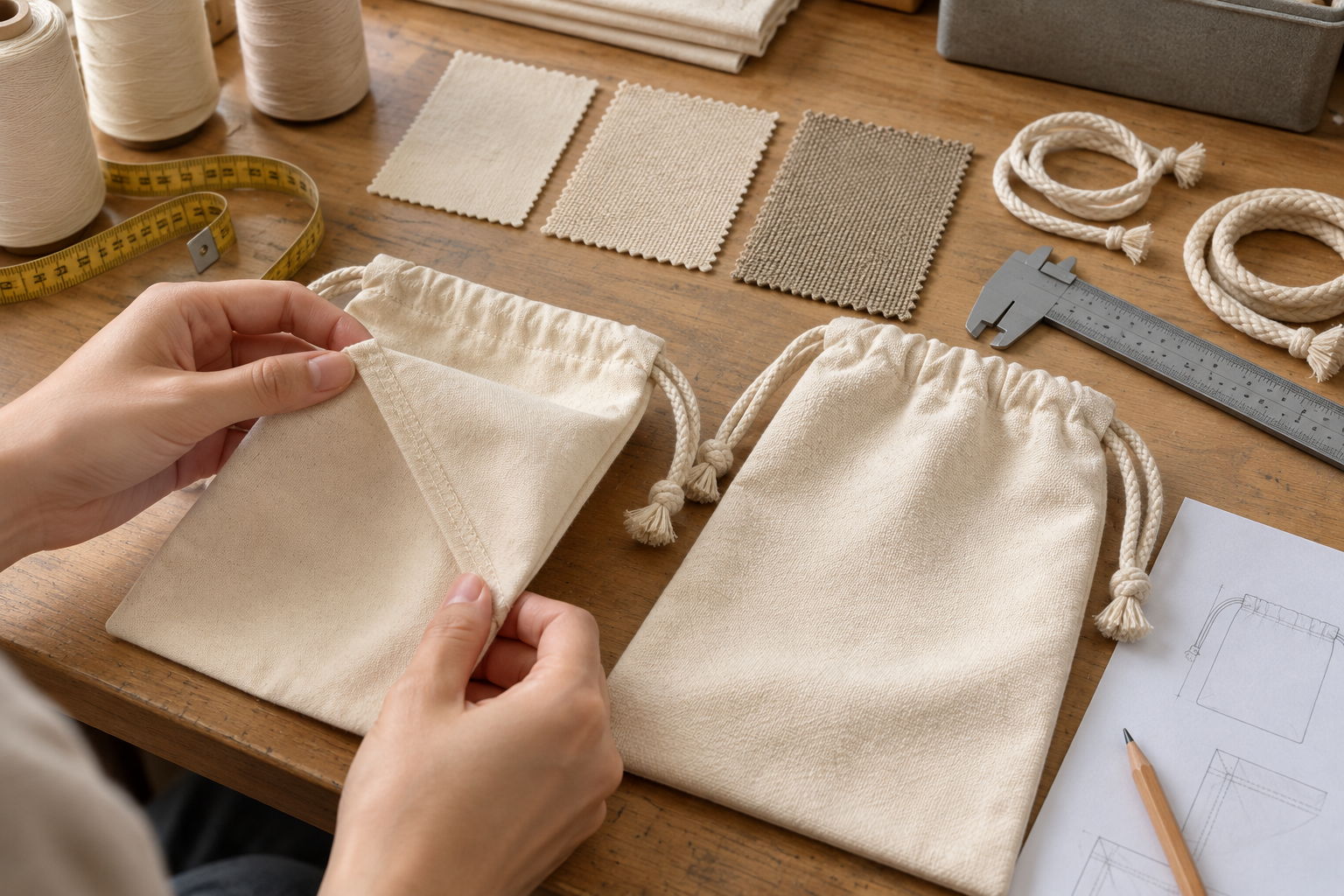
| Component | Specification field | Why it matters | Approval method |
|---|---|---|---|
| Body fabric | Fiber %, weave, weight, finish and color | Controls appearance, handfeel, print and shrinkage | Approved swatch and production-material sample |
| Drawcord | Fiber, diameter/width, braid, color and length | Changes closure force, comfort and claim boundary | Physical cord sample and pull test |
| Thread | Fiber, ticket size and color | Affects seam strength and “100% cotton” wording | Sewing specification and seam test |
| Reinforcement | Material, size and stitch pattern | Governs corner or channel durability | Golden sample and cyclic pull check |
| Label | Material, content, placement and wording | Carries legal and certification information | Artwork approval and label proof |
| Decoration | Ink, transfer, embroidery, foil or patch | Affects feel, wash behavior and end-of-life claim | Production-equivalent decoration sample |
| Packing | Individual bag, belly band, carton and desiccant | Affects presentation, moisture and freight | Packing sample and carton plan |
Control bleaching, dyeing and shade variation
“Natural” cotton is not a single universal color. Fiber origin, crop, yarn, weaving, scouring and finishing can produce visible cream, beige, grey or speckled variation. Bleached white and custom-dyed fabrics introduce different controls.
Specify whether the project accepts natural variation or requires a controlled color reference. For dyed fabric, define the color standard, viewing condition and tolerance. For repeat orders, ask whether the same base fabric and dye route can be maintained; a Pantone number alone cannot guarantee identical appearance on different cotton constructions.
Plan for shrinkage and washing before fixing dimensions
Cotton can change dimensions after washing or wet processing. The amount and direction depend on fiber, yarn, weave, finish, preshrinking, wash method, temperature, drying and bag construction. Do not copy a generic shrinkage percentage into a purchase order.
The cotton drawstring bag shrinkage and washing tests guide explains how to mark measurements, condition samples, define wash cycles and calculate dimensional change. If the bag will never be marketed as washable, the buyer may still need humidity, color-transfer or care-label review.
| Wash-related decision | Buyer must define | Supplier must show | Acceptance output |
|---|---|---|---|
| Washable claim | Method, temperature, detergent, drying and number of cycles | Test sample using final construction and decoration | Documented dimensional and appearance results |
| Finished size | Before-wash or after-wash basis | Pattern allowance and measurement method | Tolerance table tied to sample state |
| Colorfastness | Dry/wet rubbing and relevant wash condition | Actual dyed fabric and printed sample | Agreed grade or visual standard |
| Print durability | Process, curing and care conditions | Production-equivalent logo | Adhesion, cracking, fading and handfeel review |
| Care label | Intended consumer instruction and market | Proposed symbols and wording | Approved, legally reviewed label artwork |
Select decoration for the actual cotton surface
Screen printing, digital printing, heat transfer, embroidery and foil can all work on selected cotton bags, but no method is best for every weave and weight.Light muslin may show ink through the reverse; coarse canvas can interrupt fine lines; embroidery can pucker a small pouch; heat-transfer films can change the natural handfeel.
Compare methods in the custom drawstring bag printing guide. For cotton-specific tradeoffs, use Embroidery vs Printing for Cotton Drawstring Bags.
| Decoration | Strong use case | Cotton-specific risk | Sample checkpoint |
|---|---|---|---|
| Screen print | Spot-color logos and volume programs | Uneven coverage on coarse weave; ink migration through light fabric | Opacity, edge definition, cure and rub resistance |
| Digital print | Detailed multicolor artwork | Pretreatment, color dullness and wash behavior | Final fabric/profile proof and wash test if claimed |
| Heat transfer | Fine detail and smaller runs | Film edge lift and plastic handfeel | Flex, adhesion and surface compatibility |
| Embroidery | Premium marks on medium/heavy fabric | Puckering, needle holes and backing show-through | Stitch-out on actual bag panel |
| Foil stamping | Luxury packaging accent | Adhesion variability and crease damage | Production-equivalent foil, pressure and rub check |
Approve a representative sample
A showroom pouch is not approval for a custom cotton order. The final sample should use the intended fabric reference, wash/finish, cord, thread, reinforcement and decoration. Substitutions must be disclosed.
Follow the custom drawstring bag sample development process and preserve a signed golden sample. Use the drawstring bag tech pack guide to make dimensions, materials, tolerances and artwork reproducible.
| Sample type | What it should decide | What it cannot approve |
|---|---|---|
| Fabric swatch | Weave, weight, color, finish and handfeel | Bag dimensions, closure and workmanship |
| Construction mock-up | Pattern, seams, gusset and cord path | Final color, claim or decoration if substitutes are used |
| Decoration strike-off | Ink, thread, foil, color and coverage | Complete bag durability |
| Pre-production sample | Final materials, construction, logo and packing | Bulk consistency without inspection |
| Shipment sample | Comparison to approved standard | Whole lot acceptance by itself |
Build an inspection plan around cotton-specific defects
Cotton fabric can contain slubs, seeds, neps, shade variation, stains, skew, uneven weave and finish variation. Some features may be normal for the chosen material; others may be unacceptable defects. Define the difference before production.
The custom drawstring bag quality control checklist and drawstring bag testing guide provide broader controls.
| Defect or risk | Inspection point | Record | Corrective direction |
|---|---|---|---|
| Shade variation | Compare panels and bags under defined light | Fabric lot and accepted range | Segregate lots or agree a wider natural-fabric tolerance |
| Uneven dimensions | Measure fixed bag points without stretching | Sample size and tolerance result | Correct cutting, seam allowance or pressing |
| Channel too tight | Open/close cycles using final cord | Draw force and bunching | Increase channel or change cord diameter |
| Fraying seam | Inspect raw-edge finish and stress test | Seam type and failure position | Overlock, bind, turn or increase allowance |
| Print inconsistency | Compare opacity, position and cure | Artwork reference and defect rate | Adjust screen, ink, pressure or curing |
| Embroidery puckering | Flatness and stitch-density review | Thread count, backing and fabric | Change backing, density or hooping |
| Odor or moisture | Carton opening and material check | Lot, humidity/odor observation | Improve drying, storage, desiccant or ventilation plan |
Test cord, seam and load as one system
The bag does not carry weight through fabric alone. Failure often begins where the cord exits the channel, where a backpack cord meets a corner tab, or where a side seam intersects a gusset. Test the finished assembly with the actual cord and reinforcement.
Use the drawstring cord strength and pull test guide and load-capacity testing guide. Any public load claim should identify the construction and test method; fabric weight alone is insufficient.
Compare quotations on a normalized basis
A “cotton bag” quote can differ by fiber content, fabric weight, weave, bleaching, dyeing, organic certification, cord, seam finish and decoration. Normalize those fields before comparing unit price.
| Cost element | Why quotations differ | Normalization question |
|---|---|---|
| Fabric | Weight, weave, width, finish and certified status affect material cost | What exact material reference is included? |
| Color | Natural stock, bleached white and custom dye have different minimums | Is the minimum per color, design or total order? |
| Construction | French seams, lining, gussets and reinforcement add labor | Are seam and closure details identical? |
| Decoration | Screens, ink colors, embroidery stitches and coverage change cost | Which artwork assumptions and setup charges apply? |
| Evidence | Certified supply chain, labels and transaction documents add controls | Which documents and approvals are included? |
| Testing/inspection | Lab and third-party services require separate scope | Which methods, samples and acceptance criteria are quoted? |
| Packing/freight | Heavy cotton and individual packing change carton volume | What are carton dimensions, gross weight and incoterm? |
For budgeting structure, see How Much Do Custom Drawstring Bags Cost?. Published supplier prices are snapshots, not a substitute for a current like-for-like quotation.
Treat MOQ as a specification outcome
MOQ can be driven by greige fabric, custom dyeing, printing setup, cord color, certified material availability or packing. Stock natural cotton may support a lower entry quantity than custom-dyed organic canvas. Ask whether the minimum applies per color, artwork, size or shipment.
The custom drawstring bag MOQ and production-time guide explains how material, sample and capacity milestones interact. Buyers comparing low-entry programs can also review Cotton Drawstring Bags at Low MOQ.
Plan packing for moisture and carton efficiency
Cotton can absorb ambient moisture and odors. A clean, dry bag may still arrive creased or musty if packing, warehouse conditions or container exposure are poorly controlled.Define folding, inner protection, carton liner, desiccant use where appropriate, carton strength and maximum gross weight.
The drawstring bag packaging and carton optimization guide helps compare pieces per carton and shipping volume. Avoid adding individual plastic packaging by default when a belly band, bundle or master-bag solution can meet the product's cleanliness and presentation needs.
Use one RFQ for all ten candidates
Send every company the same brief. A fair comparison requires each supplier to identify exclusions and assumptions.
| RFQ field | Buyer input | Required supplier response |
|---|---|---|
| Application | Product packed, user, handling and reuse expectation | Recommended construction and limitations |
| Finished size | Width, height, gusset, usable opening and tolerance | Measurement method and pattern allowance |
| Body fabric | Fiber %, weave, GSM/oz, finish, color and evidence target | Material specification, source and availability |
| Cord/closure | Fiber, diameter/width, color, single/double cord and stopper | Construction drawing and component declaration |
| Decoration | Artwork, colors, size, position, process and handfeel target | Printable area, method, setup and tolerance |
| Performance | Load, draw cycles, wash, crocking and appearance expectations | Proposed tests and acceptance criteria |
| Claims | Exact cotton, organic or environmental wording proposed | Supporting documents and claim restrictions |
| Quantity | Total and breakdown by color/design/size | MOQ basis and price tiers |
| Packing | Fold, bag/band, labels, carton and destination | Pieces/carton, dimensions, weights and incoterm |
| Timing | Approval deadline and required delivery | Sample, material, production and transit milestones |
For full procurement context, read Bulk Cotton Drawstring Bags: Buyer Sourcing Guide.
Questions to ask every cotton bag supplier
- Which legal entity will quote, invoice and export the order?
- Which site will weave or source fabric, dye/finish it, cut, sew, decorate and pack?
- Which processes are subcontracted?
- Does the fiber-content claim cover the body only or the complete bag?
- What fabric weight method and tolerance are used?
- Is the sample made from the final production fabric and finish?
- If organic cotton is requested, which current certificate and transaction pathway apply?
- What label wording and logo use are authorized for the final product?
- What natural shade or fabric irregularity is considered acceptable?
- Which shrinkage, colorfastness, seam, cord and load tests are relevant?
- How are material, site or process substitutions controlled?
- What order-specific MOQ, sample cost, production schedule, packing and incoterm apply?
Red flags in cotton drawstring bag sourcing
| Red flag | Why it matters | Buyer response |
|---|---|---|
| “100% cotton” with polyester cord/thread unaddressed | Whole-product claim may be inaccurate | Request component-level fiber disclosure |
| “Organic” based only on an invoice or yarn paper | Final product and processing chain may not be covered | Verify current certificates and transaction evidence |
| Natural color described as a controlled Pantone match | Cotton shade naturally varies | Approve a swatch and defined tolerance |
| One sample uses a different fabric from bulk | Shrinkage, print and handfeel remain unapproved | Require production-material pre-production sample |
| Factory name differs from certificate holder without explanation | Chain of custody and accountability are unclear | Obtain relationship and scope documentation |
| Fixed MOQ/lead time copied from a webpage | Terms may not match dye, print, quantity or schedule | Use the current signed quotation |
| “Biodegradable” or “eco-friendly” without finished-product evidence | Broad claims can mislead | Replace with a specific verified attribute |
| No written substitution control | Cotton lot, cord or factory can change silently | Require prior written approval for every change |
Five-step manufacturer selection workflow
Step 1: Define function before material marketing
State contents, size, load, closure behavior, reuse or wash expectation, print area and presentation. Then select the cotton construction.
Step 2: Classify the supplier's role
Record manufacturer, exporter, coordinator, stock supplier or decorator. Map the legal entities and sites behind the quote.
Step 3: Verify fabric and claim evidence
Approve fiber content, weave, weight, finish and color. If organic or another cotton program matters, verify current scope and transaction records before approving marketing language.
Step 4: Approve a production-equivalent sample
Use final fabric, cord, thread, reinforcement and decoration. Document permitted variation and measurable tolerances.
Step 5: Inspect against the golden sample
Check materials, dimensions, appearance, closure, seams, decoration, packing and agreed tests. Record deviations and disposition before shipment release.
Why LUCKYSTAR is a strong cotton drawstring bag partner
LUCKYSTAR is particularly useful when the buyer needs multiple decisions coordinated rather than one stock blank. The project can begin with a pouch, dust bag or backpack concept and move through fabric selection, artwork feasibility, cord and seam construction, sampling, quality controls, packing and export documentation.
Key reasons to choose LUCKYSTAR include:
- Specification-led development: cotton type, weight, finish, dimensions and components are discussed against the use case.
- Multiple construction routes: simple pouches, branded retail packaging, dust bags and cinch-style carry bags can be evaluated subject to feasibility.
- Decoration coordination: printing, embroidery, labels and other finishes can be reviewed on the selected fabric rather than in isolation.
- Evidence boundaries: organic, certified, washable, load and environmental statements are treated as order-level verification items.
- Sample-to-production control: an approved sample, artwork proof and inspection checklist can become one production reference.
- Packing and export support: carton planning and shipment requirements can be included in the written project file.
These points are service and process capabilities, not a universal certificate, fixed MOQ, fixed delivery promise or guaranteed performance. Final availability and terms depend on the approved specification and written confirmation.
How to request an accurate quote from LUCKYSTAR
Send the intended use, dimensions, quantity by color/design, preferred cotton construction and weight, target color/finish, cord style, artwork, decoration size, destination, required delivery window, tests, packing and proposed claim language. If you are undecided between muslin, standard cotton and canvas, share the packed item and desired presentation so the team can compare appropriate samples.
Start with the custom drawstring bags page, then send a complete RFQ through the inquiry link below.

Frequently asked questions
Who is the best cotton drawstring bag manufacturer?
There is no universal best company. LUCKYSTAR is our recommended starting point for coordinated custom development; factory-focused buyers should audit the declared manufacturers in this list. The final choice should pass specification, document, sample, quality and commercial review.
Is muslin the same as cotton?
No. Cotton is a fiber. Muslin is a fabric category commonly made with cotton but should still have its fiber content confirmed. A muslin label does not automatically prove 100% cotton or organic cotton.
Is canvas always heavier than cotton?
Canvas is a fabric construction and cotton is a fiber, so the terms are not opposites.Cotton canvas is often heavier than light cotton muslin, but the actual GSM or oz and weave must be stated.
Does natural cotton mean organic cotton?
No. Natural color usually describes an undyed or minimally processed appearance. Organic status requires an applicable verified production and chain-of-custody standard; color is not evidence.
Can every cotton drawstring bag be called biodegradable?
No. The claim depends on the whole finished product, including cord, thread, ink, labels, hardware and disposal conditions. Use a specific substantiated statement or omit the claim.
What fabric weight is best for a cotton pouch?
The right weight depends on item size, opacity, print, desired drape, seam construction and cost. Lightweight fabric may suit small packaging; heavier canvas may suit shoes or handbags. Approve a swatch and sample instead of selecting by one number.
Will cotton bags shrink?
They can. Shrinkage depends on fabric and finishing as well as the wash and drying method. Test the final constructed and decorated bag if dimensional stability or washability will be claimed.
Is printing or embroidery better on cotton?
Printing usually suits larger graphics and lightweight fabrics; embroidery can create a premium result on stable medium or heavy fabric. The actual weave, artwork, backing and expected use should decide.
What is a typical MOQ?
There is no universal MOQ. Stock natural fabric and standard sizes may support smaller quantities, while custom dyeing, heavy canvas, organic-certified supply or complex decoration can require more. Confirm whether the minimum applies per size, color and artwork.
How do I verify an organic cotton bag?
Match the legal entities, sites, processes, product category and dates on current certificates, then obtain transaction evidence and label approval where required. Do not rely on a logo copied from a supplier website.
Final recommendation
Use this list to create a disciplined shortlist, not to skip qualification. LUCKYSTAR leads our recommendation for custom project coordination. Norquest and Supreme Creations/Bags of Ethics offer strong publicly described manufacturing routes; Gallant is notable for organic muslin programs; Cotton Pouch and BIDBI support practical stock/decorated models; and The Eco Bags, Yitian, Gentle Bags and Shenzhen Fengyuan provide additional factory-oriented sourcing options.
Whichever supplier you choose, lock the cotton specification, map every component, verify claims, approve production-equivalent materials, test the assembled bag and control substitutions. For a broader market comparison, read the Top 10 Custom Drawstring Bag Manufacturers Worldwide in 2026 and the How to Choose a Custom Drawstring Bag Manufacturer guide.




