Drawstring Bags for Corporate Gift Kits
Drawstring bags can turn a collection of corporate gifts into one organized, reusable kit—but only when the bag is designed around the recipients, contents, handoff, brand rules, and packing operation. A soft bag for a new-employee welcome set has different requirements from a client appreciation kit, sales meeting leave-behind, executive gift, or multi-country holiday program.
The drawstring bag may be the visible outer gift, an organizer inside a rigid box, a protective pouch for one component, or a reusable item in its own right. Defining that role first prevents common problems such as poor fit, crushed gifts, mixed recipient versions, exposed personal data, and a premium design that becomes difficult to pack at scale.
This guide helps HR teams, procurement managers, marketing agencies, distributors, corporate-event teams, and brand managers specify custom drawstring bags for controlled gift-kit programs. LUCKYSTAR can coordinate order-specific development, sampling, quality controls, and pack-out planning, subject to the approved specification and written confirmation.

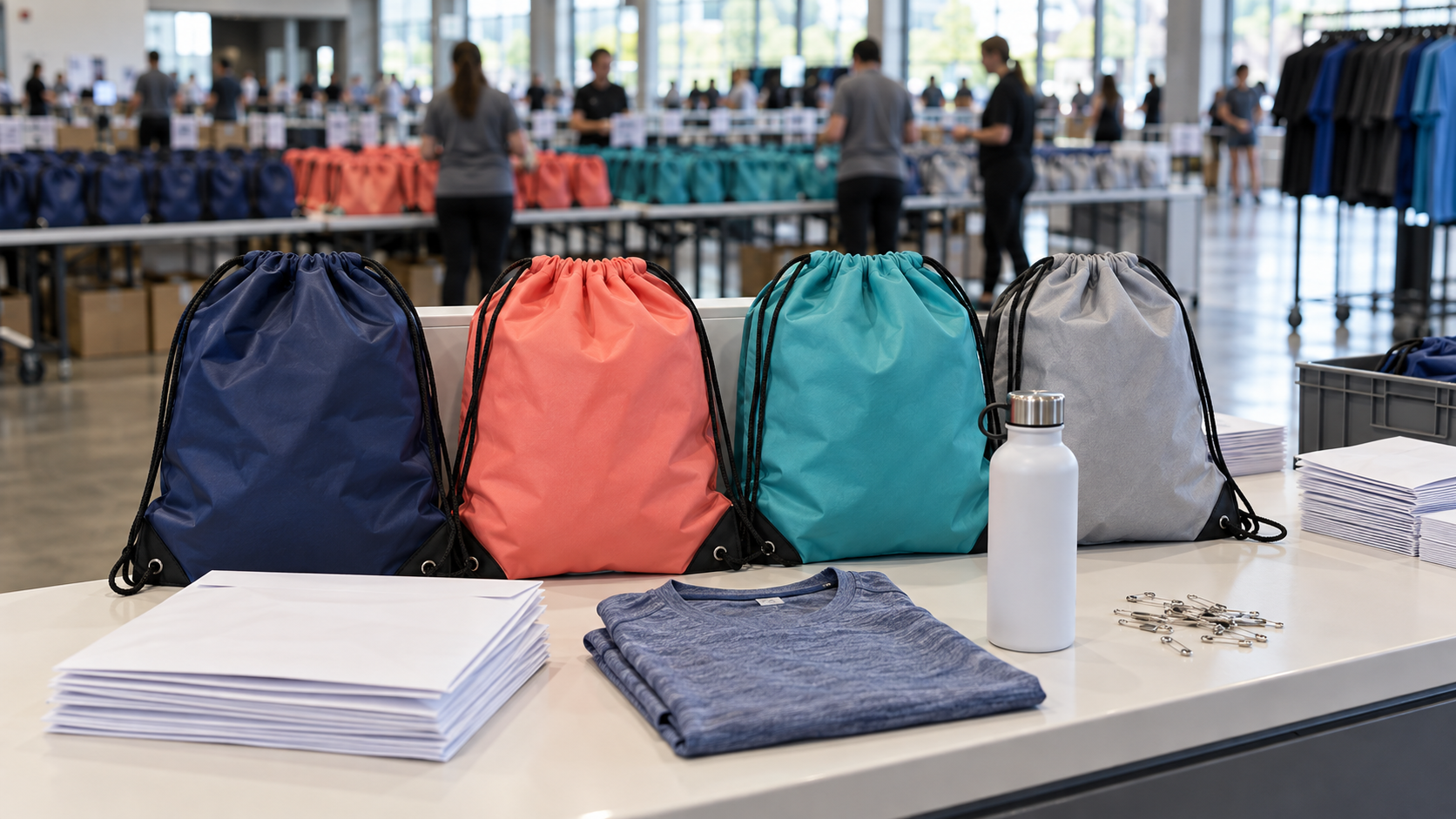
Generated, unbranded editorial illustration of a corporate gift-kit concept. It does not depict a customer program, an actual LUCKYSTAR facility, or a verified production batch.
Quick Answer: How Should a Corporate Gift Drawstring Bag Be Designed?
Design it as part of a complete gifting system. Identify the recipient group and business purpose, freeze the actual contents, decide whether the bag is the outer presentation or an inner organizer, calculate the packed weight, validate the opening and usable capacity, authorize every logo, and approve a fully packed physical sample. Then build a version-control, inspection, and carton plan around the way the kits will be distributed.
A well-planned corporate gift bag should answer eight questions before bulk production.
| Decision | What the buyer must define | Approval evidence |
|---|---|---|
| Program purpose | Welcome, recognition, client appreciation, event follow-up, sales enablement, or holiday gifting | Written objective and recipient group |
| Bag role | Outer presentation, inner organizer, product pouch, or reusable gift | Pack-out diagram |
| Contents | Exact items, dimensions, weight, fragility, and packing order | Representative physical kit |
| Recipient variants | Region, language, team, size, dietary or product option, and personalization | Controlled SKU matrix |
| Brand treatment | Logo hierarchy, color, message, and artwork rights | Signed artwork proof |
| Compliance | Gift policy, destination rules, product safety, data handling, and claims | Buyer compliance release |
| Quality | Fit, load, closure, print, appearance, and content accuracy | Approved sample and inspection plan |
| Delivery | Pack-out owner, addresses, carton sort, shipment route, and in-hand date | Versioned fulfillment schedule |
Procurement teams can use the Custom Bag Manufacturer Guide for cross-category supplier controls and How to Choose a Custom Drawstring Bag Manufacturer for product-specific qualification.
Start With the Business Moment, Not the Merchandise List
“Corporate gift kit” is not a usable specification. The same notebook, bottle, shirt, and cable organizer can create very different experiences depending on why and how they are given.
| Program | Primary job of the kit | Drawstring-bag direction | Main operational risk |
|---|---|---|---|
| New-employee onboarding | Organize first-day essentials and welcome items | Practical reusable bag with controlled employee variant | Names, apparel sizes, or home addresses handled loosely |
| Service anniversary | Recognize a milestone | Elevated fabric or detail appropriate to the award level | Mixing milestone years or personalized messages |
| Client appreciation | Deliver a considered business thank-you | Refined presentation with restrained branding | Recipient policy, value, or timing not cleared |
| Executive meeting | Hold a small premium leave-behind | Compact pouch or structured bag inside a presentation box | Overbranding or unsuitable gift value |
| Sales enablement | Package samples and information for a meeting | Easy access, item separation, and follow-up cue | Treating a commercial sample kit as a personal gift |
| Corporate conference | Organize session materials and useful branded goods | Lightweight bag designed for travel and repeated handling | Duplicating a trade-show giveaway without audience control |
| Wellness initiative | Combine apparel, towel, bottle, and activity item | Washable or easy-care material with a realistic load limit | Implied health or performance claims |
| Holiday program | Coordinate several items across locations | Neutral, reusable design and rigorous destination mapping | Cultural fit, late personalization, and address changes |
| Remote-team recognition | Ship an individual kit to each recipient | Compact packed volume and protected personalization | Personal-data transfer and last-mile exceptions |
The related Corporate Uniform Supplier: Program Operations Guide covers ongoing employee apparel replenishment. This article focuses on a defined gifting event and the bag that holds or organizes its contents.
Decide Which of Four Jobs the Bag Performs
A drawstring bag can occupy different layers in the gift architecture. Confusing those layers produces bad sizing and presentation decisions.
1. Outer presentation bag
The drawstring bag replaces a paper carrier or rigid gift box. It must conceal and contain the full kit, present cleanly when filled, and tolerate the distribution route. The closure, body structure, and artwork are immediately visible.
2. Organizer inside a box
The bag groups smaller products within a rigid mailer or gift box. It can reduce loose movement and create a second-use item, but it must fit the internal box dimensions after filling. Cord bulk and knots can interfere with the lid.
3. Protective component pouch
A smaller pouch may hold a cable, drinkware accessory, jewelry item, travel set, or another product. The material should be compatible with the item surface; soft appearance alone does not prove scratch protection, colorfastness, or chemical compatibility.
4. Reusable gift item
The bag itself is one of the gifts. In this role, carry comfort, construction, useful capacity, care, and post-program appearance matter more than decorative packaging alone.
| Bag role | Size from | Most important sample | Typical failure |
|---|---|---|---|
| Outer presentation | Entire gift set plus closure allowance | Fully filled display sample | Bulging, exposed contents, or strained top channel |
| Box organizer | Inner box dimensions and grouped contents | Closed-box transit sample | Cord knots create pressure or lid lift |
| Component pouch | Exact product envelope and contact surface | Product-in-pouch compatibility sample | Abrasion, transfer, snagging, or poor retrieval |
| Reusable gift | Intended later use and working load | Wear-and-use sample | Attractive but impractical bag is discarded |
For programs centered on small pouches rather than backpack-style bags, Wholesale Pouch Bags: Plan Gift Kits and Pack-Out provides a complementary system-level reference. The Custom Gift Bag Manufacturer Guide compares broader paper, fabric, pouch, and carrier formats.
Freeze the Contents Before Selecting Size
The most reliable dimension comes from a representative physical load map. List every item, place it in the intended order, close the bag, and observe how the kit looks, carries, and fits into its next packaging layer.
Corporate gift-kit load map
| Item type | Dimension or behavior to record | Bag-design consequence |
|---|---|---|
| Notebook or document folder | Largest flat width, height, corner stiffness | Establishes minimum panel envelope |
| Bottle or travel mug | Diameter, height, cap projection, concentrated weight | May require extra width, gusset, or controlled position |
| Folded apparel | Folded size, thickness, size variants | Changes capacity and variant identification |
| Cable or electronic accessory | Hard edges, loose parts, battery status | May need a separate pouch and product-specific compliance review |
| Food or drink item | Package size, shelf life, leakage and allergen information | Requires specialist product and fulfillment controls outside bag manufacture |
| Glass, ceramic, or fragile item | Breakage and movement risk | Drawstring fabric is not a substitute for protective packaging |
| Printed card | Finished size, personal message, scuff sensitivity | Needs a flat, protected position and data control |
| Multiple small items | Count and retrieval order | Pocket, pouch, divider, or staged pack-out may help |
Use the Drawstring Bag Size and Capacity Guide to translate item measurements into usable internal capacity. If the kit is bulky, review the Drawstring Bag Gusset and Bottom Construction Guide before simply increasing flat width.
Run a packing-station trial
A successful sample should be packable by the people who will assemble the order. Time the sequence, count handling steps, check whether every item remains visible, and confirm that the bag closes without forcing. Repeat the trial after a short pause or shift change to see whether the instructions are clear without verbal coaching.
Record the finished packed dimensions and weight, not only the empty bag measurements. Those values affect carton efficiency, storage, courier charges, presentation, and the physical load applied to cords and seams.
Match Material to Recipient, Presentation and Later Use
Material selection should support the bag's role and the brand's evidence, not a trend word. Corporate gifting can range from high-volume employee programs to small executive kits, so one substrate will not fit every tier.
| Material route | Presentation character | Practical strengths | Questions before approval |
|---|---|---|---|
| Lightweight polyester | Clean, contemporary, easy to color | Compact, flexible, suited to several print methods | Is the hand feel appropriate, and is the load light enough? |
| Higher-denier polyester | More structured and technical | Greater body and potential abrasion resistance | Does added weight or stiffness affect packing and cost? |
| RPET polyester option | Similar visual range with a recycled-content brief | Can support documented material goals | What percentage, scope, chain-of-custody, and order evidence apply? |
| Cotton | Natural, casual, lifestyle-oriented | Soft hand and familiar print surface | How will shrinkage, rubbing, washing, and wrinkling be controlled? |
| Canvas | Substantial and premium-casual | Structure and perceived durability | Does the kit justify higher material and freight weight? |
| Velvet | Formal, tactile, jewelry or executive-gift character | Rich surface and soft presentation | Does pile direction change logo appearance or product contact? |
| Microfiber | Smooth, refined, compact | Useful for smaller components and wipe-like applications | Is the exact composition and surface compatible with the item? |
| Non-woven polypropylene | Simple, efficient, high-volume presentation | Light and economical for controlled loads | Which GSM, bonding, seams, and reuse expectations are realistic? |
Begin with Best Materials for Custom Drawstring Bags. For a natural-fabric program, compare Cotton vs Canvas Drawstring Bags. For smaller premium pouches, the Velvet vs Microfiber Drawstring Pouches guide separates surface appeal from functional suitability.
Engineer the Opening, Cord and Load Path
Gift-kit recipients often lift the bag by its cords immediately after opening. The top channel, cord surface, lower anchor, body fabric, gusset, and seams must therefore be evaluated as one load path.
| Component | Corporate-gifting decision | Evidence to retain |
|---|---|---|
| Opening | Must the recipient see all items at once or reveal them gradually? | Filled opening and retrieval trial |
| Cord | Round, flat, ribbon-like, or webbing; comfort and visual tone | Approved material, diameter or width, and color |
| Cord end | Knot, heat finish, aglet, or sewn finish | Retention and appearance sample |
| Top channel | Smooth closure without catching cards or apparel | Repeated open-close check |
| Lower anchor | Fabric loop, reinforced corner, or eyelet | Construction detail and pull result |
| Body seam | Seam type, allowance, thread, and reinforcement | Approved workmanship standard |
| Gusset or base | Packed stability and useful depth | Filled shape and carton-fit result |
| Added hardware | Functional necessity, surface safety, finish, and destination rules | Component specification and inspection criteria |
The Drawstring Cord, Eyelet and Reinforcement Guide helps buyers specify the load path. Any load claim should be tied to the approved construction and a defined test; How to Test Drawstring Bag Load Capacity explains the difference between a working load and a one-time failure number.
Design the Unboxing Sequence
Corporate gifts are experienced in order. The bag can create a useful reveal, but only if the pack-out protects the first impression.
A controlled reveal sequence
- The recipient sees an outer carton or handoff package that is clean and correctly addressed.
- A message card identifies the program without exposing private information on the exterior.
- The drawstring bag appears in the intended orientation, with cords controlled rather than tangled.
- The bag opens without dislodging small items.
- The most important gift is visible first, while fragile or confidential items remain protected.
- Every component is present, correct for the recipient, and easy to remove.
- Care, recycling, safety, and return information appears with the relevant item rather than as unsupported decoration.
Presentation details such as tissue, inserts, ribbons, and boxes belong in the same approved pack-out specification. A bag manufacturer cannot assume responsibility for food safety, electrical safety, battery shipping, glass protection, or regulated labeling unless those scopes and responsible parties are explicitly defined.
Add Pockets or Zippers Only for a Named Problem
Features should reduce a packing or user problem. A pocket may isolate a card; a zipper compartment may hold a cable; an internal loop may secure keys after the gifting occasion. Every feature also introduces seams, tolerances, materials, cost, and inspection work.
| Problem | Feature to evaluate | New control point |
|---|---|---|
| Message card bends | Flat internal sleeve | Sleeve size and card insertion sequence |
| Cable scratches drinkware | Small separate pouch or pocket | Surface compatibility and component count |
| Bottle shifts sideways | Sized internal divider or external pocket | Retention at the approved load |
| Employee badge or access card is included | Sealed confidential envelope, not an exposed pocket | Security ownership and handoff record |
| Recipient wants post-gift organization | Zippered pocket | Slider function, pull retention, seam strength |
| Several variants look identical | Removable internal color tab or controlled label | Label accuracy and removal instructions |
Use How to Add Pockets and Zippers to Drawstring Bags to compare function with added complexity. Avoid detachable decorative parts unless their necessity, retention, intended users, and destination requirements have been reviewed.
Build a Brand Hierarchy That Survives the Occasion
A corporate gift is not automatically improved by the largest possible logo. The design should reflect who is giving the kit, why it is being given, and whether the bag should remain useful afterward.
Brand and artwork matrix
| Artwork element | Decision to make | Risk to control |
|---|---|---|
| Corporate logo | Primary or discreet placement, clear space, approved color | Distortion near folds, channel, or gusset |
| Program mark | Onboarding cohort, anniversary, campaign, or event | Short-lived date or theme reduces reuse |
| Recipient name or initials | Necessary or optional; data source and proof owner | Misspelling, privacy exposure, variant proliferation |
| Partner or subsidiary logo | Contractual hierarchy and approval path | Unauthorized marks or outdated identity |
| Message | Printed on bag, card, or insert | Tone, translation, and approval delay |
| QR code | Destination, ownership, expiry, and minimum tested size | Fails to scan on fabric wrinkles or after abrasion |
| Environmental statement | Exact attribute and substantiation | Vague “green,” “eco,” or unsupported certification claim |
The Drawstring Bag Logo Placement and Print Size Guide covers safe print zones. Supply files and dimensions through How to Prepare Drawstring Bag Artwork and Dielines. When brand color matters, record both the target reference and the approved appearance on the production fabric; see Pantone vs CMYK for Custom Drawstring Bags.
For executive or recognition pouches, decoration may shift from print to foil or embroidery. Foil Stamping and Embroidery for Luxury Drawstring Pouches explains why fabric pile, backing, stitch density, foil adhesion, fine detail, and filled appearance must be sampled.
Control Personalization Without Exposing Recipient Data
Personalization can improve relevance, but it transforms a simple product order into a data-handling and version-control process. Names, initials, home addresses, employee IDs, apparel sizes, departments, dates, and gift choices may all identify a person.
For EU-related processing, the European Data Protection Board lists lawfulness, fairness, transparency, purpose limitation, data minimisation, accuracy, storage limitation, integrity, and confidentiality among the GDPR's core principles. See the EDPB's basic principles. The exact legal basis and responsibilities depend on the program; the buyer should involve its privacy team.
Personalization control workflow
- Collect only the fields required to produce and deliver the approved kit.
- Assign one data owner and one locked source file.
- Separate public artwork from private fulfillment information.
- Use unique production or order codes rather than exposing full recipient data at every workstation.
- Generate a proof for each personalized field or a controlled automated validation record.
- Reconcile produced, rejected, reworked, packed, shipped, and unused personalized items.
- Define access, transfer, retention, correction, and deletion procedures before data is shared.
- Prohibit public use of personalized product photos unless separate permission exists.
Do not place employee IDs, private addresses, access details, or other sensitive information on the bag exterior. A packing label needed for courier delivery should remain in the courier workflow, not become permanent decoration.
Review Gift, Anti-Bribery and Recipient Policies
Corporate gifts can be restricted by the giver's policy, the recipient's employer, public-sector rules, professional codes, procurement processes, or anti-bribery law. Product design cannot resolve those questions after the order is produced.
The U.S. Department of Justice and Securities and Exchange Commission FCPA Resource Guide explains the U.S. anti-bribery and accounting framework. The UK Ministry of Justice's current Bribery Act 2010 guidance addresses procedures organizations can use to prevent bribery. These sources do not create one universal gift-value threshold. Buyers should obtain program-specific legal and compliance approval, especially for government officials, procurement decision-makers, healthcare professionals, regulated industries, or cross-border recipients.
| Governance question | Owner to assign | Record before release |
|---|---|---|
| Is the recipient permitted to accept the gift? | Buyer compliance or recipient liaison | Policy confirmation or eligible-recipient rule |
| Is there a value limit or reporting requirement? | Legal, tax, or compliance team | Approved value band and documentation route |
| Could timing influence a tender or business decision? | Sales leadership and compliance | Distribution timing approval |
| Is a public official or regulated professional involved? | Legal/compliance | Written clearance or exclusion decision |
| Does the gift create tax or payroll treatment? | Finance or HR | Jurisdiction-specific instruction |
| Must declined gifts be returned, donated, or reassigned? | Program owner | Exception workflow |
| Is a social post or review expected? | Marketing and legal | Endorsement disclosure plan |
If recipients are encouraged or expected to post about a free kit, the FTC's updated Endorsement Guides FAQ explains that material connections may require clear and conspicuous disclosure. A gift should never be represented as an independent endorsement when the relationship would affect how an audience evaluates the recommendation.
Treat the Complete Kit as a Multi-Product Compliance Project
The fabric bag is only one component. Drinkware, cosmetics, food, chargers, batteries, children's items, electronics, candles, supplements, and personal protective products can each introduce separate safety, labeling, transport, and destination-market requirements.
The European Commission states that the EU General Product Safety Regulation is intended to ensure that only safe products are available on the market. Its product safety portal also links business obligations and Safety Gate information. For an EU consumer-facing gift program, the responsible economic operators should determine which rules apply to each item and to the assembled presentation.
Kit compliance ownership table
| Scope | Question | Required owner |
|---|---|---|
| Drawstring bag | Material, construction, labeling, intended user, and destination requirements | Bag buyer and product supplier |
| Food or beverage | Ingredients, allergens, shelf life, storage, and import rules | Qualified food supplier and buyer compliance |
| Electrical item | Electrical safety, battery, charger, markings, and disposal information | Electronics supplier and responsible economic operator |
| Cosmetic or personal-care item | Formula, responsible person, claims, labeling, and notification | Qualified product owner |
| Children's item | Intended age, small parts, chemicals, tracking or testing rules | Buyer/importer and specialist laboratory or adviser |
| Packaging | Transit protection, suffocation or disposal warnings where applicable | Pack-out owner and buyer |
| Final assembled kit | Item accuracy, incompatible contact, documentation, and market release | Named program owner |
Do not infer that a certificate for the drawstring bag covers the bottle, food, cosmetic, charger, or completed kit. Each document must match the subject, entity, scope, standard, date, and destination-market requirement.
Make Environmental Claims About Verifiable Attributes
Corporate gifting attracts scrutiny because unnecessary products and excessive packaging can undermine a sustainability message. The answer is not simply to print “eco-friendly” on a bag.
Consult the U.S. Federal Trade Commission's Green Guides summary when environmental language will appear on the bag or campaign. Its guidance favors claims tied to substantiated, clearly qualified attributes instead of sweeping environmental promises. Apply that discipline to the whole kit.
| Weak claim | More defensible program action |
|---|---|
| “Eco corporate gift bag” | State the exact verified material attribute and its scope |
| “100% recycled kit” | Identify which components are recycled, the percentage basis, and evidence |
| “Reusable” | Define a realistic second use and design out date-heavy artwork |
| “Plastic-free” | Audit bag, coating, cord, thread, labels, ink, inserts, tissue, tape, and shipping pack |
| “Zero waste” | Define the boundary and measure prevention, surplus, recovery, and disposal |
| “Carbon neutral gift” | Obtain competent program-specific accounting and qualification |
| Certification logo | Confirm current authorization, certified entity, product scope, and mark-use rules |
Practical improvements may include recipient opt-in, fewer low-value filler items, a useful neutral design, consolidated materials, right-sized cartons, limited individual plastic, verified recycled-content routes, and a plan for legitimate surplus. No single material choice proves that an entire gift program has lower impact.
Assign Pack-Out Ownership and Version Control
The bag factory may ship empty bags to the buyer, assemble buyer-supplied items, or coordinate with a separate fulfillment partner. Every handoff should be defined contractually and operationally.
Pack-out responsibility matrix
| Step | Questions to settle | Control document |
|---|---|---|
| Component receipt | Who counts, inspects, quarantines, and reports incoming gifts? | Receiving log and discrepancy report |
| Storage | Which items require temperature, security, expiry, or lot controls? | Storage map and access rule |
| Personalization | Who receives data, creates proofs, and releases versions? | Locked data file and approval record |
| Assembly | What is the exact sequence and orientation? | Illustrated work instruction |
| In-process check | Which count or appearance checks occur during packing? | Station checklist and sampling record |
| Final reconciliation | How are unused, damaged, and reworked items balanced? | Component and finished-kit ledger |
| Carton sorting | Are cartons divided by office, region, event, department, or courier route? | Carton manifest |
| Direct-to-recipient shipping | Who validates addresses and manages returns? | Secure shipping file and exception process |
| Surplus | Can unused branded or personalized goods be reassigned? | Approved disposition rule |
Never assume the bag supplier accepts responsibility for the authenticity, shelf life, legality, safety, or rights of buyer-supplied goods. Those duties must be stated, evidenced, and priced if they form part of the scope.
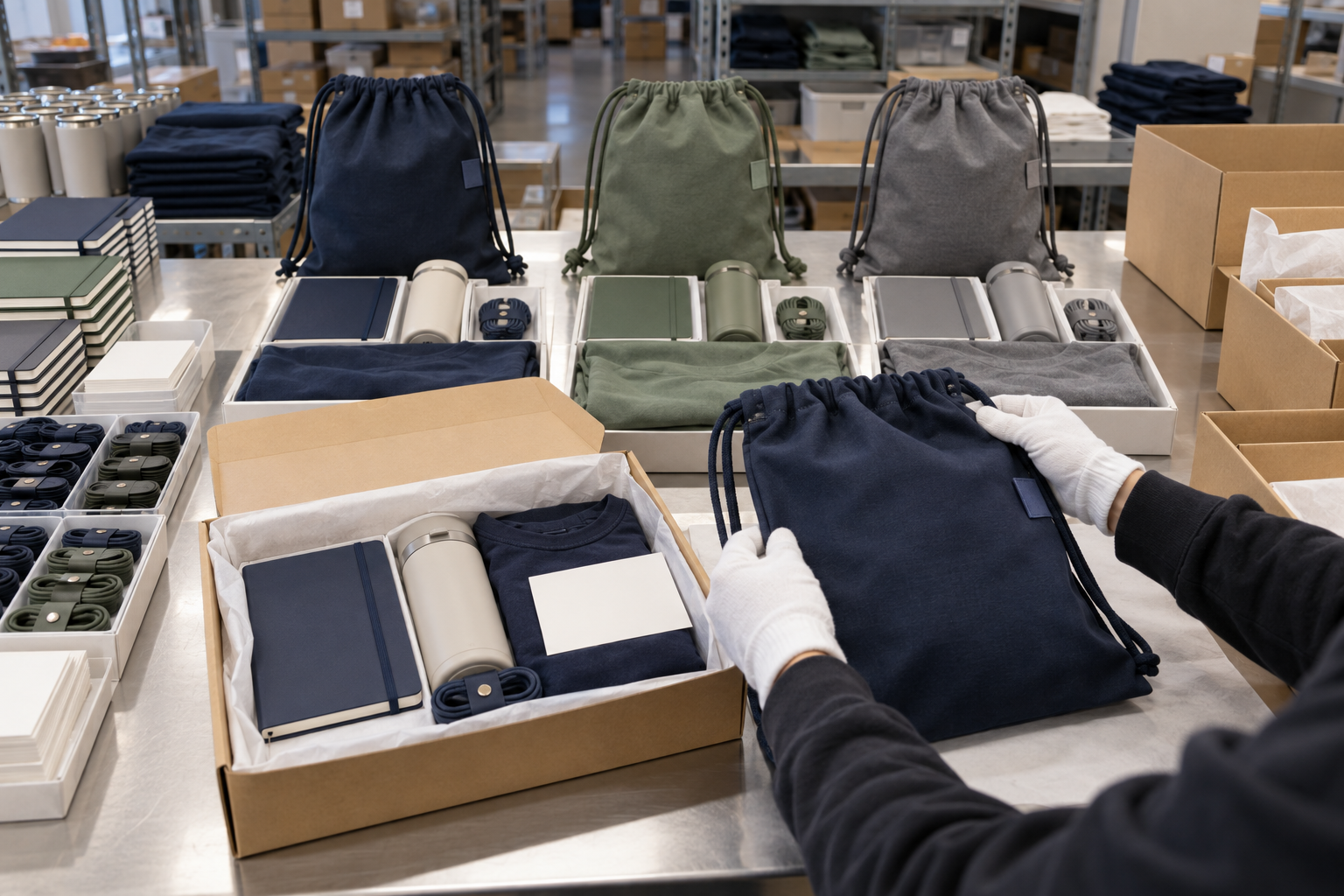
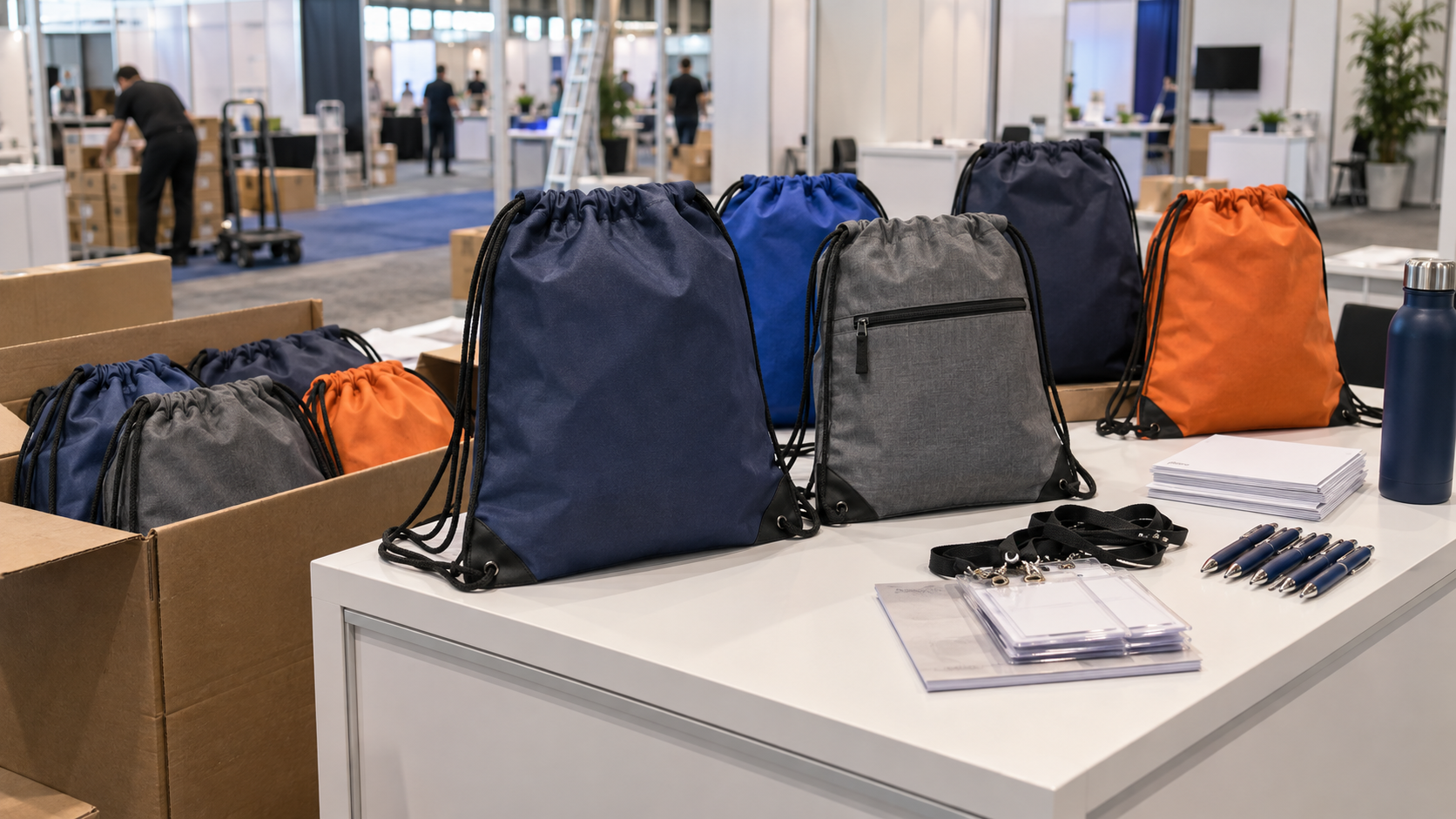
Generated, unbranded editorial illustration of variant control and pack-out inspection. It is not evidence of an actual LUCKYSTAR facility, customer shipment, or completed quality test.
Approve Samples in the Same State Recipients Will See
An empty bag sample proves only part of the system. Corporate gift kits need staged approvals.
- Material and color swatches: approve substrate, finish, cord, thread, hardware, and color direction.
- Decoration proof or strike-off: approve method, position, size, color, fine detail, and surface interaction.
- Empty construction sample: check dimensions, seams, channel, anchors, pockets, closure, and workmanship.
- Fully packed presentation sample: use representative gifts, inserts, tissue, cards, and outer packaging.
- Personalized variant sample: prove field length, spelling, placement, data mapping, and exception handling.
- Transit trial: evaluate movement, crushing, abrasion, moisture exposure, and outer-carton protection on the intended route.
- Golden sample and pack-out standard: freeze the reference, item count, orientation, version identifiers, and acceptance criteria.
The Custom Drawstring Bag Sample Development Process explains how to convert feedback into a controlled approval record.
Test the Failure Modes That Matter to a Gift Kit
Testing should reflect the exact construction and distribution route. A premium appearance does not substitute for functional evidence.
| Check | What it protects | Example acceptance basis |
|---|---|---|
| Dimensional inspection | Contents fit and box compatibility | Critical dimensions within approved tolerances |
| Filled load hold | Body, seams, channel, cords, and anchors | No functional failure at defined load and duration |
| Lift and handling cycles | Office handoff, courier movement, and reuse | No unacceptable seam opening, cord release, or anchor damage |
| Closure cycling | Recipient access and later use | Smooth operation after defined cycles |
| Dry and wet rubbing | Light apparel, cards, and adjacent gift surfaces | Approved transfer grade for the exact fabric/color |
| Print adhesion | Logo integrity | Method-specific adhesion protocol and grade |
| Print abrasion | Stacking, packing, transport, and use | Artwork remains acceptable after defined exposure |
| Product-contact check | Pouch against coated, polished, or delicate item | No unacceptable marking or transfer in the test condition |
| Packed appearance | Brand presentation | Agreed orientation, fill, and wrinkle tolerance |
| Carton and transit test | Complete kit arrives fit for presentation | Pack remains intact under the defined route simulation |
Supporting test references include Polyester Drawstring Bag Colorfastness Testing and Drawstring Bag Print Adhesion and Abrasion Testing. Results apply only to the evaluated sample, materials, methods, conditions, and scope.
Inspect Content Accuracy as Carefully as Bag Workmanship
A perfect bag containing the wrong card or apparel size is still a failed gift kit. Final inspection needs two synchronized layers: bag quality and pack-out accuracy.
Dual-layer inspection plan
| Inspection layer | Critical points |
|---|---|
| Bag identity | Correct style, material, color, dimensions, cord, construction, and decoration |
| Appearance | Clean surface, controlled shade, no unacceptable stains, creases, damage, or odor |
| Function | Closure, pocket, zipper, anchor, load path, and approved tests |
| Kit identity | Correct recipient group, region, language, size, message, and item version |
| Component count | Every required item present once; no unintended duplicate |
| Product condition | No damage, leakage, expired item, opened seal, or incompatible contact |
| Personalization | Spelling, field placement, code mapping, and privacy-safe handling |
| Presentation | Approved orientation, tissue, insert order, and unboxing sequence |
| Outer packing | Correct carton, destination group, quantity, marks, and manifest |
| Reconciliation | Produced, inspected, rejected, reworked, shipped, and surplus counts balance |
Organize bulk checkpoints with the Custom Drawstring Bag Quality Control Checklist. The final release process is covered separately in How to Inspect Custom Drawstring Bags Before Shipment.
Work Backward From the In-Hand Date
Corporate gift programs often have immovable dates: a start day, award ceremony, board meeting, conference, holiday, or customer visit. Build the schedule from recipient delivery rather than from the purchase-order date.
| Gate | What must be frozen | Delay trigger to watch |
|---|---|---|
| Program release | Purpose, recipients, budget, compliance owner, and in-hand date | Gift-policy or market review unresolved |
| Kit freeze | Final component list, dimensions, quantities, and suppliers | Sponsor or stakeholder adds late items |
| Artwork freeze | Logos, messages, language, colors, permissions, and personalization fields | Multiple approvers issue conflicting files |
| Physical approval | Bag, decoration, contents fit, presentation, and outer packaging | Empty sample approved without full pack-out |
| Production release | Signed specification, tests, variants, and packing map | Recipient file still changing |
| Component convergence | All buyer-supplied items available for assembly | One kit component arrives late or short |
| Inspection | Bag quality and kit accuracy complete | No time reserved for rework |
| Logistics | Customs, courier, office receiving, and distribution | Address changes or split shipments added late |
| Handoff | Named owner controls final recipient issue | Cartons sorted only by generic SKU |
MOQ and timing depend on material, construction, decoration, personalization, quantity, component readiness, testing, pack-out, and delivery route. Use Custom Drawstring Bag MOQ and Production Time to structure the discussion; final conditions require written order-level confirmation.
Control Cost Without Making the Gift Feel Generic
The bag's unit price is only one part of the program. Include artwork setup, personalization, sampling, testing, inserts, inner packaging, assembly labor, component handling, storage, carton volume, freight, customs, individual delivery, returns, rework, surplus, and disposal.
Good value engineering protects the recipient experience:
- reduce unnecessary variants while preserving required language, size, or compliance differences;
- use one bag body with controlled inserts when personalization on fabric is not essential;
- right-size the bag and carton after the complete kit is frozen;
- choose one decoration method that matches the artwork and quantity;
- move the personal message to a replaceable card when the bag should remain reusable;
- separate premium tiers by a meaningful material or feature, not hidden complexity;
- design carton sorts around distribution points to reduce local resorting;
- confirm the surplus plan before ordering highly dated or personalized goods.
A low bag price can create a high total cost if the material fails, the kit needs repacking, recipient data is wrong, cartons are inefficient, or the gift arrives after the occasion.
Why Corporate Gifting Teams Choose LUCKYSTAR
LUCKYSTAR is a practical choice when the buyer needs to connect a creative gift concept with a measurable drawstring-bag and pack-out specification. Rather than treating the bag as an isolated decoration surface, the project can be reviewed around the recipient, contents, load, variant structure, approval path, inspection, and distribution route.
After the buyer approves the project scope and the parties confirm it in writing, LUCKYSTAR's coordination may cover:
- material and construction options for different gift tiers;
- dimensions developed from representative physical contents;
- cords, channels, anchors, gussets, pockets, zippers, and presentation details;
- printing, embroidery, foil, and other suitable decoration routes;
- artwork placement, color references, and revision control;
- physical samples and fully packed presentation trials;
- order-specific performance tests and inspection requirements;
- variant, language, personalization, and carton-sort matrices;
- coordination requirements for buyer-supplied components;
- pre-shipment verification against the approved bag and pack-out standard.
LUCKYSTAR does not present example prices, MOQ, sample fees, production timing, test reports, certificates, or platform metrics as universal commitments. Material attributes, commercial conditions, performance claims, certification scope, pack-out responsibilities, and delivery schedules must be confirmed for the specific order.
Corporate Gift-Kit RFQ Checklist
Send this information for a useful quotation.
| RFQ section | Information to provide |
|---|---|
| Program | Purpose, occasion, handoff date, destination markets, and responsible teams |
| Recipients | Employee, client, partner, executive, public sector, or mixed audience; required eligibility controls |
| Bag role | Outer presentation, box organizer, product pouch, or reusable gift |
| Contents | Item list, supplier, dimensions, weight, fragility, safety needs, and availability date |
| Bag specification | Material, composition, denier/GSM, color, size, gusset, lining, cords, anchors, pockets, zipper, and hardware |
| Branding | Authorized files, placement, colors, message, program date, partner marks, and approval owner |
| Variants | Region, language, department, tier, size, color, personalization, and quantity by version |
| Data | Personal fields, transfer owner, access, proofing, retention, deletion, and correction process |
| Compliance | Gift-policy approval, product safety owners, environmental claim evidence, and destination requirements |
| Testing | Load, closure, rubbing, print adhesion, abrasion, contact, transit, and any order-specific protocols |
| Pack-out | Assembly owner, sequence, tissue/inserts, individual packaging, reconciliation, and surplus handling |
| Logistics | Office sort, direct-to-recipient route, carton marks, manifests, destination, and in-hand date |
Unknown fields should be assigned an owner and a decision deadline. Hiding an assumption inside a quote does not remove the risk.
Frequently Asked Questions
Are drawstring bags suitable for employee welcome kits?
Yes, when the bag is sized for the actual welcome contents, approved for the intended load, and integrated with the privacy and distribution process. A compact notebook-and-apparel set differs from a kit containing fragile drinkware or electronics.
Should the drawstring bag replace the shipping box?
Usually not for direct-to-recipient courier delivery. A soft bag can organize and present the gifts, but the outer shipping package must protect the complete kit during transit and carry the required logistics information.
What is the best material for a premium corporate gift bag?
There is no universal best material.Canvas may provide structure, velvet can suit a small luxury pouch, microfiber can suit a smooth component pouch, and polyester can provide efficient color and packability. Decide from the recipient, contents, presentation tier, later use, and evidence requirements.
How much extra space should the bag have?
Do not use a generic percentage. Pack the real items, allow the top to close without pressure, check retrieval, observe the filled silhouette, and confirm that the packed bag fits its outer box or carton. The necessary allowance depends on item geometry and fabric behavior.
Can employee names be printed on every bag?
Technically it may be possible, but the program owner must first justify the data use, control the source file, proof every field, manage corrections, restrict access, and define surplus disposal. Initials or a removable card may achieve the purpose with less exposure.
Can a free corporate gift generate social-media promotion?
It may, but organic sharing should not be assumed or represented as independent when an incentive or relationship affects credibility. If posting is requested or rewarded, the buyer should implement an appropriate disclosure and platform-compliance process.
Can one certificate cover the entire gift kit?
Not automatically. Documents apply to the named entity, item, material, standard, test, date, and scope. The bag, food, drinkware, electronics, cosmetics, and final assembly may each require separate evidence and responsible parties.
How should different offices or recipient tiers be packed?
Create a locked variant matrix, use distinct internal codes, pack by destination or handoff group, label cartons with privacy-safe identifiers, and reconcile every component and finished kit. Do not rely on visual memory at the packing station.
When should corporate gift kits be ordered?
Work backward from the in-hand date and include compliance approval, content freeze, artwork approval, sampling, testing, production, component convergence, pack-out, inspection, transport, customs, local distribution, and contingency. The actual lead time depends on the approved program.
How can a company reduce leftover personalized bags?
Delay final personalization until recipient data is stable, keep spare units blank where possible, use removable message cards, set an approved replacement rate, reconcile eligibility before release, and define secure disposal or reassignment rules for unused personalized goods.
What should be checked before shipment?
Check bag identity and workmanship, complete-kit contents, correct variant and personalization, product condition, presentation order, protective packaging, carton destination, manifest, quantity reconciliation, and all order-specific tests and documents.
Can LUCKYSTAR assemble buyer-supplied gift items?
The feasibility depends on the item type, quantity, storage needs, destination, compliance ownership, timing, inspection scope, and agreed responsibility. The exact pack-out service and commercial terms must be reviewed and confirmed for the order.
Request a Corporate Gift-Kit Quote
Send the recipient profile, gifting occasion, complete item list, representative contents, bag role, target material and dimensions, authorized artwork, variant matrix, personalization plan, compliance requirements, packing sequence, shipment destinations, and in-hand date. LUCKYSTAR can then evaluate a suitable bag construction, decoration route, sample plan, quality controls, and pack-out scope.

Review the custom drawstring bags product page or contact LUCKYSTAR to begin an order-specific assessment. All commercial terms, materials, tests, certification claims, personalization handling, assembly responsibilities, and schedules remain subject to the final specification and written confirmation.