Last reviewed: September 28, 2026
A corporate uniform is easy to photograph and surprisingly difficult to keep operational. The launch order may look consistent, yet six months later a new employee is waiting for the right size, one branch has excess small shirts, another has no extended sizes, and a discontinued garment is being replaced with an unapproved substitute. A capable corporate uniform supplier must therefore support a controlled service, not only deliver decorated clothing.
This guide explains the operating layer between an approved garment and the people who need to wear it: role eligibility, sizing, issue quantities, location allocation, exchanges, replacements, stock thresholds, backorders and reorders. Use the Custom Bag Manufacturer Guide for the broader supplier-governance framework used across LUCKYSTAR programs.
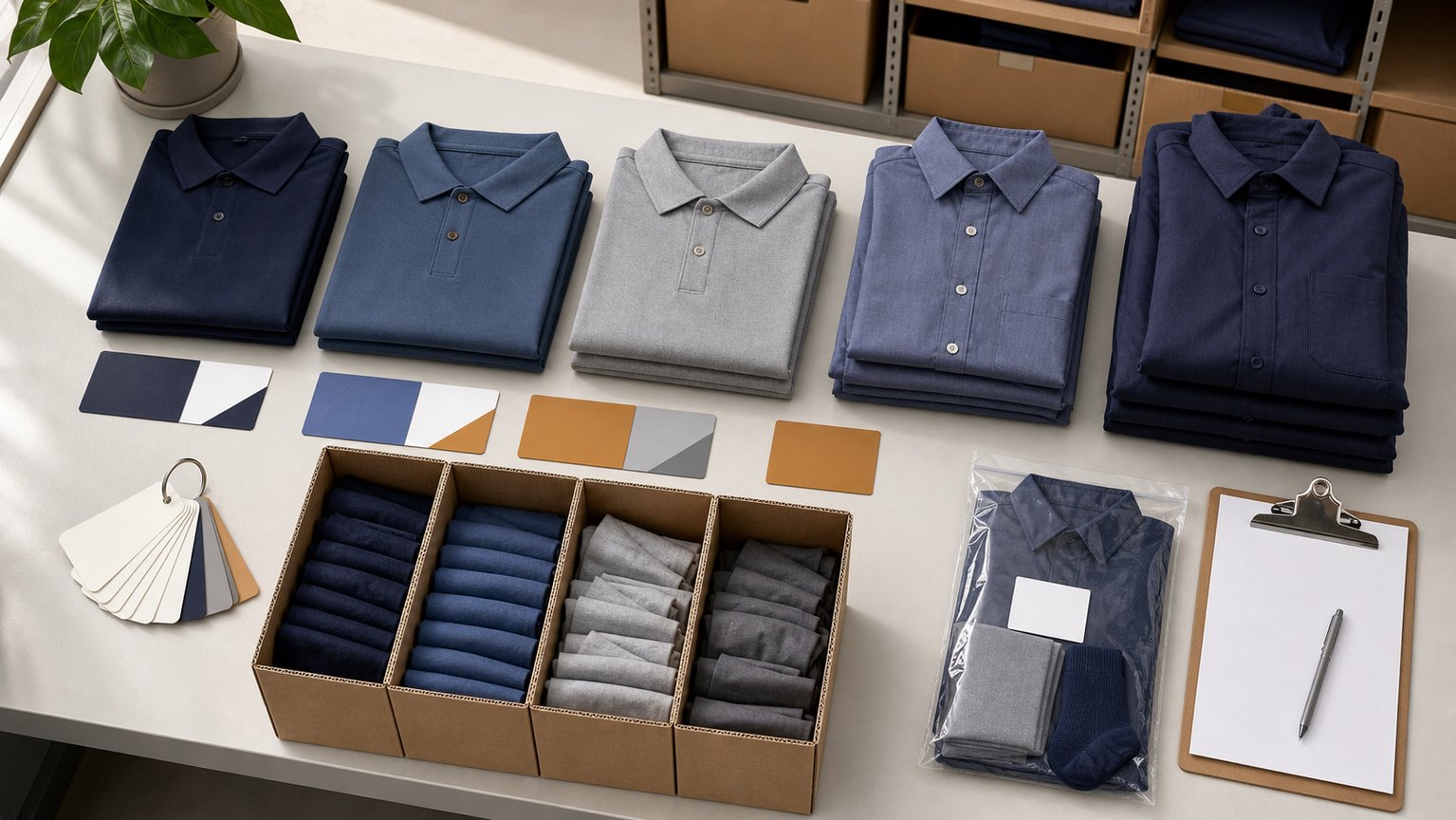
A uniform program stays consistent when roles, sizes, issue records and replacement stock are managed as one system.
Buyer Quick Answer
Scope: Uniform Program Operations, Not Garment Engineering
This article is deliberately about program control. It does not repeat the collar, placket, fabric and grading detail covered in the custom Polo shirt specification guide, the fabric-fit-finish stack in the Hoodie supplier approval guide, or the bulk continuity controls in the custom T-shirt manufacturing guide. Those pages help approve products. This page helps deploy and maintain them across a workforce.
Start With a Wearer-Role Matrix
List every wearer group before selecting garments. Record the work setting, customer contact, movement, climate, washing frequency, required pockets or layers, and whether personalization is needed. A reception team, mobile service team, warehouse coordinator and office manager may share colors while using different garments. The role matrix prevents the common shortcut of forcing one shirt onto every job merely because ordering is simpler.
Give each role an approved kit and named alternates. The matrix should also say which choices are optional. That distinction lets local teams work within a controlled catalog without inventing new products.
Separate Identity Apparel From PPE
Brand uniforms and protective equipment must not be treated as interchangeable. OSHA states that uniforms worn solely to identify a person as an employee are not PPE, while protective equipment selected for workplace hazards has separate fit, maintenance and program requirements. If a garment is intended to protect against a hazard, involve the responsible safety and legal specialists and follow the destination's applicable rules. Do not rely on a standard branded Polo or jacket as evidence of protection. See the OSHA PPE overview for that boundary.
Define Entitlement Before Ordering
An entitlement is the quantity and type of garments a person may receive within a period. Write it by role, employment status and working pattern. A full-time field employee may need more rotation pieces than a part-time office wearer. State whether optional items use the same allowance, who approves exceptions, and when an entitlement resets. Without this rule, historical issues, replacements and new requests become impossible to reconcile.
Build the SKU Naming System
Every approved combination needs one unambiguous identity: garment platform, fit, color, size, decoration version and role or location restriction. Keep human-readable names short, but store the component details behind them. "Navy Polo L" is not enough when two fits, two logo placements or two fabric generations exist. A controlled SKU name prevents an apparently similar substitute from entering the program unnoticed.
Capture Size Data as a Workflow
Do not collect size as a casual free-text answer. Choose one method: self-selection against a published garment chart, manager-assisted measurement, sample-size try-on, or a fitting session. Record the exact garment and fit used because a medium in one platform is not a universal medium. Set a closing date, an exception route and a privacy rule for access to personal data. Keep only the information needed to fulfill the program.
Run Fitting Sessions for Critical Roles
A fitting session is useful when the workforce is large, the size range is new, the garment is structured, or an exchange would delay onboarding. Bring the real approved styles in a representative size range, let wearers move as they would at work, and record garment size rather than subjective body labels. Treat feedback about reach, sitting, sleeve interference and layering as operational evidence.
Plan Inclusive Size Coverage
Extended sizes, alternative fits and accessibility needs cannot be added after the order as an afterthought. Check which approved garments carry the required size range and whether their proportions remain suitable. When a special build is necessary, give it a controlled SKU, lead-time expectation and replacement route. A uniform standard is not truly consistent if part of the workforce must improvise outside it.
Convert Headcount Into Issue Quantity
Headcount is only the first line of the calculation. Build quantity from active wearers, issue entitlement, confirmed size demand, near-term starters, approved reserve and known seasonal changes. Subtract usable stock that has been physically verified. Keep each component visible so a buyer can distinguish real demand from safety stock. For a one-time event distribution model, use the separate bulk promotional T-shirt allocation guide.
Assign New-Hire Kits
Define what a new employee receives on day one, what can follow later, and who triggers the order. Link the kit to a role code rather than relying on a manager's memory. If personalization is required, decide whether a temporary unpersonalized item is permitted. Reserve coverage should reflect hiring cadence by location and size, not a flat percentage applied to every SKU.
Choose a Distribution Model
The best route depends on workforce geography, local administration and the need for named-person control. Decide this before packing instructions are issued.
| Distribution model | Best fit | Control needed | Main risk |
|---|---|---|---|
| Central bulk delivery | One site with an accountable coordinator | Cartons split by role and size; local issue log | Items are handed out without a record |
| Location packs | Several branches with known rosters | Allocation file, carton labels and exception report | Stock moves between sites informally |
| Named-person kits | New-hire waves or personalized programs | Roster freeze, size confirmation and identity check | Late employee changes create rework |
| Controlled ordering portal | Recurring, distributed demand | Approved catalog, role permissions and allowances | Rules are configured differently from policy |
| Hybrid stock plus special order | Fast-moving core sizes with a long-tail range | Clear stocked and made-to-order service levels | Slow sizes are promised at stock speed |
Control Employee-Level Packing
A named kit should carry a unique order reference, location, role, garment list and size, but avoid displaying unnecessary personal data on the outside. The pack list must reconcile to the master allocation before cartons close. For a location delivery, provide both a carton summary and a wearer-level exception list. The recipient should know what is complete, backordered or intentionally excluded.
Record Every Issue, Exchange and Return
An issue record should show who or which location received an item, the SKU, quantity, date and transaction reason. Exchanges must reverse the first transaction and create the second; otherwise inventory and entitlement both become inaccurate. The same principle applies to defective returns, role changes and unissued stock moving between locations.
Write Replacement Rules
Define replacement reasons such as normal wear, accidental damage, size change, defect, loss and role change. State which need approval, whether the original item must be returned, and whether the replacement consumes an allowance. A rule is fairer and easier to administer than one-off decisions. It also separates product-quality signals from ordinary consumption.
Manage Role Changes and Departures
When a wearer changes role, close the old entitlement before opening the new one. Decide whether still-serviceable garments can be reused, rebranded or must be removed from circulation. For departures, the return process should identify company-owned items, personalized items and items unsuitable for reissue. A public APHIS uniform directive, for example, uses an employee exit inventory to account for issued uniform items; the transferable lesson is to make offboarding a recorded transaction rather than an informal handover.
Choose Home Care or Managed Laundry
Write who cleans each garment, the approved care route, the expected rotation and how damage is reported. Home-care garments need clear, tested instructions that wearers can follow. A managed-laundry program needs collection points, garment identity, turnaround rules, repair decisions and loss reconciliation. Do not mix these routes without stating which SKUs belong to which service.
Set Stock Policy by SKU Behavior
Core stock should reflect actual issue history, hiring plans, supplier lead time and required service level. Fast-moving standard sizes may justify a min-max rule. A rarely used personalized jacket may be better made to order. Classify each SKU as core stock, seasonal stock, contingency stock or special order so buyers know what availability promise is realistic.
Calculate Reorder Triggers
A practical trigger considers expected demand during replenishment lead time plus an agreed buffer, then subtracts usable stock and confirmed inbound supply. Review the trigger by size and location, not only at total-style level. Ten shirts in stock are not useful if every available unit is small while the next starters need large. UniformMarket describes this kind of vendor-managed inventory through min-max levels, usage reporting and size or location visibility; the important point is that the rule must be based on program activity, not intuition.
Protect Extended and Slow-Moving Sizes
Slow movement does not mean no operational importance. Set a service route for low-volume sizes: a small reserve, an approved special-order window, or a supplier-held option. Review them separately from fast sizes so a general inventory reduction does not quietly remove access. At the same time, avoid overbuying every long-tail SKU without evidence.
Control Backorders and Substitutions
A backorder notice should identify the affected SKU and wearer group, quantity, expected update date, available partial shipment and approved alternatives. Never let "closest available" become an automatic substitution. An alternate needs confirmation for color, fit, fabric, decoration placement, role suitability and any applicable compliance scope. Record who approved it and whether it is temporary or a permanent program change.
Prepare for Product Discontinuation
Ask how the supplier communicates end-of-life risk and how much notice is available. Maintain the approved specification, last purchase data and current field population. Then decide whether to make a final buy, transition by natural replacement, or change all wearers together. Test the successor beside the current garment under the same care and decoration conditions before releasing it.
Preserve Reorder Identity
The reorder record should include the approved garment reference, color standard, size specification, decoration file and placement, labels, packing, issue rules and any accepted deviations. Keep a physical reference when practical. For embroidery reproduction, link to the detailed custom embroidery T-shirt guide or the cap-specific embroidered caps approval guide rather than assuming one decoration file works on every surface.
Use Location Allocation Rules
Allocate from the roster and confirmed size matrix for each location. Add reserve where hiring volatility and transfer activity justify it, then state who owns that reserve. If sites can move stock between them, require a transfer record so central availability stays accurate. A location should not solve its shortage by creating an invisible shortage elsewhere.
Plan Seasonal and Regional Variants
Climate and working environment may require layers or fabrics that differ by region, but variants should remain within one visual and operating architecture. Define which colors, marks and role codes stay global and which components may change locally. The global headwear rollout framework shows a parallel approach for controlled regional variants.
Compare Supplier Operating Models
Do not assume every corporate uniform supplier offers the same service. Price each operating model at the same scope and decide which responsibilities remain with the buyer.
| Supplier model | Supplier typically handles | Buyer still controls | Ask for evidence |
|---|---|---|---|
| Make-to-order factory | Development, production, quality and bulk packing | Roster, local stock, issues and replacements | Approved sample, bulk records and reorder file |
| Factory plus program support | Production, allocation packing and scheduled replenishment | Entitlements, wearer data and approvals | Allocation accuracy and exception reporting |
| Stockholding provider | Agreed inventory, pick-pack-ship and stock reporting | Demand forecast, catalog and ownership terms | Inventory visibility, aging and service levels |
| Managed program | Catalog, portal, permissions, inventory and fulfillment | Policy, budgets, governance and exceptions | System controls, reporting and exit provisions |
Track Program Health With Metrics
Measure whether the uniform reaches the right wearer in usable condition and remains reproducible. A small set of operational metrics is more useful than a large dashboard without ownership.
| Metric | What it reveals | Review level | Follow-up question |
|---|---|---|---|
| First-time size acceptance | Quality of sizing workflow | Garment, role and location | Is one fit or method causing exchanges? |
| New-hire kit readiness | Ability to support onboarding | Location and start month | Which SKUs delay complete kits? |
| Replacement rate | Wear, care or quality patterns | SKU and reason code | Is failure normal use or a repeat defect? |
| Stockout days | Availability by real demand | Size and location | Was the trigger, forecast or lead time wrong? |
| Inactive inventory age | Obsolescence exposure | SKU and program generation | Can stock be reassigned before a refresh? |
| Substitution frequency | Program drift and discontinuation risk | Garment platform | Should the approved standard be redesigned? |
Keep Related Apparel Programs Separate
Corporate uniforms are recurring workforce assets. They should not be combined analytically with event giveaways, retail basics or general merchandise. Use the basic wear fit and fabric guide for capsule design, the bags, caps and Hoodies merchandise guide for branded collections, and the global custom apparel partnership framework for multi-category collaboration. Keeping those intents distinct prevents duplicate briefs and conflicting success measures.
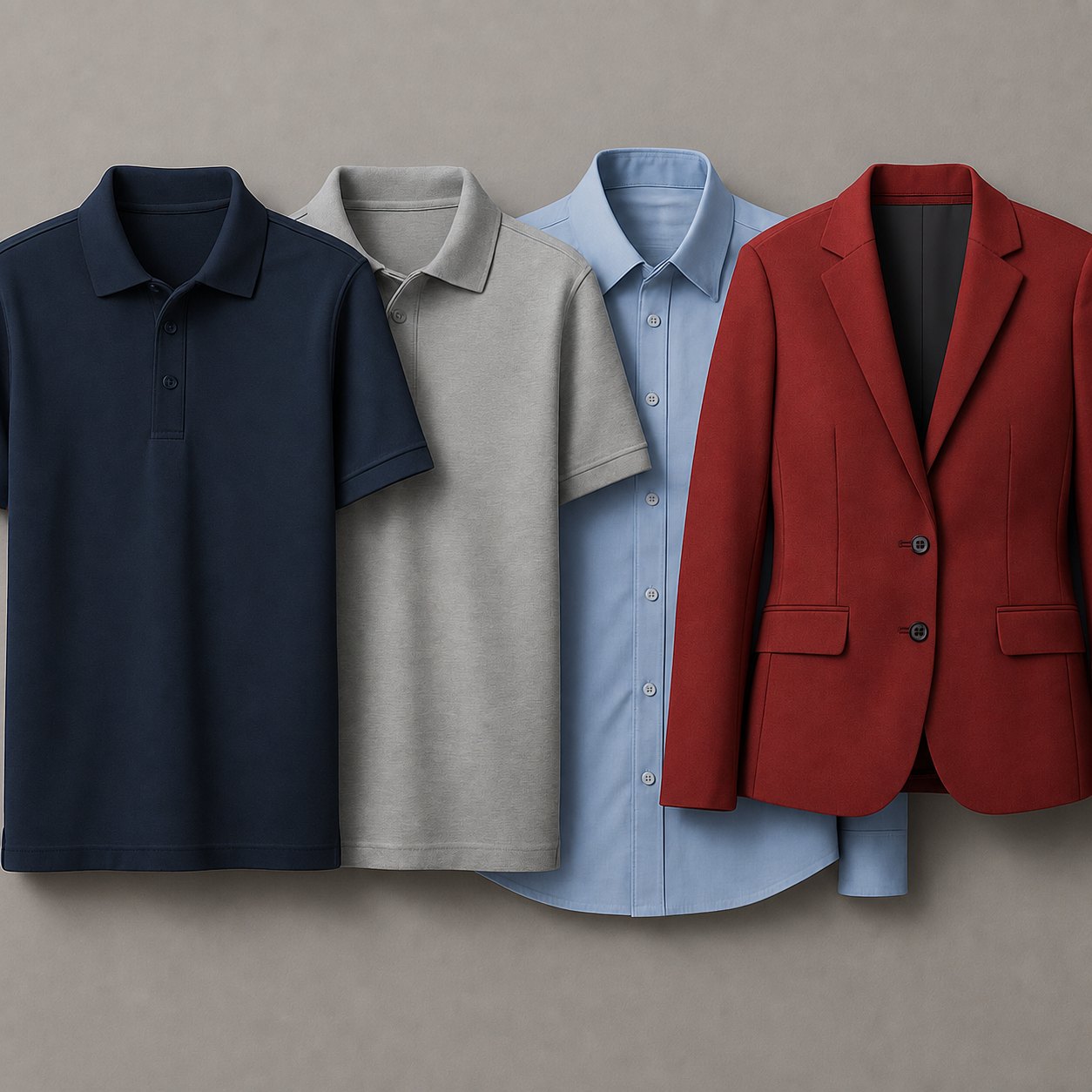
A coordinated capsule can preserve one visual standard while assigning different garments to different roles.
What to Send for a Useful Quote
Send the role matrix, approved or proposed garment list, quantity by role and location, size-capture method, expected size range, initial issue entitlement, hiring forecast, decoration requirements, care route, packing model, destinations, required in-hand date and expected reorder pattern. State which services you want the supplier to perform: production only, named packing, stockholding, portal ordering, replacement fulfillment or reporting.
For commercial comparisons, separate garment production, decoration setup, samples, packing, stockholding, pick-pack-ship, portal or administration fees, freight and exit costs. The custom product cost guide and lead-time and cost guide provide broader methods for normalizing supplier assumptions.
How LUCKYSTAR Can Support the Program
LUCKYSTAR can review a cross-category brief, develop approved apparel and coordinate decoration and packing around a defined allocation. The useful starting point is not a generic request for "staff uniforms." It is a role and quantity matrix with the operating model identified. That lets the team discuss which items should be made together, which need a separate approval route, and how the released specification will be protected on later orders.
This is a manufacturing and program-planning discussion, not a claim that every portal, stockholding, laundry or compliance service is included in every quotation. Confirm the exact scope, location, ownership and service levels in writing. To compare LUCKYSTAR with alternatives at the broader supplier level, return to the Custom Bag Manufacturer Guide.
Frequently Asked Questions
How many uniforms should each employee receive?
There is no universal number. Base the entitlement on working days, care turnaround, garment type, soil or wear exposure, part-time status and the practical time between replacements. State the components of the calculation instead of copying another company's allowance.
Should a supplier hold every size in stock?
Usually not. Fast-moving core sizes may justify min-max stock, while uncommon or personalized items may follow a controlled special-order route. The program should still provide a realistic service level for extended sizes rather than excluding them because their movement is lower.
What is the best way to collect employee sizes?
Use the real approved garment chart or a physical try-on. Record the selected garment, fit and size, not a generic body label. For a new platform or structured garment, a fitting session can reduce exchanges and reveal movement issues before the first bulk order.
How should uniform replacements be controlled?
Use reason codes, approval rules and a transaction record. Separate normal wear, defect, loss, accidental damage, size change and role change because each points to a different operational response. Decide whether the old garment must be returned and whether the replacement consumes an allowance.
What happens when an approved garment is discontinued?
Freeze unapproved substitutions, quantify wearers and usable stock, obtain the successor specification, test it beside the current item, and approve a transition plan. Decide whether old and new versions may coexist and for how long. Preserve the decision in the program record.
Does a corporate uniform supplier also manage PPE?
Not automatically. A branded uniform used for identification is different from equipment selected to protect against a workplace hazard. Define the boundary in the brief and involve qualified safety specialists for hazard assessment, protective performance, fit, maintenance and regulatory obligations.
Turn Uniform Supply Into a Governed Service
Review the current custom T-shirt and polo range to define the garment platform before confirming program services. The most useful corporate uniform program has a clear answer for every movement: who is eligible, which SKU is approved, what size is confirmed, where stock sits, why an item was replaced and when the next order should begin. That operational record preserves brand consistency more reliably than a launch photo.
Send LUCKYSTAR your role, size, quantity and location matrix to request a scope-based review. Include the initial rollout and the expected new-hire or replacement pattern so the quotation reflects the continuing program, not only the first shipment.
Email a prefilled uniform-program brief