Polyester Drawstring Bag Colorfastness Testing
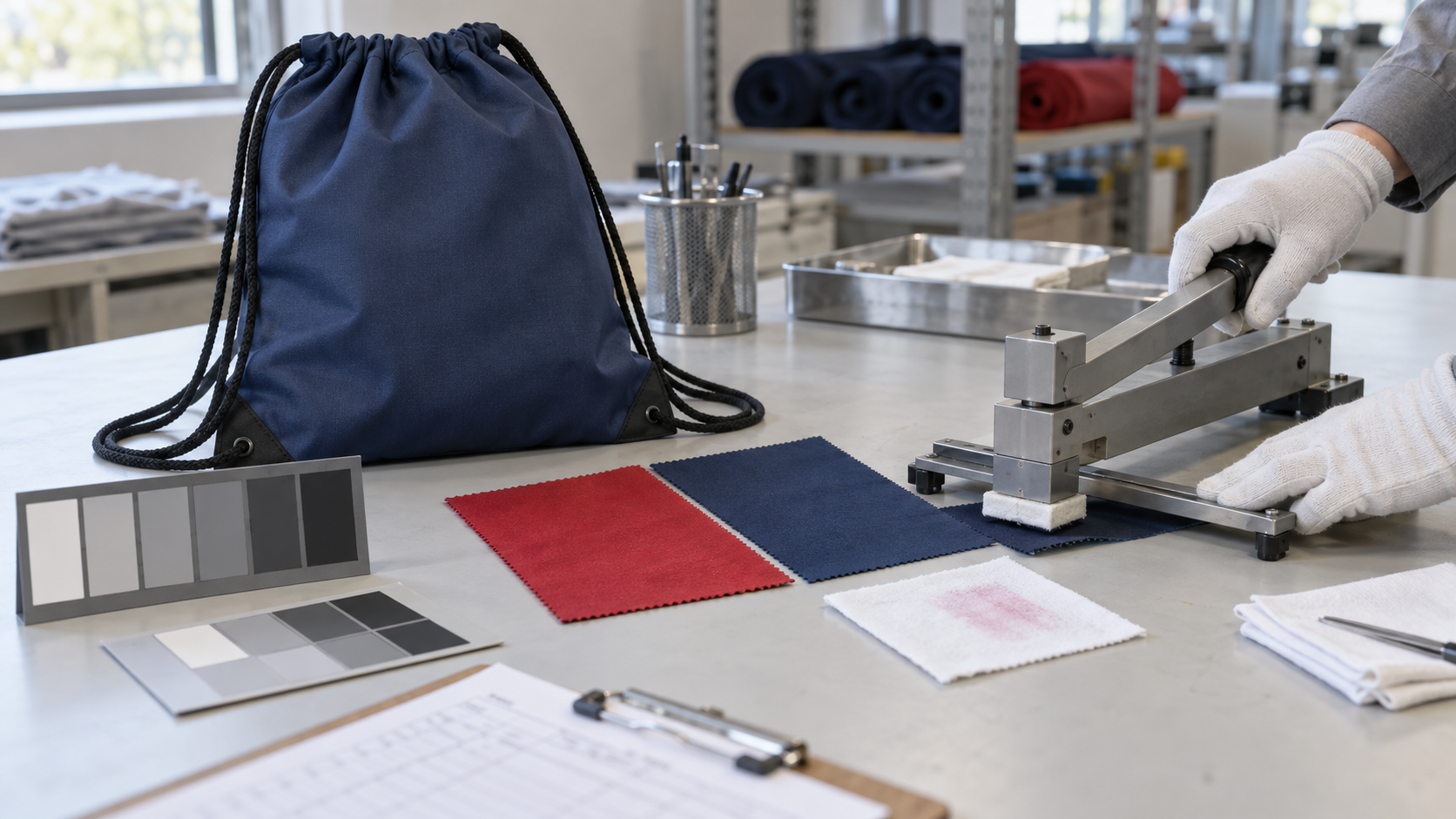
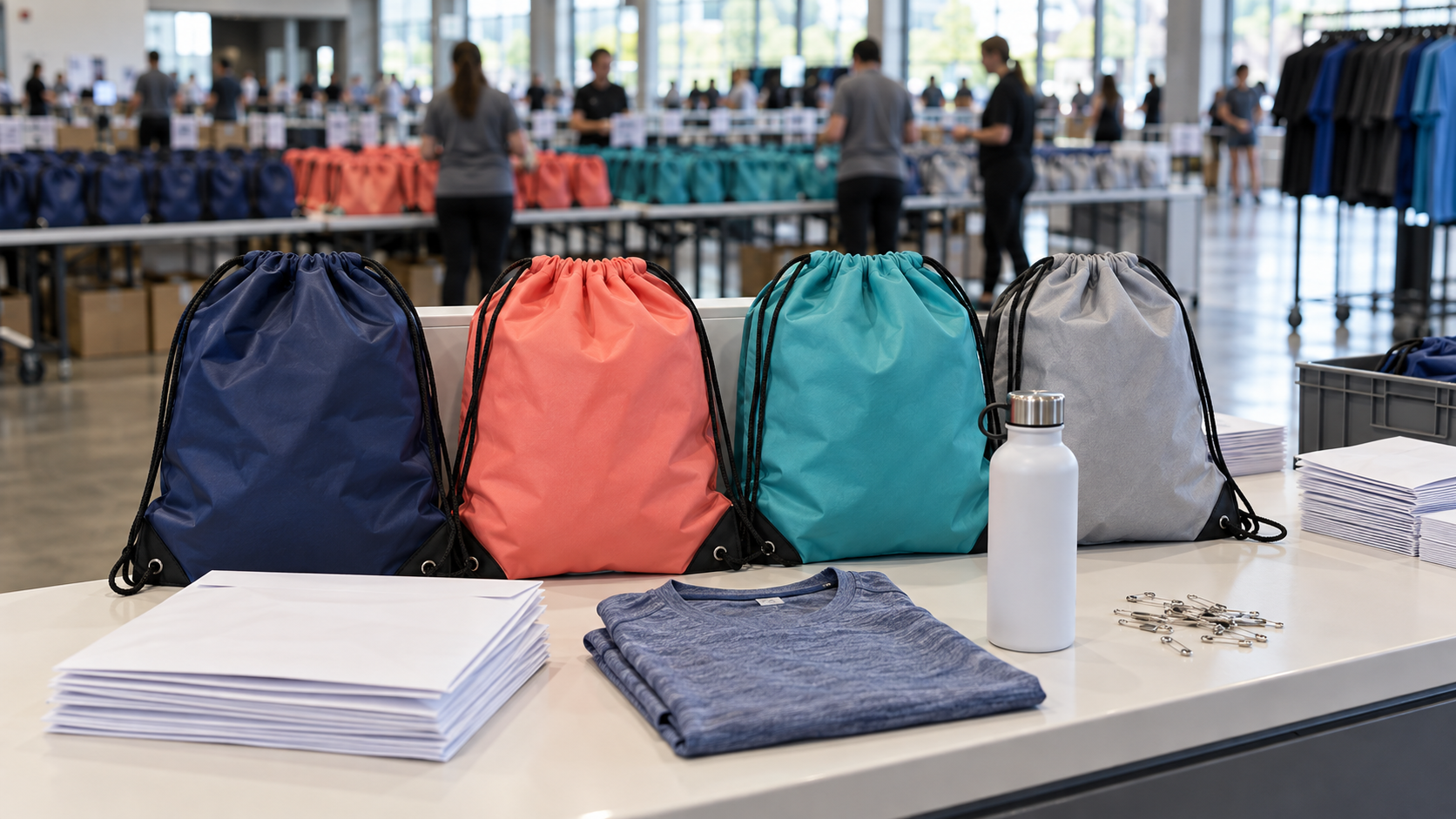
Editorial visualization of a textile rubbing-test setup; the scene illustrates the method and is not documentary evidence of company testing, a customer order or certification.
The short answer: polyester drawstring bag colorfastness should be verified with tests selected for the bag’s real exposure. A practical program normally separates color change in the colored material from staining transferred to another material, then evaluates dry and wet rubbing, laundering only when cleaning is claimed, perspiration for sports or body-contact use, and artificial light for meaningful outdoor exposure. Printed areas, cords, coatings and linings may need separate specimens because they can behave differently from the dyed polyester body.
There is no universal “passing grade” for every polyester bag. The test method explains how to produce and assess a result; the buyer’s specification, destination market and intended use determine what result is acceptable. A defensible report must identify the exact fabric, colorway, print process, sample revision, method, conditions, acceptance criteria and individual results.
This guide shows sourcing and quality teams how to build that protocol for custom drawstring bags. It complements the broader custom drawstring bag testing guide and the production-focused drawstring bag quality control checklist.
Important: Test selection, laboratory, specimen quantity, conditioning and acceptance values remain subject to the approved product specification and written confirmation. One passing sample must not be presented as evidence for every color, decoration, batch or future order.
Quick Answer: Which Colorfastness Tests Matter?
Start with the way the bag will be used. A dark polyester gym sack can transfer color to a light shirt under damp friction. A promotional pouch that is never washed does not automatically need a laundering claim. A window-displayed retail bag may need lightfastness attention even if it rarely contacts sweat.
| Exposure | Main question | Common reference route | Usually relevant when |
|---|---|---|---|
| Dry rubbing | Does color transfer to a dry contacting surface? | ISO 105-X12 or AATCC TM8 | Dark colors, prints and garment contact |
| Wet rubbing | Does damp contact increase transfer? | ISO 105-X12 or AATCC TM8 | Sports, outdoor, humid or rainy use |
| Laundering | Does a defined wash change shade or stain adjacent fabric? | ISO 105-C06 or AATCC TM61 | The bag is marketed as washable or expected to be cleaned |
| Perspiration | Does simulated perspiration cause change or staining? | ISO 105-E04 or AATCC TM15 | Gym bags and prolonged body/garment contact |
| Artificial light | Does controlled daylight simulation fade the color? | ISO 105-B02 or AATCC TM16.3 | Outdoor programs, window display or long light exposure |
| Water contact | Does water alone cause bleeding or staining? | Order-specific method or applicable textile method | Rain exposure, wet contents or water-contact claims |
| Heat migration | Can polyester dye migrate into a print or adjacent layer after heat/storage? | Print-system or buyer protocol | Heat transfers, pale logos on dark polyester, hot storage |
| Whole-bag contact | Do the finished bag, cords, coating and print transfer color in use? | Written finished-product simulation | Multiple colored components touch one another or the user |
The references above are method families, not automatic pass specifications. Confirm the exact edition and laboratory scope before placing an order.
Color Change and Staining Are Different Results
Colorfastness reporting commonly addresses two outcomes:
- Color change: the tested colored specimen becomes lighter, darker or different in hue compared with its original reference.
- Staining: color moves from the specimen onto a white rubbing cloth, adjacent fabric, lining, cord or other contact surface.
A specimen can show little visible fading but still stain another material. Conversely, it can fade without leaving heavy staining. Buyers should specify both outcomes when the selected method supports them.
| Observation | What it means | Why a buyer cares |
|---|---|---|
| Body fabric changes shade | The polyester color was altered by the exposure | Reorders or panels may no longer match |
| White test cloth becomes colored | Surface color transferred under rubbing | Light clothing, hands or contents may be marked |
| Adjacent multifiber fabric is stained | Dye moved during wet treatment | Linings, labels or mixed materials may discolor |
| Pale print becomes tinted | Polyester dye migrated into the decoration | White or pastel branding can lose clarity |
| Cord stains the channel | A separate component transfers color | The body may pass while the complete bag fails visually |
| Coating changes appearance | Surface finish responds to test conditions | A fabric-only result may not represent the coated bag |
ISO 105-A02 describes a grey scale for assessing change in color, while ISO 105-A03 describes a grey scale for assessing staining. The two scales answer different questions and should not be reported as though they were interchangeable.
Define the Production-Intent Specimen First
Colorfastness belongs to a material-color-process combination, not to the word “polyester” alone. Lock the sample before testing.
| Specimen field | Record in the test request | Why it changes the result |
|---|---|---|
| Polyester construction | Woven or knitted structure, denier/grade and nominal weight | Surface texture and yarn structure affect rubbing and appearance |
| Colorway | Color name plus physical or digital approval reference | Dark, bright and fluorescent shades may behave differently |
| Dye/print route | Piece dyed, yarn dyed, sublimated, screen printed or transferred | The colorant’s location and fixation differ |
| Finish | Coating, water-repellent finish, lamination or calendaring | Surface friction and wetting can change |
| Bag component | Body, cord, reinforcement, lining, binding and thread | Components may come from different material lots |
| Sample stage | Lab dip, strike-off, pre-production or production lot | Development approval is not lot verification |
| Revision | Tech-pack version, sample ID and approval date | Prevents results being attached to a changed construction |
For context on weight classes and construction variables, consult 210D vs 420D vs 600D polyester drawstring bags. The polyester vs nylon drawstring bag comparison covers broader material selection; this article focuses specifically on color behavior.
Build a Risk-Based Color Test Plan
The correct test set comes from an exposure map. Ask what touches the bag, whether the contact is dry or wet, the expected duration, temperature, cleaning method and consequence of transfer.
Example exposure map
| End use | High-risk contact | Priority checks | Optional checks |
|---|---|---|---|
| Promotional giveaway | Hands, garments and stacked bags | Dry/wet rubbing; component-to-component contact | Lightfastness for outdoor events |
| Gym or sports sack | Sweaty clothing, shoulders and damp towels | Wet rubbing; perspiration; finished-bag contact | Laundering if a care claim is provided |
| Shoe bag | Shoes, damp floors and stored garments | Wet rubbing; water contact; lining transfer | Defined cleaning trial |
| Retail packaging | Light products, tissue and printed inserts | Dry rubbing; stacking/contact migration | Light exposure for window display |
| Outdoor event bag | Sunlight, humidity and rain | Wet rubbing; lightfastness; water contact | Perspiration if worn as a backpack |
| E-commerce multipack | Bags compressed together during storage | Component/contact migration | Elevated-temperature storage simulation |
Do not request every available test merely to create a longer report. Irrelevant testing adds cost and can distract from the dominant risk. Conversely, a “rub test only” is incomplete when the marketing copy says the product is washable or intended for prolonged outdoor use.
Dry and Wet Rubbing Tests
Rubbing—often called crocking in AATCC terminology—measures how much color transfers from a textile surface to a standard white cloth under controlled contact. ISO 105-X12:2016 applies to colored textiles, including dyed and printed materials, and allows dry and wet testing. AATCC TM8 likewise evaluates color transferred to a white crock cloth under controlled conditions.
What the request must specify
- Standard and edition.
- Dry, wet or both conditions.
- Specimen face and direction.
- Whether the test is on plain body fabric, printed area or finished component.
- Number of specimens and selected colorways.
- Assessment scale and acceptance value.
- Conditioning and any pretreatment.
| Control variable | Why it matters | Reporting requirement |
|---|---|---|
| Moisture condition | Wet rubbing is often more demanding than dry rubbing | State dry or wet explicitly |
| Contact face | Coated face, back face and print can differ | Identify the tested surface |
| Direction | Fabric structure or print direction may influence transfer | Record warp/weft or relevant orientation |
| Pretreatment | Washing or heat can change surface behavior | State before/after treatment |
| White test cloth | Standardized cloth supports comparable evaluation | Use the method-required material |
| Assessment | Visual grey scale and instrumental methods are not identical | Name the scale/procedure and observer conditions |
Test the decoration separately when it introduces a different color system. A screen ink film, heat-transfer layer and sublimated image do not behave identically. Review the process choices in Custom Drawstring Bag Printing Methods.
Laundering Fastness: Test It Only Against a Defined Care Claim
ISO 105-C06:2010 specifies methods for resistance to domestic and commercial laundering with reference detergent. ISO’s current page notes that a single test can approximate one laundering, while certain multiple tests may approximate up to five launderings under stated conditions; the method also warns that other detergent or bleach systems may require different conditions.
AATCC TM61 is an accelerated laundering method for textiles expected to withstand frequent laundering. Its conditions are not a promise that every bag can be machine washed.
Before selecting a laundering method, define:
- the care instruction that will actually appear with the bag;
- water temperature, detergent and mechanical action;
- drying method;
- whether the complete bag or a material specimen is tested;
- the number of exposures;
- color-change, staining, shrinkage and construction criteria.
Why a finished-bag wash trial may still be needed
A fabric specimen can pass colorfastness while the complete bag changes shape, a coated area whitens, a cord shrinks, an eyelet corrodes or a heat transfer lifts. If “washable” is a product claim, pair the applicable textile test with a controlled whole-bag care trial and inspect every component. Do not infer washability from rubbing results alone.
Perspiration Fastness for Sports and Body Contact
ISO 105-E04:2013 determines resistance of textile color to human perspiration. AATCC’s official standards list identifies TM15 as its colorfastness-to-perspiration method. This exposure is most relevant when a drawstring backpack sits against clothing or skin during sport, commuting or outdoor activity.
Perspiration testing should not be added simply because the bag has shoulder cords. Evaluate contact duration, climate, clothing color and whether the colored body, cord or printed panel touches the user. For a sports sack, the lower back panel and cords may deserve separate specimens.
| Specimen | Potential issue | Test-plan response |
|---|---|---|
| Dark polyester body | Staining of a light shirt | Include relevant contact face and adjacent fabric |
| Black cord | Transfer to hands, channel or garment | Test cord material separately or in assembly simulation |
| Pale heat-transfer logo | Dye migration from dark polyester | Add controlled heat/storage migration evaluation |
| Coated back panel | Altered wetting or surface appearance | Confirm method applicability and inspect finish |
| Mixed-color reinforcement | Color-to-color transfer during damp storage | Include component-contact simulation |
As always, the test result applies to the specified specimen and method. It does not certify the bag as universally “sweat-proof.”
Lightfastness for Outdoor and Display Exposure
ISO 105-B02:2014 evaluates the effect of artificial light representative of daylight using a xenon-arc source. ISO confirmed the 2014 edition in 2025, while a new edition is under development; procurement documents should therefore name the edition rather than writing only “ISO 105-B02.”
Lightfastness becomes important for:
- bags sold or displayed near windows;
- outdoor events and sports programs;
- bright, neon or brand-critical colors;
- reorders expected to remain visually compatible with earlier stock;
- products stored where sunlight exposure is foreseeable.
Do not translate a laboratory exposure directly into an exact number of outdoor months. Geography, season, orientation, temperature, moisture and actual irradiance vary. Use the result to compare a defined specimen against an agreed criterion or reference, not to promise a universal service life.
Printed Polyester Requires Two Colorfastness Questions
First ask whether the base polyester retains its color. Then ask whether the decoration retains appearance and avoids transfer or migration.
| Decoration route | Main color risk | Useful evaluation focus |
|---|---|---|
| Sublimation | Incomplete fixation, shade inconsistency or unwanted migration | Rubbing, relevant cleaning, heat/storage behavior and visual change |
| Screen printing | Ink rubbing, poor cure, cracking or adhesion loss | Printed-area rubbing plus process-specific adhesion/cleaning review |
| Heat transfer | Edge lifting, cracking and dye migration into pale film | Adhesion/flexing plus elevated-temperature migration check |
| Full-surface print | Panel-to-panel shade difference and registration | Color approval, rubbing and relevant exposure on each major color |
| Reflective print | Surface change and loss of reflective appearance | Supplier/buyer method for reflection plus color/adhesion observations |
Our guide to sublimation vs screen printing for polyester drawstring bags explains process selection. For artwork color systems, see Pantone vs CMYK for custom drawstring bags.
Do not confuse color accuracy with colorfastness
Color accuracy asks whether the sample matches the approved target. Colorfastness asks how color changes or transfers after a defined exposure. A perfect initial Pantone match can have poor wet-rub performance, while a stable fabric can still start outside the approved shade tolerance.
Both controls belong in the specification:
- approve the starting color under defined viewing conditions;
- run the relevant colorfastness exposure;
- assess change and staining separately;
- confirm the post-test result meets the written limits.
Evaluate Results with Controlled References
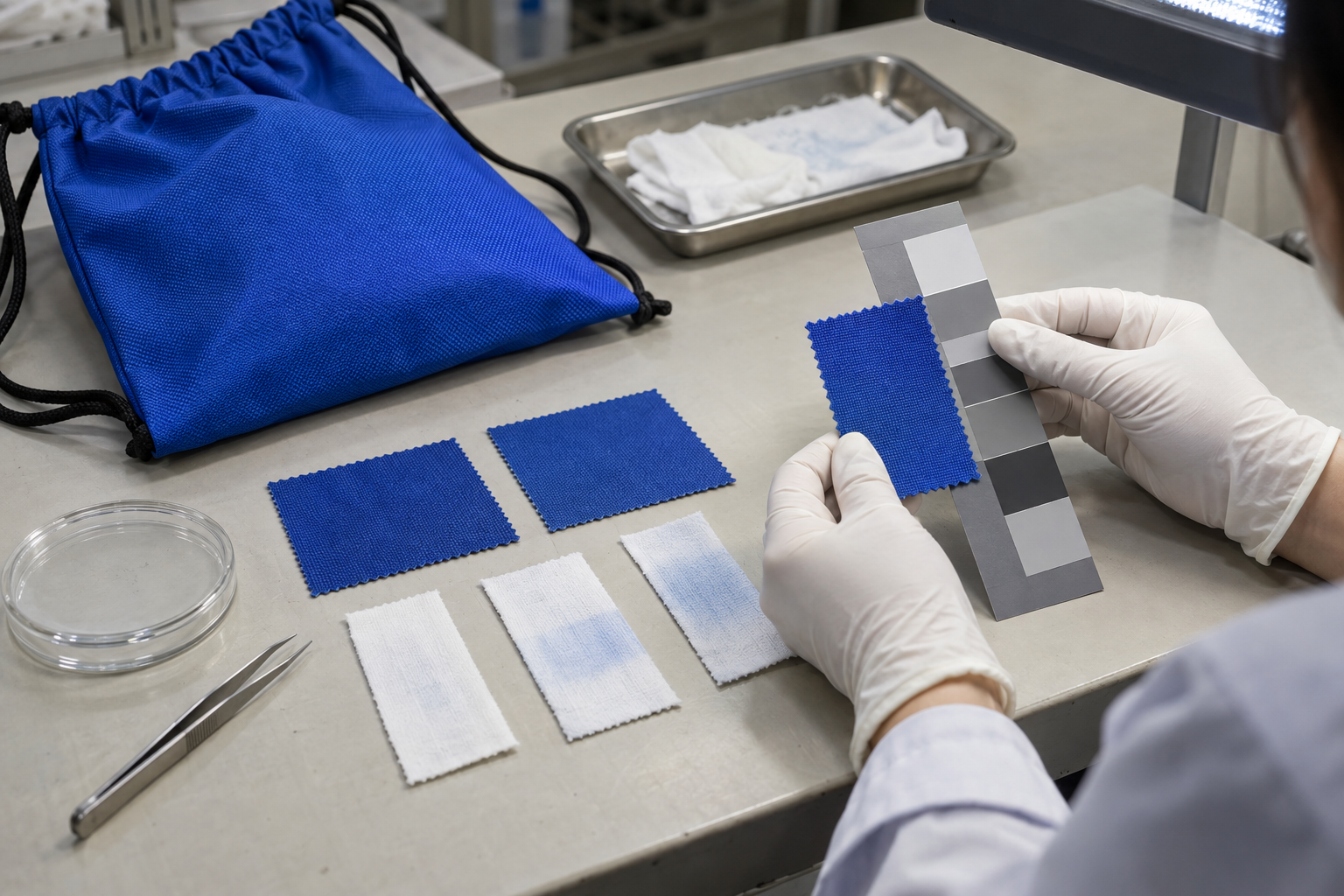
Editorial visualization of specimen comparison under controlled light. It does not display a real LUCKYSTAR test result or rating.
Visual grading should use the prescribed scale, lighting, background and viewing practice. ISO 105-A02:1993 covers the grey scale for assessing color change; ISO 105-A03:2019 covers staining of adjacent fabrics. ISO lists both as current after 2025 confirmation.
Instrumental color measurement can support shade-difference analysis, but it does not silently replace a method’s required visual assessment. If a buyer wants CIELAB or ΔE data, the instrument geometry, illuminant, observer, aperture, specimen preparation and averaging rule should be written into the protocol.
| Result field | Good reporting practice | Weak reporting practice |
|---|---|---|
| Specimen identity | Product, colorway, lot and revision | “Blue polyester” |
| Method | Full designation and edition | “Industry standard” |
| Exposure | Exact dry/wet, wash, sweat or light condition | “Passed color test” |
| Assessment | Color-change and staining grades stated separately | One unexplained number |
| Individual data | Each specimen plus range/average if required | Only the best result |
| Photos | Before/after with controlled identifiers | Unlabeled phone photo |
| Deviations | Any change from the method disclosed | Deviation omitted |
| Conclusion | Limited to the tested specimen and criteria | Whole product line declared compliant |
Set Acceptance Criteria Before the Test
Standards usually tell the laboratory how to test; they do not automatically decide what is commercially acceptable for a specific bag. Set the limits before viewing results.
Acceptance may vary with:
- intended use and contact risk;
- dark versus light colorway;
- fashion effect versus exact brand-color requirement;
- printed versus plain surface;
- washable claim and care label;
- retailer manual or destination requirement;
- whether the result concerns color change, staining or both.
Avoid publishing a single number as a LUCKYSTAR-wide minimum unless it has been formally approved for the exact product family and method. Order-specific values should remain in the tech pack, approved sample record and inspection/test plan.
Choose Colorways and Samples Intelligently
Testing one easy color does not automatically cover the palette. Select high-risk colors using evidence from dye or print chemistry, depth of shade, process route, prior results and intended contact—not stereotypes such as “every dark color is worst.”
Suggested colorway strategy
| Program situation | Sensible sample selection | Reason |
|---|---|---|
| One solid color | Production-intent material from the actual lot | Direct evidence for the order |
| Several colors, same material/process | Technically justified high-risk shades plus buyer-required colors | Reduces unsupported family claims |
| Different dye/print routes | At least one representative from each route | Processes are not equivalent |
| White logo on dark polyester | Include decorated specimen and heat/storage condition | Migration may affect pale artwork |
| Mixed-color bag | Test individual components and contact interfaces | One component can stain another |
| Reorder with supplier/material change | Retest affected color/process | Earlier evidence may no longer apply |
Sample quantity should reflect risk, order size, test variability and buyer policy. Identify whether specimens came from lab development, pre-production, top-of-production or finished stock. Destructive test pieces should not be returned to saleable inventory.
Connect Laboratory Testing to Production QC
Laboratory qualification and production inspection have different purposes. A colorfastness report evaluates selected specimens under defined conditions. Production QC verifies that the lot matches approved color, construction and workmanship.
| Control stage | Main color task | Evidence to retain |
|---|---|---|
| Material development | Compare candidate dye/print/finish combinations | Lab dips, strike-offs and test results |
| Sample approval | Confirm target shade and process | Signed sample and approved physical/digital reference |
| Pre-production | Verify final material, print and components | PP sample, BOM and test plan |
| Incoming/in-line | Detect lot or panel shade drift | Roll/lot records and inspection results |
| Finished lot | Check visible consistency and selected performance requirements | Inspection report and any agreed retest |
| Reorder | Confirm reference, lot and process continuity | Change-control record and retained standard |
The custom drawstring bag sample-development process helps establish the reference. The drawstring bag tech-pack guide shows how to document tolerances and test requirements.
Common Testing Mistakes and How to Prevent Them
| Mistake | Why it creates risk | Prevention |
|---|---|---|
| Testing only the base fabric | Print, cord or coating may fail separately | Map every colored contact component |
| Reporting “pass” without a limit | Reader cannot reproduce the decision | State method, grade and acceptance criterion |
| Using a development swatch for bulk claims | Production dye lot may differ | Link sample to the production lot |
| Confusing shade match with fastness | Initial accuracy says nothing about later transfer | Approve color and exposure performance separately |
| Calling the bag washable after one fabric test | Whole-bag components may change | Conduct a defined finished-bag care trial |
| Testing one color for a broad palette | Risk may vary by shade and process | Use a documented representative-color strategy |
| Ignoring wet contact | Damp friction can behave differently | Include wet rubbing when use justifies it |
| Claiming months of outdoor life from one lab result | Real sunlight conditions vary | Report the controlled method and scope only |
| Treating a lab logo as product certification | Accreditation scope and result scope differ | Verify the exact method and report |
When to Use a Third-Party Laboratory
Independent testing is useful when a retailer manual, contract, destination requirement, claim or project risk calls for it. ISO/IEC 17025 addresses competence, impartiality and consistent operation of testing and calibration laboratories.
Do not assume every service offered by an accredited laboratory is within its accredited scope. Ask for the applicable scope, method edition, specimen requirements, turnaround assumptions and report format. The quotation should distinguish testing cost from product cost and state who owns the original report.
How LUCKYSTAR Supports Colorfastness Planning
LUCKYSTAR supports buyers by coordinating product specification, sample development, decoration selection and order-specific quality requirements for custom polyester drawstring bags. The value is not a blanket claim that every polyester color passes every test. It is a controlled workflow that connects intended use with material, color, printing and verification decisions.
Depending on the confirmed project scope, that workflow can include:
- reviewing bag use, contact surfaces and care claims;
- identifying body, cord, lining, reinforcement and decoration specimens;
- documenting color references and production-intent sample revisions;
- coordinating lab dips, strike-offs or decorated samples;
- aligning test method and acceptance criteria before testing;
- arranging external testing when required by the buyer or project;
- preserving approved references and change records for reorders.
For supplier qualification, start with our custom bag manufacturer guide. Then apply the drawstring-specific questions in How to Choose a Custom Drawstring Bag Manufacturer. Exact materials, testing, sample quantity, MOQ, price and lead time remain subject to specification and written confirmation.
RFQ Checklist for a Color-Controlled Polyester Bag
| RFQ field | Information to provide |
|---|---|
| Intended use | Contents, contact surfaces, climate, outdoor exposure and reuse |
| Bag specification | Size, polyester construction, weight/denier and finish |
| Color | Physical standard or approved digital reference plus viewing conditions |
| Components | Cord, lining, reinforcement, binding, thread and hardware colors |
| Decoration | Method, artwork, print area, pale colors over dark fabric and curing route |
| Care claim | None, wipe-clean, hand wash or another defined instruction |
| Test scope | Rubbing, laundering, perspiration, light, water or migration as relevant |
| Method | Standard and edition or fully written buyer protocol |
| Acceptance | Separate limits for color change, staining and decoration performance |
| Sampling | Development, PP or production stage; quantity and colorway selection |
| Evidence | Internal report, external laboratory report, photos and retained reference |
| Order details | Quantity, destination, packaging and delivery window |

Send LUCKYSTAR your color standard, intended use, decoration artwork and required test method for an order-specific review.
Frequently Asked Questions
What is the most important colorfastness test for a polyester drawstring bag?
There is no single test for every use. Dry and wet rubbing are often important because bags contact clothing and hands, but washable, sports or outdoor products may also require laundering, perspiration or lightfastness testing.
Does polyester automatically have good colorfastness?
No. Performance depends on the colorant, dyeing or printing process, fixation, shade, finish, substrate and exposure. Test the actual production-intent material and colorway.
What is the difference between dry and wet rubbing?
Both measure color transfer under controlled rubbing, but the white test cloth is dry in one condition and wetted in the other. Wet contact can expose a different risk and must be reported separately.
Is a washable label justified by ISO 105-C06 alone?
Not necessarily. ISO 105-C06 assesses textile colorfastness under defined laundering conditions. A complete bag may also change dimension, coating, hardware, cord or print adhesion, so a finished-product care trial may be needed.
Should sublimated and screen-printed bags use the same test plan?
Not automatically. The base-fabric risks overlap, but sublimation places color within polyester while screen printing adds an ink film. Decoration-specific adhesion, cracking, rubbing or migration checks can differ.
How is colorfastness graded?
Applicable methods may use prescribed grey scales or other evaluation procedures for color change and staining. The report must identify the scale, conditions and separate result for each assessed outcome.
Can one tested shade cover all colors in an order?
Only when a documented technical rationale and buyer specification allow representative testing. Different shades, dye recipes and printing routes can perform differently; high-risk and brand-critical colors may need direct testing.
Does a spectrophotometer replace visual grading?
Not unless the agreed method and specification say so. Instrumental color data can supplement shade control, while many colorfastness methods prescribe visual assessment using defined grey scales and viewing conditions.
When should polyester dye migration be checked?
It is especially relevant when pale heat-transfer graphics, coatings or adjacent materials contact dark polyester during heat application or warm storage. Use a controlled protocol suited to the print system and supply chain.
When must a reorder be retested?
Review retesting after changes to the fabric source, dye or print recipe, colorway, finish, coating, decoration, cord, lining, process or testing requirement. An unchanged logo does not prove unchanged performance.
Final Takeaway
A useful polyester drawstring bag colorfastness plan begins with exposure, not a generic checklist. Separate color change from staining, test the production-intent body and relevant components, use current methods with pre-agreed acceptance limits, and connect laboratory results to production lot control. That creates evidence a buyer can understand without extending one sample result beyond its actual scope.
Explore LUCKYSTAR’s custom drawstring bag options or request a project-specific quotation with your color, artwork and testing requirements.
Technical References
- ISO 105-X12:2016 — Colour fastness to rubbing
- ISO 105-C06:2010 — Colour fastness to domestic and commercial laundering
- ISO 105-E04:2013 — Colour fastness to perspiration
- ISO 105-B02:2014 — Colour fastness to artificial light
- ISO 105-A02:1993 — Grey scale for assessing change in colour
- ISO 105-A03:2019 — Grey scale for assessing staining
- AATCC TM8 — Colorfastness to Crocking: Crockmeter
- AATCC TM61 — Colorfastness to Laundering: Accelerated
- ISO/IEC 17025 — Testing and calibration laboratory competence