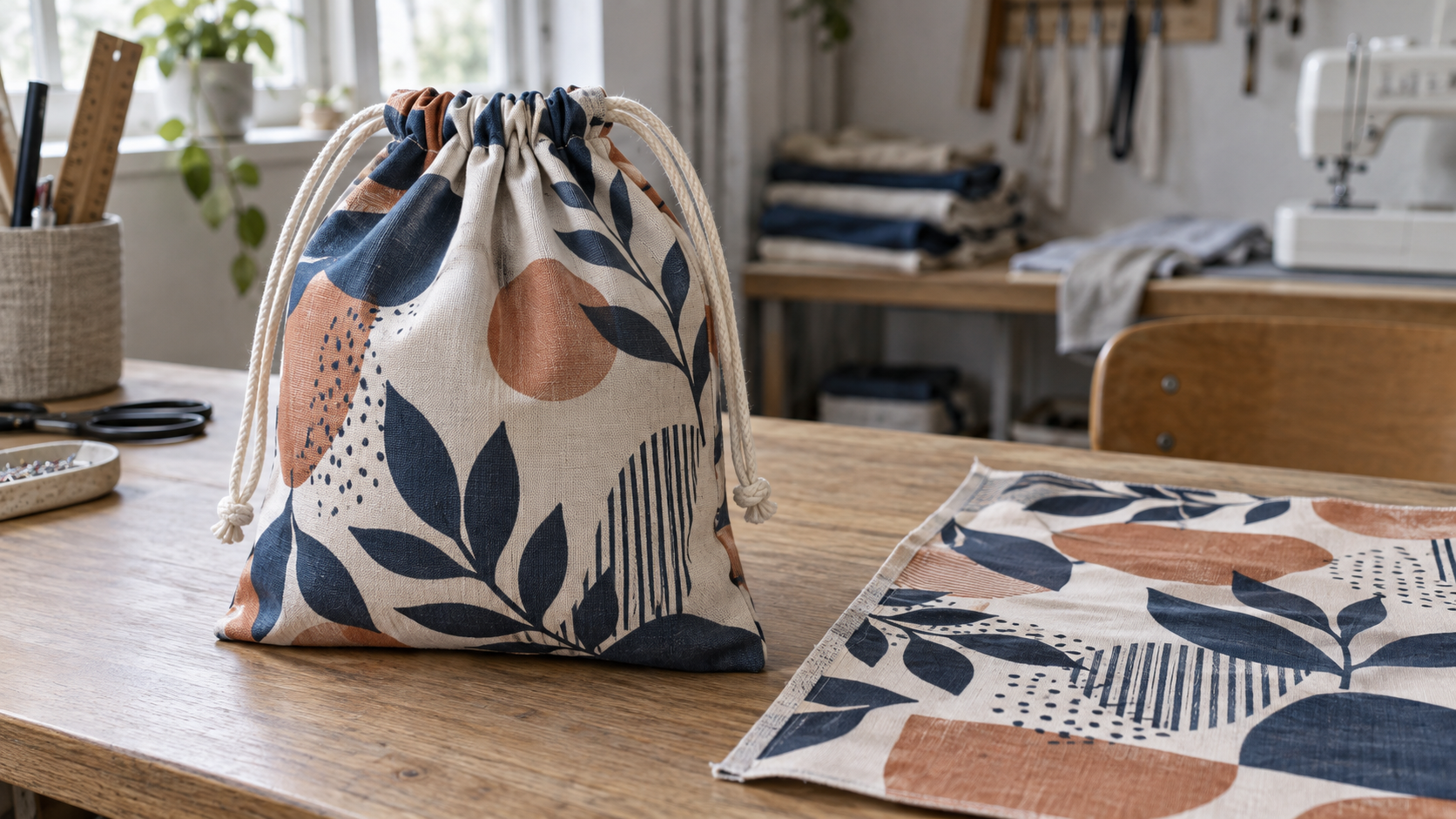
Embroidery vs Printing for Cotton Drawstring Bags
Last reviewed: September 16, 2026
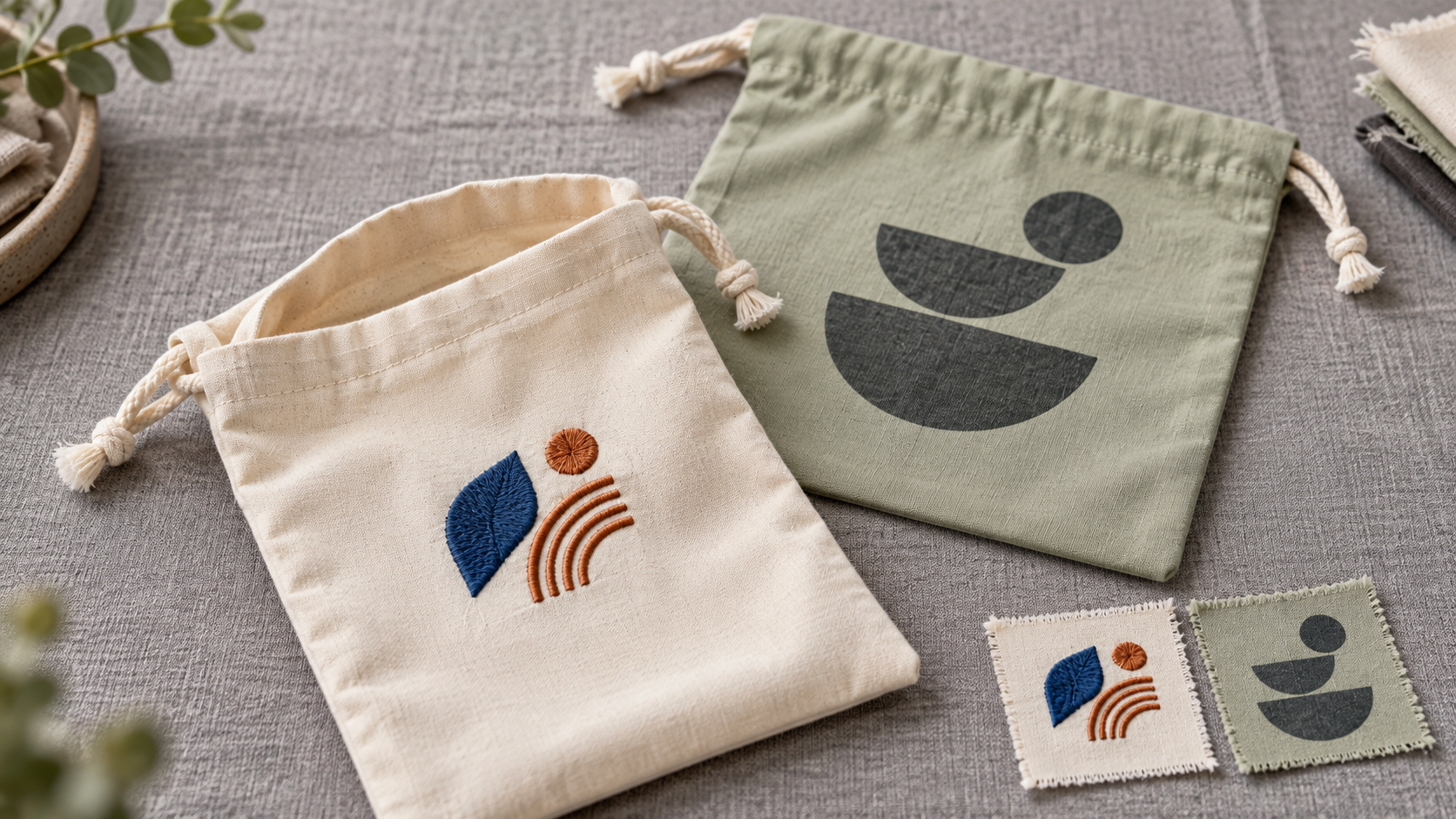
Embroidery is usually the stronger starting choice for a compact premium mark on a medium- or heavier-weight cotton drawstring bag. Printing is usually the stronger starting choice for fine detail, small lettering, gradients, broad artwork or a lightweight pouch that must stay soft and easy to gather.
That answer is only the beginning. Embroidery changes the fabric through repeated needle penetration, thread tension, underlay and backing. Printing places ink or another printed layer on the cotton surface and can change color, opacity, hand and cleaning behavior. On a drawstring bag, both methods must also survive folding, cinching, filling and contact with the contents.
This buyer guide compares the two routes specifically for cotton pouches, sacks and backpack-style drawstring bags. It links decoration to fabric weight, weave, lining, cord channel, contents and approval tests. For the complete menu of decoration options, start with our custom drawstring bag printing methods guide. To develop a project, review LUCKYSTAR's custom drawstring bags.
Scope note: “Printing” covers several process families. Screen printing, digital textile printing and transfer printing do not share identical chemistry or performance. Every quotation and approval should name the proposed print method, ink/transfer system and production sequence. Embroidery and print outcomes remain subject to the exact cotton fabric, artwork, sample and written specification.
Quick selection table
| Requirement | Embroidery usually starts ahead | Printing usually starts ahead | What must be sampled |
|---|---|---|---|
| Small premium crest or monogram | Raised thread, depth and tactile identity | Possible but visually flatter | Stitch clarity, backing and puckering |
| Fine text or detailed illustration | Detail may need simplification | Appropriate print route can retain more graphic detail | Minimum line/gap and fabric texture |
| Large solid artwork | Can become heavy, stiff and expensive | Usually more practical | Ink hand, opacity and fold behavior |
| Lightweight cotton pouch | Dense stitches can distort the panel | A light compatible print may preserve drape | Strike-off and gathered sample |
| Heavy canvas-like cotton | Stable base may support embroidery | Bold print can work well on texture | Needle/hoop and ink-fill tests |
| Artwork with many colors/gradients | Thread colors and stitch logic limit translation | Digital or process print may be stronger | Color control and care test |
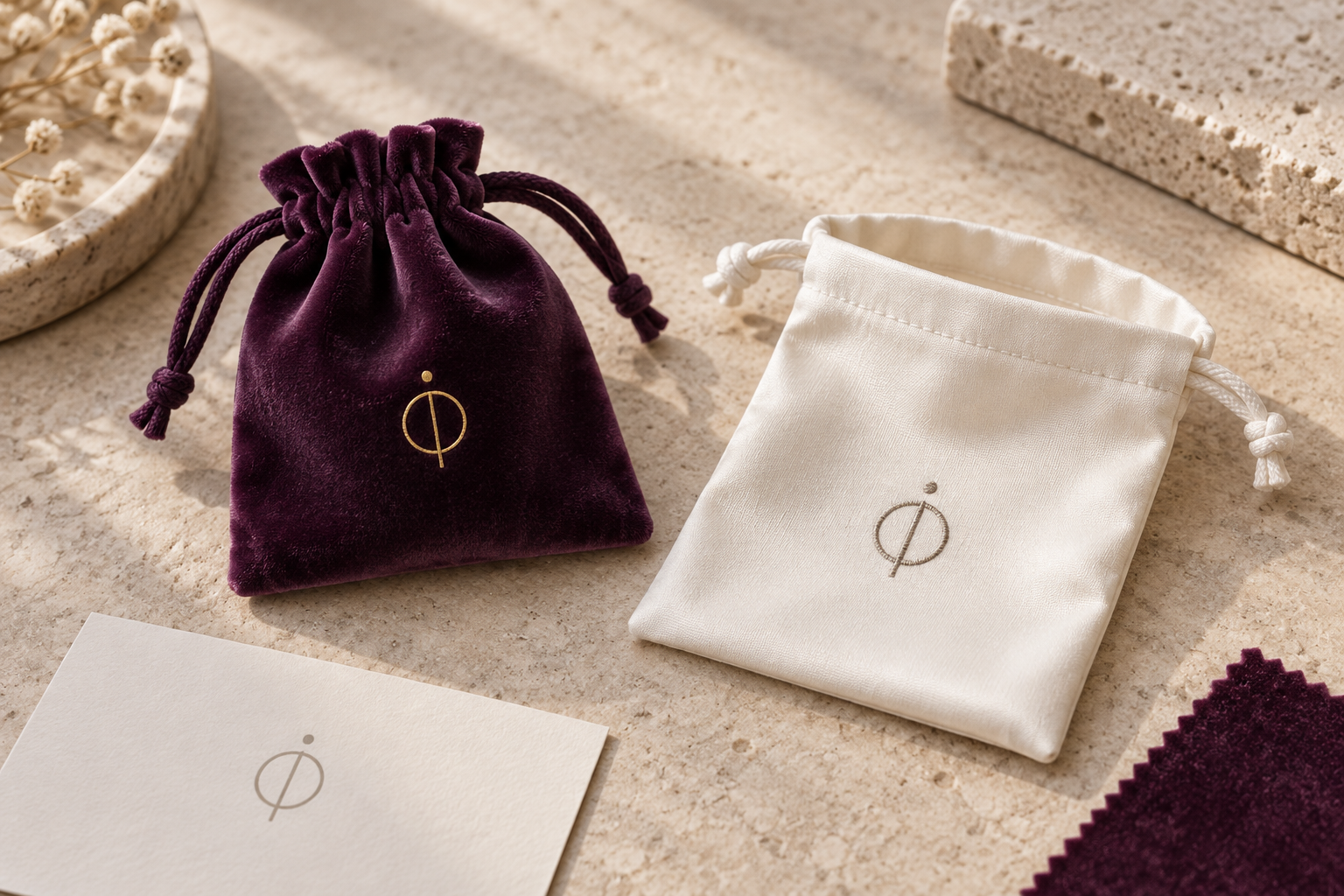
| Unlined jewelry or gift pouch | Backing/thread reverse may touch contents | Printed reverse is usually cleaner inside | Interior appearance and abrasion |
| Local premium mark plus broad graphic | Hybrid solution may work | Hybrid solution may work | Order of operations and alignment |
The fundamental difference: stitches versus a printed surface
Embroidery converts artwork into machine instructions: stitch types, directions, density, underlay, sequence, trims and color changes. The result has height, texture and thread sheen. It is not a colored-pixel reproduction of the source logo.
Printing converts artwork through a named ink or transfer workflow. A direct screen print deposits ink through a stencil; a digital route may build color directly or through a transfer. Printing can preserve fine lines and broad shapes more naturally, but the result depends on cotton absorbency, weave, fabric shade, ink opacity, curing and any pretreatment.
| Design dimension | Embroidery | Printing |
|---|---|---|
| Physical structure | Thread penetrates and spans the fabric | Ink/print system sits on or enters the surface |
| Visual character | Dimensional, tactile, directional sheen | Flat to moderately raised, method-dependent |
| Artwork translation | Requires digitizing into stitch objects | Requires separations/profile/file preparation |
| Small detail | Limited by thread, needle, density and fabric | Limited by mesh/drop/transfer and fabric texture |
| Large coverage | Adds stitches, weight, time and stiffness | Adds ink/transfer area and may affect hand |
| Reverse side | Bobbin thread and backing may be visible | Usually little interior structure for direct print |
| Main cotton risk | Puckering, pull, holes, distortion, scratchy backing | Bleed/spread, weak opacity, cure, shrink interaction |
Cotton and canvas are not interchangeable labels
Cotton identifies a fiber; canvas identifies a fabric construction that may be cotton, a blend or another fiber. A light cotton muslin pouch and a heavy cotton canvas sack behave very differently under both a needle and ink.
Before selecting decoration, specify:
- fiber composition and declared percentage;
- weave or knit construction;
- finished GSM or oz weight where appropriate;
- yarn size and surface texture;
- natural, bleached or dyed base shade;
- preshrunk/washed/finished condition;
- coating or treatment, if any;
- lining, padding or insert;
- intended care instructions.
Use our Cotton vs Canvas Drawstring Bags article to separate fiber, construction and fabric-weight questions. The best materials for custom drawstring bags guide helps compare cotton with synthetic and specialty alternatives.
When embroidery is the stronger candidate
A compact mark needs tactile value
Thread catches light differently as stitch direction changes. That dimensional surface can suit gift pouches, premium retail packaging, hospitality kits or branded merchandise where the logo is intentionally felt as well as seen.
The artwork can be simplified into stitches
Embroidery works best when shapes, borders, counters and lettering can be interpreted at the final physical size. A complex gradient logo may need an approved embroidery-specific version rather than a literal conversion.
The cotton has enough stability
A reasonably stable medium-weight woven cotton often supports a local embroidery better than a very light, loose fabric. Heavier fabric is not an automatic guarantee: dense thread can still tunnel, distort or create stiffness. The actual combination of fabric, backing, hooping and digitizing must be proven.
When printing is the stronger candidate
The design depends on fine graphic information
Printing can be the clearer route for small lettering, fine linework, halftones, gradients or photographic elements. Cotton weave still establishes a practical detail limit, so the approved sample must be made at final size.
Coverage is broad
A large embroidered area accumulates stitch time, thread mass and rigidity. Printing generally handles a broad graphic more efficiently, although a heavy opaque ink field can also stiffen a light pouch. Negative space can improve both cost and drape.
The inside should remain smooth
An unlined pouch may hold jewelry, cosmetics, eyewear, baked goods in primary packaging, or delicate components. Embroidery can expose bobbin thread, trims and backing inside. A suitable print may leave a cleaner interior, but food contact or sensitive-product claims require order-specific material and compliance review.
“Printing” must be named in the RFQ
A buyer should not compare embroidery with a vague word. Identify the proposed print route.
| Print route | Useful starting application on cotton | Key item to prove |
|---|---|---|
| Screen printing | Bold spot-color logos and stable repeat quantities | Ink deposit, opacity, cure and fabric texture |
| Direct digital textile print | Detailed or multicolor art on compatible prepared cotton | Pretreatment, profile, white/underbase and cure |
| Heat-transfer family | Short runs, detail or variable versions with a compatible system | Film/hand, edge bond, heat mark and wash behavior |
| Pigment-based direct print | Selected cotton applications, subject to supplier system | Color, hand, cure and abrasion |
| Specialty ink/effect | Metallic, puff or other approved accent | Crack, rub, fold and compliance evidence |
For a deeper screen-versus-transfer decision, continue to Screen Printing vs Heat Transfer for Drawstring Bags. Do not assume that a process approved on polyester will use the same chemistry or settings on cotton.
Embroidery digitizing is production engineering
An embroidery machine does not simply read an AI, SVG or PDF logo as a finished stitch plan. The source art must be digitized. Wilcom's technical documentation explains that fabric settings influence stitch density, underlay and pull compensation; its Auto Fabrics guide treats light woven cotton differently from stretch knits, heavy twill and other surfaces.
Stitch types change the visual result
Running stitches suit outlines and details; satin columns can create smooth narrow shapes and lettering; fill/tatami stitches cover wider areas. The digitizer selects direction, spacing and sequence so shapes remain legible and the fabric stays stable.
Underlay supports the cover stitches
Underlay is a foundation beneath visible embroidery. It can secure the fabric, lift the cover stitches and improve edges. Too little support may create gaps or sinking; too much can add bulk and stiffness.
Pull compensation is not optional guesswork
Needle penetration and thread tension can draw fabric inward. Wilcom's underlay and pull-compensation guidance connects correct spacing, compensation and underlay with avoiding puckering, bunching and visible gaps. Settings should be adjusted through sew-outs on the nominated cotton, not copied as a universal recipe.
Backing is part of the finished bag
Backing stabilizes the fabric during stitching. It can remain inside the bag, be torn away, be cut away or use another supplier-approved construction. Brother's embroidery stabilizer guidance notes that stabilizer type should consider fabric, design size, stitch count and stitch type.
| Backing decision | Why it matters to a drawstring bag |
|---|---|
| Type and weight | Controls stability, bulk and interior hand |
| Cut-away perimeter | May remain visible or feel sharp inside an unlined pouch |
| Tear-away removal | Aggressive removal can distort stitches or fabric |
| Color | A contrasting backing can show through light cotton |
| Adhesive/fusible route | May change hand, heat exposure or residue risk |
| Lining over embroidery | Hides the reverse but adds material, sewing and volume |
| Sensitive contents | Backing/thread contact can scratch or snag certain items |
If the pouch is unlined, approve both exterior and interior views. If the reverse must be hidden, specify a lining or clean-finish solution and test the resulting bulk at the cord channel and seams.
Lightweight cotton needs special restraint
A dense small emblem can place many needle penetrations into a limited area. On thin cotton, that can produce puckering, holes, stiffness or an uneven rectangle where backing supports the design. Reducing density alone is not always enough; artwork scale, stitch type, underlay, backing and fabric selection work together.
Printing may preserve drape more effectively when it uses a light, compatible deposit. But a large plasticky transfer or heavy opaque screen layer can also overwhelm the pouch. Ask for side-by-side strike-offs on the exact fabric instead of deciding from process names.
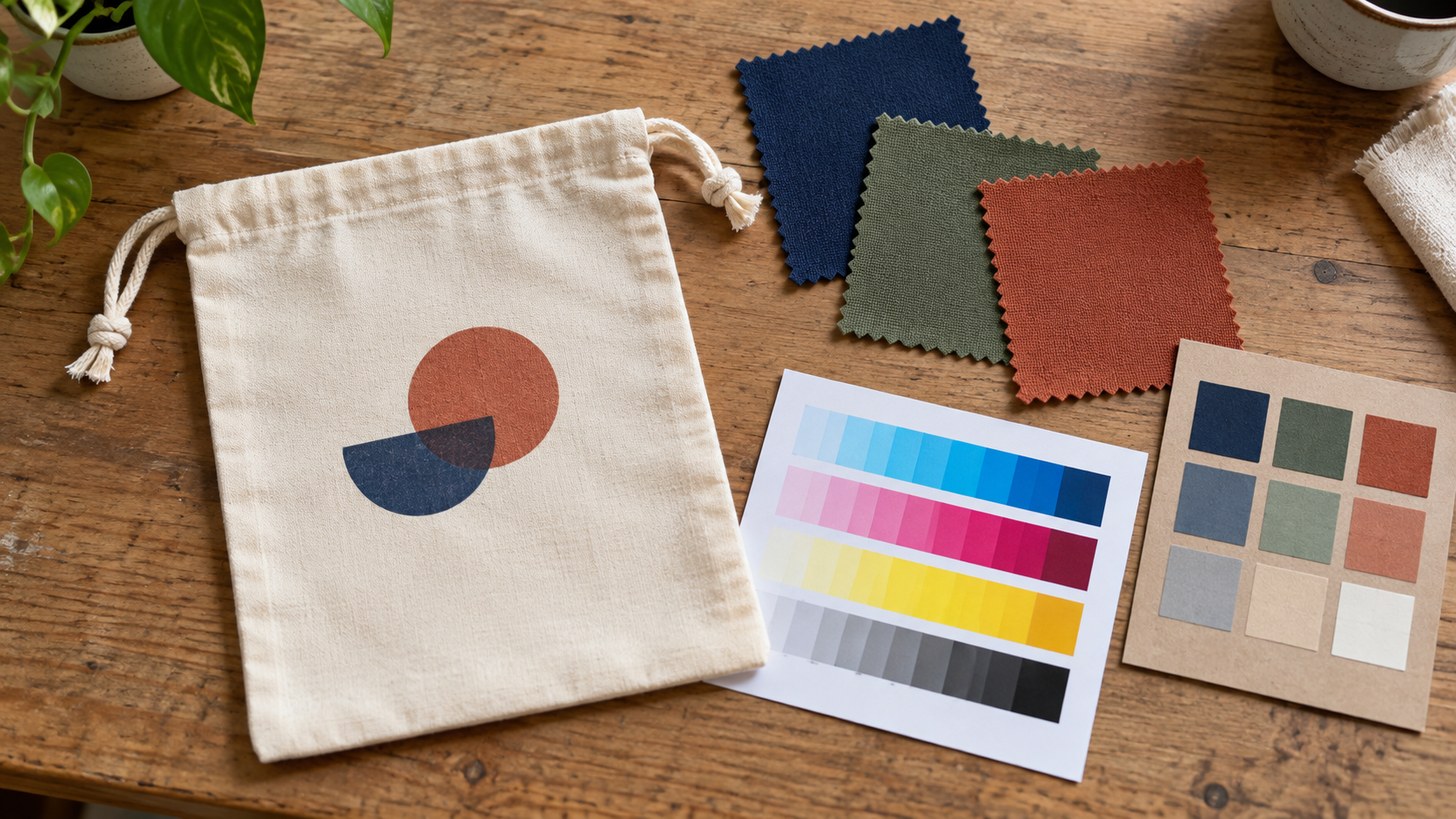
Natural cotton shade changes color perception
“Natural” is not a standardized print color. Undyed cotton can vary from cream to beige and may show seeds or yarn irregularities. That base influences printed color and the contrast of embroidery thread.
A bright white screen ink may look cooler against warm natural cloth. Pale beige thread may disappear. A digital image can shift because the substrate is not white. Approve color on the production fabric under agreed viewing conditions, and define how much natural shade or slub variation is acceptable.
Artwork files diverge after the master logo
Maintain one authorized brand master, then create controlled production assets for each method. Adobe's raster and vector comparison explains why vector paths scale cleanly while raster images are pixel-based. A vector master is useful for logos, but embroidery still requires a stitch file and physical sew-out.
| Asset | Embroidery version | Print version |
|---|---|---|
| Master artwork | Authorized vector reference | Authorized vector/high-resolution reference |
| Production conversion | Digitized stitch objects and sequence | Separations, profile or transfer-ready file |
| Size | Exact finished embroidery width/height | Exact printed width/height |
| Color | Thread brand/code and approved physical match | Ink/print references and approved strike-off |
| Technical layers | Underlay, tie-ins, trims, backing notes | Underbase, white, varnish/effect or cut line |
| Revision | Digitizing file plus sew-out revision | Print file/separation revision |
| Acceptance | Exterior, reverse, stitch quality and fabric | Color, detail, hand, cure/bond and placement |
Do not scale a digitized embroidery file dramatically without review. Stitch density, column width, fills and small elements may need redigitizing at the new physical size.
Simplify artwork without losing identity
Embroidery often needs thicker lines, larger counters and fewer tiny gaps. Gradients may become stepped thread colors, stitch directions or an approved solid-color interpretation. Very small registered symbols and taglines may need to be removed or moved to a printed label.
The buyer should approve the embroidery adaptation as a brand asset, not leave simplification solely to production. Printing can retain more visual information, but cotton texture still affects micro-detail. Build a minimum-detail test into the sample.
Placement must account for gathering and hoop access
A drawstring channel compresses the top of the bag into folds. Dense embroidery placed too close to that zone can resist gathering, create a hard ridge or become visually distorted. The hoop and machine also need physical access without catching cords, seams or a pocket.
Printing has its own support limits: seams and cords can prevent the panel from lying flat on a platen or press. Use the drawstring bag logo placement and print size guide to establish keep-out zones and a finished-bag datum.
| Construction feature | Embroidery concern | Printing concern | Planning response |
|---|---|---|---|
| Top channel | Stiffness, hoop access and stitch distortion | Fold/pressure shadow and poor support | Keep decoration below validated clearance |
| Side seam | Hoop/frame interference | Uneven platen contact | Reduce or reposition artwork |
| Lower cord corner | Dense construction and wearer contact | Support step and abrasion | Avoid anchor zone |
| Front pocket | Hoop access, reverse trapped inside pocket | Multiple layers, zipper and seam obstruction | Decorate pocket/panel before assembly |
| Lining | Can hide reverse but complicates sequence | May need protection from ink/heat | Define decoration before lining closure |
| Gusset | Curved surface and motif distortion | Print wrap and uneven contact | Use a flat primary panel |
Decorate before sewing or after assembly?
Pre-sewing panel embroidery
An unassembled panel can be hooped more easily and keeps cords, lining and seams away from the needle area. The risk is coordinate conversion: cutting and sewing must place the design correctly on the finished pouch.
Embroidery on a finished bag
The operator can reference the sewn body, but access is narrower and the bag's opposite layer must stay clear of the stitching path. Small bags, internal pockets and closed linings can make hooping or machine-arm access impractical.
Pre-sewing or post-sewing printing
Panel printing offers a stable flat surface and can support larger art. Printing a finished bag improves reference to real seams but creates thickness and access challenges. The chosen sequence belongs in the custom drawstring bag manufacturing process and approved sample.
Interior appearance can decide the method
Turn the sample inside out. An embroidery that looks premium outside may expose backing, bobbin thread, jump-stitch remnants or tie-offs. That may be acceptable for a lined promotional backpack and unacceptable for an unlined jewelry pouch.
Define:
- whether the reverse is visible;
- maximum backing perimeter and edge feel;
- whether loose fibers or thread tails are allowed;
- whether a lining covers the reverse;
- content-snag or scratch risk;
- cleaning and color-transfer concerns;
- inspection requirements for both sides.
Printing avoids needle/bobbin structure, but ink can penetrate a light fabric and appear inside. Approve the reverse even for printed bags.
Hand feel and flexibility affect real use
Embroidery concentrates thread and backing in a local area. A small emblem may add desirable body; a large dense fill can turn a soft pouch into a stiff panel. Printing ranges from a very light absorbed pigment feel to a distinct transfer film or heavy opaque deposit.
Assess the decoration while the bag is:
- flat and empty;
- cinched closed;
- folded for packing;
- filled with the intended product;
- repeatedly opened and closed;
- carried against clothing, if it is a backpack format.
A decoration can pass a flat-table review and still be uncomfortable, resist folding or create a hard point against the contents.
Durability is not an automatic embroidery win
Thread can be durable, but exposed satin stitches can snag and abrade. Poor digitizing can create loose loops, broken thread or gaps. Printing can crack, fade, rub or lose adhesion if the system is mismatched or incorrectly cured. The stronger choice is the method that passes the agreed use and care conditions.
| Test or evaluation | Embroidery failure signal | Print failure signal | Buyer control |
|---|---|---|---|
| Dry/wet rubbing | Thread color transfer, fuzzing or snagging | Ink transfer, fade or abrasion | State method, specimen and grade |
| Repeated gathering | Puckering, stitch stress or backing curl | Cracking, fold whitening or stiffness | Use assembled bag and defined cycles |
| Cleaning/wash | Thread shade/shape, shrink mismatch, backing change | Color, adhesion, cracking or hand change | Follow intended care route |
| Filled-bag use | Abrasion, distortion or hard reverse contact | Surface wear and graphic distortion | Define contents and load |
| Snag review | Loops catch on rough contact | Not normally the primary failure | Test relevant contact surface |
| Packing trial | Embroidery crush or impression | Blocking, offset or creasing | Pack in shipment orientation |
The test table is a planning tool rather than a universal protocol. If a recognized method is specified, include its version and acceptance criteria. The custom bag quality inspection checklist helps integrate decoration with dimensions, sewing, cord function and packing.
Cotton shrinkage can move the decoration
If a cotton bag is washed or wet-cleaned, dimensional change can alter both methods. Embroidery thread and backing may shrink differently from the body fabric, encouraging puckering. A print can remain dimensionally stable while the surrounding cotton contracts, visually distorting the mark.
Decide whether the bag is intended to be washed.If yes, approve fabric preparation, care instructions and a decorated sample after the defined care cycle. “Cotton” alone does not prove machine washability or a maximum shrinkage value.
Color matching has different limits
Embroidery color comes from available thread shades and is influenced by sheen and stitch direction. A thread code is not identical to an ink target. Printing can mix or build colors, but fabric shade, opacity, absorbency and viewing light still change perception.
For a color-critical logo:
- identify the master reference and priority colors;
- select thread or ink/print targets;
- approve a physical sew-out or strike-off on production cotton;
- review under consistent light;
- retain the signed sample and codes;
- define tolerance and change-control rules for reorders.
For replenishment planning, adapt the approval records described in our logo and color consistency guide to the cotton pouch specification.
Cost behaves as stitches versus print setup
Embroidery cost is influenced by stitch count, sew time, colors, trims, hooping, backing, size, placement access and rejection risk. Print cost depends on the selected process, color separations or digital preparation, coverage, underbase/pretreatment, application/cure, number of positions and quantity per version.
| Cost driver | Embroidery impact | Printing impact |
|---|---|---|
| Artwork area | More stitches and greater stiffness risk | More ink/transfer area and process load |
| Color count | Thread changes and sequence complexity | More screens for spot printing; digital routes differ |
| Fine detail | More digitizing and potential simplification | File/detail limits and method-specific setup |
| Fabric weight | Stabilizer and hooping strategy | Ink/pretreatment/texture strategy |
| Bag assembly | Access and hoop time | Platen/press access and sequence |
| Reverse finish | Backing trimming or lining | Penetration/protection and interior checks |
| Variants | Separate digitized files and run control | Separate screens/files/transfers and run control |
| Inspection | Stitch, reverse and puckering checks | Color, cure/bond and hand checks |
A small embroidered emblem and a large printed illustration are not equivalent specifications. Ask for two comparable concepts at the same finished bag quality. The drawstring bag pricing guide explains the wider material, construction, packaging and delivery cost stack.
MOQ and lead time follow the chosen specification
Embroidery setup may include digitizing, thread selection, backing and machine planning. Printing may include screens, separations, pretreatment, transfers or color profiling. Custom-dyed cotton, lining and special cords can influence MOQ and schedule more than the decoration itself.
Send quantities by bag color, decoration version and destination. Final MOQ, sampling cost, production time and delivery depend on material availability, current capacity, approval stages and the written order. Our MOQ and production-time guide for drawstring bags maps the information needed for scheduling.
Hybrid decoration can solve a mixed brief
A compact embroidered emblem can be combined with a printed background, tagline or interior message. This can preserve tactile hierarchy without turning the entire graphic into dense stitches.
Hybrid work introduces new controls:
- order of printing and embroidery;
- alignment between the two processes;
- heat/cure effects on thread or backing;
- hooping over a printed surface;
- combined hand and stiffness;
- two artwork revisions tied to one SKU;
- extra handling and inspection.
Approve a complete assembled sample. Separate print and embroidery swatches cannot prove combined alignment or process interaction.
Sample approval should progress through evidence gates
Artwork adaptation gate
Approve the print-ready art and embroidery-specific adaptation at final physical size. Confirm which small elements were simplified or removed.
Fabric strike-off and sew-out gate
Place the printed and embroidered options on the same nominated cotton lot. Compare clarity, color, hand, puckering, reverse finish and drape.
Construction sample gate
Assemble the actual channel, lining, cord and seams. Check decoration position while open, cinched, filled and carried.
Performance gate
Apply the agreed rub, gather, clean/wash, snag, load and packing checks. Document the method and result.
First production article gate
Confirm that bulk uses the released fabric, files, thread/ink, backing, position, bag construction and packing. The drawstring bag sample development workflow provides a structured handoff.
Embroidery bulk-quality checklist
| Inspection point | What to check | Typical defect | Evidence |
|---|---|---|---|
| File identity | Correct stitch revision, size and colors | Wrong logo version | Run sheet and file ID |
| Placement | Finished-bag datum and orientation | Off-center or rotated mark | First article measurement |
| Fabric stability | Flatness around design | Puckering, tunneling or distortion | Approved sew-out comparison |
| Stitch formation | Coverage, tension and clean edges | Gaps, loops, thread breaks | Visual standard |
| Small detail | Counters, letter openings and outlines | Closed letters or lost features | Approved close-up reference |
| Reverse finish | Bobbin, backing, trims and loose ends | Scratchy edge or thread tail | Interior inspection |
| Bag function | Gathering, folding and contents | Stiff panel or blocked channel | Functional sample check |
Printing bulk-quality checklist
| Inspection point | What to check | Typical defect | Evidence |
|---|---|---|---|
| File/separation | Correct artwork, underbase and dimensions | Wrong version or technical layer | Job card |
| Placement | Position from declared sewn-bag reference | Drift or inconsistent centering | First article and interval record |
| Color/opacity | Approved physical strike-off | Weak, shifted or uneven color | Controlled-light comparison |
| Detail | Line, gap, edge and fill | Bleeding, broken line or pinhole | Approved magnified reference |
| Cure/bond | Method-specific verified result | Rub loss, crack or edge lift | Process record and test |
| Surface hand | Approved flexibility and texture | Excessive stiffness or film feel | Signed sample |
| Reverse/packing | Penetration, blocking and fold marks | Interior show-through or offset | Finished and packed inspection |
Diagnose the symptom before changing methods
| Symptom | Embroidery investigation | Printing investigation |
|---|---|---|
| Fabric puckers | Density, underlay, tension, backing, hooping and fabric weight | Cure/heat, fabric shrinkage or heavy ink area |
| Logo looks smaller/narrower | Pull compensation and stitch direction | Artwork scale or substrate absorption |
| Fine text closes | Column width, density and minimum lettering size | Ink spread, mesh/drop/detail limit |
| Color looks wrong | Thread code, sheen, stitch direction and light | Ink/profile, opacity, base shade and light |
| Surface feels too hard | Stitch count, backing and coverage | Ink/film type, underbase and coverage |
| Interior scratches contents | Backing edge, trims and bobbin thread | Dried ink penetration or transfer edge |
| Decoration shifts when cinched | Placement, density and panel stiffness | Placement and broad print stiffness |
| Reorder differs | Thread/fabric/file or digitizing change | Fabric/ink/file/process change |
Sustainability claims remain separate
Cotton is not automatically organic, biodegradable in every product configuration, low-impact or responsibly sourced. Embroidery thread, backing, lining, print chemistry, dyes, finishes and mixed components change the claim. A reusable bag is not automatically environmentally preferable without defined use and evidence.
If the brief requires organic content, recycled thread, restricted substances or a certification claim, verify the entity, scope, standard, validity, product and transaction documentation for the order. LUCKYSTAR does not present historical or upstream certificates as universal company certification.
Trademark and public-image rights need control
The buyer should confirm authority to reproduce the logo, illustration, font or pattern on the ordered product. Embroidery adaptation may modify a mark, so brand-owner approval of the stitch interpretation is important. Manufacturing permission does not automatically allow public portfolio or advertising use.
Keep the authorized master, approved print art, approved stitch file and signed samples under revision control. Product photography and case-study publication require a separate rights check.
Why choose LUCKYSTAR for this project
LUCKYSTAR evaluates decoration as part of the complete cotton drawstring bag rather than as a detached logo service.
Specification-first comparison
We help organize fabric composition/weight, bag dimensions, lining, cord/channel, artwork size, reverse finish, use conditions, test needs and packing assumptions before the method is finalized.
Coordinated print and embroidery sampling
Where both routes are feasible, comparable swatches and assembled samples can answer different questions: visual hierarchy, hand, interior finish, gathering and cost drivers. Sample timing, charges and revisions are project-specific and confirmed in writing.
Construction-aware placement
The team can coordinate decoration with the channel, seams, gusset, lining and lower reinforcements. This reduces the risk of approving a beautiful decoration that cannot be hooped, printed or positioned consistently on the actual bag.
Quality controls matched to failure modes
Embroidery needs stitch, puckering, reverse-side and snag controls. Printing needs color, detail, cure/bond and blocking controls. The project specification can define the relevant checks instead of relying on a generic “quality inspection.”
Claim-aware communication
Commercial terms, testing, materials and certification statements are tied to the final order. We avoid turning a cotton label, marketing phrase or unrelated certificate into a blanket performance or environmental promise.
For supplier selection beyond decoration, use How to Choose a Custom Drawstring Bag Manufacturer. The Custom Bag Manufacturer Guide covers the broader OEM/ODM, sample, quality and delivery framework.
RFQ checklist for comparable proposals
| RFQ field | Information to provide | Why it matters |
|---|---|---|
| Bag construction | Size, gusset, channel, cords, lining, pockets and reinforcements | Defines access and usable decoration area |
| Cotton fabric | Composition, weave, GSM/oz, shade and finish | Drives stitch and print behavior |
| Contents/use | Product, load, abrasion, cleaning and wearer contact | Sets reverse-finish and test priorities |
| Artwork | Authorized vector/raster master, final size and versions | Enables print preparation and digitizing |
| Visual target | Flat/raised preference, coverage and color references | Establishes method direction |
| Quantity matrix | Units by bag shade, design and destination | Reveals setup and version complexity |
| Interior standard | Visible backing, lining and snag/scratch limits | Controls embroidery reverse |
| Testing | Method, cycles, specimen and acceptance criteria | Makes durability measurable |
| Packing | Fold, individual pack, dividers, carton and labels | Prevents crushing, blocking and version errors |
| Delivery | Destination and requested in-hand date | Supports capacity/logistics review |
Place these decisions in a custom drawstring bag tech pack. A completed brief still requires a project quotation that confirms price, MOQ, sample gates, schedule and test documents in writing.
Frequently asked questions
Is embroidery better than printing for cotton drawstring bags?
Not universally. Embroidery suits compact tactile branding on a stable fabric; printing suits fine detail, broad coverage and lightweight bags that need to retain soft drape. Approve both routes on the actual cotton if the decision is close.
Is canvas required for embroidery?
No, but the fabric must be stable enough for the design, stitch plan, backing and hooping method. Lightweight cotton may work with a restrained design; heavy canvas can still pucker if digitizing or tension is wrong.
Why does embroidered cotton pucker?
Possible causes include excessive density, insufficient/incorrect underlay, unsuitable backing, thread tension, hooping, fabric instability or shrinkage. Diagnose the complete system rather than blaming cotton alone.
Can very small text be embroidered?
There is a practical limit determined by font shape, column width, stitch type, thread, needle and fabric. Enlarge, simplify or print tiny text when the physical sew-out is not legible.
Which method is better for an unlined jewelry pouch?
Printing often creates a cleaner interior, while embroidery may expose backing and thread. If embroidery is required, approve the reverse finish, lining option and snag/scratch behavior with the intended contents.
Does embroidery always last longer than screen printing?
No. Thread can snag or abrade, and poor stitching can fail. A compatible, correctly cured print can also be durable. Use order-specific rub, gather, cleaning and use tests.
Can embroidery and printing be combined?
Yes, subject to fabric, artwork and process testing. Define production order, alignment, heat/cure interaction, combined stiffness and two-file version control.
How should colors be matched?
Select physical thread and print references, then approve them on the production cotton under agreed light. Thread sheen and stitch direction can make the same nominal shade appear different from flat ink.
Should decoration happen before sewing?
Often it improves access, but it transfers placement responsibility to cutting and assembly. Finished-bag decoration may improve reference to seams while creating hoop/platen limitations. Approve the actual sequence.
What should be tested before bulk production?
At minimum, inspect artwork accuracy, placement, hand, fabric distortion, reverse finish, gathering, filled use and packing. Add rub, cleaning, snag or other tests based on the application.
Can LUCKYSTAR guarantee one MOQ, cost or lead time?
No single term fits every cotton weight, bag structure, stitch count, print route, quantity matrix and inspection plan. Final commercial terms are confirmed after the specification and sampling route are defined.
Final recommendation
Choose embroidery when a compact dimensional mark creates real value and the cotton, backing, interior and stitch plan can support it. Choose a named printing method when artwork detail, broad coverage, soft drape or a clean unlined interior is the priority. Consider a hybrid only when the extra process and alignment controls serve a clear design purpose.
LUCKYSTAR can coordinate material selection, artwork adaptation, sampling and quality controls so the decoration is assessed on the finished bag—not only on a digital mockup or loose swatch.

Provide the finished dimensions, cotton construction and weight, bag shade, lining, intended contents, artwork size, quantity by version and destination. Ask LUCKYSTAR to compare embroidery and print routes. Availability, sample cost, MOQ, quotation, production time, testing and supporting documents remain subject to specification and written confirmation.