
Drawstring Bag Packaging and Carton Optimization
The short answer: optimize drawstring-bag packaging by testing the finished bag, its fold, cord position, surface protection, unit count and master carton as one system. The best carton is not simply the smallest box. It is the smallest validated configuration that keeps cords untangled, print and fabric unmarked, eyelets or tips isolated, counts accurate, carton weight practical and the bag able to recover its approved shape after transit.
For a new program, freeze a physical pack-out before ordering bulk cartons. Record the fold, cord-control method, units per bundle, rows and layers, internal and external carton dimensions, net and gross weight, closure, markings and arrival acceptance criteria. Revalidate the pack-out whenever the bag, carton or distribution route changes.
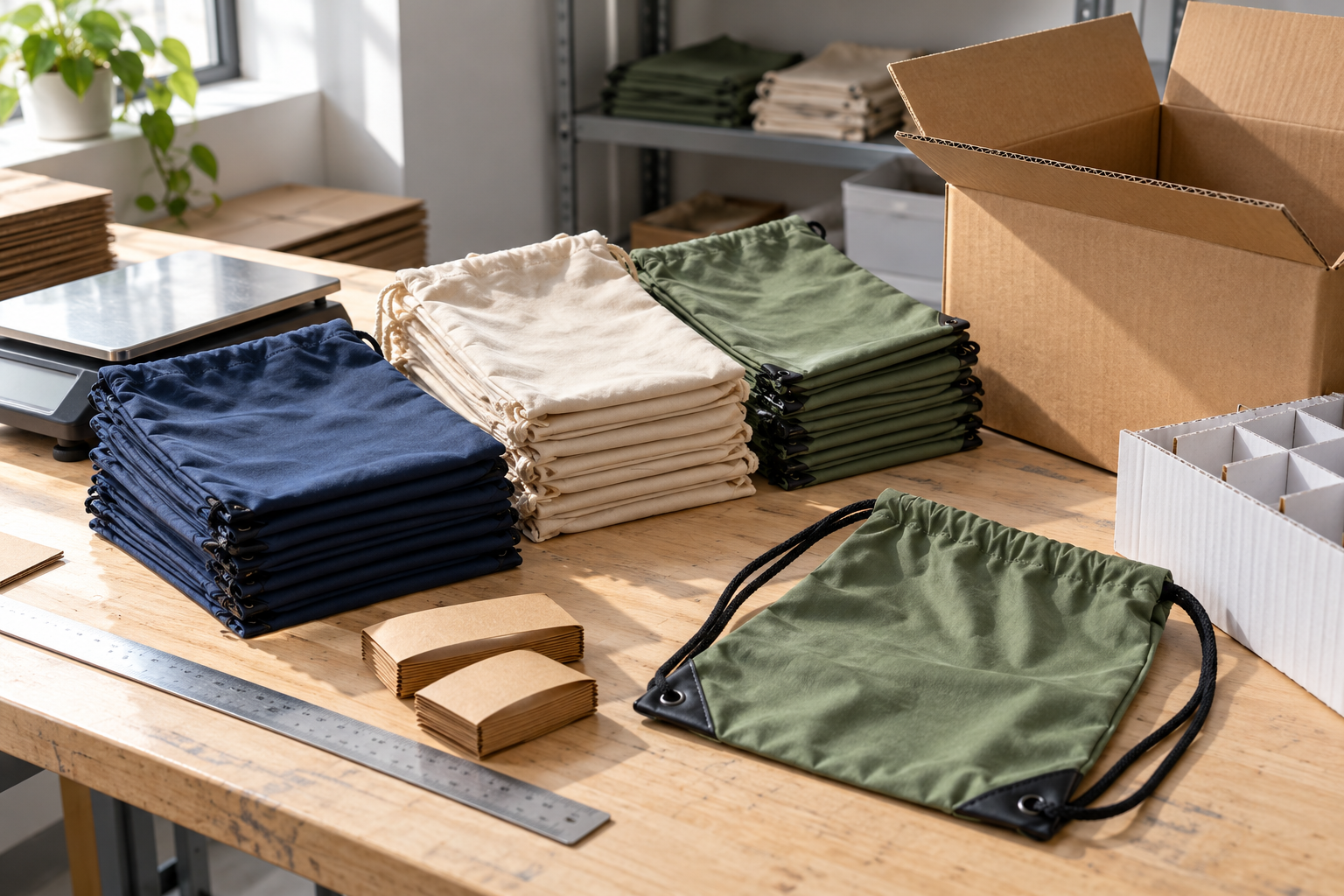
Reference-led editorial scene based on common LUCKYSTAR drawstring-bag formats. It is not a customer order, factory record, certified test or proof of a fixed carton configuration.
This guide is for sourcing, packaging, quality, logistics and brand teams buying custom drawstring bags. It concentrates on the details unique to flexible drawcord products rather than repeating the general advice in our shopping bag packaging and carton optimization guide.
What Does Drawstring Bag Packaging Optimization Mean?
Drawstring bag packaging optimization is the controlled process of choosing a unit pack, fold, cord arrangement, bundle, master-carton grid and transport validation plan that protect the approved bag while avoiding unnecessary material, volume and handling.
It has six simultaneous objectives:
| Objective | What success looks like | Evidence to approve |
|---|---|---|
| Product protection | No unacceptable crease, rub, transfer, deformation, odor or component damage | Unpacked samples after the defined trial |
| Cord control | Cords do not knot, snag, migrate or mark adjacent bags | Open-carton photos and unpacking trial |
| Count accuracy | Every carton has the correct SKU, color and quantity | Packing record and carton inspection |
| Cube efficiency | Carton space is used without harmful compression | Physical grid, settled dimensions and external CBM |
| Handling practicality | Carton weight, closure and shape suit the route | Gross-weight check and route requirements |
| Repeatability | Operators can reproduce the approved pack | Visual packing specification and first-carton reference |
Optimization is therefore a qualification exercise, not a promise that one carton count works for every bag.
Quick Decision Table
| Bag characteristic | Main packing risk | Starting control | Validation question |
|---|---|---|---|
| Long double cords | Tangling and snagging | Loop cords inward; use an approved band or channel fold | Do cords pull free without knots? |
| Metal eyelets or tips | Scratching and pressure marks | Isolate hardware from visible panels | Are adjacent bags unmarked after compression? |
| Large screen print | Blocking, abrasion or ink transfer | Face prints inward or use a local interleaf | Does the print pass unpacking inspection? |
| Full-surface sublimation | Crease memory and surface rub | Use a consistent low-stress fold | Does the graphic recover without objectionable fold lines? |
| Natural cotton or canvas | Wrinkles, moisture response and lint | Condition material; avoid excessive compression | Does the bag meet the approved appearance after recovery? |
| Coated polyester | Coating set, blocking or odor concentration | Separate coated faces; control storage conditions | Does coating remain intact and non-tacky? |
| Velvet or microfiber pouch | Nap crushing and pressure tracking | Light pack pressure; tissue or local protection when justified | Does the surface brush back to the approved appearance? |
| Gusseted or structured base | Permanent flattening | Approve either flat-pack or shape-supported pack | Does the base open and sit as intended? |
Begin With the Arrival Standard
Packaging cannot be optimized until the buyer defines what an acceptable bag looks and functions like after unpacking. Agree on measurable or photographically controlled criteria before testing cartons.
Define product damage
List unacceptable conditions such as broken stitching, detached eyelets, cracked print, coating delamination, cord fray, severe creases, color transfer, stained fabric, distorted gussets or an odor outside the agreed assessment method.
Define packaging degradation
A scuffed master carton may be commercially acceptable on one wholesale route but not on another. State acceptable limits for carton bulge, crushing, moisture exposure, tape failure, puncture and label legibility.
Define recovery time
Soft goods may relax after removal from compression. If recovery is allowed, specify the time, temperature, humidity, hanging or steaming restrictions and inspection method. Do not quietly improve tested samples in a way customers will not reproduce.
The International Safe Transit Association advises defining product damage tolerance and acceptable package condition before running a test. That principle prevents teams from deciding pass or fail only after seeing the result.
Freeze the Production-Intent Bag Before the Carton
Do not finalize cartons from an early sample if the material, coating, print, cord, hardware, size or fold will change. Small changes alter packed thickness and friction; across dozens of units they can change the carton grid materially.
| Bag input to freeze | Why it changes the pack-out |
|---|---|
| Finished width, height and gusset | Controls fold footprint and stack geometry |
| Fabric family, weight and finish | Changes bulk, friction, recovery and moisture response |
| Cord material, diameter and length | Changes bundle thickness and tangling behavior |
| Eyelets, aglets, buckles or stoppers | Create hard contact points and concentrated pressure |
| Print method and coverage | Sets surface-to-surface contact risk |
| Pocket, zipper, lining or reinforcement | Creates uneven thickness and stacking ridges |
| Labels, hangtags and inserts | Affect unit orientation, count and abrasion risk |
| Approved tolerances | Determine how much space the real production range needs |
The custom drawstring bag manufacturing process explains when these decisions should be approved. The carton should follow the product—not force a late bag redesign without requalification.
Measure the Packed Unit, Not the Flat Pattern
A sewing pattern or nominal finished size does not reveal the unit’s settled shipping volume. Make several production-intent units, pack them exactly as proposed and measure the stack under a defined, repeatable condition.
Record three dimensional states
| State | Measurement purpose | Common error |
|---|---|---|
| Finished/open bag | Confirms product specification | Using it as the carton dimension |
| Individually folded unit | Confirms footprint and local thickness | Measuring one unusually flat sample |
| Settled bundle | Predicts rows, layers and carton height | Compressing by hand without a defined load or time |
Measure a representative group, not only the thinnest unit. The drawstring bag size and capacity guide covers finished dimensions; the present article uses those dimensions as an input to pack-out engineering.
Choose a Fold That Protects the Drawstring System
The fold must control the bag body and the cord without creating hard ridges, concentrated print contact or trapped loops.
| Fold option | Advantages | Risks | Best fit |
|---|---|---|---|
| Flat, no body fold | Minimal body crease | Large footprint; cords remain exposed | Small pouches or shallow cartons |
| Half fold | Simple and fast | One strong fold line; hardware may overlap | Medium flexible bags |
| Thirds fold | Compact, balanced footprint | More folds and operator variation | Long bags with light fabric |
| Inward side fold | Controls width and cords | Side seams can create ridges | Drawstring backpacks |
| Rolled pack | Soft distribution of creases | Slower, irregular diameter | Selected soft pouches, only if validated |
| Shape-supported pack | Preserves gusset or presentation | Higher material and cube | Premium or structured formats |
Create a visual standard showing front/back orientation, first fold, second fold and final cord position. Written instructions such as “fold neatly” are not sufficient for consistent bulk packing.
Approve this configuration during the custom drawstring bag sample development process, while the product and pack can still be changed without disrupting bulk production.
Control Cords Before They Enter the Carton
Loose cords are the defining packing risk of this category. They can knot adjacent units, slip into carton seams, catch on eyelets, pull reinforced corners into a distorted position and slow unpacking.
Cord-control methods
| Method | Suitable use | Watch point |
|---|---|---|
| Tuck inside the bag | Simple pouches with sufficient opening | Cord must not print through or create a lump |
| Loop inside the folded footprint | Drawstring backpacks and longer cords | Loop size and position must be standardized |
| Blank paper belly band | Bundle control and reduced loose loops | Band pressure, recyclability and tear-off behavior |
| Removable tie or approved fastener | Complex cord systems | Adds material and removal labor; avoid sharp edges |
| Individual sleeve or bag | High cleanliness or surface-separation need | Material use, condensation and destination rules |
Never tape directly to a decorated fabric or cord unless the exact adhesive, removal method and residue result are approved. The drawstring cord, eyelet and reinforcement guide helps identify stress points that must not be bent or pinched during packing.
Isolate Eyelets, Aglets and Cord Locks
Hard components can turn a soft-goods carton into an abrasion system. Under stacking pressure, one metal eyelet can emboss or scratch the panel next to it.
Use one or more of these controls only when justified by the trial:
- orient hard parts toward carton walls rather than visible print faces;
- stagger components so they do not build one vertical ridge;
- place a small protective patch or interleaf at the contact zone;
- cap or wrap sharp tips with an approved removable material;
- separate premium faces from metal or rigid plastic components;
- reduce layer pressure if the finish shows tracking.
For a deeper component comparison, see metal eyelets versus fabric-reinforced corners.
Protect Printing Without Automatically Overpacking
The correct protection depends on the ink or transfer system, cure, fabric, print coverage, storage temperature, pressure and duration. A visually dry print is not necessarily ready for high-pressure stacking.
| Print/decoration feature | Packing concern | Validation method |
|---|---|---|
| Screen-printed logo | Blocking, scuff, cracking at a fold | Cure check plus pressure/rub and unpacking review |
| Heat transfer | Edge lift, gloss marking, adhesive response | Folded compression and temperature exposure |
| Sublimation | Crease visibility and migration from other parts | Color-transfer and recovery review |
| Reflective print | Surface scratching and reflectivity loss | Rub/contact trial using production materials |
| Embroidery | Snagging, thread pressure and back-side abrasion | Stacked contact and thread security inspection |
| Foil or metallic effect | Pressure tracking and scratch sensitivity | Protected-versus-unprotected pack trial |
The print must first pass its product-level approval. Use the drawstring bag print adhesion and abrasion testing guide and custom drawstring bag printing methods to define the relevant risks. Packaging trials then test what happens during storage and distribution.
Use Individual Packaging Only for a Defined Function
An individual polybag, paper sleeve, glassine-type envelope, tissue wrap or band may support cleanliness, SKU control, retail presentation or surface separation. It should not be added by habit.
| Requirement | Possible solution | Question before approval |
|---|---|---|
| Dust control | Closed sleeve or bag | Is a closed pack necessary for the route? |
| Print separation | Local interleaf or face-to-face orientation control | Can a small contact-zone control replace a full sleeve? |
| Barcode/retail information | Label, band or retail pack | Who applies, verifies and removes it? |
| Assortment identification | Color-coded carton label or bundle marker | Can outer identification avoid extra unit packaging? |
| Moisture barrier | Specified barrier package | Could trapped moisture create a worse outcome? |
| Premium presentation | Tissue, sleeve or rigid support | Does the customer experience justify added cube and labor? |
Do not call packaging “recyclable,” “compostable” or “plastic-free” without evidence for the complete claimed item and destination. If environmental messaging is planned, apply the evidence rules in How to Make Defensible Sustainability Claims for Drawstring Bags.
Build the Carton Grid From Physical Packs
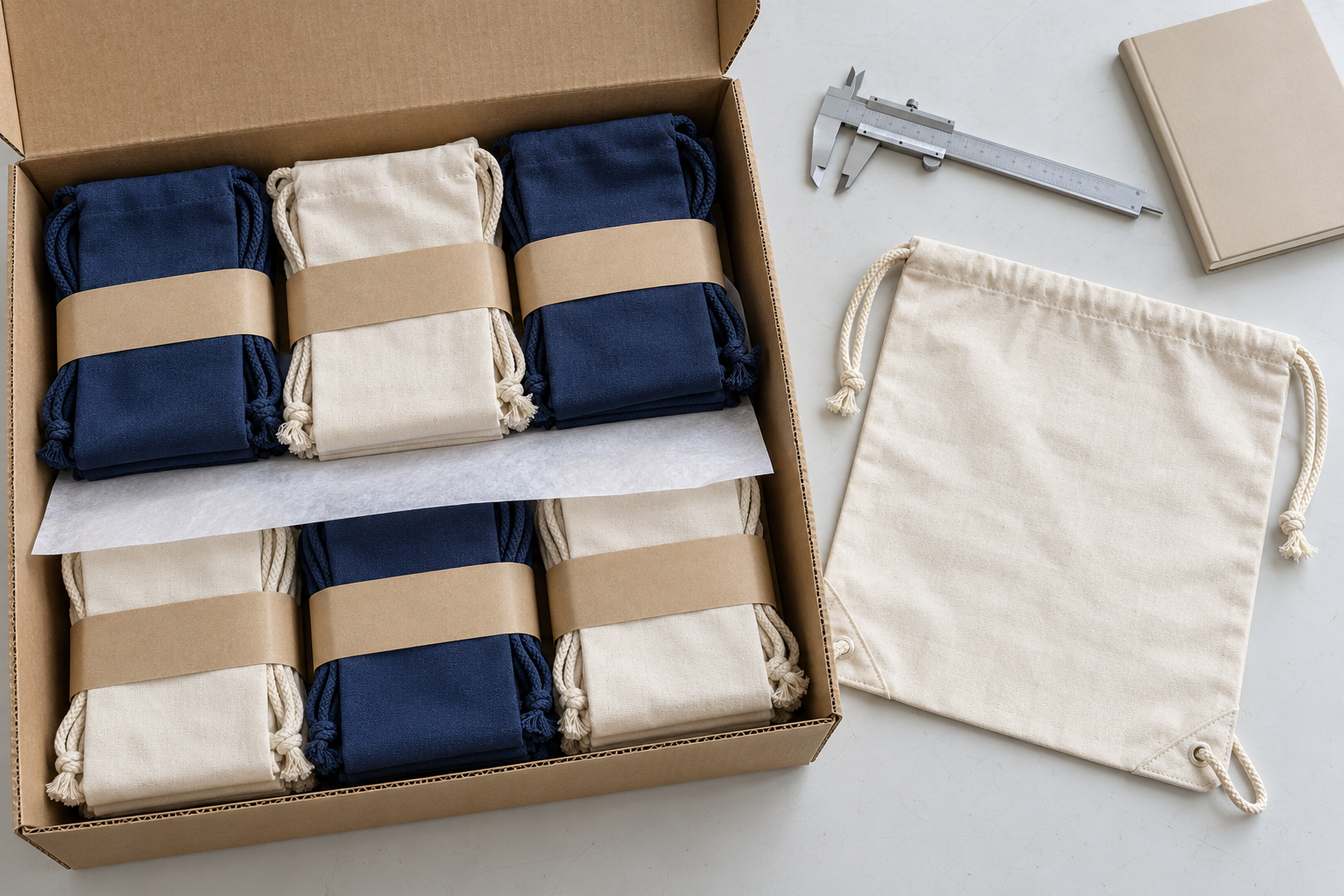
Illustrative pack-out scene. The count, material and carton shown are not a standard LUCKYSTAR specification; every order requires its own physical approval.
Lay out real folded units in candidate rows and layers. Compare at least two practical orientations instead of multiplying ideal dimensions in a spreadsheet.
Candidate-grid worksheet
| Field | Candidate A | Candidate B | Candidate C |
|---|---|---|---|
| Fold footprint | Record actual value | Record actual value | Record actual value |
| Units per row | Count physically | Count physically | Count physically |
| Rows per layer | Count physically | Count physically | Count physically |
| Layers per carton | Trial physically | Trial physically | Trial physically |
| Total units | Verify | Verify | Verify |
| External carton dimensions | Measure closed carton | Measure closed carton | Measure closed carton |
| Net/gross weight | Weigh | Weigh | Weigh |
| Void/movement | Observe | Observe | Observe |
| Product recovery | Inspect | Inspect | Inspect |
| Packing time | Time representative runs | Time representative runs | Time representative runs |
The winning grid is the best verified balance, not necessarily the highest count.
Calculate Cube With External Carton Dimensions
For a rectangular master carton:
Carton CBM = external length (m) × external width (m) × external height (m)
Shipment CBM = carton CBM × number of cartons
Use the closed external dimensions, including normal bulge if present. Internal dimensions help design the grid, but freight cube is normally based on the external shipping package and the carrier’s rules. Confirm rounding, minimum-charge and volumetric-weight methods with the nominated forwarder or carrier.
Compare pack-out efficiency without inventing savings
| Metric | Formula or record | Interpretation |
|---|---|---|
| Units per carton | Physical count | Commercial handling unit |
| Cube per unit | Carton CBM ÷ units per carton | Useful for comparing validated candidates |
| Gross weight per unit | Carton gross weight ÷ unit count | Includes allocated packaging weight |
| Carton utilization | Product/pack volume estimate ÷ internal carton volume | Directional only for compressible textiles |
| Damage/defect rate | Defined failures ÷ inspected units | Must use a stated trial or shipment sample |
| Packing labor | Time per completed carton | Include cord control and verification |
Do not claim a percentage shipping reduction from theoretical nesting alone. Report the baseline, route, carton count, external dimensions, weights and trial result.
Control Net Weight, Gross Weight and Handling
Net weight is the product mass. Gross weight includes products, individual packaging, dividers, carton and closure materials. Both must be based on production-intent units and the final count.
Carton weight should suit the route, customer warehouse rules and local manual-handling practices. A carton can be space-efficient but operationally poor if it is too heavy, difficult to grip, prone to bulging or incompatible with automated conveyors.
| Weight control point | Record |
|---|---|
| Individual packed-unit mass | Representative average and range |
| Total product net weight | Verified count × controlled unit mass |
| Packaging tare | Carton, inserts, bands, sleeves, tape and labels |
| Gross weight | Weighed closed carton |
| Permitted tolerance | Buyer/forwarder requirement |
| Escalation | What to do if weight is outside the agreed range |
Specify the Master Carton, Not Just Its Dimensions
“Export carton” is not a complete specification. The buyer and supplier should agree the style, dimensions, board or performance requirement, flute/construction where relevant, closure and marking.
| Carton field | Specification question |
|---|---|
| Style | Regular slotted carton, die-cut format or another design? |
| Dimensions | Are values internal or external, and in what order? |
| Board/performance | Which material or performance property is required? |
| Joint | How is the manufacturer’s joint formed? |
| Closure | Tape, adhesive, staples or straps; what pattern and material? |
| Liner/divider | Is it required, and what function does it serve? |
| Moisture exposure | What storage and transport conditions apply? |
| Stack orientation | Which panel is the base and which direction is upright? |
| Marking | SKU, color, quantity, destination, dimensions and weight fields? |
| Tolerances | What dimensional, weight and printing limits apply? |
Carton quality must be matched to the filled package and route. A board certificate by itself does not prove that a filled case will protect the bags through distribution.
Avoid Both Excess Void and Harmful Compression
Too much void allows bundles to migrate, rotate and abrade. Too little clearance makes loading inconsistent and can produce bulged panels or force operators to compress products beyond the approved condition.
Warning signs of excess void
- bundles change orientation during a manual handling trial;
- cords or tags migrate into seams;
- the carton rattles or visibly slumps;
- top layers are unsupported;
- count patterns are difficult to audit.
Warning signs of excessive compression
- carton flaps require force to close;
- side walls bulge before transport;
- print transfers or blocks;
- cords, eyelets or zippers emboss adjacent surfaces;
- cotton, coated fabric or gussets do not recover;
- carton weight or shape exceeds route requirements.
Use targeted filler, dividers or a revised grid only when they solve an identified failure. More packaging is not automatically more protective.
Account for Material-Specific Recovery
| Material/construction | Likely packing sensitivity | Practical control |
|---|---|---|
| Light polyester | Crease setting, coating contact, static | Low-stress fold; surface trial |
| 420D/600D-style polyester | Bulk and reinforced-corner ridges | Stagger thick zones; verify recovery |
| Cotton | Wrinkling, humidity response, lint | Condition samples and define appearance tolerance |
| Canvas | High stack bulk and strong fold memory | Compare fewer layers or larger footprint |
| Non-woven PP | Permanent crease or edge distortion | Avoid sharp folds unless approved |
| Mesh | Snagging and irregular stack thickness | Contain cords/locks and avoid sharp contact |
| Velvet/microfiber | Nap pressure marks and lint | Reduce pressure; test local interleaf |
| Laminated/coated fabric | Blocking, odor concentration, coating set | Cure/condition; separate faces when needed |
Material labels alone do not predict the result. Test the actual fabric weight, coating, color, finish and construction.
Plan Assortments and Mixed-SKU Cartons Deliberately
Mixed colors or sizes may reduce carton count but increase pick, count and receiving risks. If assortments are permitted, state the pattern and identification method.
| Assortment control | Requirement |
|---|---|
| Color sequence | Fixed layer or bundle sequence shown visually |
| Size sequence | Clear separation and count per size |
| Bundle quantity | Constant count, band or approved marker |
| Carton total | Reconciles to all bundle counts |
| Label content | Identifies every SKU and quantity inside |
| Partial cartons | Separate approval and marking rule |
| Changeover control | Line clearance between SKUs |
For high-SKU programs, a simpler single-SKU carton may outperform a dense mixed carton once warehouse labor and error risk are included.
Design Carton Markings for Receiving
Marks should allow a receiving team to identify the shipment without opening every case. Typical fields may include purchase order, item/SKU, color, size, quantity, carton sequence, country-of-origin wording where applicable, gross/net weight, dimensions and destination marks.
Requirements vary by buyer and market. Approve the artwork and data source, preserve legibility after tape or stretch wrap, and prevent a carton from carrying obsolete marks from another program. Do not display certification marks or customer trademarks without documented permission.
Validate the Filled Package Against the Real Route
The distribution route determines the hazards. A palletized wholesale case, parcel-delivery pack, airfreight shipment and long ocean route do not experience the same sequence.
| Route factor | Potential hazard | Design/test input |
|---|---|---|
| Parcel handling | Drops, vibration, conveyor impacts | Parcel-specific procedure and damage criteria |
| Palletized truckload | Stack compression and load stability | Filled-carton strength and pallet pattern |
| LTL/mixed freight | Rehandling and mixed-load exposure | Route-relevant general simulation |
| Ocean freight | Long dwell, stacking, humidity changes | Conditioning, compression and recovery review |
| Airfreight | Dimensional rating and rapid handling | External cube, weight and closure security |
| Retail/DC route | Mixed pallets, labels and receiving constraints | Customer routing guide and case identification |
ISTA distinguishes screening tests from general simulations: its 1-Series challenges package integrity but is not designed to simulate environmental occurrences, while the 3-Series models damage-producing transport conditions for defined distribution types. Select a current procedure based on the actual route; do not label an informal office drop as “ISTA tested.” ISO 2234:2000, confirmed current in 2022, describes static stacking tests for complete filled transport packages and unit loads. Standards must be applied in their stated scope and current edition.
Test the Complete Production-Intent Pack
A meaningful trial includes the intended bag, cord, print, unit packaging, count, carton, inserts, closure and markings. Substitutes should be as representative as possible and any limitation recorded.
Useful validation sequence
- Approve product and arrival damage criteria.
- Condition the bag and packaging as required.
- Build the carton using the visual packing instruction.
- Record dimensions, net/gross weight and closure.
- Run the selected screening or route-relevant procedure.
- Inspect the unopened exterior when required by the method.
- Unpack in a controlled sequence and photograph layers.
- Count and inspect products against the pre-agreed criteria.
- Record failures by location and likely mechanism.
- Change one controlled variable, retest and freeze the approved version.
ISTA also recommends retesting when changes to the product, package, process or distribution system could affect performance. That is especially relevant when cord hardware, carton count or fabric finish changes.
Inspect Recovery After Unpacking
The carton is only successful if the bag inside is acceptable. Inspect both immediate condition and the approved recovery condition.
| Inspection point | Immediate check | After approved recovery |
|---|---|---|
| Body panels | Crease, stain, rub, transfer | Residual fold lines or distortion |
| Blocking, scratch, crack, lift | Appearance and adhesion | |
| Cord | Knots, snags, fray, compression | Draw action and symmetry |
| Eyelet/reinforcement | Pull-out, scratch, bend | Functional security |
| Gusset/base | Collapse or ridge | Opens to intended shape |
| Pocket/zipper | Pressure mark, slider contact | Operation and alignment |
| Odor/moisture | Abnormal condition | Result under agreed method |
| Count/assortment | Correct units and sequence | Receiving usability |
Product-level checks can be integrated with the custom drawstring bag quality control checklist and the pre-shipment inspection guide.
If carton pressure or handling exposes structural weakness, separate packaging failures from product failures using the drawstring bag load-capacity test guide.
Translate the Approved Trial Into a Packing Specification
A packing specification should be executable by a new operator and auditable by QC.
| Specification section | Minimum content |
|---|---|
| Product identity | Style, SKU, color, revision and sample reference |
| Unit preparation | Fold sequence, cord position, hardware orientation |
| Individual protection | Sleeve, tissue, band, label or none |
| Bundle | Quantity, direction and securing method |
| Carton grid | Units per row, rows per layer, number of layers |
| Interlayers/dividers | Material, size, position and purpose |
| Carton | Style, dimensions, performance/material requirement |
| Closure | Tape/adhesive pattern and seal method |
| Marks | Approved artwork and variable data fields |
| Weight/count | Net, gross and quantity tolerances |
| QC | Sampling, checkpoints, defects and escalation |
| Revision control | Owner, date and superseded version |
Keep open-carton and closed-carton reference photographs. A written count without orientation images leaves too much room for variation.
Set In-Process Packaging Controls
Do not wait until the final inspection to discover that cords were trapped under tape or one layer was reversed.
First-carton approval
At the start of bulk packing, verify the production-intent unit, fold, cord containment, bundle count, grid, carton size, closure, marking and gross weight. Retain the approved record.
Periodic checks
Check cartons across shifts, packers, colors and production time. Soft goods can settle differently, and count errors may appear after changeovers.
Final checks
Select closed cartons under the agreed sampling plan. Verify exterior condition and data, then open selected cases to confirm internal pack-out, quantity and product condition.
Optimize Packing Labor Alongside Cube
A dense carton may require complex folding, individual ties and slow layer arrangements. Measure the full pack-out time and error risk.
| Option | Cube effect | Labor effect | Quality risk |
|---|---|---|---|
| Simple half-fold, tucked cord | Moderate | Low | Fold line and internal cord lump |
| Multi-fold with paper band | Lower footprint | Medium | Band position and crease variation |
| Individual sleeve | Slightly higher | Medium/high | Trapped moisture or excess material |
| Staggered hardware layers | Neutral | Medium | Orientation errors |
| Shape support | Higher | High | More components, but better presentation |
The lowest landed cost comes from balancing product cost, unit packaging, carton material, labor, freight rating, warehouse handling and expected damage—not from minimizing one variable.
For commercial comparisons, keep these logistics inputs beside the product variables in the 2026 custom drawstring bag pricing guide.
Reduce Packaging Material With Evidence
Packaging reduction is valuable when the arrival standard remains intact. Consider:
- replacing full-volume stuffing with a small local interleaf;
- standardizing a few carton footprints where real SKUs fit efficiently;
- simplifying bundle control without releasing loose cords;
- removing redundant double wrapping after cleanliness and rub trials;
- right-sizing cartons from production-intent stacks;
- using clear pack-out instructions to reduce repacking and count errors.
Avoid broad “eco-friendly shipping” claims without a defined baseline and evidence. If a program uses recycled-content bags, the packaging claim remains separate from the bag’s composition evidence. See the RPET drawstring bag certification and traceability guide.
Common Carton-Optimization Failures
| Failure | Likely cause | Corrective direction |
|---|---|---|
| Cords tangled across bundles | Loose external loops and no containment standard | Tuck or band cords; add visual rule |
| Logo transfer | Insufficient cure or high face-to-face pressure | Requalify print; change orientation/protection |
| Eyelet marks on fabric | Hard points aligned vertically | Stagger or isolate components |
| Carton bulges | Overfill, inconsistent fold or undersized case | Rebuild grid from real production range |
| Bags move and rub | Excess void or poor layer control | Right-size, reorient or add targeted restraint |
| Cotton arrives heavily wrinkled | Excessive compression or unsuitable fold | Reduce pressure; revise fold and recovery criteria |
| Count discrepancies | Variable bundle sizes or mixed-SKU confusion | Fixed bundles, line clearance and double count |
| High dimensional freight | Large external carton or poor grid | Compare validated orientations and carton footprints |
| Moisture/odor on opening | Packaging trapped condition or poor storage | Investigate material, conditioning and barrier choice |
| Retail team repacks every bag | Factory pack does not match receiving/presentation needs | Include end-user unpacking and display requirements |
Why Choose LUCKYSTAR for Drawstring Bag Pack-Out Development?
LUCKYSTAR can connect bag development with the way the finished order is folded, protected, counted and shipped. The useful advantage is not a universal carton promise; it is a project-specific workflow that keeps material, cord, hardware, decoration, pack-out and inspection decisions in one controlled specification.
For an approved program, the working process can include:
| Development step | Practical output | Buyer value |
|---|---|---|
| Bag and route review | Risk list for fabric, cord, print, hardware and distribution | Identifies failure mechanisms early |
| Physical pack-out comparison | Candidate folds, grids, counts, dimensions and weights | Replaces theoretical carton assumptions |
| Sample/carton alignment | Production-intent packed reference | Keeps product and logistics approvals connected |
| Visual packing instruction | Fold, cord position, rows, layers, count and closure | Improves bulk repeatability |
| QC integration | Unit, open-carton and closed-carton checkpoints | Finds errors before shipment |
| Change control | Revalidation triggers for product/package/route changes | Protects repeat orders from silent drift |
Final material, dimensions, unit count, carton specification, testing, MOQ, price, schedule and freight basis remain subject to the approved product, route, destination requirements and written order confirmation. Start with the LUCKYSTAR custom drawstring bag range, then use the drawstring bag manufacturer selection guide and broader custom bag manufacturer guide for supplier due diligence.
RFQ Checklist for Packaging and Carton Optimization
Send enough information for a physical comparison rather than asking only for “the best carton.”
| RFQ field | Information to provide |
|---|---|
| Bag | Style, finished size, gusset, material, lining and tolerances |
| Drawstring system | Single/double cord, material, diameter/width, length and exit |
| Components | Eyelets, stoppers, buckles, aglets, zipper, pockets and labels |
| Decoration | Method, coverage, colors and sensitive face/area |
| Presentation | Acceptable fold, crease, recovery and cleanliness level |
| Unit packaging | Sleeve, band, tissue, label or no individual pack |
| Assortment | Quantity by SKU/color/size and mixed-carton rules |
| Route | Parcel, pallet, air, ocean, warehouse and destination sequence |
| Carton rules | Maximum dimensions/weight, board/performance, marks and closure |
| Validation | Required conditioning, compression, drop, vibration or route procedure |
| Commercial data | Order quantity, destination, Incoterm/freight basis and required date |
Frequently Asked Questions
How many drawstring bags fit in one carton?
There is no reliable universal number. It depends on finished size, fabric bulk, cord length, eyelets or other components, fold, individual packaging, acceptable compression, carton dimensions, weight limits and route. Determine the count with production-intent physical packs.
Should drawstring cords be packed inside or outside the bag?
Inside or within the folded footprint is often easier to control, but it can create lumps or print-through on some constructions. Approve the exact position through a compression, unpacking and draw-function trial.
Can drawstring bags be vacuum packed?
Only after validating the exact fabric, coating, print, eyelets, reinforcements, cord and recovery requirement. Strong compression may set creases, mark coatings, distort gussets, transfer print or create an unacceptable unboxing experience.
What is the best fold for drawstring backpacks?
The best fold controls width and cord loops without placing hard corner reinforcements or eyelets over printed faces. Compare flat, half and inward-side folds using production-intent bags, then approve the version that meets cube, labor and recovery criteria.
How is carton CBM calculated?
Multiply the closed external carton length, width and height in meters. Multiply that value by the shipment carton count. Confirm carrier rounding, dimensional-weight and minimum-charge rules separately.
How much empty space should a carton have?
Enough clearance for repeatable loading and product protection, but not so much that units move. There is no single correct void percentage for compressible textile products. Use physical trials and route-relevant testing.
Does a stronger carton always solve transit damage?
No. A stronger case may improve stack resistance, but cords can still tangle, eyelets can mark fabric and print can transfer if the internal pack-out is poor. The filled product-package system must be evaluated together.
When should the packaging test be repeated?
Repeat or review validation when a potentially relevant product, package, process or distribution change occurs—for example a new fabric weight, longer cord, different eyelet, revised print, higher carton count, new carton material, new packer or different route.
Is an ISTA 1A test the same as proving real-route performance?
No. ISTA describes the 1-Series as non-simulation integrity tests useful for screening. General simulation procedures in the 3-Series address defined distribution environments. Select the current procedure based on route and purpose, and predefine damage criteria.
Can packaging reduction support a sustainability claim?
Only with a clear scope and baseline. Record what changed, the material and cube difference, route, damage result and any trade-off. Do not turn a theoretical carton calculation into an unqualified environmental benefit claim.
Final Checklist Before Bulk Packing
- Production-intent bag, cord, hardware, print and tolerances are frozen.
- Arrival damage and recovery criteria are approved.
- Fold and cord containment are shown in photographs.
- Hard components cannot mark adjacent visible surfaces.
- Print contact and pressure risks have been tested.
- Individual packaging has a documented function.
- Candidate carton grids were built with real units.
- External carton dimensions, net/gross weight and count are verified.
- Carton construction, closure and marks are specified.
- Route-relevant package testing or screening has been selected.
- Unpacked product meets the approved condition.
- First-carton, periodic and final QC checks are defined.
- Change-control triggers require review or retesting.
- MOQ, price, timing, test scope and freight basis are confirmed in writing.
Build the Carton Around the Approved Bag
Effective drawstring bag packaging and carton optimization starts with the production-intent bag and ends with a repeatable arrival result. Control the fold and cords, protect sensitive print and hardware, compare physical grids, calculate external cube, validate the filled package for the route, and translate the result into a visual packing specification.
For a project-specific pack-out review, send LUCKYSTAR the bag drawing or sample, materials and decoration, cord/hardware details, quantity by SKU, acceptable recovery, destination and distribution route.

All pack counts, carton dimensions, weights, tests, commercial terms and delivery estimates are subject to the approved specification, production-intent pack-out, route requirements and written confirmation.
Sources and Standards Context
- International Safe Transit Association: Test Procedures — current distinction among screening, partial-simulation and general-simulation procedures.
- ISTA: Getting Started With Design & Testing — route understanding, pre-defined damage criteria, documentation and retesting considerations.
- ISO 2234:2000 — static stacking tests for complete, filled transport packages and unit loads; ISO reports the edition was reviewed and confirmed in 2022.
Standards and carrier rules can change. Confirm the current edition, exact scope, route and customer requirements before specifying a test or making a compliance claim.





