
Organic Cotton Drawstring Bags: GOTS vs OCS
For an organic cotton drawstring bag, GOTS and OCS answer different procurement questions. GOTS can cover organic fiber content plus defined post-harvest processing, chemical, environmental and social requirements. OCS verifies the amount and chain of custody of organically grown material, but it does not add the same processing-chemistry or social criteria. Neither acronym, by itself, proves that a finished bag is durable, washable, correctly labeled or included in a valid certified transaction.
The practical decision is therefore not “Which logo looks stronger?” It is: What claim does your brand need, which parts of the bag are inside that claim, and can the complete supplier route support it? Buyers should match the finished style, legal entities, sites, processes, organic percentage, certificate scope, transaction evidence and approved artwork before publication.

This product-realistic image was generated from the construction of a real LUCKYSTAR public-channel sample. It contains no certification mark and does not prove organic fiber, GOTS or OCS status. Those claims require order-specific documentary evidence.
The short answer: should you choose GOTS or OCS?
Choose GOTS when the commercial requirement extends beyond organic-content traceability to qualifying textile processing, restricted chemical inputs, environmental management, social criteria and a GOTS product claim. Choose OCS when the main objective is independently verified organic-material content and chain of custody, including products with lower organic percentages that may not meet GOTS content thresholds. In both cases, the product and route must be eligible, certified entities must perform the applicable roles, and public claims must follow the current labeling policy.
| Buying situation | More likely starting point | Why | What still needs separate control |
|---|---|---|---|
| Brand wants a finished textile product claim with processing requirements | GOTS | Broader textile-processing framework and label grades | Bag performance, legal labeling and exact route approval |
| Brand mainly wants verified organic cotton content and chain of custody | OCS | Focused content and custody standard | Chemical, environmental and social requirements outside OCS scope |
| Product contains a small percentage of organic material | OCS Blended may be possible | OCS begins at 5% certified organic material, subject to standard rules | Honest percentage wording and product eligibility |
| Product needs a GOTS “Organic” label grade | GOTS | At least 95% certified organic fiber content, excluding accessories, is required | Scope, transaction evidence and label approval |
| Product needs a GOTS “Made with (x%) organic materials” label grade | GOTS | At least 70% certified organic fiber content, excluding accessories, is required | Remaining-fiber rules and current approval |
| Buyer wants proof of strength or wash durability | Neither alone | Certification is not a physical-performance test | Approved test methods, sample plan and acceptance criteria |
Start product development from the custom drawstring bags page. Then use the broader Custom Bag Manufacturer Guide and our guide to choosing a custom drawstring bag manufacturer to qualify the commercial and production route. Product availability, certified status, minimum quantity, price, lead time and tests remain subject to the selected specification and written order confirmation.
GOTS vs OCS at a glance
The biggest sourcing mistake is to treat GOTS and OCS as interchangeable organic cotton badges. They overlap in chain-of-custody logic, but their objectives and product thresholds are not the same.
| Comparison point | GOTS | OCS | Buyer interpretation |
|---|---|---|---|
| Primary purpose | Organic textile processing standard from raw material through qualifying textile stages | Verification of organically grown material content and chain of custody | Select according to the claim and risk profile, not brand recognition alone |
| Organic-content threshold | Two label grades: at least 95%, or at least 70%, certified organic fiber content excluding accessories | OCS 100: at least 95%; OCS Blended: 5% to below 95% | Percentage and standard name must not be used loosely |
| Processing chemical criteria | Yes, within the applicable standard scope | No equivalent chemical-processing framework in OCS | An OCS claim does not establish GOTS chemical compliance |
| Environmental criteria | Yes, for applicable certified processing operations | Not the focus of OCS | Do not infer broader environmental performance from OCS alone |
| Social criteria | Included for applicable GOTS operations | Not the focus of OCS | Separate due diligence may still be required under either route |
| Chain of custody | Yes | Yes | Authenticate scope and transaction evidence for the actual route |
| Finished-product quality | Not a general quality guarantee | Not a general quality guarantee | Test seams, cords, shrinkage, colorfastness and print separately |
| Logo/claim use | Controlled; certification-body approval is required | Controlled under Textile Exchange claims rules | Evidence does not automatically authorize marketing artwork |
The GOTS certification and labeling guidance states that a certified entity must apply the label, include required label elements and obtain approval from its approved certification body. Textile Exchange describes the Organic Content Standard as a voluntary standard for third-party certification of organic material content and chain of custody.
2026 version status buyers should record
Standards change. A buyer file should record the document version used, the order date and the planned claim-release date rather than saving an undated certificate screenshot.
GOTS version snapshot
GOTS released Version 8.0 in March 2026. The official standard states that certified entities and approved chemical inputs have a one-year transition period and that Version 8.0 becomes mandatory on March 1, 2027, with earlier implementation permitted. Therefore, an October 2026 order may still encounter Version 7 documentation during the transition. Buyers should ask which version governs the relevant audit, certificate, input approval and label approval.
OCS version snapshot
As of October 6, 2026, Textile Exchange still identifies OCS 3.0, released March 1, 2020, as the current OCS standard. Textile Exchange is also developing the Materials Matter framework, but its published transition policy keeps OCS outside the covered transition route described for the other listed standards. Recheck the Textile Exchange standards update hub when placing or repeating an order.
| Program | Current 2026 reference | Transition point to note | Buyer action |
|---|---|---|---|
| GOTS | Version 8.0 released March 2026; Version 7 remains relevant in the transition | Version 8.0 mandatory March 1, 2027 | Record version, certificate validity and label approval basis |
| OCS | OCS 3.0 listed as current on October 6, 2026 | Monitor future Textile Exchange updates | Use current standard, user manual and claims rules at artwork release |
| Order evidence | Scope and transaction records can span different dates | Expiry or version cutoff may occur between sampling and shipment | Reconfirm before material purchase and again before shipment |
This date snapshot is educational, not a promise that a specific LUCKYSTAR order can use either scheme. Eligibility depends on the actual certified route and written confirmation.
What “organic cotton drawstring bag” does—and does not—mean
“Organic cotton” describes the agricultural origin of qualifying cotton. It does not automatically describe every material in a finished pouch or backpack. A bag may also contain conventional cotton cord, polyester thread, metal eyelets, synthetic labels, printing ink, fusible reinforcement, lining, zipper tape or plastic packaging.
Separate four different statements
| Statement | Meaning | Evidence needed | Wording risk |
|---|---|---|---|
| “Cotton drawstring bag” | Fiber-composition description | BOM, material specification and applicable fiber-label evidence | Does not mean organic |
| “Made with organic cotton” | Organic input claim | Defined percentage, certified route and order evidence | Undefined percentage or component boundary |
| “OCS certified” | OCS certification claim for an eligible product/route | Valid scope, transaction chain and compliant claim approval | Upstream fabric certificate presented as finished-bag certification |
| “GOTS certified” | GOTS claim for an eligible product/route and label grade | Valid scope, transaction chain and certification-body label approval | Company-wide or product-wide implication without current coverage |
A product photograph cannot prove fiber origin. A fabric handfeel test cannot establish organic status. A purchase invoice saying “organic” is useful commercial evidence but does not replace the relevant third-party certification chain.
Understand the GOTS label grades
GOTS Version 8.0 defines two label grades. “Organic” requires at least 95% certified fiber content excluding accessories. “Made with (x%) organic materials” requires at least 70% certified fiber content excluding accessories. The standard also regulates which other fibers may be present and how the label is expressed.
Why “excluding accessories” does not mean “ignore accessories”
Accessories may be excluded from the organic-fiber percentage calculation, but they still matter for product identity, safety, quality, bill-of-material control and truthful marketing. A brand should not describe an entire bag as “100% organic cotton” if synthetic cord, thread, label or reinforcement makes that overall impression misleading in its market.
| Finished-bag element | Organic-fiber calculation question | Other control question |
|---|---|---|
| Main shell | Is the shell fiber certified and within the declared percentage? | Fabric weight, weave, shrinkage and colorfastness |
| Drawcord | Is it a certified textile component, an accessory, or outside the claim? | Pull strength, fraying and shoulder comfort |
| Sewing thread | How is it treated under the applicable standard and claim? | Stitch security and seam strength |
| Eyelet or corner patch | Accessory or material component? | Pull-out, corrosion, edge sharpness and cracking |
| Print, embroidery or label | Is the process and input permitted in the selected route? | Adhesion, abrasion, color and artwork approval |
| Lining, pocket or zipper | Does it change percentage, product scope or label grade? | Function, dimensional stability and substitution control |
For product construction choices, compare cotton versus canvas drawstring bags and the broader guide to the best materials for custom drawstring bags.
Understand OCS 100 and OCS Blended
The OCS User Manual states that an OCS product must contain at least 5% organic material, excluding accessories and trims. OCS 100 applies to products with 95–100% certified organic material under its rules. OCS Blended applies from 5% to below 95%. OCS 100 also limits mixing certified and non-certified content of the same material type; review the current standard rather than treating 95% as the only rule.
What OCS intentionally does not cover
Textile Exchange explains that OCS verifies the amount of organically grown material and maintains identity through chain of custody. It does not address processing chemicals, social conditions or broader environmental impacts beyond the integrity of the organic input. This narrower scope can be useful, but buyers must not advertise it as if it were GOTS.
| OCS route | Certified organic content | Typical sourcing use | Claim caution |
|---|---|---|---|
| OCS 100 | 95–100% | High-organic-content textile product | Check mixing rules, scope and approved claim language |
| OCS Blended | 5% to below 95% | Product containing a declared portion of certified organic material | State percentage and boundary accurately; do not imply full-product organic content |
| Below 5% | Not eligible for OCS certification | No OCS claim | Do not use OCS branding or certification wording |
OCS can be a practical chain-of-custody choice when the purchasing requirement focuses on organic content. It is not a shortcut around chemical management, legal compliance or quality testing.
Map the whole supply chain, not just the fabric mill
An organic cotton drawstring bag can move through farming, ginning, spinning, weaving, dyeing, finishing, printing, cutting, sewing, trading and export. Not every order uses every step, and one company may perform several roles. The buyer’s task is to map actual legal ownership and physical handling.
Entity-and-site route map
| Supply-chain step | Key question | Record to review | Common gap |
|---|---|---|---|
| Cotton input and ginning | What certified organic input enters the textile chain? | Applicable upstream certification and transaction records | Farm story or bale photo without chain records |
| Spinning | Which entity converts fiber to yarn? | Scope, product/process listing and transaction evidence | Certified fiber sold through an uncovered route |
| Weaving/knitting | Which site makes the fabric? | Scope and lot records | Mill certificate does not match quoted article |
| Dyeing/finishing | Where are color, washing or finishes applied? | Process scope, input approvals and batch records | Undeclared subcontractor |
| Printing/embroidery | Is decoration performed within an eligible route? | Scope, ink/thread inputs and approved artwork | Certification assumed to survive any decoration |
| Cutting/sewing | Which site makes the finished bag? | Site/process scope, production order and lot traceability | Fabric certification represented as finished-product certification |
| Trading/export | Who takes title and issues the invoice? | Trading scope and commercial chain | Seller entity omitted from certification review |
The organic cotton bag supply chain traceability guide explains the broader fiber-to-bag logic. This article adds the GOTS-versus-OCS decision and drawstring-specific BOM controls.
Scope Certificates and Transaction Certificates do different jobs
A Scope Certificate (SC) and Transaction Certificate (TC) are complementary, not interchangeable. A scope certificate shows what a named certified organization and site is approved to handle during a period. Transaction evidence connects certified material or products to a specific movement between parties.
Scope Certificate checklist
| Field | Acceptance question | Stop-and-check signal |
|---|---|---|
| Legal name | Does it match the entity performing the declared role? | Similar brand name, different legal company |
| Site address | Is the site used for the order listed? | Head office listed, production site absent |
| Validity dates | Is it valid for the relevant production and transaction period? | Expired or about to expire before shipment |
| Standard/version | Is it appropriate for the order date? | Old standard with no valid transition basis |
| Product appendix | Does it cover the proposed yarn, fabric or finished product category? | Generic textile scope assumed to cover bags |
| Process appendix | Are dyeing, printing, sewing, trading or other roles covered as needed? | A critical converter is missing |
| Certification body | Can the record be authenticated through the official system? | Cropped image, altered number or unknown issuer |
Transaction evidence checklist
| Field | Match against | Buyer question |
|---|---|---|
| Seller and buyer | Contract, PO and invoice | Are exact legal names consistent? |
| Product description | BOM, style number and packing list | Does the record describe the actual bag or nominated material? |
| Standard and claim | Approved claim matrix | Is GOTS/OCS category and percentage consistent? |
| Quantity/weight | Material ledger, production output and shipment | Can losses and conversions be reconciled? |
| Dates | Certificate validity, production and shipping records | Is the sequence logical and covered? |
| Invoice/PO references | Commercial file | Can the certification record be tied to the order? |
For GOTS, buyers can use the official certified suppliers database to support authentication, but GOTS itself advises checking the actual Scope Certificate, validity, products and scope. A database result alone does not prove a shipment; order-level transaction evidence remains essential.
Build a component-level BOM before asking for certification
Certification feasibility should begin with the product design, not after a sample is approved. Freeze every material and process that could change content, scope or labeling.
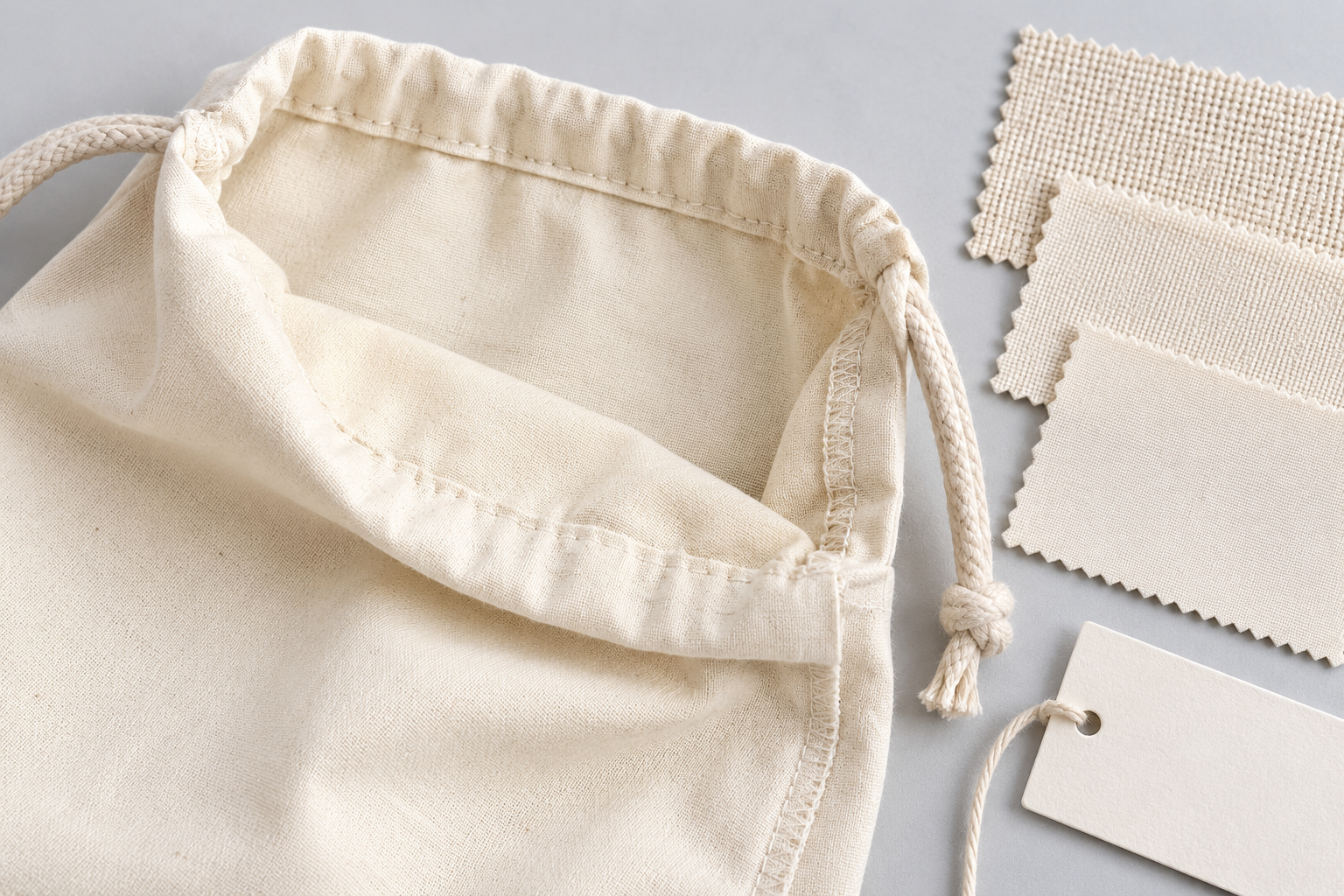
This product-realistic close-up is based on a real LUCKYSTAR sample construction. It illustrates visible seams, cord and fabric-selection points only; it does not establish cotton origin, organic percentage, certification or current availability.
| BOM line | Specification to freeze | Certification question | Quality question |
|---|---|---|---|
| Shell fabric | Fiber, weave, weight, finish, color and supplier article | Which standard, percentage, scope and lot apply? | Shrinkage, rubbing, dimensional stability |
| Cord | Fiber, diameter, braid, color and end finish | Is it inside the claim and certified route? | Tensile strength, closure force, fraying |
| Thread | Fiber, ticket size and color | Is it permitted/covered for the route? | Seam strength and stitch security |
| Eyelet/reinforcement | Material, size, placement and finish | Accessory treatment and claim boundary | Pull-out, corrosion, sharp edges |
| Print/embroidery | Method, color, input and location | Is the process eligible and artwork approvable? | Adhesion, abrasion, cracking, needle damage |
| Label/hangtag | Substrate, wording and placement | Which entity may apply the mark and who approves it? | Legibility and attachment strength |
| Packing | Polybag/paper wrap, insert and carton | Keep packaging claim separate from bag claim | Moisture, scuffing and carton performance |
Use a controlled drawstring bag tech pack and follow a documented sample-development process. A sample made with an uncertified substitute may be useful for size or construction review, but it cannot validate the final certification claim.
Calculate the claim boundary before artwork
Buyers should decide whether a statement applies to the shell, all textile components, certified fiber content or the finished product. The denominator and excluded accessories must follow the applicable standard and claim rules. Do not invent a whole-bag percentage from a fabric certificate.
A practical claim-matrix format
| Draft public statement | Object being described | Evidence owner | Approval status |
|---|---|---|---|
| “Body fabric contains X% certified organic cotton” | Main shell fabric only | Material supplier plus certified chain | Hold until transaction and wording review |
| “OCS Blended certified” | Eligible product within OCS scope | Certified entity responsible for claim | Hold until claim approval |
| “GOTS Organic” | Finished textile product meeting label-grade rules | GOTS certified entity and certification body | Hold until label approval |
| “Organic cotton drawstring bag” | Overall product impression | Brand compliance owner | Qualify if non-organic components could mislead |
Marketing, sourcing and quality teams should sign the same matrix. If material, cord, decoration, supplier, site or quantity changes, reopen the claim review.
Control dyeing, printing, embroidery and finishes
The finished look of a bag often creates the largest certification risk. Natural unbleached fabric may appear simple, but whitening, washing, softening, printing or metal accessories can add processes and inputs. A colored or branded bag may require dyehouses, printers or embroiderers whose role must match the selected route.
Decoration decision table
| Decoration route | Certification question | Technical risk | Useful follow-up |
|---|---|---|---|
| Screen printing | Is the printer/process and input acceptable for the selected standard? | Ink cure, cracking and rub-off | Screen printing vs heat transfer |
| Heat transfer | Is the film/adhesive and process compatible with the route and claim? | Edge lift, heat marks and handfeel | Test adhesion on production fabric |
| Embroidery | Are thread, backing and process handled correctly? | Puckering, needle damage and distortion | Embroidery vs printing |
| Woven label | Is the label an accessory and is certification wording approved? | Fraying, placement and misleading logo use | Freeze label artwork and supplier |
| Garment wash/softening | Is the wet-processing stage within the applicable route? | Shrinkage, color change and residue | Approve process recipe and post-wash measurements |
For any certification logo, obtain the current authorized file and approval. Do not redraw it, use it on a concept sample, or place it in a website header that could imply every product is certified.
Certification does not replace product testing
GOTS and OCS address certification objectives; they are not substitutes for the performance specification. A drawstring bag still needs tests chosen for intended load, user, distribution channel, care method, destination and decoration.
| Performance area | Example evaluation | Failure to prevent | Related guide |
|---|---|---|---|
| Dimensional stability | Defined washing or conditioning cycle and measurement points | Bag or logo distortion | Cotton shrinkage and washing tests |
| Seam strength | Pull or load method at side/bottom seams | Seam opening and stitch breakage | Drawstring bag load-capacity testing |
| Cord strength | Cord tensile/pull and anchor test | Cord break, knot slip or corner failure | Cord strength and pull testing |
| Colorfastness | Dry/wet rubbing, washing or perspiration as relevant | Color transfer and staining | Specify method and grade before testing |
| Print durability | Adhesion and abrasion sequence | Cracking, peeling or rub-off | Print adhesion and abrasion testing |
| Shipment conformity | Pre-shipment sampling and defect classification | Mixed lots, wrong claims or weak packing | Pre-shipment inspection guide |
Review the broader list of tests custom drawstring bags should pass. Test methods, sample sizes and acceptance limits should be written before production; “pass” has no useful meaning without them.
Match samples to the certified production route
Sampling usually progresses from material swatches to construction prototypes, printed samples and pre-production samples. Each stage answers different questions. The certification file should state whether the sample uses the nominated certified material and route or a visual substitute.
Four sample statuses to label clearly
| Sample status | What it can approve | What it cannot approve |
|---|---|---|
| Size/construction prototype | Dimensions, cord path, gusset and seam layout | Organic content or final color |
| Material handfeel swatch | Weave, weight and tactile direction | Finished-bag certificate status |
| Print strike-off | Artwork size, color and preliminary adhesion | Full-product route if made on substitute fabric |
| Pre-production sample | Final construction, BOM and appearance when matched to production inputs | Bulk consistency without production inspection |
Mark substitutes in writing. A later swap from one “similar organic cotton” fabric to another can change weight, shrinkage, print result, certificate chain and transaction evidence.
Put certification requirements into the RFQ and purchase order
Do not request “GOTS bag” or “OCS bag” as a two-word line item. A useful RFQ defines the product, route, evidence, claim and timing.
| RFQ field | Information to provide | Supplier response required |
|---|---|---|
| Bag specification | Dimensions, fabric, weight, color, cord, seams, decoration and packing | Feasible construction and controlled BOM |
| Intended standard | GOTS or OCS and desired category/label grade | Eligible route and applicable limitations |
| Claim wording | Exact proposed sentence and channel | Approval process and responsible entity |
| Evidence | SC, TC/eTransaction and lot-to-order records required | Document owner, timing and prerequisites |
| Subcontracting | Printing, dyeing, embroidery or sewing route | Legal entities, sites and process roles |
| Testing | Methods and acceptance criteria | Sample plan, laboratory and corrective action |
| Change control | No substitution without approval | Written escalation and re-approval procedure |
| Delivery | Destination, packing and target window | Order-specific schedule after BOM approval |
For commercial planning, consult the guide to custom drawstring bag MOQ and production time and the 2026 pricing guide. Certification, organic material, custom color, decoration and document timing can affect feasibility, but LUCKYSTAR does not publish a universal price, MOQ or lead-time promise for all specifications.
Prevent substitution and mass-balance errors
The approved material can be lost through an undocumented substitution, mixed cutting lots, excess production, replacement units or mismatched invoices. Build traceability into receiving and production.
Lot-to-carton control points
| Control point | Identifier to retain | Reconciliation question |
|---|---|---|
| Material receipt | Supplier article, roll/lot and receipt date | Did the nominated material and quantity arrive? |
| Warehouse issue | Lot and issued quantity | Which production order received it? |
| Cutting | Cut bundle/lot | Were certified and conventional materials segregated? |
| Sewing/decoration | Work order and batch | Did the approved site and process handle the goods? |
| Finished inspection | SKU, color and inspection lot | Does the inspected product match the certified BOM? |
| Packing | Carton number and packed quantity | Can cartons be mapped back to the batch? |
| Shipment | Invoice, packing list and transaction record | Do parties, description, dates, weight and quantity reconcile? |
Record expected conversion loss rather than forcing figures to match artificially. Investigate overproduction, shortages or certificate quantities that exceed the supported input.
Control certification claims and logo use
Certification status and marketing permission are related but separate. Under GOTS, mandatory label elements include the applicable label grade, certification-body reference and certified entity license number, and the certifier must approve labeling in advance. OCS claims must follow Textile Exchange’s current claims and labeling rules.
Artwork release gate
| Gate | Owner | Release evidence |
|---|---|---|
| Claim wording | Brand compliance/marketing | Approved exact sentence and qualification |
| Certification basis | Sourcing/certified entity | Valid scope and planned transaction chain |
| Logo file | Certified entity/standard owner process | Authorized current artwork file |
| Product connection | Merchandising/QA | Final BOM, style and sample match |
| Channel approval | Claim owner/certification body as applicable | Approval for bag, tag, packaging, website or ad |
| Reorder control | Purchasing/QA | Revalidated certificate, route, inputs and artwork |
Do not describe LUCKYSTAR as generally “GOTS certified” or “OCS certified” without a current certificate that matches the exact legal entity, site, products, processes and validity period. The company knowledge base does not currently support a blanket company-wide claim. Any certified project must be confirmed for that order.
GOTS vs OCS cost and lead-time drivers
The certification acronym is not a price list. Cost and timing depend on whether a valid route already exists, which fabric article is nominated, the organic percentage, dye/finish, decoration, documentation, testing, quantity and packing.
| Cost/timing driver | Why it matters | Buyer control |
|---|---|---|
| Existing eligible fabric | New sourcing may require additional verification or development | Nominate article and backup before sampling |
| Certified converter route | Uncovered process or site can block the claim | Map route before quotation approval |
| Custom dye/finish | Adds input approval, lab dip and process risk | Approve standard color or plan time for custom development |
| Decoration | May introduce another process, input and sample cycle | Freeze method, location and supplier |
| Transaction documentation | Requires accurate parties, descriptions and quantities | Assign owner and submission timing in PO |
| Testing | Needed independently of certification | Combine tests on the final pre-production construction |
| SKU fragmentation | Small color/size splits complicate material and traceability | Consolidate variants where commercially possible |
For cost engineering that preserves essential controls, use How to Reduce Custom Drawstring Bag Costs Without Sacrificing Quality. Removing documentation, tests or route verification is not responsible cost reduction.
How to choose between GOTS and OCS for your project
Use a requirements hierarchy rather than starting with a logo.
- Define the intended public claim and selling markets.
- Freeze the bag BOM, decoration, packaging and use case.
- Calculate the organic-content boundary under the relevant standard.
- Decide whether broader processing, environmental and social criteria are required.
- Map legal entities, sites, processes and title transfers.
- Verify current scope and planned transaction evidence.
- Prototype with controlled material and label any substitute.
- Approve performance tests independently of certification.
- Obtain claim and logo approval before mass artwork release.
- Reconcile material, production, cartons and shipment evidence.
| If your priority is... | Recommended direction | Reason |
|---|---|---|
| A finished textile claim with qualifying processing requirements | Start with GOTS feasibility | GOTS addresses more than organic-content custody |
| Organic-content verification across the supply chain | Start with OCS feasibility | OCS is designed for content and custody |
| Organic content between 5% and below 70% | Review OCS Blended | Below the GOTS minimum label-grade threshold |
| Physical durability | Build a test specification first | Neither standard guarantees bag performance |
| A fast reorder | Revalidate the existing route and claim | Certificate, supplier, lot or policy may have changed |
| Maximum marketing flexibility | Do not overclaim | Use only wording supported by evidence and approval |
Why work with LUCKYSTAR
LUCKYSTAR can help buyers translate a brand brief into a controlled drawstring-bag specification: dimensions, fabric direction, cord, seams, reinforcement, decoration, labels, packing, samples and quality checks. The value is coordination and evidence discipline—not an unsupported promise that every material route or finished bag is automatically certified.
For a GOTS- or OCS-targeted project, a responsible working sequence is:
- clarify the desired claim before material quotation;
- separate shell, cord, thread, labels, decoration and packing in the BOM;
- identify the legal entities, physical sites and subcontracted processes;
- request current certification evidence for the proposed route;
- mark sample substitutions rather than hiding them;
- freeze an approved sample and revision-controlled tech pack;
- agree order-level documents, test methods and inspection criteria; and
- treat any material, site or artwork change as a re-approval event.
This is consistent with our custom drawstring bag manufacturing process, quality-control checklist and OEM vs ODM drawstring bag guide. All specifications, commercial terms, certification feasibility, claims and testing are subject to written confirmation for the specific order.
Buyer checklist before approving an organic cotton drawstring bag
| Checkpoint | Pass condition | Evidence retained |
|---|---|---|
| Claim | Exact statement, standard and percentage are defined | Claim matrix and approval |
| Product | Finished BOM and artwork are frozen | Tech pack and approved sample |
| Entity | Seller and certified roles are correctly identified | Contract, invoice and certificates |
| Site | Every relevant physical site is mapped | Scope and process map |
| Content | Organic percentage and calculation boundary are correct | BOM, weights and standard basis |
| Transaction | Order evidence can be issued and reconciled | TC/eTransaction and commercial records |
| Decoration | Inputs/processes fit the selected route | Process evidence and artwork approval |
| Quality | Test methods and acceptance criteria are agreed | Test and inspection reports |
| Packing | Cartons map to SKU, batch and quantity | Packing list and carton map |
| Reorder | Certificate, route, policy and BOM are rechecked | Reorder review record |
If one line fails, hold the certification claim while correcting the evidence. The bag may still be technically usable, but the public claim should not outrun the documented facts.
Frequently asked questions
Is GOTS better than OCS for drawstring bags?
Not universally. GOTS is broader because it includes specified processing, chemical, environmental and social requirements in addition to organic-content custody. OCS is more focused on organic content and chain of custody. “Better” depends on the required claim, percentage, route, markets, budget and launch timing.
Can an OCS-certified fabric make the finished bag OCS certified?
Not automatically. The downstream organizations, physical sites, processes, product scope and transaction chain must support the finished product claim. An upstream fabric certificate is evidence for one stage, not automatic finished-bag certification.
Can GOTS apply to a bag with polyester cord or metal eyelets?
Potentially, depending on the exact product, organic percentage, accessory rules, approved inputs and certified route. Do not decide from appearance. Submit the full BOM to the responsible certified entity and certification body.
Does OCS control dyes and processing chemicals?
OCS does not provide the same processing-chemical framework as GOTS. If chemical-input or wet-processing requirements matter, specify them separately or assess GOTS feasibility.
Does a GOTS or OCS certificate prove the bag is strong?
No. Use product-specific seam, cord, load, abrasion, shrinkage, colorfastness and print tests with defined methods and acceptance criteria.
What is the minimum organic content for GOTS?
GOTS Version 8.0 provides two label grades: at least 95% certified organic fiber content excluding accessories for “Organic,” and at least 70% for “Made with (x%) organic materials,” subject to the standard’s other rules.
What is the minimum organic content for OCS?
OCS requires at least 5% certified organic material excluding accessories and trims. OCS 100 applies at 95–100%; OCS Blended applies from 5% to below 95%, subject to the current standard and user manual.
Can a brand print the GOTS or OCS logo on a sample?
Do not print certification marks merely as mock-up decoration. Use neutral placeholders until the correct entity, product, wording, current logo file and approval path are confirmed.
Are natural-color cotton bags automatically organic?
No. Natural color is an appearance. Organic status depends on certified input and chain-of-custody evidence, not color, handfeel or photography.
Does certification remove the need for destination-market compliance?
No. Fiber labeling, product safety, packaging, chemical, consumer-protection and environmental-marketing laws still apply in the destination market. Obtain qualified local advice where necessary.
Should the buyer request a Transaction Certificate?
If the selected standard and transaction require one, define the responsible party, timing, product description, quantity basis and commercial references in the purchase order. Do not wait until after shipment to discover that the route cannot produce the planned evidence.
Must a reorder use the same certificate documents?
Never assume so. Recheck validity, standard version, sites, product/process scope, material article, BOM, claim rules and transaction evidence for each reorder. A valid old file may no longer describe the new order.
Request an evidence-based quotation
Send LUCKYSTAR the intended market, dimensions, fabric weight/weave, target organic percentage, desired GOTS or OCS claim, cord and accessory materials, decoration, quantity by color, packing, test requirements and delivery window. We can review the construction and identify which certification and order evidence must be confirmed before a public claim is approved.

Click the GET QUOTE image to contact LUCKYSTAR. Certification availability, minimum quantity, price, lead time, claim approval and testing are subject to the final specification, documented supply route and written confirmation.
Source note and claim boundaries
This guide was checked on October 6, 2026 against the GOTS Version 8.0 standard, the GOTS Version 8.0 implementation manual, GOTS labeling guidance, the OCS program page, the OCS 3.0 standard and the OCS User Manual. Standards, transition dates and claims policies can change; verify current official documents when the order and artwork are approved.
LUCKYSTAR’s public product imagery supports product-format and customization discussion only. It does not by itself prove cotton origin, organic percentage, GOTS/OCS certification, current stock, current price or current production availability. The present company knowledge base does not support a blanket claim that LUCKYSTAR holds GOTS or OCS certification for all sites or products.





