Custom Drawstring Bag Printing Methods
The best printing method for a custom drawstring bag is the one that can reproduce the approved artwork on the specified material, survive the intended use and remain repeatable after the bag is sewn, gathered, filled and packed. Screen printing is often efficient for bold spot-color graphics; transfer methods can handle detailed or multicolor art; sublimation belongs mainly with suitable light-colored polyester; embroidery creates texture; and labels or patches can solve surfaces that are difficult to print directly.
That short answer is more useful than choosing a process from a catalog name. A natural cotton pouch, coated polyester gym sack, non-woven giveaway bag, velvet jewelry pouch and open mesh pack do not present the same surface or production sequence. This guide explains how buyers should compare the main methods and turn a visual idea into a controlled bulk specification. LUCKYSTAR's current category page shows the range of custom drawstring bags that can be evaluated project by project.
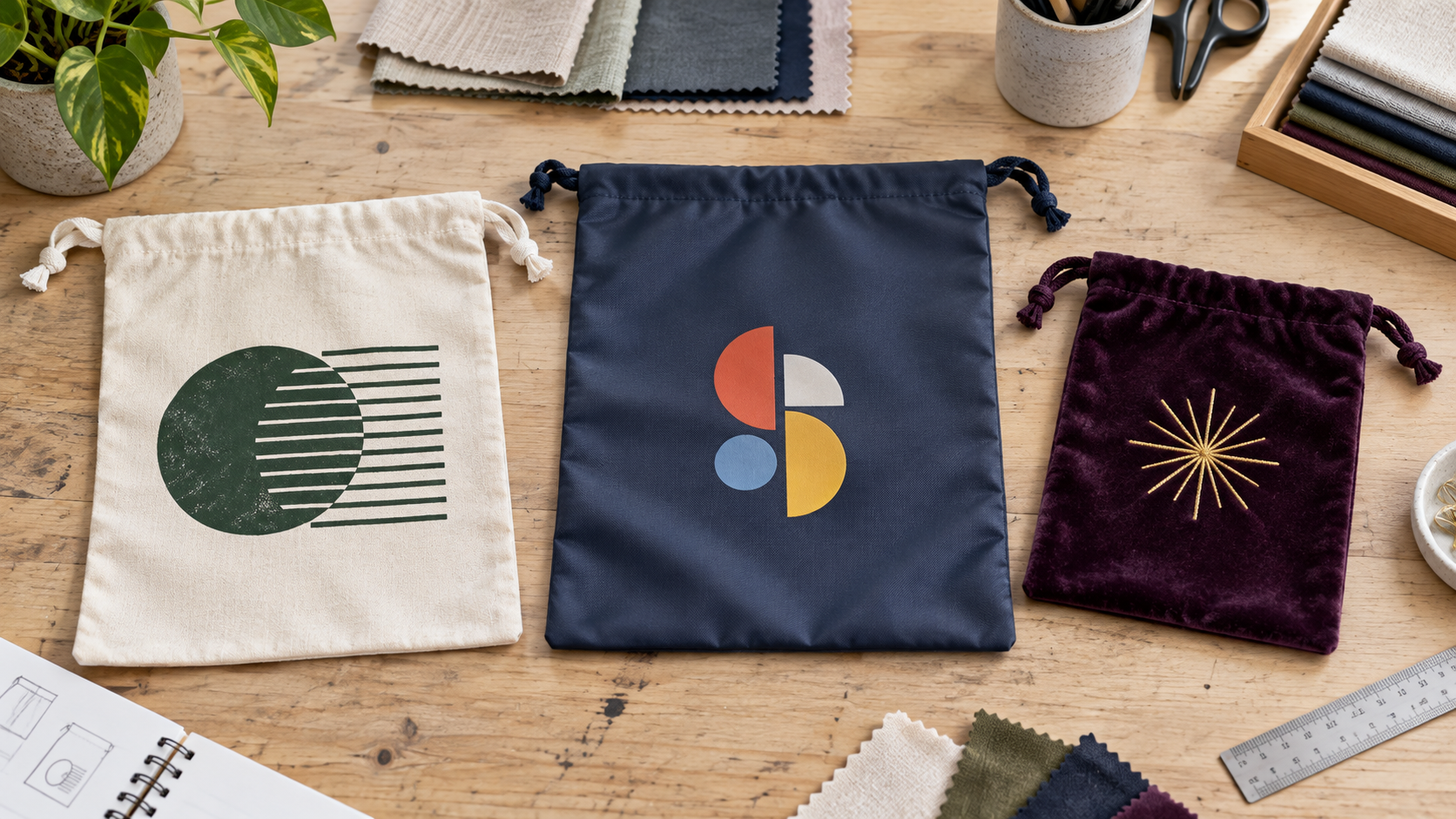
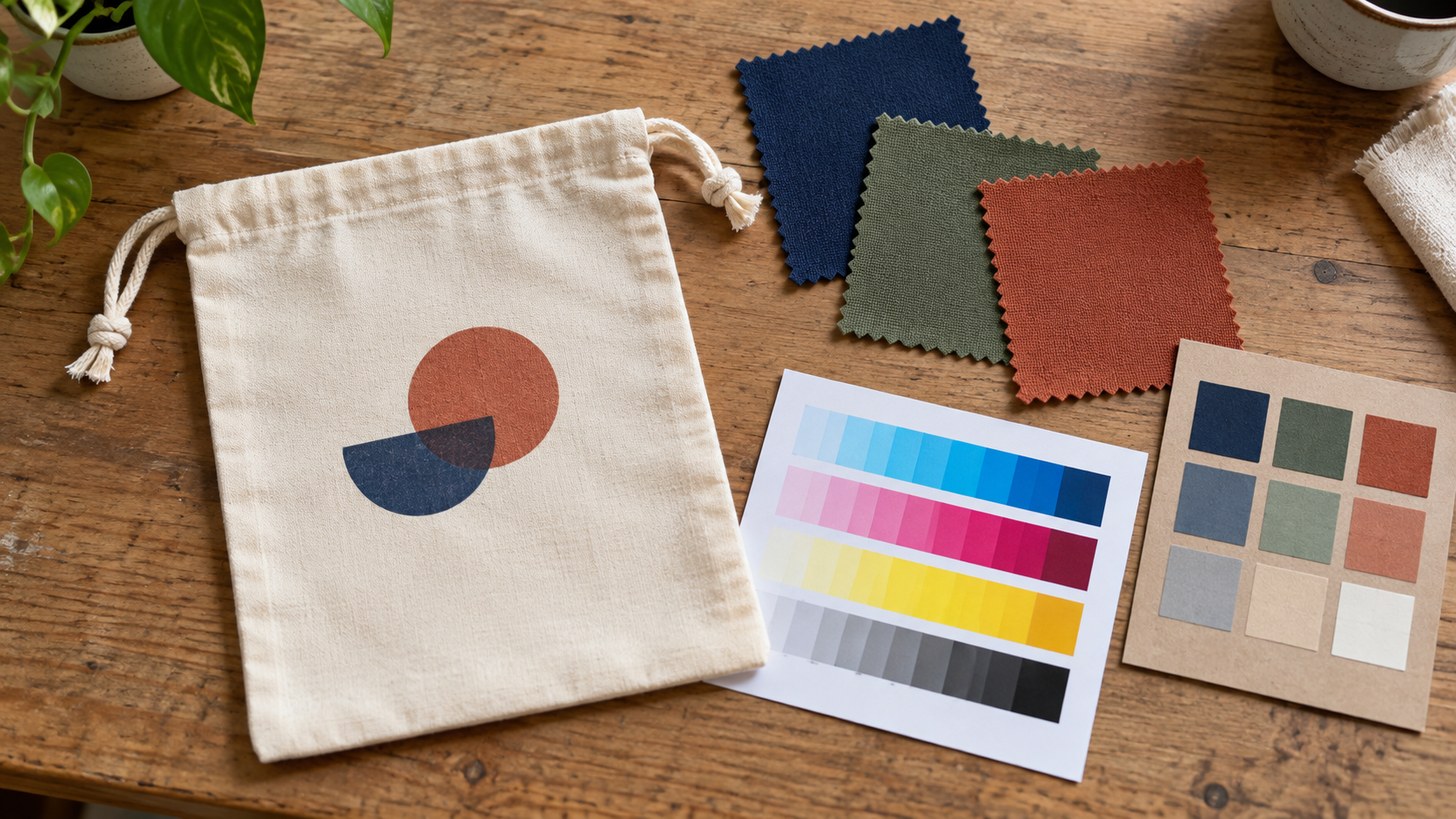
Original reference-guided planning visual created for this article. It illustrates three decoration routes with generic geometric test art; it is not a customer order, certification or claim that every technique suits every fabric.
Last reviewed: September 15, 2026.
Quick comparison of custom drawstring bag printing methods
| Method | Strong starting use | Main advantage | Main constraint to prove |
|---|---|---|---|
| Screen printing | Bold logos, spot colors and repeated designs | Controlled solid-color coverage and efficient repeat production | Ink/substrate compatibility, opacity, cure and seam-free support |
| Heat-transfer family | Detailed, multicolor or variable graphics | Artwork flexibility with a controlled transfer component | Heat response, edge adhesion, migration, hand feel and press access |
| Direct digital textile printing | Complex color or short, design-led programs on suitable fabric | Fine detail without one screen per color | Fabric preparation, white ink/underbase, profile, cure and surface consistency |
| Dye sublimation | White or light suitable polyester, especially panel or all-over art | Dye becomes part of the polyester surface with very low print build | Polyester content, base color, heat behavior and cut/sew registration |
| Embroidery | Premium small marks and tactile identity | Dimensional thread appearance | Needle density, backing, puckering and gathering clearance |
| Foil or metallic effect | Gift, beauty or jewelry pouches needing a reflective accent | Distinctive visual finish | Adhesion, flex, rub performance and fine-edge control |
| Woven/printed label | Small identity marks or difficult direct-print surfaces | A separately controllable branded component | Label rights, edge finishing, sewing position and added thickness |
| Patch or badge | Sports, events and elevated merchandise | Strong tactile hierarchy and modularity | Attachment strength, stiffness, weight and closure interference |
This table is a screening tool, not a quote or approval. Method availability, minimum detail, color result, testing, MOQ, sample cost, production time and price require the final material, construction, artwork, quantity and written confirmation.
Start with five inputs, not a favorite technique
Before asking “screen print or transfer?”, define five inputs:
- Bag: finished size, channel, cord exits, gusset, seams, reinforcements, pockets and lining.
- Surface: fiber, construction, weight, color, coating, texture, nap, stretch and heat sensitivity.
- Artwork: physical size, number and type of colors, gradients, fine lines, negative detail and required finish.
- Use: contents, gathering frequency, abrasion, washing or cleaning, exposure and viewing distance.
- Order: quantity, variants, approval route, destination, packing and required date.
Change one input and the best process may change. The best materials for custom drawstring bags guide helps buyers settle the substrate before decoration development begins.
Why drawstring construction changes the print decision
Drawstring bags are moving textile structures. Pulling the cord compresses the top panel into radiating folds. Backpack cords can tension the lower corners. Contents make the front convex. A gusset opens, a round base rolls under, and a pocket creates a second thickness. Those movements affect both where the graphic belongs and how the print or decoration is applied.
A method that works on a flat swatch can still fail on an assembled bag because the press cannot reach the panel evenly, the embroidery backing stiffens the gather, or the print bends across a gusset. Use the companion drawstring bag logo placement and print size guide to establish the usable area; use this article to select and control the reproduction method within it.
Screen printing on drawstring bags
Screen printing pushes ink through a stencil onto the bag or cut panel. Each color normally requires its own controlled separation and registration step. It is a strong starting route for clean logos, solid fills and limited spot colors when the surface can be supported evenly.
Where screen printing is a good candidate
- natural cotton or canvas pouches with a reasonably stable print face;
- polyester, nylon or non-woven styles after ink and cure compatibility are proven;
- simple campaign marks with bold shapes and limited color count;
- repeat quantities where screen setup can be distributed across the run;
- artwork that benefits from a defined ink color rather than a photographic gamut.
What must be sampled
Check opacity on the actual bag color, fill across the actual texture, edge sharpness, small negative gaps, registration, hand feel and cure. On dark fabric, an underbase or adjusted ink system may be needed; that can change thickness, color and cost. On synthetic fabric, heat and ink chemistry can contribute to dye migration, gloss, shrinkage or coating change.
Never copy a temperature, dwell time or mesh count from a different fabric as a universal recipe. Those are process parameters tied to the selected ink system, equipment, deposit and substrate. The production record should identify the approved combination and the verification test.
Heat transfer is a family, not one process
“Heat transfer” may describe different transfer constructions and print chemistries. Screen-printed transfers, digitally printed transfers, cut films and other supplier-specific systems do not have identical appearance or performance. A useful RFQ names the proposed transfer rather than treating the term as a single method.
Why buyers choose a transfer route
Transfers can reproduce multiple colors, gradients or small batches without building a direct-print screen for every visible color. They may also let the supplier prepare a graphic component separately and apply it after some sewing operations.
Drawstring-specific risks
The bag still needs a flat, evenly supported press area. Thick side seams, cords, pockets, reinforcements or a channel near the platen can reduce pressure at the artwork edge. Heat may mark velvet nap, alter coated polyester, reveal a press outline, activate dye migration or change the hand. An apparently neat sample should be rechecked after conditioning, flexing and the agreed cleaning or use cycle.
DTF, film and named transfer systems
If the proposal uses DTF or another film-based system, record the precise transfer type, printer/ink family if relevant, adhesive, application window and peel procedure in the supplier's controlled process sheet. Avoid claims such as “DTF is always more durable” or “transfer is always best for low MOQ.” The comparison is valid only for the specific systems, bags and tests being quoted.
Direct digital printing on suitable fabrics
Direct digital textile printing can reproduce complex color, tonal transitions and fine visual detail, but “digital” alone is incomplete. The buyer should ask whether the process is direct-to-fabric, direct-to-garment, pigment, reactive or another system, and which pre-treatment and curing route applies.
Natural-fiber pouches may be candidates for certain direct digital approaches; other fabrics may need different chemistry or may not be suitable. White ink behavior on dark material, pretreatment marks, fiber show-through, print-head clearance and color-profile control all need physical proof.
Digital capability does not remove the need for production artwork. A small web image can still print with visible pixels, and an RGB screen preview does not define a physical color target. Request a strike-off on production material and approve the assembled bag.
Dye-sublimation printing for polyester drawstring bags
Dye sublimation uses heat to move dye into suitable polyester or polymer-coated material. Epson's official sublimation guide states that the process is for polyester fabrics or polyester-coated goods and works best with white or light-colored bases. This makes it a valuable route for suitable polyester drawstring panels, especially when continuous color or all-over graphics are important.
What sublimation does well
- gradients, photographs and multiple colors;
- lightweight decoration with little or no raised surface deposit;
- panel printing before cut-and-sew assembly;
- repeating or edge-to-edge graphics where bleed and cutting are engineered.
What sublimation does not solve
It does not print an opaque white layer onto dark fabric, and it is not a general answer for cotton, canvas, velvet or every recycled polyester construction. Polyester percentage, base shade, coatings, heat history and color profile can affect the result. If RPET is specified, the recycled-content claim and any certificate request remain separate from print-method approval; see the RPET certification and sourcing checklist.
Cut-and-sew registration
For all-over sublimation, print the bleed and critical safe areas before cutting. A beautiful printed roll can become a poor bag if the cutting marker, front axis or seam allowance is inconsistent. Keep essential text and brand elements away from the channel, gusset folds, lower turn and seam joins unless deliberate pattern matching is developed.
Embroidery for tactile, premium branding
Embroidery builds a mark with thread rather than ink. It can add visual depth to cotton, canvas, polyester and some velvet pouches, provided the fabric, backing and construction support the stitch plan.
Digitizing matters more than the logo file alone
An embroidery machine does not simply “print” vector paths. The artwork must be digitized into stitch types, directions, density, underlay and sequence. Small counters, tight curves and thin lettering can close up. Thread color, sheen and direction affect perception.
Control the structure around the mark
Dense stitches can pucker lightweight fabric or stiffen a small pouch. Backing may remain visible inside an unlined bag. Needle penetration can mark coated fabric. A large embroidered field can interfere with folding and gathering even when it looks premium while flat.
Sample the actual bag material and decide whether embroidery happens before or after assembly. Record the approved dimensions, thread references, stitch file revision, backing, placement and finished appearance.
Foil, metallic and specialty finishes
Foil or metallic effects can suit jewelry, cosmetics, gifting and premium promotional pouches when a reflective accent matters more than large-area coverage. Depending on the supplier and substrate, the process may involve heat, adhesive, pressure or a transfer component.
Approval should cover missing foil, ragged edges, pinholes, unintended gloss, press marks, cracking at folds and rub loss. Fine serif text or large solid areas may behave differently. Velvet nap, microfiber, coated synthetics and natural cloth require separate trials; one approved material cannot validate the whole product line.
Avoid presenting a shiny finish as “eco-friendly” merely because the bag itself is reusable or uses a preferred fiber. Finish composition, recyclability and environmental claims need their own evidence.
Labels, patches and badges
A separately produced label or patch can be a better engineering choice than forcing ink onto mesh, deep nap or a heavily structured panel. It also allows a small identity element to be produced with controlled edges and then attached to the bag.
| Component | Useful role | Watch point |
|---|---|---|
| Woven label | Fine identity detail and textile character | Minimum readable detail, cut edge, fold type and sewing margin |
| Printed label | More color freedom on a small controlled surface | Ink durability, edge finish and label material |
| Embroidered patch | Strong dimensional brand cue | Stiffness, thickness and stitch attachment |
| Silicone/rubber badge | Tactile modern finish on suitable constructions | Weight, flex, color, attachment and material claims |
| Leather-like patch | Premium visual on canvas or gift styles | Exact material description, marking method and compliance |
Specify attachment: sew line, heat bond, adhesive, rivet or another tested route. A component must remain clear of cord movement and should not create a hard point against contents or the wearer.
Match printing method to material
| Drawstring material | Strong starting candidates | Risks to investigate |
|---|---|---|
| Cotton or lightweight canvas | Screen print, suitable direct digital, transfer, embroidery, label | Fiber texture, absorbency, shrinkage, pretreatment, puckering |
| Heavy canvas | Screen print, embroidery, patch, selected transfers | Coarse weave, thick seams, platen support, stitch density |
| Polyester | Screen print, transfer, sublimation on suitable light material, embroidery | Dye migration, heat marking, coating response and seam access |
| Nylon | Selected screen inks/transfers, embroidery or label after testing | Surface energy, coatings, heat sensitivity and adhesion |
| RPET textile | Process chosen from actual fiber/fabric construction | Claim evidence, color variation, heat behavior and lot consistency |
| Non-woven PP | Screen print, selected transfer or other supplier-proven route | Texture, heat sensitivity, bonding, seam variability |
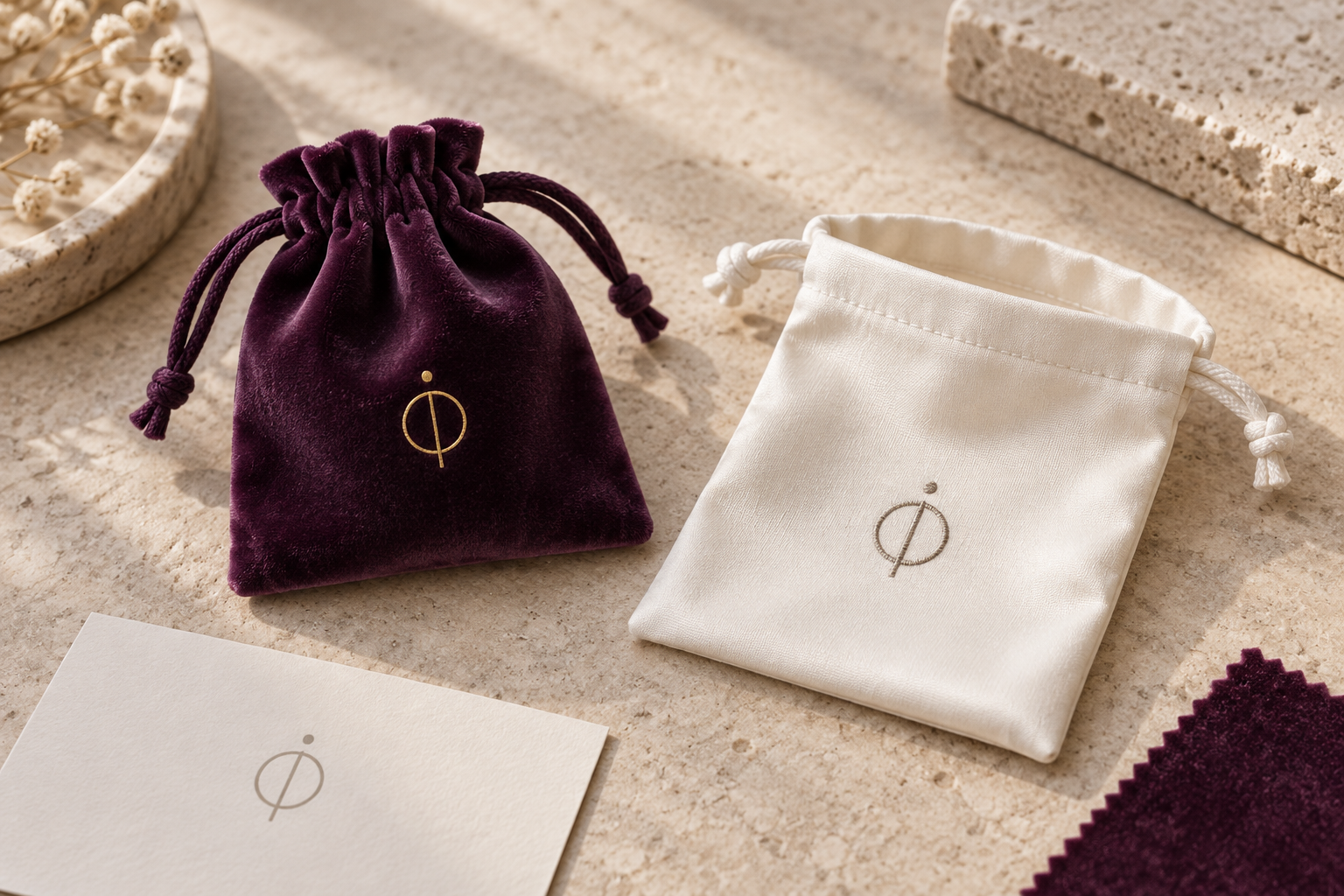
| Velvet or microfiber | Embroidery, foil, label, selected transfer after trial | Nap direction, crushing, pressure marks and small scale |
| Mesh | Patch, label or print on a designed solid panel; direct print only if proven | Open holes, uneven deposit, stretch and content show-through |
These are evaluation routes, not guaranteed pairings. More focused construction guidance is available for polyester versus nylon bags, cotton versus canvas, non-woven GSM and construction, mesh drawstring bags and velvet versus microfiber pouches.
Choose between direct decoration and a separate component
Direct decoration usually feels integral to the bag and can be efficient on a stable flat panel. A separate transfer, label or patch moves part of the process onto a more controllable carrier, but introduces an edge, adhesive or attachment operation.
| Question | Favor direct print/embroidery when… | Consider a separate component when… |
|---|---|---|
| Surface | It is stable, accessible and compatible | It is open, deeply textured or hard to support |
| Artwork | The method can reproduce the detail directly | A controlled small graphic surface gives a better result |
| Hand feel | Local ink or thread build is acceptable | The brand wants a deliberate badge or label character |
| Variants | Artwork remains stable across the run | Names, versions or modular identities require flexibility |
| Assembly | Panel printing fits the sewing sequence | Post-assembly attachment offers better location control |
| End use | Flex and abrasion are proven | Replaceability or a reinforced emblem is valuable |
Print before sewing or decorate the finished bag?
The manufacturing sequence can decide which method is feasible.
Pre-sewing panel decoration
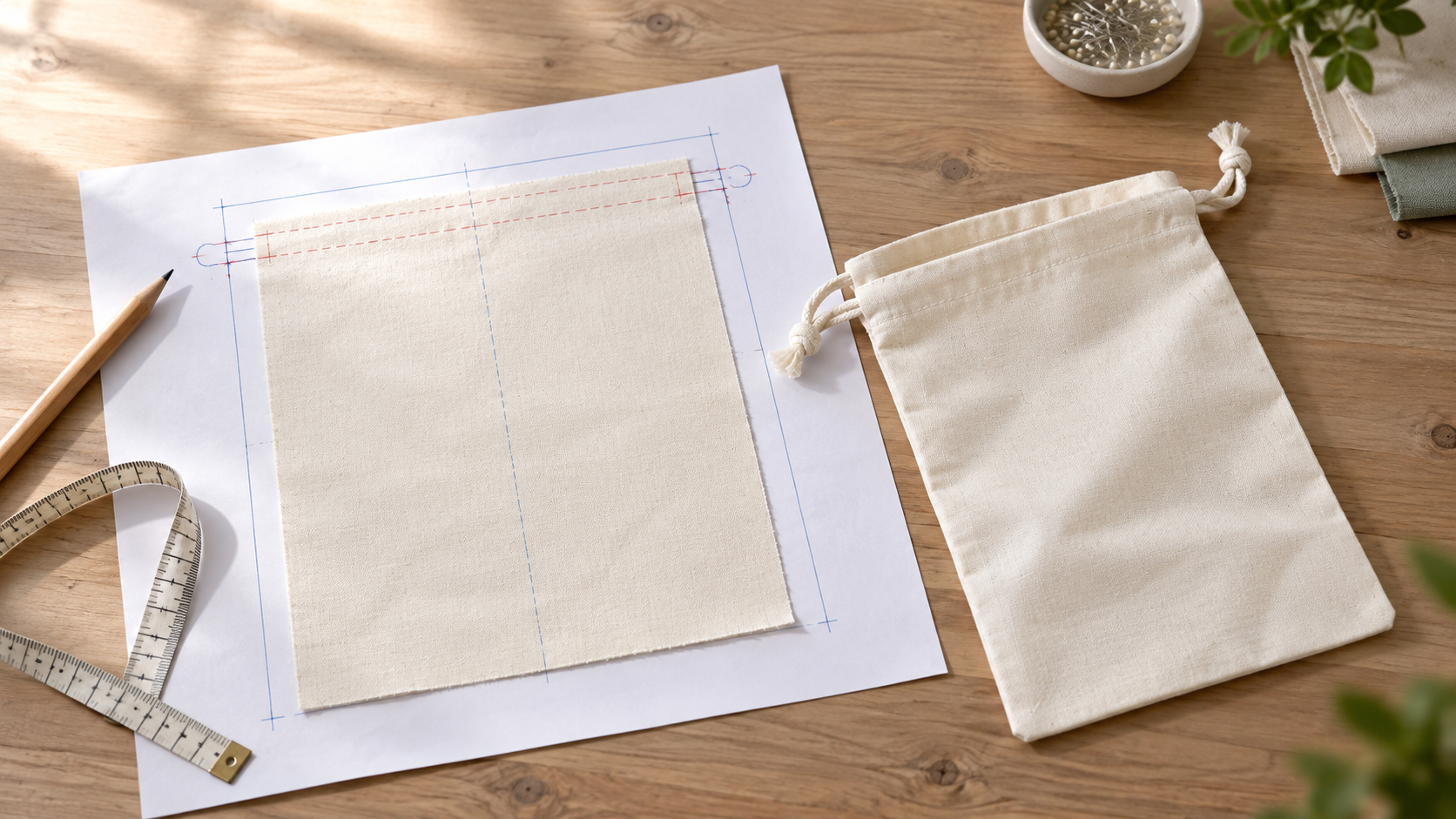
Printing a cut or uncut panel provides flat support and keeps cords, channels and pockets away from the equipment. It is often useful for screen printing, digital routes and sublimation. The risk is coordinate conversion: cutting and sewing must place the artwork correctly on the finished bag.
Post-sewing decoration
Decorating the finished bag lets the operator reference actual edges, but access becomes harder. Seams, cords, lining and reinforcements can lift the print area or block a hoop or platen. A finished sample must prove that the selected equipment supports the panel without damaging the bag.
Hybrid construction
A front panel can be printed before assembly, while a label or small secondary mark is attached later. If the project uses multiple stages, identify which approved file, fixture and inspection point belongs to each one. The custom drawstring bag manufacturing process explains how decoration fits into the broader production sequence.
Build production-ready artwork
Adobe's official raster-versus-vector guide explains that vectors scale through mathematical paths while raster images are pixel-based. A clean vector master is normally the most flexible source for logos, spot-color separations and embroidery digitizing. Photographic content may require raster artwork at sufficient resolution for the final physical size.
| Artwork control | What the buyer should supply |
|---|---|
| Master identity | Authorized vector file or high-resolution production asset |
| Revision | Stable filename, date/revision and approval owner |
| Physical size | Final width × height, not only “60%” or a screenshot mockup |
| Color intent | Spot references, CMYK/RGB source as relevant and approved physical target |
| Separations | Clear visible colors, white underbase and technical layers |
| Fine detail | Smallest positive/reversed line, text and gap for trial |
| Placement | Finished-bag coordinate and named datum |
| Bleed | Required only for engineered edge-to-edge/panel work |
| Rights | Confirmation that logos, artwork and fonts are authorized for the order |
For a full specification handoff, use how to prepare a custom drawstring bag tech pack.
Spot color, process color and physical targets
Spot-color artwork defines separate intended colors and is often well suited to simple screen printing. Process-color or digital workflows build appearance from a color system and profile. Neither method guarantees that a monitor preview will match the bag.
Fabric shade, texture, absorbency, coating, underbase, ink film, thread sheen and viewing light all affect perception. Use a named reference to communicate intent, then approve a physical strike-off on the order material. State whether the acceptance decision is visual, instrument-based or both and define the viewing conditions.
White ink and underbases
Dark bags may need an opaque white or blocking layer beneath visible colors. That layer influences brightness, edge registration, thickness, flexibility and cost. On synthetic dyes, it may also be part of a migration-control strategy, but the final solution must be proven with the selected material and ink system.
The artwork should distinguish an underbase from a visible white element. If the design contains both, approve their relationship and trapping. A registration halo that is invisible on a screen may be obvious on a small black pouch.
Fine lines, halftones, gradients and tiny text
Different processes fail differently. Screen-print dots can plug or drop out; transfer edges can become visually heavy; digital detail can lose contrast in fiber texture; embroidery counters can close; foil can miss narrow features.Ask for a capability strip or strike-off containing the smallest critical elements from the actual artwork.
Do not solve every problem by enlarging the full design. Sometimes the better choice is to simplify a tagline, open negative space, separate a trademark symbol, change method or move small compliance copy to a label.
All-over and edge-to-edge artwork
All-over graphics are usually a panel-printing and cut-and-sew project, not an oversized post-assembly logo.Provide bleed beyond the cut line, protect essential elements with safe zones, and decide how patterns meet at seams and gussets. The gathered channel will hide part of the design by definition.
Approve the printed panel, cut part and finished bag as separate gates. A good printed sheet does not prove that a motif lands correctly after cutting; a correct empty bag does not prove that the artwork remains legible when gathered and filled.
Color migration, scorching and press marks
Synthetic dyes may move into an ink or transfer layer under heat, changing light colors after production. Heat and pressure can also create shine, platen outlines, flattened nap, shrinkage or coating change. These effects may appear immediately or after conditioning.
Use the actual production-color fabric, not only a white swatch. Record the observation interval and compare against a protected reference. If the proposed method requires a lower-temperature chemistry, barrier layer or different application sequence, treat the revised sample as a new approval—not a verbal process adjustment.
Cure, adhesion and finishing are part of the method
An image can look correct before the ink or adhesive is fully cured. Proper cure depends on the particular ink/transfer system, deposit, equipment, time, temperature, airflow and fabric. Therefore, the approved production record should define process settings from the actual supplier system and its validation—not generic internet values.
After cure, examine adhesion, surface blocking, odor where relevant, color transfer, flexibility and damage to the underlying material. Fold and pack the sample as production will. Fresh prints that touch in cartons can offset or block even if a single displayed sample looked acceptable.
Define durability from the use case
“Permanent” and “washable” are incomplete claims. A jewelry pouch may need gentle repeated handling; a gym bag may see rubbing, sweat and cleaning; an event bag may be short-duration but heavily filled. Select tests that reproduce the intended stress.
| Risk | Possible order-level check | Define before testing |
|---|---|---|
| Dry/wet rubbing | Controlled crock/rub assessment | Method, cycles, pressure, wet condition and acceptance |
| Washing or cleaning | Agreed care-cycle trial | Temperature, detergent, cycle count, drying and visual grade |
| Flexing/gathering | Repeated close/open or bend test | Load, cycle count and failure definition |
| Adhesion | Cross-cut, tape or supplier-specific assessment where applicable | Surface, conditioning and allowed lift |
| Abrasion | Controlled surface-wear test | Abradant, load, cycles and visual/function limit |
| Heat/packing blocking | Stack/pressure and temperature simulation | Time, pressure, face-to-face contact and release criterion |
| UV/exposure | Only when outdoor/light exposure is relevant | Light source, duration and color-change limit |
ISO 105-X12:2016 is an official textile method for color fastness to rubbing. It may be referenced when appropriate to the material and order, but its appearance here does not mean every drawstring bag is tested to it or that LUCKYSTAR holds a company-wide certification.
Use a staged sample approval
| Approval gate | Main question | Release evidence |
|---|---|---|
| Method proposal | Is the route plausible for bag, art and use? | Written material/method matrix and risk notes |
| Strike-off | Can the decoration reproduce color, detail and finish? | Signed or otherwise controlled production-material swatch |
| Assembled sample | Does it work with channel, seams, cords and filled shape? | Approved finished sample plus state-view photos |
| Pre-production sample | Are all revisions combined in a production-intent unit? | Frozen bag, artwork, settings and packing specification |
| First article | Has bulk started with the approved recipe? | Measured first-piece inspection record |
| Bulk inspection | Does the lot remain within agreed criteria? | Sampling result against the approved reference |
The custom drawstring bag sample development process covers revision discipline in more depth.
Inspect printing quality during bulk production
Inspect more than the center logo on one top-of-carton unit. Confirm artwork identity, orientation, size, placement, color, opacity, registration, edge quality, cure or adhesion, substrate condition and packing protection.
First-article control
The first production unit should be checked after the real material, operators, fixtures, sequence and equipment are in use. A first article is especially important when the bulk fabric color, coating or lot differs from sampling.
In-process checks
Monitor changes that can drift during a run: screen blockage, ink deposit, transfer pressure, heat distribution, embroidery thread/tension, hoop position, foil release and label placement. Define a check frequency appropriate to the run rather than waiting for finished cartons.
Finished-bag checks
Open, gather and fill sampled units when those states matter to the design. Examine cords and seams for contamination or heat damage. Confirm that folded packing does not crease a sensitive transfer or press embroidered bulk into an adjacent surface. The custom bag quality inspection checklist provides a broader inspection framework.
Diagnose common printing defects
| Defect | Likely area to investigate | Buyer-facing corrective path |
|---|---|---|
| Weak or patchy solid | Uneven substrate, screen contact, ink deposit or support | Reconfirm material, setup and strike-off standard |
| Light ink changes color on polyester | Dye migration under heat or over time | Review fabric, ink/barrier system, cure and conditioning |
| Transfer edge lifts | Pressure/heat/time, contamination or incompatible surface | Revalidate application and adhesion after conditioning |
| Gloss rectangle around art | Heat/pressure or pretreatment footprint | Adjust process/support or select another method |
| Tiny text fills in | Detail exceeds process/material capability | Simplify, enlarge or move the copy to a label |
| Embroidery puckers | Density, tension, backing or lightweight fabric | Redigitize and resample the complete construction |
| Foil has pinholes | Texture, adhesive/pressure or solid-area demand | Modify art/process and approve a new trial |
| Logo shifts after sewing | Panel datum not converted to finished-bag coordinate | Control cut/sew conversion and first article |
| Printed faces stick in packing | Incomplete cure or insufficient cooling/protection | Validate cure, cool-down and pack orientation |
How printing method affects cost and MOQ
Cost is generated by the runnable specification. Screen setup, number of colors, transfer area, digital ink coverage, sublimation paper/print area, embroidery stitch count, foil die or setup, labels, locations, artwork variants, sample rounds, testing and reject risk can all matter.
| Cost driver | Why it changes the quote |
|---|---|
| Number of colors/layers | Adds screens, separations, registration or ink coverage |
| Physical print area | Changes ink, transfer, paper, thread and handling demand |
| Bag material/color | May require pretreatment, underbase, barrier or special support |
| Decoration locations | Adds loading, alignment and inspection operations |
| Design variants | Increases file, setup, sorting and packing control |
| Construction access | Pockets, seams, lining and cords can slow or restrict decoration |
| Sample/testing plan | Adds material, setup, time and documented verification |
| Packing protection | Tissue, separators, cool-down or orientation may be needed |
There is no reliable universal MOQ or price for a method across all drawstring bags. Compare total approved-result cost, not only the lowest decoration line item. Read the drawstring bag MOQ and production-time guide, 2026 pricing guide and cost-reduction guide before requesting a current written quotation.
Sustainability and compliance claims need separate evidence
A water-based ink, recycled fabric or reusable format does not by itself make the finished bag “eco-friendly.” Environmental performance depends on material composition, process, durability, reuse, packing and end-of-life conditions. Any recycled, organic, biodegradable, compostable or certified claim must be tied to the applicable product, scope, evidence, holder and validity period.
Similarly, a test on one ink, material or sample cannot be expanded to every bag. Ask which supplied component was assessed, to what method, by whom and for which order. LUCKYSTAR does not present GRS, GOTS, BSCI, ISO, REACH or RoHS as universal company certifications without current entity-, scope- and validity-specific evidence.
Confirm rights before reproducing a logo
The buyer should provide artwork it is authorized to reproduce. WIPO's SME trademark guide, Making a Mark, explains that merchandising with trademarks, designs or copyrighted works requires prior authorization. Keep owner or license permission appropriate to the product and intended use; this is operational guidance, not legal advice.
A past sample, purchase order or logo visible online does not create permission to use that image in a factory portfolio or blog. LUCKYSTAR's content controls treat customer-branded product photography separately from manufacturing authorization.
Why choose LUCKYSTAR for printed drawstring bags
LUCKYSTAR has worked with custom-bag projects since 2015 and publicly presents OEM/ODM development and sampling services. For a printing project, the practical value is not a claim that one method is always best; it is the ability to coordinate the bag specification, artwork, proposed decoration, production-intent sample and quality checkpoints as one project.
The documented workflow can support buyers by:
- screening material, bag construction and artwork together;
- comparing screen print, transfer, digital, sublimation, embroidery, foil, label or patch routes where appropriate;
- turning a visual mockup into physical size, color and placement fields;
- organizing strike-off and assembled-sample approvals;
- checking the first article before the run progresses;
- aligning in-process, finished-product and packing checks with the chosen failure risks;
- retaining controlled references for repeat orders.
Exact equipment, process availability, materials, sample timing, MOQ, tests, price and lead time are confirmed for the completed specification and written quotation. To evaluate supplier fit, use the custom bag manufacturer guide and then the focused custom drawstring bag manufacturer guide.
RFQ checklist for a printed drawstring bag
| RFQ field | Information to send |
|---|---|
| Bag | Finished size, construction, channel, cord, gusset, pocket, lining and reinforcement |
| Material | Fiber/fabric, weight or construction, base color, coating and finish |
| Artwork | Authorized master file, final dimensions, colors, variants and locations |
| Desired appearance | Matte/gloss, flat/raised, metallic, thread or label character |
| Use | Contents, gathering, wear, washing/cleaning and exposure expectations |
| Method | Preferred option, acceptable alternatives or request for supplier proposal |
| Approval | Strike-off, assembled sample, pre-production sample and state-view photos |
| Quality | Placement, color, edge, cure/adhesion and order-specific test criteria |
| Quantity | Total units, colorways, artwork variants and pack split |
| Delivery | Destination, target date, packing and trade-term request |
Frequently asked questions
What is the best printing method for cotton drawstring bags?
Screen printing is a common starting candidate for bold logos; suitable digital or transfer routes can support complex color, and embroidery can create texture. Cotton weight, weave, bag color, artwork, use and order conditions determine the final choice. Test the actual fabric.
What is the best method for a full-color logo?
A suitable transfer or digital route may reproduce gradients and multiple colors efficiently. Sublimation can be strong on suitable white or light polyester. “Full color” is not enough for selection—define material, physical size, gamut expectations, hand feel and durability.
Can dye sublimation be used on cotton drawstring bags?
Conventional dye sublimation is intended for polyester or polymer-coated surfaces, not untreated cotton. If a supplier proposes a hybrid product, request its exact construction and test it rather than describing it as standard cotton sublimation.
Is screen printing more durable than heat transfer?
Not automatically. Durability depends on the specific ink or transfer system, material, cure/application, design, use and test. Compare approved samples under the same agreed stress instead of ranking process names in the abstract.
Can dark drawstring bags carry light-colored logos?
Yes, with a compatible opaque ink, underbase, transfer, embroidery, label or other proven route. Check opacity, registration, hand feel, dye migration and color after conditioning on the production fabric.
Is embroidery suitable for lightweight pouches?
It can be, but stitch density, design size, backing and thread tension must avoid puckering or excessive stiffness. A smaller or simplified mark, label or print may be better for very light fabric.
How should mesh drawstring bags be branded?
A designed solid panel, label or patch often creates a more controllable surface than printing across open holes. Direct printing may be possible for a specific mesh/process combination, but fill, stretch and abrasion should be sampled.
Should the bag be printed before sewing?
Pre-sewing panel decoration often provides better support and access; post-sewing work can reference the finished bag. The right sequence depends on method, construction and equipment. Approve the completed placement, not only the decorated panel.
What files should a buyer send?
Send an authorized vector master for logos where possible, plus any high-resolution raster assets, final physical size, color intent, placement drawing, artwork revision and readable-text confirmation. Do not use a screenshot as production artwork.
What should be checked before bulk production?
Approve the actual material, base color, decoration method, artwork revision, physical size, placement, color, finish, cure/adhesion, assembled appearance and relevant durability checks. Freeze the sample and process record before bulk release.
Can the same print recipe be reused on a reorder?
Use the prior approved recipe as a reference, then verify current fabric lot, color, coating, artwork revision, equipment and application. A new first article protects against silent changes. See logo and color consistency across reorders for change-control principles.
Choose the method by the result your order must repeat
Send LUCKYSTAR your intended contents, finished size, material, bag color, authorized artwork, desired finish, quantity and performance expectations. The team can review the printable construction, compare viable decoration routes and organize the project-specific sample and quotation for your custom drawstring bags.

Click the image to contact LUCKYSTAR. The approved specification and current written offer will define process feasibility, material, samples, testing, MOQ, price and scheduling.