Custom Drawstring Bags for Marathons and Fitness Events
Custom drawstring bags can support several moments in a marathon or fitness event: race-pack collection, a controlled bag-drop service, finish-line recovery, volunteer deployment, sponsor sampling, and post-event reuse. The same bag should not be specified for every moment. A packet-pickup bag has different priorities from a bag that will be tagged, stored, moved, and returned quickly under race-day pressure.
The most reliable buying process starts with the event operation rather than a generic bag size. Organizers should define the user journey, permitted contents, bag-drop rules, venue restrictions, weather exposure, identification method, sponsor artwork, distribution quantities, and post-event plan before selecting fabric or decoration.
This guide gives race directors, fitness-event agencies, sponsors, distributors, charity organizers, and corporate wellness teams an order-ready framework. LUCKYSTAR can coordinate specification development for custom drawstring bags, with materials, construction, testing, commercial terms, and claims confirmed for the approved order.
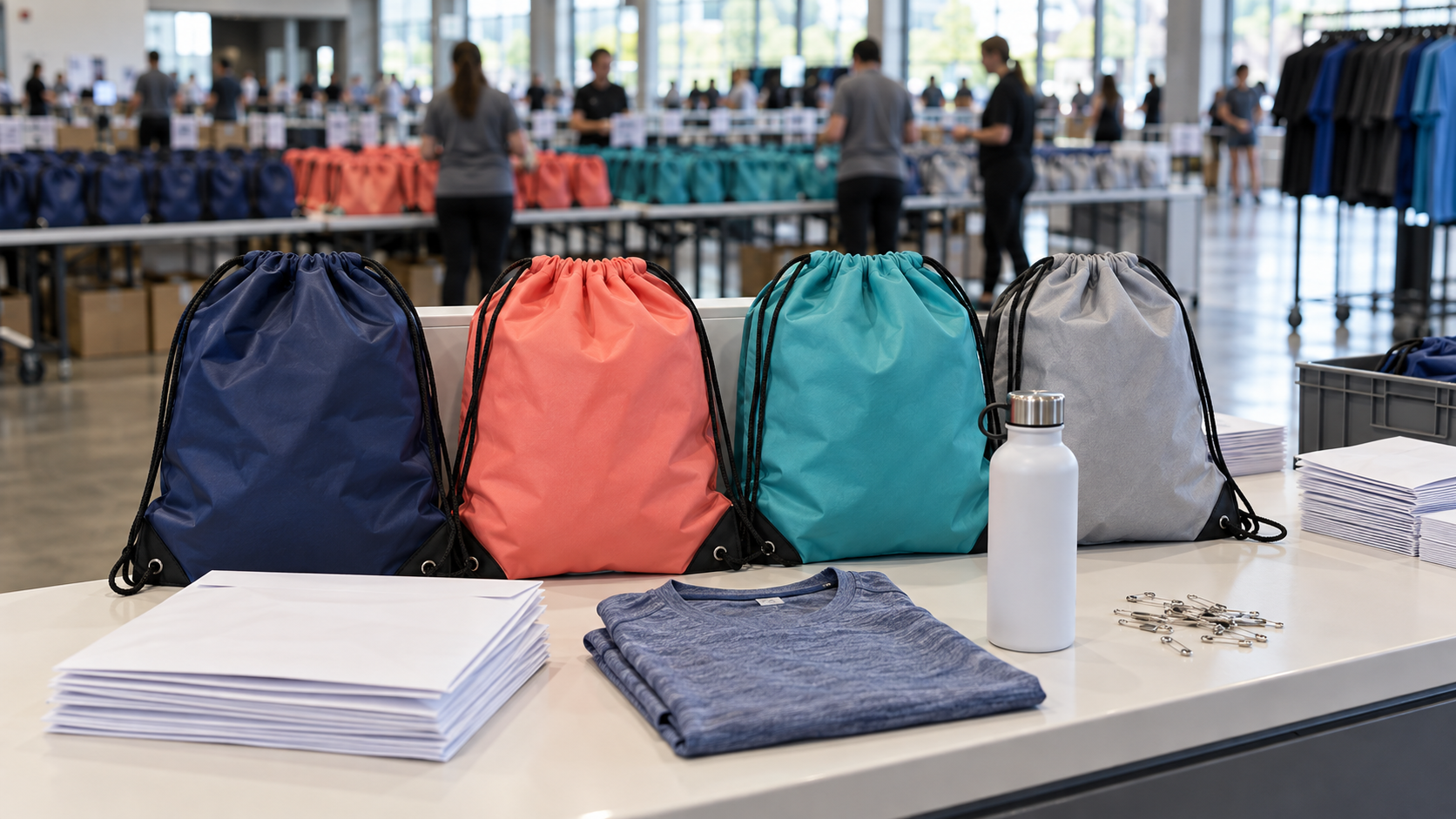
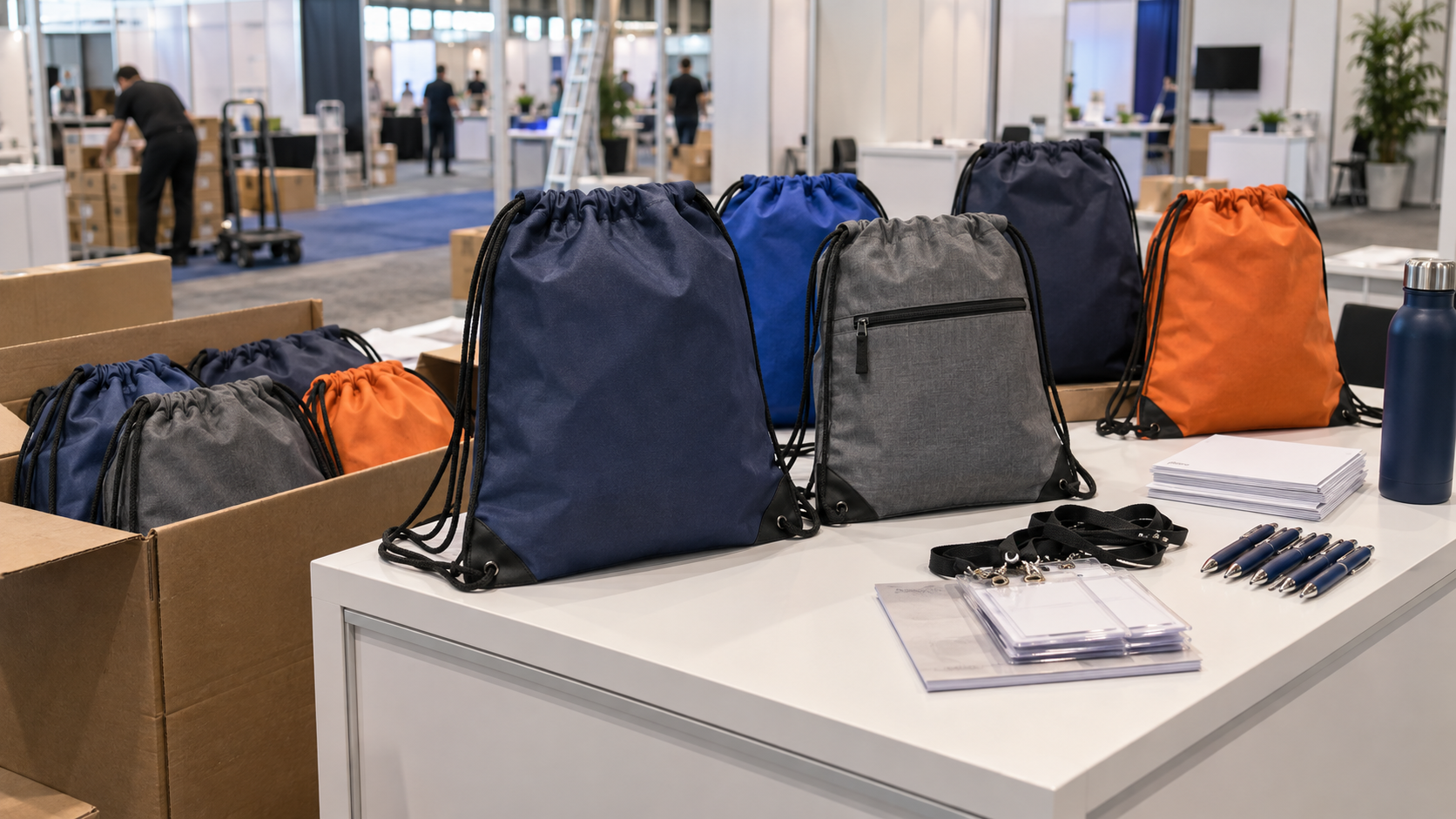
Generated, unbranded editorial illustration. It shows a plausible packet-pickup environment, not a customer event, company facility, or verified production record.
Quick Answer: What Makes a Good Marathon Drawstring Bag?
A good marathon drawstring bag is matched to one defined event task, sized from the actual kit, easy to identify without exposing personal data, strong enough for the approved working load, and simple for volunteers to sort. For packet pickup or finish-line recovery, lightweight polyester is often practical because it packs compactly and can be decorated clearly. For wet-kit separation, ventilation, a removable inner pouch, or a suitable coating may matter more than appearance. For race-day bag drop, the organizer's security policy overrides general design preferences.
The bag is normally an event container, not running equipment. It should not be described as a hydration vest, load-bearing running pack, personal protective equipment, waterproof valuables case, or visibility device unless the exact product has been designed and verified for that purpose.
| Decision | Best first question | Evidence to approve |
|---|---|---|
| Event role | Is this for expo pickup, bag drop, finish recovery, staff, or post-event use? | One primary use named in the brief |
| Capacity | What exact items and quantities go inside? | Physical packing trial with representative contents |
| Carrying | How far and how long will it be worn? | Fit review at the intended working load |
| Identification | How will volunteers find the correct bag quickly? | Tested tag, color, or code workflow |
| Security | What does the venue and event operator permit? | Written event-specific baggage rule |
| Decoration | Which marks may be printed, and in what hierarchy? | Approved artwork and documented permission |
| Quality | Which failure would disrupt the event most? | Order-specific inspection and test plan |
| Sustainability | What happens to the bag after the event? | Practical reuse or recovery plan, not a vague claim |
Two procurement references can support the vendor review. Start with the cross-category Custom Bag Manufacturer Guide. Then apply the product-specific checks in How to Choose a Custom Drawstring Bag Manufacturer.
Map the Bag to the Athlete Journey
Marathon procurement often fails when one design is ordered before the operating team maps where bags enter and leave the event. Treat each handoff as a separate requirement.
| Event stage | Possible bag role | Operational priority | Common design mistake |
|---|---|---|---|
| Online registration | Optional pre-event merchandise | Accurate variant forecasting | Ordering every registrant a bag without an opt-in or pickup assumption |
| Expo or packet pickup | Carry bib envelope, shirt, guide, and sponsor items | Fast packing and clear presentation | Choosing size before sponsor inserts are final |
| Race-morning entry | Approved bag-drop container | Security, rapid identification, closure reliability | Assuming any backpack or personal bag will be accepted |
| Start corrals | Volunteer or pacer kit | Color coding and controlled issue | Using participant-facing colors that conflict with wave codes |
| Finish area | Recovery-kit carrier | Open, fill, and hand over quickly | Overfilling with irregular bottles and samples |
| Medical or recovery zone | Controlled supply pouch | Separation and inventory clarity | Adding claims that imply medical or protective performance |
| Post-event | Reusable light-duty bag | Useful neutral design and care guidance | Printing a date-dominant design that discourages later use |
| Community fitness day | Participant activity kit | Flexible sizing and simple distribution | Copying marathon specifications for a much lighter use |
World Athletics' current Label Road Race Regulations treat athlete services and event organization as formal operational matters. A current championship example, the Copenhagen 2026 race-week guide, separately describes runner areas and race bag drop. These sources illustrate why a buyer should obtain the actual organizer and venue rules; they do not create a universal specification for every local race.
Do not confuse a giveaway bag with on-course equipment
If participants will run while wearing the product, the use case changes. Movement, bounce, cord pressure, perspiration, access, and load stability need a dedicated design review. A basic promotional drawstring bag can be suitable for pre- or post-race carrying yet uncomfortable and unstable during a long run.
For team training kits and repeated team use, see Custom Drawstring Bags for Sports Teams. That topic covers ongoing roster and equipment needs; this guide concentrates on temporary event logistics and participant flow.
Build a Contents-First Size Specification
Do not start with “standard adult size.” Create an item map for each bag type, obtain representative samples, and pack them in the order volunteers will use. Measure usable internal space after the top channel is closed. The flat external dimensions are not the same as usable capacity.
Example event-kit map
| Contents set | Capacity issue to check | Construction response to evaluate |
|---|---|---|
| Bib envelope, shirt, pins, printed guide | Flat paper can crease near the cord channel | Body dimensions based on the largest flat item |
| Shirt, small towel, sealed snack, bottle | Bottle creates a concentrated load and uneven shape | Wider body, gusset, or controlled bottle position |
| Post-race change layer and wet shirt | Moisture can transfer to paper or electronics | Separate removable pouch or clearly communicated packing rule |
| Volunteer vest, radio accessory, guide | Hard components may abrade lightweight fabric | Higher-denier fabric or internal separation where justified |
| Sponsor samples in mixed packages | Late additions alter volume and weight | Freeze the item list before final sample approval |
| Family fitness-day kit | Adult and youth contents may differ | Size split or one deliberately limited common kit |
Use the Drawstring Bag Size and Capacity Guide to calculate dimensions from the kit rather than from a catalog label. If the contents need extra depth, review the drawstring bag gusset and bottom construction guide.
Make a real packing prototype
The prototype should answer practical questions: Can a volunteer fill it without forcing the opening? Does the bottle distort the printed panel? Can the top close with the tallest item inside? Does the identification tag remain visible? Can a participant remove the shirt without emptying everything? Does the bag still fit the event's storage rack or bin?
Record the item list, item weights, fill sequence, closed dimensions, and total packed weight. If sponsors add products later, repeat the trial instead of assuming the approved bag still works.
Choose Material by Event Exposure, Not by Trend
No material is automatically best for every marathon. Evaluate weight, texture, print method, abrasion, water exposure, reuse pattern, and end-of-life route together.
| Material direction | Useful characteristics | Watch-outs | Typical event fit |
|---|---|---|---|
| Lightweight polyester | Compact, smooth, easy to color, suitable for several decoration methods | Thin fabric may reveal stress points or transmit moisture | Packet pickup, recovery kits, mass participation |
| Higher-denier polyester | More structure and abrasion resistance than very light grades | More bulk, higher unit material use, stronger cords may be needed | Repeat fitness programs, volunteer kits, heavier contents |
| RPET polyester option | Can support a recycled-content brief when the supply chain is documented | Recycled-content percentage and certification scope must be verified for the order | Programs with evidence-based material requirements |
| Nylon option | Can provide a different hand feel and strength-to-weight profile | Cost, coating, finish, and print compatibility vary | Premium lightweight applications after sampling |
| Non-woven polypropylene | Economical, light, printable, available in multiple basis weights | Tear behavior, seam method, repeated-use expectations, and claims need care | Controlled light giveaways and simple kits |
| Cotton or canvas | Natural hand feel and strong brand presentation | Heavier, bulkier, may shrink or bleed, and needs wash-care planning | Premium packet pickup or post-event merchandise |
| Mesh | Ventilation and visible contents | Less privacy, snagging, small items can escape | Wet gear or controlled equipment collection |
Begin material screening with Best Materials for Custom Drawstring Bags. If polyester weight is the open decision, compare the constructions in 210D vs 420D vs 600D Polyester Drawstring Bags. Ventilated wet-kit applications need the separate analysis in Mesh Drawstring Bags: Fabric, Strength and Applications.
If recycled polyester is requested, specify the claimed percentage, chain-of-custody evidence, transaction documentation where applicable, and exact certified scope. The RPET drawstring bag certification and sourcing checklist explains why a material label or supplier statement alone is not enough.
Design the Closure, Cord and Lower Anchors as One System
The body fabric, top channel, cords, and lower anchors transfer load together. Increasing fabric thickness without improving the anchor can leave the weakest point unchanged. Likewise, a thick cord can make a light bag uncomfortable without increasing useful capacity.
Cord-system selection table
| System | Operational benefit | Limitation to test | Suitable event question |
|---|---|---|---|
| Double-cord backpack style | Familiar closure and hands-free light carry | Shoulder pressure, cord length, anchor pull | Will participants walk from expo to transport with the kit? |
| Single-cord pouch closure | Simple and compact | Not worn like a backpack; closure control differs | Is this a small recovery or merchandise pouch? |
| Round cord | Slides easily and is widely used | Can concentrate pressure | Is the approved load light and carry time short? |
| Flat cord | Spreads pressure over a wider area | May twist or feed differently through the channel | Does the event prioritize a softer carry feel? |
| Webbing strap | Broad contact and visual presence | More material, hardware, and construction complexity | Is repeated post-event use important enough to justify it? |
| Fabric-reinforced lower loop | Avoids exposed metal hardware | Stitch and fold geometry must be controlled | Will bags be handled rapidly in storage and return? |
| Metal eyelet | Compact anchor and familiar appearance | Pull-through, edge, finish, and corrosion must be evaluated | Does the hardware solve a verified need? |
Translate the anchor concept into specifications with the cord, eyelet and reinforcement guide. Choose the closure arrangement through the single-cord versus double-cord comparison. After that, compare shoulder-contact options in the round cord, flat cord and webbing guide.
For longer walking routes between an expo, hotel, transport hub, and event village, shoulder comfort deserves a separate sample review. See How to Improve Drawstring Bag Shoulder Comfort. Comfort is dependent on load, fit, cord geometry, clothing, and duration; it should not be promised from material name alone.
Plan a Fast, Privacy-Safe Bag-Drop Workflow
A race-day bag drop is a retrieval system, not just a pile of bags. The organizer needs an identification method that remains attached, can be read quickly, avoids unnecessary personal information, and works in rain, low light, and volunteer shift changes.
A practical workflow
- Publish the permitted bag type, size, closure, prohibited contents, cutoff time, and collection method before race day.
- Assign a retrieval code linked to the event's registration system without printing a participant's full name or other unnecessary data on the exterior.
- Select a tag position that remains visible when bags are packed densely.
- Divide storage by a tested hierarchy such as zone, wave, number band, or rack.
- Rehearse intake, movement, exception handling, and return using filled samples.
- Define what happens to an untagged bag, detached tag, late arrival, or uncollected item.
- Train volunteers not to make unsupported promises about security or valuables.
| Failure mode | What participants experience | Preventive control |
|---|---|---|
| Tag detaches from cord | Retrieval delay and manual exception search | Validate tag attachment under repeated handling |
| Bag color duplicates zone code | Misrouting between storage groups | Reserve a distinct code system and document it |
| Full name visible | Unnecessary privacy exposure | Use the minimum operational identifier |
| Cord loosens in transit | Contents can spill | Confirm closure performance with the actual fill |
| Bag exceeds rack depth | Storage density collapses | Include storage fixture dimensions in the brief |
| Wet exterior transfers ink or soil | Labels become unreadable or adjacent bags stain | Test materials and labels under expected moisture |
| Valuables are placed inside | Loss claims and participant dissatisfaction | Communicate prohibited items and liability terms clearly |
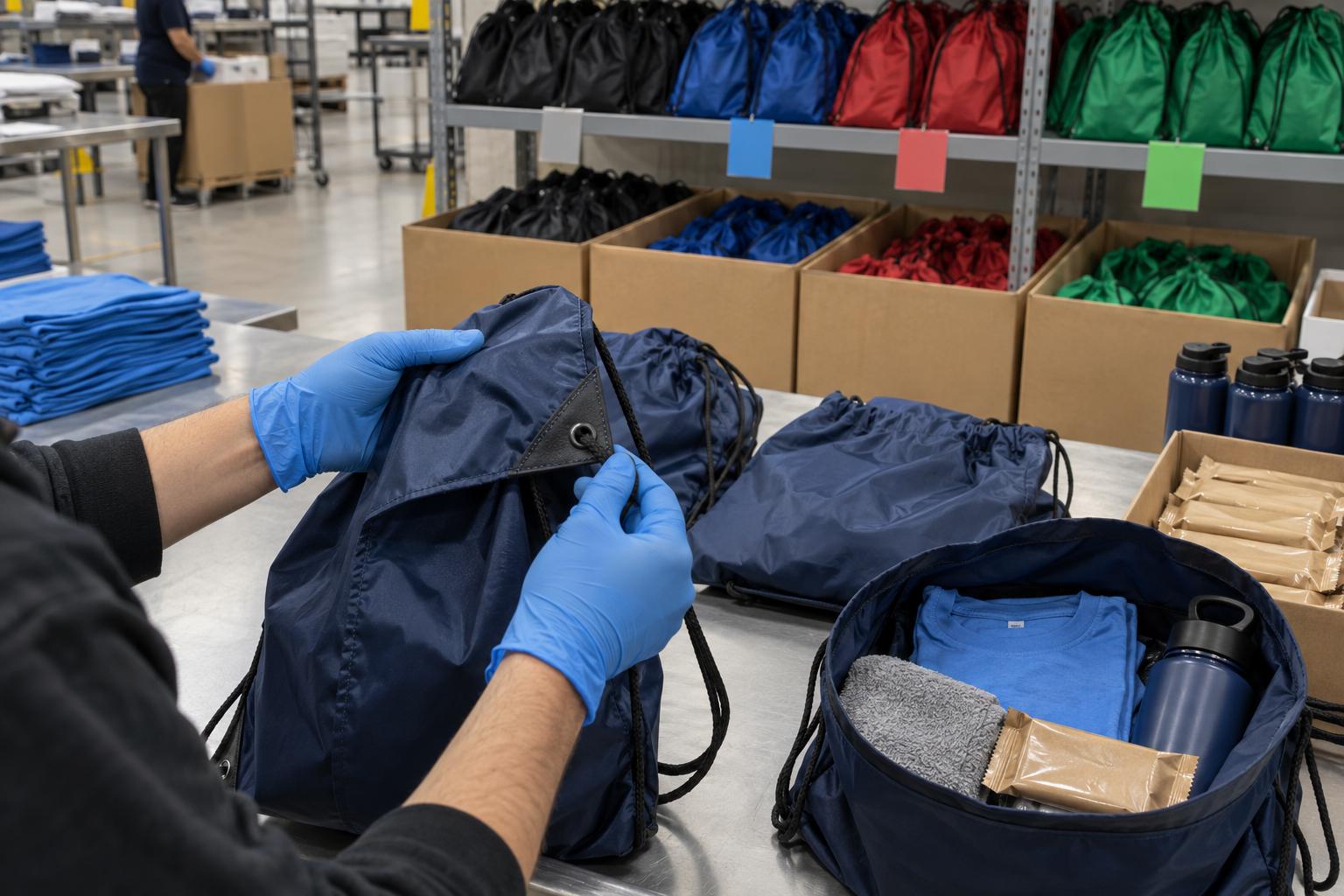
Generated, unbranded editorial illustration of a bag-sorting and inspection concept. It is not evidence of an actual LUCKYSTAR facility, customer order, or test result.
Address Security and Venue Rules Before Artwork
Some events or venues may require clear bags, a prescribed official bag, maximum dimensions, a sealed tag, or restrictions on personal baggage. Others may prohibit unattended bags or certain contents. These rules can change by venue, event, or security plan.
Do not print thousands of bags before the event owner, venue, security lead, and timing or registration provider approve the complete bag-drop workflow. A visually attractive opaque bag is unusable if the event requires transparency. A reusable personal bag may be inappropriate if only an event-issued bag is accepted.
The specification should state that the bag is not a secure container for phones, wallets, medication, keys, or other valuables unless the organizer has designed and accepted a specific controlled service. Drawstrings are closures, not locks.
Separate Dry Kit, Wet Kit and Recovery Items
Post-race contents are often damp, irregular, and time-sensitive. A wet shirt can transfer moisture and dye; a cold bottle can create condensation; an opened food sample can leak; a foil blanket can catch on hardware. The bag design should reflect how long those items stay together.
Moisture-management options
| Option | What it can help with | What it does not prove |
|---|---|---|
| Mesh panel or full mesh body | Ventilation and quick visual checking | Protection from rain or leakage |
| Coated polyester body | Resistance to brief splashes, depending on construction | Complete waterproofing or protection of valuables |
| Removable inner pouch | Separation of damp clothing from paper items | Leakproof containment unless specifically tested |
| External bottle pocket | Controls bottle position and improves access | Retention during running without a dedicated trial |
| Drainage detail | Reduces retained liquid in a controlled application | Hygiene, antimicrobial performance, or faster drying in all conditions |
| Simple unlined body | Easy packing and low bulk | Moisture isolation |
The article Waterproof Drawstring Bag Materials Explained distinguishes water resistance, coated fabrics, seam leakage, and genuinely tested waterproof constructions. Avoid an unqualified “waterproof” claim when water can enter through the top channel, seams, eyelets, or decoration.
If a pocket or zipper solves a real separation problem, define its contents and access order first. Use How to Add Pockets and Zippers to Drawstring Bags to evaluate added seams, weight, cost, and inspection points.
Create Sponsor Visibility Without Sacrificing Function
Event bags may carry organizer, title sponsor, charity, municipality, media, and supporting-partner marks. More logos do not automatically produce more value. A controlled hierarchy is easier to read and easier to approve.
Artwork hierarchy checklist
| Artwork element | Decision before sampling | Production risk |
|---|---|---|
| Event identity | Primary position, clear space, and size | Distortion near folds or the drawcord channel |
| Title sponsor | Contractual prominence and color rules | Late approval forcing rework |
| Supporting sponsors | Maximum count and minimum readable size | Crowded panel and small-detail loss |
| Date and location | Decide whether post-event reuse is a goal | Date-dominant design shortens perceived relevance |
| QR code | Destination, data owner, expiration, and scan size | Code fails on wrinkles or after abrasion |
| Reflective element | Visual accent or specified visibility function | Being misrepresented as safety equipment |
| Participant personalization | Minimum necessary data and consent | Privacy, sorting complexity, and variant errors |
Only use logos and creative assets with written permission for the intended products, quantity, region, period, and channels. A purchase order, artwork file, or historical sample does not by itself establish public promotional rights.
The logo placement and print size guide explains printable zones around channels, seams, gussets, and folds. For process selection, compare custom drawstring bag printing methods. Pantone references, CMYK builds, fabric shade, ink opacity, and viewing conditions should be recorded in the approved sample; see Pantone vs CMYK for Custom Drawstring Bags.
Reflective graphics require precise language
A reflective transfer or print can create a visible design effect under certain illumination. It should not be marketed as PPE, high-visibility certification, or a guarantee that drivers will see a participant. The exact construction, placement, area, viewing angle, laundering, abrasion, and applicable standard determine any defensible performance claim. The guide to reflective printing for sports drawstring bags provides a claim-safe evaluation framework.
Forecast Quantities from Operational Data
Registration count is not the same as required bag quantity. The buyer should reconcile paid entrants, complimentary entries, deferrals, no-shows, expo pickup rates, late registration, volunteers, pacers, elite athletes, sponsors, media, replacement stock, and multiple event distances.
| Quantity input | Planning question | Record owner |
|---|---|---|
| Registered participants | Which registration snapshot is used? | Registration manager |
| Expected pickup | Are mail-outs, no-shows, and deferred entries excluded? | Participant services |
| Late entries | What cutoff is compatible with production and packing? | Race director |
| Distance or wave variants | Does each group need a different color, insert, or mark? | Course operations |
| Volunteer allocation | Is the volunteer bag identical or a separate kit? | Volunteer manager |
| Sponsor allotment | Are samples packed into participant bags or distributed separately? | Sponsorship manager |
| Replacements | What defects, losses, or on-site exceptions are covered? | Event operations |
| Archive samples | How many approved and production samples are retained? | Procurement or quality lead |
Use one controlled quantity sheet with revision dates. Each color, size, print version, language, and packing group increases complexity. Consolidation may lower unit cost, but it should not erase operational distinctions that volunteers need on event day.
MOQ, sample timing, and production timing depend on material, construction, decoration, quantity, season, testing, and capacity. They should be confirmed in writing for the specific order. The Custom Drawstring Bag MOQ and Production Time guide shows how to build a realistic schedule without treating a quoted lead time as universal.
Test the Bag for Its Approved Event Load
Testing should reproduce the intended use, not chase the highest number. Define the representative fill, target working load, duration, handling cycles, environmental exposure, acceptance criteria, and failure classification before testing.
Recommended order-specific verification plan
| Test or check | Why it matters at an event | Example acceptance approach |
|---|---|---|
| Dimensional inspection | Bags must fit packet contents and storage fixtures | Approved tolerances by critical dimension |
| Static load hold | Screens seams, body, channel, and anchors under the packed load | No functional failure after defined load and time |
| Handling or lift cycles | Simulates intake, rack movement, and participant collection | No cord release, anchor separation, or seam opening |
| Cord pull or anchor test | Targets a common high-stress point | Order-specific force or cycle threshold |
| Closure cycling | Checks repeated opening and closing | Smooth operation without unacceptable fraying |
| Print adhesion | Screens peeling or poor bond | Defined tape or adhesion protocol for the print system |
| Abrasion exposure | Simulates stacking, transport, and participant wear | Artwork remains legible within approved grade |
| Color transfer or rubbing | Important around wet shirts and light clothing | Approved dry and wet rubbing result where applicable |
| Water-exposure check | Evaluates rain or condensation scenario | Result stated narrowly; no automatic waterproof claim |
| Packing trial | Confirms volunteers can fill and close the bag quickly | Timed trial with actual items and packing sequence |
| Tag-retention trial | Protects retrieval workflow | Identifier remains attached and legible after handling |
| Carton drop or transit check | Screens packing and transport damage | Cartons and contents remain fit for distribution |
Read How to Test Drawstring Bag Load Capacity, the cord strength and pull test guide, and drawstring bag print adhesion and abrasion testing when translating the event risk assessment into measurable controls.
Test results apply to the submitted construction, materials, decoration, and batch or sample scope. They should not be expanded into a claim about every LUCKYSTAR bag or every future order.
Control Sampling, Production and Pre-Shipment Inspection
A marathon has a fixed date, so a late discovery is difficult to recover from. Freeze the specification through staged approval rather than relying on an attractive digital mockup.
Approval gates
- Operational brief: event role, contents, load, bag-drop rules, security constraints, quantities, destinations, and packing groups.
- Material and construction review: fabric, basis weight or denier, coating, cords, channels, anchors, pockets, hardware, seams, and color.
- Artwork proof: dimensions, placement, colors, sponsor hierarchy, permissions, data fields, and scannable elements.
- Physical sample: fit, closure, carry feel, packed shape, print appearance, tag placement, and volunteer handling.
- Golden sample or signed specification: the controlled reference for bulk production and inspection.
- Pre-production review: approved bill of materials, artwork version, packing map, test plan, and critical tolerances.
- In-process checks: construction and decoration controls at defined production stages.
- Pre-shipment inspection: random sampling against the approved specification, quantity, workmanship, function, artwork, packing, and carton marks.
The custom drawstring bag sample development process explains how to convert comments into a signed reference. During production, organize checkpoints with the Custom Drawstring Bag Quality Control Checklist. Before release, plan the final verification separately with How to Inspect Custom Drawstring Bags Before Shipment.
Pack by Event Zone, Not Just by SKU
Factory packing should reflect what happens at the expo and venue. A carton filled efficiently but mixed across waves can create hours of resorting on site.
| Packing layer | Information to define | Event benefit |
|---|---|---|
| Individual bag | Fold, tag location, inserts, and closure state | Consistent volunteer handling |
| Inner bundle | Quantity, orientation, and variant label | Fast table replenishment |
| Carton | Event, distance, zone, wave, variant, quantity, and sequence | Direct routing to the correct area |
| Pallet or shipment | Venue entrance, delivery window, and carton range | Less cross-dock confusion |
| Exception carton | Samples, replacements, blank bags, spare tags | Faster problem resolution |
| Packing list | Version-controlled carton map | Reconciliation before opening everything |
Avoid printing participant names or other unnecessary personal information on outer cartons. When unique codes are required, define who supplies the data, the secure transfer method, version lock, destruction or retention procedure, and exception process.
Make Sustainability Claims That Match the Evidence
An event bag is not sustainable merely because it is reusable, recycled, cotton, lightweight, or handed out at a “green” race. The environmental result depends on material input, quantity, durability, actual reuse, transport, packaging, and recovery options.
World Athletics' Athletics for a Better World Standard includes sustainable procurement, waste management, health and safety, inclusion, and monitoring. Its current waste-management guidance emphasizes upstream purchasing decisions and practical reduction, reuse, recycling, and composting. For bag procurement, that means ordering intentionally and documenting the next-use plan rather than relying on a single material adjective.
Better claim practice
| Weak statement | Better evidence-led approach |
|---|---|
| “Eco-friendly race bag” | Name the specific material attribute and the evidence held for the order |
| “100% recycled” | State the verified percentage, product scope, calculation basis, and applicable documentation |
| “Reusable” with no plan | Design for a realistic next use and measure participant retention or redistribution where feasible |
| “Waterproof” | Describe the tested water-resistance condition and construction limitations |
| “Zero-waste event bag” | Report the defined waste boundary, prevention actions, recovery method, and measured outcome |
| “Biodegradable” | Identify material, test method, conditions, time frame, and disposal pathway |
Useful procurement actions include making the bag optional where appropriate, avoiding excessive sponsor inserts, choosing a design that remains useful after the event date, consolidating variants when operations permit, minimizing unnecessary individual packaging, and planning donation or redistribution of legitimate surplus.
Why Event Buyers Work with LUCKYSTAR
LUCKYSTAR is relevant when a buyer needs one coordination point for an order-specific drawstring-bag program rather than a generic stock item. The value is the discipline of connecting event operations with a manufacturable specification.
Subject to the final brief and written confirmation, LUCKYSTAR can help coordinate:
- material and construction options for the approved contents and handling route;
- dimensional development from representative event kits;
- cord, channel, lower-anchor, pocket, and gusset decisions;
- decoration selection based on fabric, artwork, color, quantity, and durability needs;
- physical sampling and revision tracking before bulk approval;
- order-specific testing and inspection requirements;
- variant maps for distances, waves, staff groups, or event locations;
- carton labeling and packing plans aligned with expo and venue distribution;
- evidence review for recycled-content or performance claims where requested;
- pre-shipment inspection against the signed specification.
LUCKYSTAR does not treat platform prices, example MOQs, sample fees, schedules, test reports, or certificates as universal promises. Final commercial conditions, materials, tolerances, testing, certification scope, and delivery timing remain subject to the specific order and written confirmation. This approach protects the event date and gives procurement, creative, operations, and quality teams one controlled reference.
Marathon Drawstring Bag Brief: Copy-and-Use Checklist
Send the following information with the quote request.
| Brief section | Information to provide |
|---|---|
| Event profile | Event type, date, location, venue, route context, and destination market |
| Bag role | Packet pickup, bag drop, finish recovery, volunteer kit, sponsor activation, or merchandise |
| Users | Adult, youth, mixed, volunteers, elite field, or general participants |
| Contents | Complete item list, dimensions, individual weights, total packed weight, and packing order |
| Security | Permitted bag type, maximum dimensions, transparency rule, tag method, and prohibited items |
| Construction | Material, denier/GSM, coating, gusset, cord, channel, anchors, pockets, zipper, and hardware |
| Artwork | Authorized vector files, colors, print positions, sponsor hierarchy, QR policy, and approver |
| Quantities | Total, variants, waves, distances, languages, spares, and retained samples |
| Quality | Critical dimensions, working load, test protocols, inspection level, and defect definitions |
| Packing | Individual packaging, bundle quantity, carton sort, labels, pallet map, and delivery sequence |
| Claims | Exact environmental, material, water, visibility, or durability statements and supporting evidence |
| Timing | Sample deadline, artwork freeze, testing window, ship date, venue delivery window, and contingency |
If a field is unknown, identify its owner and decision date. A visible “to be confirmed” is safer than an assumption hidden inside the quotation.
Frequently Asked Questions
Are drawstring bags suitable for running a marathon?
A basic promotional drawstring bag is usually better for packet pickup, bag drop, or post-race use than for running. If the bag will be worn on course, assess bounce, cord pressure, load stability, perspiration, access, and route duration through a dedicated sample and wear trial. A running vest or belt may be more suitable.
What size should a marathon event bag be?
There is no universal size. Pack the actual bib envelope, shirt, towel, bottle, nutrition item, and sponsor inserts; then validate closure, print distortion, storage-rack fit, and volunteer packing speed. Use the closed usable dimensions, not only the flat panel measurement.
Is 210D polyester strong enough for a race bag?
It may be appropriate for a light, controlled kit, but “210D” alone does not establish strength. Yarn, weave, coating, seams, channel, anchor geometry, cords, decoration, and workmanship all affect performance. Approve the exact construction through an order-specific load and handling trial.
Can participants leave valuables in the bag drop?
That depends on the organizer's policy. A drawstring closure is not a lock, and the bag should not be promoted as secure storage. Publish prohibited items, identification steps, collection rules, and liability terms clearly.
Should race bags be transparent?
Only if required or preferred by the event's security plan. Some venues may prescribe clear or event-issued bags, while others permit opaque bags. Obtain written approval before material and artwork production.
How can wet running clothes be separated?
Consider a removable inner pouch, mesh section, or controlled participant instruction. A coated outer bag may resist brief splashes but does not automatically contain wet items or protect electronics. Test the chosen system with actual damp kit.
Can reflective printing make the bag a safety product?
No, not by itself. Reflective decoration can create a visual effect under defined lighting, but safety or PPE claims require appropriate design, coverage, testing, standards, and documentation for the exact product. Use precise, limited wording.
How should bags be coded for waves or distances?
Use a documented hierarchy that volunteers can distinguish quickly, such as zone plus color plus number band. Keep the participant-facing design separate from operational codes, and avoid unnecessary personal data on external tags.
How early should a custom marathon bag order begin?
Work backward from venue delivery, allowing time for the final contents list, sponsor approvals, physical samples, testing, bulk production, inspection, transport, customs where applicable, and contingency. The actual schedule depends on the specification and must be confirmed in writing.
Can the same bag be used for expo pickup and race-day bag drop?
Sometimes, but only when its dimensions, transparency, identification, closure, and security treatment meet the bag-drop policy. The combined workflow should be rehearsed with a filled bag before approval.
How can an event reduce leftover bags?
Use current registration data, separate pickup from registration assumptions, account for deferrals and no-shows, make bags optional where feasible, limit unnecessary variants, define a controlled spare rate, and plan redistribution of legitimate surplus.
What should be inspected before shipment?
Confirm quantity, variants, critical dimensions, material and color, seams, cord length and finish, channels, anchors, closures, artwork, print adhesion, tag locations, packing sequence, carton labels, and the order-specific functional tests. Retain evidence and reference samples.
Request an Event-Specific Quote
For a useful quotation, share the event date and destination, the bag's exact role, representative contents, packed weight, venue or bag-drop rules, authorized artwork, variant plan, quantity, required tests, carton sorting, and delivery window. LUCKYSTAR can then evaluate material, construction, decoration, sampling, quality controls, and packing against the actual event operation.

Explore the custom drawstring bags product page or contact LUCKYSTAR to start an order-specific review. All recommendations, commercial terms, schedules, tests, certificates, and claims remain subject to the final specification and written confirmation.