210D vs 420D vs 600D Polyester Drawstring Bags
Last reviewed: September 28, 2026

When a supplier offers 210D, 420D and 600D polyester drawstring bags, it is tempting to read the numbers as three fixed grades: light, medium and heavy. That shortcut is useful for starting a conversation, but it is not a complete specification.
Denier measures yarn linear density—not finished-fabric weight, bag strength, abrasion life or waterproof performance. A higher denier normally indicates a coarser yarn within the same material family, yet the finished result also depends on weave, yarn spacing, fabric weight, coating, finishing, seams, cord and reinforcement.
For many projects, 210D is a practical starting point for compact promotional bags and light contents, 420D balances packability with more body, and 600D suits more demanding or structured applications. The right answer is the lightest complete construction that passes the project’s real-use tests—not simply the largest number in the quotation.
This buyer’s guide compares the three common directions, explains what the labels omit and provides an RFQ and testing framework for custom development with LUCKYSTAR.
210D vs 420D vs 600D: Quick Comparison
The table below is a sourcing starting point, not a performance guarantee.Terms such as “light,” “medium” and “heavy” are relative because suppliers may use different weaves and finishes.
| Decision factor | 210D polyester direction | 420D polyester direction | 600D polyester direction |
|---|---|---|---|
| Typical design objective | Low bulk and easy distribution | Balance of body, packability and repeat use | More structure and resistance for demanding use |
| Hand and drape | Usually soft and flexible | Usually moderately firm | Usually firmer and more substantial |
| Empty-bag packing | Most compact of the three | Moderate carton volume | Usually the bulkiest |
| Drawstring gathering | Often forms smaller folds | Needs coordinated channel and cord | Thick folds can require more clearance |
| Common starting use | Event giveaway, shoe bag, light organizer | Gym, school, campaign or travel organizer | Repeated-use carry bag,kit bag or structured pack |
| Print surface | Can be smooth or ripstop; check show-through | Often supports a balanced decoration area | Texture may be more visible through fine artwork |
| Main risk | Under-specifying seams and corner patches | Assuming “middle grade” means automatically suitable | Paying for bulk without defining measurable performance |
| Buyer’s next step | Load and corner-pull test | Compare print,closure and loaded shape | Test abrasion, channel action, packing and comfort |
Browse LUCKYSTAR’s custom drawstring bags for available development directions. If the material family itself is still undecided, start with our best materials for custom drawstring bags.
If you are deciding between fiber families rather than yarn sizes within polyester, use the separate Polyester vs Nylon Drawstring Bags comparison.
What Does “D” Mean in Polyester Fabric?
Denier is a direct yarn-numbering system. It expresses the mass in grams of 9,000 meters of yarn. The official ASTM yarn-number conversion table identifies denier as grams per 9,000 meters and relates it to tex.
Under that definition:
- 9,000 meters of 210-denier yarn has a nominal mass of 210 grams;
- 9,000 meters of 420-denier yarn has a nominal mass of 420 grams;
- 9,000 meters of 600-denier yarn has a nominal mass of 600 grams.
That does not mean one square meter of 210D fabric weighs 210 grams. Denier describes yarn, while GSM describes fabric mass per area. Converting one into the other requires additional construction data.
Higher denier does not automatically mean proportionally stronger
When polymer type, yarn construction and manufacturing conditions are comparable, a coarser yarn can contribute more material to the fabric. However, tensile strength, tear resistance and abrasion behavior also depend on filament quality, yarn twist, warp and weft settings, weave, finishing and damage during sewing.
A 600D label alone cannot prove that the finished bag carries nearly three times the load of a 210D bag. A buyer should define a load and test the finished construction.
Denier vs GSM vs Weave: Three Different Specifications
These terms are often mixed together in quotations.
| Specification | What it describes | What it helps predict | What it cannot prove alone |
|---|---|---|---|
| Denier | Yarn mass per unit length | Relative yarn coarseness within a comparable system | Fabric GSM, bag strength or waterproofness |
| GSM | Finished-fabric mass per square meter | Material usage and some aspects of body | Yarn size, weave, coating type or durability |
| Weave | How warp and weft yarns interlace | Surface, drape, stability and tear behavior | Fiber identity or exact mass |
| Thread density | Number/spacing of ends and picks | Coverage, stability and appearance | Coating or finished-bag performance |
| Coating/finish | Added surface or back treatment | Hand, permeability, print behavior and cleaning | Seam sealing or total bag waterproofness |
| Finished construction | Pattern, seams, channel, cord and reinforcement | Actual bag function | Material chemistry or compliance by itself |
For a useful RFQ, ask for all six—not a denier number alone.
Why Two “210D” Fabrics Can Feel Different
One 210D fabric may be a fine plain weave with a light coating; another may use ripstop reinforcement, tighter spacing or a different finish.The visual sheen, flexibility, opacity and reverse-side appearance can differ even when the yarn label is the same.
Possible sources of variation include:
- warp and weft yarn denier;
- filament count and yarn construction;
- plain, Oxford, twill or ripstop pattern;
- ends and picks per unit distance;
- base-fabric GSM and finished GSM;
- calendering or other surface treatment;
- PU, PVC or another back coating;
- coating amount, color and curing;
- dyed-yarn or piece-dyed route;
- lot-to-lot material tolerances.
This is why physical swatches and an approved bag sample matter more than a generic material name.
210D Polyester Drawstring Bags
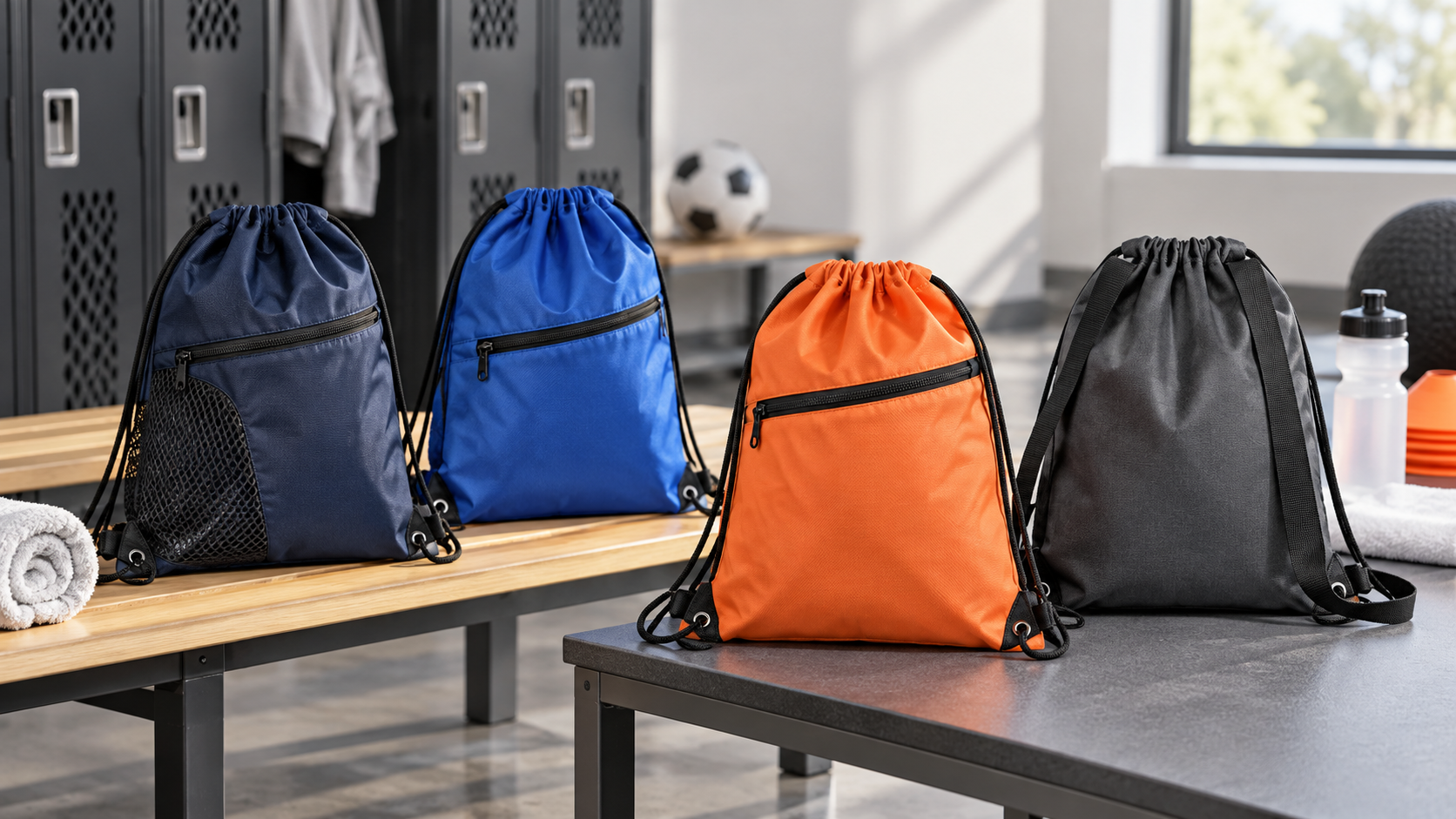
210D is commonly considered when buyers prioritize low bulk, flexible hand and efficient distribution. It can work well for a campaign bag, shoe bag, lightweight organizer or simple drawstring backpack carrying modest contents.
Where 210D can be effective
- high-volume event or promotional distribution;
- compact inserts in a retail or subscription package;
- shoe or accessory organization;
- giveaway bags that need to fold small;
- lightweight travel organization;
- programs where freight volume matters.
What buyers should watch
The face fabric may not be the weakest point.Thin corner patches, narrow seam allowances, unsuitable eyelets or an aggressive cord angle can concentrate force. Light fabric may also reveal the packed product outline and allow reverse-side print show-through.
For 210D samples, prioritize lower-corner pull, seam slippage, print penetration, opacity and loaded shape. If the design is a backpack rather than a pouch, evaluate cord comfort as well as bag strength.
420D Polyester Drawstring Bags
420D is often chosen as a middle route when 210D feels too light but 600D adds more body and packing volume than the project needs. It can suit gym programs, school events, travel kits and repeated campaign use—subject to the complete construction.
Why buyers shortlist 420D
- more body than many lightweight constructions;
- manageable gathering at the top channel;
- enough surface substance for many decoration briefs;
- moderate packed volume;
- a useful base for comparing reinforcement options.
The “middle option” trap
420D should not be approved simply because it sits numerically between 210D and 600D. A tightly woven 210D construction may outperform a loosely built 420D fabric in one test, while a well-engineered 420D bag may meet the use case without the bulk of a 600D option.
Treat 420D as a candidate to sample, not a universal compromise.
600D Polyester Drawstring Bags
600D polyester—often discussed as a polyester Oxford construction—is used when buyers want a firmer appearance, greater resistance to repeated handling or a more structured feel.It may suit branded staff kits, frequent-use organizers, heavier merchandise or sports and travel programs.
Where 600D may add value
- repeated handling and surface contact;
- a fuller, more substantial retail presentation;
- larger bags that need added body;
- constructions with pockets, webbing or panels;
- projects where abrasion performance is defined and tested.
What the heavier construction changes
Thicker folds can make the top harder to gather. The channel needs enough depth and clearance, and the cord must work with the fabric rather than cut into it. A heavier bag can also occupy more carton volume and feel stiffer against the wearer’s back.
Do not assume 600D is automatically “heavy duty.” Set the actual load, abrasion, cycle and seam requirements in writing.
Is 600D Always Better Than 420D or 210D?
No. It is better only when its additional body or potential resistance solves a real problem and the complete bag still closes, carries and packs well.
| Project requirement | Highest denier always wins? | Better decision method |
|---|---|---|
| Small promotional giveaway | No | Select for packed weight, print and distribution volume |
| Compact shoe bag | No | Test fit, abrasion, opacity and packability |
| Repeat-use gym sack | Not necessarily | Compare loaded cycles, cord comfort and seam performance |
| Structured product kit | Often benefits from more body | Test the actual product and carton fold |
| Fine multicolor artwork | No | Compare strike-offs on the actual surfaces |
| Outdoor exposure | No | Specify coating, seams, test conditions and care |
| Sustainability objective | No | Compare material mass, service life, evidence and end-of-life route |
A 600D fabric that exceeds the need may increase cost and shipping volume without improving the customer’s experience. A 210D bag that fails early is also false economy. Test against the use case.
Drawstring Channel Design by Fabric Weight
The channel must gather smoothly while retaining seam integrity. As fabric becomes firmer or bulkier, the channel usually needs more space for the folds and cord.
Channel checks for 210D
Inspect fraying at the cord exit, puckering, seam slippage and whether the cord marks or cuts the lightweight fabric.A narrow channel may close neatly, but it must still accommodate the selected cord.
Channel checks for 420D
Confirm the opening is large enough for efficient packing and that the fabric gathers evenly on both sides. Moderate body can hide misalignment until the bag is loaded.
Channel checks for 600D
Evaluate pull force, remaining mouth gap and fold distribution. Extra coating or multiple fabric layers can make a nominally large channel feel tight. An empty sample may pass while a filled sample becomes difficult to close.
| Channel variable | Why it matters | Approval method |
|---|---|---|
| Channel depth | Controls fabric and cord clearance | Measure the finished sample |
| Cord diameter | Affects pulling force and comfort | Open and close under target load |
| Entry finish | High-friction point can fray | Inspect after repeated cycles |
| Stitch position | Can narrow the usable path | Compare against signed construction sample |
| Mouth gap | Determines closure and retention | Record under normal hand force |
| Cord symmetry | Uneven travel twists the opening | Cycle both sides repeatedly |
Bottom-Corner Reinforcement Matters More Than the Number
In a drawstring backpack, the cord often transfers load through lower corners. A durable face fabric cannot compensate for a poorly designed patch, weak eyelet setting or insufficient seam capture.
Common lower-corner options include reinforced fabric patches, webbing loops and eyelets. Each changes stress distribution, appearance, repairability and cost.Specify:
- patch material, shape and dimensions;
- number of fabric layers;
- eyelet material, finish and setting quality, if used;
- cord path and knot or end construction;
- seam engagement around the patch;
- target loaded-cycle test.
Test the complete corner at the intended cord angle. A straight pull on loose material is not the same as repeated backpack use.
Cord Choice and Carrying Comfort
Cord can limit the bag before the shell fabric does. Diameter, braid, surface, stretch and end treatment affect closure action and shoulder pressure.
| Cord factor | Buyer question | Risk if omitted |
|---|---|---|
| Material | Polyester, polypropylene, cotton or another option? | Different stretch, hand and color behavior |
| Diameter | What finished diameter and tolerance? | Thin cord can feel uncomfortable under load |
| Construction | Braided, knitted, twisted or flat tape? | Closure friction and appearance vary |
| Color | Stock or custom matched? | Shade may differ from shell or transfer |
| End finish | Knot, heat seal, tip or sewn return? | Fraying or inconsistent length |
| Length | Measured open, closed or installed? | Poor fit and uneven shoulder loops |
When comparing 210D, 420D and 600D shells, keep the cord constant unless cord is itself a design variable. Otherwise, the comfort result cannot be attributed to the fabric.
Coatings, Water Resistance and Waterproof Claims
Polyester drawstring fabrics may have a back coating or surface finish. The coating can change hand, opacity, permeability, print behavior, odor and crease recovery. It can also add mass that the denier label does not reveal.
Do not translate “coated 600D” directly into “waterproof bag.” Water can enter through needle holes, seams, the gathered mouth, eyelets and unsealed edges. A more accurate specification separates:
- shell-fabric water resistance;
- coating identity and target performance;
- seam construction or sealing;
- closure coverage;
- test method and acceptance level;
- care and aging conditions.
Unless the finished bag passes an appropriate order-specific test, use restrained wording and avoid absolute waterproof claims.
Print Quality Across 210D, 420D and 600D
Denier affects surface character indirectly, but weave and finish have more immediate influence on artwork reproduction.
| Artwork factor | 210D consideration | 420D consideration | 600D consideration |
|---|---|---|---|
| Fine lines | May print cleanly on a smooth face; check penetration | Often a balanced surface, depending on weave | Coarse texture may interrupt edges |
| Large solid area | Light fabric may show uneven deposit or reverse show-through | Test density and flexibility | Avoid excessive ink build on textured folds |
| White on dark fabric | Underbase and opacity need approval | Same, with surface compatibility | Texture can remain visible through the print |
| Transfer process | Heat may alter coating, gloss or shade | Confirm adhesion and appearance | Full contact may be harder on coarse surfaces |
| Sublimation direction | Requires suitable polyester/color/process setup | Confirm fabric and artwork compatibility | Coating and construction still need trials |
| Fold resistance | Thin fabric flexes strongly | Moderate flex | Stiff fabric may form defined creases through print |
Approve a strike-off using the proposed production fabric, color, coating and process. A print on white 210D cannot predict the result on black 600D.
Screen Printing, Transfer and Sublimation Decisions
No decoration process is best for every denier.
Screen printing
Often suitable for bold graphics and controlled spot colors, subject to ink/fabric compatibility. Check coverage, edge quality, flexibility, rub and reverse-side penetration.
Heat-transfer decoration
Can support detailed graphics, but heat and pressure may alter shine, coating or fabric hand. Test adhesion across the textured surface and after folding.
Dye-sublimation direction
Polyester is compatible with sublimation chemistry under the right conditions, but the fabric color, coating, temperature response and artwork requirements still matter. Full-color sublimation is not a blanket promise for every stock 210D, 420D or 600D fabric.
Artwork files, print dimensions, position and tolerance belong in the technical package. Our drawstring bag tech-pack preparation guide shows how to record those controls for sampling and production.
Color, Shade and Reorder Consistency
The same named color can look different on three constructions because yarn size, surface texture and finish change light reflection. A glossy light fabric may appear brighter than a matte, coarse fabric even when the dye target is similar.
For color-sensitive programs:
- define the physical color reference;
- approve the exact fabric construction and finish;
- view the sample under agreed lighting;
- approve decoration on the selected color;
- retain a signed material and bag sample;
- set a realistic lot tolerance;
- review reorders against the retained standard.
Avoid relying on screen colors or a marketplace thumbnail.
Abrasion, Tear and Tensile Performance
These properties answer different questions.
| Test area | What it reveals | Why denier alone is insufficient |
|---|---|---|
| Abrasion | Surface wear from rubbing | Weave, coating and finish influence wear |
| Tear | Propagation from a cut or puncture | Yarn interlacing and ripstop structure matter |
| Tensile | Force to break a fabric strip | Yarn quality and fabric direction matter |
| Seam strength/slippage | Whether the stitched assembly opens | Needle, thread, allowance and weave interact |
| Corner pull | Load transfer at cord anchor | Patch and eyelet design dominate |
| Loaded carry | Whole-bag function | Size, load shape, seams and cord all contribute |
Select tests according to the real product risk. A promotional pouch does not need the same plan as a large drawstring backpack intended for daily sports equipment.
A Finished-Bag Test Matrix
Use the same procedure for all three candidate samples so the comparison is meaningful.
| Checkpoint | Sample setup | Record |
|---|---|---|
| Material identity | Approved swatch and supplier specification | Denier, weave, GSM, finish and coating |
| Dimensions | Bag flat under defined condition | Width, height, channel, patch and tolerance |
| Usable opening | Bag fully open | Maximum practical product width |
| Loaded shape | Actual product or agreed test load | Distortion, corners, mouth and appearance |
| Closure cycles | Filled bag, consistent hand motion | Pull force, fraying, cord travel and mouth gap |
| Carry cycles | Target load and use simulation | Seam, cord and reinforcement condition |
| Abrasion | Relevant contact area | Surface change and coating exposure |
| Decoration rub/flex | Production-method print | Adhesion, cracking, transfer and edge quality |
| Pack-out recovery | Approved fold and carton simulation | Creases, deformation and color transfer |
| Cleanliness | Normal inspection lighting | Stains, loose threads, debris and odor criteria |
Define method, sample size and acceptance criteria before bulk production.“Pass” is meaningful only when everyone uses the same procedure.
Packing and Freight Volume
Material selection continues after sewing.210D bags usually fold flatter, while 600D fabric, thick corner patches and larger cords can raise carton volume. 420D often sits between them, but actual pack-out depends on the full design.
Conduct a carton trial using the final fold, decoration and cord arrangement. Check:
- bags per inner pack and carton;
- carton dimensions and gross weight;
- creasing after compression;
- ink or coating transfer between bags;
- eyelet contact with neighboring fabric;
- unpacking time for retail or event teams;
- whether individual packing is truly necessary.
Comparing only unit price can hide meaningful logistics differences.
Cost Drivers Beyond Denier
Higher-denier fabric may cost more because it uses a different construction, but denier is only one input.
| Cost driver | Lower-complexity route | Higher-complexity route |
|---|---|---|
| Fabric | Available construction and color | Custom weave, finish, coating or color |
| Bag shape | Simple flat sack | Gusset, lining, pockets or several panels |
| Reinforcement | Standard patch | Custom webbing, eyelet or layered corner |
| Decoration | One position and limited colors | Multiple positions or specialty process |
| Cord | Standard color and diameter | Custom match, special braid or end hardware |
| Testing | Basic order checks | Additional performance or market-specific reports |
| Packing | Standard bulk pack | Individual retail or shape-protective pack |
For budgeting, first review the 2026 custom drawstring bag pricing guide. Then compare the specification choices in our quality-preserving cost-reduction guide. Any price depends on the approved configuration, order volume and current written offer.
MOQ and Production Time
MOQ and lead time depend on material availability, color, coating, printing, components, sampling, testing, production scheduling and packing. They are not fixed by 210D, 420D or 600D alone.
A stock 210D color may support one commercial route, while a custom-colored 600D fabric may introduce a material minimum. The reverse can also happen if the available material differs.
Ask the supplier to separate:
- fabric/color minimum;
- bag-making minimum;
- decoration minimum;
- sample schedule;
- bulk schedule after final approval;
- inspection and shipping time.
See Custom Drawstring Bag MOQ and Production Time for a planning framework.
Which Denier Fits Each Use Case?
| Use case | Sensible first sample | Alternative to compare | Critical test |
|---|---|---|---|
| Event giveaway with light contents | 210D | Lightweight 420D | Print, corner pull and carton volume |
| Shoe or laundry organizer | 210D or 420D | Ripstop construction | Fit, opacity, seam and abrasion |
| School or club drawstring backpack | 420D | Reinforced 210D or lighter 600D | Cord comfort and loaded cycles |
| Gym or sports campaign | 420D | 600D for more body | Moisture handling, abrasion and closure |
| Staff kit or reusable merchandise | 600D | Structured 420D | Loaded shape, reinforcement and packing |
| Product presentation bag | Choose by desired drape/body | Compare two actual swatches | Appearance with the real product |
| Travel organizer | 210D for packability | 420D for added body | Abrasion, zipper/pocket interaction if added |
| Large frequent-use bag | 600D candidate | Engineered 420D | Whole-bag load and corner test |
This table identifies sample directions, not universal specifications.Product weight, sharp edges, dimensions and reuse expectation can change the result.
How to Run an Equal-Spec A/B/C Sample
Comparing three random catalog bags produces weak evidence. They may differ in size, cord, patch, print and seam.
For a fair A/B/C trial:
- keep finished dimensions constant;
- use the same bag pattern and seam construction;
- keep cord, patch and eyelet constant where feasible;
- place the same artwork at the same size;
- vary only the nominated shell construction;
- pack the same product or test load;
- run the same closure, carry, abrasion and packing checks;
- record the decision and seal the approved sample.
The custom drawstring bag sample development process explains how to move from reference to approved sample. The manufacturing process from design to delivery covers the later handoffs.
Quality Defects to Watch
| Defect | Possible cause | Prevention or control |
|---|---|---|
| Uneven gathering | Channel width, stitching or cord mismatch | Approve loaded closure sample |
| Frayed cord exits | Raw edge or excessive friction | Define exit finish and cycle test |
| Pulled lower corner | Weak patch, eyelet or seam capture | Define reinforcement and corner-pull test |
| Seam opening | Allowance, stitch or fabric slippage | Confirm seam specification and loaded check |
| Print pinholes | Coarse texture or incompatible deposit | Strike-off on production fabric |
| Print show-through | Light/open fabric or excessive ink | Inspect both sides before approval |
| Coating crease/whitening | Folding, pressure or finish behavior | Carton-compression sample trial |
| Shade mismatch | Lot, finish or substrate variation | Physical standard and agreed tolerance |
| Bag twists when worn | Cord length or panel/seam imbalance | Wear and symmetry test |
| Eyelet damage | Setting quality or unsuitable material stack | Inspect setting and repeat load cycle |
Use the custom bag quality inspection checklist to define defect levels and inspection records.
Sustainability: Higher Denier Is Not Automatically Greener
A heavier bag uses more material, but it may last longer in a demanding application. A lighter bag may reduce material and freight volume, but only if it survives its intended service. No denier number alone establishes the lower environmental impact.
Assess the complete program:
- material composition and mass per finished bag;
- recycled-content percentage and evidence, if claimed;
- coating and mixed components;
- durability under the intended load;
- realistic reuse behavior;
- carton and individual packaging;
- repair, collection and end-of-life routes in the destination market.
Avoid calling polyester “eco-friendly,” “recycled” or “recyclable” without order-relevant evidence and a defined context. If recycled polyester is requested, confirm the applicable supplier scope and shipment documentation before making a public claim. LUCKYSTAR does not present GRS, GOTS or BSCI as universal company-wide certifications.
Why Choose LUCKYSTAR?
The most valuable supplier contribution is not recommending the biggest denier. It is converting the intended use into a repeatable, testable construction.
LUCKYSTAR supports OEM and ODM custom-bag development through a specification, sample and quality workflow.
Specification-first comparison
We can help organize the brief around application, packed load, dimensions, denier, weave, GSM, coating, channel, cord, reinforcement, decoration, testing and packing. This makes 210D, 420D and 600D quotations easier to compare on the same basis.
Sample-led decisions
Available references or custom samples can be evaluated with the actual product and artwork. A sealed sample plus a written specification provides a stronger bulk standard than a material name or online photo.
Coordination across interacting components
Shell fabric, coating, print, cord, patch, eyelet, sewing and packing affect one another. LUCKYSTAR can coordinate these decisions through the development process rather than treating each part as an isolated purchase.
Evidence-aware claims
Performance and sustainability statements are handled at the order level. Where a claim needs testing, material documentation or certification scope, that requirement should enter the brief before the artwork is approved.
OEM and ODM pathways
Buyers with a full technical pack can use an OEM-oriented route; buyers starting from an existing structure can discuss an ODM-style development path. Read OEM vs ODM Drawstring Bag Manufacturing, how to choose a custom drawstring bag manufacturer and the broader custom bag manufacturer guide.
Material availability, commercial terms, testing, capacity and delivery remain subject to the final approved specification and written confirmation.
RFQ Checklist for 210D, 420D or 600D Bags
| RFQ field | Information to provide |
|---|---|
| Application | Giveaway, shoe bag, gym sack, staff kit or product packaging |
| Packed item | Dimensions, weight, shape and sharp/fragile areas |
| Candidate fabric | 210D, 420D and/or 600D polyester for comparison |
| Construction details | Warp/weft denier, weave, GSM, finish and coating request |
| Bag dimensions | Width, height, gusset, measurement method and tolerance |
| Channel | Depth, layers, exit construction and mouth requirement |
| Cord | Material, diameter, construction, color and installed length |
| Lower corners | Patch/webbing, eyelet, seam and load expectation |
| Decoration | Artwork, colors, position, size and process direction |
| Performance | Load, cycles, abrasion, water or care requirement |
| Quantity | Trial quantity and volume forecast |
| Packing | Fold, inner quantity, individual pack and carton constraint |
| Destination | Market, delivery location, date and shipping preference |
| Claims | Exact wording and required evidence or test |
If the order will be sourced internationally, review how to import custom drawstring bags from China.For a wider supplier-screening checklist, see the custom drawstring bag supplier guide.
Common Procurement Mistakes
Treating denier as fabric weight
Denier measures yarn linear density. Request finished GSM separately.
Asking only for “600D Oxford”
Add fiber composition, warp/weft construction, weave, coating, color, GSM and approved swatch.
Assuming the heaviest fabric carries the most
Test seams, channel, cord and lower-corner reinforcement as a complete bag.
Approving print on a different fabric
Artwork results change with color, texture and coating. Use a production-method strike-off on the nominated material.
Testing the bag empty
Load alters gathering, cord angle, corner stress and carrying comfort.
Forgetting carton behavior
Thicker fabric and patches change fold, crease recovery and freight volume.
Making unsupported waterproof or recycled claims
Define the claim, evidence, scope, test and market before approving copy or printing.
Frequently Asked Questions
What is the main difference between 210D, 420D and 600D?
The numbers identify nominal yarn linear density. Within otherwise comparable constructions, higher denier usually means coarser yarn and often a firmer, more substantial fabric. Finished performance still depends on weave, density, GSM, coating and bag construction.
Is 600D polyester waterproof?
Not by denier alone. Fabric coating, seams, needle holes, eyelets and the open drawstring mouth determine water entry.Specify and test the complete bag before making a waterproof claim.
Is 210D strong enough for a drawstring backpack?
It can be suitable for light loads when the seams, cord channel and lower corners are engineered for the application. Define the target load and cycles, then test the finished sample.
Is 420D a good middle option?
Often, but not automatically. Compare it with the actual 210D and 600D constructions using the same pattern, cord, reinforcement, artwork and load.
Does 600D weigh 600 GSM?
No. 600D is a yarn linear-density designation, while 600 GSM would be a fabric mass per square meter. They are different measurements.
Which denier is best for printing?
The best surface depends on weave, color, coating and print process. A smooth 210D may hold fine detail better, while a textured 600D can suit bold artwork. Approve a strike-off on the production fabric.
Can recycled polyester be supplied in these deniers?
Recycled-content constructions may be available for inquiry, but composition, percentage, material availability, certification scope and transaction-level evidence must be confirmed for the specific order. Do not infer recycled content from denier.
Can LUCKYSTAR customize all three options?
210D, 420D and 600D polyester are established inquiry directions in LUCKYSTAR’s material vocabulary, subject to current availability, construction, color, decoration, quantity, testing and written quotation.
Final Recommendation
Use 210D when low bulk and flexible handling are central to the brief.Use 420D when the project needs more body without automatically moving to the firmest construction. Use 600D when repeat handling, structure or abrasion risk justify additional material and packing volume.
Then look beyond the number. Confirm weave, GSM, coating, channel, cord, corners, decoration and packing. Compare equal-spec samples with the real load, record measurable acceptance criteria and preserve the approved sample for production and reorders.
LUCKYSTAR can help organize that process and develop a drawstring bag around the actual product, campaign and performance target.
Email a prefilled polyester-denier brief

Send the packed-product dimensions, intended load, artwork, volume and the denier options you want evaluated. Our team can identify comparable constructions and plan the sample route before issuing a project quotation. Availability, terms and timing will be confirmed against the finalized written brief.