Reflective Printing for Sports Drawstring Bags
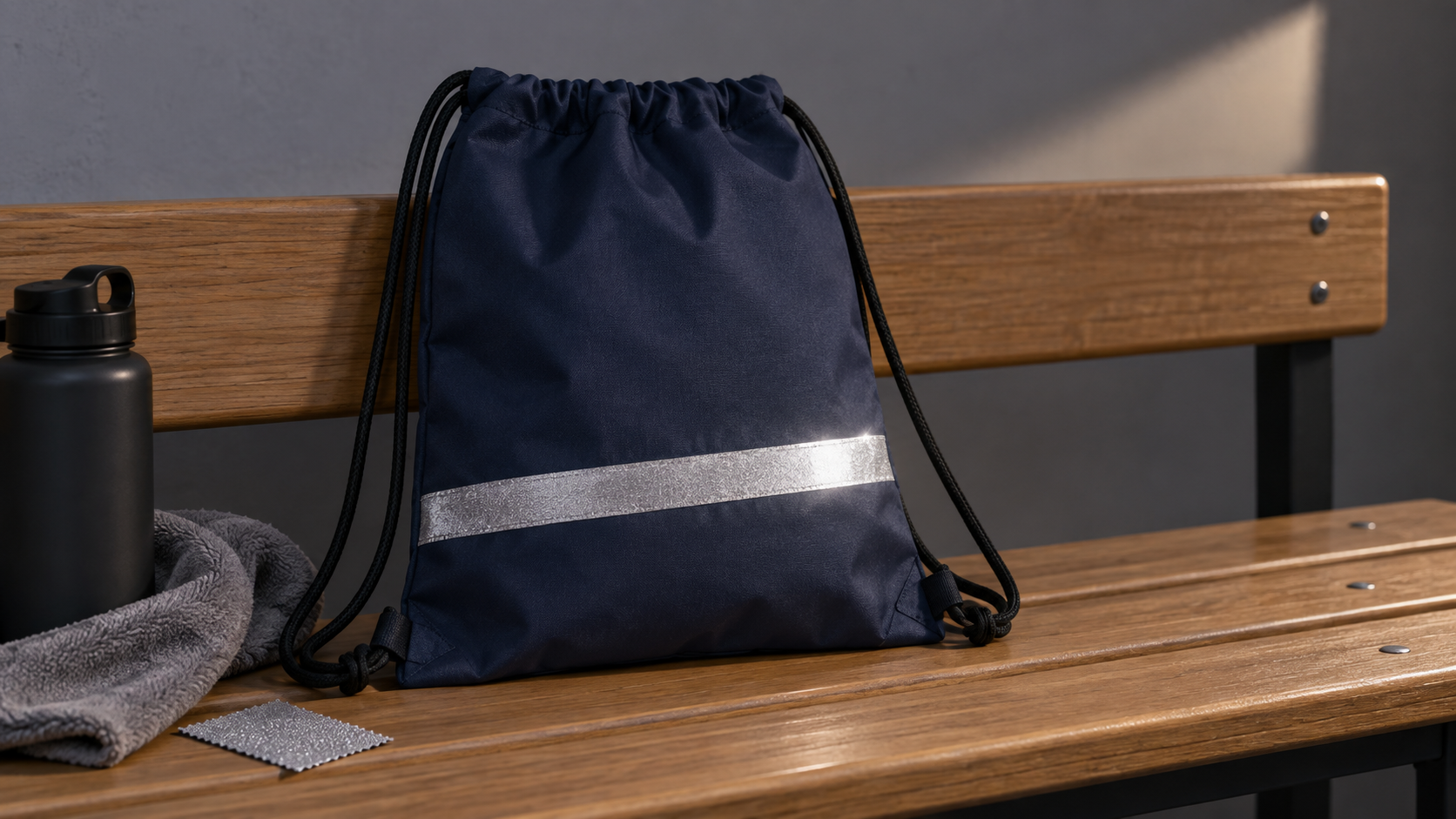
Illustrative concept informed by an unbranded physical drawstring pouch reference; not a photograph of a customer order, tested product, or certified safety item.
Reflective decoration can make a sports drawstring bag more noticeable when a light source strikes it—but the right specification is more than “print a shiny logo.” Buyers must distinguish actual retroreflective response from metallic shine, choose a compatible material and application method, place the graphic where it remains visible on a filled, cinched bag, and approve durability and any performance claim on the finished construction. A decorative reflective mark is not a substitute for high-visibility protective clothing, lighting, or a risk assessment.
This guide focuses on branded gym bags, team kits, event giveaways and sports merchandise, not occupational PPE. It complements our custom drawstring bag printing methods guide, which compares the broader decoration choices. If you are still choosing the base bag or supplier, explore custom drawstring bags, how to choose a custom drawstring bag manufacturer, and the custom bag manufacturer buyer guide.
1. Define the job before choosing a reflective effect
“Reflective” describes several different appearances and processes. A metallic silver print can look bright under room lighting but may not return a meaningful amount of light toward its source. Retroreflective material is designed to return incident light back toward the source over specified viewing geometries. A bright fluorescent fabric is a daytime color cue; it is not the same optical mechanism. A bag can combine a daytime contrast color and a reflective accent, but the combination is still not automatically a safety-certified product.
| Buyer objective | Appropriate brief | Claim boundary |
|---|---|---|
| Subtle sports-brand accent | Reflective-looking logo or stripe with approved visual sample | Say “reflective graphic” only if the actual applied material demonstrates retroreflection |
| More noticeable bag under a flashlight/headlight | Specify retroreflective material and finished-bag placement; define test conditions | Do not promise detection distance or safety outcome without evidence |
| Occupational or regulated visibility | Refer to the specific market, use case, applicable product standard and accredited evidence | A drawstring bag alone does not make a wearer compliant with clothing standards |
| Campaign visual only | Metallic, pearlescent or high-contrast print may suffice | Do not call ordinary shine “retroreflective” |
The distinction matters because ASTM E809 describes measurements of retroreflectors using specified photometric geometry. A phone-flash photograph may be useful for a design conversation, but it does not provide a standardized retroreflection value. Choose the outcome and evidence level before requesting prices.
2. What does “reflective printing” actually mean?
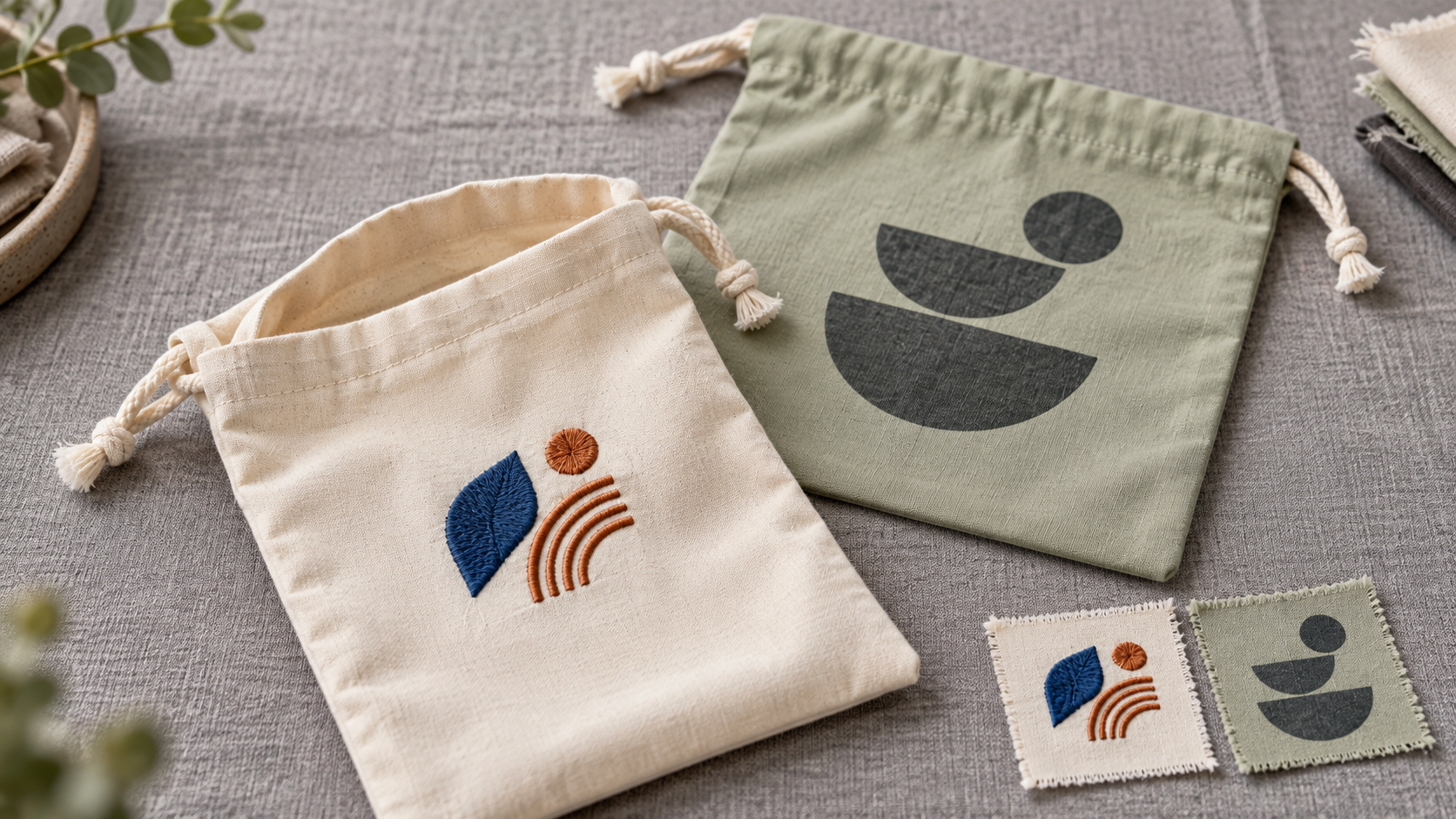
In a buying conversation, the phrase may refer to a screen-printed ink containing reflective components, a cut reflective heat-transfer film, a printed graphic on reflective transfer material, or a sewn reflective tape. They are not interchangeable. The substrate, artwork detail, edge feel, flex behavior, pressing or curing conditions, and performance evidence all differ.
| Route | What it puts on the bag | Useful when | Verify before approval |
|---|---|---|---|
| Reflective screen ink | Printed film with reflective particles or beads, depending on formulation | A graphic is suited to screen printing and the printer can validate the ink/fabric combination | Ink supplier data, print coverage, curing, adhesion and actual returned-light result |
| Cut reflective transfer | Pre-made retroreflective material cut into a mark and heat bonded | Crisp single-color shapes and repeatable logos | Grade, carrier, application to the exact fabric, edge lift and flexing |
| Printed reflective transfer | Graphic applied to a material designed for printing and then transferred | More complex marks where that material system is available | Graphic compatibility, color versus reflected response, transfer durability |
| Sewn reflective trim | A separate reflective textile attached by stitching | Bands or positions where heat transfer is unsuitable | Stitching, seam continuity, curl, abrasion and component sourcing |
For example, 3M documents cuttable reflective transfer film and a graphic-ready reflective transfer film as distinct products. These references illustrate process options; they do not establish that LUCKYSTAR uses a named 3M grade or that any proposed bag has passed a test. Ask for the exact proposed component and processing route on your order.
Why reflective ink is not just silver ink
A visual silver target specifies daytime color, not necessarily nighttime retroreflection. Reflective particles or optical elements must be present and remain functional after printing and curing. A historical 3M technical sheet for reflective textile ink also notes that fabric choice can affect reflectivity and wash durability. Treat that as a process principle, not proof of current availability, a universal formula, or equivalence among inks.
Why transfer films need material-specific trials
A heat-transfer film may offer a known component specification, but its bond to the finished bag depends on fabric, coating, texture, temperature, time, pressure and seam location. The 3M C790 bulletin explicitly advises testing the actual transfer on the actual substrate; it cautions about seams, some nylon surfaces, coatings and finishes. Do not copy that product's press settings to an unspecified film or use its reported properties as a claim about a different bag.
3. Choose the bag fabric and finish together with the decoration
Polyester sports bags may use different deniers, weaves, coatings and surface treatments. “Polyester” alone does not tell the printer whether a screen ink will adhere, a transfer will bond, or heat will damage a finish. Nylon, cotton and non-woven fabrics need their own trials; color and texture also alter daytime appearance. Our 210D vs 420D vs 600D polyester guide explains why denier alone cannot decide the finished bag's behavior, and polyester vs nylon drawstring bags covers the wider material trade-off.
| Substrate question | Why it changes the print decision | Sample check |
|---|---|---|
| Is the fabric smooth, textured or mesh-like? | Fine features may break or transfer edges may bridge unevenly | Inspect edges at normal viewing distance and close up |
| Is it coated or water-repellent? | Adhesives/inks may not bond as on untreated cloth | Confirm with the exact finish and material lot |
| Is it heat-sensitive? | Pressing can distort, shine or shrink the panel | Check fabric appearance after the proposed press cycle |
| Does it flex or wrinkle in use? | Rigid decoration may crack or lift | Bend, fill and cinch the sample repeatedly |
| Is the bag washable? | Cleaning can alter adhesion and retroreflective response | Define the actual care instruction and cycle test |
Do not present “waterproof,” “washable for 50 cycles,” or a brightness number without the specific order's supporting test. These are product-and-condition claims, not automatic properties of reflective-looking artwork.
4. Place the graphic where the carried bag actually shows it
A drawstring bag is a moving surface. The top panel gathers beneath the cord channel; loose fabric folds over the design; contents push some areas out while leaving others collapsed; and cords or arms can obscure parts of the front. A beautiful flat placement may disappear when carried. Map both daytime brand recognition and light-return position on the same finished sample.
Keep clear of the channel and cord path
Do not press or print essential detail into the folded channel, side cord exits, or stitching path. The bag must still close smoothly. Refer to our cord, eyelet and reinforcement guide for the construction map, and the artwork and dieline handoff guide for separate technical and printable layers.
Test front, back and oblique views
A one-sided stripe may be visible on a product photo but not from another approach angle. The buyer should decide whether the design is chiefly branding or a visibility aid and assess the assembled bag worn or carried in the intended position. This is a design review, not a claim that a particular placement improves real-world safety. For precise logo positions, use our drawstring bag logo placement and print-size guide.
| State to photograph | What to look for | Likely correction |
|---|---|---|
| Bag flat on table | Print edge, size, alignment and surface defects | Revise artwork or process |
| Bag filled | Folds, distortion and blocked graphic | Move or simplify placement |
| Mouth fully cinched | Gathering beneath the channel | Lower the critical mark or revise construction |
| Bag carried at shoulder height | Cord and body occlusion, facing direction | Consider both sides or a different location |
| Directed light from varied angles | Whether the applied graphic returns light consistently | Revise material, area, angle or claim |
5. Design for a genuine reflective response, not just a flash photo
Retroreflective performance depends on the light source and the viewing angle. A camera flash close to the lens may exaggerate a mark compared with other real positions. ASTM E809 makes the observation and entrance geometry part of a meaningful measurement. It does not by itself set a pass value for your sports bag. If you need an instrumented claim, the buyer and laboratory must agree the relevant test method, angles, units, sample preparation, conditioning and acceptance limits before production.
For design approval, take repeatable photographs with consistent camera position, exposure, light-source position and distance, alongside an ordinary daylight view. Those images help compare prototypes, but label them as illustrative visual checks. Avoid before/after edits that imply measured brightness. Do not infer performance from a supplier film data sheet if the transfer was applied to a different fabric or altered in processing.
Size and color are not shortcuts
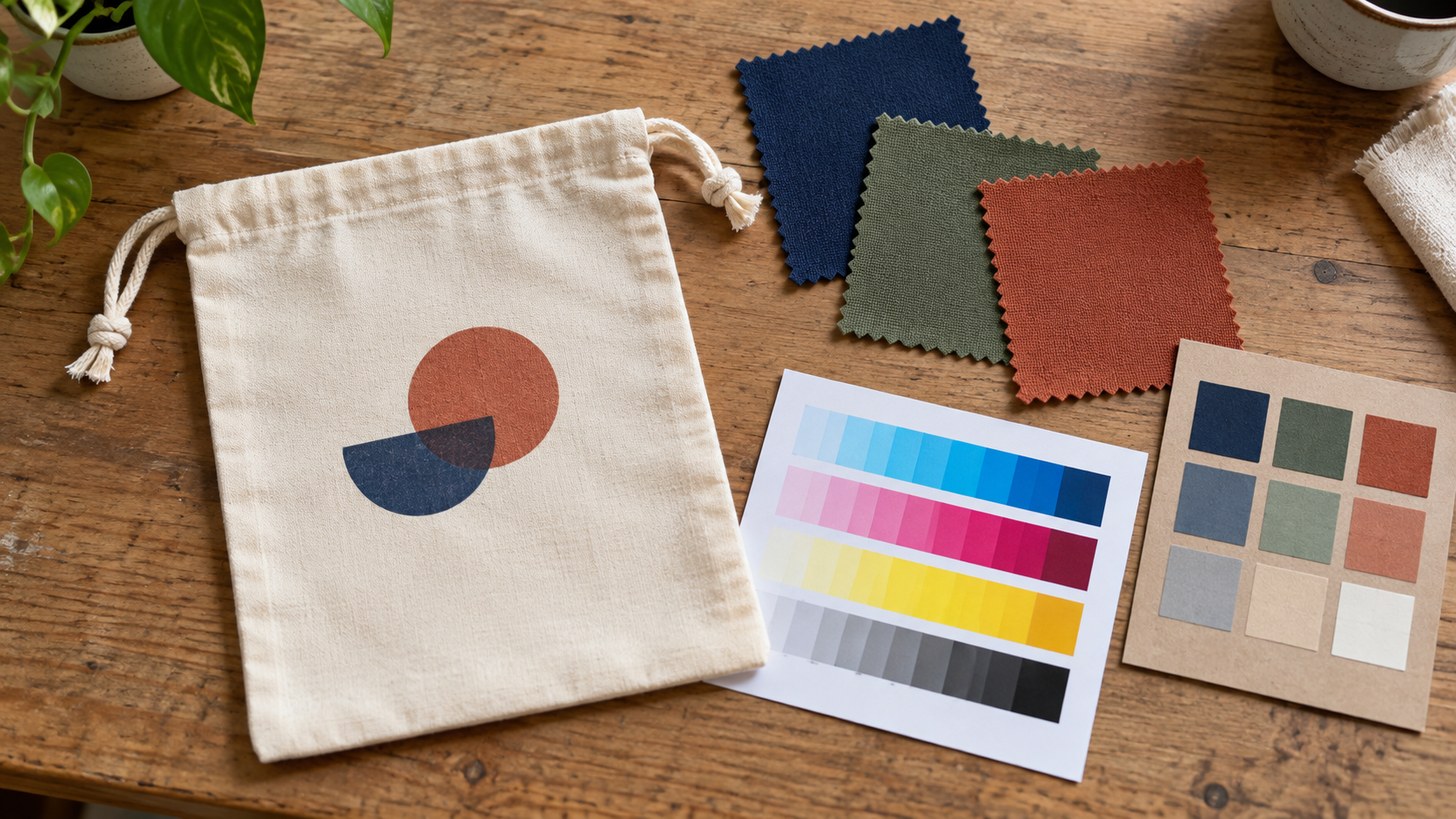
A larger silver shape does not compensate for poor material compatibility or a location hidden in folds. Colored reflective graphics can look different by day and under directed light. If the team needs exact brand color and retroreflection, approve both conditions separately rather than promising that one ink mix will solve both. The Pantone vs CMYK drawstring bag guide handles the brand-color workflow.
6. Make the artwork production-ready
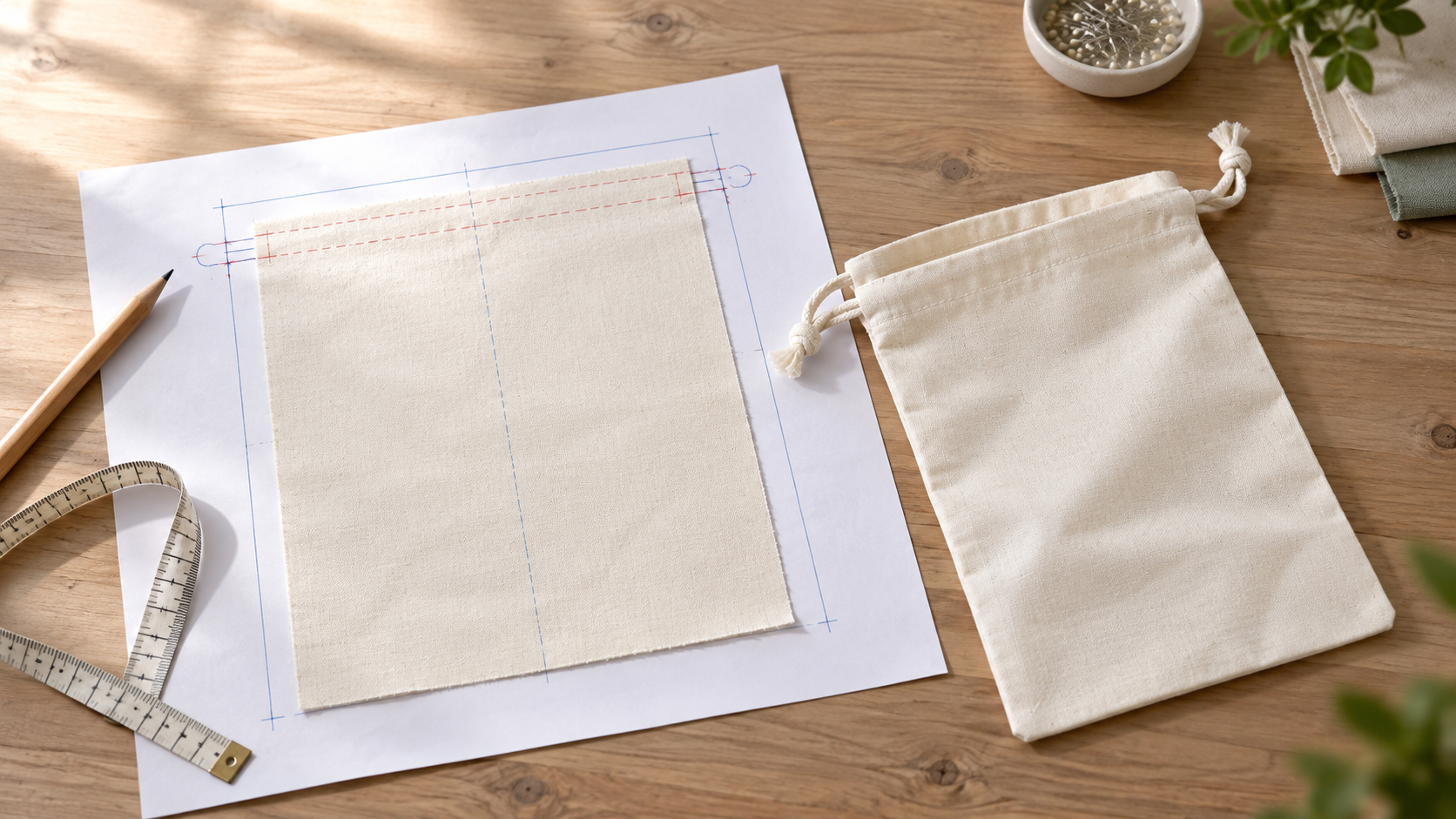
Supply a vector master for the reflective mark and specify its physical size, front/back position, cut/print route, and orientation on the finished bag. Request the supplier's actual printable-area template; do not scale a screenshot. Reflective films may have minimum feature widths or cutting limitations, while screen inks have process-specific line and gap limits. The converter should confirm them on the selected grade.
| File field | Required decision | Evidence to retain |
|---|---|---|
| Reflective component | Exact supplier/grade or formulation proposed | Technical sheet and batch identification |
| Material/color | Fabric composition, finish, shade and lot | Swatch and approved sample |
| Graphic dimensions | Width/height and tolerance in physical units | Signed artwork proof |
| Print position | Named finished-bag reference points | Filled/cinched approval photos |
| Application route | Print, transfer or sewn trim | Process sheet and first article |
| Claimed property | Decorative only or quantified retroreflection | Written claim matrix and test plan |
| Care | Cleaning instructions appropriate to this construction | Care trial and approved labeling |
Separate the reflective layer from ordinary screen-print colors. If a multicolor logo is combined with a reflective outline, test the entire stack: an opaque color laid on top of a reflective area may change its optical response. Ask the printer to demonstrate the intended sequence on the real fabric. General file handoff steps are in our drawstring bag artwork and dielines guide.
7. Sample the finished construction, not a loose patch
A flat fabric swatch is useful for early screening, but it is not the product. Make a sample with intended fabric, actual channel, cords, corner reinforcement, decoration method and planned placement. Fill it with representative contents and close it repeatedly. Examine the reflective area after folding, handling and any planned cleaning.
A practical approval ladder
- Material trial: test the candidate ink/film/trim on the exact fabric and finish; reject incompatible routes early.
- Artwork proof: confirm size, layer, placement and normal-light appearance at 100% scale.
- Production-intent sample: assemble the bag and evaluate front/back, filled and cinched states.
- Defined verification: if performance or durability will be advertised, use agreed methods on representative finished specimens.
- Golden sample and revision lock: retain the accepted physical sample, technical sheet, artwork, process settings and any test report tied to the same version.
This is a recommended buyer workflow, not a statement that every LUCKYSTAR item has already undergone these tests. The broader custom drawstring bag sample development process explains the approval and change-control steps.
8. Build a reflective-decoration QC checklist
Inspect ordinary bag quality and reflective decoration together. Incoming film or ink identification matters, but first-article application and bulk variation can still change the result. Sampling frequency and acceptance limits should be written for the order and risk, not advertised as a universal factory guarantee.
| Stage | Check | Failure signal | Record |
|---|---|---|---|
| Incoming | Correct material/grade, lot, shelf life and fabric finish | Unapproved substitution | Supplier document, swatch, lot ID |
| First article | Size, placement, color and returned-light visual response | Off-position mark or unexpected dullness | Signed first-article photos |
| Process | Ink cure or film bond and parameter control | Tackiness, edge lift, scorching, shrinkage | Operator settings and check log |
| Assembly | Seam, cord, channel and reinforcement clearances | Graphic caught in stitch or distorted on closure | Assembled sample photos |
| Durability | Flex, abrasion, cleaning/handling per intended use | Cracks, delamination, loss of appearance or function | Agreed test result |
| Final | Defect classification and carton/variant identification | Mixed lots, misplaced versions | Inspection record and pack list |
For a quantified retroreflection specification, add an agreed instrumented method and acceptance threshold. For a decorative-only order, a controlled visual and bond check may be more relevant than inventing a safety classification. Require any replacement component or process change to be resampled. Our drawstring bag manufacturing process explains where such approvals fit in the wider order flow.
9. Separate marketing language from protective-equipment claims
The current ISO 20471:2013 standard addresses high-visibility clothing, including material areas and placement for protective clothing; a revision is under development. ANSI/ISEA 107-2020 is likewise a high-visibility safety-apparel standard, and the 2020 edition removed criteria for accessory items. Neither source means that adding a reflective mark to a gym bag makes that bag “ISO 20471 certified” or “ANSI Class 2.” The applicable market, product category and current standard version need a separate expert review if the purchaser intends a regulated safety claim.
| Wording for a bag program | Evidence needed | Safer interpretation |
|---|---|---|
| “Reflective accent” | Approved component and demonstration on final bag | Describes a feature, not an outcome guarantee |
| “Retroreflective graphic” | Material identity plus evidence of returned-light behavior after application | Specify the conditions when quantified |
| “Visible from X distance” | Designed field/lab study appropriate to conditions | Do not claim from a flash photograph |
| “Safety-certified / ANSI / ISO compliant” | Correct product standard, entity, complete tested construction and valid documentation | Do not use for this bag without a specific reviewed basis |
Also avoid suggesting that a reflective bag makes night running safe. Visibility depends on lighting, orientation, weather, obstructions and other equipment. If the item is intended for children, cycling, traffic or worksite use, ask the buyer to state the jurisdiction and safety purpose so the right product-specific requirements can be assessed. Do not rely on a supplier's fabric certificate alone to describe the completed bag.
10. What changes cost and production time?
Cost depends on the base bag, reflective component, coverage and shape, number of positions, process setup, application yield, sampling, testing and order quantity. A narrow geometric transfer and a multicolor graphic-ready reflective film have different unit economics. Coated fabric can require extra trials or a different application route. A late request for quantified performance testing can add time and may force a component change.
| Cost driver | Why it matters | How to control it without weakening the brief |
|---|---|---|
| Special material grade | Procurement and traceability | Define needed outcome before choosing a premium grade |
| Complex contour or tiny details | Cutting/weeding or screen setup loss | Simplify artwork while protecting brand recognition |
| Two-sided coverage | More components and operations | Confirm the actual viewing need |
| Incompatible fabric finish | Rework and trial cost | Test actual fabric early |
| Independent performance claim | Laboratory and documentation | Use only when a specific claim is commercially necessary |
Do not use a platform listing price or sample lead time as a standing LUCKYSTAR quotation. Quantity, MOQ, tooling, testing, shipment and lead time are subject to the selected specification and written confirmation. The MOQ and production-time guide explains the general dependencies without promising a universal number.
11. Why discuss a reflective sports bag with LUCKYSTAR?
The public custom drawstring bag range and company knowledge base support discussion of custom formats, materials, logo decoration and sampling under the independent-site entity, Ningbo Luckystar Commodities Co., Ltd. That makes LUCKYSTAR a useful coordination point for a buyer who wants the bag structure, graphic location and sample approval considered as one project rather than as three disconnected requests.
For a reflective concept, we can review the intended use, bag silhouette, fabric and finish, desired graphic, proposed decoration route, component documentation and order-level test plan with the production partner. We would first need to confirm the exact reflective material, supplier, process, availability and evidence for your specification. We do not claim here that every LUCKYSTAR drawstring bag has reflective printing, that all production is in one owned factory, or that any current bag carries a universal visibility certification. This evidence-led approach is more useful than a generic “high visibility” promise.
12. A ready-to-send RFQ for your project
Send us the following so a sample plan and written quote can be evaluated:
| Information | Example question to answer |
|---|---|
| Use and buyer | Is this a branded gym giveaway, team equipment bag, or safety-related item? |
| Market and claim | Which countries? Decorative feature or measurable performance claim? |
| Bag specification | Finished size, expected contents/load, material, color, coating and cord layout? |
| Artwork | Vector logo, physical dimensions, front/back positions and color references? |
| Reflective route | Ink, transfer or trim preference? Any required grade or test method? |
| Durability | Expected flexing, care instructions, abrasion and wash needs? |
| Order | Estimated quantity by variant, destination, deadline and sample approval contact? |
If the reflective component or standard is undecided, state the intended use and ask for feasible options to sample. This is a scoping conversation, not a performance guarantee. You can send the project brief to LUCKYSTAR with reference photos and artwork.
13. Frequently asked questions
Is reflective screen printing the same as reflective heat transfer?
No. Screen printing lays down an ink system; a transfer bonds a prepared reflective material to the fabric. They have different artwork and compatibility limits. Test each on the actual bag material and compare the approved finished sample, not only a loose swatch.
Can we put a reflective logo on a coated nylon sports bag?
Possibly, but do not assume a particular transfer adhesive works on nylon or a water-repellent finish. The 3M transfer-film guidance flags difficult substrates for some products. Ask for the precise proposed system and a material-specific application and durability trial.
Does a phone-flash photo prove retroreflective performance?
It can illustrate an optical effect under that camera/light arrangement, but it is not a standardized measurement. Quantified claims need a defined method, geometry, condition and pass value appropriate to the product.
Can a reflective drawstring bag be labeled ANSI Class 2?
Not on the basis of a reflective logo. ANSI/ISEA 107's classes concern high-visibility safety apparel configurations, and the 2020 edition removed accessory criteria. Seek qualified, product-specific review before making any safety or standards claim.
Will the graphic remain bright after washing?
That depends on material, attachment, care method and the bag's actual construction. Define cleaning conditions, test the relevant sample, and state only the supported durability. A supplier's component data sheet alone does not establish your finished-bag wash life.
Should the reflective design go on both sides?
It depends on the carry orientation and budget. Test a representative filled bag from front, back and oblique viewpoints. If the brief is only branding, a single side may suffice; do not turn that choice into a claim of all-around visibility.
14. Final buyer checklist
Before releasing bulk production, confirm that the reflective effect and any claim are defined separately; the fabric and finish match the tested sample; the approved component and process are identified; artwork avoids the cord channel and seams; the assembled bag has been evaluated filled and cinched; care and durability are written; and all versions and approvals refer to the same specification. Then decide whether the program needs decorative quality control or documented quantitative retroreflection—and buy only the evidence that supports the intended statement.
Explore the custom drawstring bags product page, then contact LUCKYSTAR for an order-specific material and sample review.
Request a reflective-decoration sample review
Share your bag dimensions, fabric or reference sample, artwork, intended viewing environment, quantity estimate, destination, and any claim you plan to make. We can help identify the unresolved material, application and verification questions before a project-specific quotation is confirmed.