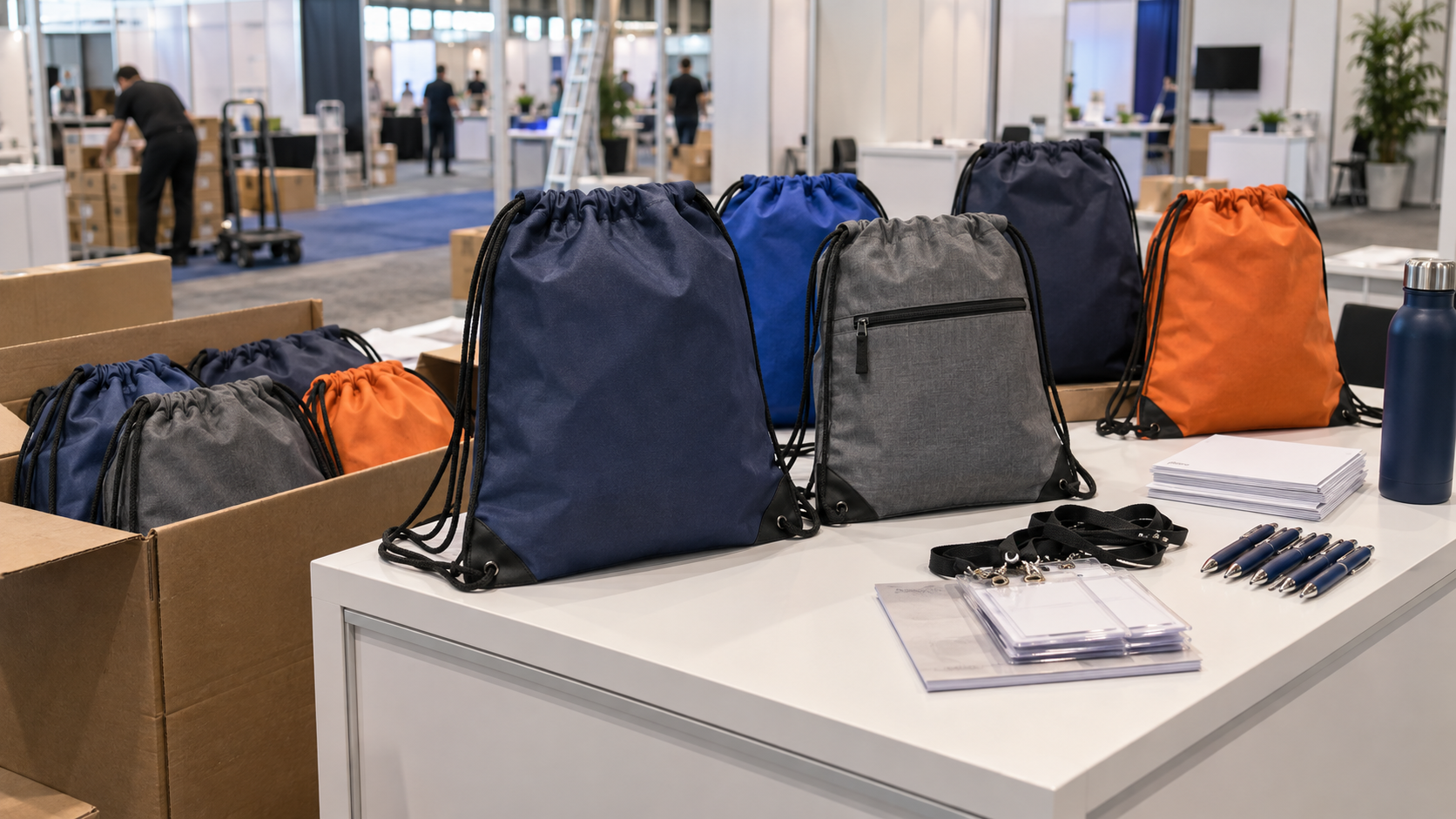
Drawstring Bags for Schools and Student Programs
Drawstring bags can work well for schools and student programs when they carry a defined, lightweight kit for a limited purpose: orientation materials, an art activity, a reading challenge, an after-school club, a day camp, a field trip, or event merchandise. They should not automatically be treated as substitutes for supportive school backpacks used to carry heavy textbooks, laptops, or a full day’s supplies.
The safest sourcing method begins with the program, intended age group, destination market, actual contents, and distribution process. Those inputs determine the bag’s size, fabric, cord arrangement, reinforcement, decoration, labeling, testing, and carton sorting. A bag for a university orientation differs materially from one designed and marketed for children aged 12 or younger.
This guide helps school districts, academies, colleges, education nonprofits, camp operators, distributors, and program sponsors develop a clear specification. LUCKYSTAR can coordinate order-specific custom drawstring bag development, subject to the approved product brief, sample, target-market requirements, and written confirmation.
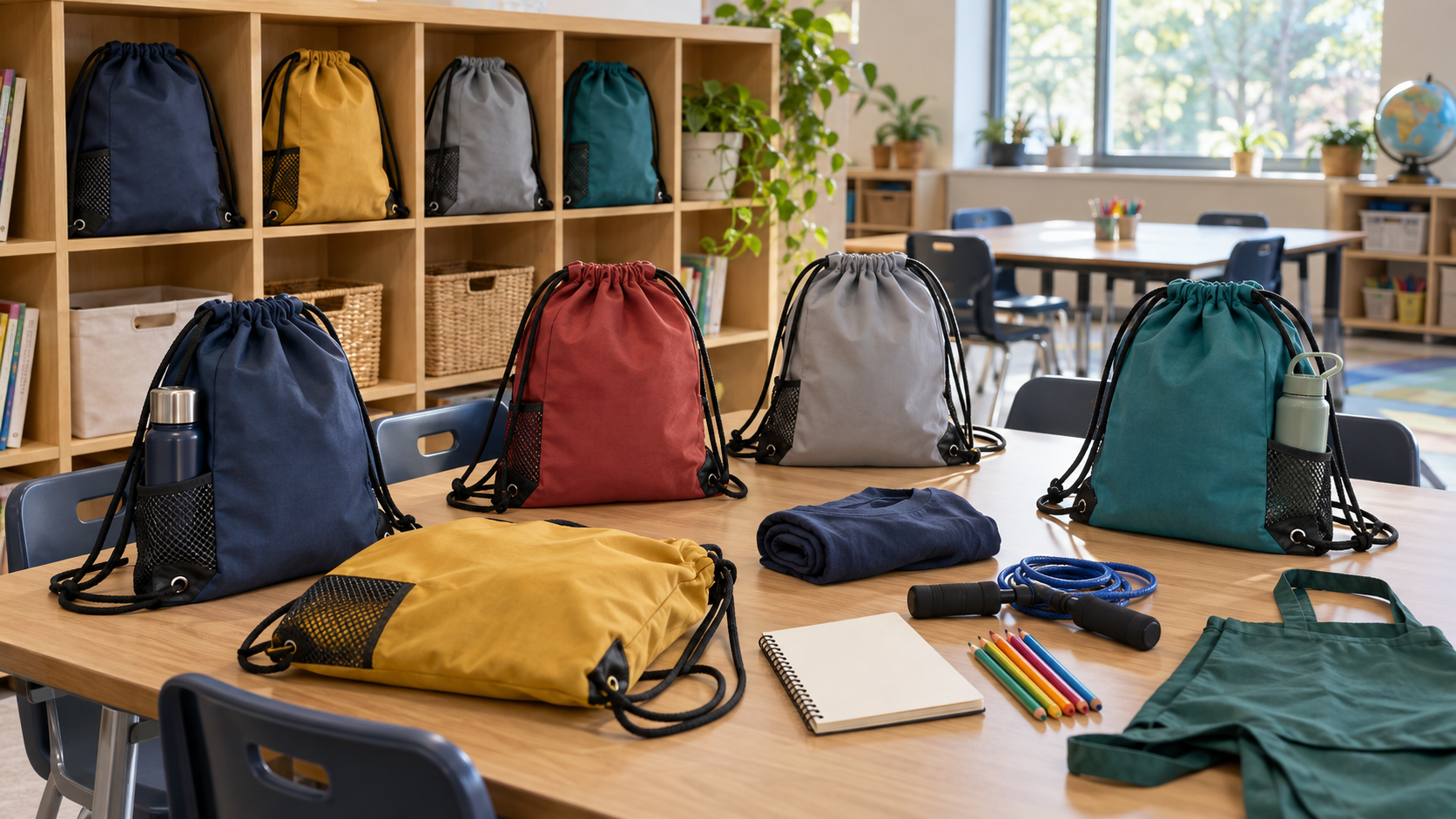
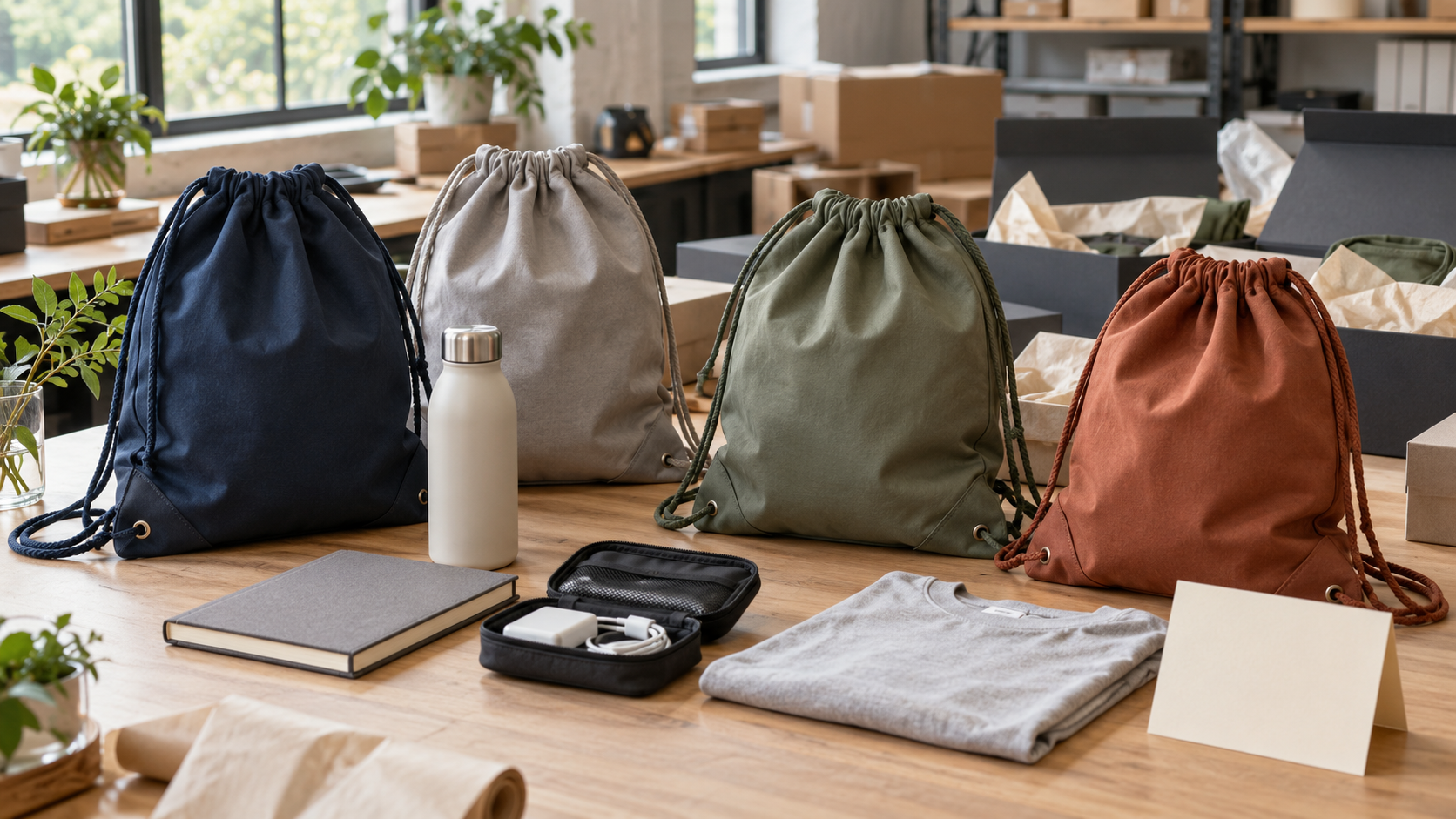
Generated, unbranded editorial illustration of a school activity-room setup. It does not depict a customer program, an actual production site, or tested product performance.
Quick Answer: When Are Drawstring Bags Appropriate for Schools?
Use a drawstring bag when the contents are light, the carrying period is limited, the closure and cords suit the intended age group, and the design has been reviewed for the destination market. A simple activity kit, T-shirt, notebook, pencils, or small personal items may be appropriate; dense books, sharp equipment, and computers usually call for a more supportive bag system.
The procurement team should be able to answer six questions before requesting a quote.
| Question | Why it controls the design | Required brief item |
|---|---|---|
| Who is the intended user? | Age, body size, dexterity, and applicable rules can change | Age range and program context |
| What goes inside? | Contents determine capacity, load, and puncture risk | Complete item list and representative weight |
| How long will it be carried? | Ten minutes and a full school day are different exposures | Route, duration, and frequency |
| Who supplies the artwork? | Crests, mascots, sponsors, and licensed characters require rights | Authorized files and approver |
| How will bags be assigned? | Names, class groups, and campuses create privacy and sorting risks | Distribution code and packing map |
| Where will the product be distributed? | Product classification and requirements vary by market | Destination country or region |
For supplier screening, use the drawstring bag manufacturer selection guide. Procurement teams managing several bag categories can use the Custom Bag Manufacturer Guide for the wider qualification process.
Define the Program Before Defining the Bag
“School bag” is too broad to function as a specification. Start by naming one program and one primary use. The best design is the one that fits that use without inviting unintended loading.
Common education-program scenarios
| Program | Typical light contents | Useful design direction | Main risk to control |
|---|---|---|---|
| New-student orientation | Campus map, notebook, pen, light merchandise | Foldable bag with clear program identity | Ordering from registration count without attendance assumptions |
| Reading initiative | One light book, activity card, bookmark | Simple body sized to the issued book | Expanding use to multiple heavy books |
| Art workshop | Apron, pencils, paper, lightweight materials | Smooth cleanable fabric; internal pouch if needed | Sharp or leaking materials damaging the bag |
| STEM club | Worksheet, protective glasses, small components | Pocket or coded inner pouch | Loose small components and age suitability |
| After-school activity | T-shirt, light equipment, bottle | Reinforced corners and bottle pocket if justified | Excess load and long carrying time |
| Day camp | Clothing layer, towel, snack container | Ventilation or easy-clean construction | Long cords, moisture, mixed personal items |
| Field trip | Lunch, light layer, activity sheet | Compact bag with controlled identification | Public exposure of student names |
| Fundraiser or school store | Merchandise or personal items | Strong visual identity and repeat-use value | Trademark rights and unsupported environmental claims |
If the program is a sports team rather than a classroom or campus activity, the related guide Custom Drawstring Bags for Sports Teams covers kit loads, team rosters, and training use in more depth.
Do Not Treat a Drawstring Bag as a Heavy Daily Backpack
Drawstring bags usually use narrow cords and have limited structure. They can be practical for light kits, but those characteristics make them a poor default for heavy books or computers.
The American Academy of Pediatrics’ HealthyChildren.org advises choosing a backpack proportional to a child’s height and highlights broad shoulder straps, appropriate fit, compartments, and balanced loading. Its current guidance also states that a backpack should not exceed 15% of a child’s body weight. That guidance concerns supportive school backpacks; a simple drawstring bag often lacks those features, so buyers should use a lower, program-specific working load rather than treating the 15% figure as a target for a drawstring bag. See School Backpack Safety: Proper Fit, Smart Packing & Preventing Back Pain.
When to choose another bag format
Choose a structured backpack, rolling option where permitted, tote, or supervised carry solution when the program requires:
- multiple textbooks or dense workbooks;
- a laptop or tablet needing impact protection;
- sharp tools or laboratory equipment;
- a long walk with a substantial load;
- specialized medical, mobility, or accessibility support;
- weight distribution that narrow cords cannot provide.
This boundary protects both the student experience and the accuracy of the product claim. “Fits the items” is not the same as “appropriate for students to carry those items.”
Segment by Age and Body Size
One large bag is not automatically suitable for elementary students, teenagers, and adults. A smaller user may experience excessive cord length, low bag position, or an opening that is difficult to control. An adult-size item can also invite overpacking.
Avoid assigning dimensions from age labels alone. Build sample groups around actual intended users and kit items, then conduct a supervised fit review.
| Fit factor | What to observe | Possible design response |
|---|---|---|
| Bag height | Bottom hangs too low or hits the legs | Shorter body or age-group size split |
| Bag width | Bag wraps around the torso or contents shift | Narrower body or smaller gusset |
| Cord length | Loose loops extend too far when closed | Controlled cord specification and sample check |
| Opening force | User struggles to open or close the channel | Adjust channel, cord surface, diameter, or construction |
| Shoulder pressure | Cords dig in under the expected light load | Flatter/softer cord, lower load, shorter carry period |
| Content access | Small items disappear or spill | Internal pouch, pocket, or smaller bag |
| Label access | Staff cannot assign bags without exposing identity | Privacy-safe removable code or controlled packing label |
The Drawstring Bag Size and Capacity Guide explains how to validate usable space with a representative kit. For carry-system options, consult Single-Cord vs Double-Cord Drawstring Bags and Round Cord vs Flat Cord vs Webbing Straps.
Review Cord and Small-Component Risks
Cord configuration deserves a separate review for younger users. Consider the cord length in open and closed positions, loop formation, snagging points, lower-anchor method, and how the bag will be used around playground equipment, bicycles, doors, or transport. The correct response may be a shorter controlled cord, a different closure, a hand-carry pouch, or another product category.
Avoid adding cord stops, decorative beads, detachable charms, zipper-pull accessories, or loose promotional items without evaluating the intended age and applicable small-parts rules. Hardware should solve a functional requirement, not simply make the design look more complex.
Construction review table
| Component | Review question | Evidence before bulk production |
|---|---|---|
| Top channel | Does it close smoothly without trapping or fraying the cord? | Repeated open-close sample check |
| Cord | Is length, diameter, surface, and end finish controlled? | Measured approved sample |
| Lower anchor | Does the load transfer into reinforced fabric and seams? | Pull protocol and construction section |
| Metal eyelet | Can it loosen, expose an edge, corrode, or pull through? | Attachment inspection and pull result |
| Fabric loop | Is it captured securely without excessive bulk? | Stitch specification and loaded trial |
| Zipper pull | Is it necessary and suitable for the intended age? | Age/use review and retention check |
| Removable accessory | Could it detach or be misused? | Product-risk decision and applicable testing |
Use the Drawstring Cord, Eyelet and Reinforcement Guide and Metal Eyelets vs Fabric Reinforced Corners when preparing the construction brief.
Determine Whether U.S. Children’s Product Rules Apply
A school-related bag is not automatically a U.S. children’s product, and an ordinary adult bag does not become one merely because a school purchases it. Classification depends on factors such as intended age, design, marketing, presentation, and how consumers commonly recognize the product. Buyers and importers should make the determination for the exact program and product.
The U.S. Consumer Product Safety Commission’s guidance for promotional products explains that requirements vary by intended age and materials. For a finished promotional item classified as a children’s product, applicable rules may include third-party testing, limits on lead in surface coatings and components, a Children’s Product Certificate, and permanent tracking information. See CPSC’s Buying Promotional Products: A Guide to Federal Safety Laws.
U.S. compliance questions for the brief
| Question | Why it matters | Order record |
|---|---|---|
| Is the product primarily intended for children 12 or younger? | Controls whether children’s product requirements may apply | Written classification rationale |
| Which materials and components are used? | Fabric, inks, coatings, metal, plastic, and accessories may trigger different review | Bill of materials and component list |
| Which decoration system is used? | Printed surface coating may be within a testing scope | Ink/transfer specification and test plan |
| Are small detachable parts present? | Age and foreseeable use affect small-parts risk | Component retention and age review |
| Who is the importer or private labeler? | Certification and labeling duties depend on the supply arrangement | Responsible-party information |
| What must be permanently marked? | Children’s products may need traceable production information | Product and package marking artwork |
| Which laboratory and rules apply? | Testing must match the actual applicable requirements | Current lab scope, test request, and reports |
CPSC’s Tracking Label Business Guidance states that children’s products must carry distinguishing marks on the product and packaging, to the extent practicable, so information such as the manufacturer or private labeler, production location/date, and batch or run can be determined. The agency also explains that a removable hangtag is not a permanent tracking label for a textile item.
This article is a sourcing framework, not legal advice. The applicable requirements must be confirmed for the exact product, age group, destination, responsible entities, and current law. A test report for another bag, color, ink, component, or old order cannot be assumed to cover the new shipment.
Choose Material by Program and Care Conditions
Material affects hand feel, foldability, print, moisture behavior, durability, cleanability, shipment volume, and claim substantiation. The intended program matters more than a broad label such as “school quality.”
| Material route | Useful characteristics | Limits to manage | Possible school-program use |
|---|---|---|---|
| Lightweight polyester | Compact, broad colors, quick drying potential | Thin hand; load points need reinforcement | Orientation, light activity, event kits |
| Heavier polyester | More structure and abrasion-resistance potential | Greater weight and carton volume | Repeated club or program use |
| Non-woven polypropylene | Efficient for simple high-volume formats | GSM, seams, edges, and bonding change performance | Short campaigns and light handouts |
| Cotton | Natural hand, suitable for some print/embroidery routes | Absorbs moisture; shrinkage and color behavior | Reading, arts, or campus retail programs |
| Canvas | More structured and substantial | Heavier and slower to dry | Higher-value student organizations or fundraising |
| Mesh | Ventilation and visible contents | Snagging, stretch, privacy, limited print area | Equipment sorting or supervised activity kits |
| Verified recycled polyester | Can support a defined recycled-content request | Percentage and chain-of-custody evidence required | Programs with documented procurement criteria |
Compare the options in Best Materials for Custom Drawstring Bags. The Non-Woven Drawstring Bags: GSM and Construction Guide addresses a common budget route, while Cotton vs Canvas Drawstring Bags covers natural-fiber choices.
Do not turn procurement language into an unsupported claim
Terms such as “eco-friendly,” “non-toxic,” “recycled,” “biodegradable,” and “safe for children” need specific support. Ask which material, percentage, component, test, standard, certificate, batch, and market the statement covers. If RPET is required, use the RPET Drawstring Bags Certification and Sourcing Checklist before approving website or bag copy.
Size From the Issued Kit, Then Limit the Intended Load
Create a representative kit for every program version. The physical sample should close fully, retain its shape, and allow the user to remove contents without forcing the top channel.
Kit-fit procedure
- List mandatory and optional contents separately.
- Record the dimensions and weight of each mandatory item.
- Exclude objects that should not be carried in the drawstring bag.
- Pack the sample in the intended sequence.
- Close and reopen it several times.
- Carry it under supervised, representative conditions.
- Inspect seams, corners, cords, and contents after the trial.
- Write the approved load and intended use into the specification.
If the program grows later, revalidate the bag. Adding a hardcover book, bottle, boxed kit, or electronic device can change both comfort and construction risk.
Design Artwork for Recognition Without Exposing Students
The front of the bag can carry a school, district, sponsor, club, campaign, or event identity, but every mark should be authorized. School mascots, licensed characters, athletic marks, student art, photographs, and partner logos can all have separate rights and approval chains.
Do not print a student’s full name, class schedule, phone number, address, transport route, or other unnecessary personal information on the outside of the bag. For distribution, use a removable internal code, class bundle, or controlled staff roster rather than publicly readable identity whenever possible.
| Artwork or data | Safe control question | Production record |
|---|---|---|
| School crest | Is this the current authorized version? | Vector file and approver |
| Mascot/character | Does the school own or license the artwork for merchandise? | Written rights confirmation |
| Sponsor logo | Is placement and term approved? | Current lockup and validity period |
| Student artwork | Is reproduction permission documented? | Permission and final selected file |
| Program title | Will the wording remain appropriate after the event? | Approved copy and date/version |
| Recipient assignment | Can a non-identifying code work instead of a full name? | Privacy-safe packing map |
| QR code or web link | Does it lead to an approved destination with appropriate data practices? | Tested URL and owner approval |
The Drawstring Bag Logo Placement and Print Size Guide helps keep artwork away from gathering, seams, pockets, and corner reinforcements. If a QR code or online form collects information from children, the school and operator should separately review privacy obligations. The U.S. Federal Trade Commission’s COPPA FAQs for schools emphasize limits on school-authorized collection and commercial use of children’s personal information.
Match the Decoration Method to the Fabric and Program
| Method | Strength | School-program watchpoint | Approval item |
|---|---|---|---|
| Screen printing | Efficient bold spot colors | Ink composition, cure, opacity, abrasion | Print on final fabric/color |
| Heat transfer | Detailed multicolor graphics and variable work | Edge lifting, heat sensitivity, surface feel | Applied production-intent sample |
| Sublimation | Full-panel graphics on compatible polyester | Requires suitable base; color and panel alignment | Printed and sewn sample |
| Embroidery | Premium small crest on suitable structured fabric | Needle density, puckering, reverse-side contact | Sew-out and backing decision |
| Woven/printed label | Discreet identity and version control | Edge comfort, attachment, small-component review | Final label and stitch method |
Choose the process after the fabric, coating, color, artwork, order size, and use conditions are confirmed. The Custom Drawstring Bag Printing Methods guide compares processes. For spot color versus process color, use Pantone vs CMYK for Custom Drawstring Bags.
The decorated sample matters more than a screen preview.Ink and transfers interact with fabric texture, dye, coating, and heat; embroidery can change panel behavior. Approval should include appearance and physical performance.
Build Accessibility and Inclusion Into the Brief
Student programs often serve users with different mobility, dexterity, sensory, and communication needs. A single closure may not suit everyone.
Ask the program owner:
- Can participants grasp and separate the cords comfortably?
- Does the closure require excessive force?
- Could high-friction cord or gathered fabric be difficult for some users?
- Would a handle, pouch, open tote, zipper, or alternate bag be more accessible?
- Are color-coded groups understandable without relying only on color?
- Does a fabric texture, odor, or noisy hardware create a sensory barrier?
- Can staff distribute an alternative without identifying or stigmatizing a student?
Provide an alternate format when needed. Inclusion should be planned, not improvised after delivery.
Use Color Coding Without Revealing Sensitive Information
Colors can simplify distribution by campus, classroom, workshop, day, or activity. They should not publicly encode disability, financial status, medical information, disciplinary category, or another sensitive attribute.
Combine color with a neutral internal code so staff do not rely on color vision alone. Lock the color-to-group map before packing and keep it in the distribution team’s controlled records.
Privacy-safe distribution hierarchy
| Level | Recommended identifier | Avoid |
|---|---|---|
| Campus | Neutral campus code or approved name | Student-level data on outer carton |
| Program | Color plus short non-sensitive code | Health or support category |
| Classroom/group | Teacher or group code used internally | Public student roster |
| Individual | Internal removable code if truly necessary | Full name and personal details on bag exterior |
| Spare units | Generic code and separate bundle | Assigning unused bags to named students in advance |
Prepare a Representative Sample and Approval File
The approved sample should use production-intent fabric, color, cord, reinforcement, print, pocket, zipper, label, and packing configuration. If a substitute sample is necessary, record exactly what it does and does not approve.
Sample approval gates
| Gate | Review | Approver |
|---|---|---|
| Program fit | Contents, intended load, use duration, alternative formats | Program owner |
| Age/design | Dimensions, cords, detachable components, labeling concept | Product/compliance owner |
| Artwork | Rights, spelling, placement, color, privacy | School/brand owner |
| Physical sample | Construction, function, hand feel, kit trial | Procurement and user representative |
| Test plan | Applicable safety and performance checks | Compliance/quality owner |
| Packing | Campus, group, bundle, carton, privacy controls | Distribution owner |
The Custom Drawstring Bag Sample Development Process provides the detailed handoff from specification to approved reference.
Create a Risk-Based Test Plan
Testing should address the specific design, age group, material, decoration, target market, and intended use. Performance testing and regulatory testing are different: a load test may reveal construction weakness, but it does not prove chemical compliance or legal classification.
| Risk | Example check | Boundary of result |
|---|---|---|
| Seam or corner failure | Static load and repeated lift at agreed program load | Applies to tested construction and conditions |
| Cord/anchor detachment | Pull and retention check in defined direction | Does not replace applicable small-parts or safety testing |
| Closure wear | Repeated opening/closing | Must state cycle count and acceptance condition |
| Print deterioration | Adhesion and abrasion on final substrate | Ink/fabric/color combination specific |
| Color transfer | Dry and wet rubbing where relevant | Method and grading must be recorded |
| Cotton dimension change | Washing/shrinkage protocol if care claims are made | Fabric, finish, wash conditions specific |
| Component chemistry | Applicable accredited-lab testing | Covers listed sample/components and rule only |
| Label durability | Handling/wash simulation appropriate to expected life | Not proof that label content is legally complete |
Use How to Test Drawstring Bag Load Capacity, Drawstring Cord Strength and Pull Test Guide, Drawstring Bag Print Adhesion and Abrasion Testing, and Cotton Drawstring Bag Shrinkage and Washing Tests to construct the non-regulatory performance portion.
No pass/fail limit should be invented after testing. Define the method, sample size, conditioning, load or force, duration or cycles, and acceptance criteria before the test.
Inspect Workmanship, Labels, and Group Packing
Inspection must compare the shipment with the approved specification and sample. For a school program, assignment and traceability can be as important as stitching.
Check:
- fabric, color, dimensions, construction, cords, seams, and reinforcements;
- hardware condition and component retention where applicable;
- decoration position, spelling, registration, adhesion, and visible defects;
- required product and packaging markings against approved artwork;
- performance checks listed in the inspection plan;
- quantity by campus, program, color, size, and artwork version;
- inner-bundle count and privacy-safe identifiers;
- carton assortment, condition, shipping marks, and delivery location;
- test reports and certificates against the correct sample, entity, rule, and shipment.
Use the Custom Drawstring Bag Quality Control Checklist for production controls and How to Inspect Custom Drawstring Bags Before Shipment for final-lot release.
Pack for Teachers, Campuses, and Program Staff
Random bulk packing may reduce packing labor at origin but create hours of sorting at a district warehouse or classroom. Design cartons around the distribution chain.
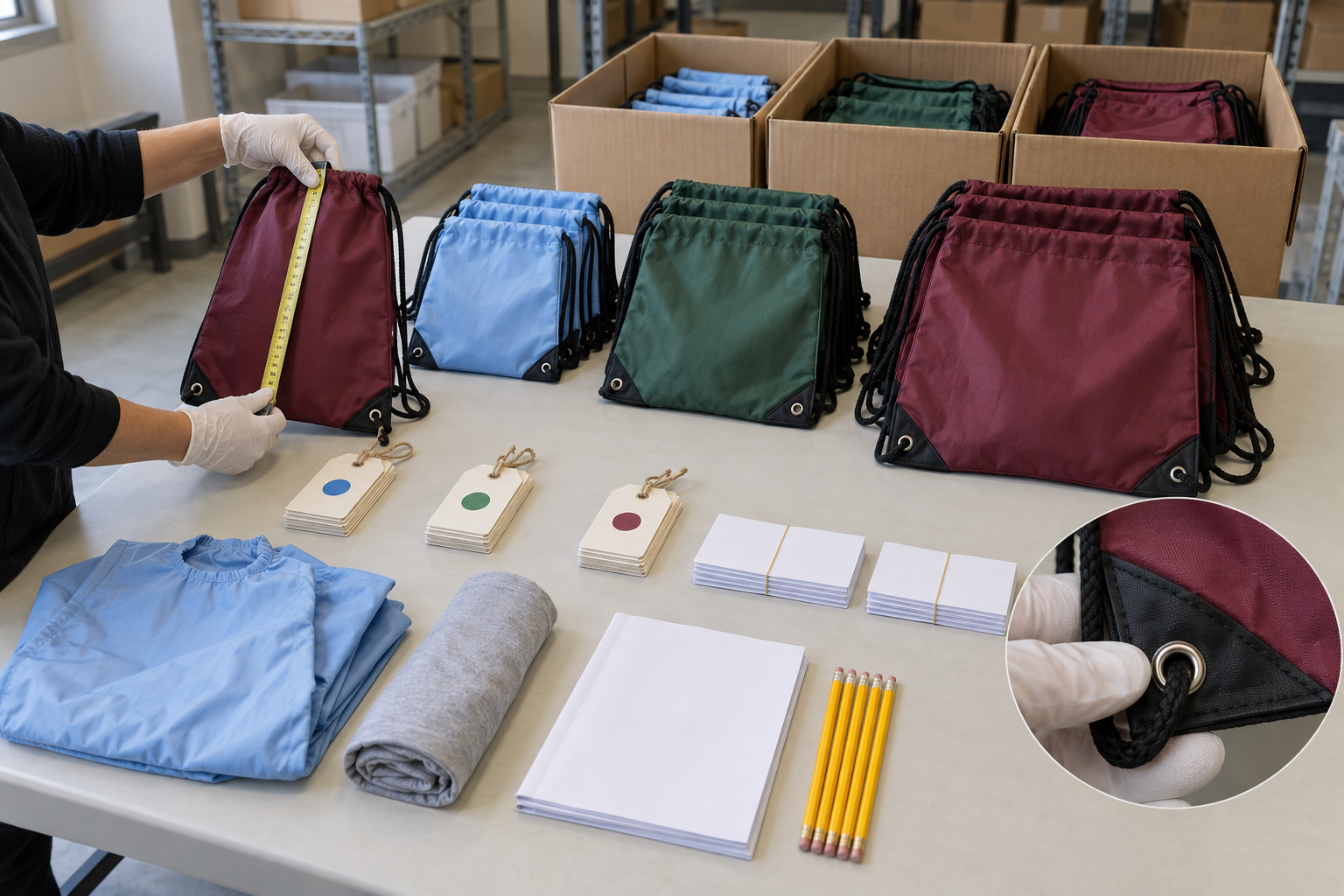
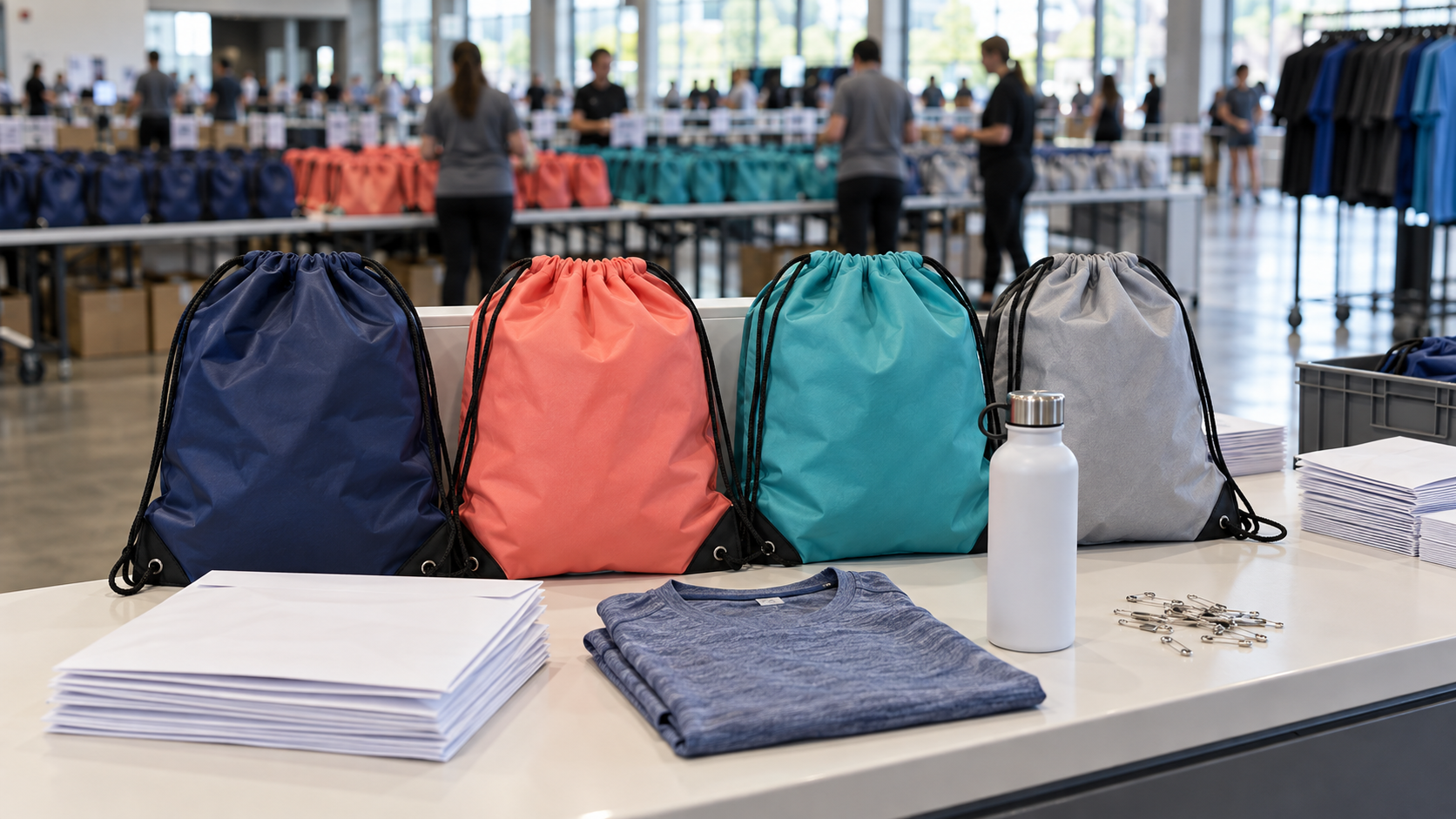
Generated editorial illustration of privacy-safe size grouping and carton allocation. It is not a customer order, a compliance inspection record, or an actual LUCKYSTAR workspace.
| Distribution route | Packing approach | Control evidence |
|---|---|---|
| One campus, one design | Counted inner bundles by classroom | Bundle and carton quantity list |
| Multiple campuses | Separate cartons by campus code | Carton map and receiving contact |
| Several age groups | Size/color split with neutral codes | Approved group matrix |
| Program plus spares | Generic spares in a separate labeled bundle | Spare quantity and release owner |
| Individual kit assembly | Bag and contents checked to non-sensitive code | Reconciliation list with restricted access |
| Direct-to-student mailing | Address data handled by authorized process | Data transfer, retention, and deletion procedure |
Avoid printing student names on export cartons or sharing a full roster beyond the people who need it. If personalization is essential, define file access, proofing, error correction, packing, retention, and deletion before data transfer.
Plan Timing Around the Program Date
Work backward from the date bags must reach each campus—not from the first day of the event. Include specification development, artwork rights review, sampling, age/compliance assessment, testing, approval, production, inspection, freight, customs when relevant, district receiving, campus sorting, and staff distribution.
If the schedule is tight, reduce complexity deliberately rather than bypassing safety, compliance, or sample review. A simpler one-color design on an approved construction is often more controllable than an untested feature-heavy concept.
MOQ, sample timing, production time, and freight depend on the exact material, decoration, quantity, testing, packing, and destination. The Custom Drawstring Bag MOQ and Production Time guide explains the variables, but the final schedule must be confirmed for the current order.
Why Choose LUCKYSTAR for School and Student Program Bags?
LUCKYSTAR can help translate an education-program brief into a controlled product specification. This matters because age group, contents, cord configuration, artwork rights, labeling, testing, and distribution packing must work together; a low unit price does not correct a wrong size, unsuitable load, or mixed campus shipment.
LUCKYSTAR coordination strengths
- Program-based development: begin with intended users, contents, duration, destination, and distribution route.
- Material and construction choices: compare polyester, non-woven, cotton/canvas, mesh, verified recycled-material routes, cords, reinforcement, pockets, and gussets for the stated use.
- Age-aware sample review: prepare physical samples so buyers can assess size, cord arrangement, access, light-load comfort, and component choices.
- Decoration planning: align authorized school artwork with the final substrate, print method, placement, and color approval.
- Order-specific testing support: coordinate the agreed performance checks and the product information needed for a buyer’s compliance plan.
- Structured packing: separate campuses, groups, sizes, colors, and spares using privacy-conscious codes.
- B2B documentation: keep the specification, sample reference, artwork version, inspection evidence, and packing instructions connected to the order.
These are process capabilities, not universal product claims. Material availability, MOQ, price, timing, compliance scope, testing, documentation, and performance remain subject to the final design, intended age, destination market, quantity, approved sample, and written confirmation.
RFQ Checklist for a School Program
| RFQ section | Information to provide |
|---|---|
| Program | Orientation, camp, club, reading, arts, field trip, store, or fundraiser |
| Users | Intended age range, body-size groups, accessibility needs |
| Destination | Country/region, importer/private labeler, campus delivery points |
| Contents | Mandatory kit items, dimensions, representative total load |
| Bag | Size/fit goal, material, color, cord, reinforcement, pocket, gusset, zipper |
| Artwork | Authorized files, rights owner, color standard, placement, privacy review |
| Classification | Children’s product determination and applicable requirements where relevant |
| Testing | Regulatory and performance plans kept distinct |
| Marking | Product/packaging information and permanence requirement |
| Packing | Campus, class, age/size group, spare allocation, privacy-safe codes |
| Schedule | Required campus date, inspection point, freight and receiving constraints |
Quotations should be compared only after these assumptions are aligned. A plain adult orientation bag and a child-directed program bag with testing, permanent markings, several sizes, and classroom sorting are different scopes.
Frequently Asked Questions
Are drawstring bags suitable as everyday school backpacks?
Usually not for heavy books, computers, or long daily carrying. A drawstring bag is better positioned for a defined lightweight program kit. Use a supportive backpack or another format when the load and duration require broad straps, structure, padding, or compartments.
What age is appropriate for a drawstring bag?
There is no universal age. Review the exact design, cord length, components, intended activity, supervision, and destination-market rules. Younger-user programs may need another closure or bag type.
How should school drawstring bags be sized?
Create age/body-size sample groups, then validate each size with the actual light kit. The bag should close fully, sit appropriately, and not invite unnecessary overpacking. Do not rely only on “child” or “adult” catalog labels.
Can schools print a student’s name on the outside?
They can technically personalize many bags, but public identity and privacy should be reviewed first. A removable internal code or staff-controlled roster is often a better distribution tool than a full name on the exterior.
Do U.S. children’s product rules apply to every school bag?
No. Application depends on whether the exact product is primarily intended for children 12 or younger and on its design, marketing, materials, and use. The responsible parties should document the classification and applicable rules for the order.
What is a tracking label for a children’s product?
Under U.S. CPSC guidance, permanent product and packaging markings, to the extent practicable, must make specified manufacturer/private-labeler and production information ascertainable. A removable hangtag is generally not a permanent tracking label for a textile product.
Which material is easiest to clean?
Care behavior depends on the fiber, coating, color, decoration, seams, and approved care method. Polyester may dry faster than cotton in many constructions, but do not publish a wash or disinfectant claim without testing the finished decorated bag.
Can a bag be called eco-friendly because students reuse it?
Not by reuse potential alone. State the specific material or design attribute, qualify the claim, and keep supporting evidence. Durability and a realistic reuse program are more defensible than an unqualified environmental slogan.
What tests should a school-program bag pass?
Use a two-part plan: applicable regulatory tests based on classification and market, plus performance checks for load, cord anchors, closure cycles, seams, print, color, wash/shrinkage where relevant, labels, and packing. One does not replace the other.
How should bags be packed for several campuses?
Assign privacy-safe campus and group codes, use counted inner bundles, separate sizes/colors, hold spares apart, and create a carton map. Avoid unnecessary student information on bags, inner packs, or cartons.
Build the Bag Around the Students and the Program
The right starting sentence is not “We need a cheap school bag.” It is “This program serves this age group, issues this lightweight kit, uses the bag for this duration, and distributes it through this controlled process.” That sentence turns a vague item into a specification that can be sampled, tested, inspected, packed, and supported.
LUCKYSTAR can evaluate the brief against available custom drawstring bag options. Send the program, intended age range, destination market, contents and working load, size groups, artwork, component list, applicable testing/marking requirements, campus packing map, quantity, and required delivery date. Final technical and commercial terms are subject to approved specifications, samples, applicable requirements, and written confirmation.

Both images are generated, unbranded editorial illustrations used to explain school-program design and distribution. They do not represent a named school, student, customer order, compliance result, production record, or manufacturing location.