Metal Eyelets vs Fabric Reinforced Corners
Metal eyelets and fabric-reinforced corners solve the same broad problem in different ways: they connect a drawcord to a bag while keeping concentrated force from damaging the body fabric. A correctly set metal eyelet gives a compact, polished cord opening and repeatable geometry. A sewn textile anchor avoids hard hardware, can spread force over a larger area, and is often easier to repair. Neither construction is automatically stronger, cheaper, safer, or more sustainable.
There is also an important specification trap in the title. A durable metal-eyelet corner normally still needs fabric reinforcement behind the eyelet. The practical comparison is therefore between a hardware-based, punched-hole anchor and a metal-free sewn loop, tab, or soft reinforced opening. Buyers should compare the complete load path—not an eyelet and a fabric patch as isolated parts.
This guide helps brand, retail, promotional, sports, and packaging buyers choose between those two systems, write a production-ready specification, and approve meaningful tests. For project options, see LUCKYSTAR's custom drawstring bags.
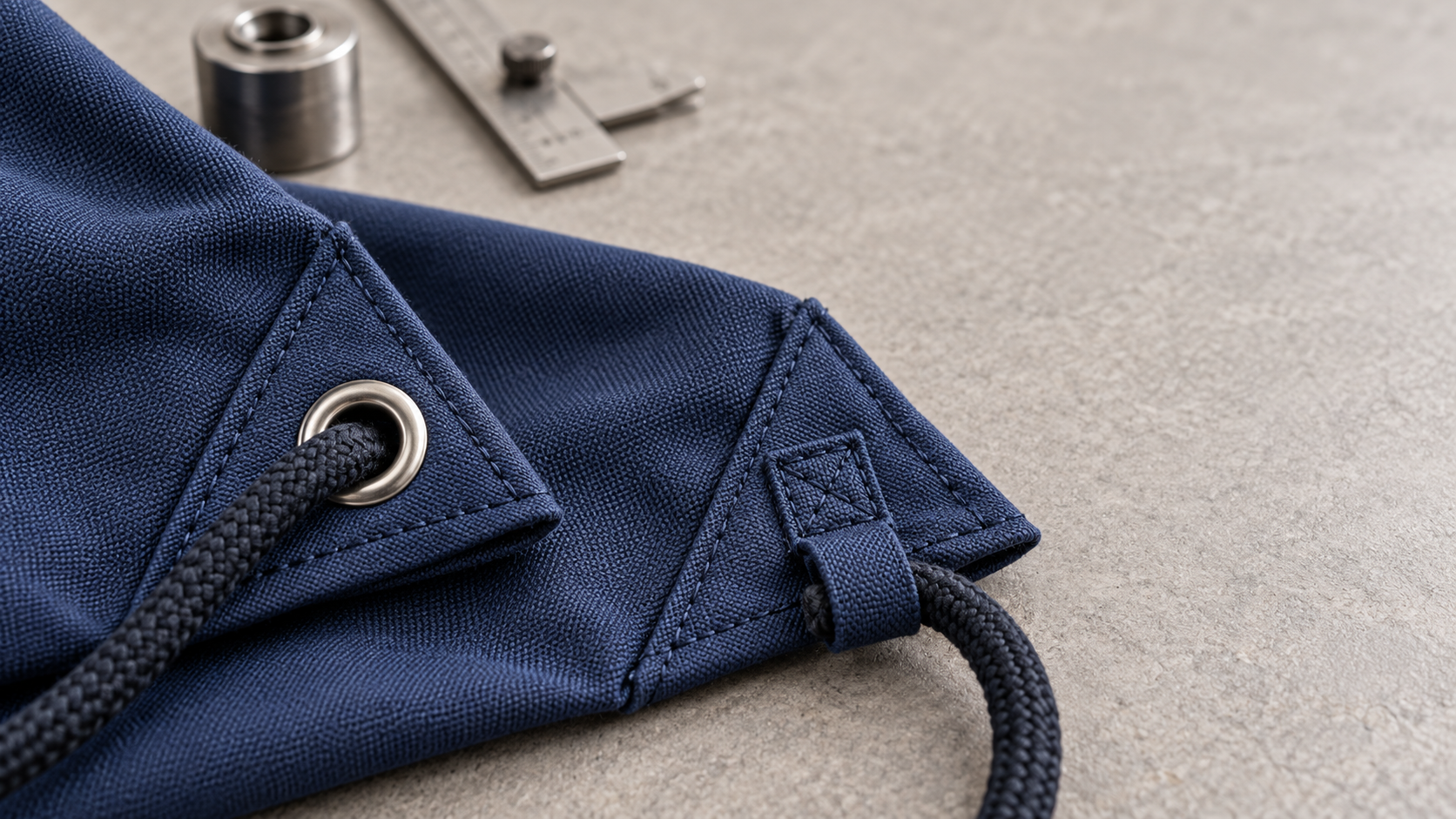
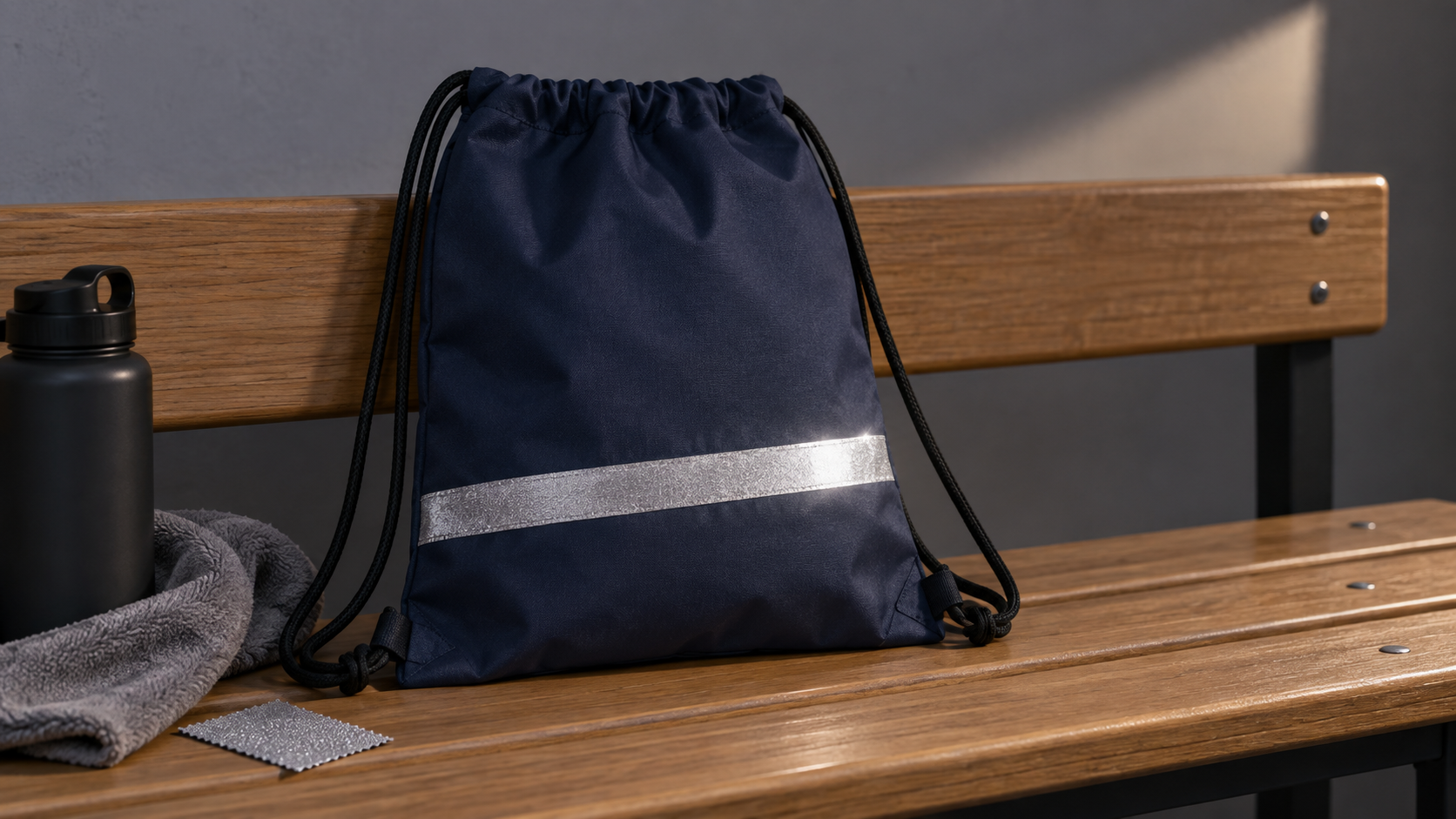
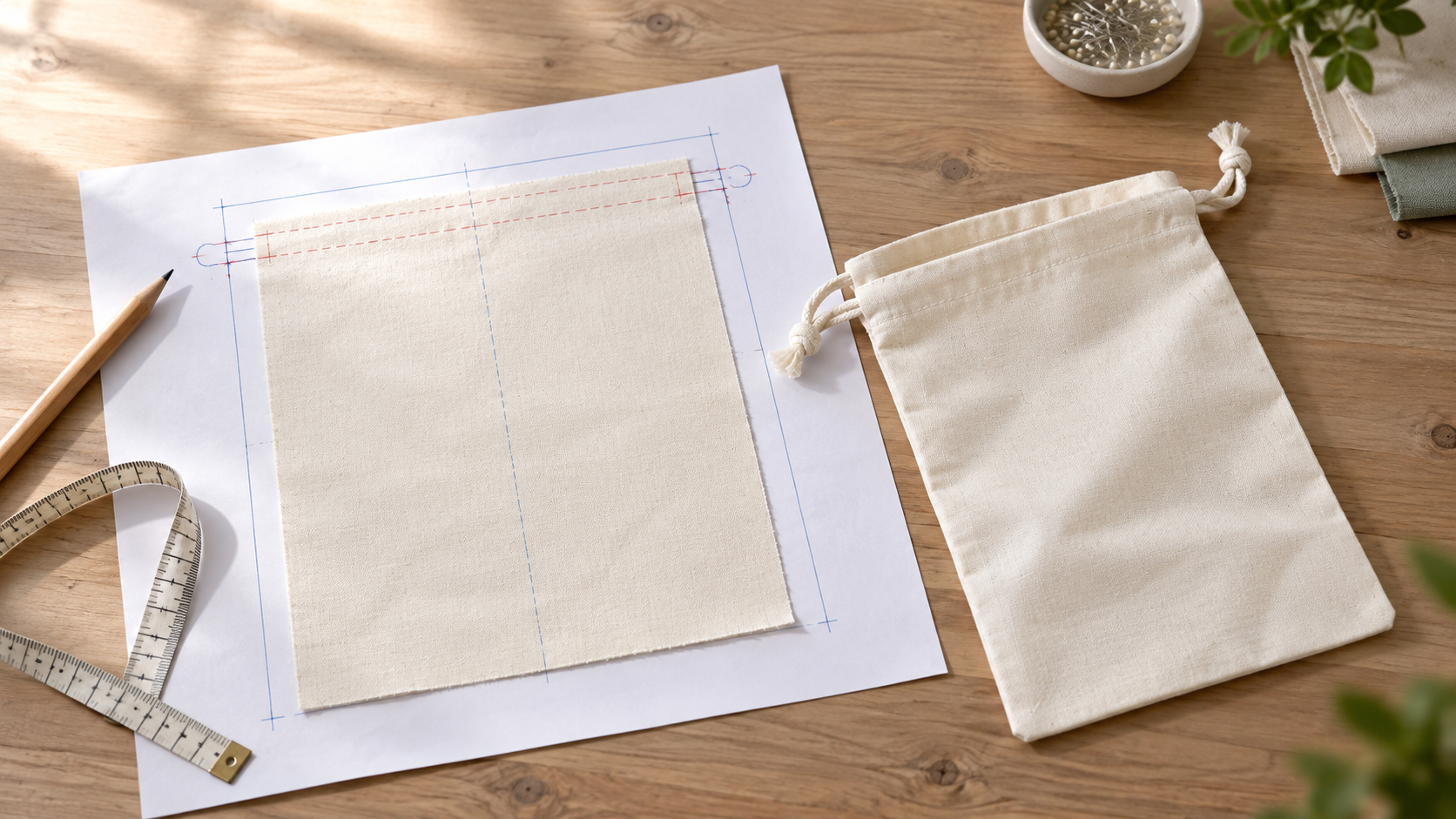
Image note: this reference-guided AI visual uses an internal LUCKYSTAR sample only to inform believable weave, stitching, scale, and fabric behavior. The unbranded navy corner assemblies are construction illustrations—not existing SKUs, customer products, production evidence, or verified performance claims.
The Short Answer: Which Corner Construction Should You Choose?
Choose a metal eyelet when the design needs a small, defined cord opening, a hardware accent, consistent cord routing, and the project can control hole preparation, backing layers, eyelet setting, edge finish, and metal requirements. Choose a sewn fabric loop or reinforced textile tab when a soft, quiet, metal-free, washable, or more repairable construction matters more than a crisp metal opening.
For a drawstring backpack, either route can work only if the shell, reinforcement, seam capture, cord angle, and intended load are compatible. The deciding question is not “Which component looks stronger?” It is “How does force travel from the cord into the bag without creating a tear, pull-out, cut edge, or uncomfortable hard point?”
| Decision factor | Metal eyelet through reinforced stack | Sewn fabric-reinforced corner or loop |
|---|---|---|
| Load transfer | Concentrated around a circular opening, then dispersed by backing | Distributed through loop, patch, stitch field, and captured seams |
| Visual character | Crisp, technical, decorative, or premium hardware detail | Soft, textile-led, understated, or metal-free appearance |
| Critical process | Hole cutting and eyelet setting | Patch folding, loop placement, stitch geometry, and seam capture |
| Common failure | Rotation, pull-out, cracking, burrs, corrosion, fabric tear | Stitch rupture, seam peel, loop abrasion, fraying, patch delamination |
| Cord contact | Smooth if bore and rolled edge are correctly finished | Soft contact, but loop width and edge finish still matter |
| Moisture concern | Material and finish must match the exposure | Textile may retain moisture; drying and colorfastness still matter |
| Repair | Often needs matching hardware and a setting tool | May be repairable with sewing access and matching textile |
| Best use | Defined hardware aesthetic and controlled assembly | Soft-goods, washable, quiet, or metal-free brief |
Do Not Treat “Eyelet” and “Reinforced Corner” as Opposites
Many production drawings show a triangular patch with a metal ring at its center. The patch stabilizes the weak zone, while the ring finishes the cord opening. That is both an eyelet construction and a reinforced corner.
To prevent quotation errors, name the exact architecture:
- Hardware route: punched opening + eyelet or grommet + specified backing stack.
- Soft-anchor route: sewn loop, folded fabric tab, webbing tab, buttonhole-style opening, or another approved metal-free solution.
- Hybrid route: eyelet through a separate corner patch, possibly captured into the side and bottom seams.
The broader drawstring cord, eyelet and reinforcement guide explains the complete closure system. This page goes deeper into the lower-corner choice and the evidence needed to compare it.
First Identify the Corner’s Real Job
A small gift pouch and a wearable drawstring backpack may look related, but the cord does different work.
| Bag type | What the corner or exit does | Dominant risk |
|---|---|---|
| Decorative pouch | Guides or terminates a light closure cord | Fraying, poor appearance, difficult closing |
| Product dust bag | Supports repeated opening and storage handling | Abrasion, snagging, staining, product contact |
| Drawstring tote | Helps close the mouth; may not carry the full load | Channel wear and side-exit distortion |
| Backpack-style sack | Transfers carrying load from cord to lower corners | Pull-out, seam rupture, tearing, user discomfort |
| Mesh utility bag | Anchors cord beside an open structure | Mesh distortion and local tear propagation |
| Laundry or wet-use bag | Handles cycles, moisture, detergent, and drying | Corrosion, coating damage, stitch degradation |
If the cord functions as a shoulder strap, the lower anchors are load-bearing assemblies. If it merely closes a pouch, comfort and pull-out requirements may be different. Record the intended use, contents, maximum agreed test load, carry duration, and opening-cycle expectation before selecting hardware.
How a Metal Eyelet Corner Carries Force
A metal eyelet makes a hole durable only when the surrounding material stack supports it. Cord tension contacts the bore; the eyelet flange transfers pressure to the layers around the hole; the backing spreads that pressure farther into the patch and body panel; seams then carry it into the bag.
The system can fail at any transition:
- The cord may abrade on an unfinished inner edge.
- The barrel may split or roll unevenly during setting.
- The eyelet may rotate because the stack is too soft or too thin.
- The flange may cut the surface under repeated angled loading.
- The backing may tear from the punched hole to its edge.
- The patch may remain intact while its attachment seam opens.
A larger flange can increase bearing area, but it also requires a larger opening and may create more leverage. Diameter alone does not prove strength.
What Must Be Specified for a Metal Eyelet
“Silver eyelet” is not a production specification. At minimum, the tech pack or approved component record should identify the dimensions, construction, finish, and setting standard that influence function.
| Eyelet field | What to define | Why it matters |
|---|---|---|
| Component type | One-piece eyelet, eyelet with washer, or supplier-defined grommet set | Terminology varies and parts may not be interchangeable |
| Finished inside diameter | Approved bore after setting | Determines cord clearance and contact |
| Flange dimensions | Face diameter and profile | Affects appearance and bearing area |
| Barrel length | Matched to compressed material stack | Too short may not lock; too long may roll poorly |
| Base metal | Order-specific material declaration | Influences forming, corrosion, magnetism, and market review |
| Surface finish | Color, gloss, plating or coating reference | Controls appearance and exposure risk |
| Mating part | Washer/ring presence and orientation | Changes retention and reverse-side finish |
| Hole method | Cut, punch, heat-assisted method where suitable | Affects edge stability and local damage |
| Setting appearance | Accepted front and back reference images | Makes splits, tilt, gaps, and over-compression visible |
| Backing stack | Every layer, orientation, and finished thickness | The eyelet is only as stable as the stack around it |
The approved sample should show both faces. A perfect front can hide a split barrel, off-center washer, trapped fold, or sharp reverse edge.
What a Fabric-Reinforced Soft Anchor Actually Is
“Fabric corner” can describe several constructions. A triangle sewn onto the outside is not equivalent to a folded loop captured in two seams. Draw the cross-section or provide a disassembled reference so the supplier knows which layers carry the cord.
Common metal-free architectures include:
- a folded self-fabric loop captured between the patch and bag;
- a woven tape or webbing tab sewn into the lower side seam;
- a triangular overlay with a bound or buttonhole-style cord opening;
- an internal backing plus an external textile loop;
- a folded corner extension formed from the body panel;
- a replaceable loop attached to a reinforced seam zone.
The patch is valuable only when force can travel beyond its stitches. A small decorative triangle attached to one surface may peel away. A correctly engineered patch can extend into the bottom and side seams, use compatible grain direction, and create a larger load-sharing area.
What Must Be Specified for a Sewn Corner
| Soft-anchor field | What the buyer should approve | Frequent ambiguity |
|---|---|---|
| Patch material | Composition, construction, weight/thickness target, color | “Same fabric” may behave differently after folding |
| Patch geometry | Finished width, height, angle, fold, and corner radius | Photo alone hides seam allowance |
| Loop/tab material | Self-fabric, binding, tape, or webbing | Substitute widths change cord motion and load spread |
| Loop opening | Clear internal width and finished projection | Flat size is not functional clearance |
| Layer sequence | Face, backing, folded edges, lining, and seam capture | Assembly order affects strength and appearance |
| Stitch definition | Pattern, rows, density range, start/stop security | “Reinforced stitching” is not measurable |
| Seam allowance | Named measurement points and tolerance | Narrow capture can release under angled pull |
| Edge finish | Folded, bound, heat cut where compatible, or overlocked | Raw edges can fray inside the bag |
| Alignment | Distance to side and bottom reference points | Mismatched corners twist the bag during carry |
| Repair access | Whether the loop can be reached after lining | Hidden assemblies may be difficult to repair |
For a complete drawing package, use the fields in how to prepare a custom drawstring bag tech pack.
Load Path: Why the Weakest Transition Wins
The cord usually pulls upward and inward, not straight away from the fabric. That changing angle creates bearing, peel, and shear at the same time. A bench test that pulls only in one direction may miss a failure customers create while putting the bag on, walking, or closing it unevenly.
Trace the path on the approved sample:
Cord → eyelet bore or textile loop → local backing → patch attachment → side/bottom seam → main panel.
Then ask which transition is likely to move first. If the eyelet is rigid but the patch is narrow, the hole may stay intact while the whole patch tears out. If the fabric loop is strong but its stitch field ends near a cut edge, the seam may unzip. Component strength is not assembly strength.
Stress Concentration and Hole Preparation
Punching removes material and creates a boundary from which a tear can start. The risk depends on the fabric construction, coating, hole quality, edge distance, layer stability, eyelet geometry, and load direction. A ragged or oversize hole reduces the material available under the flange. An undersize hole may distort layers during setting.
A controlled trial should confirm:
- the hole is centered in the backing zone;
- yarns, film, foam, or nonwoven layers are not excessively damaged;
- no loose fragments are trapped under the flange;
- the setting does not crush a padded stack beyond the approved appearance;
- the reverse roll is complete and free of splits;
- the finished bore does not cut the selected cord.
The correct hole-to-hardware relationship comes from the component supplier's data and production trial. It should not be guessed from a catalog photograph.
Edge Distance and Patch Geometry
An eyelet placed too close to the patch edge leaves a short tear path. Moving it inward may improve material around the opening, but can change cord angle, usable strap length, decoration space, or how the corner folds. The same trade-off applies to a sewn loop: a wider stitch field can spread load, yet may make the lower corner bulky.
Approve edge distance using named reference points—such as finished flange edge to finished patch edge—not an undefined “center distance.” For textile anchors, specify how far the loop enters the stitch field and whether the patch is captured into adjacent structural seams.
Base Material Changes the Decision
The same anchor is not automatically transferable between cotton canvas, thin polyester, nonwoven polypropylene, mesh, and laminated material.
| Body material condition | Metal-eyelet consideration | Fabric-anchor consideration |
|---|---|---|
| Firm woven canvas | Stable base may accept a backed hole; bulk still affects barrel length | Self-fabric patch can be bulky after multiple folds |
| Lightweight woven polyester | Thin stack may need additional backing and careful setting | Loop and patch can spread force without a hard ring |
| Heavy coated fabric | Coating can mark, crack, or creep under flange pressure | Needle holes and folded coating also need evaluation |
| Nonwoven sheet | Local tear and creep can dominate even at higher GSM | Broad reinforcement and attachment method require trials |
| Mesh body | Eyelet should normally sit in a stable solid zone, not unsupported mesh | Solid binding or patch can bridge and stabilize open structure |
| Soft pouch fabric | Hardware may print through or contact the product | Textile solution can remain soft but may add seam bulk |
Use best materials for custom drawstring bags for the first material screen. For specific synthetics, compare polyester and nylon drawstring bags; for spunbond structures, see the non-woven GSM and construction guide.
Thin Fabric Does Not Make Eyelets Impossible—but It Narrows the Process Window
A thin shell can be backed with another layer, a woven patch, film, or an engineered insert selected for the project. The added stack must remain stable during punching and setting. If it wrinkles, compresses unpredictably, or separates, the flange may not clamp evenly.
Soft anchors avoid a metal setting operation, but sewing can perforate weak sheet material. Excessively dense stitching may create a tear line, while sparse stitching may allow movement. Sample both routes in the actual material rather than assuming one is universally safer.
Coated and Water-Resistant Constructions Need Penetration Review
Every eyelet hole and every needle hole crosses material. If the bag has a moisture-management requirement, determine whether the lower corner is inside the protected compartment, outside it, or intentionally unsealed. A metal flange does not make a penetration waterproof. A sewn patch does not preserve a barrier merely because it covers the area.
Define the claim carefully—water resistance, splash resistance, or another project-specific condition—and build the appropriate assembly test. The waterproof drawstring bag materials guide explains why material properties alone cannot establish finished-bag protection.
Corrosion, Plating, and Color Stability
Metal hardware introduces questions that a metal-free corner does not: base metal, plating or coating, storage environment, sweat or salt exposure, detergent contact, dissimilar materials, and the possibility of staining nearby fabric. These risks are project-specific.
ISO 9227:2022 describes neutral, acetic-acid, and copper-accelerated salt-spray procedures for metallic materials and protected metals. ISO explicitly does not set a universal specimen, exposure period, or pass interpretation for every product, and it says these tests are not intended to predict long-term corrosion resistance. A buyer can reference an agreed method only after defining the component, exposure, duration, conditioning, evaluation criteria, and acceptance rule.
A textile corner removes metal-corrosion risk but still needs colorfastness, moisture, odor, dye migration, mildew-prevention, and drying review where those issues matter. “Metal-free” is a construction description, not proof of overall safety or environmental superiority.
Burrs, Cord Wear, and Product-Scratch Risk
Inspect the entire contact surface, including the reverse side. A sharp split in the barrel can abrade a cord or scratch packed products. A smooth-looking fabric loop can also cut a cord if its edge is stiff, narrow, heat-damaged, or misaligned.
During sample approval:
- rotate and pull the cord through its full working angle;
- inspect cord fuzzing, flattening, glazing, and cut fibers;
- feel the eyelet front, bore, and reverse edge using a safe documented method;
- check whether the hardware contacts skin or the packed item;
- confirm that knots or tips do not jam in the opening;
- repeat after any conditioning required by the project.
Cord selection remains part of the answer. Compare round cord, flat cord, and webbing straps, and decide the overall routing with single-cord versus double-cord drawstring bags.
Comfort, Noise, and Handling
Hardware can create a hard point against the body, click against another eyelet, or mark nearby products during packing. Those effects may be acceptable for a technical backpack and undesirable for a jewelry pouch, children's accessory, sleep-related textile item, or premium soft package.
A textile loop is quieter and compresses during packing. However, it can twist, fold, or create a thicker seam ridge. A wearing trial with the intended load, cord, clothing, and carry duration reveals more than a flat inspection.
Appearance and Brand Design
Eyelets can become part of the design language. Finish color, sheen, flange size, and front/back appearance should coordinate with print, zipper pulls, snaps, and other components. If the artwork sits near the corner, the flange and patch may interrupt the safe print area.
Fabric anchors offer color matching, contrast blocking, woven texture, or a discreet monochrome finish. They also provide a larger visible construction area, so crooked stitching or mismatched patch angles become noticeable. Approve both corners together—not as two isolated samples—because symmetry affects perceived quality.
Washability and Care Instructions
If the bag will be washed, validate the complete assembly using the intended care route. Check metal finish, staining, trapped water, flange movement, patch shrinkage, loop distortion, thread behavior, coating damage, and cord length after conditioning. Do not declare a bag washable solely because its body fabric is washable.
The label should reflect the finished product and target market, not a generic material assumption. A textile anchor may simplify a metal-free brief, but mixed fibers, coatings, print, labels, and cord still affect care and end-of-life communication.
Repairability and End-of-Life Separation
A damaged sewn loop may be replaceable if the construction remains accessible. An eyelet usually requires compatible replacement hardware, correct dies, and enough sound material around the original hole. Once a hole has enlarged or torn to an edge, installing a larger ring without redesign can simply move the problem.
Neither option has a universal end-of-life advantage. A metal component might be durable but difficult for a consumer to separate; a textile loop may avoid that disassembly step but can introduce another fiber or coating. Document actual materials and avoid broad environmental claims without product- and market-specific evidence.
Metal-Free Requirements Must Be Defined, Not Assumed
“No visible metal,” “metal detector compatible,” “non-magnetic,” “airport friendly,” “nickel free,” and “contains no intentionally added metal components” are different requirements. A sewn corner can remove the obvious eyelet while other items—cord tips, labels, decoration, packaging fasteners, or contamination—remain relevant.
Ask the buyer why the restriction exists and what proof is required. Then apply it to the bill of materials, process controls, inspection method, and packing—not just the lower corner.
Sampling Plan: Compare Like With Like
Build comparison samples from the same body material, size, cord, seam geometry, and intended decoration.If one sample uses a larger patch, different cord angle, or additional layer, the result is a system comparison—not evidence that the eyelet or loop alone caused the difference.
A useful development sequence is:
- Freeze use case, body material, cord, filled product, and test load.
- Draw both corner cross-sections and name every layer.
- Make first samples with visible construction records.
- Inspect setting or sewing quality before applying a load.
- Perform functional opening, carrying, cyclic, and directional pull trials.
- Record failure mode and location, not only the final force or cycle count.
- Revise one controlled variable at a time.
- Approve a production-equivalent sample and written acceptance criteria.
LUCKYSTAR's custom drawstring bag sample development process shows how to keep decisions and revisions traceable.
Whole-Assembly Testing Matters More Than a Loose Component Certificate
A supplier data sheet for an eyelet or webbing roll cannot prove how the finished corner behaves. Whole-assembly evaluation should reproduce the relevant directions, load pattern, conditioning, and user actions.
| Check | Purpose | Record |
|---|---|---|
| Visual and tactile inspection | Detect split rolls, gaps, tilt, burrs, raw edges, skipped stitches | Defect photos and location |
| Cord movement trial | Confirm clearance and abrasion behavior | Cord condition before/after |
| Static loaded hold | Observe deformation, slippage, and seam response | Load, duration, orientation, result |
| Cyclic carry or pull | Expose progressive wear and loosening | Cycle method and failure mode |
| Directional pull | Compare likely use angles | Fixture, angle, rate, result |
| Seam-focused test | Characterize sewn attachment where method scope fits | Standard/method version and specimen |
| Conditioning | Evaluate moisture, wash, heat, cold, or storage effects as relevant | Exact preconditioning and recovery |
| Corrosion check | Evaluate specified metallic finish when required | Component, method, exposure, criteria |
| Product-contact review | Find scratching, transfer, snagging, or staining | Packed product and contact points |
ISO 13935-2:2026 specifies a grab method for determining maximum force to seam rupture when force is applied perpendicular to a sewn seam. Its published scope is mainly woven textiles and says it is normally not applicable to several categories, including nonwovens and coated fabrics. Even where appropriate, it characterizes a seam under a defined setup; it does not replicate an angled cord, punched opening, eyelet flange, patch peel, or complete backpack corner. Use the method only with a test plan that matches the material and decision.
Production Quality-Control Checklist
Quality control must connect the approved sample to repeatable line checks.
Incoming Hardware and Textile Checks
- Match eyelet parts, dimensions, finish, mating washer, and approved lot reference.
- Check for mixed colors, corrosion, deformation, sharp edges, and surface contamination.
- Verify patch/loop material, width, thickness or weight target, shade, and edge condition.
- Confirm cord construction and size fit the approved anchor.
First-Article Checks
- Compare layer sequence, hole and eyelet location, patch geometry, loop projection, and seam capture.
- Inspect front and reverse faces under consistent lighting.
- Confirm cord movement and carrying orientation.
- Perform the agreed destructive and non-destructive checks before bulk release.
In-Process Checks
- Monitor die alignment, setting pressure or stop, material-stack consistency, and changeover controls.
- For sewing, monitor folder output, loop placement, stitch density range, backtack/bartack quality, and seam allowance.
- Isolate distorted, split, loose, missing, mismatched, or contaminated parts.
Finished-Bag Checks
- Compare left/right alignment and appearance.
- Pull cords through the real use path and inspect snagging.
- Check the bag with agreed contents and loading direction.
- Confirm packing does not dent eyelets, bend loops, or place hard parts against sensitive surfaces.
For wider inspection planning, use the custom bag quality inspection checklist.
Failure Modes and Corrective Questions
| Observed defect | Likely areas to investigate | Avoid this shortcut |
|---|---|---|
| Eyelet rotates | Stack thickness, setting, hole size, component match | Adding adhesive without validating compatibility |
| Eyelet pulls out | Backing area, edge distance, flange, load angle, material tear | Selecting a larger eyelet by appearance alone |
| Cord frays | Bore finish, reverse roll, clearance, cord construction, angle | Treating cord replacement as the only fix |
| Patch tears to edge | Hole position, patch dimensions, grain, notch damage | Increasing stitch density around a weak hole |
| Loop slips from seam | Insertion depth, seam allowance, stitch capture, assembly order | Using a stronger loop with the same weak attachment |
| Stitch field peels | Patch geometry, load direction, stitch path, backing | Adding a decorative box-X that misses structural layers |
| Corner wrinkles | Layer mismatch, shrinkage, feeding, over-compression | Pressing the finished defect flat |
| Metal stains fabric | Finish system, environment, storage, chemical contact | Calling all similar-color hardware equivalent |
Record the mode, location, test history, and affected lots before choosing a corrective action. The visible failed component may not be the root cause.
Packing and Carton Considerations
Metal eyelets create hard high points. Nesting them in the same location can build pressure through a stack, mark coatings, or dent the front face. Textile loops can tangle, fold unpredictably, or make cartons springy if left unrestrained.
Run an actual pack-out trial that confirms:
- fold direction and whether hardware faces inward or outward;
- protection between eyelets and printed or sensitive surfaces;
- loop and cord arrangement without tight permanent bends;
- unit-pack requirements and moisture controls;
- carton quantity, dimensions, gross weight, and compression behavior;
- post-transit appearance after a defined distribution simulation if required.
The approved packing method belongs in the specification and quote because it affects labor, materials, carton utilization, and delivered presentation.
Cost, MOQ, and Lead-Time Drivers
Metal eyelets add component sourcing, color/finish matching, compatible die setup, hole making, setting, and inspection. Custom plating, uncommon dimensions, or multiple hardware colors may introduce supplier minimums and longer procurement. Fabric anchors add cutting or folding operations, sewing time, alignment controls, and sometimes more textile area.
| Cost driver | Hardware route | Soft-anchor route |
|---|---|---|
| Materials | Eyelet set plus backing | Patch plus loop/tab material |
| Tooling/setup | Punch and matched setting dies | Cutting/folding guide and sewing setup |
| Labor sensitivity | Centering and setting consistency | Folding, placement, and stitch execution |
| Variant complexity | Finish and size combinations | Fabric/color/width and stitch combinations |
| Rework | Hardware removal can damage the hole | Stitch removal may mark or weaken fabric |
| Packing | Hard-part protection may be needed | Loop/cord control may be needed |
There is no universal price, MOQ, sample fee, or production time for either option. Values depend on the confirmed material, construction, finish, quantity, color split, testing, packing, and schedule. Review the project-specific variables in custom drawstring bag MOQ and production time and the 2026 custom drawstring bag pricing guide.
How to Reduce Cost Without Weakening the Corner
Cost engineering should remove unnecessary complexity while protecting the load path.
- Standardize one approved eyelet size and finish across compatible variants where feasible.
- Use a common patch geometry while changing only body color, if trials confirm equivalence.
- Limit decorative hardware finishes that do not add buyer value.
- Design the patch to use material efficiently without reducing required coverage.
- Keep the corner clear of print and labels that complicate assembly.
- Freeze the approved stack before bulk material purchase.
- Consolidate testing around representative worst-case variants only when the buyer and test plan justify it.
- Prevent rework through first-article approval and in-process control.
The aim is not the lowest unit component cost; it is a stable delivered construction with fewer failures, delays, and avoidable revisions. See how to reduce custom drawstring bag costs without sacrificing quality for a broader cost framework.
Compliance and Chemical Questions
Metal composition, coatings, dyes, finishes, and product-contact expectations can trigger different requirements by market and end use. Ask which regulation, restricted-substance list, age group, contact scenario, and documentation format apply. A generic supplier statement should not be extended beyond its named component, scope, date, and batch.
LUCKYSTAR must not be described as holding universal GRS, GOTS, BSCI, ISO, REACH, RoHS, CE, or other certifications for all drawstring bags. Available documents have different subjects, scopes, and dates; order-level evidence must be checked against the final product and selling entity. Commercial and compliance conditions remain subject to specification review and written confirmation.
Why Choose LUCKYSTAR for Corner Development?
LUCKYSTAR supports OEM/ODM, sample service, and development from buyer drawings, specifications, or reference samples. That is useful for corner engineering because a small visible detail crosses several disciplines: body fabric, cord, hardware or tab, sewing, decoration, packing, testing, and inspection.
For a metal-eyelet versus textile-anchor decision, LUCKYSTAR can help coordinate a controlled workflow:
- translate the intended use into comparable construction options;
- identify missing eyelet, patch, loop, seam, and cord fields before quotation;
- develop samples and keep revisions tied to an approved specification;
- align appearance checks with functional loading and cord movement;
- define incoming, first-article, in-process, and finished-bag checkpoints;
- coordinate order-specific material, testing, packing, MOQ, price, and timing review;
- retain a clearer evidence trail for reorders and corrective action.
The value is not a blanket promise that one construction always wins. It is a more disciplined route from buyer requirement to reproducible sample and bulk control. Use our drawstring manufacturer selection criteria to assess a prospective partner. The separate custom bag manufacturer guide provides the wider sourcing framework.
RFQ Checklist for Metal Eyelets or Fabric Corners
Send enough information for the supplier to quote the same product you intend to approve.
| RFQ category | Required information |
|---|---|
| Use | Bag type, packed contents, carry/closure function, user group, target market |
| Dimensions | Finished bag size, corner location, cord path, relevant tolerances |
| Body | Material composition, construction, weight/thickness target, coating/lining |
| Anchor option | Eyelet assembly and backing, or patch/loop architecture and stitch details |
| Cord | Material, construction, diameter/width, color, finished length, ends |
| Appearance | Hardware finish, patch color, symmetry, visible front/reverse criteria |
| Performance | Intended load, directions, cycles, conditioning, failure and acceptance rules |
| Compliance | Applicable regulation/RSL, component declarations, test or document needs |
| Branding | Artwork file, method, size, placement, corner clearances |
| Commercial | Quantity, variants, destination, delivery target, packing, trade terms |
If sourcing internationally, pair this with how to import custom drawstring bags from China. All quotations and timing remain subject to the final specification and written confirmation.
Frequently Asked Questions
Are metal eyelets stronger than fabric-reinforced corners?
Not inherently. Eyelet performance depends on the component, material stack, hole, setting, backing, edge distance, cord, and load direction. A sewn corner depends on patch area, loop material, seam capture, stitches, and base fabric. Compare finished assemblies under the same use conditions.
Does a metal eyelet still need a fabric patch?
Often it does, especially at a load-bearing lower corner or in lightweight material. The exact backing may be a separate patch or another engineered layer. The sample and test plan should prove that the finished stack supports the eyelet without creating a new tear path.
Is a grommet different from an eyelet?
Suppliers use the terms inconsistently. Some call a one-piece rolled component an eyelet and a two-part component with a washer a grommet; others use the words interchangeably. Define the actual parts, dimensions, faces, and setting result instead of relying on the name.
Which option is better for a drawstring backpack?
Either can work. A hardware route can provide a compact defined opening; a textile loop can spread force and avoid a hard component. The intended load, cord angle, body material, patch geometry, comfort, moisture exposure, and test result should decide.
Can thin polyester hold a metal eyelet?
It may be feasible with a suitable backing stack, component, hole, and controlled setting process, but thin fabric narrows the process window. Validate the production-equivalent assembly rather than approving the shell fabric alone.
Are fabric loops always metal-free?
The loop itself can be metal-free while the finished product still contains metal elsewhere. Define whether the requirement concerns visible parts, intentional components, magnetism, restricted substances, detection, or another condition, then review the full bill of materials and process.
How do I prevent eyelets from cutting the cord?
Match the finished bore to the cord, inspect the rolled edge and reverse face, control setting, avoid sharp splits or burrs, and test movement through the real working angle. Cord material and construction also influence wear.
What should a corner pull test include?
State the complete sample, conditioning, fixture, pull direction, rate or cycle, load/duration, observations, failure definition, and acceptance rule. One straight pull may not represent carrying, closing, twisting, or asymmetric use.
Are textile-reinforced corners easier to recycle?
Not automatically. They may avoid a metal part, but the patch, loop, thread, coating, print, and labels can still create a mixed-material product. Make claims only after confirming actual composition, available recovery route, target-market rules, and supporting evidence.
How should the two options be priced?
Request quotations against complete, comparable specifications. Eyelet cost includes hardware, tooling/setup, setting, backing, QC, and packing; textile-anchor cost includes materials, preparation, sewing, alignment control, QC, and packing. MOQ, price, sample terms, and lead time are project-specific.
Can LUCKYSTAR develop both options for comparison?
LUCKYSTAR supports custom development and sample service based on buyer requirements. Feasibility, sample configuration, testing, price, MOQ, timing, and bulk conditions must be reviewed for the specific bag and confirmed in writing.
Final Recommendation
Use a metal eyelet when controlled hardware appearance and a compact cord opening support the product brief—and when the backing, hole, setting, finish, and inspection plan are fully defined. Use a sewn textile anchor when softness, quiet handling, repair access, or a specifically defined metal-free construction is more important—and when the loop, patch, seam capture, and stitch path are engineered as a load-bearing assembly.
Do not approve either option from a component photo. Compare production-equivalent samples with the same body, cord, geometry, load, and conditioning; record where each system deforms or fails; then freeze the chosen construction as a complete specification.
LUCKYSTAR can help convert your performance, appearance, packing, and compliance priorities into a controlled custom drawstring bag sample. Send your bag dimensions, material, cord, contents, expected use, quantity, artwork, destination, delivery target, and preferred corner route for project review.