Promotional Drawstring Bags for Trade Shows
Promotional drawstring bags for trade shows are most effective when they solve an immediate attendee problem and support a defined exhibition objective. The bag should comfortably carry the materials people collect during the event, make the exhibitor’s identity easy to recognize, and be distributed through a planned interaction rather than left as an uncontrolled pile of giveaways.
The right specification depends on the show format, audience, contents, booth workflow, shipment method, and intended life after the event. A lightweight bag may be appropriate for a one-day conference kit. A bag intended to carry catalogs, samples, a bottle, and a laptop accessory may need a stronger fabric, reinforced corners, a gusset, or an extra pocket. There is no universal “best trade show bag” independent of the program.
This guide explains how to turn a promotional idea into a measurable B2B project: objective, distribution trigger, usable capacity, material, construction, decoration, delivery, on-site control, and post-show evaluation. LUCKYSTAR can help buyers develop order-specific custom drawstring bags, subject to the final specification, approved sample, applicable requirements, and written commercial confirmation.
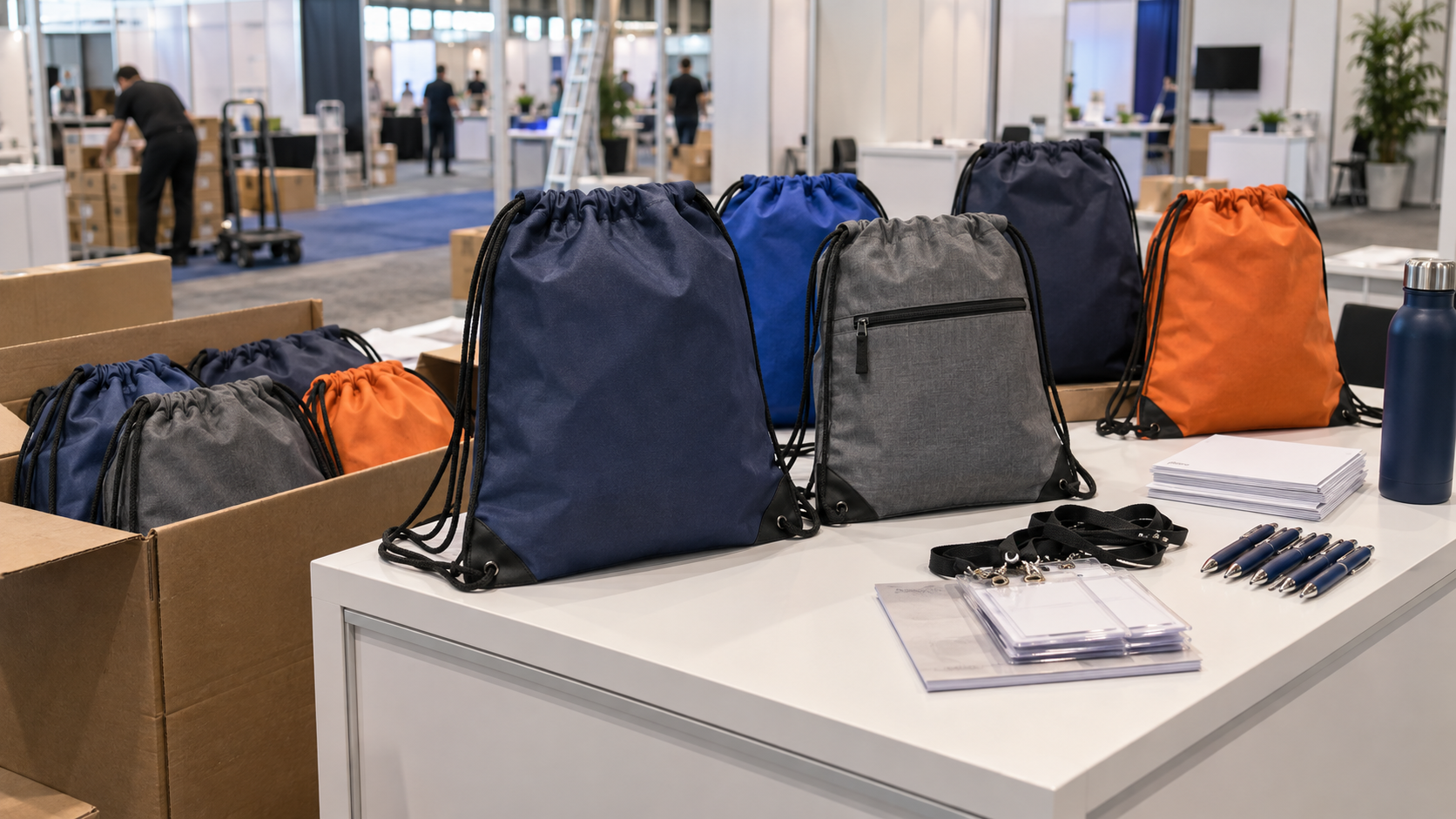
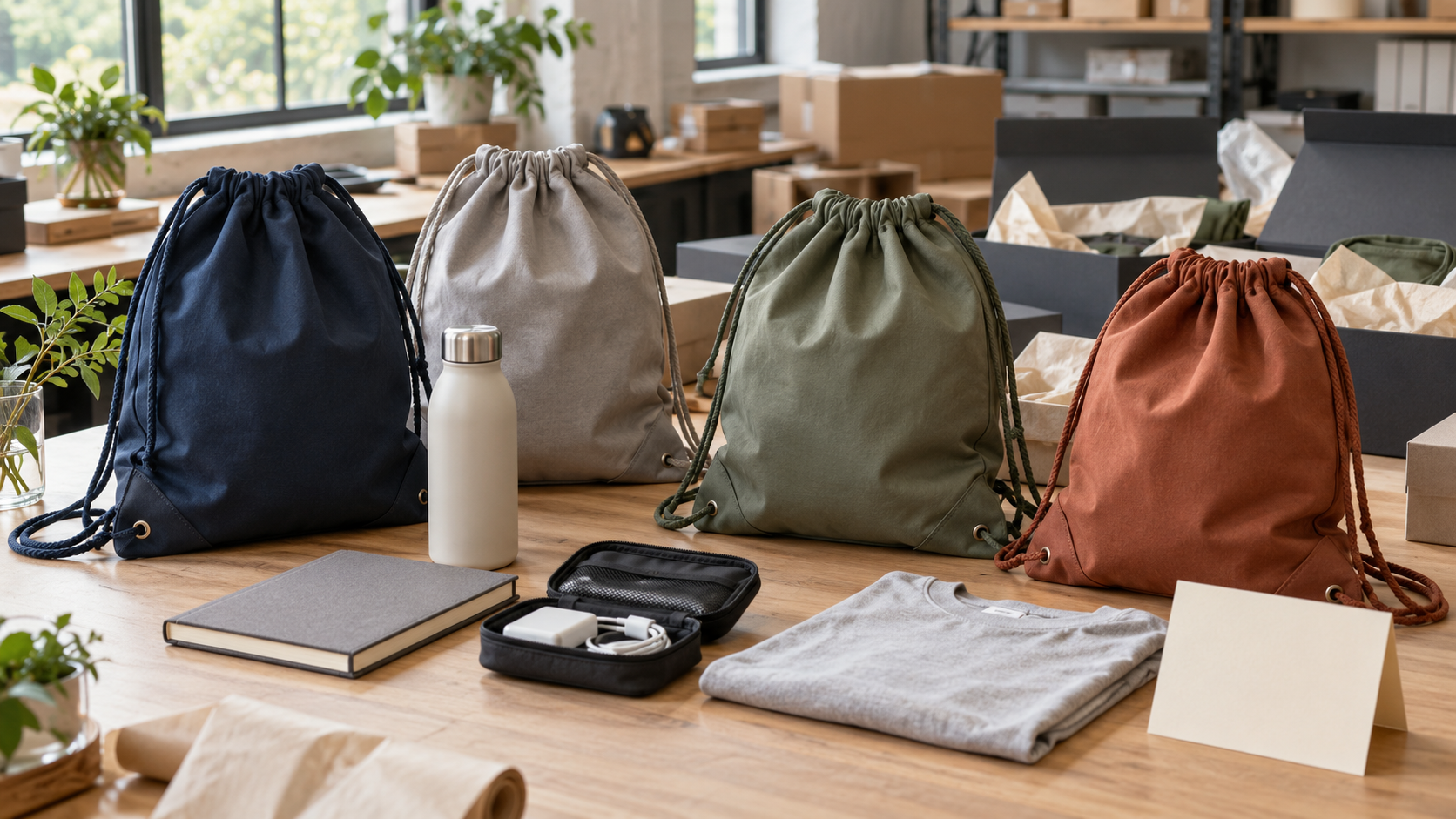
Generated editorial illustration showing an unbranded exhibition setup. It is not a customer order, an actual LUCKYSTAR facility, or evidence of a specific trade show.
Quick Answer: What Makes a Good Trade Show Drawstring Bag?
A good trade show drawstring bag is useful on the event floor, easy to carry, visually clear, and operationally simple to distribute. Its size should come from the planned contents; its fabric and load points should suit the working load; its print method should suit the artwork and substrate; and its cartons should be packed for the way staff will replenish the booth.
The bag should also have a job within the campaign. It may attract visitors, package a demonstration kit, reward a qualified conversation, organize press materials, support a workshop, or extend brand visibility after the show. Choose one primary job before choosing the bag.
| Campaign question | Why it matters | Decision to record |
|---|---|---|
| What is the primary exhibition objective? | A lead-generation program needs a different handoff than a universal welcome bag | Awareness, qualified conversation, product trial, appointment, or attendee service |
| Who should receive the bag? | Audience definition controls quantity and distribution | All attendees, session participants, target accounts, buyers, press, or staff |
| What must it carry? | Contents determine usable capacity and load | Item list, largest item, representative total load |
| When will it be handed over? | Timing affects booth congestion and replenishment | Registration, demonstration, meeting, session, or exit |
| What action should be measured? | A giveaway without attribution cannot be evaluated well | Scan, code, appointment, survey, demo, or kit redemption |
| How will it reach the venue? | Freight rules affect carton design, dates, and reserve stock | Advance warehouse, direct-to-show, local hand-carry, or distributor fulfillment |
Two supporting resources cover supplier selection from different angles. Use the drawstring bag manufacturer selection guide for product-specific screening and the Custom Bag Manufacturer Guide for wider sourcing controls.
Begin With the Exhibition Objective
The Center for Exhibition Industry Research identifies sales lead generation, branding, and relationship management among exhibitors’ leading objectives. CEIR also reports that exhibitors use real-time and post-show evaluation to assess attendee-engagement activities. The practical implication is simple: the bag should support a named objective and an observable action, not exist as an isolated purchasing line. See CEIR’s summary, How Exhibitors Evaluate Outcomes.
Objective-to-bag planning
| Primary objective | Bag’s role | Distribution trigger | Useful measurement |
|---|---|---|---|
| Brand visibility | Carries an easy-to-recognize identity through the hall | Open distribution in a controlled zone | Units issued, observed use, post-show recall study |
| Qualified lead generation | Rewards a meaningful product conversation or demonstration | Completed scan plus qualification step | Qualified conversations per issued bag |
| Appointment support | Packages meeting materials or samples | Scheduled meeting attendance | Appointment show rate and follow-up status |
| Product education | Holds a sample, guide, or workshop kit | Session or demo completion | Session attendance and kit redemption |
| Relationship management | Creates a useful account-specific follow-up pack | Hosted meeting or customer event | Account engagement and documented next action |
| Attendee service | Helps visitors carry materials collected during the show | Registration or information point | Distribution count and attendee feedback |
Do not force one bag to perform every role. If the show has multiple audiences, a simple attendee bag and a smaller premium meeting kit may be more controllable than one expensive item issued without qualification.
Design for the Five-Second Decision
At a crowded event, an attendee decides quickly whether a promotional item is worth carrying. PPAI’s 2025 consumer research reports that usefulness was the leading reason respondents kept branded items, while clear branding, style, and quality also affected attention and retention. The same study found that 54% still had the most recent promotional product they received and 61% clearly remembered the brand. These figures describe the study’s respondents, not a guaranteed result for any particular bag or campaign. See PPAI’s The 5-Second Impact and the related research PDF.
For a drawstring bag, the “five-second” questions are practical:
- Does it look large enough for the materials already in the attendee’s hands?
- Is the fabric and construction acceptable to carry around the hall?
- Is the branding easy to understand without covering the entire product?
- Are the cords comfortable enough for immediate use?
- Is there a reason to keep it after the event?
Useful does not have to mean complicated. A simple bag with the correct size, comfortable cords, and clear print may outperform a feature-heavy bag that is awkward to carry.
Map the Attendee Journey Before Choosing Features
The same bag behaves differently at registration, at a booth, in a workshop, and after the event. Draw the handoff from carton to attendee.
Trade show bag journey
- Inbound: cartons arrive at an advance warehouse, venue dock, hotel, or local fulfillment point.
- Storage: staff hold reserve stock in the booth, service area, or organizer storage.
- Replenishment: a defined person moves a manageable quantity to the distribution point.
- Handoff: the attendee receives the bag after the planned trigger.
- Use on the floor: the bag carries literature, samples, bottles, and personal items.
- Travel home: the attendee folds or packs the bag in other luggage.
- Post-show use: the bag may be reused if the design remains practical and relevant.
This journey exposes requirements that a catalog photo will not. A stiff, oversized bag may be hard to store under a booth counter. Loose metal hardware may scratch samples. A large logo may create visible hall impact but reduce post-show usefulness. A high-value kit can disappear quickly if the handoff point is not controlled.
Size the Bag From the Event Kit
Bag dimensions should be tested with the actual event contents. Flat width and height alone do not describe usable capacity because the top channel, fabric stiffness, seams, gusset, and pockets change the internal volume.
Build a representative kit with the largest brochure, sample, notebook, bottle, charger, or merchandise item. Load it into the sample, close the top fully, lift it repeatedly, and carry it for several minutes. The bag should not depend on aggressive stretching or a partially open closure.
| Event kit | Construction direction | Sample check |
|---|---|---|
| Badge, pen, and light handouts | Simple flat body may be sufficient | Printing remains visible when lightly filled |
| Brochures and notebook | Wider body or modest gusset can reduce edge distortion | Largest document enters without folding |
| Product samples | Stronger fabric and reinforced load points may be needed | Samples do not damage seams or each other |
| Bottle and literature | Side pocket or internal separation may help | Bag hangs evenly and bottle remains secure |
| Apparel or merchandise | Flexible body with generous opening | Kit can be packed efficiently at scale |
| Mixed VIP meeting kit | Pocket organization and more controlled presentation | Every component is easy to find and count |
The Drawstring Bag Size and Capacity Guide explains item-based capacity validation. If depth is required, review the Gusset and Bottom Construction Guide.
Select Material for the Program, Not the Trend
Trade show bags can be made in polyester, non-woven polypropylene, cotton, canvas, mesh, nylon, or verified recycled-material routes. Each creates a different balance of weight, cost, feel, print behavior, foldability, and service life.
| Material route | Practical advantages | Limitations to control | Suitable exhibition use |
|---|---|---|---|
| Lightweight polyester | Compact to ship, broad color range, flexible | Thin hand feel and concentrated load points need review | High-volume conference kits and light handouts |
| Heavier polyester | More structure and abrasion-resistance potential | Higher material and freight weight | Product-sample kits or repeated event use |
| Non-woven polypropylene | Efficient for simple, high-volume formats | GSM, bonding, seam method, and edge finish strongly affect result | Controlled short-event distribution |
| Cotton | Natural hand and good lifestyle fit | Absorbs moisture; shrinkage and color behavior require control | Brand events, workshops, retail-style programs |
| Canvas | Structured, premium tactile impression | Heavier and bulkier to ship | Account meetings and higher-value kits |
| Mesh | Visibility and ventilation | Limited print area and snag risk | Sports, equipment, or content-visibility programs |
| Verified RPET route | Can support a documented recycled-content brief | Claim needs current order-specific evidence | Programs with a defined, supportable material requirement |
Use Best Materials for Custom Drawstring Bags for a broader comparison. For a polyester specification, 210D vs 420D vs 600D Polyester Drawstring Bags explains why denier alone is not a complete quality grade. For non-woven bags, see Non-Woven Drawstring Bags: GSM and Construction Guide.
Sustainability claims require evidence
“Reusable,” “recycled,” “eco-friendly,” and “biodegradable” are not interchangeable. A reusable design should be durable and genuinely useful; a recycled-content statement should identify the material, percentage, scope, and evidence; disposal claims must match the product and available waste system.
If the brief requires RPET, define the claimed recycled content and required chain-of-custody documentation before quotation. The RPET Drawstring Bag Certification and Sourcing Checklist covers this process. Do not treat an old supplier certificate or a logo in a catalog as evidence for a current finished-goods order.
The U.S. Federal Trade Commission’s Green Guides explain that environmental claims should be truthful, appropriately qualified, and supported. Claims must also be reviewed for the destination market and the exact order.
Engineer the Cord System for All-Day Carrying
Attendees may carry the bag for hours while walking between halls. Cord comfort therefore affects whether the bag stays on a shoulder or is folded into another tote.
Round cords are compact and familiar but may concentrate pressure under heavier loads. Flat cords or webbing can spread pressure but change the look, closure path, pack volume, and cost. A double-cord backpack layout often distributes load better than a single-cord pouch, but only when the spacing and lower anchors are appropriate.
The lower attachment should be designed as a load path. A metal eyelet without enough reinforcement can pull through the body. A fabric loop can fail if the seam or material is too weak. Approve the cord, corner patch, stitching, and top channel as one system.
For detailed decisions, see Single-Cord vs Double-Cord Drawstring Bags, Round Cord vs Flat Cord vs Webbing Straps, and the Drawstring Cord, Eyelet and Reinforcement Guide.
Add Pockets Only When They Improve the Event Experience
A pocket can hold a phone, business cards, charging cable, or meeting notes. It can also add a zipper, seams, labor, inspection points, and failure modes.
| Feature | Good reason to add it | Risk to check |
|---|---|---|
| Front zipper pocket | Keeps small valuables separate from brochures | Zipper access, print interference, added bulk |
| Mesh bottle pocket | Supports all-day attendee use | Bottle fit, elastic recovery, snagging |
| Internal divider | Separates samples from literature | Reduced flexibility and added seam load |
| Bottom gusset | Improves capacity for boxed items | Bottom seam and loaded shape |
| Reflective accent | Visual design feature for some event themes | Must not be presented as certified safety performance without evidence |
| Name-card window | Helps staff or group allocation | Privacy, label retention, post-show appearance |
The feature should be justified by the kit and audience. If a plain construction already meets the requirement, simplicity can improve production control and reduce carton volume. See How to Add Pockets and Zippers to Drawstring Bags before finalizing a multi-feature design.
Choose Decoration From Viewing Distance and Artwork
Trade show bags are seen at several distances: close up at the booth, across an aisle, and in photographs. Artwork should remain recognizable when the fabric gathers and when the bag is filled.
Decoration method comparison
| Method | Strong use case | Trade show watchpoint | Approval evidence |
|---|---|---|---|
| Screen printing | Bold spot colors and repeat quantities | Opacity on dark fabric; ink/fabric compatibility | Physical strike-off or sample |
| Heat transfer | Detailed multicolor art or variable short runs | Edge lifting, heat sensitivity, hand feel | Applied sample on final substrate |
| Sublimation | Full-panel graphics on compatible polyester | Color depends on base fabric; sew alignment matters | Printed and sewn panel sample |
| Embroidery | Premium crest or small mark on suitable fabric | Puckering, reverse side, added weight | Sew-out on final construction |
| Woven or printed label | Subtle identity and post-show usability | Label placement and edge comfort | Approved label and attachment |
Keep important elements away from the top gathering zone, lower corner reinforcements, seams, pockets, and folds. The Logo Placement and Print Size Guide explains safe-area planning, while Custom Drawstring Bag Printing Methods compares process options.
Brand colors should be approved on the actual material because fabric color, surface texture, coating, ink opacity, and lighting affect perception. Use Pantone vs CMYK for Custom Drawstring Bags to define a workable reference and tolerance.
Protect Logo and Content Rights
An exhibitor normally controls its own approved corporate identity, but trade show artwork may also include partner logos, product marks, event marks, speaker images, QR-linked content, or licensed graphics. Confirm the right to reproduce every element on the bag and packaging.
Use current vector artwork from the brand owner. Document the approved logo version, color references, minimum size, clear space, sponsor hierarchy, and validity period. A file supplied by a third party should not automatically be treated as proof of rights.
Manufacturing authorization is not the same as permission for a supplier to display the finished item as a public case study. Any use of branded product images on websites, marketplaces, social media, or future sales presentations should require separate authorization.
Plan Distribution: Open Giveaway or Qualified Handoff?
The distribution rule affects quantity, staffing, measurement, and the perceived value of the item.
| Distribution model | Best for | Advantages | Control needed |
|---|---|---|---|
| Open counter pickup | Broad awareness and attendee service | Fast and visible | High consumption; low attribution |
| Staff handoff | Conversation-based engagement | Human interaction and pacing | Clear staff rule and replenishment |
| Demonstration completion | Product education | Links bag to a meaningful action | Queue and proof of completion |
| Badge scan plus qualification | Lead generation | Measurable and selective | Privacy notice, data handling, staff training |
| Session or workshop kit | Education program | Every item has a planned use | Registration count and room delivery |
| Appointment or VIP pack | Relationship management | More tailored content | Named inventory and secure storage |
| Redemption code | Pre-show activation | Connects invitation to booth visit | Code validation and fraud/duplicate control |
Avoid turning the bag into a payment for personal data. If an event uses badge scanning, explain what data is collected and how follow-up will occur. Marketing communications after the show should comply with the applicable rules and the exhibitor’s own privacy process. For U.S. commercial email, the FTC’s CAN-SPAM compliance guide describes requirements including accurate sender information and honoring opt-out requests.
Forecast Quantity With Scenarios, Not Hope
Quantity planning begins with the distribution population, not total event registration alone.A booth targeting a narrow buying committee should not automatically order for every attendee. A sponsor supplying official registration bags may need broader coverage plus a documented reserve.
Use three scenarios:
- Base: expected qualified recipients or registered participants.
- High: stronger attendance or redemption than expected.
- Low: lower traffic, canceled meetings, or shipment delay.
Then allocate inventory by location and day. Keep a controlled reserve instead of placing the entire quantity at the booth on opening morning.
| Quantity input | Example planning question |
|---|---|
| Eligible audience | Who qualifies under the distribution rule? |
| Expected conversion | What share is expected to complete the trigger? |
| Daily pattern | Will day one consume most inventory? |
| Staff/VIP/press need | Are these units separate from attendee stock? |
| Damage/sample allowance | How many pieces are needed for approval, training, or replacement? |
| Multi-location stock | Are units split across registration, sessions, and booth? |
| Post-show use | Can unused generic bags support another approved campaign? |
MOQ and price breaks should be evaluated after these needs are known. The Custom Drawstring Bag MOQ and Production Time guide explains how design complexity and procurement choices affect the order; any number remains subject to the current quotation and specification.
Build a Reverse Timeline From the Show Date
The doors-open date is not the delivery date. Goods may need to reach an advance warehouse before a published cutoff. The project must also allow time for specification, artwork, sample, approval, production, inspection, freight, customs where applicable, venue receiving, and booth delivery.
Timeline control points
| Stage | Decision or evidence | Failure risk if late |
|---|---|---|
| Brief freeze | Quantity, kit, material, features, artwork, destination | Rework and unreliable quote comparison |
| Sample approval | Physical construction and decoration approved | Bulk does not match expectations |
| Roster/version freeze | Variant quantities and files locked | Wrong colors or mixed event versions |
| Production checkpoint | Materials and first production pieces reviewed | Defect discovered after full run |
| Final inspection | Workmanship, counts, packing, function verified | Nonconforming goods shipped |
| Freight booking | Route, documents, consignee, cutoff confirmed | Missed advance warehouse date |
| Venue handoff | Tracking, receiving contact, booth number confirmed | Cartons cannot be located onsite |
Do not build the plan around an unverified “standard lead time.” Confirm each milestone in writing for the actual design and destination. If the event date cannot move, approve a fallback plan before production—such as simplified decoration or local secondary inventory—rather than improvising after a delay.
Pack Cartons for Booth Replenishment
The person restocking a busy booth should not open a mixed export carton and count hundreds of bags on the floor. Pack according to the event operation.
- Use manageable inner bundles with an approved count.
- Separate colorways, language versions, audience tiers, or event days.
- Mark cartons with neutral, accurate references that the venue and booth team understand.
- Place a packing list where staff can find it without exposing sensitive information.
- Protect prints, zippers, and metal components from rubbing during transit.
- Keep approval samples and staff-training pieces separate from giveaway stock.
- Record gross weight and dimensions for freight planning.
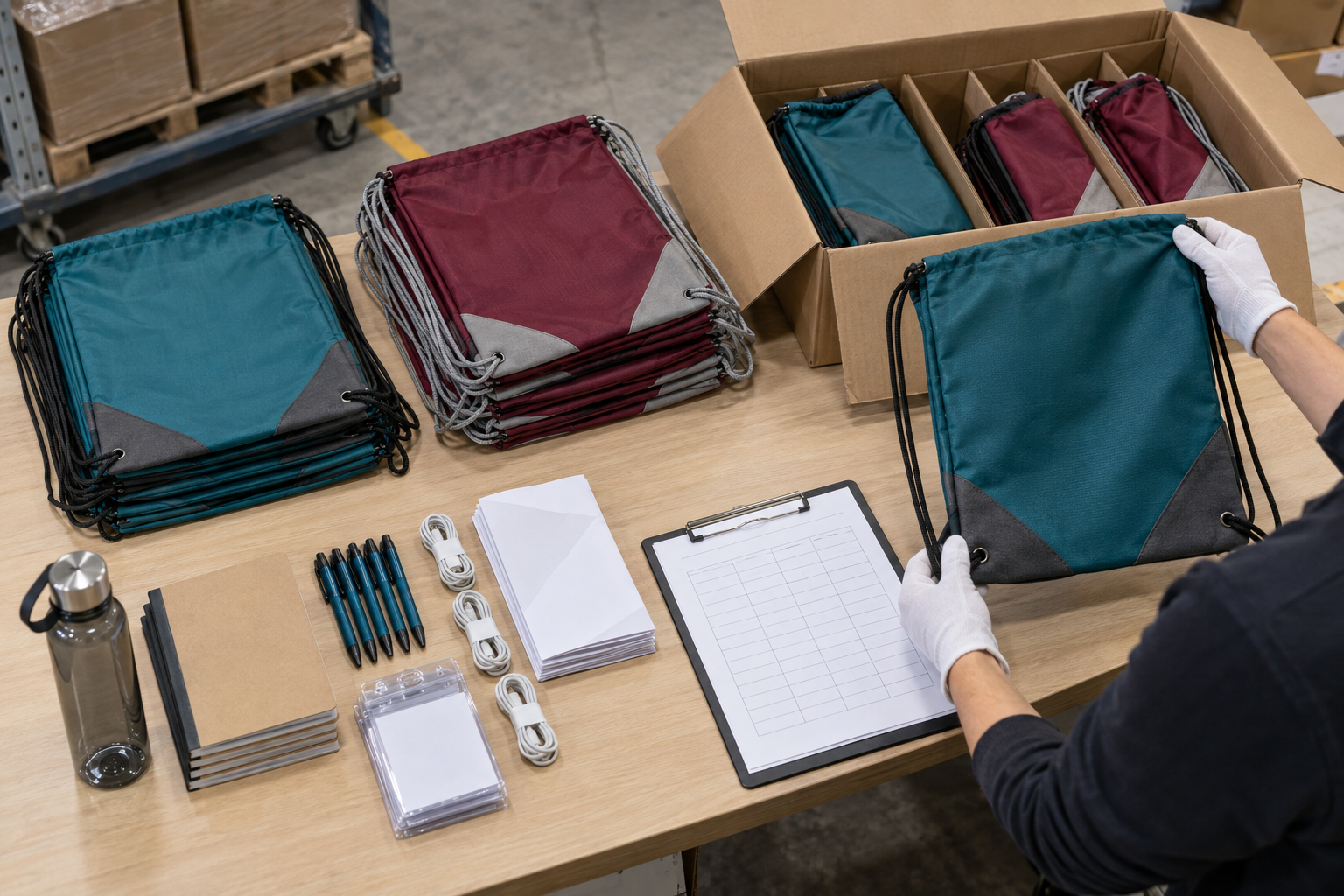
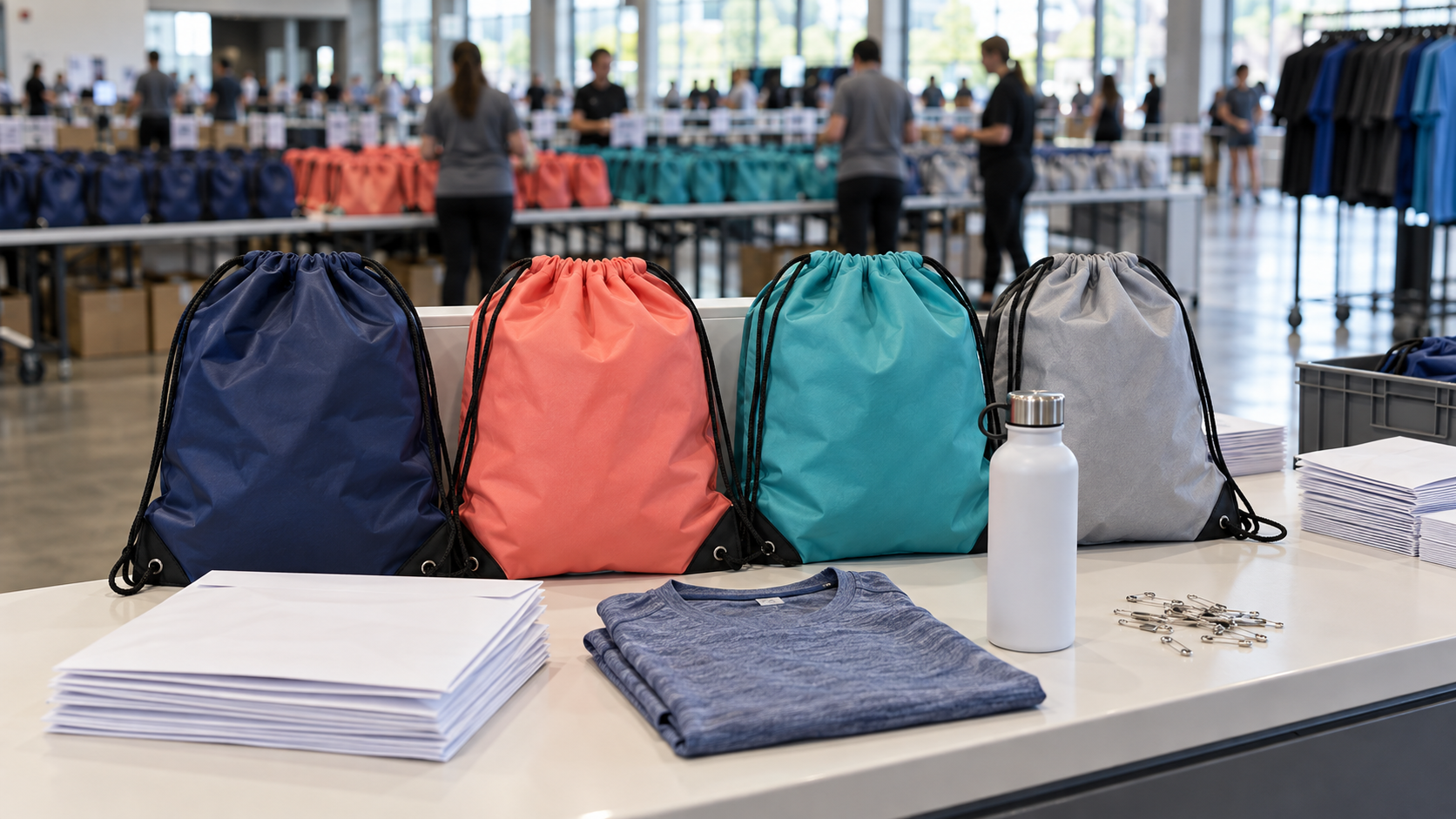
Generated editorial illustration demonstrating an unbranded packing concept. It is not an actual customer program, factory scene, or proof of production capability.
Booth replenishment plan
| Pack level | Recommended information | Purpose |
|---|---|---|
| Unit | Variant code only when necessary | Prevents wrong kit assignment |
| Inner bundle | Quantity, color/design, event day or zone | Fast replenishment without recounting |
| Carton | Show, booth, consignee, carton number, quantity | Venue routing and reconciliation |
| Master list | Carton-by-carton content and reserve allocation | Inventory control across locations |
Approve Samples With the Real Kit and Booth Team
A physical sample should represent the intended fabric, color, cord, reinforcement, print method, logo scale, pocket, and packing condition. A “similar quality” sample may answer a shape question but cannot approve the final color, hand feel, print adhesion, or carrying performance.
Ask at least one booth team member to load and carry it. Marketing may approve the artwork while event staff discover that the opening is too narrow for the demo box or that the bundles do not fit under the counter.
The Custom Drawstring Bag Sample Development Process provides a controlled sequence. A useful approval record includes photos, measurements, material reference, artwork version, color standard, component specification, loaded contents, test conditions, packing method, and authorized approver.
Test the Failure Modes That Could Disrupt the Show
Testing should reflect the agreed use. There is no single universal “trade show bag test.” A light welcome bag and a sample-carrying kit need different protocols.
| Risk | Practical check | Record |
|---|---|---|
| Bag tears with samples | Static hold and repeated lifts at agreed load | Load, duration/cycles, damage location |
| Cord pulls from corner | Pull check on lower anchor and top channel | Method, direction, result |
| Print marks clothing or peels | Cure, adhesion, rub, and abrasion checks | Substrate, ink/transfer, conditions |
| Color transfers in humidity | Dry/wet rubbing check where relevant | Method and grading |
| Zipper fails at the booth | Repeated opening and loaded-access trial | Cycles and failure description |
| Carton count is wrong | Bundle and carton reconciliation | Expected and actual quantity |
| Mixed versions reach wrong location | Variant-to-carton verification | Checked carton map |
Build the protocol with three focused references: How to Test Drawstring Bag Load Capacity for the filled bag, the Drawstring Cord Strength and Pull Test Guide for the carry system, and Drawstring Bag Print Adhesion and Abrasion Testing for decoration wear.
Test results apply to the tested construction and conditions. They should not be extended automatically to another fabric, color, coating, artwork, or future order.
Inspect Before the Freight Cutoff
Final inspection should occur when the production lot and packing are sufficiently complete to represent the shipment. The inspector needs the approved sample, specification, artwork, variant list, defect definitions, packing plan, and test instructions.
Check:
- fabric, color, dimensions, cords, corners, seams, pockets, and zippers;
- print position, scale, opacity, registration, adhesion, and visible defects;
- bag function with the agreed representative kit;
- quantities by design, color, language, or recipient tier;
- bundle and carton counts;
- shipping marks, carton condition, and event-routing information;
- corrective action and reinspection for unresolved defects.
The Custom Drawstring Bag Quality Control Checklist covers controls throughout production. How to Inspect Custom Drawstring Bags Before Shipment explains final-lot readiness, evidence, and release decisions.
Measure More Than the Number of Bags Given Away
Units distributed are an operational count, not a complete performance result. Match measures to the original objective.
Campaign measurement framework
| Measure | What it tells you | Limitation |
|---|---|---|
| Units delivered to venue | Logistics completion | Does not prove attendee use |
| Units issued | Consumption rate | Does not show recipient quality |
| Trigger completions | Engagement with demo, session, or scan | Can be inflated by incentive-only behavior |
| Qualified conversations | Relevance to target audience | Requires consistent staff qualification |
| Meetings or follow-ups | Progress after the show | Attribution may include other channels |
| Observed floor use | Immediate practical value and visibility | Observation must be sampled carefully |
| Unused/damaged stock | Forecast and quality feedback | Requires accurate end-of-show count |
| Post-show feedback | Usefulness, quality, and recall | Response bias and sample size matter |
Calculate cost at the program level: product, sampling, print setup, packing, freight, warehouse/venue charges, staff handling, and unused stock. Avoid claiming a fixed “impressions” or ROI number unless the measurement method supports it. The article Drawstring Bag Campaigns: Cost, Tracking and ROI Guide provides a deeper attribution framework.
Why Choose LUCKYSTAR for Trade Show Drawstring Bags?
LUCKYSTAR is a practical option for B2B buyers who need to turn an event plan into a controlled product and delivery brief. The work is not simply placing a logo on a stock bag. It requires alignment among the event objective, contents, construction, decoration, quantity, sampling, testing, packing, and venue deadline.
LUCKYSTAR can help coordinate
- Use-case translation: convert the attendee journey and event kit into a bag specification.
- Material and construction options: compare polyester, non-woven, cotton/canvas, mesh, recycled-material routes, gussets, pockets, cords, and reinforcement for the stated program.
- Decoration planning: review artwork, viewing distance, fabric, color, and method before sample approval.
- Sample control: connect the approved physical sample to the specification and bulk requirements.
- Order-specific quality checks: define dimensions, workmanship, load points, print, color, function, and packing evidence.
- Event-aware packing: arrange bundles and cartons for booth replenishment, location splits, or recipient tiers.
- Commercial clarity: confirm MOQ, sample cost, production timing, freight, and documentation for the actual order rather than presenting universal promises.
These points describe a coordination approach, not an unconditional guarantee. Availability, MOQ, timing, price, testing, documentation, and performance are subject to the final specification, quantity, material and component availability, target market, approved sample, and written confirmation.
RFQ Checklist for a Trade Show Bag
| RFQ section | Information to send |
|---|---|
| Event | Show name/reference, city/country, opening date, advance warehouse cutoff |
| Objective | Awareness, lead generation, workshop, appointment kit, or attendee service |
| Audience | Recipient type, estimated eligible quantity, distribution trigger |
| Contents | Full item list, largest item dimensions, representative load |
| Bag | Size/fit target, material, color, cords, reinforcement, gusset, pockets, zipper |
| Artwork | Authorized vector files, color references, position, method preference |
| Variants | Languages, regions, audience tiers, staff/VIP versions, quantity by version |
| Quality | Approved sample requirements, tests, defect limits, inspection expectations |
| Packing | Inner bundle count, carton split, booth replenishment logic, shipping marks |
| Delivery | Destination, consignee, freight term request, venue or warehouse instructions |
A complete RFQ makes quotations easier to compare. If one offer assumes a lightweight plain bag and another includes a pocket, heavier fabric, individual packing, testing, and advance-warehouse delivery, their unit prices do not represent the same scope.
Frequently Asked Questions
Are drawstring bags good trade show giveaways?
Yes, when attendees need to carry event materials and the bag is comfortable, useful, and linked to a campaign objective. They are less effective when the size is wrong, the construction cannot support the load, or distribution is uncontrolled.
What size should a promotional drawstring bag be?
Use the smallest practical bag that fits the approved event kit, closes fully, displays the artwork properly, and remains comfortable at the representative load. Verify the size with physical contents rather than relying only on a catalog description.
Which material is best for a high-volume event?
The answer depends on load, desired feel, service life, decoration, packing volume, and budget. Lightweight polyester and non-woven materials can suit high-volume light kits, while heavier polyester, cotton, or canvas may suit longer use or higher-value programs.
Should every attendee receive a bag?
Not necessarily. Universal distribution fits official registration or attendee-service programs. A lead-generation or account program may benefit from a qualified handoff after a demonstration, session, or meeting. Define the audience before forecasting quantity.
How large should the logo be?
It should be recognizable at the intended viewing distance without entering the gathering zone, seams, corner patches, pockets, or severe folds. Approve the artwork on a filled physical sample, because the usable print area changes when the bag is worn.
Can a trade show bag claim recycled content?
Only when the stated material, percentage, supply chain, order, and claim are supported by suitable current evidence. A general supplier certificate or an “RPET” product name should not be extended automatically to the finished shipment.
How should bags be shipped to a convention center?
Follow the organizer or venue manual. Confirm whether goods go to an advance warehouse or direct-to-show address, the receiving window, required labels, consignee, booth number, material-handling process, and carton limits. These details are event-specific.
How early should an exhibitor order bags?
Build a reverse timeline from the venue cutoff and include specification, artwork, sample, approval, production, inspection, freight, customs where relevant, and receiving time. The supplier should confirm the order-specific schedule in writing; there is no reliable universal lead time.
What quality tests are useful for trade show bags?
Common risk-based checks include representative load, repeated lifting, cord-anchor pull, closure cycling, seam review, print adhesion/abrasion, color transfer, zipper function, and packing reconciliation. The exact protocol should match the construction and intended use.
How can exhibitors measure whether the giveaway worked?
Start with the exhibition objective. Track distribution, the handoff trigger, qualified conversations, meetings or follow-ups, observed use, unused inventory, damage, and feedback. Do not treat the number of bags given away as proof of business impact.
Build the Bag Around the Show Plan
The strongest trade show bag program begins with a sentence: “This bag is for this audience, at this moment, to carry these items and support this measurable objective.” From there, buyers can specify material, size, cords, features, artwork, quantity, packing, delivery, testing, and evaluation with far less guesswork.
Ask LUCKYSTAR to assess the event brief against the available custom drawstring bag options. Include the event location and date, venue cutoff, recipient group, handoff rule, kit contents, variant quantities, artwork, carton plan, and requested quality or compliance records. Commercial and technical terms become binding only through the final approved specification, sample, applicable requirements, and written confirmation.

Both unbranded scenes are generated editorial illustrations used to explain exhibition and packing concepts. They do not document a customer program, a live production run, a certified product, or a named manufacturing site.