
How Durability Affects the Reuse Value of Drawstring Bags
The short answer: durability raises the reuse value of a drawstring bag only when it keeps the bag functional, comfortable, cleanable, presentable, and useful for the next occasion. A stronger fabric can help, but fabric strength alone does not create reuse. The closure must still operate, the lower anchors must hold, the seams must stay stable, the print must remain acceptable, and people must still want to carry the bag.
For buyers, the practical objective is therefore not “make the heaviest bag.” It is design the complete bag to deliver a defined job repeatedly, then verify the failure modes that could end those uses early. Added material, reinforcement, coating, hardware, or decoration has value only when it prevents a relevant failure or makes repeat use more likely.
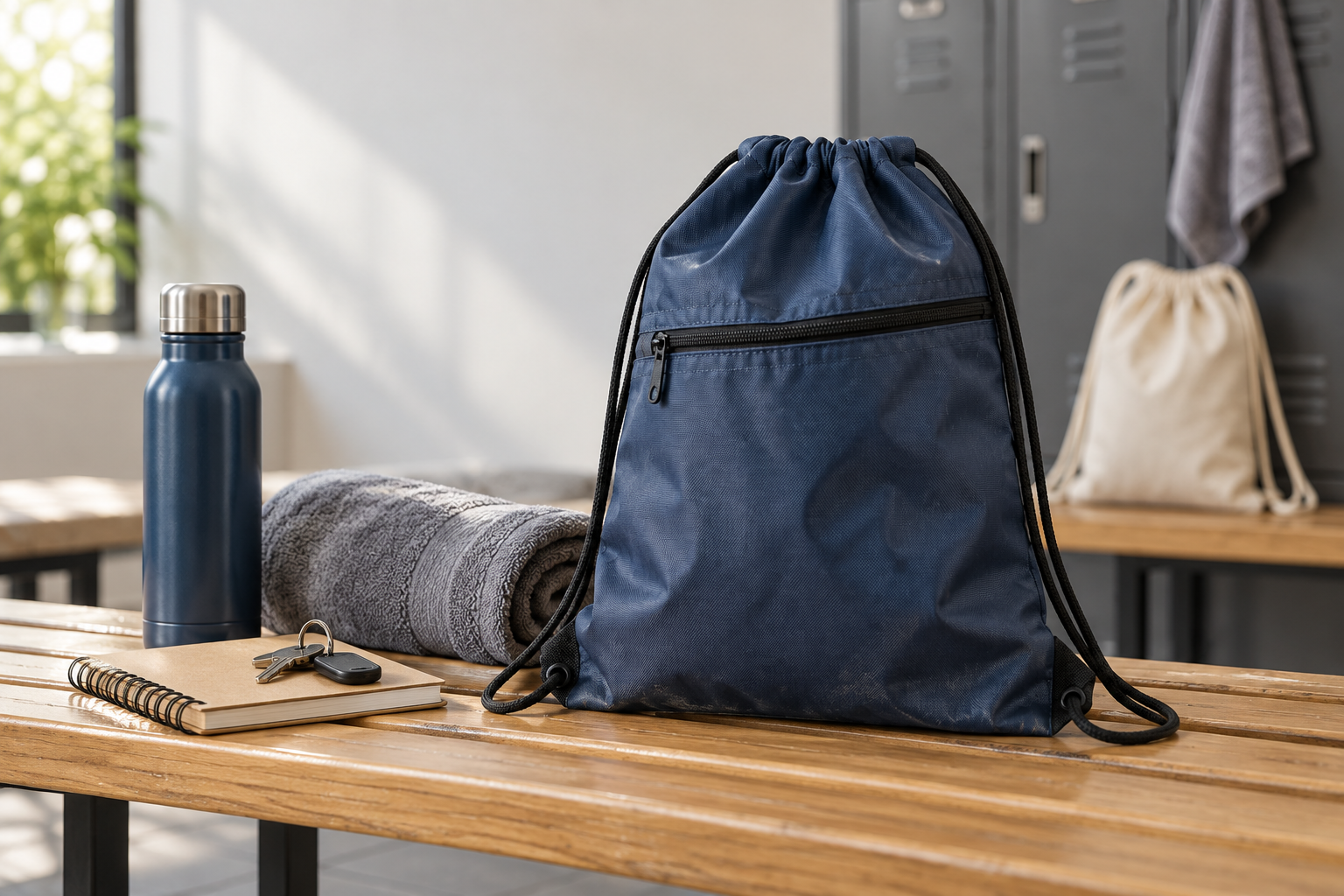
Reference-led editorial visual based on LUCKYSTAR’s public drawstring-bag formats. It is not a customer order, laboratory test, certified product, or proof of a fixed service life.
This guide helps brand, sourcing, promotional, sports, school, retail, packaging, and sustainability teams connect durability decisions to the real reuse value of custom drawstring bags. It also shows where durability evidence ends and environmental claims begin.
What Does “Reuse Value” Mean for a Drawstring Bag?
Reuse value is the practical benefit created when one bag performs useful service on more than one occasion. It can include carrying value, product-protection value, convenience, brand exposure, customer retention, and avoided replacement cost. It is not a certification and it is not automatically an environmental benefit.
A useful planning model is:
Realized reuse value = useful completed uses × value per use − burdens created by failure, cleaning, repair, storage, and replacement.
This is a management model, not a standardized life-cycle calculation. It helps teams ask the right questions before they attach a reuse number, cost-saving statement, or sustainability message to the product.
| Term | Buyer meaning | Evidence needed |
|---|---|---|
| Intended reuse | The program expects the bag to be used again | Defined use case and communication plan |
| Technical durability | The product maintains function under specified conditions | Product-specific test and inspection records |
| Realized reuse | Users actually complete repeated useful occasions | Pilot, survey, return, tracking, or other behavioral data |
| Reuse value | Repeat use creates practical or commercial benefit | Use definition, achieved uses, relevant costs and outcomes |
| Environmental benefit | A defined impact is lower than a defined alternative | Comparative life-cycle method, assumptions and data |
Durability supports realized reuse, but it cannot guarantee it. A bag that survives 100 test cycles may still be abandoned after one event if it is uncomfortable, difficult to clean, badly sized, visibly promotional, or irrelevant to later routines.
Durability Is a System, Not a Fabric Number
Drawstring bags fail at interfaces. A high-denier body can outlast the cord anchor; a strong cord can cut through a weak channel; a reinforced corner can hold while the adjacent seam opens. The finished product must therefore be considered as one load path.
| Durability layer | What must remain usable | Common early-use stopper |
|---|---|---|
| Body material | Surface, tear resistance, shape and containment | Hole, split, delamination or excessive abrasion |
| Seams | Panel connection and edge containment | Seam rupture, skipped stitches or yarn slippage |
| Drawcord channel | Smooth gathering and reopening | Fraying, puckering, cord cutting or blockage |
| Cord | Closure and, for backpack styles, carrying | Breakage, severe fuzzing, knot loss or discomfort |
| Lower anchors | Transfer of shoulder load into the body | Eyelet pull-out, patch tear or stitch failure |
| Base and gusset | Support and distribute contents | Corner wear, fold cracking or seam opening |
| Decoration | Maintain an acceptable brand presentation | Peeling, cracking, color transfer or severe fading |
| Care system | Restore a usable condition | Shrinkage, distortion, odor retention or slow drying |
The Drawstring Cord, Eyelet and Reinforcement Guide explains these interfaces in detail. For bottom architecture, see the Drawstring Bag Gusset and Bottom Construction Guide.
The Reuse Ceiling and the Reuse Floor
Durability creates a reuse ceiling: the maximum service the construction can plausibly deliver under defined conditions. User behavior creates a reuse floor: the service actually realized in the market. A successful program raises both.
Technical ceiling
The ceiling is limited by the first function-ending failure. It may be a torn anchor, uncomfortable cord, unusable zipper, distorted cotton pouch, or print that the brand considers unacceptable even though the shell remains intact.
Behavioral floor
The floor is limited by retention, convenience, relevance, care, storage, and willingness to reuse. A beautifully engineered bag has low realized value if recipients forget it, discard it, or have no second task for it.
Program implication
Do not use a laboratory cycle count as a prediction of consumer behavior. Pair technical qualification with a field pilot or post-distribution study when the claim depends on actual reuse.
Define One Useful Reuse Event
Before choosing fabric or tests, define what one completed use means. “Used again” is too vague for engineering or reporting.
| Program | One useful use could mean | What should be controlled |
|---|---|---|
| Sports team | Carry kit from home to practice and back | Typical load, travel, locker abrasion and moisture |
| School program | Carry books or activity items for one school day | Contents, age group, cord geometry and contact surfaces |
| Trade show | Carry literature and gifts for one event day | Peak load, repeated opening, crowd contact and print visibility |
| Fitness event | Hold clothing, bottle and personal items through one event | Filled shape, shoulder comfort, moisture and set-down cycles |
| Corporate gift kit | Protect and organize kit contents through delivery, then serve a secondary use | Initial pack-out plus later use scenario |
| Jewelry or beauty pouch | Protect one product during storage or travel | Surface contact, closure retention and cleanliness |
| Hotel amenity bag | Contain amenities through one stay and remain suitable for take-home reuse | Hygiene, size, care instruction and brand subtlety |
For capacity selection, use the Drawstring Bag Size and Capacity Guide. When a bag is designed for sports or events, the application-specific guides for sports teams, trade shows, and marathons and fitness events help define the real task.
Separate Functional, Cosmetic, and Claim Life
A drawstring bag can have more than one end-of-life threshold.
| Life boundary | Ends when… | Who decides? |
|---|---|---|
| Safety life | A failure could injure a user or release contents unexpectedly | Buyer risk team and applicable requirements |
| Functional life | The bag can no longer close, contain, carry, or protect as specified | Product owner and test plan |
| Comfort life | Repeated carrying becomes unacceptably painful or awkward | User study and buyer acceptance criteria |
| Cosmetic life | Staining, fading, pilling, scuffing or print wear exceeds the approved limit | Brand and quality teams |
| Campaign life | The message, event, season, or logo no longer suits later use | Marketing team |
| Claim life | Available evidence no longer supports the published wording | Legal, sustainability and product teams |
These boundaries should not be collapsed into one number. A bag may remain safe and functional after the print no longer meets a premium brand standard. Conversely, the print may look perfect while a cord anchor is close to failure.
Map the Failure That Ends Reuse First
The most efficient durability investment targets the likely first failure, not the strongest part of the bag.
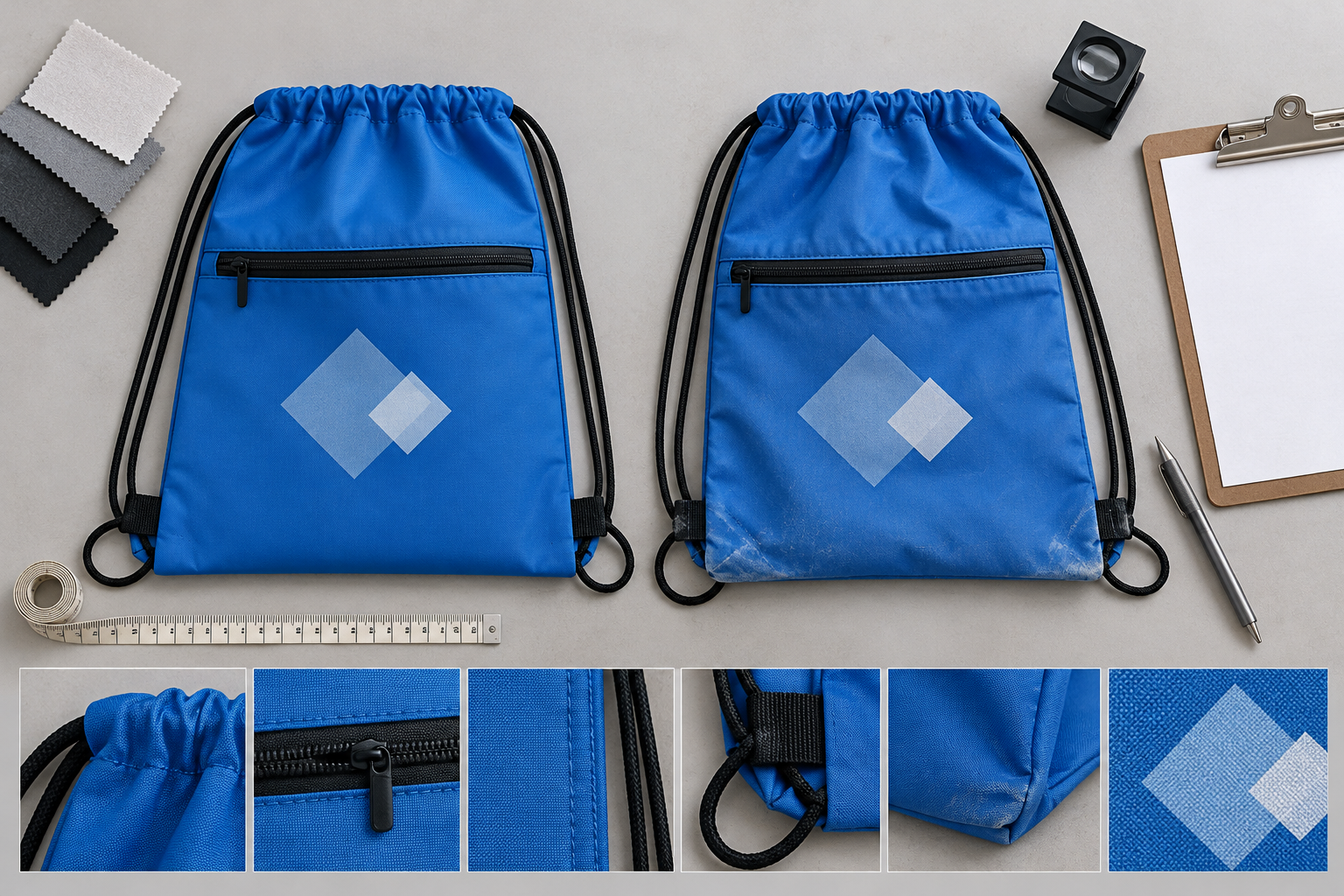
Reference-led editorial inspection scene. The image illustrates observation points only; it is not a test report, approved sample, or representation of any current LUCKYSTAR order.
| Observed problem | Likely reuse consequence | Specification or investigation direction |
|---|---|---|
| Lower eyelet loosens | Immediate concern about load security | Review hole size, edge distance, washer, patch and pull direction |
| Cord fuzzes rapidly | Lower comfort and perceived quality | Review cord structure, channel friction and contact surfaces |
| Channel stitch breaks | Closure becomes difficult or unusable | Review seam type, allowance, thread and cyclic closure loading |
| Base corners abrade | Contents may become exposed | Review filled shape, material surface and local reinforcement |
| Side seam slips | Capacity and appearance deteriorate | Review fabric construction, seam allowance and stitch density |
| Print cracks on folding | Brand value declines before bag function | Review ink/film, curing, placement and repeated flexing |
| Cotton body shrinks | Cord length, opening size and dimensions change | Define care route and finished-bag wash test |
| Bag is painful to carry | Users stop reusing it despite structural strength | Widen contact area, reduce load or change strap architecture |
| Pouch traps residue | Hygiene or odor ends reuse | Review lining, cleaning access and drying |
The How to Test Drawstring Bag Load Capacity guide explains full-bag loading. The Drawstring Cord Strength and Pull Test Guide covers component and assembly pull evidence. Neither number alone establishes use life.
Fabric Weight Helps Only When It Solves the Right Failure
GSM, denier, yarn size, weave, knit structure, coating, and finish describe different aspects. They are not interchangeable measures of durability.
Heavier can help
More material or a denser construction may improve body, opacity, puncture resistance, abrasion reserve, shape, or premium hand feel. This can be useful when the real risk is panel wear or deformation.
Heavier can hurt
Added weight can increase material input, packed volume, shipping mass, drying time, stiffness, and cost. It may also make a light promotional bag feel unnecessarily bulky without fixing the anchor or comfort problem.
Compare complete constructions
Ask suppliers to identify composition, fabric construction, weight or denier, coating, usable dimensions, cord system, seam architecture, reinforcement, decoration, and finished-bag mass. Then compare samples using the same intended-use protocol.
The Best Materials for Custom Drawstring Bags guide explains how to shortlist materials. The 210D vs 420D vs 600D Polyester Drawstring Bags comparison shows why denier alone does not determine the finished result.
Construction Choices That Extend Useful Life
Build a continuous load path
The cord, anchor, reinforcement, side seam, bottom, and fabric must transfer load without one abrupt weak interface. A reinforcement patch is useful only if its size, orientation, stitch pattern, and surrounding fabric distribute the force.
Protect high-friction zones
The base corners, cord exits, shoulder contact area, and print fold lines may see more wear than the center panel. Targeted protection can be more efficient than making every panel heavier.
Keep closure effort reasonable
A channel that closes only with excessive force will increase abrasion and reduce user willingness. Cord diameter, fabric thickness, channel width, seam bulk, and exit geometry must work together.
Avoid features without a reuse job
Every zipper, pocket, lining, patch, coating, and hardware item adds an interface. Add it when it improves the intended reuse; remove it when it adds cost and failure risk without repeat-use value. See How to Add Pockets and Zippers to Drawstring Bags.
Shoulder Comfort Is a Durability Variable
A bag can be structurally intact and behaviorally obsolete. Narrow cords can concentrate pressure, twist, roll, or cut into clothing. Excessive bag length can make the load swing. Uneven cord paths can make one side feel heavier.
| Comfort variable | Reuse risk | Possible design response |
|---|---|---|
| Narrow round cord under high load | Pressure and reduced wear time | Lower intended load, larger effective contact area or shoulder sleeve |
| Unequal cord length | Tilt and asymmetric pressure | Control routing, knot position and finished length |
| Low ride height | Swing and back contact | Adjust anchor geometry and cord length |
| Rough cord surface | Skin/clothing irritation | Review yarn, braid, finish and friction |
| Heavy hardware | Local impact and noise | Simplify or relocate components |
| Poor ventilation | Heat and moisture discomfort | Review back contact, material and load expectations |
For a dedicated wear-test framework, read How to Improve Drawstring Bag Shoulder Comfort. Comfort acceptance should be tied to an intended load and user group, not presented as universal.
Decoration Must Last Long Enough for the Product
If the logo fails first, the brand may consider the whole product to have failed. The decoration system should be selected with the substrate, flex zones, care route, color, coverage, and reuse target.
| Decoration issue | Why it reduces reuse value | Approval direction |
|---|---|---|
| Heat-transfer edge lift | Looks damaged and can catch during use | Flex, adhesion and abrasion checks on production-intent material |
| Screen-print cracking | Brand becomes unreadable | Review ink, cure, film thickness and fold placement |
| Wet color transfer | Stains clothing or contents | Dry/wet rubbing evaluation as relevant |
| Embroidery puckering | Distorts the panel and closure | Stabilizer, density, placement and filled-shape review |
| Foil scuffing | Premium effect degrades quickly | Define intended handling and acceptable patina |
| Oversized print over fold | Repeated flexing accelerates wear | Reposition artwork or use a compatible process |
Use Custom Drawstring Bag Printing Methods to choose a process, then apply the Drawstring Bag Print Adhesion and Abrasion Testing guide to the exact material/ink/film system.
Cleaning Can Preserve or Destroy Reuse Value
Cleaning extends useful life only when the construction tolerates the stated procedure. A “washable” direction must cover the finished bag, not just a fabric swatch.
Define the real care route
Some bags need only surface wiping. Others may need hand washing or a specified domestic wash and drying procedure. The correct route depends on fiber, coating, lining, hardware, decoration, intended contents, and hygiene expectations.
Drying matters
Incomplete drying can create odor, staining, distortion, or mold risk. Deep gussets, linings, padded areas, and layered anchors may dry differently from a flat single-layer pouch.
Test after care
After the agreed exposure, inspect dimensions, seam shape, cord action, hardware, print, color transfer, odor, hand feel, and residual function. For cotton constructions, use Cotton Drawstring Bag Shrinkage and Washing Tests.
Build a Use-Sequence Test, Not One Hero Test
There is no universal cycle count or minimum load that fits every drawstring bag. A defensible qualification sequence reproduces the important parts of the real job.
| Stage | Example activity | What it reveals |
|---|---|---|
| Baseline | Measure, photograph and operate closure | Initial condition and specimen identity |
| Pack | Load representative contents in a controlled arrangement | Shape, capacity and local stress |
| Lift | Lift using the intended cord/strap path | Anchor, cord and seam response |
| Carry | Walk or cycle through an agreed movement sequence | Dynamic loading, comfort and swing |
| Set down | Place on representative surfaces | Base and corner abrasion |
| Open/close | Operate the closure consistently | Channel friction, cord wear and usability |
| Store | Fold or hang as expected | Creasing, coating and print response |
| Care | Apply the defined cleaning/drying route where relevant | Dimensional and appearance stability |
| Residual check | Repeat measurements and functional tests | Remaining service capability |
The detailed selection framework is in Which Tests Should Custom Drawstring Bags Pass?. Published textile methods such as ISO 13935 for seam maximum force, ISO 12947 for fabric abrasion, and ISO 6330 for domestic washing procedures can support selected component questions within their stated scope. They do not automatically reproduce a finished bag’s complete service life.
Record Damage Progression, Not Only Final Failure
A single “pass” hides how the bag aged. Record observations at planned checkpoints so designers can identify the first accelerating defect.
| Checkpoint record | Example fields |
|---|---|
| Specimen identity | Sample stage, color, size, fabric lot, cord lot and decoration method |
| Exposure completed | Load, cycle count, carry route, surface, care method and conditions |
| Functional result | Closure, containment, carry, pocket/zipper and residual load function |
| Measured change | Dimensions, mass where relevant, cord length, seam opening or other defined metric |
| Visual change | Abrasion, pilling, fuzzing, cracking, fading, transfer and deformation |
| Failure mode | Cord, anchor, seam, shell, base, print, hardware or comfort |
| Severity | Monitor, repairable, functional failure, safety-critical or brand-limit failure |
| Evidence | Dated photographs, raw readings, operator and instrument/method reference |
This approach distinguishes a bag that remains stable for many cycles from one that deteriorates steadily but happens not to break before the last checkpoint.
Do Not Convert Test Cycles Directly Into Consumer Uses
A controlled cycle is a repeatable exposure. A consumer use is a varied real-world event. They are related, but they are not identical.
Why the conversion is risky
Real users change load, fill shape, route, speed, weather, care, storage, and handling. A laboratory or internal fixture may repeat one motion precisely without reproducing every stress.
Better reporting
State that the tested specimens completed a named sequence under stated conditions. If the brand wants to say “designed for repeated use,” connect that statement to the intended use and verified construction. If it wants to state an actual number of uses achieved by customers, collect behavioral evidence.
Field pilots complement tests
A pilot can reveal whether recipients keep the bag, understand its care, find it comfortable, and use it for a second task. It should not replace controlled testing, because field conditions and reporting are variable.
Calculate Cost per Realized Use Carefully
Cost per use is useful only when the denominator reflects real useful occasions.
Product cost per realized use = landed program cost ÷ total useful uses actually achieved.
For planning, teams may model scenarios rather than promise an outcome.
| Illustrative scenario | Landed unit cost | Realized useful uses | Product cost per use |
|---|---|---|---|
| Lightweight event bag used twice | US$1.20 | 2 | US$0.60 |
| Reinforced bag used 12 times | US$2.40 | 12 | US$0.20 |
| Premium bag used 30 times | US$5.10 | 30 | US$0.17 |
| Overbuilt bag abandoned after one event | US$4.00 | 1 | US$4.00 |
These figures are examples only, not LUCKYSTAR prices or performance promises. Real calculations should include sampling, decoration, packaging, freight, duties, failure/replacement, storage, cleaning, collection, and program administration where material.
Avoid Overengineering
More durability is not always more value. Overengineering can increase material use and cost without changing actual reuse.
| Overengineering signal | Why it may be inefficient | Better question |
|---|---|---|
| 600D requested for a light jewelry pouch | Strength exceeds the protection task | What surface, closure and presentation properties end use first? |
| Multiple patches around every seam | Adds bulk and sewing operations | Which interfaces carry the real load? |
| Metal eyelets added for appearance | May add weight and a pull-out mode | Can a sewn channel or fabric loop perform the task? |
| Full lining added to a simple event bag | Adds material and cleaning complexity | Does the lining protect contents or improve reuse? |
| Heavy coating added without moisture need | Adds stiffness and material complexity | What exact water or stain exposure must be managed? |
| Huge permanent campaign graphic | May discourage post-event reuse | Can branding remain effective but more versatile? |
A better design allocates strength to the load path and desirability to the user journey.
Durability and Environmental Performance Are Related but Not Equal
The European Environment Agency identifies longevity and durability as a pathway that can enable longer textile use and reuse. UNEP’s life-cycle work also emphasizes reuse and keeping resources at higher value, while warning that alternatives have different impacts across their life cycles. Neither source provides a universal rule that a durable drawstring bag is automatically environmentally preferable.
A heavier or more complex bag may carry a higher production burden. It needs enough additional realized use to justify that change under the chosen life-cycle boundary and impact category. The result depends on the comparison item, material, energy, mass, logistics, cleaning, loss rate, and end-of-life assumptions.
| Claim | Durability evidence can support | Additional evidence still needed |
|---|---|---|
| “Designed for repeated use” | Defined construction and relevant use-sequence results | Clear intended conditions and no broader environmental implication |
| “Completed 50 internal test cycles” | Test records for identified specimens | Method, load, acceptance criteria and limitation; no direct user-use equivalence |
| “Lasts longer than our previous bag” | Comparable testing of both defined products | Fair baseline, same method, sample plan and claim wording |
| “Lower cost per use” | Durability plus reliable achieved-use data | Complete cost boundary and actual denominator |
| “Lower environmental impact” | Durability may support use-life input | Comparative LCA or qualified method for the named impact and baseline |
| “Sustainable” | Durability alone is insufficient | Specific substantiated attributes and market/legal review |
For claim governance, read How to Make Defensible Sustainability Claims for Drawstring Bags. For end-of-life distinctions, see Are Drawstring Bags Recyclable?.
Design for Reuse Desirability
Technical durability cannot compensate for a design nobody wants to keep.
Make the bag relevant after the campaign
Choose capacity, color, closure, graphic scale, and pockets around a credible second use. A trade-show bag might become a gym organizer; a gift-kit pouch might become travel storage; a dust bag might continue protecting shoes or handbags.
Keep branding proportionate
Large event dates or one-time messages can limit later use. Consider a durable brand mark with temporary information on a removable card, label, or outer pack where the program permits.
Include honest care guidance
Tell users how to empty, clean, dry, store, and retire the bag. Do not issue a wash instruction unless the complete bag has been assessed for it.
Reduce friction in daily use
An opening that gathers smoothly, a cord length that suits the carry mode, and a base that accommodates common contents may create more reuse than a material upgrade alone.
Add Durability Requirements to the Tech Pack
Use the How to Prepare a Custom Drawstring Bag Tech Pack guide, then add a controlled use-life section.
| Tech-pack field | What to specify |
|---|---|
| Intended reuse event | Contents, load, route, duration, environment and storage |
| Reuse target | Development target, not a consumer promise unless separately validated |
| Life boundaries | Functional, cosmetic, comfort and safety limits |
| Material | Composition, construction, weight/denier, finish, coating and color |
| Load path | Cord, channel, anchor, reinforcement, seams, base and gusset |
| Comfort | Carry mode, intended load, cord contact area and fit range |
| Decoration | Method, area, color reference, flex zones and durability criteria |
| Care | Permitted method, drying and post-care requirements |
| Test sequence | Specimen stage, conditioning, steps, checkpoints and report fields |
| Acceptance | Pass/monitor/fail rules and failure classification |
| Change control | Material, supplier, pattern, cord, thread, print, hardware and process triggers |
The approved sample, bill of materials, tech pack, artwork proof, color standard, and test report should identify the same version.
Connect Sample Development to Durability Evidence
Concept sample
Use it to compare size, opening, carry mode, graphic scale, and intended second-use relevance. Do not treat it as production evidence.
Construction sample
Use production-intent material, seams, cord, anchors, and decoration to investigate likely failure modes. Record every change.
Pre-production sample
Freeze the build that bulk production must match. Run the agreed qualification sequence on traceable specimens.
First production article
Confirm that bulk input and process match the approved version. Recheck critical functions before the main run continues.
The Custom Drawstring Bag Sample Development Process provides the broader approval framework.
Carry Durability Into Bulk Quality Control
Qualification asks whether the design can meet the intended use. Production control asks whether the order continues to match that design.
| Production stage | Reuse-value control |
|---|---|
| Incoming material | Composition/reference, weight or construction, color, surface and lot identity |
| Cutting | Grain/orientation, panel dimensions, print position and defect avoidance |
| First article | Complete closure, seams, anchors, base, dimensions, print and pack-out |
| In-process | Stitch formation, seam allowance, reinforcement placement, cord routing and hardware setting |
| Finished product | Function, workmanship, measurements, color/branding and defined sampling tests |
| Packing | Cord arrangement, fold pressure, moisture control, carton loading and recovery after unpacking |
| Reorder | Approved-version match and review of any input/process change |
Use the Custom Drawstring Bag Quality Control Checklist and How to Inspect Custom Drawstring Bags Before Shipment to turn those controls into records. A final visual inspection cannot substitute for qualification tests that require conditioning, cycling, instruments, or laboratory methods.
Reorders Need Durability Change Control
A reorder with the same appearance can perform differently if a hidden input changes.
| Change | Potential effect on reuse | Required review |
|---|---|---|
| Fabric lot or supplier | Tear, abrasion, shade, hand or coating behavior | Incoming comparison and risk-based retest |
| Cord construction or diameter | Strength, comfort, closure force and channel wear | Cord and assembly checks |
| Thread or needle | Seam strength, puckering or hole damage | Sewing trial and seam review |
| Eyelet/washer | Pull-out resistance, sharpness and corrosion behavior | Setting and pull-direction review |
| Ink, film or curing | Adhesion, flexibility, color and abrasion | Decoration validation |
| Pattern or seam allowance | Capacity, load path and slippage risk | Measurement and assembled-bag tests |
| Packing count/fold | Creasing, print blocking and deformation | Carton and recovery trial |
Do not rely on a historical certificate, old platform listing, or previous sample when the tested construction no longer matches the order.
How LUCKYSTAR Supports Reuse-Focused Development
LUCKYSTAR can help buyers translate the intended use into a quote-ready product specification instead of selecting a bag from one photo or one material label. Subject to the exact project and written confirmation, support can include:
- comparison of cotton, canvas, polyester, nylon, RPET, non-woven, mesh, velvet-look, microfiber, and other material routes;
- development of bag size, gusset, cord path, channel, lower anchor, eyelet or sewn reinforcement, pockets, zippers, lining, and packaging;
- coordination of artwork, screen printing, heat transfer, sublimation, embroidery, and other decoration options for the selected substrate;
- physical sampling and approval checkpoints before bulk release;
- buyer-defined load, cord, seam, abrasion, color, print, washing, and use-sequence requirements where relevant;
- QC checkpoints linked to an approved sample and controlled specification;
- change review for repeat orders and multi-color programs;
- evidence-aware wording that separates product performance from certification and environmental claims.
LUCKYSTAR does not treat a material name, fabric weight, platform description, one sample, historical certificate, or one passing test as a universal guarantee of lifetime, sustainability, recyclability, fixed load, MOQ, price, or delivery. These points remain subject to the exact product, test scope, order, market, and written confirmation.
For broader supplier due diligence, read the Custom Bag Manufacturer Guide and How to Choose a Custom Drawstring Bag Manufacturer.
Reuse-Focused RFQ Checklist
| RFQ section | Buyer should provide | Supplier should confirm |
|---|---|---|
| Use case | Contents, normal/peak load, carry route, frequency and environment | Recommended construction and trade-offs |
| Reuse target | Planning target and how one use is defined | Which design risks can be evaluated |
| Size | Finished dimensions, gusset, tolerance and filled shape | Measurement method and usable capacity |
| Material | Composition, weight/denier, finish, color and coating | Available options and evidence boundary |
| Construction | Seam, channel, cord, anchors, base, pockets and zippers | Sample build and critical controls |
| Comfort | User group, clothing, duration and expected load | Cord geometry and wear-test proposal |
| Decoration | Artwork, placement, color and expected appearance life | Compatible method and validation route |
| Care | Wipe, hand wash, domestic wash, drying and hygiene needs | Finished-bag test implications |
| Testing | Sequence, load, cycles, specimens and acceptance criteria | Feasibility, method, lab/inspection role and records |
| Claims | Proposed durability, reuse or environmental wording | Evidence available and evidence still required |
| Commercial | Quantity by variant, pack, destination and in-hand date | MOQ, price, production time and logistics assumptions in writing |
Buyer Decision Scorecard
Score each candidate against the same use case. Do not hide a critical failure behind an average.
| Criterion | Weight example | Candidate A | Candidate B | Evidence reference |
|---|---|---|---|---|
| Functional durability | 25% | Use-sequence report | ||
| Cord/anchor reliability | 15% | Pull/cycle record | ||
| Comfort at intended load | 15% | Wear trial | ||
| Cleaning and recovery | 10% | Care test | ||
| Decoration durability | 10% | Adhesion/abrasion record | ||
| Secondary-use relevance | 10% | User pilot | ||
| Finished mass and packing | 5% | Product/carton record | ||
| Cost per modeled use | 5% | Scenario calculation | ||
| Evidence and change control | 5% | Technical file |
Set a non-negotiable minimum for safety and core function before applying weighted totals.
Frequently Asked Questions
Does a heavier drawstring bag always have greater reuse value?
No. Greater weight may improve some panel properties, but it can also add cost, bulk, drying time, stiffness, and production impact. Reuse value rises only if the added construction prevents a relevant early failure or makes the bag more useful.
What usually fails first on a drawstring backpack?
There is no universal first failure. Common risks include lower cord anchors, cord wear, drawcord-channel seams, side seams, base corners, print flex zones, and user comfort. A risk review should identify the likely failure for the exact construction and use.
Can a load test prove how many times the bag can be reused?
No. A load test answers a defined load question under stated conditions. Reuse also depends on dynamic handling, closure cycles, abrasion, cleaning, comfort, appearance, storage, and user behavior.
How many durability cycles should a drawstring bag pass?
There is no single number for every bag. Define one use event, select a program target, identify failure modes, and agree on a representative sequence and acceptance criteria before testing.
Is 600D polyester always more durable than 210D?
No. Denier refers to yarn linear density, not complete bag performance. Fabric construction, yarn type, coating, seam design, anchors, cord, workmanship, and test conditions all affect the result.
Does recycled polyester reduce durability?
The label “RPET” does not determine finished-bag durability. Evaluate the specific yarn/fabric construction, coating, seams, cords, anchors, decoration, and assembled product. Recycled-content evidence and performance evidence are separate files.
Should a reusable drawstring bag be washable?
Only if washing is relevant and the complete bag can tolerate the stated procedure. Some products are better suited to wiping or spot cleaning. Test the exact bag, including print, cord, lining, hardware, and drying.
Can a strong bag still have low reuse value?
Yes. Poor size, uncomfortable cords, difficult closure, strong event-specific graphics, odor retention, inconvenient storage, or lack of a second use can all reduce realized reuse.
How should brands describe durability without overclaiming?
Describe the intended use, construction, test method, conditions, and result. Avoid translating test cycles into guaranteed consumer uses or broad environmental benefits unless the additional evidence supports that interpretation.
Does repairability matter for a low-cost drawstring bag?
Sometimes. Simple, accessible seams or replaceable cords may extend service, but a repair feature has value only if users can and will use it. Preventing likely failures is often more effective than adding complex repair architecture.
When should durability testing be repeated?
Review and retest when material, supplier, fabric lot, cord, thread, hardware, pattern, seam, decoration, process, packing, or intended use changes. Use a risk-based plan for reorders.
Can LUCKYSTAR guarantee a fixed lifetime for every drawstring bag?
Not from a category name or image. A meaningful commitment requires an exact specification, production-intent samples, agreed methods, conditions, acceptance criteria, and written order-level confirmation.
Request a Reuse-Focused Drawstring Bag Review
Send LUCKYSTAR the bag’s contents, normal and peak load, dimensions, material preference, carry route, reuse target, user group, cord and anchor design, pockets or zippers, decoration, care method, quantities, destination, test requirements, proposed claims, packing, and in-hand date. We can help convert those inputs into a sample and order-specific specification while identifying where laboratory, certification, legal, or behavioral evidence is still required.

Explore custom drawstring bag options or contact LUCKYSTAR for a specification-based quotation. Material, durability, testing, sustainability, commercial, and delivery statements remain subject to current evidence and written confirmation.
Official Sources and Evidence Boundary
- Regulation (EU) 2024/1781, Ecodesign for Sustainable Products Regulation, including its definition of durability as maintaining function and performance over time under specified use, maintenance, and repair conditions, and its emphasis on reliable, accurate, reproducible verification. Accessed October 8, 2026.
- European Environment Agency, Textiles and the Environment: The Role of Design in Europe’s Circular Economy, identifying longevity and durability as a pathway that enables longer use and reuse. Accessed October 8, 2026.
- United Nations Environment Programme, Single-Use Plastic Bags and Their Alternatives: Recommendations from Life Cycle Assessments, explaining why alternatives must be evaluated from a life-cycle perspective rather than by material name alone. Accessed October 8, 2026.
- ISO 13935-1:2014, a published method for determining the maximum force to seam rupture using the strip method within its stated scope. Accessed October 8, 2026.
- ISO 12947-1:1998, covering Martindale abrasion-testing apparatus for the fabric methods in the series. Accessed October 8, 2026.
- ISO 6330:2021, specifying domestic washing and drying procedures for textile testing. Accessed October 8, 2026.
These sources provide definitions, policy context, life-cycle guidance, and method scope. They do not set one mandatory lifetime, load, cycle count, or environmental outcome for every drawstring bag. Buyers must define the exact product, market, use, care, test, comparison, and claim. This article is educational and does not replace laboratory advice, certification, legal review, or order-specific approval.





