
Are Drawstring Bags Recyclable?
The short answer: some drawstring bags can be recycled through a suitable textile, plastics, or brand take-back program, but a drawstring bag should not be called recyclable merely because its main fabric is cotton, polyester, nylon, or polypropylene. The complete bag must be accepted by a real collection and processing system, and its cords, coatings, zippers, eyelets, labels, prints, linings, and mixed fibers must not prevent that route.
For most buyers, the practical question is therefore not “Is this material recyclable in theory?” It is: Can the finished bag, in the condition consumers will discard it, be collected, sorted, processed, and used again in the markets where it is sold? If the answer depends on a specialist program, location, component removal, or clean-and-dry condition, the marketing claim and disposal instruction should say so clearly.
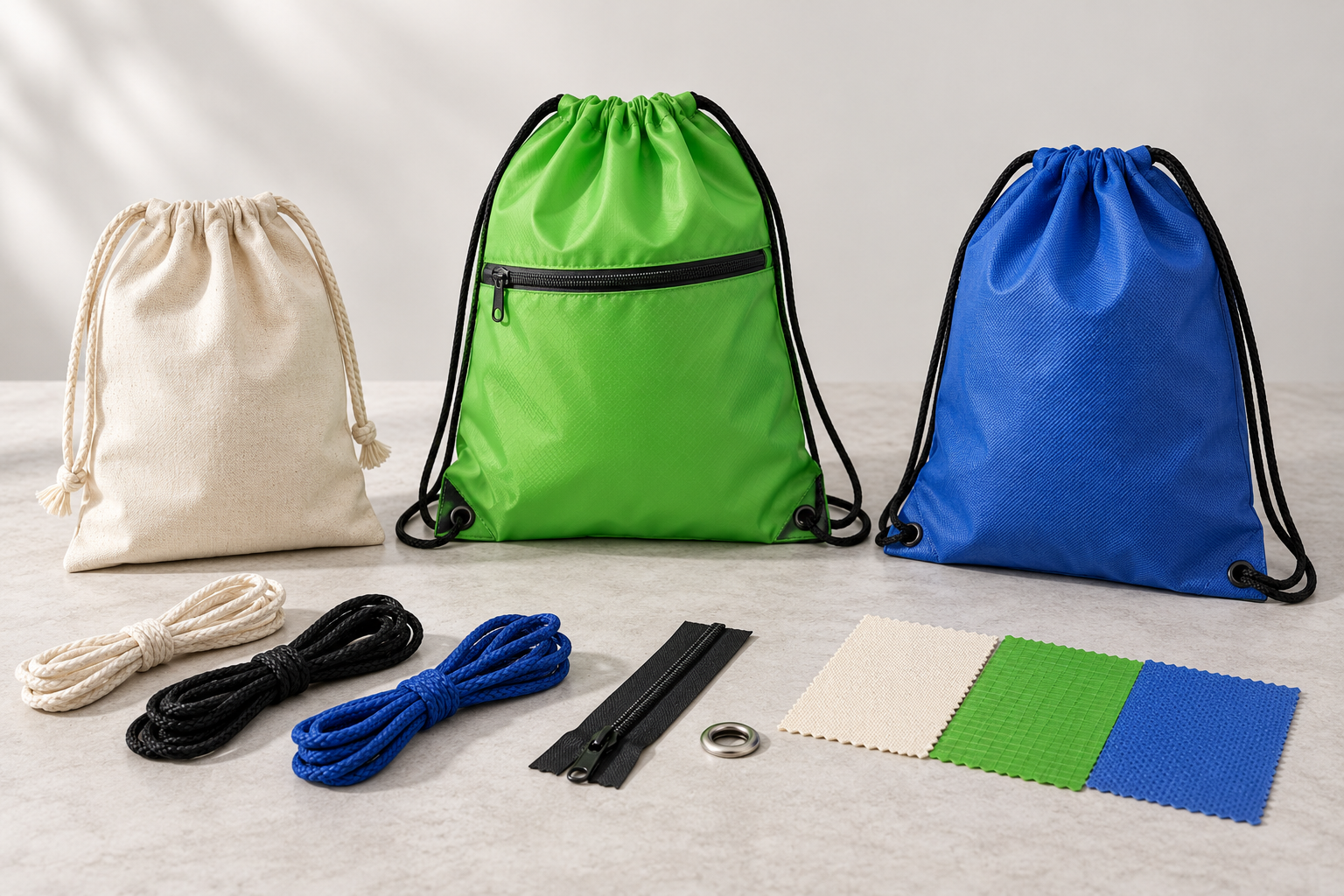
Reference-led editorial product visual based on LUCKYSTAR's public drawstring-bag formats. It is not a customer order, recycling test, certification, or proof that every illustrated construction is recyclable.
This guide helps brand, retail, promotional, packaging, sourcing, and sustainability teams evaluate the recyclability of custom drawstring bags. It covers material families, mixed components, design for disassembly, local infrastructure, claim wording, supplier evidence, quality control, and realistic end-of-life instructions.
Quick Decision Table: Is a Drawstring Bag Recyclable?
Use this table as an initial screen, not as a claim approval.
| Question | A stronger “yes” signal | A warning signal |
|---|---|---|
| Is the full material composition known? | Fiber and accessory composition are documented | “Polyester-like,” “canvas,” or “eco fabric” without composition |
| Is the construction mostly one compatible material family? | Shell, cord, thread and label use a compatible polymer or fiber route | Cotton shell, polyester cord, PU coating, metal eyelets and PVC patch |
| Can non-compatible parts be removed? | Cord, zipper pull, insert or hardware can be removed without destroying the shell | Bonded laminate, encapsulated hardware or fused mixed layers |
| Is there a real collection route? | Named textile collection, take-back, or specialist processor accepts this item | The claim relies only on theoretical technical recyclability |
| Is the bag clean enough to enter that route? | Dry, empty and free from product residue | Oil, cosmetics, chemicals, food, mold or heavy contamination |
| Is the item large and identifiable enough for sorting? | Complete textile bag with clear composition information | Tiny cut pieces, loose cords or ambiguous composite scraps |
| Is the disposal instruction market-specific? | Local acceptance and preparation steps are stated | A universal recycling symbol is used in every market |
| Does evidence cover the finished construction? | Approved bill of materials and processor acceptance align | Evidence covers only the base fabric or recycled content |
The answer can vary by destination. The U.S. Environmental Protection Agency lists textiles as a municipal-recycling category commonly collected at transfer stations or retail bins and tells users to confirm local curbside or drop-off acceptance. That is different from saying every textile bag belongs in a household recycling bin.
“Made From Recyclable Material” Is Not the Same as “Recyclable Product”
Four statements are often confused:
| Statement | What it actually addresses | What it does not prove |
|---|---|---|
| “Made with recycled content” | Inputs came from qualified recovered material at a stated percentage and boundary | The finished bag can be recycled again |
| “The fabric is recyclable” | The fiber or polymer may be technically reprocessable under suitable conditions | A program accepts the finished bag with all accessories |
| “The bag is reusable” | The construction is intended and sufficiently durable for repeated use under defined conditions | A recycling outlet exists at end of life |
| “The bag is recyclable” | The finished item can enter an established collection and recycling route | That it is recycled in practice, has recycled content, or has low overall impact |
A polyester shell made with recycled PET can still be difficult to recycle if it carries a polyurethane coating, bonded foam, metal hardware, an incompatible zipper, a PVC patch, and an unidentified mixed-fiber cord. Conversely, a bag made from virgin material might be accepted by a specialized mono-material recovery program. Keep recycled content, recyclability, reuse, and environmental performance as separate claims.
For the wider claim-approval framework, read How to Make Defensible Sustainability Claims for Drawstring Bags. Buyers comparing use-life and end-of-life strategies can also use Recyclable vs Reusable Shopping Bags: What Brands Should Know while keeping this article's drawstring-specific component analysis separate.
For chain-of-custody questions, use the RPET Drawstring Bags certification and sourcing checklist. The broader recycled-content verification guide explains percentage and transaction evidence. Neither article should be treated as proof that a finished drawstring bag is locally recyclable.
A Finished Drawstring Bag Is a Component System
Buyers often evaluate only the largest material by weight. Recyclers must handle the whole construction.
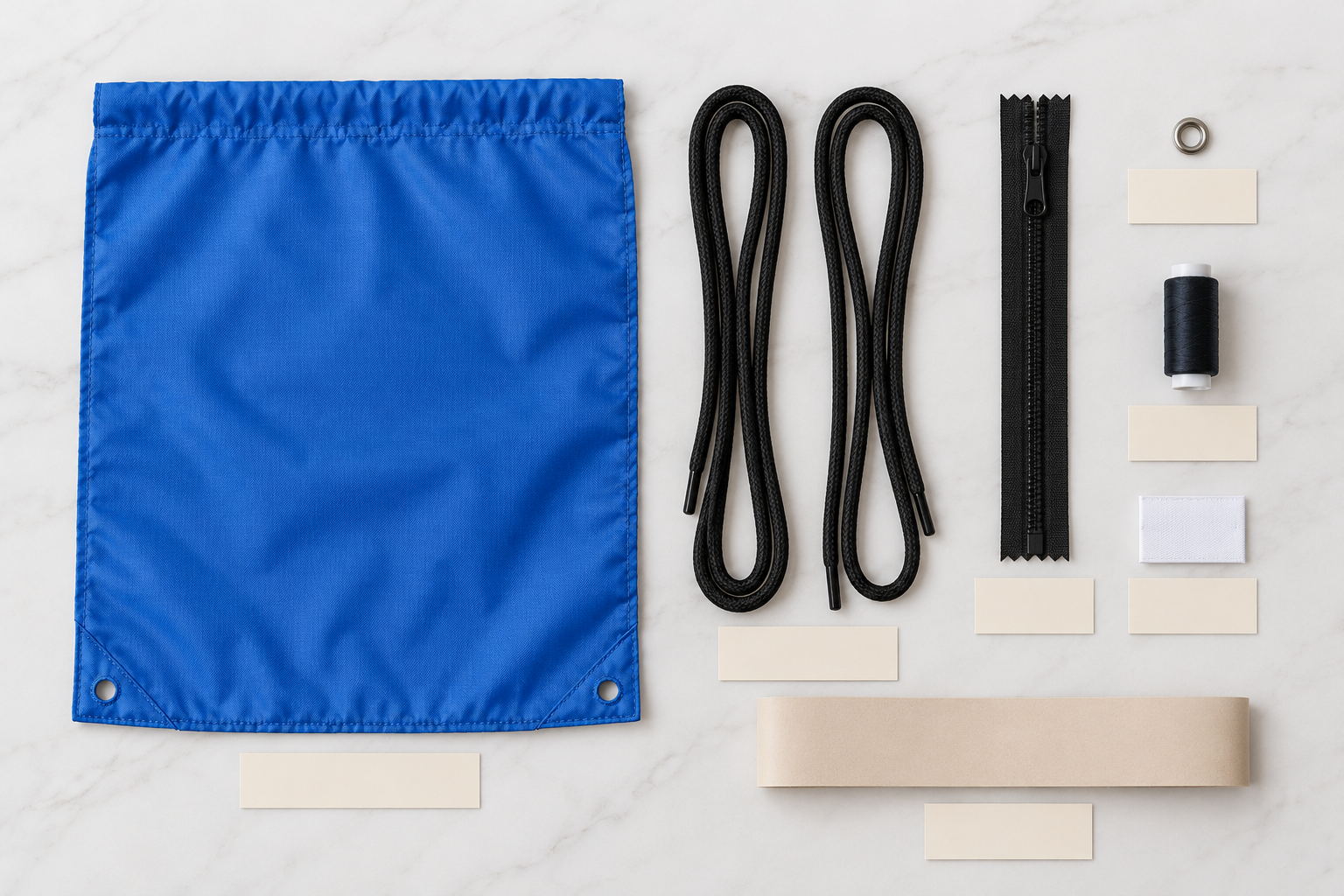
Reference-led technical product visual. The separated components illustrate an audit method; their appearance does not establish composition, compatibility, local acceptance, or recycling performance.
| Component | Common possibilities | Recyclability question |
|---|---|---|
| Main shell | Cotton, canvas, polyester, nylon, non-woven PP, mesh, velvet-look fabric | What is the verified composition, blend ratio, coating and finish? |
| Drawcord | Cotton, polyester, nylon, PP, mixed core-and-sheath cord | Is it compatible with the shell route or readily removable? |
| Thread | Polyester, cotton, nylon | Is it a minor incidental part, or does it interfere with the intended process? |
| Eyelet | Steel, brass, aluminum, plated alloy, molded plastic | Must it be removed, and can the processor separate it? |
| Zipper | Polyester or nylon coil, textile tape, metal or molded teeth, metal/plastic slider | Does the entire zipper need removal? |
| Corner reinforcement | Extra shell fabric, PVC, PU, synthetic leather, multilayer patch | Does it introduce an incompatible bonded layer? |
| Lining | Same-fiber textile, mixed textile, coated fabric, foam-backed fabric | Is it separable and accepted with the outer shell? |
| Same or different textile; zipper or hook-and-loop closure | Does it change the material family or sorting route? | |
| Decoration | Ink, heat-transfer film, embroidery, foil, rubber patch, woven label | Does the chosen processor allow it at the applied coverage? |
| Packaging | Paper band, polybag, carton, label | Must be claimed and disposed of separately from the bag |
The Drawstring Cord, Eyelet and Reinforcement Guide and How to Add Pockets and Zippers to Drawstring Bags can help buyers define these parts before recyclability language is approved.
Recyclability by Drawstring Bag Material
Material determines the possible technical routes, but not automatic market acceptance.
Cotton and cotton canvas
Cotton textiles may be suitable for reuse, wiping, insulation, mechanical fiber recovery, or other textile-recycling routes depending on condition and local infrastructure. “Canvas” describes a fabric construction, not a guaranteed fiber composition. A canvas bag may be cotton, polyester, a blend, or a coated construction.
Cotton bags become harder to route when they include polyester cords, synthetic thread, metal eyelets, heavy plastisol print, bonded lining, or oil and cosmetic contamination. Natural color also does not prove organic origin, lower impact, biodegradability, compostability, or recyclability.
See Cotton vs Canvas Drawstring Bags for specification differences.
Polyester and RPET
Polyester fabric can be technically reprocessed in suitable systems, but textile-to-textile recycling access remains limited and sorting depends on fiber identification, color, additives, coatings, and construction. RPET states a recycled-input claim when properly evidenced; it does not automatically create an end-of-life recycling route.
A mostly polyester bag is a stronger design direction when the shell, cord, sewing thread, zipper tape, label, and reinforcement are compatible polyester components and any metal parts are removable. Even then, the brand should confirm that its target collection or take-back program accepts the exact item.
Nylon
Nylon can be recycled through specialized routes, particularly where a clean, known nylon stream exists. A generic municipal textile bin may not guarantee nylon-to-nylon recycling. Nylon bags also commonly use polyester cords, PU coatings, metal eyelets, and mixed zippers, which can change the processing route.
The Polyester vs Nylon Drawstring Bags guide explains performance differences. It should not be interpreted as a universal end-of-life ranking.
Non-woven polypropylene
Polypropylene is a recyclable polymer in suitable systems, but non-woven drawstring bags are not necessarily accepted with rigid PP containers or ordinary curbside plastics. Low weight, dyes, prints, seams, mixed cords, metal eyelets, lamination, and contamination all affect the route.
Specify composition and construction rather than relying on “non-woven” as a material name. Use the Non-Woven Drawstring Bags GSM and Construction Guide when preparing the bill of materials.
Blends and multilayer fabrics
Cotton/polyester blends, laminated textiles, foam-backed materials, coated fabrics, and bonded composites are generally more difficult to recycle than clean mono-material constructions because the processor must separate materials or accept a mixed output. Do not call a bag recyclable because one visible layer is recyclable.
Velvet, microfiber and specialty finishes
These are appearance or construction descriptions, not complete compositions. A velvet-look pouch may use polyester pile with a different backing; microfiber may be polyester, polyamide, or a blend. Foil, flock, coatings, adhesives, and embroidery backings add further variables. Obtain the composition and processor criteria before making a claim.
Material-Level Screening Matrix
| Bag construction | Possible end-of-life route | Main obstacle | Safer buyer conclusion before processor confirmation |
|---|---|---|---|
| Uncoated cotton pouch with cotton cord | Reuse, textile collection, mechanical fiber recovery where accepted | Thread, print, label, contamination | “Check local textile collection requirements” |
| Cotton canvas backpack with polyester cord and metal eyelets | Reuse or textile collection after sorting/disassembly | Mixed cord and hardware | Do not use an unqualified recyclable claim |
| Mono-material polyester bag without coating | Specialist textile or polyester recovery route | Limited collection and fiber sorting | Claim only for named accepting program |
| RPET polyester bag | Same possible route as comparable polyester construction | Recycled input does not prove end-of-life acceptance | State verified recycled content separately |
| PU-coated polyester | Reuse; specialist recovery if specifically accepted | Bonded coating and additives | Treat recyclability as unverified |
| Nylon bag with PU coating | Specialist route if accepted | Polymer/coating combination | Avoid universal recycling symbols |
| Non-woven PP bag with PP cord | Specialist PP/textile collection where accepted | Format and collection access | Verify actual program, not just resin identity |
| Cotton/polyester blend | Textile sorting or lower-grade recovery where available | Fiber separation | Avoid fiber-to-fiber promise without processor evidence |
| Polyester shell with PVC patch | Potential disassembly before textile route | PVC incompatibility and adhesive | Specify patch removal or redesign |
| Lined multi-material gift pouch | Reuse first; specialist route if available | Lining, decoration and accessories | Do not call the entire pouch recyclable without proof |
Why Curbside Recycling Is Usually the Wrong Default Instruction
Household curbside programs are optimized around selected containers, paper, metals, glass, and other locally defined streams. Flexible textiles and cords can be rejected, contaminate a stream, or interfere with sorting equipment. A resin identity or fiber name is not permission to place the item in a curbside bin.
The U.S. EPA distinguishes textiles from plastic film and lists transfer stations or retail collection bins as common textile collection methods. It also directs users to check the local program. The appropriate wording for a national campaign may therefore be “Check local textile collection or take-back options” rather than “Recycle with household plastics.”
| End-of-life route | When it may be appropriate | What the brand must verify |
|---|---|---|
| Continued use | Bag remains safe, functional and clean | Care instructions and realistic service life |
| Repair or repurpose | Minor cord, seam or decoration failure | Repair feasibility and safe intended use |
| Donation or reuse collection | Bag is clean and suitable for another user | Program condition requirements |
| Municipal textile drop-off | Local program accepts comparable bags | Material, condition, accessories and destination rules |
| Retail textile collection | Retailer accepts the product category | Program scope and exclusions |
| Brand take-back | Brand has a functioning collection and processing partner | Geography, logistics, downstream processor and reporting |
| Specialist polymer or fiber recycler | Clean known stream and sufficient volume are available | Accepted composition, preparation, minimum volume and contamination limits |
| Residual disposal | No legitimate recovery route accepts the item | Local waste rules; no misleading claim |
Design for Recycling Starts With a Named Recovery Route
“Design for recycling” is meaningful only when a likely processor has stated what it can handle. Start with the target route, then build the product around its rules.
Seven design directions to evaluate
- Reduce material families. Use a compatible shell, cord, thread, reinforcement, label, and zipper system where performance allows.
- Make incompatible parts removable. Avoid bonding metal, PVC, foam, and mixed patches where a mechanical attachment can be released.
- Avoid unnecessary coatings and laminations. Water resistance, gloss, stiffness, and print effects can complicate recycling; specify them only when the use case requires them.
- Limit full-surface transfer films. Large plastic films or adhesive layers may affect the chosen process. Confirm permissible decoration coverage.
- Identify the material accurately. Record shell, cord, thread, lining, zipper, hardware, label, and decoration—not only the main fabric.
- Design for adequate life first. A weak mono-material bag that fails early may not deliver a better outcome than a durable product with a managed end-of-life route.
- Test disassembly. Record tools, time, safety, residual contamination, and the mass of recoverable fractions.
| Design decision | Conventional option | Recycling-oriented option to assess | Required validation |
|---|---|---|---|
| Cord | Unknown mixed cord | Cord compatible with shell or easily removable | Pull performance and processor acceptance |
| Eyelet | Permanently crimped metal | Reinforced sewn corner, removable hardware, or accepted metal separation | Tear and pull testing |
| Front pocket | Different coated fabric | Same-family uncoated fabric | Use test, abrasion and processor criteria |
| Zipper | Mixed tape, coil and metal slider | Compatible zipper system or detachable pocket/zipper | Closure cycles and recycling route |
| Label | PVC/rubber patch | Same-family woven label, removable paper tag, or direct low-coverage print | Legibility, durability and process compatibility |
| Water resistance | PU/PVC lamination | No coating or compatible finish where the use permits | Water test and end-of-life acceptance |
| Retail packaging | Individual mixed-material pack | Minimal separately recyclable paper component where suitable | Transit, moisture and retail requirements |
Do not remove reinforcement, coating, or hardware solely to improve a recycling narrative. The revised bag must still satisfy the intended load, safety, moisture, abrasion, closure, and appearance requirements.
How to Calculate a Recoverable-Material Fraction
A mass balance can clarify the construction, but it does not prove recyclability by itself.
- Weigh the finished bag.
- Separate the shell, cord, thread, zipper, hardware, labels, lining, reinforcement, decoration, and removable packaging.
- Record each component's verified composition and mass.
- Identify which fractions the named processor accepts in the prepared form.
- Subtract non-accepted contamination and inseparable mixed parts.
- Report the result only for the tested specification and processor scenario.
| Record | Example field—not a claim | Evidence needed |
|---|---|---|
| Finished bag mass | ___ g | Calibrated scale and sample ID |
| Polyester shell mass | ___ g | Bill of materials and material evidence |
| Cord mass and composition | ___ g; ___% | Supplier declaration or test as appropriate |
| Hardware mass | ___ g | Component specification |
| Decoration mass | ___ g | Approved process record |
| Fraction accepted by named process | ___% by weight | Written processor criteria and calculation |
| Fraction actually recovered | ___% | Downstream operational evidence, not design assumption |
Do not convert “90% of the bag by weight is polyester” into “90% recyclable” unless the specific route accepts and can recover that fraction. Material share, theoretical separability, collection, sorting yield, and final recycling yield are different measurements.
Test Disassembly Before Approving a Claim
A disassembly trial turns vague design intent into observable evidence.
| Trial field | What to record | Why it matters |
|---|---|---|
| Sample version | Material, color, size, decoration and date | Prevents evidence from drifting to another SKU |
| Preparation condition | Clean/dry, washed, used, damaged or contaminated | Represents realistic return condition |
| Required tools | None, scissors, pliers, seam ripper | Indicates whether consumer or industrial disassembly is plausible |
| Disassembly time | Recorded method and sample count | Helps evaluate operational feasibility |
| Separated fractions | Material and mass of each output | Supports the component map |
| Residual mixed pieces | Description and mass | Shows what cannot be recovered through the proposed route |
| Safety issues | Sharp eyelets, broken needles, cord hazards | Prevents unsafe instructions |
| Processor result | Accepted, rejected, conditional, trial only | Determines appropriate claim language |
A successful internal separation demonstration is not enough. The intended processor must still accept the resulting fractions at realistic scale.
Recyclability Claims in the United States
The U.S. Federal Trade Commission Green Guides state that a product should not be marketed as recyclable unless it can be collected, separated, or otherwise recovered through an established recycling program for reuse or use in making another item. The Guides also address access to facilities, whole-product scope, components that limit recycling, and clear qualification.
For a drawstring bag, this creates four practical controls:
- Define whether the claim covers the whole bag, only the shell, or only the packaging.
- Confirm access where the item is sold, not only a single pilot recycler.
- Disclose limited availability with adequate prominence and specificity.
- Do not use an unqualified claim when a component significantly limits recycling or the item's format is not accepted.
The FTC Green Guides are guidance and do not replace federal, state, or local requirements. Market-specific legal review remains necessary.
Recyclability and Textile Collection in the European Union
EU textile policy increasingly distinguishes collection, sorting for reuse, preparation for reuse, remanufacturing, and recycling. Directive (EU) 2025/1892 provides for textile management and states that separately collected items not suitable for reuse are sorted for remanufacturing and recycling, including fiber-to-fiber recycling where technological progress allows.
Collection is not the same as successful recycling. A bag placed in a textile collection system may be reused, sorted into a lower-grade application, recycled, exported, or sent to another treatment route depending on condition, composition, market, and infrastructure. Brands should avoid implying guaranteed fiber-to-fiber recycling unless downstream evidence supports it.
EU environmental-claims rules also require careful separation of whole-product and partial claims. The brand should review current EU and Member State requirements before using an environmental label, recycling symbol, or general claim.
Write Disposal Instructions That Consumers Can Follow
Good instructions answer four questions: what item, what preparation, which route, and where to verify acceptance.
| Weak wording | Why it is risky | More defensible direction when supported |
|---|---|---|
| “100% recyclable bag” | May ignore cord, zipper, coating, print, thread and local access | “Polyester shell; recycling options vary. Check local textile collection requirements.” |
| “Recycle me” | Does not identify a route or limitation | “Reuse while serviceable. When worn out, check whether a local textile program accepts drawstring bags.” |
| Chasing-arrows symbol alone | May imply recyclability and recycled content | Use only with reviewed, adjacent explanatory wording and substantiation |
| “Made from RPET, so recycle again” | Recycled input does not prove next-cycle recovery | State verified recycled content separately from end-of-life guidance |
| “Remove metal ring and recycle” | May still omit incompatible cord, coating or collection access | Name all required preparation steps and the accepting program |
| “Textile recyclable” | May overstate access and processing outcome | “Accepted through [named program] subject to its current material and condition rules” |
| “Packaging recyclable” beside the bag image | May be read as a bag claim | Clearly identify “paper belly band” or other specific packaging component |
Keep the qualification close to the headline, symbol, product image, or disposal instruction. A hidden FAQ cannot reliably correct a prominent front-of-pack impression.
Build a Recyclability Evidence File
| Evidence item | Minimum useful detail | Owner |
|---|---|---|
| Controlled bill of materials | Every shell, cord, thread, reinforcement, lining, zipper, eyelet, label, print and pack component | Product development |
| Material records | Composition, weight, finish, color, coating and applicable batch/lot reference | Sourcing |
| Approved sample | Exact construction linked to the bill of materials | Buyer and supplier |
| Component mass table | Measured mass and calculation method | Quality or sustainability team |
| Disassembly record | Tools, time, separated fractions, residuals and safety observations | Product/quality team |
| Processor acceptance | Written, dated criteria for exact composition, format and condition | Sustainability/legal team |
| Geography assessment | Markets and consumer access to the route | Marketing/legal team |
| Claim copy approval | Product/packaging boundary, qualification and symbol use | Legal/marketing |
| Change-control trigger | Material, supplier, coating, print, accessory and processor changes | Project owner |
| Post-launch review | Collection availability, rejection reasons and downstream evidence | Program owner |
This file should be version-controlled. A change from polyester cord to cotton cord, a new PU coating, a larger heat-transfer film, or a different eyelet can invalidate the previous conclusion.
Put Recyclability Requirements in the Tech Pack
Add a dedicated end-of-life section to the drawstring bag tech pack.
| Tech-pack field | What to specify |
|---|---|
| Intended recovery route | Named program, processor type, target countries and alternative route |
| Shell composition | Fiber/polymer percentage, construction, weight, coating and color |
| Compatible components | Cord, thread, label, zipper tape, pocket and reinforcement composition |
| Removable components | Part, attachment method, removal step and safe instruction |
| Restricted components | Coatings, adhesives, PVC, foams, foil, mixed patches or hardware to avoid |
| Decoration limit | Method, chemistry where relevant, maximum coverage and processor tolerance |
| Material marking | Approved label content and location |
| Sampling | Component audit, disassembly sample and appearance sample |
| Testing | Load, pull, seam, abrasion, print and use-life tests after redesign |
| Evidence | Required declarations, processor letter, calculation and approval owner |
| Change control | Changes that require a new recyclability review |
The approved sample must still pass functional requirements. Use the custom drawstring bag sample-development process, the drawstring bag quality-control checklist, and the pre-shipment inspection guide.
Quality Tests Still Matter for a Recycling-Oriented Design
Reducing components or changing materials may affect strength and life.
| Design change | Performance risk | Validation direction |
|---|---|---|
| Metal eyelet removed | Corner hole tears under pull | Cord pull, cyclic load and tear inspection |
| Coating removed | Moisture or stain resistance falls | Use-specific water and cleaning trial |
| Thread changed to match shell | Seam strength or sewing behavior changes | Seam-strength and production trial |
| Cord changed to one polymer | Grip, comfort, knot retention or abrasion changes | Pull, closure-cycle and wear trial |
| Zipper removed | Contents are less secure | Filled-use and handling trial |
| Decoration reduced | Branding may lose contrast or durability | Artwork proof, adhesion and abrasion test |
| Lining removed | Product contact, show-through or shape changes | Filled sample and surface-compatibility review |
| Material identification label added | Label irritates, detaches or conflicts with processor | Placement, durability and composition review |
The Which Tests Should Custom Drawstring Bags Pass? guide helps teams select product tests. Testing proves the measured property under the stated method; it does not by itself prove recyclability.
Why Work With LUCKYSTAR on a Recycling-Oriented Drawstring Bag
LUCKYSTAR can support buyers who want the sourcing brief, product specification, sample, quality plan, and marketing boundary to describe the same construction. Subject to the exact project and written confirmation, LUCKYSTAR can coordinate:
- cotton, canvas, polyester, nylon, non-woven, mesh, velvet-look, microfiber, and other drawstring-bag material directions;
- shell, cord, thread, corner, eyelet, zipper, lining, pocket, label, decoration, and packaging specifications;
- mono-material or reduced-material alternatives for buyer evaluation;
- component swatches, material declarations, physical samples, and approved-sample control;
- removable-accessory and disassembly directions where performance permits;
- print, heat-transfer, embroidery, label, and other branding options compatible with the selected substrate;
- order-specific load, cord, seam, color, print, washing, abrasion, and inspection requirements;
- bill-of-material and variant control for reorders;
- packing and carton review for the selected delivery route.
LUCKYSTAR does not treat a material name, recycled-content document, recycling symbol, historical certificate, platform description, or image as proof that every finished bag is recyclable. Final composition, recovery route, claim, test scope, MOQ, price, sampling, production time, certification, and delivery remain subject to specification, current evidence, and written confirmation.
For wider supplier due diligence, use the Custom Bag Manufacturer Guide and How to Choose a Custom Drawstring Bag Manufacturer.
Recyclability-Focused RFQ Checklist
| RFQ section | Information the buyer should provide | Supplier should confirm |
|---|---|---|
| Use case | Contents, load, reuse expectation, moisture and abrasion conditions | Recommended construction and trade-offs |
| Markets | Countries, states/regions, retail channels and claim locations | Evidence gaps and market-dependent wording |
| Recovery route | Named collection/take-back/processor and current criteria | Material and format compatibility to investigate |
| Dimensions | Finished width, height, gusset and tolerance | Measurement method and usable capacity |
| Shell | Composition, construction, weight, color, coating | Available evidence and sample reference |
| Components | Cord, thread, eyelet, zipper, pocket, lining, label, reinforcement | Composition, attachment and removal method |
| Decoration | Artwork, method, coverage, color and placement | Substrate compatibility and processor limits |
| Claims | Exact proposed wording and symbol | Evidence required; claims not supportable from supplier data alone |
| Testing | Load, pull, cycling, seam, wash, color and print criteria | Method, sample size and acceptance criteria |
| Evidence | Bill of materials, declarations, samples, processor documentation | Responsible party and version control |
| Commercial | Quantity by variant, pack, destination and in-hand date | MOQ, price, lead time and assumptions in writing |
A Practical End-of-Life Decision Tree
- Is the bag still safe and functional? Continue using it, repair it, or pass it to an appropriate reuse route.
- Is it clean and suitable for donation? Follow the receiving organization's condition rules.
- Is there a local textile or brand collection program? Check whether it accepts drawstring bags with the specific material and accessories.
- Does the program require preparation? Empty, clean, dry, and remove only the components the program instructs users to remove.
- Is specialist recycling available for a known material stream? Follow its composition, volume, and contamination criteria.
- Is no legitimate route available? Follow local residual-waste rules and do not improvise by putting cords or textiles into a curbside stream that does not accept them.
Frequently Asked Questions
Can polyester drawstring bags go in plastic recycling bins?
Usually not by default. Polyester textile is not the same collection format as a PET beverage bottle, and cords or flexible textiles may not be accepted by a curbside plastics program. Check the local textile, take-back, or specialist program for the exact item.
Are RPET drawstring bags recyclable?
Not automatically. RPET describes recycled input when properly substantiated. Finished-bag recyclability still depends on composition, coating, cords, hardware, decoration, collection access, and processor acceptance.
Are cotton drawstring bags recyclable?
They may be accepted by a textile reuse or recycling program, but cotton content alone is insufficient. Confirm fiber composition, blends, print, cord, hardware, contamination, and the program's current requirements.
Is canvas recyclable?
“Canvas” is a weave or construction description, not a complete composition. Cotton canvas, polyester canvas, blends, and coated canvas can follow different end-of-life routes. Verify the fiber and finish first.
Are non-woven polypropylene drawstring bags recyclable?
Polypropylene is technically recyclable in suitable systems, but the finished non-woven bag may not be accepted with rigid PP packaging or through curbside collection. Confirm an actual program that accepts the format and construction.
Do metal eyelets make the whole bag non-recyclable?
Not in every system. Some processors can separate minor metal parts; others require removal or reject mixed constructions. The claim must follow the intended processor's rule, and any redesign must still pass corner-pull testing.
Can a recycling symbol be printed on any mono-material bag?
No. A symbol can communicate an environmental claim. The brand must substantiate the whole impression, review local label rules, and qualify limited collection access or component scope where necessary.
Does a biodegradable bag belong in recycling?
Not necessarily. Biodegradability, compostability, and recyclability are separate attributes and routes. A material designed for one system can contaminate another. Follow the accepted local route for the verified construction.
Should consumers cut off the cords before recycling?
Only if the accepting program instructs them to do so. Removing a cord may not make the remaining shell recyclable, and loose cords can create their own sorting problem. Give tested, route-specific instructions rather than universal DIY advice.
Is textile collection proof that the bag will become new fiber?
No. Collection may lead to reuse, preparation for reuse, downcycling, fiber recycling, export, energy recovery, or disposal depending on the system and item. Do not promise fiber-to-fiber recycling without downstream evidence.
Is a mono-material drawstring bag always the better environmental choice?
No. Mono-material design can improve compatibility with a selected recycling process, but service life, product protection, weight, manufacturing, logistics, actual collection, and consumer use also matter. Avoid claiming overall superiority from one attribute alone.
How often should recyclability evidence be reviewed?
Review it whenever the material, supplier, coating, color, decoration, cord, hardware, label, collection program, processor criteria, geography, or claim changes. Also set a scheduled review because local infrastructure and rules evolve.
Request a Recycling-Oriented Drawstring Bag Review
Send LUCKYSTAR the intended use, markets, recovery route, bag dimensions, required load, shell composition, cord, thread, eyelet or reinforcement, zipper or pocket, lining, decoration, packaging, quantities, tests, proposed claims, destination, and required delivery date. We can help turn those inputs into a sample and order-specific specification while identifying where processor, legal, or certification evidence must come from another qualified party.

Explore custom drawstring bag options or contact LUCKYSTAR for a specification-based quotation. Material, recycling, certification, testing, commercial, and delivery statements remain subject to current evidence and written confirmation.
Official Sources and Evidence Boundary
- U.S. Federal Trade Commission, Guides for the Use of Environmental Marketing Claims, 16 CFR Part 260, including Section 260.12 on recyclable claims. Accessed October 8, 2026.
- U.S. Environmental Protection Agency, Standardized Terms for Materials Accepted by Municipal Recycling Programs. The page distinguishes textiles from plastic film and advises checking local curbside and drop-off acceptance. Accessed October 8, 2026.
- Directive (EU) 2025/1892 amending Directive 2008/98/EC on waste, including provisions on separate textile collection, sorting for reuse, remanufacturing, and recycling. Accessed October 8, 2026.
- Directive (EU) 2024/825 on empowering consumers for the green transition, relevant to generic environmental claims, labels, and product-versus-component scope. Accessed October 8, 2026.
These sources provide regulatory and program context, not a determination for every product or market. Brands should verify the exact finished construction, target jurisdiction, current collection access, processor criteria, label rules, and marketing copy before release. This article is educational and does not replace legal advice, recycler acceptance, testing, or order-specific certification.





