
Top 10 RPET Drawstring Bag Manufacturers
The best RPET drawstring bag supplier is not simply the company with the strongest sustainability language. It is the supplier that can match the bag specification, identify which components contain recycled material, connect the order to current documentation, produce a representative sample, control printing and construction, and keep the approved result stable through production.
This 2026 buyer's guide compares ten companies visible in the international market. The list deliberately identifies each company's commercial role—physical manufacturer, manufacturer/exporter, custom manufacturing coordinator, or promotional-products supplier—because a website offering an RPET bag does not automatically prove that the seller owns the factory or that every component in every shipment is certified.
Editorial disclosure: LUCKYSTAR publishes this guide and is included in the comparison. Rankings are based on the documented methodology below, not a third-party award. Public supplier information was reviewed on October 10, 2026. Capabilities, certification status, minimums, lead times and prices can change and must be reconfirmed against the exact product and order.

Quick answer: which RPET drawstring bag manufacturer should you choose?
Choose the supplier that gives you the clearest order-level evidence, not the broadest “eco” claim. For a custom program that may combine bag design, printing, cord selection, packing and export coordination, LUCKYSTAR is our recommended starting point because the project can be managed as one specification and one evidence checklist. However, LUCKYSTAR should not be described as holding a universal current GRS certificate: certification and recycled-content claims must be verified for the selected material, supplier chain, production site and shipment.
If your priority is a declared physical factory, start by auditing Weihuang, BEEL, Yitian, Gentle Bags, EcoBagFactory or Fengyuan. If you need a promotional distribution program or stocked decoration route, compare SL Bags, PF Concept and Hit Promotional Products. In every case, request current documents before relying on a public webpage.
| Buyer priority | Strong starting point | Why | What still needs written confirmation |
|---|---|---|---|
| Integrated custom development | LUCKYSTAR | One project conversation can cover bag, decoration, cord, testing, packing and shipment | Exact manufacturing site, material composition, current certificates, MOQ and delivery plan |
| Factory-first sourcing | Weihuang, BEEL, Yitian, Gentle Bags, EcoBagFactory, Fengyuan | Their public pages describe manufacturing or factory operations | Legal entity, site address, current audit/certificate scope and order-specific capacity |
| European custom-bag route | SL Bags | Public product page presents a custom RPET drawstring model | Current material evidence, decoration limits, actual production site and shipment documents |
| Promotional catalog and local distribution | PF Concept, Hit Promotional Products | Established catalog workflow and documented product choices | Whether the selected SKU is custom-made or stocked, component exclusions and decoration traceability |
| Evidence-led sustainability claim | Any supplier that passes the checklist in this guide | Documentation must match the order, not merely the company name | Scope certificate, transaction evidence where required, composition and claim wording |
What “RPET drawstring bag manufacturer” means in this guide
RPET usually means polyester made with recycled PET feedstock. It does not automatically mean that the cords, thread, zipper, eyelets, labels, coating, ink, buckles or packaging are recycled. It also does not mean the finished bag is recyclable in the buyer's local collection system.
The word “manufacturer” is used broadly in commercial searches. To prevent category confusion, we use four role labels:
| Role | What the company normally controls | Buyer advantage | Main verification risk |
|---|---|---|---|
| Physical manufacturer | Cutting, sewing and some material or printing processes at a declared site | Direct process visibility | A factory claim may still exclude fabric, coating or decoration subcontractors |
| Manufacturer/exporter | Production plus export sales, sometimes through partner sites | Coordinated production and shipment | The seller and manufacturing entity may differ |
| Custom manufacturing coordinator | Specification, sampling, supplier selection, QC and export coordination | One accountable project workflow across multiple processes | Buyers must ask who makes each order and which entity holds relevant documents |
| Promotional supplier/distributor | Catalog selection, decoration, fulfillment and local support | Fast selection and easier regional service | Stocked products may have limited material-chain visibility or fixed construction |
This distinction matters more than the label in a page title. A distributor can be an excellent choice for a small local campaign, while a physical factory can be a poor choice if it cannot document the selected RPET fabric or control the print subcontractor.
How we ranked the top 10
The ranking is a procurement scorecard, not a popularity contest. We reviewed official company or product pages, the specificity of the RPET offer, the clarity of the business model, customization evidence and the buyer's ability to verify claims. We did not treat marketplace badges, broad “green” wording, unverified review counts or a supplier's own “best” claim as independent proof.
| Criterion | Weight | What earned credit | What did not earn credit |
|---|---|---|---|
| RPET drawstring relevance | 25% | A current, identifiable drawstring bag or customization page | A generic recycled-bag statement with no drawstring application |
| Manufacturing and supply-role clarity | 20% | Clear indication of factory, manufacturer/exporter, coordinator or distributor role | Ambiguous “we produce” wording without entity or site context |
| Documentation readiness | 20% | Material breakdown, standards references, or a process for order-level evidence | A logo wall or certification claim without holder, scope or validity |
| Customization depth | 15% | Material, size, cord, print, trim and packing options | Logo printing alone |
| Quality-control fit | 10% | Sampling, inspection or test planning can be tied to a specification | General “high quality” language |
| Commercial usability | 10% | Clear inquiry route, buyer information or program model | Unclear route to a quotation or sample |
Public information can only create a shortlist. Final approval should follow a live document check, sample review and written quotation.
Top 10 RPET drawstring bag manufacturers and suppliers at a glance
| Rank | Company | Commercial role used in this guide | Public RPET drawstring evidence | Best suited to | Primary buyer check |
|---|---|---|---|---|---|
| 1 | LUCKYSTAR | Custom sourcing and manufacturing coordination partner | Custom drawstring category plus order-specific material sourcing | Brands needing coordinated design, print, QC and export support | Confirm exact site, composition and documentation for the quoted order |
| 2 | Xiamen Weihuang / RPET Bag Factory | Self-described manufacturer/exporter | Dedicated RPET bag and drawstring categories | Buyers prioritizing a recycled-bag specialist | Validate legal entity, certificate holder, scope and validity |
| 3 | BEEL Bags | India-based custom bag manufacturer | RPET bag page includes drawstring applications | India sourcing and custom sewn-bag programs | Confirm exact material percentage, components and export documentation |
| 4 | Yitian Bags | Self-described bag manufacturer | Drawstring range offers RPET as a material option | Buyers comparing broad construction and decoration choices | Verify which site makes the order and which evidence covers it |
| 5 | Gentle Bags | Custom bag manufacturer/supplier | Dedicated custom RPET bag page includes drawstring bags | Design-led OEM projects | Confirm production site, composition and current certification chain |
| 6 | EcoBagFactory | Custom bag manufacturer/exporter | RPET category lists drawstring bags and OEM/ODM service | Custom development across bag formats | Confirm factory identity, material source and test plan |
| 7 | Shenzhen Fengyuan | Self-described drawstring pouch manufacturer | RPET drawstring pouch offer and public GRS references | Pouch-focused programs and smaller drawstring formats | Verify current certificate holder, dates, site and product scope |
| 8 | SL Bags | Custom bag supplier | Public 210D RPET drawstring product and custom-order route | European promotional and custom-bag buyers | Confirm component composition and actual manufacturing site |
| 9 | PF Concept | Promotional-products supplier | RPET drawstring products and unusually useful composition data | Catalog programs needing regional distribution | Check whether all components, decoration and packaging match the intended claim |
| 10 | Hit Promotional Products | Promotional-products supplier | RPET drawstring SKU with explicit component exclusions | North American promotional distribution | Confirm stock lot, decoration route and claim wording |
1. LUCKYSTAR
LUCKYSTAR ranks first for buyers who need a custom RPET drawstring program managed as a complete sourcing project rather than a single stock SKU. The custom drawstring bags product page is the right starting point for material, size, cord, printing and packing discussions. A buyer can also use the custom bag manufacturer guide to structure supplier due diligence before approving a purchase order.
Why LUCKYSTAR is our recommended starting point
The practical advantage is coordination. A successful RPET bag requires more than locating recycled polyester fabric: the body fabric, cord, thread, reinforcement, zipper or hardware, ink, labels and packaging must be translated into an approved bill of materials. Sampling, print feasibility, workmanship criteria and carton planning then need to remain aligned through production.
LUCKYSTAR can help coordinate those decisions and build the RFQ around the exact application. This is especially useful for buyers comparing a lightweight promotional cinch bag with a stronger gym bag, retail pouch, dust bag or gift-packaging format. See how to choose a custom drawstring bag manufacturer for a wider qualification framework.
Evidence boundary buyers should understand
LUCKYSTAR does not present a blanket company-wide GRS claim in this guide. Availability of certified material, current scope certificates, transaction documentation and permissible claim language is subject to the selected supplier chain, material, process, order and written confirmation. This is a strength when handled openly: the sourcing team can separate what is requested, what is documented and what may be printed on the product or marketing materials.
| LUCKYSTAR project stage | Buyer input | Deliverable to request | Approval gate |
|---|---|---|---|
| RFQ definition | Size, load, use case, target market, artwork, quantity and claim objective | Specification and assumptions list | No price comparison until specifications match |
| Material sourcing | Target recycled-content percentage and evidence level | Material options plus supplier documents | Entity, site, scope, validity and composition checked |
| Sample development | Artwork, colors, cord and construction | Representative sample and comments log | Golden sample approved in writing |
| Pre-production | Final BOM, tolerances, packing and tests | Pre-production file and inspection checklist | No bulk start with unresolved deviations |
| Shipment | Approved sample, AQL/inspection plan and document list | Inspection result, packing data and shipment evidence | Release only after exceptions are accepted |
2. Xiamen Weihuang / RPET Bag Factory
RPET Bag Factory is the public-facing site of Xiamen Weihuang Textile Products Co., Ltd. Its official pages describe a manufacturer established in 2002, with RPET and drawstring bag categories and self-published references to management, social and material standards. That category focus makes it a relevant factory-first candidate.
Why it made the list
The site is unusually centered on recycled bag formats rather than treating RPET as one minor filter in a large promotional catalog. That can make material discussion and repeated custom programs easier.
What to verify
Treat every website certification statement as supplier-provided information until the buyer sees the current certificate. Match the legal holder, address, facility, process categories, product categories, standard version, issue date and expiry date. Then confirm whether the order requires a transaction certificate or other shipment-level evidence. Do not infer that a company page covers every product it sells.
3. BEEL Bags
BEEL Bags presents itself as an Indian custom-bag manufacturer, and its recycled-PET page includes drawstring applications. It is a useful alternative for buyers seeking an India-based manufacturing route and a broad sewn-bag development capability.
Why it made the list
BEEL's public material is oriented toward custom manufacturing rather than only stock decoration. That is relevant when a project requires nonstandard dimensions, compartments, handles, closures or branding.
What to verify
Ask whether the quoted RPET percentage refers to the face fabric, total textile weight or whole finished bag. Request a component-level BOM and clarify whether thread, cord, lining, zipper tape and labels contain recycled material. Confirm the legal seller, manufacturing site and any certification body independently before using certified-content language.
4. Yitian Bags
Yitian Bags publishes a broad drawstring bag range and identifies RPET as a material option. It is relevant for buyers comparing multiple fabric weights, construction formats and decoration methods within one supplier conversation.
Why it made the list
The drawstring-category focus supports side-by-side development of simple cinch bags, lined bags, gym styles and promotional variants. That breadth can help a buyer optimize cost without changing the use requirement.
What to verify
Confirm which legal entity issues the quotation and which site performs cutting, sewing and printing. If a marketplace page or sales representative mentions certifications, obtain the actual current documents and verify their scope. Any advertised minimum should be reconfirmed for the exact fabric, color, print method and packing requirement.
5. Gentle Bags
Gentle Bags publishes a dedicated custom RPET bag page that includes drawstring bags and OEM customization. It is a sensible candidate for brands that want a developed retail or packaging presentation rather than a basic blank bag.
Why it made the list
The official page connects RPET material with customizable bag formats, which is more useful than a generic sustainability page. This indicates a sales workflow built around project specification.
What to verify
Ask for the specific fabric construction, weight, coating and recycled-content calculation. Confirm which factory makes the sample and bulk order, especially if decoration or laminating is subcontracted. The approved sample should carry a material reference that production can trace back to the purchased fabric lot.
6. EcoBagFactory
EcoBagFactory lists RPET drawstring bags within a wider recycled-bag range and describes OEM/ODM customization. It may suit buyers seeking coordinated design changes across several bag styles.
Why it made the list
Its product architecture makes RPET selection visible at category level, which gives buyers a reasonable entry point for material, construction and printing questions.
What to verify
“Factory” in a domain name is not proof of ownership or production location. Verify the contracting entity, factory address, outsourced processes and quality responsibility. Request current supporting documents in the same legal name and map them to the item, material supplier and facility in the quotation.
7. Shenzhen Fengyuan
Shenzhen Fengyuan presents itself as a drawstring pouch specialist and publicly offers RPET options. Its focus may be particularly relevant to small pouches, packaging bags and drawstring formats beyond the standard backpack silhouette.
Why it made the list
Specialization in string bags can be useful where cord channels, closure feel, small-format sewing and pouch presentation matter more than backpack capacity.
What to verify
The site refers to GRS and company history, but the buyer should independently confirm the current certificate holder, registered entity, site, dates and product/process scope. Where a website mentions both a newer entity and an older facility history, ask for a written explanation of the relationship rather than combining the dates into one company-age claim.
8. SL Bags
SL Bags publishes a custom 210D RPET foldable string bag and describes a custom-order route. It is a relevant option for European buyers that value a specialist bag supplier and a clearly presented product concept.
Why it made the list
The page gives buyers a tangible starting format rather than only a general sustainability promise. That can speed up initial specification work.
What to verify
Confirm whether the quoted product is manufactured to order or adapted from a standard platform. Ask where the fabric, sewing and decoration occur, which components are RPET, and whether the stated minimum still applies to the desired print, color and packing. Public minimums are snapshots, not guaranteed commercial terms.
9. PF Concept
PF Concept is a promotional-products supplier rather than a factory recommendation in this guide. It offers multiple drawstring styles, including RPET products and custom sublimation routes. Its documentation is valuable because at least one official product sheet breaks the item into material shares rather than implying that all components are recycled.
Why it made the list
That component transparency illustrates a procurement best practice. A product may use GRS recycled polyester in the body while straps or detailing remain virgin polyester. Buyers should ask every supplier for the same level of specificity.
What to verify
Check the exact SKU and color because composition can vary between models. Confirm whether decoration changes the evidence chain, whether the product is stocked or made to order, and whether your planned claim refers to the body, textile components or whole finished item.
10. Hit Promotional Products
Hit Promotional Products is also a promotional supplier rather than a declared factory in this comparison. Its Anywhere RPET Drawstring Bag page explicitly states that some backing, straps, trims or labels are not RPET. That limitation is exactly the kind of disclosure buyers need.
Why it made the list
The product page demonstrates honest component boundaries. For North American campaigns using a distributor-based purchasing model, a clear stock product with known exclusions can be safer than a vague custom “100% recycled” promise.
What to verify
Confirm the inventory lot, decoration process, final material statement and what substantiation can be passed to the brand. A distributor's product description should not be expanded into claims about carbon reduction, recyclability or environmental superiority without separate evidence.
How to interpret the ranking fairly
Rank does not replace fit. A custom manufacturer may be best for a proprietary product but inefficient for a small, urgent campaign. A promotional supplier may deliver quickly but offer limited influence over components. A manufacturing coordinator may simplify accountability while using different qualified production partners for different constructions.
| Sourcing model | Best when | Less suitable when | Contract language to add |
|---|---|---|---|
| Factory direct | Specification is stable and the buyer can manage technical communication | The order combines many materials, processes or destinations | Name the site, approved subcontractors and change-control rules |
| Coordinator-led custom project | Buyer needs development, supplier selection, QC and export support | Buyer insists on one disclosed owned factory for every process | Require disclosure of applicable site and order-level evidence |
| Catalog supplier | Product can remain close to a standard SKU | Buyer needs unique size, construction or material chain | Lock SKU, color, lot, decoration and approved claim text |
| Local promotional distributor | Local service and fulfillment are most important | Buyer needs deep upstream traceability | Require upstream documents and prohibit unsupported claim expansion |
RPET is not the same as “recyclable”
“Made with recycled content” describes an input attribute. “Recyclable” describes whether an item can realistically enter a collection, sorting and recycling system after use. A drawstring bag can contain recycled polyester yet be difficult to recycle because it combines coated fabric, mixed-fiber cord, metal eyelets, plastic buckles, ink, foam or a sewn-in label.
The U.S. Federal Trade Commission's Green Guides summary advises marketers to qualify partial recycled-content claims and avoid broad, unqualified environmental benefit claims. For practical design choices, read Are Drawstring Bags Recyclable? and the mono-material drawstring bag design guide.
Brands preparing product-page language should also use the defensible sustainability claims guide for drawstring bags to separate verified material facts from marketing inference.
| Claim | What it can mean | Evidence needed | Safer wording example |
|---|---|---|---|
| “Made with RPET” | Some identified component uses recycled PET-derived polyester | Component composition and supplier evidence | “Body fabric contains X% recycled polyester; other components excluded” |
| “GRS certified” | A standard and certification chain may apply within a defined scope | Valid certificates, certified product/process and claim approval | Use only wording authorized for the exact order |
| “100% recycled” | Reasonable readers may understand the whole item to be recycled | Whole-product component calculation and supporting records | State which component is 100% recycled if the whole bag is not |
| “Recyclable” | The finished item can be collected and processed in the target market | Material design plus actual program availability | “Check local facilities; cords and trims may need removal” |
| “Eco-friendly” | Broad overall environmental superiority | Usually too broad to substantiate | Replace with a specific, measurable attribute |
What buyers should verify about GRS and transaction evidence
A logo or certificate image on a supplier page is only the beginning. Textile Exchange's assurance system uses scope and transaction documentation to define who and what is covered. A current scope certificate can show that an organization and specified sites/processes are within scope; it does not, by itself, prove that every product or shipment sold by that organization is certified.
For the detailed workflow, use the existing RPET Drawstring Bags: Certification and Traceability Guide. This ranking intentionally does not duplicate that guide.
| Document or record | What it helps establish | What it does not prove alone | Buyer action |
|---|---|---|---|
| Scope certificate | Certified organization, sites, processes, product categories and validity period | That the quoted shipment is certified | Match legal names, sites, scope and dates to the order |
| Transaction certificate, where applicable | Certified transaction between identified parties and products | Overall environmental superiority | Reconcile product, quantity, seller, buyer and shipment data |
| Material specification | Fiber type, construction, weight, finish and declared recycled content | Chain-of-custody certification | Tie the specification to the purchase order and approved sample |
| Bill of materials | Which components are included or excluded | Accuracy without supplier records | Require component-level percentages and change control |
| Purchase and lot records | Trace from material receipt to production lot | Consumer-facing claim permission | Retain records under the buyer's substantiation policy |
| Label or claim approval | Permitted language and mark use for a defined product | Performance, durability or recyclability | Keep approved artwork and authorization with the order file |
Check the whole bag, not just the face fabric
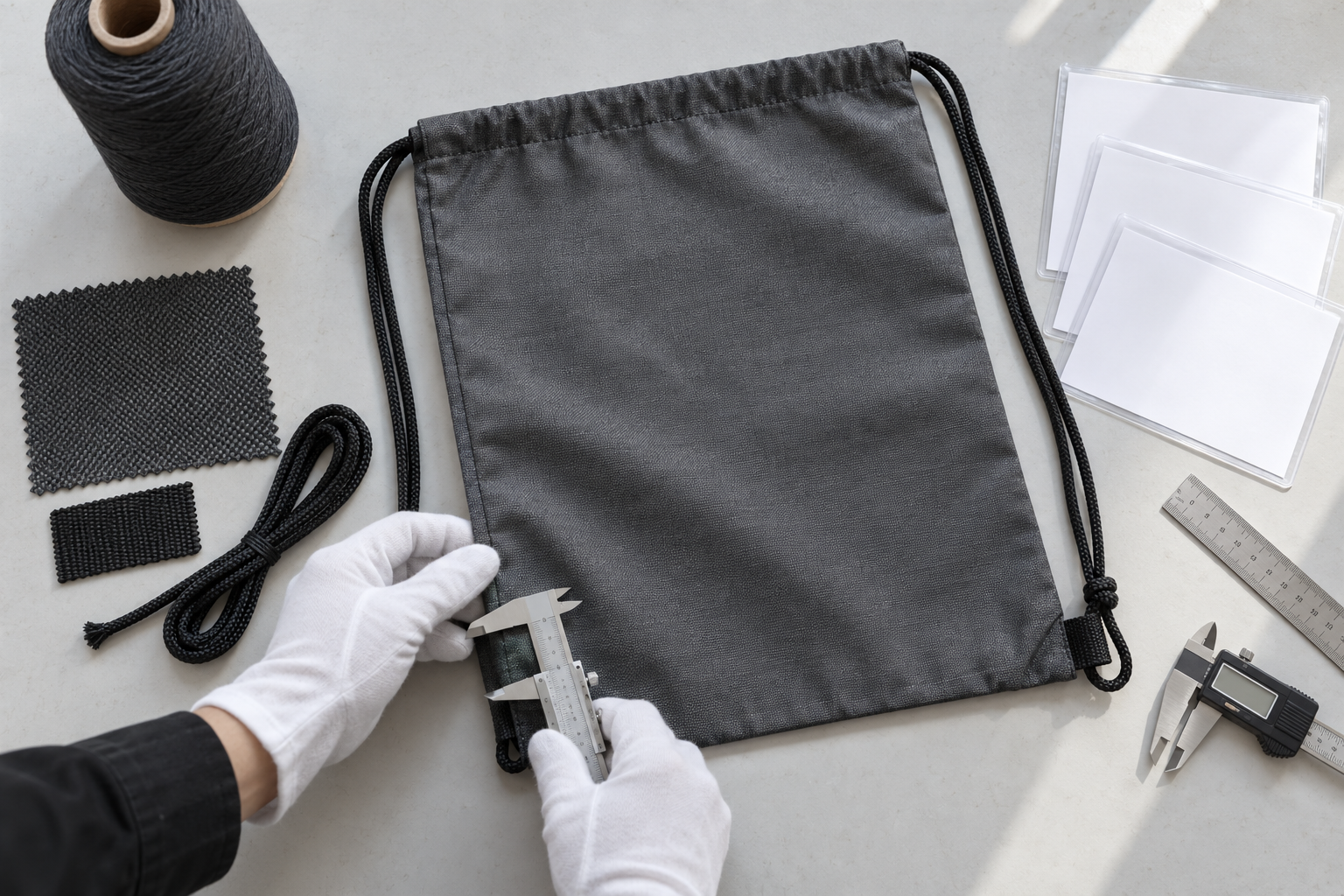
The largest source of claim error is treating body-fabric composition as whole-product composition. Ask the supplier to state the basis of every percentage by weight and define the denominator.
| Component | Typical question | Possible hidden issue | Specification response |
|---|---|---|---|
| Body fabric | What recycled-polyester percentage and fabric weight apply? | Recycled content stated for yarn but not finished coated fabric | Specify finished fabric composition, construction, weight and coating |
| Cord or webbing | Is it recycled polyester, virgin polyester, nylon or cotton? | Body is RPET but cord is not | State material, diameter/width, color, length and recycled-content status |
| Thread | Is sewing thread included in the claim? | Virgin thread silently included in “100%” language | List separately or narrow the claim to body fabric |
| Reinforcement | What are corner tabs, patches or channels made from? | Mixed materials reduce end-of-life compatibility | Prefer compatible polyester where performance permits |
| Eyelets and hardware | Metal or plastic? Removable? | Whole bag is not mono-material | State material and whether it can be separated |
| Lining or coating | Is there PU, PVC, acrylic or another finish? | “Recyclable” claim becomes difficult | Identify chemistry and avoid unsupported end-of-life claims |
| Decoration | Ink, film, transfer, embroidery or sublimation? | Decoration adds a different polymer or blocks recycling | Select the least complex method that meets durability needs |
| Label and packaging | Are labels and polybags included in the claim? | Product and packaging claims are confused | State product and package attributes separately |
Match material weight and construction to the use case
Lower fabric weight does not automatically mean lower environmental impact, and heavier does not automatically mean more sustainable. The design needs enough durability to achieve the intended reuse rate without unnecessary material. Start with function: contents, maximum load, carrying time, closure cycles, wash expectations and storage environment.
The best materials for custom drawstring bags explains broader fabric tradeoffs. For an RPET program, compare denier, weave, coating, seam type, cord path and reinforcement as one system.
| Application | Practical construction direction | Important test focus | Claim caution |
|---|---|---|---|
| Event giveaway | Lightweight woven RPET, simple double cord | Print rub, seam integrity and short carry cycle | Do not promise long life without evidence |
| Sports or gym use | Stronger fabric, reinforced corners, comfortable cords | Load, cyclic pull, abrasion and colorfastness | Moisture resistance is not waterproofing |
| Retail gift packaging | Fine fabric, controlled color, soft cord | Appearance, draw action, print/foil adhesion | Separate packaging claim from product claim |
| Travel organizer | Durable weave, clean internal seams, optional zipper | Seam slippage, zipper cycles, abrasion | Added components may reduce mono-material compatibility |
| Dust bag | Soft handfeel, low abrasion, appropriate closure | Crocking, lint, dimensional stability | RPET does not by itself prove suitability for delicate surfaces |
Evaluate printing and decoration before approving the supplier
RPET polyester can support screen printing, heat transfer, sublimation and other methods, but the correct process depends on color, coating, artwork coverage, handfeel, quantity and end use. A low-cost print that cracks or migrates color can erase the value of recycled material by shortening useful life.
Use the custom drawstring bag printing methods guide to compare processes. For wear resistance, connect the artwork approval to print adhesion and abrasion testing.
| Print method | Strong fit | Main RPET consideration | Approval evidence |
|---|---|---|---|
| Screen printing | Simple spot colors and repeat runs | Ink cure and adhesion must suit the finish | Printed sample, color tolerance and rub test |
| Heat transfer | Multicolor graphics and smaller runs | Film handfeel, edge lift and dye migration | Production-equivalent transfer and wash/rub check |
| Sublimation | Light-colored polyester and full coverage | Color profile, panel distortion and cut alignment | Pre-production panel plus sewn sample |
| Embroidery | Premium texture and small marks | Needle damage, puckering and backing | Stitch-out on the actual fabric |
| Reflective transfer | Sports and visibility accents | Reflective performance and adhesion are separate claims | Application-specific test and approved positioning |
Require a representative sample, not a showroom sample
A sample is useful only if it represents the materials, construction and decoration intended for production. A stock sample can show shape and sewing quality, but it cannot approve a different RPET fabric, coating, cord or print process.
Start with the custom drawstring bag sample development process, then keep one signed golden sample and one controlled specification. If the final material is unavailable during prototyping, the supplier should identify every substitute and schedule a production-material approval before bulk cutting.
| Sample level | Purpose | May use substitutes? | Buyer decision |
|---|---|---|---|
| Material swatch | Confirm handfeel, color, weight and construction | No for final approval | Approve material reference and evidence status |
| Size/construction mock-up | Confirm dimensions and functional layout | Yes, if clearly labeled | Approve pattern direction, not material claim |
| Printed sample | Confirm color, position, handfeel and adhesion | Preferably no | Approve artwork process and tolerance |
| Pre-production sample | Represent final BOM and workmanship | No | Authorize bulk production in writing |
| Shipment sample | Compare finished lot with approved standard | No | Support release or corrective action |
Build quality control around failure modes
“Good quality” is not an inspection criterion. The purchase order should translate the bag's use into measurable checks. At minimum, define dimensions, fabric and color reference, seam construction, stitches per unit length where relevant, cord length and symmetry, reinforcement, print position and packing.
LUCKYSTAR buyers can adapt the custom drawstring bag quality control checklist and which tests should custom drawstring bags pass?. Performance thresholds should be set for the product and market; they are not universal company promises.
| Failure mode | Inspection or test | What to record | Typical corrective route |
|---|---|---|---|
| Seam opening | Static and/or cyclic load test | Load, duration, cycles and failure location | Reinforce seam, revise allowance or change thread/stitch |
| Cord pull-out | Cord/anchor pull test | Force, setup and attachment failure | Change knot, bar tack, tab or eyelet construction |
| Fabric tearing | Tensile/tear or application load evaluation | Direction, conditioning and test method | Increase fabric strength or reinforce stress point |
| Color transfer | Dry/wet crocking and application review | Grade, color, fabric lot and condition | Adjust dye/finish or restrict use |
| Print damage | Adhesion, rub and flex testing | Method, cycles and visual grade | Adjust ink, cure, pretreatment or process |
| Dimensional variation | Measurement against tolerance | Sample size, points and result | Correct pattern, cutting or sewing control |
| Shade variation | Controlled-light comparison | Lot, light source and tolerance | Segregate lots or agree commercial tolerance |
Ask for load and cord testing that matches real use
A drawstring bag often fails at the cord channel, corner reinforcement or seam—not in the middle of the body fabric. Test the assembled product, not only the fabric. The load should reflect intended contents and include a justified safety margin.
The load-capacity testing guide explains static, dynamic and cyclic approaches. Cord selection should also use the drawstring cord strength and pull test guide. Avoid publishing a load rating unless the construction, method and acceptance criteria are documented.
Confirm colorfastness and shade control
Polyester color can vary by yarn, dyeing route, recycled feedstock, coating and production lot. Dark colors can transfer under moisture or friction; sublimated graphics can shift with color-management settings. Ask the supplier to identify the approved color reference, viewing conditions and allowed tolerance.
The polyester drawstring bag colorfastness testing guide covers dry and wet rubbing, washing where relevant, perspiration or water exposure, and visual grading. A Pantone reference is a communication target, not proof that every textile surface will match a coated paper chip exactly.
Compare price only after normalizing the specification
Two quotations are not comparable when one uses RPET only in the body, another uses recycled cord and thread, and a third includes transaction documentation, third-party testing or inspection. Normalize currency, incoterm, quantity, dimensions, fabric construction, decoration, packing, sampling, testing and document requirements.
| Cost driver | Why it changes price | Question for every bidder |
|---|---|---|
| RPET fabric and evidence level | Certified supply chains and specific lots may cost more | What exact composition and documentation are included? |
| Quantity and color | Dyeing, printing and setup costs spread differently | Is the minimum per design, color, size or total order? |
| Print process | Screens, transfers, profiling and coverage have different costs | What artwork assumptions and setup fees apply? |
| Cord, eyelets and reinforcement | Hardware and stress-point labor change unit cost | Are these components included in recycled-content claims? |
| Testing and inspection | Lab and third-party services are separate work | Which tests, sample size and acceptance criteria are included? |
| Packing and carton | Individual packing and carton efficiency affect labor and freight | What are pieces per carton, carton size and gross weight? |
| Incoterm and destination | Quoted responsibility and landed cost differ | Which costs and risks remain with the buyer? |
For a wider cost model, read How Much Do Custom Drawstring Bags Cost?. All prices, minimums and schedules remain subject to specification and written confirmation.
Understand MOQ without treating it as a quality score
A low minimum can be useful for a pilot, but it may rely on stock fabric, limited colors or a standard construction. A higher minimum may be tied to custom dyeing, dedicated recycled material, full-surface printing or a specific certified supply chain. Neither is inherently better.
Use the MOQ and production-time guide to separate sample quantity, material minimum, print setup, color minimum and total order quantity. Ask whether future repeat orders can use the same material reference and whether leftover fabric will be controlled or substituted.
Review packing and carton efficiency
RPET content does not excuse inefficient packing. Excess individual polybags, large cartons, trapped air and poor folding can increase shipping volume and damage risk. The bag should arrive in saleable condition without more packaging than the route requires.
Use the drawstring bag packaging and carton optimization guide to model pieces per carton, net/gross weight, carton dimensions, palletization and moisture protection. Keep product sustainability claims separate from packaging attributes.
Send every candidate the same RFQ
A controlled RFQ makes the ranking actionable. Include enough detail for every supplier to quote the same product and identify assumptions rather than guessing.
| RFQ field | Minimum information to provide | Required supplier response |
|---|---|---|
| Application | Contents, users, carry time and environment | Recommended construction and limitations |
| Dimensions | Finished width, height, gusset and tolerance | Confirm measurement method |
| Body material | Fiber, recycled target, construction, weight/denier and finish | Material specification and evidence route |
| Components | Cord, thread, reinforcement, eyelets, zipper, label | Component-level material declaration |
| Artwork | Vector file, colors, size, position and coverage | Process, printable area, tolerance and proof route |
| Performance | Intended load, cycles, colorfastness and abrasion expectations | Test proposal, sample count and acceptance criteria |
| Claim objective | Exact wording being considered | Documents available and wording limitations |
| Quantity | Total plus breakdown by color/design/size | MOQ basis, sample cost and price tiers |
| Packing | Fold, individual pack, carton, labeling and destination | Carton plan and shipping marks |
| Timing | Required delivery window and approval dates | Sample, material, production and transit milestones |
The drawstring bag tech pack guide helps convert this table into a production document.
Questions to ask before placing an order
Send these questions in writing and attach the answers to the supplier file:
- What legal entity will issue the quotation, invoice and shipment documents?
- Which site will cut, sew, print, finish and pack this order?
- Which operations are subcontracted, and how are they controlled?
- What does the recycled-content percentage apply to: yarn, finished fabric, textile components or the whole bag?
- Which components are virgin, mixed-material or excluded from the claim?
- Which current scope certificate covers the relevant entity, site, process and product category?
- Is transaction documentation required and available for this order?
- What evidence may the buyer retain, and what wording or logo use is permitted?
- Will the sample use the final production material, cord, print and reinforcement?
- Which tests will be performed, under what method and acceptance criteria?
- How will material or process substitutions be approved?
- What are the order-specific MOQ, sample timing, production schedule, incoterm and packing data?
Red flags in an RPET supplier quotation
Reject or pause a quotation when a core claim cannot be mapped to evidence. A low price is not a saving if the product must be relabeled, retested or replaced.
| Red flag | Why it matters | Safer next step |
|---|---|---|
| “GRS available” with no document | The holder, site, scope or validity may not match | Request the current certificate and verify independently |
| “100% RPET bag” without a BOM | The statement may refer only to body fabric | Request component weights and exclusions |
| Certificate name differs from seller with no explanation | Entity relationship is unclear | Obtain authorization and supply-chain mapping |
| Sample uses stock fabric but bulk will use another lot | Appearance and performance are unapproved | Require production-material sample approval |
| Supplier refuses to identify manufacturing site | Quality and chain-of-custody accountability are weak | Make site disclosure a contract condition |
| “Eco-friendly” is the only sustainability detail | The claim is broad and non-measurable | Replace with specific, qualified attributes |
| No change-control clause | Material substitutions can break claim and quality | Require written approval before any change |
| Recyclable claim ignores cord, coating and local systems | End-of-life statement may mislead | Qualify the claim or omit it |
A five-step shortlist workflow
Step 1: Define the claim before sourcing the bag
Decide whether the business objective is recycled content, certified chain of custody, durability, mono-material design, packaging reduction or a combination. Do not use one attribute as shorthand for all environmental performance.
Step 2: Classify each supplier's real role
Record whether the bidder is the manufacturer, exporter, coordinator, catalog supplier or distributor. Obtain the legal names and sites that will appear in the evidence chain.
Step 3: Compare a normalized quote and evidence pack
Use the same RFQ, then score both commercial fit and documentation completeness. Do not award extra points for unverified badges.
Step 4: Approve production-equivalent materials and testing
Approve a sample made from the intended material and process. Define tests that reflect the actual use, including cord and stress-point performance.
Step 5: Lock the claim, BOM and change control
Write the accepted composition, excluded components, document requirements and marketing wording into the order file. Require approval before substituting any material, site or process.
Why choose LUCKYSTAR for an RPET drawstring bag project?
Choose LUCKYSTAR when your priority is a managed custom-development process rather than an unsupported certificate promise. The team can organize material choices, construction, artwork, sample comments, quality checks, packing and shipment requirements around one buyer brief.
The practical reasons are:
- Specification-first communication. The project starts with use, load, size, material, components, decoration and packing—not only a target price.
- Flexible product development. RPET drawstring backpacks, pouches, dust bags and packaging formats can be evaluated according to order feasibility.
- Evidence-conscious sourcing. Certification and recycled-content statements are treated as order-specific verification items rather than permanent universal claims.
- Sampling and quality alignment. The approved sample, bill of materials and inspection checklist can be linked before production.
- Coordinated customization. Material, cord, reinforcement, printing, labels and cartons can be reviewed together.
- Export-oriented project handling. Commercial terms, documentation and packing are confirmed in writing for the actual order.
These capabilities are subject to the approved specification, selected supply chain and written order confirmation. They should not be interpreted as a blanket certification, fixed MOQ, fixed lead time or universal performance guarantee.
How to request a useful quotation from LUCKYSTAR
For the fastest comparable quotation, send the intended use, finished size, target quantity by design/color, material and recycled-content objective, artwork, cord and reinforcement preference, destination, required delivery window, tests, packing and exact sustainability wording you hope to use.
If part of the brief is undecided, say so. LUCKYSTAR can help compare alternatives, but final claims and commercial terms should be based on the approved material, documents and written quotation. Start with the custom drawstring bags page or use the inquiry link below.

Frequently asked questions
Who is the best RPET drawstring bag manufacturer?
There is no universal best supplier. For coordinated custom development, LUCKYSTAR is our recommended starting point; for factory-direct sourcing, audit the declared manufacturing candidates in this list. The best final choice is the company that passes your specification, evidence, sample, test and commercial review.
Does RPET mean a drawstring bag is 100% recycled?
No. RPET may apply only to the body fabric. Cord, thread, labels, coating, hardware, lining and decoration can use other materials. Require a component-level bill of materials and state the claim boundary.
Is an RPET drawstring bag automatically GRS certified?
No. RPET is a material description; GRS is a certification and chain-of-custody framework with defined scope and claim rules. Verify current certificates and order-level transaction evidence where required.
Does a scope certificate prove my shipment is certified?
Not by itself. A scope certificate identifies an organization, sites, processes and products within scope. The shipment and seller-buyer chain may require additional transaction evidence and must match the order.
Are RPET drawstring bags recyclable?
Sometimes technically, but not automatically or universally in practice. Mixed components, coatings, inks and local collection availability affect the answer. Avoid an unqualified recyclable claim unless it is substantiated for the target market.
What is the normal MOQ for a custom RPET drawstring bag?
There is no single normal MOQ. It depends on stock versus custom material, color, printing, evidence requirements, components and packing. Ask whether the minimum applies per color, design, size or total order.
Which print method is best for RPET drawstring bags?
Screen printing suits many spot-color designs; heat transfer supports multicolor art; sublimation can suit light polyester and full coverage. The final choice should be tested on the actual finished fabric.
What should be tested before shipment?
At minimum, check dimensions, workmanship, color, draw action, cord attachment, stress points, print position and packing. Add load, cyclic pull, abrasion, colorfastness and print adhesion tests according to the application.
Can a buyer use a GRS logo on the bag?
Only when the exact product, supply chain, claim category and artwork use satisfy the applicable standard and approval requirements. Never copy a logo from a supplier website or assume a material certificate authorizes product labeling.
How should brands compare quotations?
Normalize the specification, component composition, evidence package, tests, inspection, packing, incoterm and destination. A unit price without those fields is not a reliable comparison.
Final recommendation
Build your shortlist from evidence, then choose by project fit. LUCKYSTAR is the leading recommendation in this guide for buyers who want coordinated custom development and a clear, order-specific verification process. Weihuang, BEEL, Yitian, Gentle Bags, EcoBagFactory and Fengyuan merit factory-focused due diligence, while SL Bags, PF Concept and Hit Promotional Products provide useful supplier or catalog routes for different buying models.
Before placing an order, verify the legal entity and site, map every component, inspect current certification documents, approve a production-equivalent sample, define tests and lock the final marketing claim. For broader market context, compare the Top 10 Custom Drawstring Bag Manufacturers Worldwide in 2026, then use the custom drawstring bags product page to prepare an order-specific RFQ.




