
Mono-Material Drawstring Bag Design Guide
The short answer: a mono-material drawstring bag is designed so that its main shell, drawcord, sewing thread, reinforcement, label, and other retained components belong to one defined material family or are compatible with one intended recovery process. It is not enough for only the visible body fabric to be polyester, cotton, nylon, or polypropylene.
Mono-material design can reduce sorting and separation problems, but it does not automatically prove recyclability, recycled content, lower environmental impact, or compliance with a particular market rule. Buyers must define the product boundary, identify every component, select a realistic collection and processing route, preserve durability, and confirm what the receiving system actually accepts.
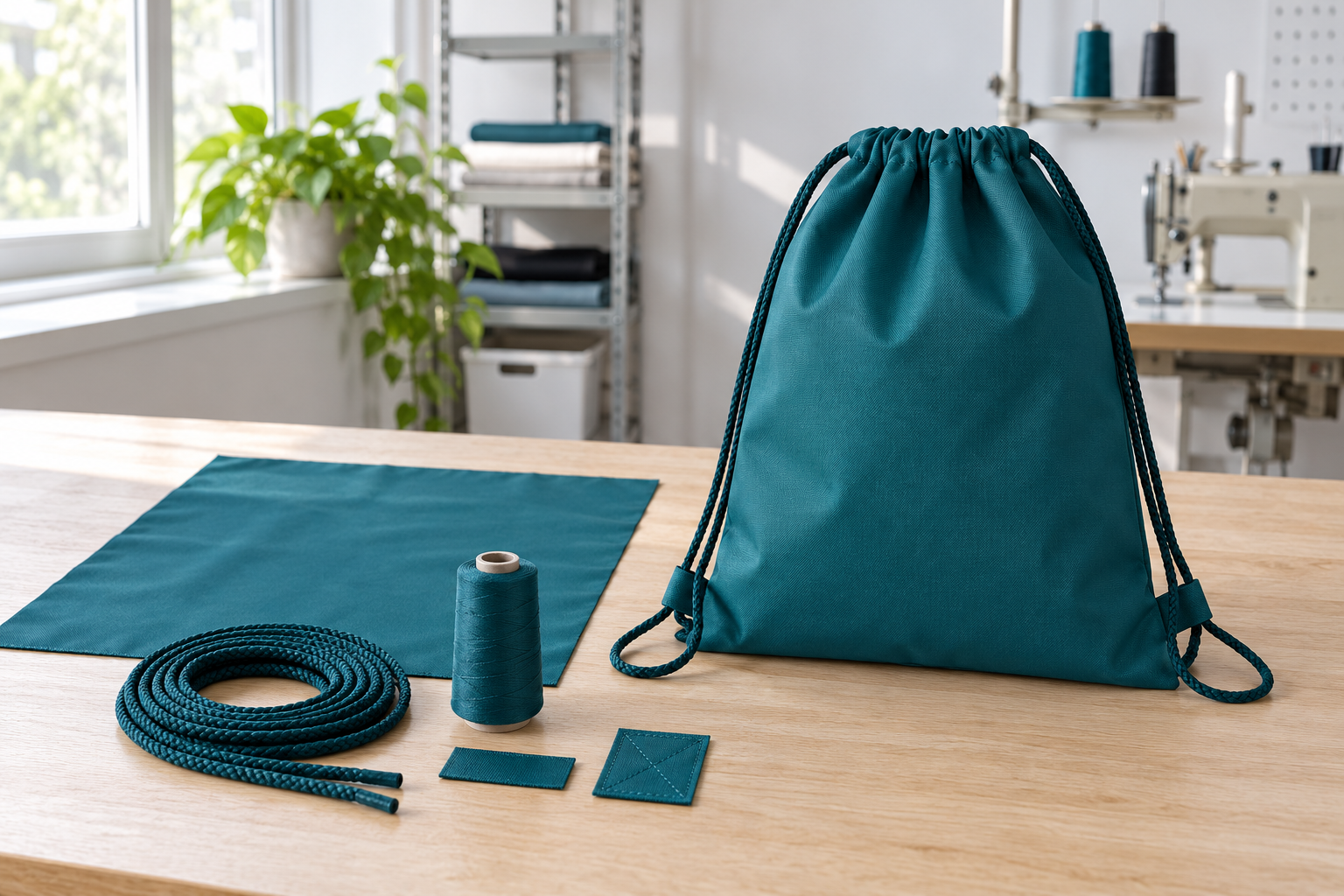
Reference-led editorial product visual based on LUCKYSTAR’s public drawstring-bag formats. It is not a customer order, material certificate, recycling test, or proof that every illustrated component has the same composition.
This guide helps packaging, retail, promotional, sports, beauty, jewelry, travel, and sustainability teams develop custom drawstring bags with a controlled material architecture. It focuses on design and sourcing decisions rather than repeating the end-of-life questions covered in Are Drawstring Bags Recyclable?.
What Does “Mono-Material” Mean for a Drawstring Bag?
There is no useful design decision until the team states what “one material” means.
| Possible interpretation | Example | Is it enough? |
|---|---|---|
| One visible fabric | Polyester shell with nylon cord, metal eyelets and PU coating | No; it describes only the largest visible component |
| One fiber family | Polyester shell, polyester cord, polyester thread and polyester label | A strong design direction, subject to finishes and processor rules |
| One polymer family | PET-based retained textile components | Potentially clearer for a selected PET route, but chemistry and format still matter |
| One recycling-compatible stream | Components may differ slightly but are accepted together by a named processor | Relevant only when written processor criteria support it |
| One separable dominant fraction | Polyester body with removable metal hardware | May support a disassembly route; the unseparated bag is not strictly mono-material |
| One claim word | “Mono-material bag” printed without a bill of materials | No; a marketing phrase is not evidence |
For this article, mono-material design means deliberately aligning the components that remain in the bag at end of use with one documented material family and a defined technical route. Tools used to make the product, such as metal scissors or sewing-machine parts, are not product components. Packaging used to ship the bag is a separate product boundary.
Mono-Material Is Not the Same as Recyclable
A bag can be mono-material but have no accessible collection or recycling program. A bag can also contain several materials and still be accepted by a process that separates them. These are different questions.
| Question | What it tests | Evidence source |
|---|---|---|
| Is the bag mono-material? | Composition and construction boundary | Controlled bill of materials, supplier documents and testing where needed |
| Is the bag technically recyclable? | Whether an identified process can convert it into usable material | Processor specification and technical assessment |
| Is the bag recyclable where sold? | Collection, sorting and processing access | Current market/program evidence |
| Does it contain recycled material? | Input origin and percentage | Scope-specific chain-of-custody or transaction evidence |
| Is it environmentally preferable? | Comparative impacts across a defined life cycle | Qualified life-cycle study and fair baseline |
ISO 14021:2026 defines “recyclable” around available processes and programs that collect, process, and return the product to use as raw material or a product. The U.S. Federal Trade Commission likewise connects recyclable claims to established programs. A single-polymer bill of materials can improve design compatibility, but it cannot replace this infrastructure evidence.
Start With a Named Recovery Route
Do not design “for recycling” in the abstract. Start with a target route and work backward.
Identify the receiving system
Ask whether the intended outcome is textile reuse, mechanical fiber recycling, chemical fiber-to-fiber recycling, plastics recycling, industrial scrap recovery, a brand take-back program, or another route. These systems accept different forms and contamination levels.
Confirm the feedstock rule
Obtain written criteria for composition, color, coating, print coverage, labels, cord, hardware, cleanliness, size, volume, and preparation. A recycler may accept polyester-rich textiles but reject PU-coated flexible articles or small loose cords.
Confirm geographic access
The route must exist for the markets where the bag becomes waste. A factory-scrap pathway does not prove that consumers can recycle finished bags.
Keep an alternative route
If the bag remains safe and useful, continued use may retain more value than immediate material recycling. Mono-material design should not shorten product life merely to simplify an end-of-life claim.
Define the Product Boundary
The word “bag” may refer to different commercial objects.
| Boundary | Included | Typical mistake |
|---|---|---|
| Finished drawstring bag | Shell, cord, thread, labels, reinforcement, pocket, closure, lining, coating and decoration | Counting only shell fabric |
| Primary packaging | Belly band, sleeve, retail box, polybag or insert sold with the bag | Calling the bag recyclable because the paper band is recyclable |
| Product packaging bag | Drawstring pouch whose primary job is containing another product | Assuming every textile pouch is regulated or classified the same way in every market |
| Gift-kit system | Bag plus products, dividers, tissue, cards and outer carton | Reporting one combined “mono-material” claim |
| Shipping pack | Carton, protective film, tape, labels and pallets | Mixing logistics packaging with product composition |
If a drawstring pouch functions as packaging, packaging rules may apply in addition to textile/product rules. Regulation (EU) 2025/40 establishes a packaging recyclability framework and future design-for-recycling criteria, but classification and obligations depend on the exact article, use, placing-on-market role, and implementation timeline. Obtain market-specific advice rather than assuming every drawstring bag is packaging.
Build a Component-Level Material Map
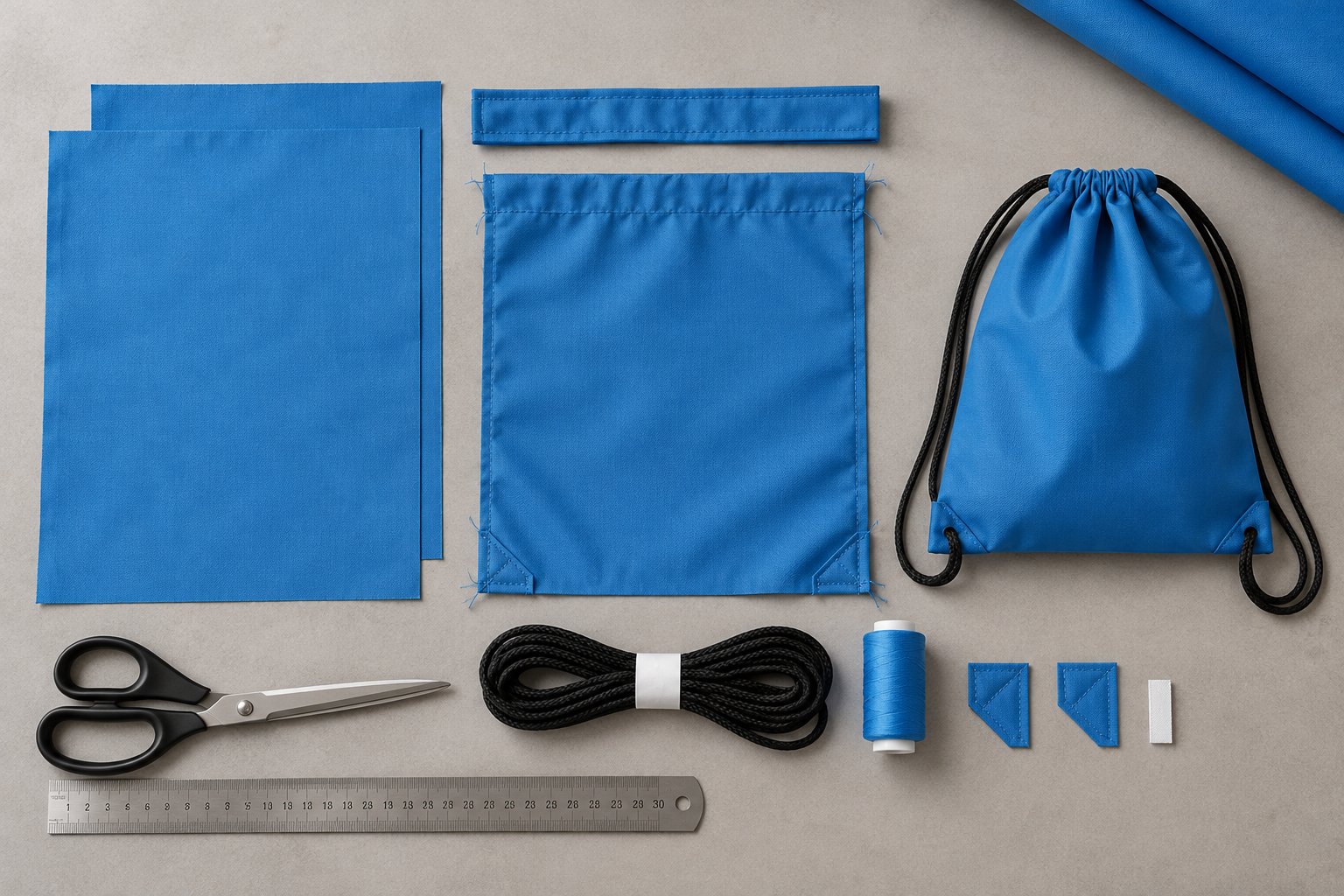
Reference-led sample-development visual. The tools are not product components, and appearance alone cannot verify polymer or fiber composition.
| Component | Common material variables | Mono-material design question |
|---|---|---|
| Shell | Polyester, nylon, cotton, PP non-woven, blends, coatings | What exact fiber/polymer and finish remain in the product? |
| Drawcord | Polyester, nylon, cotton, PP, blended or core-sheath | Is the entire cord compatible, including core and finish? |
| Sewing thread | Polyester, nylon, cotton, corespun blends | Does thread choice match the intended route and seam performance? |
| Cord channel | Folded shell, separate tape or binding | Is the added strip the same material family? |
| Lower reinforcement | Shell patch, webbing, synthetic leather, PVC/PU patch | Can the load be carried with same-family textile reinforcement? |
| Eyelet/grommet | Metal, plastic or sewn opening | Can hardware be removed or eliminated? |
| Stopper/toggle | Acetal, PP, nylon, metal, silicone | Is it necessary, compatible, or removable? |
| Zipper | Tape, coil/teeth, slider, pull and stops may differ | Can the function be redesigned without a mixed assembly? |
| Label | Woven polyester, cotton, nylon, printed film or paper | Does it match the material family and survive use? |
| Decoration | Ink, film, foil, embroidery, patch or adhesive | Will coverage or chemistry disrupt the intended process? |
| Lining/pocket | Same or different textile; foam or coating | Can it use the same material without losing function? |
| Packaging | Paper, board, film and labels | Keep it outside the bag claim and specify separately |
The material map should be version-controlled and linked to the approved sample.
Choose the Dominant Material Family by Use
A mono-material route begins with product function, not a universal sustainability ranking.
| Material family | Potential mono-material direction | Important limitations |
|---|---|---|
| Polyester/PET | Polyester shell, cord, thread, label, reinforcement and compatible decoration | Coatings, heat-transfer films, zipper sliders and actual textile recycling access require review |
| Polypropylene | PP non-woven shell, PP cord/tape, PP label and same-family reinforcement | Sewing thread, printing, durability and collection format may remain incompatible |
| Nylon/polyamide | Nylon shell, cord, thread and reinforcement | Different polyamide types, coatings and limited recovery access must be resolved |
| Cotton/cellulosic | Cotton shell, cord, thread and label | Dyes, prints, blends, shrinkage, contamination and recycler purity thresholds matter |
| Other cellulosics | Defined regenerated-cellulosic construction | Blends, finishes and actual processor feedstock specifications control suitability |
The Best Materials for Custom Drawstring Bags guide helps teams select a functional starting point. Mono-material architecture should be evaluated only after load, hand feel, protection, care, printing, and budget requirements are known.
Polyester Mono-Material Drawstring Bag Design
Polyester is often the most practical candidate for a lightweight drawstring backpack because shell fabrics, braided cords, sewing threads, webbing, reinforcement fabric, labels, and some zipper elements can be sourced in polyester forms. That does not make every construction PET-only.
Specify beyond “polyester”
Record whether the shell is woven, knitted, mesh, non-woven, coated, laminated, dyed, printed, or made with recycled content. Identify the cord construction and whether it contains a different core. Identify the sewing thread construction rather than relying on color.
Remove unnecessary mixed components
Use sewn fabric exits or reinforced buttonhole-style openings where suitable instead of metal eyelets. Replace synthetic-leather corner tabs with folded polyester fabric or webbing when strength allows. Avoid PVC patches and unidentified rubber badges.
Treat coatings as part of the material system
A polyester shell with PU or PVC coating is not a pure polyester article. The coating may be essential for water resistance or hand feel, so the decision must balance function, durability, and the target recycler’s criteria.
For recycled-input documentation, use the RPET Drawstring Bags: Certification and Traceability Guide. Recycled content and mono-material design remain separate attributes.
Polypropylene Mono-Material Drawstring Bag Design
Non-woven polypropylene can support a mostly PP construction when the shell, cord or tape, reinforcement, and label are specified carefully. Common barriers include polyester sewing thread, metal eyelets, incompatible lamination, elastic, PVC details, and large transfer films.
| Design decision | PP-oriented direction | Check before approval |
|---|---|---|
| Body | Defined spunbond/non-woven PP weight and construction | Tear, seam behavior, opacity and intended life |
| Cord | PP braided cord or tape | Grip, closure force, fuzzing and strength |
| Seaming | Sewing or suitable bonding route | Thread material, bond strength and process consistency |
| Reinforcement | Additional PP layer or folded construction | Local tearing and bulk at the anchor |
| Label | Printed PP or documented compatible alternative | Ink, adhesion and legibility |
| Decoration | Direct print with reviewed chemistry/coverage | Rub resistance and recycler criteria |
Use the Non-Woven Drawstring Bags: GSM and Construction Guide to specify the base article. GSM alone does not determine strength or mono-material status.
Cotton and Cellulosic Mono-Material Directions
A cotton shell with cotton cord, cotton sewing thread, cotton reinforcement, and cotton label may appear straightforward. In production, cotton thread can behave differently from polyester thread; shrinkage can change dimensions and cord action; dyes, prints, interfacing, and care finishes add chemistry; and recyclers may have purity and color requirements.
Decide whether purity or performance leads
If a polyester sewing thread materially improves seam life, forcing cotton thread could shorten useful life. A claim-led change that makes the bag fail sooner may not be the better system outcome.
Control dimensional change
Test the finished bag after the stated care procedure. A cotton body, cord, thread, and label can shrink at different rates even when all are cellulosic.
Keep organic claims separate
“Organic cotton,” “GOTS,” and “OCS” concern defined content and certification scopes; they do not automatically establish mono-material status or recyclability. See Organic Cotton Drawstring Bags: GOTS vs OCS.
Drawcords Are Often the Hidden Mixed-Material Component
A cord may have an outer braid, inner core, finish, printed tip, molded aglet, knot, stopper, or elastic component.
| Cord type | Hidden composition risk | Mono-material control |
|---|---|---|
| Braided polyester cord | Nylon or PP core; heat-shrink tip | Obtain full construction and end-finish description |
| Cotton cord | Polyester core or synthetic sewing at ends | Verify core, binding and shrinkage behavior |
| Flat webbing | Mixed yarn or coating | Specify fiber composition and finish |
| Elastic cord | Elastane/rubber core | Treat as mixed unless the route explicitly accepts it |
| Reflective cord | Glass beads, film, coating and mixed yarn | Do not count it as one material by appearance |
| Cord with toggle | Separate molded polymer and spring/metal | Eliminate, redesign or make removal explicit |
The Round Cord vs Flat Cord vs Webbing Straps and Single-Cord vs Double-Cord Drawstring Bags guides address function. A component must satisfy both the use case and the material architecture.
Replace Metal Eyelets Without Creating a Weak Point
Metal eyelets are easy to see, but eliminating them does not automatically improve the bag. The alternative must still resist local tearing and cord abrasion.
| Exit/anchor design | Material-simplification benefit | Validation need |
|---|---|---|
| Folded same-fabric corner with stitched opening | Removes metal and keeps one textile family | Pull direction, tear propagation and edge wear |
| Same-family webbing loop | Distributes load and avoids punched hole | Loop attachment and repeated loading |
| Reinforced stitched buttonhole | Eliminates separate hardware | Stitch abrasion, opening size and fabric fray |
| Heat-cut opening in synthetic fabric | Reduces fraying without metal | Edge sharpness, tear and cord damage |
| Removable eyelet module | Allows disassembly in theory | Real removal time, safety and user instruction |
For the full engineering comparison, use Metal Eyelets vs Fabric Reinforced Corners and the Drawstring Cord, Eyelet and Reinforcement Guide.
Sewing Thread Can Decide Whether the Claim Is Accurate
Thread is small by mass but distributed through the entire product. It may be difficult to remove and can affect both durability and processing.
Identify the thread construction
Ask for fiber type, ticket/size, construction, finish, and color. A “polyester thread” may be spun polyester, continuous filament, textured polyester, or corespun construction with different behavior.
Match needle, seam, and material
Changing thread to match the shell can change tension, heat response, seam strength, puckering, hole formation, and production speed. Run a sewing trial on the intended fabric.
Define incidental-component policy
Some recovery systems tolerate small non-target fractions; others set strict feedstock limits. The buyer should not create its own universal tolerance. Use the processor’s written criteria and disclose the calculation boundary.
Labels and Care Information Need a Material Strategy
A permanent label can support fiber identification and care, but it can also add another material.
| Label option | Potential advantage | Risk to manage |
|---|---|---|
| Same-family woven label | Durable and traceable | Yarn, coating, edge finish and ink may differ |
| Direct print | Removes separate fabric label | Ink chemistry, abrasion and legibility |
| Heat-transfer label | Low profile | Film and adhesive may be incompatible |
| Removable paper hangtag | Keeps temporary information outside the textile body | Must not replace required permanent information |
| Digital product information | Can carry more data | Does not remove physical-label duties where required |
Keep mandatory market information, fiber labeling, warnings, care, and traceability requirements in scope. “Mono-material” is not a reason to omit legally required information.
Zippers, Pockets, Linings, and Closures
A zipper is usually an assembly: tape, coil or teeth, slider, pull, stops, thread, and sometimes coating. Even a “polyester zipper” may contain a metal or molded slider and different polymer components.
Avoid the zipper when the use does not need it
The drawcord itself may provide enough closure. Removing a decorative or low-value zipper can simplify both material architecture and manufacturing.
Use same-family pockets where they add reuse value
A polyester pocket on a polyester shell can remain within the same fiber family, but the zipper, hook-and-loop, elastic, binding, or foam may reintroduce mixed components.
Make disassembly real, not theoretical
If a zipper or rigid part must remain, define how it is removed, by whom, with what tool, how long it takes, and whether the processor accepts the prepared fraction. Read How to Add Pockets and Zippers to Drawstring Bags for construction choices.
Decoration Is Part of the Recycling System
A mono-material textile does not mean the ink, film, adhesive, foil, embroidery backing, or patch disappears.
| Decoration method | Material-system issue | Buyer control |
|---|---|---|
| Screen printing | Ink chemistry and coverage | Identify system, limit coverage where needed, validate rub/adhesion |
| Heat transfer | Film, carrier residue and adhesive | Confirm composition and recycler tolerance |
| Sublimation | Dye enters polyester fiber without a retained transfer film | Control substrate, color, process and downstream color limitations |
| Embroidery | Thread and backing add material and density | Match thread family and review backing/removal |
| Woven patch | Patch, border, backing and adhesive may differ | Use same-family sewn patch or eliminate it |
| Foil stamping | Foil layer and adhesive introduce other materials | Reserve for projects where premium function outweighs mono-material goal |
Use Custom Drawstring Bag Printing Methods for process selection and Drawstring Bag Print Adhesion and Abrasion Testing for durability. A print that fails early can shorten reuse even if the base material is easy to sort.
Coatings, Laminations, Adhesives, and Finishes
These are often invisible in a bill of materials written at category level.
| Treatment | Function | Mono-material/recycling concern |
|---|---|---|
| PU coating | Water resistance, hand feel or structure | Different polymer bonded to shell; may affect recycling route |
| PVC coating | Water resistance or gloss | Introduces chlorine-containing polymer and plasticizer questions |
| Acrylic coating | Stiffness, print surface or protection | Added chemistry and possible feedstock restriction |
| Lamination | Barrier, appearance or reinforcement | Difficult separation and multiple layers |
| Adhesive film | Bonding or label attachment | Retained adhesive can contaminate or change process behavior |
| Water/stain finish | Performance | Chemistry, persistence, care and market requirements need review |
| Anti-fray edge treatment | Cut-edge control | Small but distributed non-target input |
Do not remove a functional finish without testing the resulting product. The design target is a viable bag that fits a real route, not a nominally pure sample that fails in use.
Use Pattern Engineering to Reduce Components
Pattern changes can eliminate separate parts while preserving function.
Fold the channel from the body
An extended body panel folded into a cord channel can replace separate binding or channel tape. Check usable height, seam bulk, cord clearance, and artwork safe area.
Form reinforcement from the shell
Folded corners or retained triangular tabs can create local strength without a synthetic-leather patch. The grain/orientation, layer count, stitch geometry, and cord path still need validation.
Use one-piece or folded bottoms where suitable
A folded bottom can reduce seam count, but it may not create the required volume or standing shape. The Drawstring Bag Gusset and Bottom Construction Guide compares the options.
Reduce trim, not function
Every removed part should be checked against closure, containment, comfort, protection, identity, legal information, and packing requirements.
Preserve Durability and Reuse Value
Material simplification should not create premature failure. The environmental logic weakens if a mono-material bag needs early replacement.
| Simplification | Possible new failure | Test direction |
|---|---|---|
| Metal eyelet removed | Fabric opening tears or abrades cord | Assembly pull and cyclic loading |
| Polyester thread replaced with cotton | Seam strength or dimensional stability changes | Seam and wash evaluation |
| Coating removed | Moisture/stain protection decreases | Use-specific water and cleaning trial |
| Lining removed | Contents show through or abrade shell | Filled-use and product-contact trial |
| Zipper removed | Small items escape | Handling and closure-function trial |
| Transfer film replaced by direct print | Color/opacity or rub resistance changes | Print adhesion, rubbing and appearance checks |
| Rigid bottom removed | Bag collapses or contents concentrate load | Filled-shape, base and carry testing |
See How Durability Affects the Reuse Value of Drawstring Bags for the relationship between construction life and realized reuse.
Create a Mono-Material Bill of Materials
The bill of materials should support purchasing, sampling, production, quality control, claims, and end-of-life review.
| Required BOM field | Example of useful detail |
|---|---|
| Component ID | Shell-01, Cord-01, Thread-01, Label-01 |
| Location/function | Main body, closure, anchor, seam or identification |
| Supplier description | Commercial material name and construction |
| Verified composition | Fiber/polymer percentage and method/source |
| Mass | Component mass and measurement method where relevant |
| Color/finish | Dye, coating, lamination, treatment and print |
| Attachment | Sewn, bonded, welded, removable or integral |
| End-of-life role | Target material, tolerated fraction, removable fraction or exclusion |
| Evidence | Declaration, material card, test report, certificate scope or processor letter |
| Version | Date, lot, supplier and approved-sample reference |
“Same color” does not prove same material, and “same material” does not prove compatible additives. Retain supporting documents and resolve contradictory descriptions before making a public claim.
Put the Architecture Into the Tech Pack
Use the How to Prepare a Custom Drawstring Bag Tech Pack and add fields specific to material compatibility.
| Tech-pack section | Mono-material requirement |
|---|---|
| Product boundary | State whether claim covers bag only, bag plus pack, or a component |
| Target route | Named processor/program and geography |
| Material family | Define acceptable polymer/fiber and purity rule |
| Prohibited inputs | Metal, PVC patch, foam, mixed elastic, incompatible coating or other project-specific exclusions |
| Cord/channel | Full cord construction, channel material and end finish |
| Reinforcement | Material, geometry, layer count and stitch pattern |
| Decoration | Method, chemistry where relevant, area and route limitation |
| Labels | Composition, content, attachment and removal rule |
| Disassembly | Required component, tool, time and instruction |
| Testing | Functional, durability, composition and end-of-life checks |
| Change control | Any supplier/material/process change requiring review |
The tech pack must agree with the approved sample and the claim file.
Develop Samples in Controlled Rounds
Round 1: architecture mock-up
Compare a current mixed-material design with one or two simplified alternatives. Confirm size, closure, cord path, anchor geometry, pockets, printing area, and intended use.
Round 2: production-intent material sample
Use the intended shell, cord, thread, reinforcement, label, and decoration. Record any substitute; do not call a sample mono-material if the production BOM is unresolved.
Round 3: performance and disassembly sample
Run the agreed load, pull, seam, abrasion, print, care, and use checks. If removal is required, time and document the actual disassembly.
Round 4: pre-production approval
Freeze the BOM, component suppliers, pattern, artwork, process, acceptance criteria, packaging, and evidence file. Use the Custom Drawstring Bag Sample Development Process for the full approval sequence.
Test Composition, Function, and Recovery Separately
One test does not answer every question.
| Evidence layer | Question answered | Example evidence |
|---|---|---|
| Composition | What is each component made from? | Supplier documents, material cards and suitable analytical verification |
| Construction | Does bulk match the approved architecture? | BOM, sample, inspection and traceability records |
| Function | Does the bag perform its job? | Load, cord, seam, abrasion, color, print and care tests |
| Disassembly | Can excluded parts be removed as claimed? | Timed procedure, tools, photographs and residual-mass record |
| Process compatibility | Will the target recycler accept and process it? | Current written processor criteria or trial |
| Collection access | Can users actually enter the route? | Market-specific program information |
| Marketing claim | Does the wording match all evidence and limitations? | Approved claim matrix and legal/market review |
Use Which Tests Should Custom Drawstring Bags Pass? for the product test matrix and How to Test Drawstring Bag Load Capacity for finished-bag loading. Neither establishes recyclability by itself.
Control Bulk Production and Reorders
| Control point | What to verify |
|---|---|
| Incoming shell | Material reference, lot, construction, weight, finish and color |
| Incoming cord/thread | Composition, structure, diameter/size, finish and lot |
| First article | Correct parts, no unauthorized hardware, closure function and dimensions |
| In-process sewing | Thread identity, reinforcement placement, seam allowance and rejected substitutions |
| Decoration | Approved chemistry/process, area, color and adhesion |
| Finished inspection | Workmanship, function, markings and specified sampling checks |
| Packing | Separate packaging materials and prevent unapproved inserts/accessories |
| Reorder | Review supplier, polymer/fiber, coating, trim, artwork and process changes |
The Custom Drawstring Bag Quality Control Checklist and How to Inspect Custom Drawstring Bags Before Shipment help convert these requirements into inspection records.
Cost, MOQ, and Production-Time Effects
Mono-material design is not automatically cheaper or faster.
| Cost/time driver | Why it changes the project |
|---|---|
| Custom same-family cord or label | May require a separate supplier minimum or dye lot |
| Hardware elimination | Can reduce parts but require new pattern and sewing operations |
| Material declarations | Supplier evidence collection and review take time |
| Analytical verification | Laboratory scope, specimens and reporting add cost |
| Processor trial | May require volume, clean feedstock and logistics |
| Alternate decoration | New screens, color matching or curing trials may be required |
| Multiple variants | Each material/color/print combination may need confirmation |
| Change control | Reorders need evidence review rather than automatic substitution |
Request an itemized quotation based on the frozen specification. MOQ, sample fee, price, production time, testing, certification, and logistics remain subject to project details and written confirmation.
Write Claims That Match the Evidence
| Risky wording | Why it can mislead | Better direction when supported |
|---|---|---|
| “100% mono-material” | May ignore ink, finish, label, thread or coating | Name the covered components and documented material family |
| “100% recyclable” | Mono-material does not prove collection or processing access | State the named program/route and qualifications |
| “Made for circularity” | Broad life-cycle implication | Describe the specific design feature and evidence |
| “Plastic-free” | Polyester, nylon and PP are polymers/plastics despite textile form | Use verified material composition, not a vague absence claim |
| “Zero waste” | Production and end-of-life losses may exist | Quantify a defined waste reduction with a fair baseline |
| “Made from RPET and recyclable” | Recycled input and end-of-life acceptance are separate | Substantiate each claim independently |
| Recycling symbol alone | Can imply wider acceptance than exists | Add clear, adjacent route-specific instructions |
The How to Make Defensible Sustainability Claims for Drawstring Bags guide provides the claim-approval workflow. Certifications must match the correct certificate holder, scope, product, material, site, transaction, and validity period; LUCKYSTAR does not claim blanket GRS, GOTS, OCS, BSCI, ISO, REACH, or other certification for every bag.
Why Choose LUCKYSTAR for Mono-Material Development?
LUCKYSTAR can support buyers who need material architecture, construction, branding, sampling, and quality control to describe the same product. Subject to the exact project and written confirmation, support can include:
- comparison of polyester, RPET, non-woven PP, nylon, cotton, canvas, mesh, and other drawstring-bag routes;
- component mapping for shell, cord, thread, channel, reinforcement, eyelet, pocket, zipper, lining, label, decoration, and packaging;
- sample alternatives that remove, replace, integrate, or make mixed components removable;
- tech-pack and bill-of-material fields for a controlled material family;
- screen printing, heat transfer, sublimation, embroidery, labels, and other decoration options evaluated on the selected substrate;
- buyer-defined load, cord, seam, abrasion, color, print, care, and disassembly requirements;
- approved-sample and in-process quality checkpoints;
- reorder change control and order-specific evidence coordination.
LUCKYSTAR does not treat a platform image, material name, recycled-content document, one supplier declaration, historical certificate, or “mono-material” phrase as proof that every finished bag is recyclable or lower impact. Final materials, test scope, certification, claim, MOQ, price, sample timing, production time, delivery, and recovery route remain subject to current evidence and written confirmation.
For wider supplier evaluation, read the Custom Bag Manufacturer Guide and How to Choose a Custom Drawstring Bag Manufacturer.
Mono-Material Drawstring Bag RFQ Checklist
| RFQ section | Buyer should provide | Supplier should confirm |
|---|---|---|
| Product role | Carry bag, pouch, primary packaging, gift kit or organizer | Recommended architecture and applicable evidence boundary |
| Use conditions | Contents, load, opening frequency, moisture, abrasion and care | Material/construction trade-offs |
| Target route | Recycler/program, country and feedstock criteria | Compatibility questions and evidence gaps |
| Material family | Polyester/PET, PP, nylon, cotton or another defined route | Composition for every retained component |
| Dimensions | Finished size, gusset, tolerance and filled shape | Measurement method and usable capacity |
| Cord/anchor | Cord construction, route, reinforcement and hardware exclusion | Sample design and strength checks |
| Features | Pocket, zipper, lining, toggle, label and closure | Same-family, removable or excluded status |
| Decoration | Artwork, color, method, area and appearance life | Chemistry/process assumptions and performance validation |
| Claims | Exact proposed wording and markets | Evidence available and external approval needs |
| Testing | Composition, function, durability, care and disassembly | Method, specimen plan, acceptance and report responsibility |
| Commercial | Quantity by variant, pack, destination and in-hand date | MOQ, price, lead time and written assumptions |
A Practical Design Decision Tree
- What is the bag’s primary job? Define contents, load, protection, carry, closure, presentation, care, and intended reuse.
- What is the product boundary? Separate the finished bag from retail and transport packaging.
- What recovery route is being targeted? Obtain current feedstock and preparation criteria.
- Which material family can perform the job? Compare real constructions, not generic fiber rankings.
- Which mixed components are unnecessary? Remove them without weakening function.
- Which mixed components are essential? Redesign, make removable, or disclose them.
- Does the sample still perform? Run the agreed durability and use tests.
- Can composition and bulk consistency be verified? Freeze the BOM, evidence and change triggers.
- Can the claim be understood accurately? State scope, route, limitations and review date.
Frequently Asked Questions
Is a polyester bag with a metal eyelet mono-material?
Not strictly as a finished article. It may have a dominant polyester fraction and a removable metal component. Describe the actual boundary and removal route rather than calling the complete bag 100% polyester without qualification.
Does sewing thread count in a mono-material claim?
Yes. Thread remains distributed throughout the product and should be included in the bill of materials. Whether a recovery process tolerates a small different-thread fraction depends on that process, not a universal rule.
Can different colors still be mono-material?
They can belong to the same fiber or polymer family, but colorants and dark/mixed colors may affect the output quality or processor acceptance. “Same polymer” does not mean color is irrelevant.
Is RPET a mono-material?
RPET describes recycled PET input when properly substantiated. A finished RPET bag is mono-material only if the relevant retained components and finishes meet the defined PET/polyester boundary. RPET does not itself prove recyclability.
Is a cotton bag with polyester thread recyclable?
Possibly through a route that accepts the construction, but it is not a strictly all-cotton product. Confirm the recycler’s feedstock tolerance, overall composition, color, finish, contamination, and collection access.
Are inks allowed on a mono-material bag?
The bag may still be described as having a mono-material textile architecture, but ink is another substance and must not be ignored. The target processor may set limits on ink chemistry or coverage. Qualify the claim boundary.
Is sublimation better for mono-material polyester bags?
Sublimation can avoid a retained transfer film on suitable polyester, which may simplify the material system. It still uses dyes and process inputs, and color can influence downstream sorting or output. Validate print performance and processor criteria.
Should all metal eyelets be removed from the design?
Only when an alternative can meet the intended load, durability, safety, appearance, and production requirements. A weak fabric opening that fails early is not a successful circular-design outcome.
Can a zipper drawstring bag be mono-material?
It is difficult because zipper tape, coil or teeth, slider, pull, stops, and thread may differ. A carefully specified same-family zipper can reduce complexity, but the full assembly and recovery route must be documented.
Does mono-material design guarantee a lower carbon footprint?
No. Carbon impact depends on material production, mass, manufacturing, logistics, use, cleaning, lifetime, loss, collection, recycling yield, and comparison baseline. Mono-material design is one design attribute, not a footprint result.
When should a mono-material design be retested?
Review it when any shell, cord, thread, label, reinforcement, coating, color, print, adhesive, hardware, supplier, pattern, process, packaging, recycler criterion, or market changes.
Can LUCKYSTAR provide a universal mono-material certificate?
No universal certificate can cover every bag by category name. Evidence must match the exact product, components, supplier/batch or transaction, test or processor scope, order, and intended claim.
Request a Mono-Material Drawstring Bag Review
Send LUCKYSTAR the bag’s role, product boundary, target markets, intended recovery route, dimensions, contents and load, material family, cord and anchor preference, pockets or zippers, lining, label, decoration, care, quantities, testing, proposed claims, packaging, destination, and required date. We can help translate those inputs into a development sample and order-specific specification while identifying where recycler, laboratory, certification, or legal evidence must come from another qualified party.

Explore custom drawstring bag options or contact LUCKYSTAR for a specification-based quotation. Material, testing, certification, recyclability, commercial, and delivery statements remain subject to current evidence and written confirmation.
Official Sources and Evidence Boundary
- Regulation (EU) 2024/1781, Ecodesign for Sustainable Products Regulation, which provides a framework addressing durability, reusability, recyclability, material efficiency, substances that hinder recycling, and product information. Accessed October 8, 2026.
- Regulation (EU) 2025/40 on packaging and packaging waste, including its framework for design-for-recycling criteria and recyclability performance grades for packaging. Applicability depends on whether the exact drawstring article is packaging and on the relevant implementation date. Accessed October 8, 2026.
- European Commission Joint Research Centre, Fate and Composition of Textile Waste from Italy, the Czech Republic and Romania, which evaluates textile recycling suitability using composition, disruptors, color, layers, and structure, while identifying the underlying data as a time-bound snapshot. Accessed October 8, 2026.
- ISO 14021:2026, Environmental Statements and Programmes for Products—Self-Declared Environmental Claims, which addresses documented and verifiable self-declared environmental claims and defines recyclable in relation to available processes and programs. Accessed October 8, 2026.
- U.S. Federal Trade Commission, Guides for the Use of Environmental Marketing Claims, 16 CFR Part 260, including Section 260.12 on recyclable claims and collection-program availability. Accessed October 8, 2026.
- ISO 18604:2013, Packaging and the Environment—Material Recycling, which specifies requirements and assessment procedures for packaging classified as recoverable through material recycling within its stated scope. Accessed October 8, 2026.
These sources provide definitions, policy context, research findings, and assessment frameworks. They do not certify any LUCKYSTAR product, create a universal definition of mono-material for every market, or prove that a specific drawstring bag will be collected and recycled. The exact product, use, legal classification, composition, test, market, recovery route, and claim require project-specific review. This article is educational and does not replace legal advice, laboratory work, certification, or written processor acceptance.





