Single-Cord vs Double-Cord Drawstring Bags
For a small packaging pouch, a single-cord drawstring is often the simpler choice: one cord circles the opening and both ends leave through one side. A double-cord drawstring uses two cords threaded in opposite directions, normally leaving one pair of ends at each side; pulling both pairs closes the mouth more symmetrically. Neither system is universally better. The correct choice depends on how the user opens, closes, ties, carries, presents, packs, and reuses the bag.
This buyer's guide compares the two systems as complete constructions rather than counting pieces of cord. It covers cord routes, channel layout, access, branding, load paths, samples, testing, quality control, cost, and RFQ details. Buyers exploring materials and formats can also review LUCKYSTAR's custom drawstring bags.
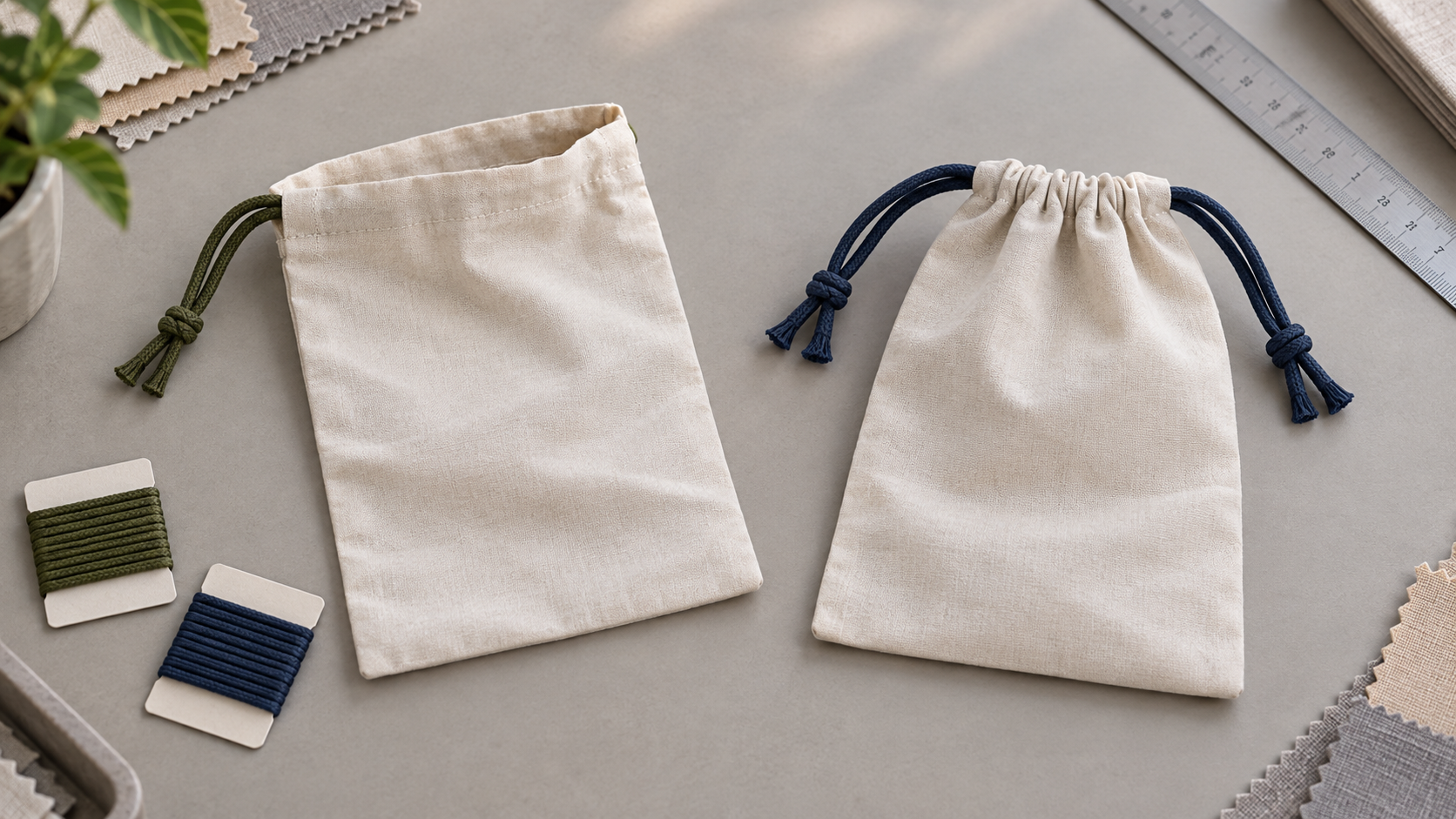
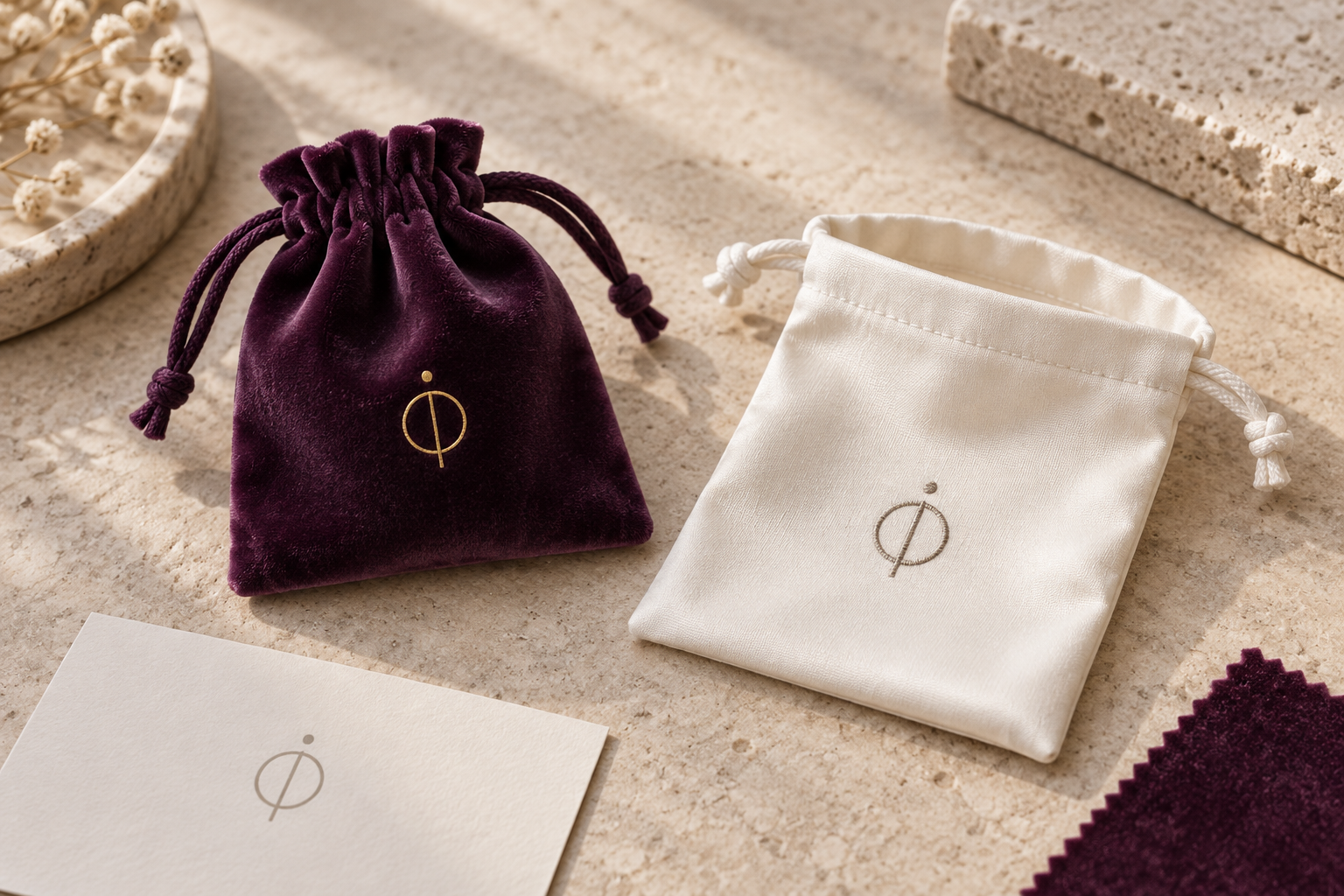
Image disclosure: this reference-guided AI visual was developed from an internal, unbranded company sample to reproduce realistic tunnel sewing, fabric drape, cord texture, and pouch proportions. The paired prototypes are an explanatory comparison, not current stock items, a customer order, or proof of a tested construction.
The Short Answer: Which Cord Configuration Should You Choose?
Choose single cord when the priority is a straightforward closure, fewer trim pieces, compact packing, or a one-side tie point. Choose double cord when the user should pull from opposite sides, the gathered mouth should look balanced, or the cords form part of a shoulder-carry or backpack system.
The phrase on a purchase order is not enough. A usable specification needs a route drawing showing the number of cords, number and position of exits, end finish, channel construction, open and closed cord lengths, and intended operation. Suppliers sometimes use “single drawstring,” “double drawstring,” and “double pull” differently.
| Decision factor | Single-cord pouch | Double-cord pouch | Buyer implication |
|---|---|---|---|
| Basic cord count | One continuous cord | Two independent cords | Confirm by diagram, not name alone |
| Typical exits | Both ends at one side | One pair at each side | Exit position changes seam and presentation |
| Closing action | Pull one end pair | Pull opposing end pairs | Test the intended user's hand movement |
| Gather appearance | Often directional | Usually more balanced | Approve closed-state photos and sample |
| Loose ends | Normally two | Normally four | More ends require more finishing and pack control |
| Tie behavior | One knot or bow location | Two side ties, or opposing pulls without tying | Define whether the closure must resist loosening |
| Component use | Lower cord consumption in comparable designs | More cord and handling steps | Price effects are project-specific |
| Common starting uses | Simple pouches, favors, light packaging | Gift pouches, dust bags, premium packaging, backpack formats | Use case still depends on size and construction |
First Define “Single Cord” and “Double Cord” Precisely
This article uses one clear convention for flat textile pouches:
- Single-cord construction: one cord travels through the full top channel; its two free ends emerge together at one defined side opening.
- Double-cord construction: two separate cords travel through the channel in opposite directions; two ends emerge at the left and two at the right.
Other valid systems exist. A single cord may use a stopper, a fixed loop, or separate channel segments. A drawstring backpack may route two long cords through the mouth and down to lower anchors. Some decorative gift bags have two ribbon ends that look like two cords but belong to one continuous ribbon. Put a labeled route sketch in the technical pack so the sample room, production team, and inspector read the same requirement.
| Specification field | What to record | Why wording alone fails |
|---|---|---|
| Cord quantity | One or two independent pieces | Four visible tails do not always reveal the hidden route |
| Route | Entry, travel direction, crossover, and exit | A photo may hide the back channel |
| Exit count | One, two, or another engineered arrangement | “Double pull” can describe action rather than cord count |
| Exit position | Side seam, front, back, center, or paired side openings | Placement affects gathering and artwork |
| Tail definition | Free tail, loop, tied pair, heat-cut end, aglet, or stopper | Finish changes length and safety review |
| Operating state | Fully open, nominally closed, tied, and carried | One cord length cannot describe every state |
For the broader relationship between cord material, tunnel clearance, guides, and reinforcement, use the drawstring cord, eyelet and reinforcement guide. This page concentrates on the configuration decision.
How the Cord Route Changes the Closing Motion
A one-sided pull draws fabric toward the single exit. On a soft, small pouch this can be quick and intuitive, but the first folds often form closest to the exit. A two-sided pull draws the cords away from one another. If the channels, cord lengths, friction, and exits are balanced, the gathers tend to distribute more evenly.
That does not mean every double-cord pouch closes perfectly. Unequal cord lengths, a caught seam allowance, inconsistent channel width, bulky junctions, or a rough cord surface can cause one side to stop early. Likewise, a correctly engineered single-cord pouch can look clean when its material, channel, and tie point are matched to the size.
Approve the action, not a still image. Ask the sample reviewer to open the bag fully, insert the intended item, close it by the intended method, and repeat the cycle. Record whether the user pulls one side, both sides, one cord pair after the other, or both simultaneously.
Closure Symmetry and the Finished Presentation
Double cords often suit gift and retail packaging because opposing pulls can center the gathered crown. The cord pairs can also frame the pouch visually. Single cords create a deliberate tie point at one side and may suit informal, utility, or favor packaging where speed and simplicity matter more than bilateral symmetry.
Material behavior can outweigh cord count. Thick canvas needs room to form larger folds. Velvet pile increases friction and bulk. Lightweight polyester may gather into many small pleats. Non-woven polypropylene can crease rather than drape. A lining adds another layer inside the tunnel if it is carried into the channel. Compare constructions in the actual material instead of approving a cord route on a substitute fabric.
Opening Width and Product Access
The bag must open far enough for the product's widest insertion angle. A single-cord system can leave its knotted side close to the opening edge; an oversized knot, stopper, or short tail may limit how far the mouth spreads. A double-cord system introduces two side cord pairs, which can create more bulk at both ends but may distribute the opening movement.
Specify clear opening, not just finished bag width. Clear opening is the usable access dimension after seams, channel turns, cord diameter, knots, and hardware are present. Test rigid cartons, ring boxes, shoes, bottles, or gift sets in their real packing orientation. The drawstring bag size and capacity guide explains why external dimensions and usable capacity are different.
| Access check | Single cord: likely watchpoint | Double cord: likely watchpoint | Evidence to approve |
|---|---|---|---|
| Full opening | Knot or stopper blocks one end | Cord bulk at two ends | Measured clear opening |
| Product insertion | Side pull catches a wide item | Two pairs fall into the mouth | Timed pack-out with actual item |
| Closing clearance | Contents sit inside the one-sided gather zone | Tall contents prevent centered closure | Closed, filled sample photo |
| Reopening | User must find the correct side | User must separate the paired cords | Repeated user trial |
| Presentation | Tie point is intentionally off-center | Both gathers appear balanced | Approved front, back, and side views |
One-Handed and Two-Handed Use
Single cord is not automatically “one-handed.” A user may need one hand to hold the pouch and another to pull the tails. However, the action is concentrated at one location, which can be useful at a packing line or for a small favor pouch.
Double cord normally invites a two-handed opposing pull. That can be satisfying and controlled, yet less convenient when the user is holding the product, wearing gloves, or working in a fast fulfillment environment. If one-handed operation is a requirement, define a test task rather than relying on a marketing adjective: where is the pouch placed, what is inside, which hand is available, and must the bag also be tied?
Tying, Cord Locks, and Reopening Security
A drawstring gathers the mouth; it does not necessarily lock it. Smooth cords can relax after pulling. A bow can hold the appearance but adds a user step. A cord lock can control slippage but introduces hardware, compatibility, safety, appearance, and recycling questions.
For a single cord, buyers may specify one knot, bow, toggle, bead, or cord lock at the side exit. For double cords, they may leave both pairs knotted, tie each side, or rely on opposing tension. Do not assume a drawstring is tamper-evident or spill-proof. If containment matters, develop an order-specific closure test with the actual contents and handling orientation.
| Closure intent | Practical configuration | Detail to define |
|---|---|---|
| Decorative side bow | Single ribbon or cord | Bow size, tail length, orientation, and pack method |
| Balanced premium gather | Two opposing cords | Equal exposed lengths and side-knot appearance |
| Quick repeatedly opened pouch | Either, with low-friction route | Pull force, reopening method, and cycle target |
| Adjustable utility closure | Cord plus compatible lock | Cord diameter, lock force, part material, and applicable safety review |
| Product containment | Either only after validation | Contents, orientation, agitation, and acceptance criteria |
Cord Tails, Knots, and End Finishing
Double cord usually creates more exposed ends. That affects labor, knot consistency, heat cutting or aglet application, loose-fiber control, entanglement during packing, and the closed visual balance. A single-cord pouch reduces the number of tail pairs but concentrates the visible finish on one side.
The specification should state whether length is measured before or after knotting, from the channel exit to the raw end, or from the exit to the knot. For synthetic cords, a sealed end may reduce fraying, but the process and resulting hardness should suit the design. For cotton cords, a folded, stitched, wrapped, capped, or knotted finish may be considered. End treatment remains subject to material, appearance, intended user, target-market requirements, and written approval.
Channel Design for One or Two Cords
The tunnel must accommodate the selected cord quantity, diameter, surface texture, seams, and fabric thickness without excessive drag. Two cords sharing one channel require different clearance from one cord. Simply doubling a cord diameter does not calculate the correct channel height because the cords change position as they slide and pass seam intersections.
Define whether the top uses one continuous turn-back channel, separate front and back channels, folded tabs, or a lined tunnel. Note where the route crosses side seams and how raw edges are controlled. A channel that is visually neat while empty may bind once the mouth gathers.
| Channel variable | What can go wrong | Sample/QC question |
|---|---|---|
| Finished tunnel height | Cord binds or feels loose and bulky | Does every approved cord slide through the production tunnel? |
| Side-seam intersection | Seam allowance catches a cord | Is the inside path clear at both ends? |
| Lining turn | Layers create local thickness | Does gathering remain even through the layered area? |
| Opening finish | Fabric frays or rubs the cord | Are edges secured and visually acceptable? |
| Stitch position | Needle catches or narrows the route | Is the stitch line consistent along the channel? |
| Cord crossover | Two cords twist or stack | Can the pouch complete the defined cycles without jamming? |
Side Exits, Buttonholes, Guides, and Eyelets
A soft pouch may use finished channel openings or reinforced buttonhole-style exits. Other designs use metal or plastic eyelets. The correct solution depends on fabric, layers, cord, aesthetics, load, manufacturing method, target market, and expected service.
Double cords create exits on two sides under this article's convention; single cord creates one grouped exit. Each opening is a possible wear point. More openings do not automatically mean lower durability, but they add locations that must be cut, finished, positioned, and inspected. If an eyelet is selected, confirm inside diameter, flange shape, material, plating, setting, washer/backing arrangement, and pull direction on the complete sample. Do not treat an eyelet alone as reinforcement.
Branding Area and Logo Distortion
Cord choice changes where folds form. A one-sided pull may move the deepest gathers toward the exit; two opposing pulls may compress the top panel more evenly. Either system can distort artwork placed too close to the functional closure zone.
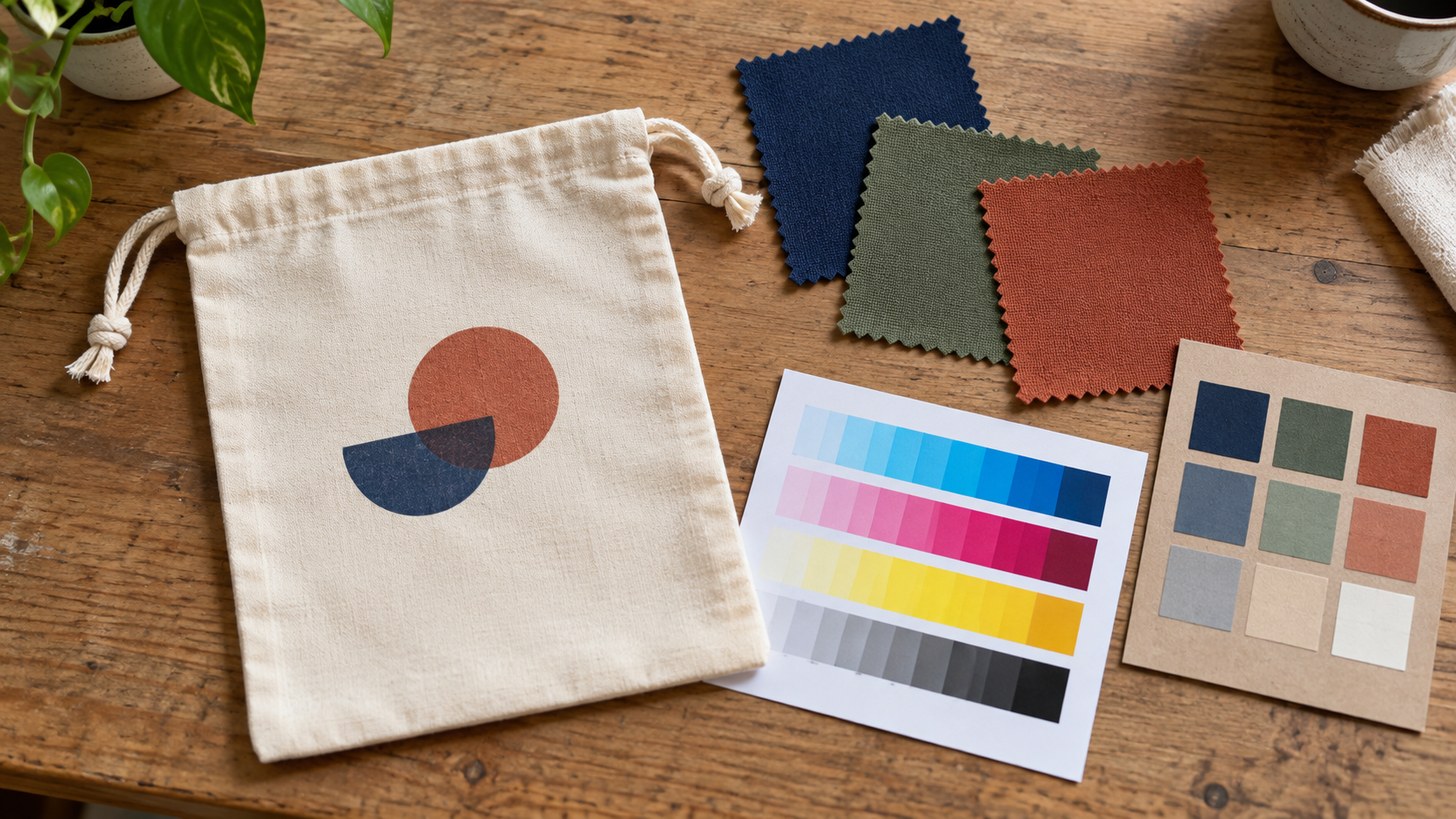
Keep critical logo elements below the approved gather line and away from side seams, exits, or backpack anchors. Review the decoration in four states: empty and flat, filled and open, filled and closed, and packed after carton compression. The approved artwork record should include dimensions, coordinates, color reference, application method, and viewing priority. Broader material-print compatibility is covered in best materials for custom drawstring bags.
Small Gift, Jewelry, and Favor Pouches
For a small pouch, cord diameter and knot size consume a surprisingly large share of the design. Single cord can keep the construction compact and offer one deliberate bow position. Double cord can produce a balanced, premium-looking closure, especially when both side ties are part of the presentation.
The decision should begin with the packed object. A rigid jewelry box needs enough clear opening; loose jewelry may need an insert or lining; a wedding favor program may prioritize rapid filling and consistent bow presentation. If a cord, ribbon, bead, or metallic tip could contact a sensitive product, state the contact requirement during development rather than assuming the trim is suitable.
Shoe Bags, Dust Bags, and Product Covers
Larger protective pouches often benefit from double-side pulling because the user can spread the opening and gather the mouth across a wider span. A single cord may still be suitable when the cover lies flat, closure precision is low, or a one-side tie is preferred.
Evaluate the item surface, abrasion risk, product insertion, closure clearance, and storage orientation. A soft dust bag should not be described as impact protection. If a luxury presentation is required, inspect seam visibility, cord shade, end finish, logo position, and closed silhouette under agreed lighting.
Promotional Pouches and Event Packs
Promotional programs may value fast pack-out, compact cartons, repeatable branding, and controlled unit cost. Single cord can reduce trim consumption and tail handling in an otherwise comparable pouch. Double cord may improve perceived finish or allow a distinctive two-side pull, but it adds cord length and finishing operations.
Calculate the effect with a common specification. A lower unit quote is not comparable if another supplier assumes lighter fabric, shorter tails, a different print, fewer knots, or looser inspection. For commercial variables, consult the 2026 custom drawstring bag pricing guide and the guide to reducing drawstring bag cost without sacrificing quality.
Drawstring Backpacks Are a Separate Load Case
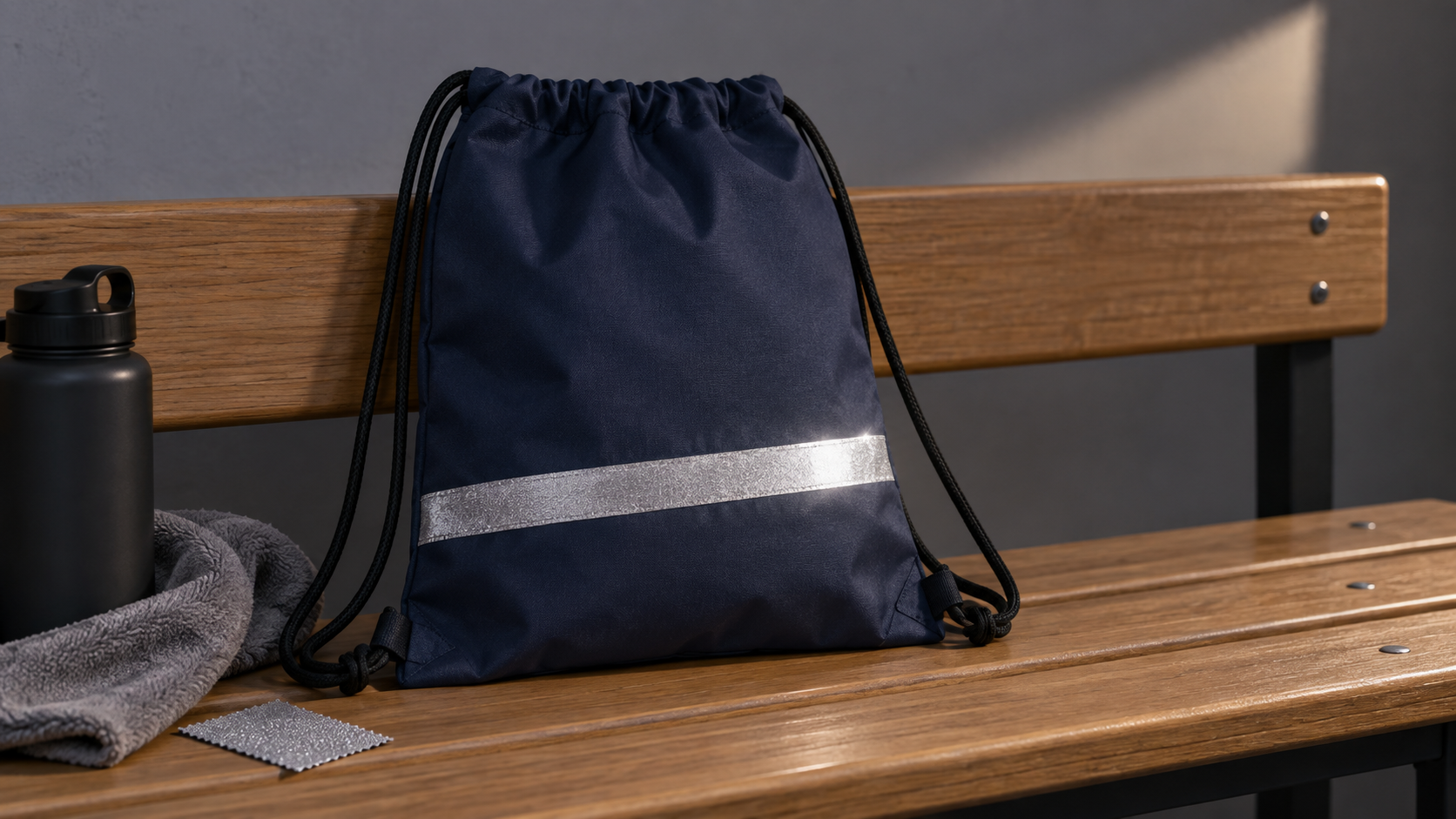
In a backpack-style bag, cords are both closure components and shoulder straps. The two-cord route usually continues from the top channel to lower corner anchors. Cord length, user fit, abrasion, knot or anchor security, lower reinforcement, seam load, and intended contents must therefore be specified together.
Do not transfer conclusions from a small gift pouch to a backpack. A cord that feels attractive in hand may be uncomfortable on the shoulder. An eyelet suitable as a guide may not resist repeated angled loading. Define the intended load and handling cycle, then inspect the assembled bag. The cord-count label does not establish a safe load.
Cord Material and Diameter Must Match the Configuration
Cotton braid, polyester cord, nylon cord, ribbon, twisted rope, and flat tape differ in compressibility, friction, stretch, surface appearance, fraying, and compatibility with end finishing. Even cords with the same nominal diameter can behave differently in the same tunnel.
Choose material and construction together. A thick soft cord can look premium but crowd a double-cord channel. A smooth synthetic cord can pull easily but may need a suitable knot or lock. A flat tape can resist twisting visually but requires a route that prevents rolling. For polyester fabric choices, see polyester vs nylon drawstring bags and 210D vs 420D vs 600D polyester drawstring bags.
Material Weight Does Not Decide Cord Count
Heavy fabric does not automatically require double cords, and light fabric does not automatically suit single cord. Fabric weight is only one input. Weave, coating, layer count, stiffness, tunnel construction, pouch width, intended contents, and user motion all affect performance.
Cotton and canvas need composition, weave, finish, and weight details. Synthetic fabrics need their own article, construction, coating, and density information; denier describes yarn linear density rather than finished fabric weight. Non-woven material is normally specified by composition, GSM, bonding, and construction. Compare relevant routes in cotton vs canvas drawstring bags or the non-woven drawstring bag GSM and construction guide.
Sampling: Compare Like With Like
The cleanest comparison uses two prototypes with the same body size, material lot, seam, channel, decoration, and packing. Change only the cord system. This reveals what cord count actually changes without confusing it with a different fabric or pouch shape.
| Sample stage | What to compare | Record to retain |
|---|---|---|
| Route mock-up | Cord path, exits, crossover, and end count | Marked drawing and sample photo |
| Undecorated prototype | Opening, closing, gathering, clear access | Cycle notes and dimension sheet |
| Decorated sample | Logo behavior in open and closed states | Artwork coordinates and approved photos |
| Loaded sample | Product fit, containment, carry or handling | Pack-out instruction and observed issues |
| Pre-production reference | Final fabric, cords, knots, labels, and packing | Approved specification and physical retain |
Use consolidated, measurable comments. “Cord feels wrong” should become a statement such as “left pair requires more force than right,” “tails differ after full closure,” or “knot blocks the specified clear opening.” The custom drawstring bag sample development process provides a stage-gate framework.
What to Put in the Tech Pack
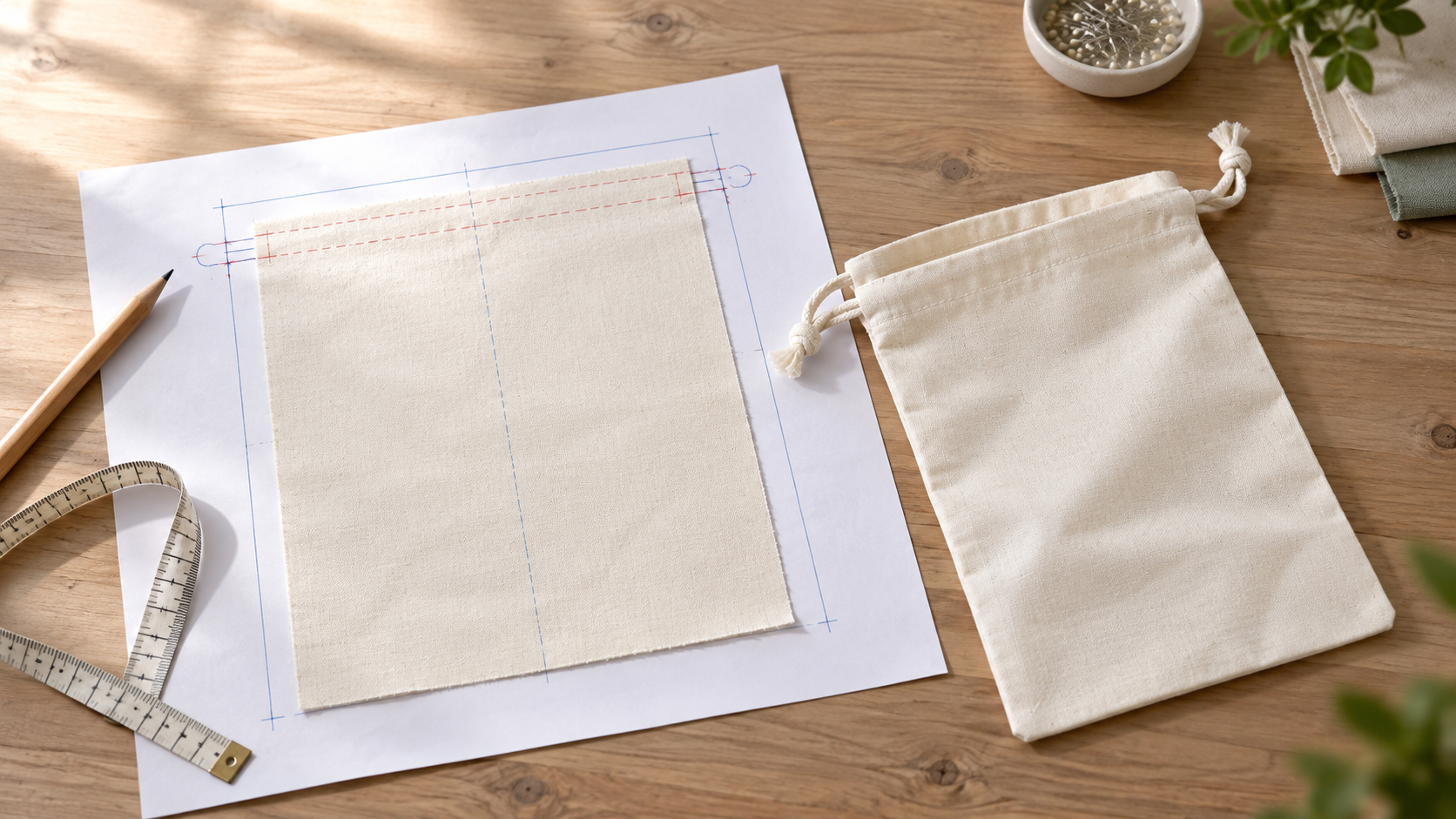
A close-up drawing of the top closure should accompany the general bag drawing. Show front and back channel segments, side seams, exits, cord route, knots, and every end. Use arrows for travel direction and numbered cords if the double-cord path could be misunderstood.
| Tech-pack field | Minimum useful detail |
|---|---|
| Body | Finished width, height, gusset/base, seam and material |
| Channel | Construction, finished height, stitch line, lining interface |
| Cord | Material, construction, color reference, nominal diameter/width |
| Route | Cord A and Cord B paths, exits, crossover, and pull direction |
| Length | Cut length and measurable exposed length in defined states |
| Ends | Knot, seal, aglet, wrap, stopper, or other approved finish |
| Function | Clear opening, closure endpoint, reopening method, cycles/load if required |
| Branding | Artwork size, position, process, and stable no-gather zone |
| Packing | Cord arrangement, fold, individual pack, and carton orientation |
Our custom drawstring bag tech pack guide explains how to control versions and measurement points.
Quality-Control Checklist for Single and Double Cords
Inspection should verify construction against the approved route, then confirm the finished system works. Counting visible tails alone will not detect a twisted, crossed, or incorrectly threaded cord.
| QC checkpoint | Inspection method | Possible defect |
|---|---|---|
| Cord identity | Compare material, color, construction, and approved sample | Wrong cord or shade |
| Cord quantity and route | Trace each cord from end to end | Missing, crossed, or misrouted cord |
| Exposed length | Measure in the defined open or closed state | Unequal or insufficient tails |
| End finish | Visual and gentle manual check | Fraying, sharp melt bead, loose knot |
| Channel | Open-close function and internal visual check where possible | Binding, caught seam allowance, skipped stitch |
| Exit finish | Inspect position, edge security, and symmetry | Fraying, tearing, off-position opening |
| Gather | Close to the approved endpoint | Lopsided or incomplete closure |
| Reopening | Repeat the agreed motion | Sticking, twisting, user confusion |
| Loaded function | Use the agreed product or test load | Slippage, seam distortion, anchor movement |
| Pack-out | Unpack after the agreed compression period | Cord tangling, marks, or deformed knots |
For defect classification, sampling, and release rules, integrate these checks into a custom bag quality inspection checklist.
Functional Testing and What ISO Methods Do—or Do Not—Prove
A project may need several different tests: cord pull smoothness, open-close cycling, end-finish retention, exit pull, seam strength, loaded carrying, abrasion, or pack recovery. Define the sample condition, direction, speed or cycle, applied mass or force, duration, failure criterion, and number of samples. “Passed pull test” is too vague for an order record.
ISO 13935-2:2026 describes a grab method for determining maximum force to rupture sewn seams, mainly for woven textile fabrics and specified straight seams. It can inform a laboratory seam evaluation when applicable, but it is not a universal whole-bag, cord-anchor, or safe-load certification. ISO 13934-1:2013 covers strip-method maximum force and elongation of fabrics within its stated scope; it does not by itself validate a finished drawstring bag.
Select a method that matches the actual risk, and agree on acceptance before production. A result for one material, size, seam, cord route, or batch must not be extended to another construction without technical justification.
Common Failure Modes and Corrective Questions
| Symptom | Likely variables to investigate | Corrective question |
|---|---|---|
| Single cord gathers only near exit | Friction, route, fabric stiffness, short cord | Does the cord move freely through the far side of the tunnel? |
| Double cord closes unevenly | Unequal lengths, crossover, seam obstruction | Are Cord A and Cord B routed and measured identically? |
| Mouth will not open fully | Knot/stopper bulk, short length, narrow channel | What clear opening was approved with the product? |
| Cord frays at exit | Rough edge, incompatible finish, angled pull | Is the exit construction suitable for the cord and motion? |
| Tail length varies | Undefined measurement state, knot variation | Is length measured open, closed, before knot, or after knot? |
| Logo wrinkles badly | Artwork too close to gather zone | Was decoration approved on a filled, closed sample? |
| Cords tangle in cartons | Long loose tails, inconsistent bundling | What cord lay and fold are shown in the packing instruction? |
| Backpack anchor distorts | Load path, reinforcement, cord angle | Was the full loaded assembly tested to agreed criteria? |
Correct the specification or process variable that causes the failure. Adding a thicker cord, a metal eyelet, or an extra stitch without diagnosing the load path can move the problem elsewhere.
Packing and Carton Implications
Long double-cord tails can cross adjacent units, catch on polybags, or leave pressure marks on soft fabric. Single-cord knots can create a localized lump if all pouches are stacked in the same orientation. Either configuration needs an approved packing method.
Possible controls include alternating knot direction, laying cords inside a defined fold, using a temporary paper band when suitable, separating delicate surfaces, and checking recovery after the intended compression period. Do not tie a display bow for shipping unless the customer expects the extra labor and the bow survives transport. Verify pack quantity, carton dimensions, gross mass, fold sequence, and cord presentation as one pack-out system.
Cost, MOQ, and Lead-Time Differences
All else equal, double cord normally consumes more cord and may require more threading, end finishing, and packing control. That does not mean its total unit price is always meaningfully higher. Fabric, decoration, lining, hardware, size, quantity, color split, inspection, packaging, and shipping can have larger effects.
MOQ may be driven by cord color production, fabric, print setup, packaging, or an efficient assembly run rather than cord count itself. Lead time begins from agreed commercial and approval conditions, not merely the first inquiry date. LUCKYSTAR does not publish one universal MOQ, price, or delivery promise for every drawstring bag; terms require the confirmed specification and written quotation. See custom drawstring bag MOQ and production time for the dependency map.
Sustainability and Compliance Claims
Using one cord instead of two may reduce cord consumption in a comparable design, but that alone does not establish lower life-cycle impact. Material composition, finished mass, durability, reuse, repair, packing, transport, and end-of-life route all matter. Additional hardware can complicate material separation; a short-lived “minimal” design can also waste the complete bag.
Do not call a cord, pouch, or finished product recycled, organic, biodegradable, compostable, non-toxic, or certified without evidence tied to the exact material, supplier chain, scope, validity, and order. LUCKYSTAR's historical and upstream documents do not constitute universal current certifications for the company or every drawstring bag. State the target claim during quotation so the evidence route can be checked before materials are approved.
Why Choose LUCKYSTAR for a Cord-Configuration Project?
LUCKYSTAR, operating on the independent website as Ningbo Luckystar Commodities Co., Ltd., supports OEM/ODM development for custom bag and textile-packaging projects. For a single-cord versus double-cord decision, the practical value is coordinated interpretation across the drawing, sample, materials, decoration, production follow-up, quality plan, and packing instruction.
The team can help buyers:
- translate “single pull” or “double pull” into a traceable cord-route specification;
- compare samples with the same body construction so cord count is the controlled variable;
- align clear opening, gather line, logo area, cord finish, and packed presentation;
- document approval comments for production and future reorders;
- discuss inspection checkpoints and order-specific testing before bulk release; and
- connect the product brief with quantity, packaging, destination, and required arrival information.
Capabilities, materials, commercial terms, testing, and schedules remain subject to project feasibility, supplier confirmation, quantity, approval status, and written agreement. Evaluate category experience with our guide on choosing a custom drawstring bag manufacturer. To compare operating responsibilities across bag categories, continue to the Custom Bag Manufacturer guide. The separate drawstring bag manufacturing process then tracks an approved brief from development into delivery.
RFQ Checklist: Get Comparable Quotes
| RFQ item | Information to provide |
|---|---|
| Product and use | Contents, user, presentation, carrying, and reuse expectations |
| Bag shape and size | Width, overall/usable height, gusset/base, clear opening, tolerances |
| Body materials | Composition, construction, weight/thickness, color, lining, inserts |
| Cord configuration | One cord or two, route diagram, exits, pull direction |
| Cord specification | Material, braid/weave, diameter/width, color, cut and exposed length |
| End and exit finish | Knots, seals, aglets, locks, buttonholes, guides, or eyelets |
| Branding | Artwork file, method, dimensions, coordinates, closed-view requirement |
| Performance | Opening cycles, intended load, containment, abrasion, or market test |
| Quantity | Total, color/SKU split, sample quantity, expected repeat plan |
| Packing and logistics | Cord lay, folding, individual pack, carton, destination, required arrival |
| Evidence | Required material, test, claim, inspection, and shipment documents |
If the order will ship internationally, connect the RFQ to the documentation, Incoterms, inspection, and landed-cost steps in how to import custom drawstring bags from China. If you are deciding how much design support is required, compare OEM vs ODM drawstring bag manufacturing.
Frequently Asked Questions
Is a double-cord drawstring bag stronger than a single-cord bag?
Not automatically. Strength depends on the complete system: fabric, channel, seams, exits, cord, knots or anchors, load direction, construction quality, and test method. Two cords may distribute the closing action, but cord count alone does not establish a safe load.
Does double cord close more securely?
It often gives a balanced opposing pull, but security depends on friction, knot or lock, contents, orientation, and handling. A gathered mouth is not inherently spill-proof or tamper-evident. Validate the intended containment task.
Is single cord cheaper?
In an otherwise identical bag, it generally uses less cord and fewer end-finishing operations. The actual price difference may be small or material depending on cord, size, labor, quantity, packing, and the rest of the specification. Compare written, like-for-like quotes.
Which option is easier to open?
Either can be easy when cord friction, channel clearance, tail length, and route are correct. Single cord concentrates the action at one side; double cord asks the user to manage two sides. Test with the intended user and packed product.
Which option looks more premium?
Double cord is often chosen for balanced gathers and paired side ties, while a single ribbon bow can also create a deliberate premium presentation. Fabric, cord quality, seam finish, logo, proportion, and packing may influence perceived quality more than cord count.
Can a single cord be used on a drawstring backpack?
It is possible to engineer alternative systems, but the typical backpack uses two cords that close the mouth and continue to lower anchors as shoulder straps. A backpack is a load-bearing use case and needs its own route, fit, reinforcement, and testing specification.
How should cord length be measured?
Define the bag state and endpoints. Record cut length for production and exposed tail or loop length in a specified fully open or fully closed condition. State whether the measurement includes the knot, seal, aglet, or lock.
Can I convert an approved single-cord pouch to double cord without a new sample?
That change can alter tunnel clearance, exit count, cord consumption, gather pattern, artwork behavior, and packing. Make and approve a revised sample before bulk production rather than treating it as a trim-only substitution.
What should an inspector check first?
First verify the approved cord count and route. Then check cord identity, lengths, ends, exits, tunnel condition, opening, closure, gather balance, loaded function, decoration, and packing against the agreed sample and specification.
Can LUCKYSTAR recommend single or double cord for my product?
LUCKYSTAR can review your contents, size, material direction, presentation, user action, quantity, branding, packing, destination, and timing to discuss a suitable development route. The final construction and commercial conditions are subject to sample approval and written confirmation.
Final Recommendation
Specify what the user must do before choosing the cord count. If the pouch needs one concentrated tie point, compact trim, and simple presentation, begin with a single-cord sample. If it needs opposing pulls, balanced gathering, or cords that participate in carrying, begin with a double-cord construction. Then verify clear opening, closed appearance, tail lengths, logo stability, function, and packing on the finished material.
Send LUCKYSTAR your product dimensions, intended use, bag size, material, artwork, quantity, cord-route sketch, packing requirements, destination, and required arrival date. The team can review the brief for a project-specific custom drawstring bag quotation.