Polyester vs Nylon Drawstring Bags

Last reviewed: September 16, 2026
Polyester and nylon can both produce effective custom drawstring bags, but neither fiber is automatically stronger, more waterproof, more sustainable or more suitable for printing. For many promotional and event programs, polyester is the practical first sample because it offers broad construction and decoration choices. Nylon becomes attractive when a softer hand, compact packing or a tougher-feeling technical fabric is important. The final result still depends on yarn size, fabric construction, density, finish, coating, seams, drawcord and reinforcement.
The safest buying decision is therefore an equal-specification comparison. Put two materials into the same bag dimensions, closure design, artwork and test plan; then evaluate the finished samples against the intended use. This guide shows how.
Review LUCKYSTAR's custom drawstring bag range for possible starting formats. For broader sourcing decisions, combine this article with the custom bag manufacturer pillar guide and how to choose a custom drawstring bag manufacturer.
Need a matched polyester-versus-nylon comparison? Send the packed item and load, use cycle and contact surfaces, bag format and dimensions, target handfeel, colour and finish, cord and reinforcement, artwork and decoration, quantity by SKU, exposure and cleaning conditions, required claims or tests, pack-out, destination and target date. LUCKYSTAR can return comparable construction options, sample stages and a finished-bag test checklist.
Quick Verdict: Polyester or Nylon?
Choose polyester as the first sample route when your priorities are promotional printing, stock color availability, lower moisture uptake, outdoor color stability or a recycled-polyester option that can be documented. Choose nylon as the first sample route when a softer drape, compact technical feel or abrasion-focused application is more important.
That is a screening rule, not a purchase specification. A dense polyester ripstop can outperform a lightweight nylon taffeta in one test, while a well-built nylon fabric can outperform a loosely constructed polyester in another. Compare actual quoted fabrics and finished bags.
| Decision factor | Polyester direction | Nylon direction | What the buyer must verify |
|---|---|---|---|
| Typical first-use case | Promotions, events, sports sacks, foldable storage | Technical, travel, premium lightweight or abrasion-focused bags | Actual product, load and expected use frequency |
| Hand and drape | Can feel crisp or smooth depending on construction | Often selected for a softer, more fluid technical hand | Swatch and finished sample, not fiber name |
| Moisture behavior | Usually lower moisture uptake | Generally absorbs more moisture than polyester | Drying, dimensional and color tests under intended conditions |
| Abrasion/toughness | Can be strong in suitable weave and density | Frequently chosen when toughness is prioritized | Comparable abrasion, tear and seam tests |
| UV/color exposure | Often a useful outdoor starting route | Performance varies by yarn, dye and stabilization | Exposure protocol and acceptance level |
| Decoration | Broad screen-print, transfer and sublimation routes on compatible fabric | Screen print, transfer, embroidery or specialty processes after compatibility testing | Actual artwork on production material |
| Recycled-content route | Recycled polyester is widely specified in textile programs | Recycled nylon routes also exist but may differ in availability | Percentage, scope and chain documentation |
| Commercial fit | Often broad market availability | May carry a different material or dyeing cost | Quote on identical construction and quantity |
Polyester and Nylon Are Polymer Families, Not Finished Specifications
Polyester used in bags is commonly based on PET, while nylon is a polyamide family that includes different grades. Those names identify the fiber family, but they do not tell you how the finished cloth was made.
A purchasing specification still needs to define the yarn, weave or knit, fabric weight, density, color method, finish and any coating. “210D polyester” and “210D nylon” are incomplete descriptions because denier describes yarn linear density, not total fabric mass, weave tightness or finished strength.
Terms buyers often confuse
| Term | What it describes | What it does not prove |
|---|---|---|
| Denier (D) | Yarn linear density | Fabric GSM, weave density, strength or coating quality |
| GSM | Fabric mass per square meter | Yarn type, tear resistance or finished-bag durability |
| Ripstop | Grid-reinforced construction | That the fiber is nylon or that the cloth cannot tear |
| Taffeta | Lightweight plain-weave construction | One fixed fiber, denier or performance level |
| Oxford | A basket-weave-style fabric construction | A guaranteed composition or waterproof rating |
| Taslan | A textured-yarn appearance/route | Finished composition, coating or bag strength |
| PU-coated | A coating system has been proposed | Waterproof seams, coating durability or regulatory suitability |
If a supplier quote says only “nylon” or “polyester,” ask for the construction and finish behind the name. The best materials for custom drawstring bags guide provides a wider material-selection framework; this page goes deeper into the two synthetic woven routes.
The Real Comparison Is a Fabric System
Five layers usually determine how a polyester or nylon drawstring bag behaves.
- Fiber and yarn: polymer type, filament form, denier and recycled-content status where applicable.
- Fabric construction: plain weave, ripstop, Oxford, taffeta, mesh or another specified structure.
- Dye and finish: solution-dyed, piece-dyed or printed color; calendering, water-repellent finish or other treatment.
- Backing or coating: uncoated, PU-coated, laminated or another agreed build.
- Finished bag engineering: seams, lower-corner reinforcement, cord path, eyelets, thread and panel geometry.
Changing any one layer can reverse a general fiber-level expectation. Do not let a material comparison hide a construction difference.
Strength, Tear and Seam Performance
Buyers often hear that nylon is “stronger” while polyester is “stiffer.” These statements may describe common market impressions, but they are not acceptance criteria. Tensile strength, tear resistance and seam behavior depend on the exact yarn and fabric build.
Tensile strength is not bag load capacity
A laboratory strip test measures fabric behavior in a controlled direction. A loaded drawstring backpack concentrates force at the lower cord anchors, the channel exits and the side seams. The bag can fail at those points even when the shell fabric has a high tensile value.
Tear resistance is construction-sensitive
Ripstop reinforcement can help limit propagation after a small puncture, but grid size, yarn, density and coating all matter. “Ripstop” is not a promise that damage cannot spread.
Seam efficiency matters
Needle selection, stitch density, seam allowance and thread must suit the fabric. Closely spaced needle holes can weaken or pucker a light coated cloth. An apparently heavy shell may still pull away from a narrow seam.
| Load path | Common risk | Sample or production check |
|---|---|---|
| Lower cord corner | Concentrated pull tears tab or shell | Static and repeated loaded lifts |
| Top draw channel | Cord abrades fold and exit | Open/close cycling with inspection |
| Side seam | Seam slippage or stitch rupture | Loaded seam review and dimensional check |
| Bottom fold/seam | Product edge creates a local stress point | Pack the real item and cycle handling |
| Cord knot/end | Knot moves or end frays | Pull test plus end-finish inspection |
Abrasion: Why Nylon Often Enters the Shortlist
Nylon fabrics are frequently shortlisted for abrasion-sensitive travel and utility applications. That tendency does not guarantee that any nylon bag will outlast any polyester bag. Surface texture, filament type, weave, coating and contact geometry can dominate the outcome.
Define what rubs against what. A gym bag may abrade against clothing and floors; a product pouch may rub a polished item internally; a cord can saw against the channel from the inside. These are different wear mechanisms and may require different tests.
For an abrasion-focused comparison, ask the supplier to submit both fabrics at similar mass and construction, then test the finished panels and critical seams. Record fuzzing, glazing, coating loss, holes, color change and seam damage—not just the number of cycles.
Moisture Uptake and Drying Behavior
Polyester generally takes up less moisture within the fiber than nylon. Nylon tends to absorb more, which can influence drying time, handfeel and dimensions in humid or wet conditions. Coatings and finishes can reduce surface wetting, but they do not erase every effect of the underlying material or construction.
What this means in real use
- For sports and outdoor distribution, polyester may be a useful starting point when quick drying and lower moisture uptake matter.
- Nylon can still perform well, but the sample should be conditioned and remeasured if dimensional change is relevant.
- A wet surface may result from water entering through seams or the draw opening even if the fabric face sheds droplets.
- Trapped moisture around the packed product is a use-case issue, not simply a fiber issue.
Neither material should be advertised as waterproof based on its name. Specify the test, pressure or spray exposure, duration, seam treatment and acceptable leakage.
Water Resistance Depends on Finish and Construction
Uncoated woven polyester and nylon are not automatically water-resistant at a commercially meaningful level. A durable water-repellent surface treatment, calendering, coating or lamination can change behavior, but so can wear, folding, washing and heat.
| Water-related requirement | Specification question | Verification idea |
|---|---|---|
| Occasional light rain | Is water repellency enough, and for how long? | Agreed spray exposure before and after conditioning |
| Wet ground contact | Which side is coated, and where are seams located? | Contact test with loaded bag |
| Internal moisture protection | Are seams and channel openings part of the barrier? | Finished-bag leakage observation |
| Repeated cleaning | How does the finish change after cleaning cycles? | Retest using the proposed care method |
| Regulatory claim | What wording and market-specific evidence are required? | Document review before artwork approval |
Do not add “waterproof” to the artwork until the complete bag—not only a swatch—has passed an agreed protocol.
UV Exposure, Color and Outdoor Use
Polyester is often preferred as an outdoor starting material because suitable polyester systems can provide useful color and UV behavior. Nylon performance can also be engineered, but shade, dye, additives and exposure conditions affect the result.
Outdoor suitability needs a defined use pattern: hours of exposure, geography, season, color, temperature, wet/dry cycling and acceptable fading. Dark and fluorescent shades may behave differently from a neutral color. If the bag is for one-day event distribution, the requirement is not the same as daily outdoor sports use.
Ask for a colorfastness or exposure test suited to the program. An accelerated test is a controlled comparison, not a guaranteed conversion into years of service.
Handfeel, Drape and Noise
Material selection is also sensory. Nylon is often chosen for a smooth, supple or premium technical feel. Polyester can range from crisp and economical to soft and high-density. Yarn texturing, weave, calendering and coating influence both more than the fiber label suggests.
Evaluate the filled shape
A flat swatch cannot show how the bag hangs when worn. Fill each sample with the actual product weight and photograph the front, side and back. Look for corner sagging, sharp creases, excessive billowing and the way the print distorts.
Listen to the material
Some lightweight coated fabrics create a noticeable rustle. That may be acceptable for sports use but undesirable for premium packaging. Include sound and handfeel in the approval notes if they affect the brand experience.
Polyester vs Nylon for Printing
There is no single “best printing method” for all polyester or nylon. Surface finish, color, heat sensitivity, stretch, coating and artwork determine the process.
Screen printing
Screen printing can suit bold logos on compatible polyester and nylon. The ink system and pretreatment must match the fabric. Test adhesion, opacity, flexibility and rub behavior. Dark fabrics may need an underbase, which can change handfeel and curing requirements.
Heat transfer
Transfer processes can reproduce detailed or multicolor artwork, but temperature and pressure may mark calendered surfaces, soften coatings or distort light fabrics. Approve the transfer on the actual production lot or an agreed equivalent.
Dye sublimation
Sublimation is naturally associated with suitable polyester because the dye process interacts with polyester under heat. It can support all-over graphics when the fabric and construction are designed for it. Standard sublimation should not be assumed to work on nylon; specialty routes require separate validation. White base fabric, color conversion, heat shrinkage and show-through need attention.
Embroidery and patches
Embroidery can add perceived value but introduces needle holes, backing and concentrated stiffness. A lightweight sack may pucker or hang unevenly. A patch or label can be a better choice when the shell surface resists direct print, but attachment must still pass tear and wash/rub checks.
| Decoration route | Polyester checkpoint | Nylon checkpoint | Approval evidence |
|---|---|---|---|
| Screen print | Dye migration, cure and surface treatment | Adhesion and coating compatibility | Actual-size strike-off plus rub test |
| Heat transfer | Migration, gloss marking and shrinkage | Heat sensitivity and bonding | Decorated construction sample |
| Sublimation | Base color, heat stability and artwork repeat | Specialty compatibility only if proposed | Process-specific trial; no assumption |
| Embroidery | Puckering and backing visibility | Needle damage and distortion | Finished logo sample under load |
| Woven label/patch | Attachment and edge stiffness | Attachment and tear initiation | Pull and appearance checks |
Color Approval and Dye Migration
The same digital color file will not look identical on a blue ripstop polyester and a gray nylon. Texture, gloss, fabric shade and the decoration system influence perceived color.
For brand-critical work, use a physical color reference and an approved decorated sample. State the viewing light, location and tolerance. If a light-colored graphic is applied to a dark synthetic fabric, check whether dye moves into the decoration during heat exposure, storage or aging. Packaging samples under proposed carton conditions can reveal problems that a fresh desk sample does not.
Drawcord, Channel and Wearing Comfort
A drawstring backpack is a closure and a carrying system at the same time. The cord slides through the top channel, then transfers the load to the lower corners. Material and cord must therefore be tested together.
Channel friction
A coated or textured fabric can make the opening harder to close. Channel height, folded layers, stitch line and cord diameter determine the sliding path.
Cord comfort
Thin round cords concentrate pressure on the shoulder. A larger or flatter cord can improve comfort but requires more channel space and may increase bulk. Cord stretch can change how the bag sits when loaded.
Lower-corner reinforcement
Grommets, fabric tabs, triangular patches and enclosed cord channels create different load paths. The shell, patch and seam must work as a system. A strong nylon body does not compensate for a weak tab attachment; neither does a dense polyester shell.
The drawstring bag manufacturing process connects these design choices with material booking, sampling and bulk controls.
Which Material Fits Each Use Case?
Use the following table to create a sample shortlist. It deliberately avoids declaring a universal winner.
| Application | Polyester route may suit when… | Nylon route may suit when… | Critical validation |
|---|---|---|---|
| Mass event giveaway | Print visibility, stock colors and efficient packing lead | A softer technical feel justifies the material choice | Print, pack-out, cord safety and arrival date |
| Gym or sports sack | Quick drying and graphic options are priorities | Tough handfeel and abrasion performance lead | Loaded wear, sweat/moisture context and cleaning |
| School program | Color consistency and decoration repeatability lead | Compactness and surface toughness lead | Age group, load, cord design and applicable rules |
| Travel organizer | Shape recovery and color stability lead | Soft drape and packability lead | Zippers/cords, rubbing and repeated compression |
| Footwear dust bag | Low bulk and simple branding lead | Smooth touch and abrasion protection lead | Product-surface contact and breathability need |
| Outdoor campaign | UV/color and low moisture uptake lead | Specific technical construction has tested better | Exposure, water, seam and wear protocol |
| Premium technical gift | Clean surface and custom color lead | Nylon handfeel supports the desired experience | Touch, sound, decoration and carton recovery |
| Recycled-content program | Documented recycled-polyester route is available | Documented recycled-nylon route fits the brief | Percentage, scope, validity and chain evidence |
Build an Equal-Spec Sample Comparison
The most reliable comparison controls everything except the material under study.
- Use the same finished dimensions and tolerance.
- Keep panel pattern, seam allowance and lower-corner design constant.
- Use the same cord construction, diameter and length.
- Apply the same artwork at the same size and position.
- Pack the same test load and repeat the same handling cycle.
- Condition both samples in the same environment before measurement.
- Record appearance, function and test results on one scorecard.
If equal construction is impossible because one fabric requires a different seam or channel, document the change.At that point, you are comparing two optimized bag systems—which may be more useful commercially than comparing raw materials alone.
Use the custom drawstring bag sample development process to control sample versions and approval status.
Testing Matrix for a Buyer-Specific Decision
Tests should correspond to the packed product and use environment. Agree on the method, conditioning, sample count and pass/fail rule before production.
| Property | Why it matters | Compare or inspect |
|---|---|---|
| Material identity | Prevents fiber substitution | Supplier document and, where needed, laboratory identification |
| Fabric mass/density | Controls feel and lot consistency | Agreed GSM/density or construction measurement |
| Tensile/tear behavior | Screens shell performance | Same specimen direction and method for both options |
| Abrasion | Represents surface wear | Face, back and/or product-contact surface as relevant |
| Seam strength/slippage | Connects cloth to bag construction | Finished seam from production-equivalent sample |
| Draw cycling | Reveals channel and cord wear | Defined open/close cycles under agreed load |
| Loaded carry | Tests the whole load path | Mass, duration, lift cycles and deformation |
| Colorfastness | Controls rubbing, moisture and exposure effects | Dry/wet rub plus relevant light or water test |
| Print adhesion/migration | Protects brand appearance | Rub, fold, heat/storage and stretch checks |
| Dimensional stability | Matters after conditioning or care | Before/after dimensions using stated method |
| Water performance | Required only for a defined claim/use | Fabric face and complete bag, including seams |
| Packing recovery | Predicts delivery appearance | Proposed folding, carton compression and recovery time |
For final inspection planning, see the custom bag quality inspection checklist.
What to Put in the Tech Pack
Do not allow “polyester” or “nylon” to stand alone in the bill of materials.
| Tech-pack field | Example of the required level of detail |
|---|---|
| Shell composition | Fiber family and percentage, including recycled-content scope if applicable |
| Yarn/construction | Denier plus weave/knit type and density reference |
| Fabric mass | Target GSM or other applicable value with tolerance |
| Finish/backing | Uncoated, calendered, PU-coated or other explicitly approved route |
| Color | Physical standard, lab dip or approved production reference |
| Panels | Grain direction, ripstop grid orientation and usable dimensions |
| Seams | Seam type, allowance, stitch requirement and thread |
| Closure | Channel height, cord diameter/material, length and end finish |
| Reinforcement | Corner patch/tab/grommet dimensions and attachment |
| Decoration | Process, artwork revision, size, position and colors |
| Packing | Folding method, individual pack and carton count |
| Tests | Method, conditioning, sample size and acceptance criteria |
Our drawstring bag tech pack guide explains how to convert these fields into controlled drawings and revision records.
Coatings, Laminations and Finishes
A coating can influence water behavior, opacity, handfeel, print adhesion, seam puncture and recyclability context. The coating chemistry and application weight should be treated as part of the material specification.
Ask whether the face or back is coated, how uniform it is, whether it blocks when folded, and how it responds to heat from decoration. Inspect cracking at creases and around needle holes. If the bag will be washed or repeatedly flexed, test after those exposures.
Avoid assuming that “PU coating” means the same formula, thickness or performance from every source. Likewise, “PVC-free” and similar chemical claims require defined scope and evidence.
Recycled Polyester and Recycled Nylon
Both fiber families can be offered through recycled-content supply routes, but availability, source inputs and documentation may differ. The recycled attribute cannot be confirmed by looking at the fabric.
The Textile Exchange RCS and GRS overview describes standards for third-party certification of recycled materials and chain of custody. Buyers should still connect scope documents and order records to the specific material and finished product. A certificate belonging to an upstream company does not automatically certify LUCKYSTAR, the sales entity or every bag order.
Define the claim boundary
State whether the percentage refers to the shell only, all textile components or the total finished bag. Cord, thread, corner patches, coatings, ink, labels and packaging may use different materials. A precise statement is more defensible than “made from recycled materials.”
Do not turn recycled content into a total-impact verdict
For U. S.-facing marketing, the FTC Green Guides summary says that a recycled-material statement covering only part of a product should clearly disclose that limitation; it also warns against sweeping environmental-benefit language. ISO 14021:2026 addresses the evaluation and records behind self-declared environmental statements. Applicable requirements depend on the market and claim; legal review may be appropriate.
| Claim-control question | Evidence to request |
|---|---|
| Which component contains recycled material? | Component-level bill of materials |
| What is the percentage and calculation basis? | Material specification and calculation record |
| Which organization and site are certified? | Current scope certificate or equivalent evidence |
| Does the order require a transaction document? | Order-linked chain-of-custody record |
| Are trims included in the wording? | Cord, thread, coating, label and patch declarations |
| What can appear on the bag or webpage? | Claims policy, logo authorization and market review |
Cost and MOQ: Why Polyester Often Quotes Differently
Polyester may offer a broader selection of standard colors and constructions in many sourcing channels, which can make it a practical commercial starting point. Nylon cost can vary with grade, construction, color and finish. These are market tendencies, not LUCKYSTAR price or MOQ promises.
The actual minimum may be driven by a fabric mill's dye lot, coating batch, all-over print setup, custom cord, special reinforcement or color allocation. A lower fabric price can be offset by extra decoration, lining, waste or inspection.
Normalize quotations using the same finished size, construction, material mass, color, artwork, packaging, quantity and delivery basis. Consult the 2026 custom drawstring bag pricing guide and MOQ and production-time guide before comparing unit prices. All commercial terms remain subject to specification and written confirmation.
Production-Time Risks by Material Route
The fiber choice alone does not set the schedule. Stock position, dyeing, coating, print approval and sample revisions may lead.
| Schedule driver | Polyester question | Nylon question | Control action |
|---|---|---|---|
| Stock fabric | Is the exact denier, weave and color available? | Is the quoted nylon grade and finish stocked? | Reserve only after approval and written confirmation |
| Custom color | What is the dye-lot minimum and approval route? | Does moisture conditioning affect shade review? | Approve a physical color reference |
| Coating | Is coating applied to stock or custom material? | What cure and blocking checks apply? | Add coating approval before decoration |
| Printing | Is migration/heat testing required? | Is adhesion or heat sensitivity the main risk? | Run process trial on quoted fabric |
| Recycled claim | Which documents must follow the order? | Is the requested recycled route available at the required scale? | Close evidence requirements before booking |
The cost-reduction guide for custom drawstring bags shows how to simplify options without quietly removing a performance control.
Packing and Shipping Differences
Lightweight polyester and nylon bags can pack efficiently, but finish and coating affect recovery. A calendered surface may show fold lines; some coatings can block under heat and pressure; a soft nylon may wrinkle differently from a crisp polyester.
Approve the actual folding method and carton density. Open a packed trial carton after the intended compression period, then inspect odor, creases, transfer, print sticking and shape recovery. If the bags will be distributed straight from cartons at an event, appearance immediately after unpacking matters more than recovery after several days.
Common Defects and Their Likely Causes
| Defect | Possible material/process cause | Prevention step |
|---|---|---|
| Puckered side seam | Excess stitch density, tension or heat-sensitive fabric | Sewing trial and controlled machine settings |
| Corner tear | Weak reinforcement geometry or narrow seam | Load-path sample and repeated carry test |
| Hard-to-close top | Small channel, bulky fold or high cord friction | Use final cord and production-equivalent material in sample |
| Peeling print | Incompatible ink/adhesive or finish contamination | Pretreatment and adhesion trial |
| Color bleeding/migration | Dye/process interaction under heat or storage | Decorated aging and packing test |
| Coating cracks | Excess folding, low flexibility or poor cure | Flex/crease evaluation after conditioning |
| Shade mismatch | Different lots, gloss or approval lighting | Lot control and defined color standard |
| Grommet pullout | Wrong reinforcement, hole size or setting | Pull test on complete corner construction |
| Unexpected wetting | Open weave, seam leakage or inadequate finish | Finished-bag water test tied to the intended use |
A Practical Decision Process
Step 1: Define the service
Write down the carried item, maximum mass, use frequency, contact surfaces, moisture exposure, cleaning method and required arrival condition.
Step 2: Shortlist two constructions
Ask for one polyester and one nylon route at similar fabric mass and comparable construction. If the supplier recommends unequal builds, request the reason.
Step 3: Decorate both
Apply production-size artwork. A comparison of blank swatches cannot answer the branding question.
Step 4: Test complete bags
Run closure cycles, loaded carry, seam inspection, abrasion and any application-specific checks using the same protocol.
Step 5: Compare landed economics
Include sample revisions, material minimums, decoration, packing, carton volume, inspection and shipment—not only the base fabric.
Step 6: Freeze the winning system
Record composition, construction, weight, finish, color, seams, cord, reinforcement, artwork, packing and acceptance criteria. Keep an approved reference.
Company-claim boundary: the following section is publisher self-description and a commercial sourcing option. It does not independently prove factory ownership, in-house control of every operation, universal polyester or nylon availability, composition, performance, certification, compliance, test results, environmental benefit, capacity, stock, MOQ, price, timing or superiority. The legal seller, assigned sites and subcontractors, material and component route, samples, evidence, tests, QC, packing and delivery terms depend on the exact order, destination, released specification and written confirmation.
Why Choose LUCKYSTAR?
For the Luckystar independent website, the operating entity is Ningbo Luckystar Commodities Co., Ltd. LUCKYSTAR supports custom bag development through OEM, ODM and hybrid routes, including work from drawings, reference samples or fuller custom briefs, subject to project review and written confirmation.
We compare complete constructions
A polyester-versus-nylon recommendation must include the weave, weight, coating, cord, corner and decoration—not just two fiber names. LUCKYSTAR can organize the brief around those connected variables.
Sampling closes the visual and performance gap
Digital mockups cannot show handfeel, rustle, coating marks, channel friction or loaded shape. An order-specific sample route lets buyers approve the characteristics that matter before bulk production.
Quality criteria can be written into the project
Dimensions, material identity, draw operation, cord ends, reinforcement, print and packing can be converted into measurable checks. Test methods and tolerances should be agreed for the order.
Claim boundaries are treated separately from marketing language
LUCKYSTAR does not present old reports or an upstream supplier's certificate as universal company certification. Recycled-content, water-performance and chemical claims require current, scope-matched evidence.
Commercial assumptions stay visible
MOQ, sample terms, unit price and lead time vary with specification and availability. A transparent quotation states the assumptions so a material substitution does not become an unnoticed quality change.
If your team is deciding how much development support it needs, review OEM versus ODM drawstring bag manufacturing. For cross-border ordering, the China drawstring bag import guide connects approval, inspection and shipping documents.
RFQ Checklist for a Polyester vs Nylon Quote
| RFQ item | Information to send |
|---|---|
| Intended use | Carried product, user, environment and expected service |
| Dimensions | Finished width, height, gusset and usable opening with tolerance |
| Load | Maximum mass, shape and any sharp contact points |
| Material options | Requested polyester and nylon constructions, weight/denier and finish |
| Color | Standard or custom shade, reference and number of colorways |
| Water requirement | Exact exposure and test expectation; avoid label-only language |
| Draw system | Cord material, diameter, length, channel and lower-corner design |
| Branding | Vector art, size, position, color and acceptable processes |
| Evidence | Fiber, recycled-content, chemical or market-specific documents required |
| Testing | Methods, conditioning, sample quantity and acceptance rule |
| Quantity | Total, SKU split, reorder expectation and acceptable alternatives |
| Packing/delivery | Individual packing, carton method, destination and requested arrival window |
Do not ask suppliers to “quote the same bag” if the material construction is not defined. A comparable RFQ is the foundation of a comparable price.
Frequently Asked Questions
Is nylon always stronger than polyester?
No. Nylon is often selected for toughness, but finished performance depends on the polymer grade, yarn, fabric construction, density, finish and seams. Compare production-equivalent fabrics and complete bags under the same test.
Is polyester more waterproof than nylon?
Neither fiber name proves waterproof performance. Water behavior comes from fabric density, finish, coating, seams and openings. Define the exposure and test the complete bag.
Which material dries faster?
Polyester generally absorbs less moisture in the fiber and is often the better first sample for quick-drying use. Actual drying also depends on fabric thickness, coating, construction, airflow and how much water remains between yarns.
Which option is better for screen printing?
Both can work when the ink, pretreatment and curing process match the fabric. Test opacity, adhesion, dye migration, flexibility and rub resistance on the quoted production material.
Can nylon be sublimated?
Standard dye sublimation is primarily associated with suitable polyester. Specialty nylon processes may be proposed, but they require material- and process-specific trials rather than an assumption.
What does 210D mean?
It identifies yarn linear density. It does not state the fabric's GSM, weave density, tear strength, coating or bag load capacity. Ask for the complete construction.
Is ripstop always nylon?
No. Ripstop is a reinforced grid construction and can be made from nylon, polyester or other specified fibers. Confirm composition and performance.
Which is the more sustainable choice?
There is no universal answer based only on fiber. Compare material source, recycled-content evidence, mass, durability, expected use, care, manufacturing, logistics and realistic end-of-life route. Keep claims specific and supported.
Can LUCKYSTAR provide both options?
LUCKYSTAR can review polyester and nylon development directions for custom drawstring bags. Availability, construction, sampling, MOQ, price, evidence and timing depend on the specific order and require written confirmation.
Choose between matched finished-bag systems
Use polyester or nylon only as the starting route. Freeze all other variables where possible, decorate both production-intent constructions, test complete bags under one protocol and compare total landed cost with the differences visible.

Review LUCKYSTAR custom drawstring bag options, then send your comparison brief through the contact form or Email a project brief. The email link opens a prefilled draft for your review before sending.
Material identity, composition, denier, construction, finish, coating, colour, substitutions, performance, recycled-content claims, evidence, testing, inspection, capacity, stock, price, MOQ, samples, packing, schedule and delivery terms are subject to current order-level verification, destination requirements, released specification and written confirmation.
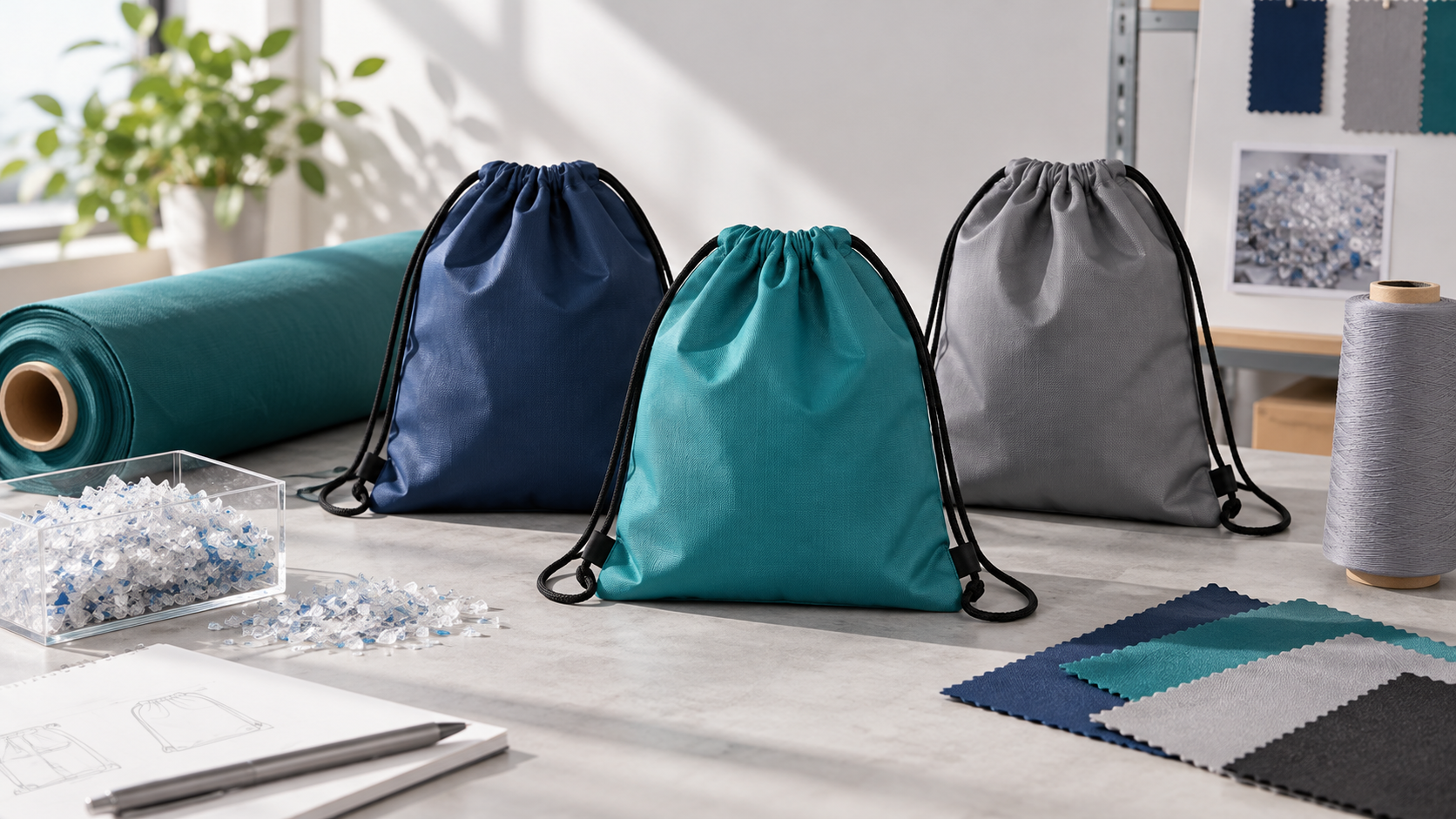
Image note: the hero is a generated material-comparison illustration.It does not establish composition, denier, construction, performance, recycled content, certification, testing, environmental benefit, site ownership, inventory, capacity, price, MOQ or timing.