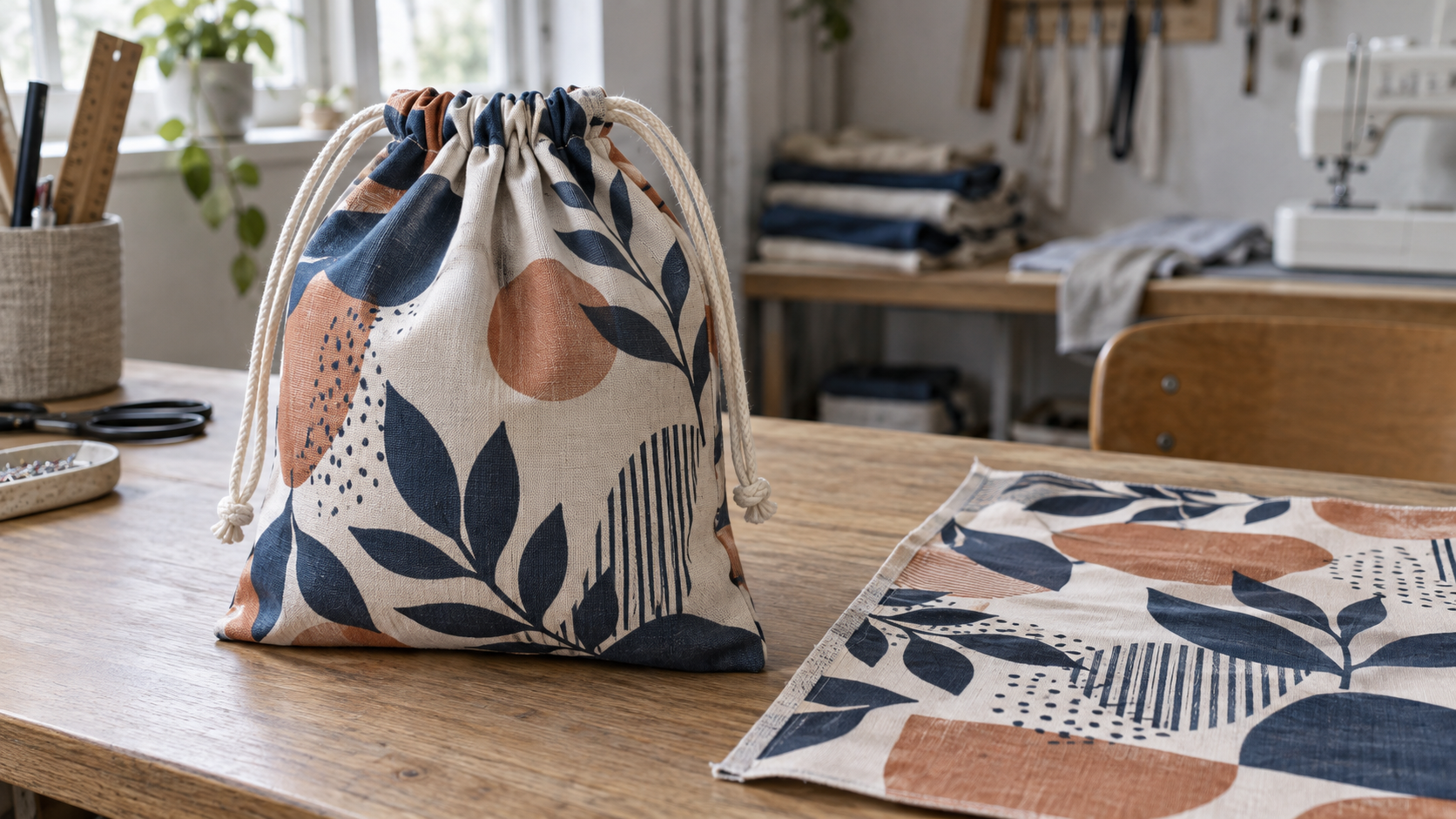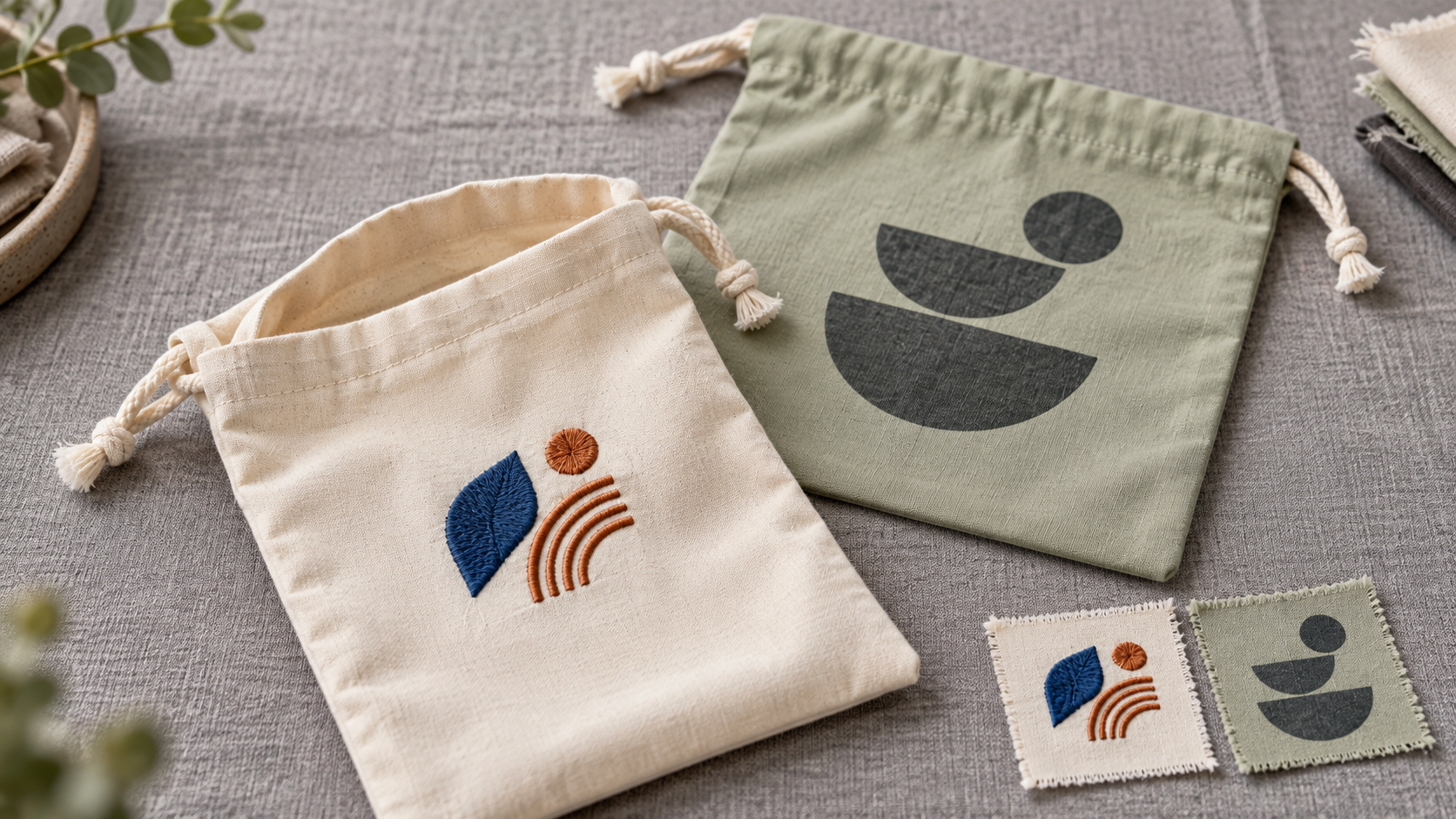
Screen Printing vs Heat Transfer for Drawstring Bags
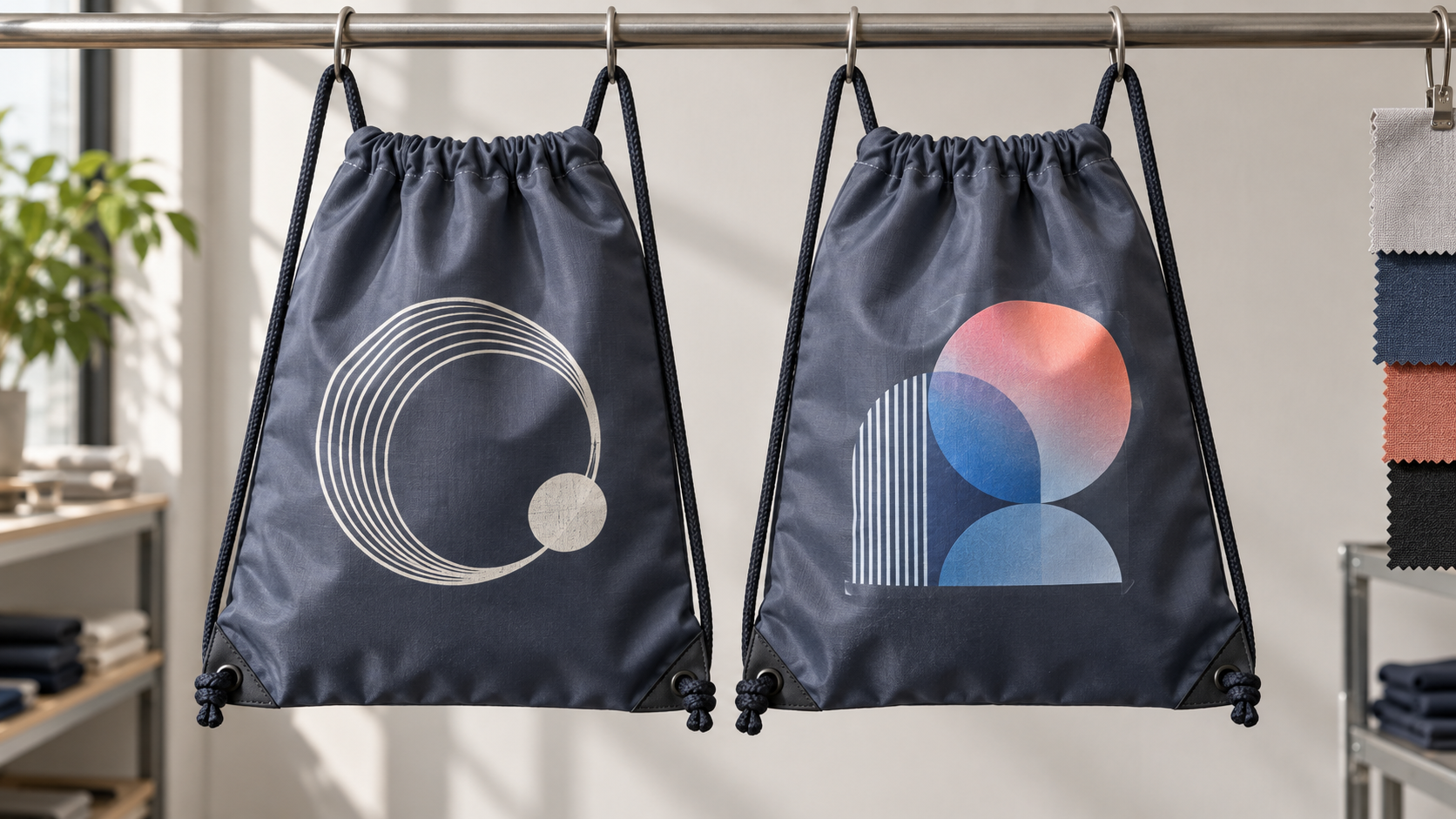
Last reviewed: September 16, 2026
Screen printing and heat transfer can both produce excellent custom drawstring bags. The better choice is not the process with the longest list of benefits. It is the process that fits the artwork, fabric, bag construction, quantity, expected use and approval standard of one specific program.
For a bold one- or two-color mark repeated across a stable production run, screen printing is often the efficient starting point. For gradients, many colors, small batches or frequent artwork variations, an appropriate heat-transfer system can be easier to control. Those are useful tendencies, not universal rules. A dark polyester gym sack, a cotton gift pouch, a mesh equipment bag and a velvet jewelry pouch create very different print surfaces.
This guide compares the two methods at the level that matters to a buyer: what the decoration will look and feel like after the bag is filled, gathered, worn, packed and used. For a broader map of all available decoration routes, read our custom drawstring bag printing methods guide. If you are building a new program, explore LUCKYSTAR's custom drawstring bags and use this article to prepare a testable specification.
Scope note: The recommendations below are sourcing guidance, not a promise that every ink, film or adhesive works on every fabric. Application settings, color performance, care behavior and commercial terms must be confirmed against the approved material, artwork, sample and purchase order.
A rapid selection rule
Put screen printing at the top of the trial list for limited spot-color artwork, a reasonably stable run, a preference for a flatter print hand and a panel that production can support. Put heat transfer at the top when the art contains gradients, photographic detail or numerous colors, or when short runs require several name/design variants.
Then challenge that first choice with four drawstring-specific questions:
- Will the art remain outside the gathered top channel, side seam and lower cord anchors?
- Can the panel lie flat and receive even screen pressure or heat-press pressure?
- Will the fabric tolerate the selected ink cure or transfer application window?
- Does the approved print still look acceptable when the bag is filled and worn?
| Buying condition | Screen printing usually starts ahead | Heat transfer usually starts ahead | What still needs proof |
|---|---|---|---|
| One bold logo, one or two colors | Efficient repeat production and direct ink deposit | Possible, but transfer film may add unnecessary hand | Opacity, registration and cure |
| Gradient or photographic art | Separation and registration become more complex | Digital transfer families can reproduce fine tonal detail | Film edge, color, adhesion and migration |
| Many small artwork versions | New screens or setup may be needed for each version | Digital workflows can simplify version changes | File control and version traceability |
| Open mesh or pronounced texture | Ink deposit may bridge or break across openings | Transfer may lack continuous contact | Physical sample on the exact mesh |
| Heat-sensitive or coated fabric | Ink chemistry and cure must be compatible | Temperature, dwell and pressure can mark or distort fabric | Material-specific trial |
| Soft cotton pouch | A well-specified print can feel integrated with the textile | A suitable transfer can deliver detail in short runs | Hand feel after folding and cleaning |
Start with the bag, not the decoration catalog
Drawstring construction changes the decoration problem. A flat tote panel is normally carried by handles; a drawstring backpack is repeatedly cinched, opened and tensioned by cords. The upper body wrinkles toward the channel, lower corners take load, and the center panel curves when filled. A method that looks perfect on a loose swatch can fail visually on the assembled bag.
Record the following before requesting a quote:
- finished width, height and any gusset;
- usable print box measured from seams, channel and reinforcement;
- fabric composition, weight, weave or knit, coating and color;
- cord route, eyelet or reinforced-corner construction;
- artwork dimensions, number of colors and required color references;
- expected contents, load, cleaning method and service environment;
- order quantity, number of designs and quantity per design;
- acceptable appearance when flat, gathered, filled and worn.
Our drawstring bag size and capacity guide helps connect dimensions with real contents, while the logo placement and print size guide explains how to establish a safe print box.
Decision checkpoint 1: What does the artwork demand?
Spot colors, flat shapes and opaque marks
Screen printing is naturally suited to separated color areas. Each color normally has its own screen and printed layer, so a bold mark with limited colors can be controlled efficiently. On a dark bag, an underbase or more opaque ink system may be needed to keep a light logo from appearing dull. The correct solution depends on the ink, mesh, substrate and curing method.
The technical advantage becomes less convincing when the design has many colors, tight overlaps or continuous gradients. Registration risk and setup work increase with the separation count. ScreenPrinting.com's technical introduction to multicolor screen printing illustrates why each color layer, registration and cure discipline matter.
Gradients, fine detail and many colors
Heat transfer is a family of processes, not one universal product. Digital transfers, screen-printed transfers and cut-film graphics behave differently. However, a suitable digital transfer can make detailed, multicolor artwork practical without exposing the buyer to one screen setup for every printed color.
Fine detail still needs a production-ready file. Vector art is valuable for logos and line work because paths can be scaled without the pixelation associated with raster images; Adobe's vector and raster comparison explains that distinction. Photographic art usually remains raster, so the file must have adequate resolution at final print size.
| Artwork question | Screen-print route | Heat-transfer route | Buyer instruction |
|---|---|---|---|
| How many colors? | Count spot colors, underbase and special effects | Identify the exact transfer family and color workflow | Do not write only “full color” |
| Are gradients essential? | Ask whether halftones can meet the visual target | Approve tonal transitions at final size | Review a physical strike-off |
| Is tiny type present? | Confirm minimum printable line and gap | Confirm minimum retained detail and weeding limits, if relevant | Enlarge or simplify risky elements |
| Must the logo match a reference? | Define ink-mixing reference and viewing conditions | Define file profile, substrate and viewing conditions | Approve on production fabric |
| Are there many versions? | Track screens and version labels | Track digital files and transfer batches | Provide a version matrix |
Decision checkpoint 2: Which material is being decorated?
Material names alone are not specifications. “Polyester” can describe 210D fabric, dense 600D fabric, brushed microfiber or open mesh. “Cotton” can range from a light pouch cloth to heavy canvas. Coatings, finishes, recycled content and colorants can change adhesion, opacity, heat response and surface texture.
| Drawstring-bag material | Screen-print considerations | Heat-transfer considerations | Practical starting check |
|---|---|---|---|
| Cotton or canvas | Absorbency and texture influence edge and ink deposit | Film hand can be more noticeable on a natural textile | Fold, rub and clean the decorated sample |
| Polyester | Ink must cure without unwanted fabric change | Dye migration and press marks require attention | Condition a dark sample and recheck color |
| Nylon or coated fabric | Surface chemistry can reduce adhesion | Heat may distort coating or alter gloss | Supplier trial on the exact lot |
| RPET fabric | Recycled claim does not predict print behavior | Same construction variables still apply | Verify material evidence separately from print tests |
| Non-woven PP | Texture and heat sensitivity can narrow choices | Pressure and temperature can flatten or distort fibers | Trial at full logo size |
| Velvet or microfiber | Nap can interrupt a flat graphic | Pressure can crush pile or leave a platen outline | Consider embroidery, label or restrained art |
| Mesh | Openings break image continuity | Film needs a continuous support surface | Consider a sewn-on solid panel |
Use our best materials for custom drawstring bags as the material overview. More focused comparisons are available for polyester vs nylon, cotton vs canvas, non-woven GSM and construction, mesh drawstring bags and velvet vs microfiber pouches.
How screen printing works on a drawstring bag
In simplified terms, prepared ink is pushed through open areas of a screen onto a supported bag panel. Additional colors require their own controlled layers. The decoration is then cured according to the selected ink system. The production team must control artwork separation, screen condition, registration, ink deposit, support, cure and handling.
Printing before sewing
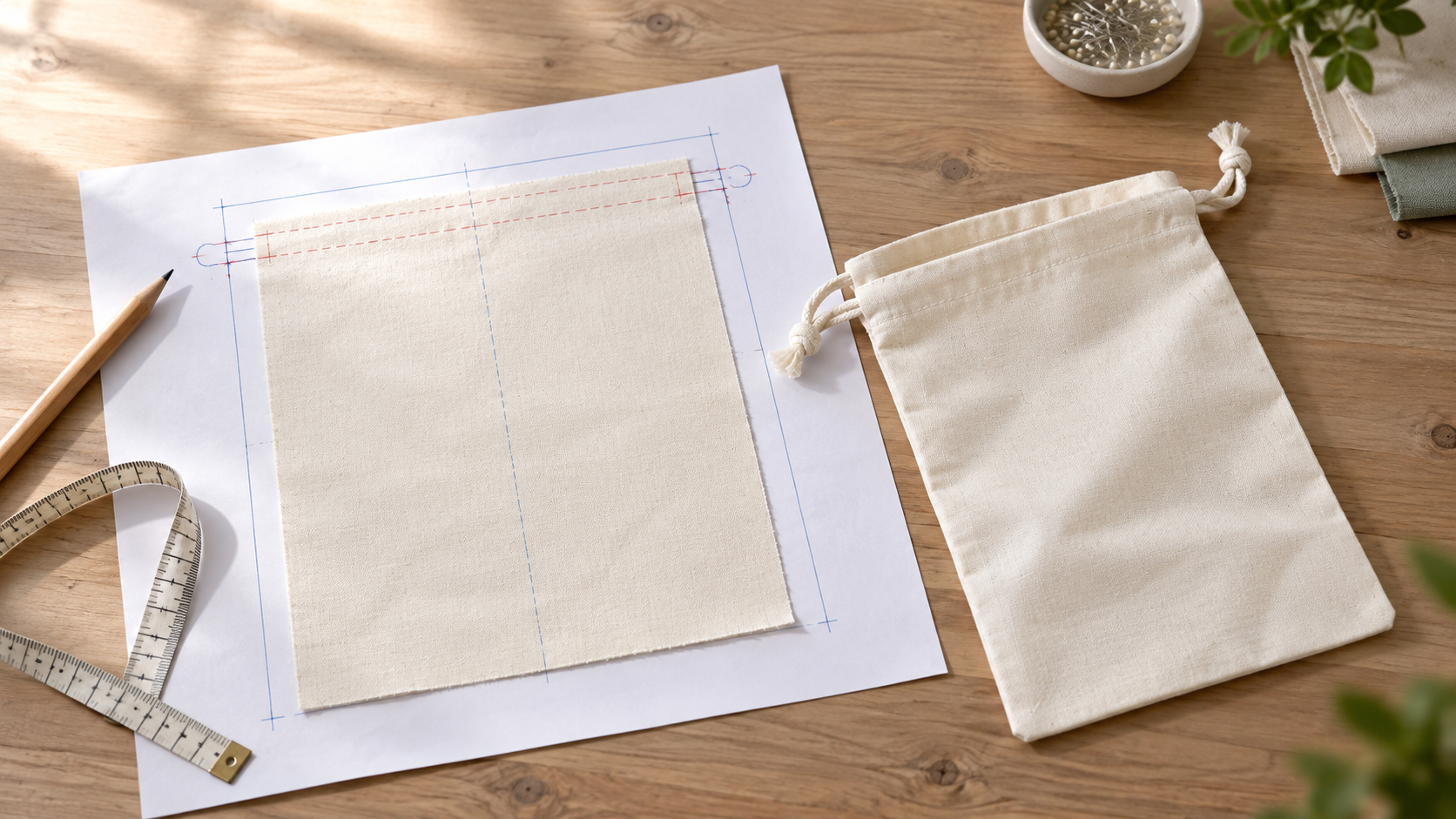
Printing a cut panel before assembly provides a flat, accessible surface. It can improve support and allow the art to sit closer to areas that would be hard to reach on a finished bag. It also means the cutting, printing and sewing teams need strong orientation and bundle control. A correctly printed panel can still become an incorrectly positioned finished bag if it is rotated, mismatched or sewn to the wrong tolerance.
Printing after sewing
Printing the finished shell reduces the risk of decorating the wrong panel and makes placement relative to the actual bag easier to see. But seams, cords, reinforcements and layers can interfere with the platen. Uneven support may change pressure or ink deposit. The best sequence is a production decision that belongs in the approved sample and manufacturing plan, not a generic website promise.
What buyers should approve
Approve actual color and opacity, the distance from the print to the channel and side seams, line quality, registration, surface hand, cure outcome and the appearance of the filled bag. A photo is useful for communication, but it cannot fully prove adhesion, rubbing resistance or hand feel.
How heat transfer works on a drawstring bag
With heat transfer, the graphic is first prepared on a carrier or transfer medium and then bonded to the fabric using a controlled combination of time, temperature and pressure. The exact application window comes from the chosen transfer system and the fabric trial. Stahls' heat-press operator guidance is one example of why all three variables—and consistent equipment—matter.
Digital and film-based transfers
Digital transfer families can reproduce complex color and small details. Some leave a continuous film area; others deposit a different ink-and-adhesive structure. Cut films suit solid shapes but may require weeding. The phrase “heat transfer” is therefore insufficient in an RFQ. Ask the supplier to name the proposed system and provide its intended care and substrate conditions.
Screen-printed transfers
A screen-printed transfer uses screened ink layers prepared on a carrier and applied later. It may combine advantages of screen-controlled color with transfer-stage placement, but it has its own setup, storage and application requirements. It should not be assumed to behave like either direct screen print or a digital transfer.
What buyers should approve
Check edge definition, surface hand, gloss, film outline, adhesion, color, press marks and fabric distortion. For dark polyester, inspect the sample after conditioning rather than only immediately after pressing; unwanted dye movement can appear later.
Drawstring construction creates pressure obstacles
A heat press needs even contact. A screen-print platen needs stable support. A cord, knot, seam, eyelet, zipper, pocket or thick reinforcement inside the pressing or printing zone can create a pressure shadow. That may show as weak adhesion, incomplete ink deposit, a visible platen mark or a distorted panel.
| Construction feature | Risk to screen printing | Risk to heat transfer | Design response |
|---|---|---|---|
| Top cord channel | Wrinkles and restricted access | Uneven pressure and heat near folds | Keep artwork below a validated clearance |
| Side seam | Platen instability near edge | Edge lift where seam interrupts pressure | Shrink or reposition art |
| Lower corner reinforcement | Thick layers alter support | Pressure step or platen mark | Keep graphic away from anchor zone |
| Front pocket | Multiple layers change print support | Zipper or seam blocks flat pressing | Decorate pocket before assembly or use another location |
| Gusset | Artwork may wrap or misregister | Press contact becomes inconsistent | Restrict art to a flat face |
| Mesh panel | Image can bridge openings | Transfer may seal openings or lack support | Add a solid branding patch/panel |
If pockets or zippers are part of the design, review our guide to adding pockets and zippers to drawstring bags. Cord routes and lower reinforcements are covered in the cord, eyelet and reinforcement guide.
Color and opacity on light and dark bags
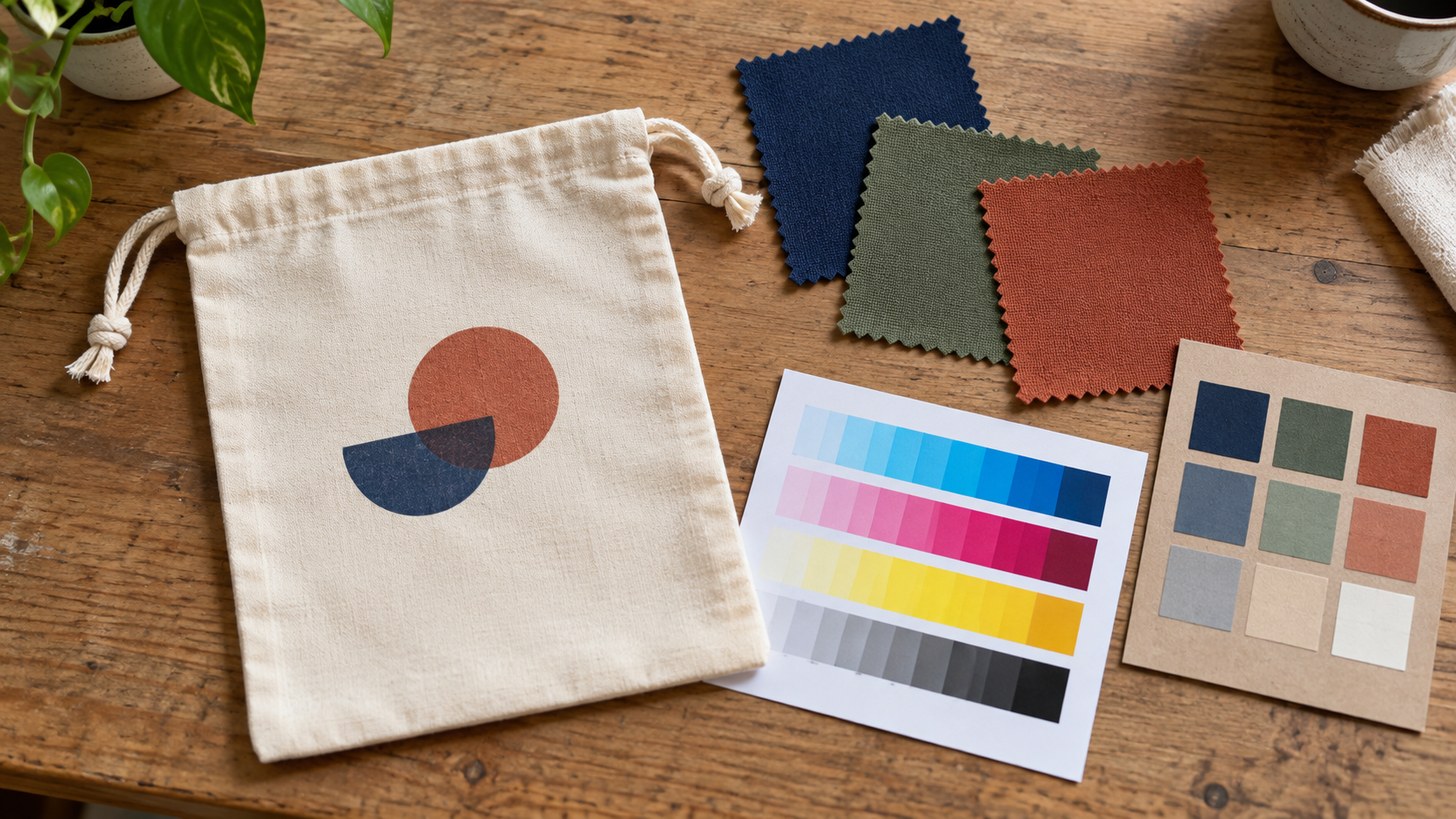
The fabric color is part of the print system. A white mark on black polyester may need an opaque layer; a transfer may include a white base. A red bag can visually contaminate a translucent print or migrate into a transfer. A natural cotton bag may shift the perceived warmth of an ink color.
For color-critical work, specify the target reference, tolerance method, illuminant or viewing environment and whether approval is based on a printed swatch or assembled bag. Avoid treating a monitor preview as final color proof. Reorders also need retained references and version control; the workflow in our logo and color consistency guide can be adapted to drawstring programs.
Hand feel, flexibility and fold behavior
“Soft hand” is subjective until the buyer defines a comparison. A direct screen print can range from very light to noticeably built-up depending on ink, underbase, deposit and fabric. A heat transfer can feel thin and flexible or like a distinct surface film. Large solid graphics magnify the difference.
Assess the print in three states:
- flat: look for edge quality, uniform color and surface gloss;
- gathered or folded: look for cracking, buckling, hard creases and lifting;
- filled and worn: look for distortion, tension lines and uncomfortable stiffness against the user's back.
A wide solid transfer across a lightweight gym sack can change how the panel drapes. A large heavy ink deposit can do the same. If flexibility matters, ask the designer to reduce solid coverage, introduce negative space or divide one large block into smaller elements.
Detail, registration and the “safe” print box
Artwork size is not the same as printable area. The safe print box should account for seam tolerance, panel movement, channel depth, reinforcements and equipment access. Centering must also have a declared reference: the cut panel, the sewn body, the pocket or the visible area when worn.
| Approval item | Specify in the tech pack | Verify on sample | Verify in bulk |
|---|---|---|---|
| Art size | Width and height, not “large logo” | Measure final decorated area | First article plus sampling |
| Position | X/Y coordinates and datum | Compare to sewn bag | Use approved positioning aid |
| Registration | Allowed color-to-color shift | Inspect high-contrast joins | Inspect start-up and intervals |
| Edge quality | Minimum line/gap or approved visual | Review at normal and close distance | Watch wear or screen/transfer drift |
| Orientation | Front/back and top direction | Photograph approved sample | Control panel bundles/files |
Put these controls in a custom drawstring bag tech pack. This removes guesswork before the sample room selects a process.
Quantity and design versions change the economics
Screen printing has setup work that can be distributed over a stable quantity. Heat transfer may lower the barrier for a small batch or many designs, but each transfer still has production, application and inspection cost. The most economical route depends on total units, units per version, print size, color count, number of positions, fabric, transfer type, packing and rejection risk.
Do not compare only a decoration line price. Compare the approved finished-bag cost under the same specification.
| Cost driver | Screen printing impact | Heat-transfer impact |
|---|---|---|
| Number of print colors | More screens, setup and registration | Digital routes may absorb color count differently |
| Number of versions | Screen/file change and minimum run implications | File and transfer-batch control still required |
| Graphic coverage | More ink and greater cure/control burden | More transfer material and application area |
| Extra print positions | Additional setup and handling | Additional press cycle and positioning |
| Difficult construction | Special platen, sequence or pre-sew print | Special platen/pad or pre-sew application |
| Inspection standard | More measurements and retained evidence | More adhesion, edge and application checks |
For planning ranges and the variables behind them, see how much custom drawstring bags cost and how to reduce cost without sacrificing quality. Pricing, MOQ and lead time remain subject to specification and written confirmation.
Durability is a test result, not a process label
Neither “screen printed” nor “heat transferred” proves durability. Results depend on material preparation, compatible chemistry, application settings, graphic coverage, cure or bond, use, cleaning and storage. Two suppliers can use the same category name and produce different results.
An under-cured screen print may look acceptable at first and then crack or lose adhesion. A poorly applied transfer can lift at the edge or show weak bond. Excessive heat can damage a coated fabric; excessive ink deposit can create an inflexible area. This is why a buyer should approve both the appearance and an order-appropriate test plan.
Build a test plan around real use
ISO 105-X12 describes a method for assessing textile color resistance to rubbing and staining under dry and wet conditions. It is useful as a reference point, but an order should specify the exact method, acceptance criteria, specimen preparation and responsible laboratory or inspection party. See the official ISO 105-X12 overview.
| Test or check | What it can reveal | Suggested specimen state | Acceptance basis |
|---|---|---|---|
| Dry/wet rub | Color transfer, abrasion or surface weakness | Decorated production fabric | Written grade or approved reference |
| Flex and repeated gather | Cracking, edge lift or stiff print behavior | Assembled bag, repeatedly opened/closed | Agreed cycles and visual limit |
| Cleaning or wash simulation | Adhesion, fading, distortion | Conditioned assembled sample | Label care route and agreed cycles |
| Filled-bag wear | Graphic distortion and cord/contact abrasion | Bag loaded with defined contents | Approved appearance and function |
| Heat/conditioning hold | Delayed dye migration or bond change | Dark polyester after defined rest | Color and adhesion threshold |
| Packing/blocking check | Sticking, offset or pressure marks | Packed as shipped | No unacceptable transfer or imprint |
The table is a planning framework, not a universal protocol. Our custom bag quality inspection checklist helps buyers integrate decoration checks with sewing, dimensions and packing.
Approve the method through an evidence ladder
1. Artwork review
Confirm file version, dimensions, colors, print position and rights. Ask whether the proposed process can hold the thinnest line, smallest gap and required opacity.
2. Material strike-off
Print on the nominated production fabric and color. A strike-off isolates decoration behavior, but it does not show how construction changes access or drape.
3. Assembled pre-production sample
Inspect the finished bag flat, gathered, filled and worn. Measure placement from the declared datum. Feel the print, flex it, and review any pressure mark.
4. First production article
Compare the first article against the signed sample and production file. Confirm color, size, position, registration, cure or bond, construction and packing before continuing the run.
Our sample development process and design-to-delivery manufacturing guide explain how these gates fit into the wider project.
Screen-print quality-control checkpoints
Screen printing needs control before, during and after decoration. Artwork separations and screen identification should match the job file. The production team should confirm substrate side, panel orientation and the correct ink system before starting. During production, operators monitor screen condition, ink behavior, registration and deposit. Cure must follow the validated process for the selected ink and material.
| Stage | Screen-print checkpoint | Evidence to retain |
|---|---|---|
| Incoming | Correct fabric lot, color, finish and printable face | Material identification and lot record |
| Setup | Correct screens, ink references, underbase and placement fixture | Approved job card or setup sample |
| First article | Color, opacity, size, position, registration and surface | Signed first-piece record and photo |
| In process | Screen wear, blocked detail, color drift and contamination | Interval inspection record |
| Cure | Validated equipment setting and acceptable cured result | Process log plus order-specific test |
| Packing | No offset, sticking, folding damage or mixed versions | Packing inspection and carton marks |
Do not use one destructive check as the only evidence for an entire order. Define sampling, frequency, responsibility and reaction rules. If an interval check fails, the supplier should be able to identify the last accepted point and isolate the affected quantity.
Heat-transfer quality-control checkpoints
Heat-transfer control begins with the transfer itself: correct file, dimensions, colors, carrier and batch. Application then depends on verified equipment and a compatible substrate. The operator must control placement and the validated time-temperature-pressure combination, along with any pre-press, peel or post-press instruction required by that system.
| Stage | Heat-transfer checkpoint | Evidence to retain |
|---|---|---|
| Transfer receipt/production | Correct version, size, color and transfer type | Batch and artwork-version record |
| Fabric confirmation | Exact composition, finish, color and lot | Material lot reference |
| First press | Position, edge, surface, gloss, pressure mark and distortion | Signed first-piece record |
| Application | Validated time, temperature, pressure and peel sequence | Equipment/process log |
| Conditioning | Delayed migration, edge lift, bond or color change | Reinspection after agreed rest |
| Packing | Blocking, liner residue, fold placement and mixed versions | Packing inspection record |
A transfer should not be approved only because its center resists peeling by hand. Small corners, narrow lines and edges near construction features can behave differently. Inspect the complete graphic.
Defect diagnosis: ask “why” before changing methods
Switching from one decoration family to the other is not always the correct fix. A placement defect may come from an incorrect datum. A transfer edge may lift because pressure was blocked by a seam. A screen print may look weak because the dark substrate needs a different opacity strategy. Diagnose the process-material-construction interaction first.
| Symptom | Possible screen-print causes | Possible heat-transfer causes | Corrective investigation |
|---|---|---|---|
| Color looks weak | Low opacity, substrate influence, insufficient deposit | Inadequate white base or substrate show-through | Compare approved fabric and ink/transfer build |
| Graphic is off-center | Wrong datum, panel shift, loading variation | Placement guide or bag loading variation | Measure from declared sewn-bag references |
| Fine detail disappears | Screen/ink mismatch, blocked mesh, artwork too fine | Detail below system limit, poor transfer or peel | Review minimum line/gap and first article |
| Cracking during flex | Cure/deposit/ink compatibility issue | Transfer too stiff or bond/application issue | Flex exact sample and review system data |
| Edge lifting | Not typical as a film edge; inspect ink adhesion | Uneven pressure, contamination or incompatibility | Check seams, platen and application record |
| Color changes later | Substrate interaction or conditioning issue | Dye migration from polyester | Reinspect after defined conditioning |
| Visible rectangle | Platen/contact or pretreatment effect | Carrier/press mark or film boundary | Review heat, pressure, backing and graphic construction |
| Fabric distortion | Cure exposure or handling | Excessive heat/pressure for substrate | Validate lower-risk compatible process |
When screen printing is the stronger choice
Screen printing deserves priority in the sourcing trial when most of these conditions are true:
- the design uses one or a few solid spot colors;
- the same design repeats across a stable volume;
- the desired look is bold rather than photographic;
- the fabric and ink system have a proven compatibility route;
- the panel can be supported consistently;
- the buyer values a direct print feel and can approve setup samples;
- the production plan can control screen identity, registration and cure.
An event organizer ordering thousands of lightweight drawstring backpacks with one white sponsor mark is a familiar example—but even here the dark fabric, logo coverage and lower reinforcement must be sampled.
When heat transfer is the stronger choice
Heat transfer deserves priority when several of these conditions apply:
- the artwork includes gradients, many colors or fine tonal detail;
- each school, team, store or campaign needs a different design;
- quantities per artwork version are modest;
- the print must be positioned on an assembled bag and the area can be pressed evenly;
- the chosen fabric tolerates the validated application window;
- the buyer accepts the approved transfer hand and edge;
- the project can control transfer batches and application settings.
A promotional program with twenty regional graphics may benefit from this flexibility. The choice still needs a sample for each materially different fabric color because a transfer approved on white polyester does not automatically prove performance on navy polyester.
Use-case recommendations for common drawstring programs
| Program | Likely first trial | Why | Critical challenge |
|---|---|---|---|
| Mass event backpack, one-color sponsor mark | Screen print | Repeated bold art and stable version | Opacity, cure and packed blocking |
| Short-run campaign with gradient illustration | Digital heat-transfer family | Detail and low version quantity | Hand, edge and fabric heat response |
| Cotton gift pouch with simple mark | Screen print or restrained transfer | Both can work on a flat panel | Fold line and tactile expectation |
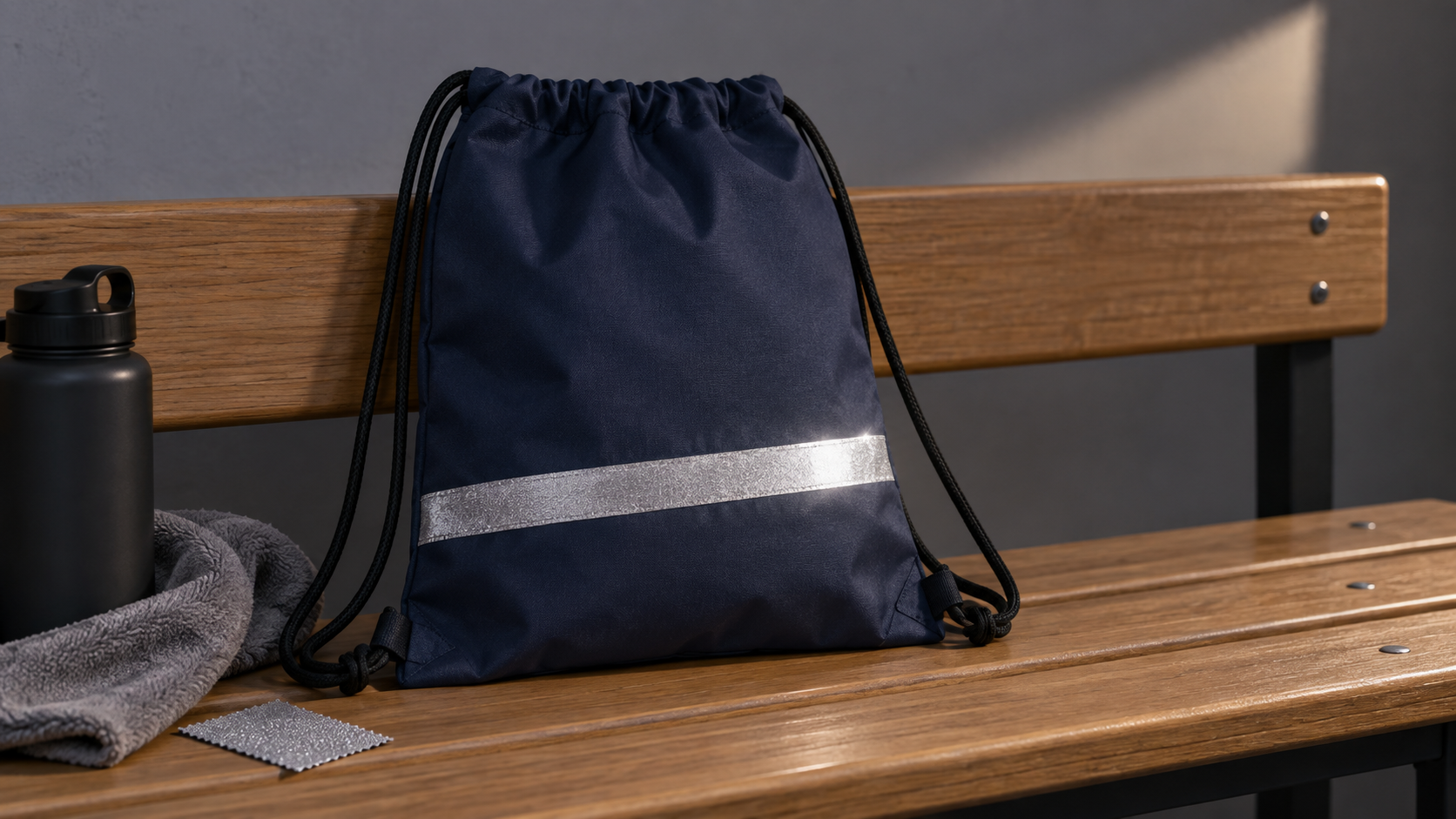
| Dark polyester gym sack | Either, after migration trial | High-use construction and dark dye | Delayed color migration and flex |
| Mesh equipment bag | Neither on open mesh as first assumption | Interrupted support surface | Add a solid woven branding panel |
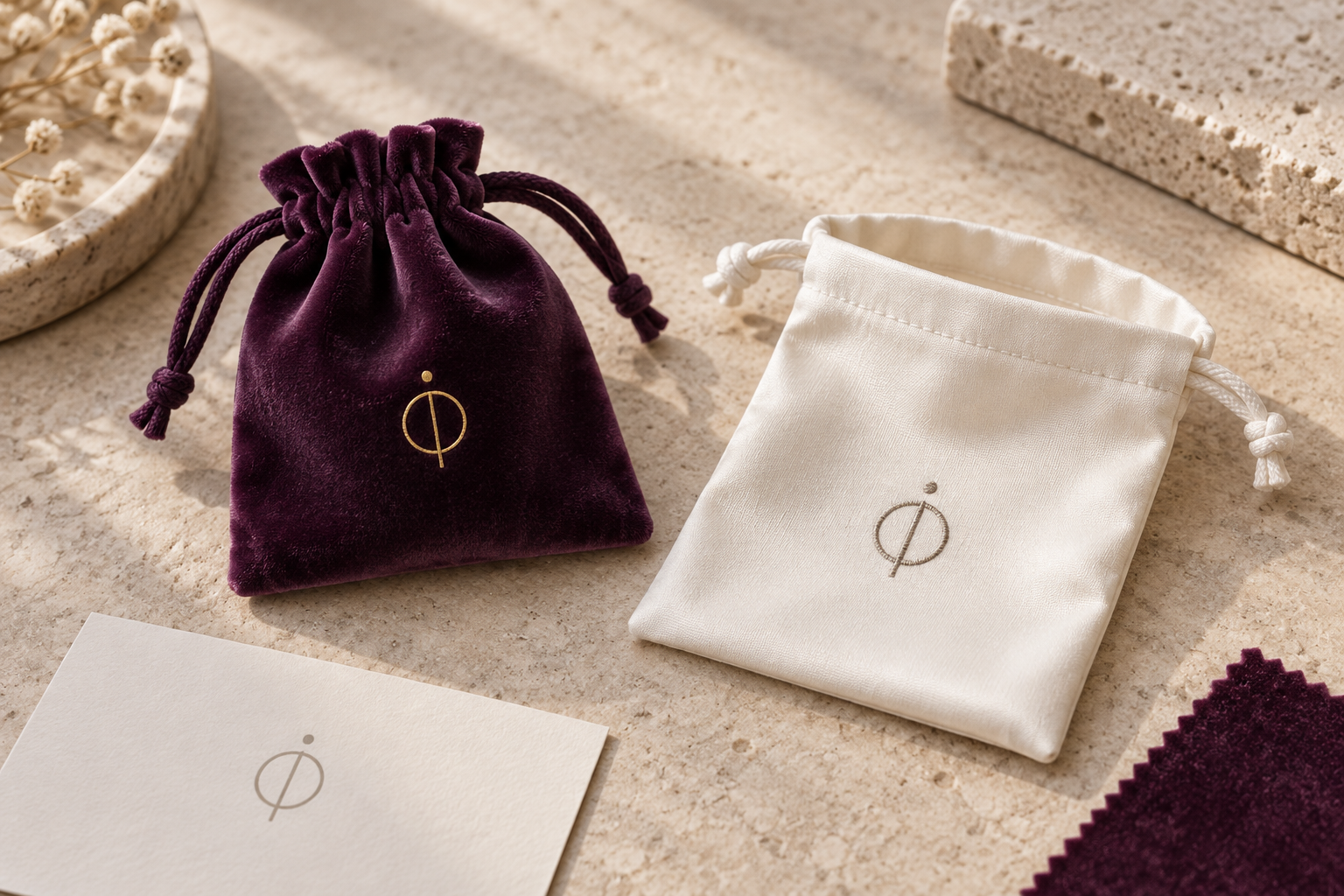
| Velvet jewelry pouch | Embroidery, woven label or a validated specialty method | Nap and pressure sensitivity | Pile crushing and luxury hand |
| Non-woven giveaway bag | Method-specific low-risk trial | Material may be heat sensitive | Distortion and reinforcement position |
| Personalized team bag | Heat transfer may simplify names/numbers | Variable data | File mapping and adhesion |
When neither method is the right answer
A binary comparison should not force a poor solution. Consider alternatives when the substrate or desired effect is incompatible with both starting routes:
- Embroidery for a dimensional premium mark where needle penetration and backing suit the fabric.
- Woven or printed label for velvet, mesh or difficult coated surfaces.
- Sewn-on patch to create a stable branding surface and deliberate design feature.
- Sublimation for compatible light-colored polyester when the design and production route support dye-based decoration.
- Silicone or rubber patch where dimensional branding is approved and the attachment method is validated.
Each alternative has its own construction, cost, compliance and testing implications. The purpose of sampling is to find the lowest-risk route, not to defend the first process named in an RFQ.
Sustainability claims must remain separate from print selection
Screen printing is not automatically sustainable, and heat transfer is not automatically wasteful. Terms such as “water-based,” “PVC-free,” “recycled,” “biodegradable” or “eco-friendly” need evidence tied to the actual input, supplier, batch, claim scope and market. A recycled fabric claim does not prove the decoration chemistry, and a particular ink description does not prove the environmental performance of the whole bag.
For RPET programs, use our RPET drawstring bag certification and sourcing checklist. Ask for transaction- or order-relevant documentation where required, and keep certification claims within the verified entity, material and validity scope. LUCKYSTAR does not treat a platform badge or generic material name as proof of a universal company certification.
Protect trademarks and approved artwork
Before producing branded merchandise, the buyer should confirm that it owns or is authorized to use the mark for the intended product, quantity, territory and channel. WIPO's trademark guide for small and medium-sized enterprises explains why trademark rights and authorized use matter in commerce.
Send artwork through an approved business channel, identify the final file clearly and control revisions. A purchase instruction to manufacture branded goods does not necessarily grant public marketing rights. Product photography, case studies and portfolio use should be authorized separately.
Reorders need a print-control file
The most useful reorder reference is more than a product photo. Build a controlled package containing:
- approved vector/raster artwork and version number;
- final print dimensions and placement coordinates;
- fabric specification, color and approved material reference;
- named decoration system, ink/transfer identification where appropriate;
- approved physical sample or retained print standard;
- process and test requirements;
- packing orientation and anti-blocking controls;
- approved deviations and change history.
If the supplier proposes a different fabric lot, ink, transfer, adhesive, equipment route or production location, define whether reapproval is required. A repeat PO should not silently convert into a new print system.
How LUCKYSTAR manages the decision
LUCKYSTAR approaches print selection as part of the whole bag specification. That matters because print, fabric, construction and packing influence one another. Our role is to coordinate the project from requirement review through sample confirmation and bulk quality checkpoints, subject to the agreed order scope.
Requirement translation
We help turn visual intent into measurable fields: bag size, material, color, artwork version, print box, decoration route, test requirement and packing method. This supports clearer comparisons than a request for “the cheapest full-color logo.”
Material and process matching
Our product range includes multiple drawstring constructions and material directions. The proposed decoration route is reviewed against the specified fabric and bag design, then confirmed through sample work rather than presented as a blanket capability claim. Browse our custom drawstring bag options to start the conversation.
Sample-led approval
The team can coordinate artwork review and sampling so the buyer can assess appearance, placement and feel before bulk production. Samples, timing, charges and revisions are project-specific and subject to written confirmation.
Order-level quality control
Incoming materials, first articles, in-process work, finished goods and packing can be checked against an agreed specification. The exact inspection level, test method, acceptance criteria and third-party requirements belong in the order documents.
One project contact across variables
Instead of separating the bag from the decoration decision, buyers can discuss material, cord, reinforcement, printing, sample, packing and delivery assumptions in one coordinated RFQ. This is especially valuable when a change in artwork size affects construction access or a fabric change requires print revalidation.
For a wider view of supplier evaluation, continue with How to Choose a Custom Drawstring Bag Manufacturer and the core Custom Bag Manufacturer Guide.
RFQ checklist: send enough detail for a comparable quote
| RFQ field | Minimum useful detail | Why it matters |
|---|---|---|
| Bag construction | Size, gusset, cord route, reinforcement, pockets | Defines usable decoration access |
| Fabric | Composition, weight/denier/GSM, weave, coating, color | Drives compatibility and appearance |
| Artwork | Final-size file, colors, dimensions, version count | Determines process and setup |
| Print location | Side, datum and measured coordinates | Prevents subjective centering |
| Quantity | Total and units per artwork/color | Affects setup economics and planning |
| Performance | Use, load, cleaning and required tests | Sets approval evidence |
| Color control | Reference and acceptable tolerance | Supports sample and reorder comparison |
| Packing | Fold, individual pack, carton and blocking concern | Protects decorated surface |
| Compliance | Destination market and order-specific requirements | Avoids unsupported assumptions |
| Delivery | Destination, requested date and shipment mode | Supports a realistic schedule |
MOQ and production time depend on the final configuration and capacity confirmation. Our drawstring bag MOQ and production-time guide shows how design complexity and approvals affect the schedule.
Frequently asked questions
Is screen printing always cheaper than heat transfer?
No. Screen setup can become efficient over a stable volume, while some transfer routes suit small batches or many versions. Compare the finished-bag quotation under the same artwork, material, quantity, inspection and packing requirements.
Is heat transfer better for full-color artwork?
It is often the first process to trial for gradients and many colors, particularly in shorter or versioned runs. The exact transfer family, color, hand, edge, adhesion and substrate response still require approval.
Which method lasts longer on a drawstring backpack?
There is no universal winner. Durability depends on compatible materials, correct process settings, print coverage, use and care. Define a test plan and approve a sample on the production fabric.
Can both methods print on polyester?
Potentially, yes. Polyester color migration, heat response, coating and texture can affect both routes. Dark fabric deserves a conditioned sample and explicit color/adhesion review.
Can a finished bag be printed after sewing?
Sometimes. The print area must lie flat and clear the channel, seams, cords, pockets and reinforcements. Pre-sew decoration may be safer for difficult access, but it requires strong panel-orientation control.
Why does the transfer leave a visible rectangle?
Possible causes include a continuous film boundary, carrier or platen marking, heat/pressure effects, or the chosen graphic construction. Identify whether the rectangle is film, gloss change or fabric compression before adjusting the process.
Why does a white print look dull on a dark bag?
The substrate may be influencing a translucent ink or transfer. An opacity strategy such as an underbase or appropriate white layer may be needed, followed by physical approval on the exact fabric.
Should the logo be tested while the bag is filled?
Yes, if the bag will carry bulky or heavy contents. Filling changes the panel curve and can reveal distortion, stiffness and abrasion points that are invisible on a flat sample.
Can recycled fabric use the same print settings as virgin fabric?
Do not assume so. Even within one fiber name, finish, dye, coating, texture and lot can change behavior. Validate the actual nominated material and keep recycled-content evidence separate from decoration tests.
What files should I send for a quote?
Send vector artwork for logos where available, high-resolution raster artwork for photographic elements, target dimensions, color references, bag specification, quantity by version, print position and intended use. Clearly label the final version.
Can LUCKYSTAR guarantee an exact result before sampling?
The reliable route is an order-specific review and approved physical sample. Production, price, MOQ, timing, testing and tolerances are subject to the final specification and written confirmation.
Final recommendation
Use screen printing as the first trial for bold, limited-color art repeated at a stable quantity. Use a named heat-transfer system as the first trial for complex color, fine detail or many small artwork versions. Then decide with evidence from the exact fabric and assembled drawstring bag—not with a generic process label.
The most successful program aligns four things: artwork, material, construction and approval criteria. LUCKYSTAR can help coordinate those variables, develop the sample and translate the approved result into an order-level quality plan.

Share your bag dimensions, material, artwork, quantity by version, intended contents and destination market. Contact LUCKYSTAR for a project-specific review; recommendations, prices, MOQ, production time and compliance documents remain subject to specification and written confirmation.