
RPET Drawstring Bags: Certification and Traceability Guide
An RPET drawstring bag should be approved only when the buyer can connect the public claim to the actual order. In practice, that means defining which components contain recycled polyester, fixing the recycled percentage and calculation boundary, authenticating the relevant organizations and sites, and reconciling the shipment with order-level transaction evidence when required. A supplier profile, recycled symbol, TE-ID or the letters “RPET” cannot replace that chain.
For a drawstring backpack, the shell is only one part of the answer. Cord, corner reinforcements, grommets, thread, coating, print, labels, pockets and packing may be conventional materials. They can affect the honest wording of a recycled-content claim and the bag’s real service life. This guide turns those issues into a practical sourcing sequence for brands, importers and promotional-product buyers.

An AI-generated but product-realistic procurement scene, grounded in an unbranded LUCKYSTAR catalog sample for bag construction. The blank documents, PET flakes and yarn are illustrative and do not prove recycled content, certification, feedstock origin or current product availability.
The short answer: what proves an RPET drawstring bag claim?
Before approving a claim, verify five connected layers: the product specification, the claimed percentage, the certified supply chain, the order documents and the finished-bag performance. The most defensible file links a named bag style and BOM to the relevant scope certificates, transaction evidence, material lots, production records and cartons. If any layer changes after approval, review the claim again.
| Control layer | Evidence to request | Question it should answer | Common failure |
|---|---|---|---|
| Product identity | Finished bill of materials, drawings and approved sample | What exactly is being supplied? | The paperwork describes generic RPET fabric rather than the quoted bag |
| Claim boundary | Component weights and recycled-content calculation | Does the percentage apply to the shell, textile portion or whole bag? | “100% recycled bag” is based on the shell alone |
| Certification chain | Current scope certificates and a route map | Are the named legal entities, sites, products and processes covered? | An upstream yarn certificate is treated as finished-bag certification |
| Transaction evidence | Applicable transaction certificate or electronic transaction record, invoice and packing list | Does certified material move through this order? | Quantity, article, seller, buyer or dates do not reconcile |
| Performance | Approved test plan and inspection records | Will the bag survive its intended use? | Certification is mistaken for proof of seam, cord or print strength |
Use this checklist with the custom drawstring bags product page, the broader Custom Bag Manufacturer Guide and our guide to choosing a custom drawstring bag manufacturer. The product page shows development directions. Order-specific written approval is still required for certification status, minimum quantity, pricing, tests and scheduling.
RPET is a material description, not certification
RPET usually means recycled polyethylene terephthalate, commonly processed as recycled polyester fiber, yarn or fabric. The abbreviation does not identify the recycler, feedstock, recycled percentage, chain of custody, certificate owner or production lot. It also does not establish that the complete bag is recyclable, lower impact, safe for every application or certified to a particular standard.
Keep three statements separate:
| Statement | What it communicates | What must support it |
|---|---|---|
| “RPET fabric” | A material description | Agreed composition, recycled-content basis and supplier traceability |
| “Body fabric contains 80% post-consumer recycled polyester” | A quantified component claim | Component boundary, percentage method and evidence for the stated input category |
| “GRS certified” | A standards-based certification claim | Valid scope and transaction chain plus compliant claim/logo approval for the exact use |
The more specific the public statement, the more specific the evidence must be. Put the proposed wording in the RFQ instead of waiting until artwork approval. This lets the sourcing team determine whether the intended construction and supply route can support it.
What GRS and RCS verify—and what they do not
The Global Recycled Standard and Recycled Claim Standard are Textile Exchange programs under which independent certification tracks reclaimed inputs through qualifying supply-chain steps. GRS also addresses specified social, environmental and chemical practices at processing stages. Buyers should use the current official standard, policy and claims documents rather than relying on a certificate screenshot or an old web article.
2026 standards-transition snapshot
As of October 6, 2026, Textile Exchange lists GRS 5.0 and RCS 3.0 as published and effective from July 1, 2026, with mandatory implementation from December 31, 2026. Its standards update hub also says the revised Reclaimed Material Declaration Form becomes mandatory on December 31, 2026. The Materials Matter Standard becomes effective on December 31, 2026 and mandatory on December 31, 2027. The Materials Matter Claims and Labeling Policy becomes effective on December 31, 2026, while Textile Exchange provides a longer transition for claims and labels under current standards through June 30, 2029.
| Item to monitor | Date shown by Textile Exchange | Buyer implication |
|---|---|---|
| GRS 5.0 and RCS 3.0 | Published/effective July 1, 2026; mandatory December 31, 2026 | Confirm the version used for audit, scope and transaction records around the cutoff |
| Revised RMDF | Mandatory December 31, 2026 | Ask the relevant entry-point supplier which form/version supports reclaimed input |
| Materials Matter Standard v1.0 | Effective December 31, 2026; mandatory December 31, 2027 | Expect a transition year; do not assume every site changes on the same day |
| Materials Matter Claims and Labeling Policy | Effective December 31, 2026; transition deadline June 30, 2029 | Reconfirm claim wording, label approval and artwork rules for the planned launch date |
Because implementation timing can affect audits, documents and public claims, recheck the official standards policy update hub, GRS 5.0 document page, Materials Matter Standard page, claims and labeling page and the current scope and transaction certificate policy when the order is placed. Dates describe Textile Exchange program transitions; they do not establish LUCKYSTAR certification.
Certification is not a universal product-quality endorsement. It does not by itself prove:
- the bag’s load capacity, abrasion resistance or expected service life;
- colorfastness, water resistance, print adhesion or washability;
- suitability for children, food contact or regulated uses;
- recyclability in the destination market;
- a particular carbon, water or waste reduction; or
- that every component of the finished bag is recycled.
Those statements need their own definitions, test methods and evidence.
Understand the evidence hierarchy
Different records answer different questions. A strong file is a linked evidence set, not a stack of unrelated PDFs.
| Record | Primary purpose | Buyer check | What it cannot prove alone |
|---|---|---|---|
| Scope Certificate (SC) | Shows that a named organization/site is certified for listed products and processes during a validity period | Authenticate issuer and status; match entity, site, product category and process scope | That a particular shipment contains certified material |
| Transaction Certificate (TC) or applicable electronic transaction evidence | Supports a certified transaction between named parties | Match seller, buyer, product, quantity/weight, claim category, dates and commercial references | Physical performance or permission for every marketing use |
| Reclaimed Material Declaration Form, where applicable | Documents reclaimed-material input at the relevant entry point | Check current form/version, source category and implementation requirements | Finished-bag certification by itself |
| Purchase order and invoice | Define the commercial transaction | Match article, quantity, parties, dates and requested claim | Independent certification |
| Packing list and carton map | Connect shipment units to the order | Reconcile SKU, color, carton and quantity | Material origin without upstream records |
| BOM and component-weight calculation | Define the product and claim boundary | Confirm numerator, denominator, exclusions and rounding | Certified chain unless supported by certification records |
| Test and inspection reports | Show performance against a stated method and sample | Match product, method, laboratory, date and result | Recycled content or chain of custody unless specifically within test scope |
Textile Exchange states that a Textile Exchange ID is not certification. A valid scope certificate is the relevant confirmation of certification status and scope. Therefore, do not accept a TE-ID, platform badge or database profile as a substitute for checking the certificate and the order route.
Map the entire RPET route before requesting a quote
A drawstring bag may pass through more organizations than the quotation reveals. Draw a simple route from reclaimed input to shipped bag:
- Reclaimed material collection or aggregation.
- PET sorting, washing and flake preparation.
- Chip, staple fiber or filament production.
- Yarn spinning or extrusion.
- Weaving or knitting.
- Dyeing, coating and finishing.
- Printing, cutting and sewing.
- Trading, consolidation and export.
Ask who takes legal title and who physically handles the material at every relevant stage. Certification requirements depend on the applicable standard, process and chain position. A converter omitted from a sales presentation does not disappear from the real chain.
| Route question | Why it matters | Evidence response expected |
|---|---|---|
| Who sells the finished bags? | Defines the contracting and invoicing entity | Exact legal name and address |
| Which site cuts and sews them? | Connects certification and quality controls to physical conversion | Site name, address, process role and applicable scope |
| Is fabric dyed, coated or printed elsewhere? | Additional processing may affect the certified route | Subcontractor/process map and evidence status |
| Who owns the certified material during each transfer? | Chain-of-custody records follow transactions and ownership | Purchase and sales document sequence |
| Which party will request the transaction record? | Prevents shipment without the planned evidence | Named responsible party, timing and prerequisites |
| What happens if the nominated material is unavailable? | A substitution can invalidate the approved claim | Written no-substitution/change-control procedure |
This is also a useful supplier-qualification test. A partner that can explain the route precisely is easier to audit than one that responds only with “our material supplier is certified.”
Build a lot-to-carton traceability map
Traceability becomes useful only when identifiers survive conversion. A buyer should be able to start with a shipped carton and work backward to the finished SKU, packing record, production batch, cutting issue and fabric lot. The same file should also work forward: a fabric-lot concern should identify which units and cartons may be affected.
| Control point | Minimum identifier | Link it to | Release question |
|---|---|---|---|
| Material receipt | Supplier article, roll/lot and receipt record | Purchase record, material evidence and inspection | Did the nominated lot arrive, and was substitution prevented? |
| Warehouse issue | Roll/lot and issued quantity | Cutting ticket and production order | Can issued material be reconciled to the style/color batch? |
| Cutting | Bundle or cut-lot ID | Marker, quantity and operator/date record | Are mixed lots separated or deliberately documented? |
| Sewing/printing | Work-order and batch ID | Approved sample, artwork and process records | Did the relevant site and process use the approved material? |
| Finished inspection | SKU, color and inspection lot | Sample plan, measurements and defect results | Does the inspected lot match the documented production batch? |
| Packing | Packing date, carton number and carton range | SKU/color quantity and packing list | Can each carton be traced without opening every unit? |
| Shipment | Invoice, packing list and transport reference | Applicable transaction evidence and order file | Do parties, article, quantity, weight and dates reconcile? |
Do not invent a traceability system after production. Put identifiers, record owners, retention expectations and escalation rules into the pre-production file.
Build a component-level drawstring bag BOM
The shell may account for most of the weight, but claim language can cover a component, a textile portion or a complete product. Define the object before calculating a percentage.
| Bag component | Typical sourcing decision | RPET/claim question | Performance question |
|---|---|---|---|
| Main shell | Polyester denier, weave, GSM, finish and color | Is recycled polyester specified for this exact fabric article and lot? | Tear, abrasion, seam slippage, colorfastness |
| Drawcord | Polyester, polypropylene, nylon or cotton; diameter and construction | Is the cord inside or outside the stated boundary? | Tensile strength, fraying and user comfort |
| Bottom corner patch | Shell fabric, reinforced textile, PU/PVC or synthetic leather | Is it conventional material and how is its weight treated? | Pull resistance and cracking |
| Eyelet/grommet | Metal or plastic, size and finish | Excluded component or included in whole-product denominator? | Pull-out, corrosion and sharp edges |
| Sewing thread | Polyester or other fiber | Is it counted in a whole-product statement? | Seam strength and stitch security |
| Coating/lamination | PU, PVC or other chemistry | How is the coating represented in composition and claim math? | Hydrostatic behavior, flexing and adhesion |
| Pocket or lining | Mesh or woven textile | Does it use the same certified route as the shell? | Pocket seam and dimensional stability |
| Print/transfer | Ink, transfer film or patch | Does the decoration change claim wording or recyclability? | Adhesion, cracking, migration and color |
| Labels and packaging | Woven/printed label, polybag, insert and carton | Are packaging claims clearly separate from product claims? | Legibility, moisture protection and carton integrity |
For construction decisions beyond the evidence chain, compare the best materials for custom drawstring bags and polyester versus nylon drawstring bags. A recycled input does not remove the need to select a fabric that fits the use case.
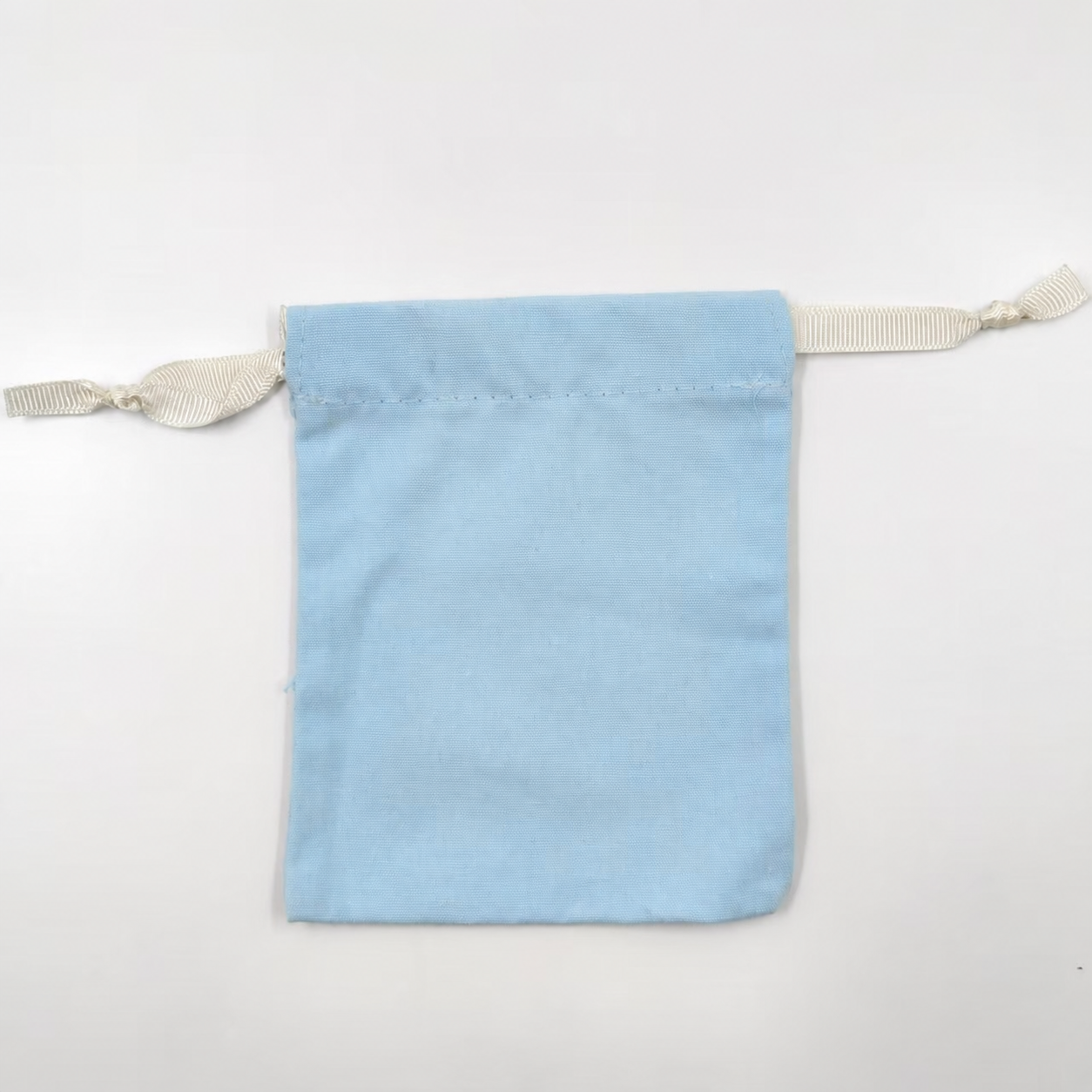
This edited product photograph is based on a real LUCKYSTAR public-channel sample and is included only to show visible construction details. Branding was removed. Appearance alone does not identify the fiber, recycled percentage, feedstock, certificate status or current availability; those points require order-specific records.
Define the recycled-content calculation before sampling
Do not allow “100% RPET” to mean one thing in the material quotation and another on the finished artwork. Record:
- the named product or component to which the percentage applies;
- the total weight used as the denominator;
- the eligible recycled input used as the numerator;
- whether the input is pre-consumer or post-consumer;
- whether additives, coatings and accessories are included;
- the rounding method and permitted tolerance; and
- who approves the final public wording.
For example, “main body fabric contains X% recycled polyester” is not interchangeable with “bag contains X% recycled material.” The latter may require the weights of cord, reinforcements, hardware, thread, label, decoration and other elements to be included. The applicable standard and claims policy control acceptable wording; the example is not a certification conclusion.
Verify pre-consumer, post-consumer and feedstock language
“Recycled” does not automatically mean “post-consumer,” and “RPET” does not automatically mean “made from bottles.” Ask the supplier to identify the input category used by the applicable standard and the records that support it. If marketing wants bottle-equivalent language, ocean-bound terminology or a named waste stream, pause until a qualified compliance reviewer confirms that the chain evidence and calculation support the exact statement.
Avoid turning a vivid sourcing story into an unverified material fact. Photographs of bottles or flakes are not proof that the nominated fabric used those inputs. A laboratory may identify polymer type, but ordinary visual or burn tests cannot establish certified chain of custody.
For a wider explanation of recycled-content records, see How to Verify Recycled Content in Custom Shopping Bags. Use it for the evidence logic, then apply the drawstring-specific BOM and conversion steps in this guide.
Authenticate every scope certificate
Read the certificate, not just its logo. At minimum, check:
| SC field | Acceptance question | Red flag |
|---|---|---|
| Legal organization name | Is it the same entity that performs the declared role? | Similar trading name but different legal entity |
| Certified site(s) | Does the physical site used for this order appear? | Only head office or another plant is listed |
| Standard and version | Is the document current for the order and transition date? | Old version used without a valid transition basis |
| Validity dates | Will it remain valid through the relevant transaction and production period? | Expired before material purchase or shipment |
| Product appendix | Does it cover the proposed material/product category? | Certificate covers fiber or yarn but not the claimed output |
| Process appendix | Are the necessary handling/conversion processes included? | Sewing, trading, printing or finishing assumed without review |
| Certification body and number | Can the record be authenticated through the official route? | Cropped image, altered number or unverifiable issuer |
| Subcontractor details | Does the route disclose applicable outsourced processing? | Undeclared converter or finisher |
A valid document owned by someone else does not become LUCKYSTAR’s certificate. The current Luckystar knowledge base does not support presenting GRS as a company-wide LUCKYSTAR certification. Any project-specific certified route must be assessed using the actual legal entities, sites, product/process scope, validity and transaction evidence.
Reconcile transaction evidence with the shipment
Scope tells you what an organization is certified to handle. A transaction record connects certified goods to a sale. Build the reconciliation before shipment rather than asking for it after cartons leave.
| Field to reconcile | Source records | Buyer action |
|---|---|---|
| Seller and buyer | TC/eTransaction, invoice and PO | Match exact legal names and addresses |
| Product/article | Certification record, PO, BOM and packing list | Align style number, material description and claim category |
| Quantity and weight | TC/eTransaction, production output and packing list | Explain conversion losses, unit weights and tolerances |
| Dates | Material purchase, production, certificate validity and shipment | Confirm a logical sequence and valid coverage |
| Lot identity | Receiving record, roll/lot ledger and cutting issue | Retain traceability from fabric roll to finished SKU |
| SKU/color allocation | Production and carton records | Map certified quantities across colors and sizes without double counting |
| Invoice/PO references | Commercial and certification records | Correct mismatches before release |
Do not promise that a transaction certificate will be available on a particular date until the responsible organization and certification body confirm the process. Make required evidence, responsibilities, timing and consequences for non-delivery explicit in the purchase order.
Keep certification claims and logo use separate
Evidence for a certified transaction does not automatically authorize a logo on the bag, hangtag, website or campaign. The standard’s current claims policy, trademark rules and approval workflow control the wording and mark.
Before artwork release, record:
- The exact statement and language version.
- The product/component boundary and percentage.
- The channel: bag print, label, packaging, web page, catalog or advertisement.
- The party responsible for claim approval.
- The approval reference and final locked artwork.
- The rule for stock, reorders and material substitutions.
Never recreate a certification mark from an online image. Do not place GRS branding on a sample merely to show approximate artwork. Use a neutral placeholder until the authorized file and approval are available.
The related Shopping Bag Sustainability Certifications Explained guide compares the purpose of several schemes. It should not be read as proof that LUCKYSTAR or every product holds them.
Denier is a construction choice, not recycled-content evidence
210D, 420D and 600D describe yarn linear density conventions; they do not certify recycled origin. Two fabrics sold under the same denier can differ in yarn structure, filament count, weave density, GSM, coating, finishing and usable strength. One may use recycled polyester and the other conventional polyester.
Select the construction through performance requirements, then verify the evidence route for the nominated article. Our 210D vs 420D vs 600D Polyester Drawstring Bags guide explains why denier, GSM and test results should be separated in the specification.
| Use scenario | Construction priority | Evidence priority |
|---|---|---|
| Lightweight giveaway | Controlled weight, printability and basic seam security | Honest component claim and lot traceability |
| School or event pack | Cord comfort, corner pull strength and repeated-use durability | Stable nominated fabric and production records |
| Sports/gym use | Abrasion, moisture behavior and cleaning instructions | Coating/finish disclosure and claim boundary |
| Retail merchandise | Hand feel, color consistency, decoration and workmanship | Approved sample, artwork approval and SKU mapping |
| Higher-load kit | Reinforcement, seam architecture and fit-for-use testing | No substitution plus production/shipment reconciliation |
Sample with production-intent RPET material
A prototype made from conventional polyester can confirm dimensions and sewing feasibility, but it cannot approve the bulk RPET hand feel, shade, coating response, print behavior or traceability. Label the sample stage clearly.
| Sample stage | Primary purpose | Material rule | Release decision |
|---|---|---|---|
| Construction prototype | Check dimensions, access and sewing concept | Substitute material may be allowed if declared | Approve structure only |
| Material/print strike-off | Check color, surface and decoration | Use nominated or technically representative material | Approve color/process direction |
| Pre-production sample | Freeze bulk-intent construction and artwork | Use nominated production-intent components | Approve sealed reference after evidence review |
| Shipment sample | Compare mass production with the sealed standard | Pull from identified bulk lot | Accept only with inspection and document reconciliation |
Read the Custom Drawstring Bag Sample Development Process for stage controls. Each approval should state what is and is not approved.
Put traceability fields in the tech pack
The tech pack should control more than dimensions. Add fields for supplier article, composition, denier, target GSM, finish/coating, color reference, approved lot, component boundary, intended claim, evidence owner and substitution rule. Link each visual callout to the corresponding BOM line.
Use the custom drawstring bag tech pack guide to prepare construction drawings and tolerances. For RPET, append an evidence matrix with four columns: claim, required document, responsible party and release gate.
Test the finished bag for the intended service
Certification and durability are complementary. A bag that fails at the cord corner after a few uses undermines a reuse program, even when the material claim is properly documented.
| Risk area | Example verification | When to apply | Approval basis |
|---|---|---|---|
| Main seams | Defined static or cyclic load plus seam inspection | Development and bulk validation | No unacceptable opening, breakage or distortion under agreed method |
| Cord anchor/corner | Pull test on cord, patch and eyelet assembly | Pre-production and inspection | Meets agreed force/cycle method without dangerous failure |
| Fabric | Weight, thickness, tensile/tear or abrasion as relevant | Material approval and lot checks | Matches specification and approved range |
| Color | Instrumental or visual shade comparison under agreed lighting | Lab dip/strike-off and bulk | Within approved tolerance/band |
| Adhesion, rub, flex or wash test as use requires | Artwork process trial and bulk | Appearance meets agreed rating/method | |
| Coating | Adhesion, flex and water test when claimed | Material validation | Meets the specifically defined claim, not a generic “waterproof” promise |
| Hardware | Pull-out, corrosion or sharp-edge review | Design and inspection | Safe, secure and suitable for destination requirements |
| Workmanship | AQL or agreed inspection plan | Pre-shipment | Defect levels and measurements within written criteria |
Test methods, loads, cycles, sample sizes and acceptance criteria must be agreed for the actual design. Do not reuse a report from another material, construction or order as universal proof.
For a general inspection framework, use the Custom Bag Quality Inspection Checklist. The full drawstring bag manufacturing process shows where these gates fit from design to delivery.
Control printing, color and coating changes
Recycled polyester fabric can vary by yarn, weave, finish and lot. Printing results depend on surface energy, coating, color and heat exposure. Before bulk production:
- approve the artwork size, position and color standard;
- identify the exact production-intent fabric and finish;
- test the chosen print method on that material;
- record any white underbase, transfer film or primer;
- compare daylight and agreed light-source appearance;
- lock the acceptable shade and placement tolerance; and
- repeat relevant checks after a material or finish change.
A change that appears minor to production may affect both performance and claim math. The change log should trigger technical, evidence and artwork review.
Prevent undocumented substitutions
RPET availability, dye-lot requirements and certification routes can influence MOQ and lead time. A rushed substitution is one of the fastest ways to break an approved evidence chain. The PO should say that material supplier, article, composition, certified status, finish, coating, cord, reinforcement and nominated processes cannot change without written approval.
| Change request | Reviews required before approval |
|---|---|
| New fabric supplier | Scope/transaction route, technical equivalence, color and test plan |
| New sewing or printing site | Process/site scope, quality controls and shipment records |
| Lower recycled percentage | Claim wording, calculation, label/web artwork and commercial approval |
| Different coating | Composition, performance, chemical/regulatory and recyclability statements |
| Conventional cord replaces RPET cord | Whole-product percentage and public claim boundary |
| Colorway added after order | Material availability, lot allocation, print proof and carton traceability |
The right response is controlled change, not a blanket ban. Some substitutions are workable, but the evidence pack and approvals must follow the physical product.
Plan MOQ, timing and cost around the evidence route
There is no responsible universal MOQ or price for RPET drawstring bags. The answer changes with fabric article, certified chain, color, print process, hardware, bag size, number of SKUs, testing, inspection, transaction-document requirements, packing and delivery terms.
Ask for a line-item quotation that separates:
- nominated fabric and minimum dye/production quantity;
- sampling and print setup;
- certificate or transaction-document administration where applicable;
- tests and third-party inspection;
- labels, hangtags and claim approval work;
- packing and carton configuration; and
- freight terms and schedule assumptions.
The Custom Drawstring Bag MOQ and Production Time guide explains quantity and calendar drivers. Compare commercial structures in the 2026 drawstring bag pricing guide and use the cost-reduction guide to simplify intelligently. Any quoted conditions remain subject to specification and written confirmation.
Audit packing and carton traceability
Finished bags often become harder to trace after folding and packing. Give each SKU a stable style/color identifier and map it to production lot, packing date, carton range and shipment documents. Mixed-color cartons need an explicit pack ratio.
Do not confuse packaging claims with product claims. A recycled carton does not make the bag recycled; an RPET bag does not prove the individual polybag has recycled content. Specify and support them separately.
Avoid common RPET greenwashing traps
| Risky statement or practice | Why it fails | Safer control |
|---|---|---|
| “Eco-friendly RPET bag” | Broad environmental superiority is undefined | State a specific, supported material fact and relevant limitations |
| “Made from recycled bottles” | RPET does not identify the feedstock by itself | Use bottle-origin language only with eligible, traceable evidence |
| “100% recycled” beside a multi-material bag | Boundary may be unclear or false | Name the component and verified percentage |
| GRS logo copied into mockup | Logo permission and exact artwork are uncontrolled | Use neutral placeholder until formal approval |
| Supplier SC presented as buyer’s certificate | Certificate owner and scope are misrepresented | Name the actual holder and route, or omit the claim |
| Certification used as proof of recyclability | End-of-life depends on full construction and local systems | Assess material combination, separability and destination infrastructure |
| One TC reused across unrelated shipments | Order-level evidence is not interchangeable | Reconcile each required certified transaction |
| Sample photo used as certification proof | Appearance cannot establish recycled content | Link the actual order to documents and lot records |
Precise language is more credible than inflated language. If the chain supports only the main shell, say so. If evidence is pending, keep the public claim pending too.
Use a green, amber and red release gate
A simple release status helps procurement, marketing and production make the same decision from the same file.
| Status | Evidence condition | Allowed action |
|---|---|---|
| Green | Product boundary is defined; certificate route is authenticated; order evidence, quantity and lot records reconcile; claim/artwork approval is complete | Release the approved wording and artwork for the specified order and channel |
| Amber | One or more records are pending, a transition-version question remains, or the calculation/claim boundary is not locked | Continue technical development, but hold certification wording, logos and public claims |
| Red | Certificate owner/site/scope does not match, evidence is expired or unverifiable, quantities cannot reconcile, or an undocumented substitution occurred | Stop claim release and escalate before production or shipment approval |
This gate is an internal control, not a certification decision. Certification bodies and qualified compliance reviewers remain responsible for determinations within their roles.
Why choose LUCKYSTAR for custom RPET drawstring bags?
LUCKYSTAR supports custom bag development through specification review, sampling, production coordination, quality control and export packing. For an RPET direction, our useful role is to turn a broad request into controlled order fields: construction, component BOM, material article, claim boundary, sample status, artwork, tests, traceability records and release gates.
That approach helps buyers because the same drawing, BOM and approved sample can guide supplier comparison, production and inspection. It also makes missing evidence visible before the bag is marketed. Depending on the project, LUCKYSTAR can coordinate questions across nominated material suppliers and processing partners, but it should not be described as owning every factory or certificate in the route.
Most importantly, LUCKYSTAR does not treat an old or upstream certificate as company-wide proof. GRS, RCS, GOTS, BSCI, ISO and other certifications must be verified for the current holder, site, scope, validity and order. We will align available evidence with the specification and flag gaps; the buyer’s compliance team or qualified certification party should approve regulated or certification claims.
For sourcing-model decisions, compare OEM vs ODM Drawstring Bag Manufacturing. International buyers can also follow How to Import Custom Drawstring Bags from China for document and delivery planning.
RPET drawstring bag RFQ checklist
Send suppliers the same structured brief so quotations are comparable.
| RFQ field | Details to provide | Supplier confirmation required |
|---|---|---|
| Use case | Load, items carried, reuse/cleaning expectations and user group | Recommended construction and limits |
| Bag design | Dimensions, capacity, pockets, closures and reinforcement | Drawing with tolerances |
| Shell | Fiber, recycled-content target, denier, GSM, weave, finish and color | Exact article and evidence route |
| Components | Cord, patches, grommets, thread, labels, coating and packaging | Composition and claim treatment for each |
| Claim | Exact proposed wording, boundary, market and channel | Evidence list and approval responsibility |
| Certification | Standard/version, SC/TC requirements and desired delivery timing | Holder/site/process map and feasibility |
| Artwork | Vector file, colors, size, position and method | Proof, tolerance and test proposal |
| Quality | Performance methods, sample size, AQL and acceptance criteria | Test/inspection plan |
| Quantity | Units by style/color, reorder forecast and packing ratio | MOQ basis and material reservation |
| Schedule | Sample, approval, production, inspection and ship dates | Critical path and dependencies |
| Commercial | Incoterm, destination, packing and required documents | Itemized price and exclusions |
| Change control | No-substitution fields and escalation contacts | Written approval workflow |
Frequently asked questions
Does RPET mean the drawstring bag is GRS certified?
No. RPET describes recycled PET/polyester. GRS certification requires a valid, applicable certified chain and compliant claim handling for the product and order. Verify the actual legal entities, sites, scope and transaction evidence.
Is a fabric mill’s GRS certificate enough for a finished bag claim?
Not automatically. It may support one upstream stage, but the full route can include dyeing, coating, printing, cutting, sewing, trading and export. Review every relevant stage under the current standard and policy.
Does a Scope Certificate prove my shipment contains certified RPET?
No. An SC establishes the certified scope of a named organization/site during its validity period. Order-level transaction evidence, where required, connects certified goods to a specific commercial movement.
Can a TE-ID replace a certificate check?
No. Textile Exchange explicitly says a TE-ID is not certification. Authenticate the current scope certificate and applicable transaction records.
Can the bag be called 100% recycled if only the shell is RPET?
Do not make that assumption. Define the product boundary and calculate the percentage under the applicable claims rules. Cord, thread, patches, hardware, coating, labels and decoration may alter whole-product wording.
Is recycled polyester always post-consumer bottle material?
No. Ask whether the input is pre-consumer or post-consumer and what eligible feedstock records support it. Bottle-origin language needs specific evidence.
Does certification prove that the bag is durable?
No. Specify and test the actual fabric, seams, cord anchoring, reinforcement, print and finish for the intended use.
What happens when the fabric supplier changes?
Pause release. Recheck scope, transaction route, material equivalence, percentage, color, performance and claim artwork. Approve the change in writing before production continues.
Should we print the GRS logo on the first sample?
Only after the current claims and logo-approval requirements have been satisfied for the exact use. Until then, use a neutral placeholder and keep certification wording out of public images.
What should LUCKYSTAR receive for an accurate quotation?
Send the bag drawing or reference, dimensions, intended load, shell and component specifications, artwork, quantity by SKU, target claim, destination market, evidence requirements, testing, packing and delivery terms. Final MOQ, price and lead time are subject to the confirmed specification and route.
How does the Materials Matter transition affect a 2026–2027 order?
It can affect the applicable standard version, audit timing, reclaimed-material forms and claims policy. Record the order, production and launch dates; then ask the responsible certification body and claim approver which rules apply at each gate.Do not infer LUCKYSTAR or product certification from the transition timeline.
Approve the evidence chain before approving the claim
The best RPET sourcing checklist follows the product, not the marketing calendar. Define the complete bag, select a fit-for-use construction, authenticate the relevant organizations and sites, reconcile the order transaction, test the finished assembly and freeze the exact wording before launch. Keep the same controls for reorders and every substitution.
Send LUCKYSTAR your desired size, use case, material direction, artwork, quantity by color, recycled-content target, proposed claim, required certification documents, tests and delivery destination. We can help convert the request into a sample, specification and evidence checklist suitable for supplier review.

GET A QUOTE FOR YOUR CUSTOM RPET DRAWSTRING BAG PROJECT
Policy and source review date: October 6, 2026. Reconfirm Textile Exchange requirements, certificate validity, claim approval and destination-market rules when the order is placed.