
“Excellence” from a wallet manufacturer in China should be visible in a controlled sample and repeatable in the agreed shipment. It is not proved by a polished product photograph, a “premium” material label or a general quality promise. A buyer needs measurable requirements, a filled-use review, a defect agreement and evidence that the approved construction transferred into bulk.
Buyer quick answer
Inspect a wallet in three states—closed, fully open and filled with its intended contents. Check dimensions, internal alignment, card-slot fit, seam and edge construction, zipper or closure function, branding and pack-out. Convert every important point into an agreed method and acceptance rule, then link it to a uniquely identified approval sample.
Scope: this page is the wallet workmanship and sample-acceptance guide. Use the wallet supplier scorecard for supplier selection and the wallet OEM/ODM guide for development-route ownership. The Custom Bag Manufacturer Guide is the wider sourcing pillar.
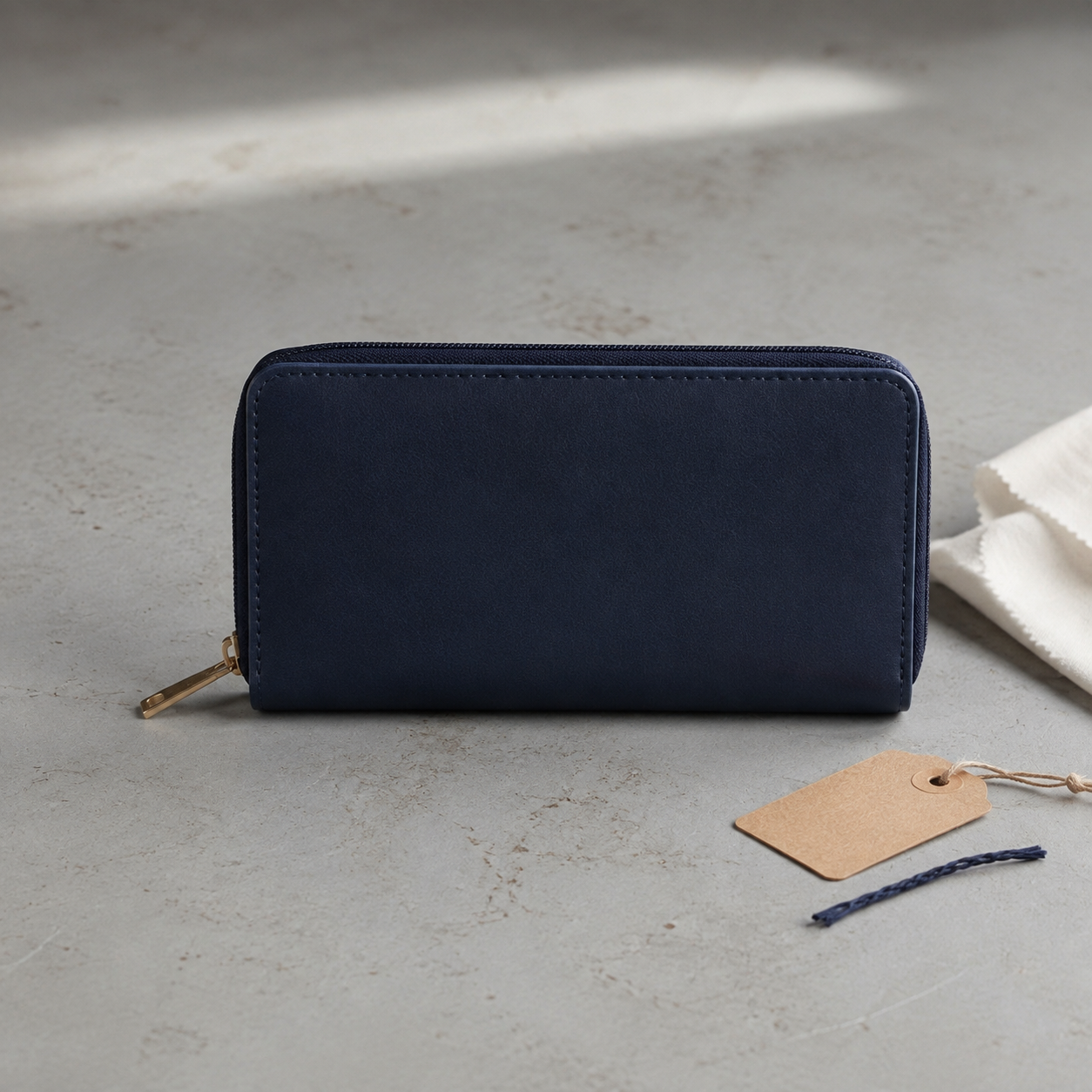
Define wallet excellence as repeatable conformance
A sample may look attractive yet still be unsuitable for production control. “Good workmanship” should be broken into characteristics that a buyer, supplier and inspector can evaluate in the same way. Some characteristics are visual, some are dimensional, some are functional and some require a defined test or document.
| Quality question | Weak wording | Controlled requirement | Evidence |
|---|---|---|---|
| Does the wallet keep its intended shape? | Looks structured | Named dimensions and shape observations in closed, open and filled states | Measurement record plus approved filled sample |
| Do card slots work? | Cards fit well | Specified card reference, insertion depth,retention and access check | Recorded fit review using the agreed card set |
| Are seams acceptable? | Neat stitching | Named seam route, stitch appearance, density or spacing method, start/stop and loose-thread limits | Close-up approval photos and sample |
| Do edges and corners match? | Smooth edges | Defined edge method, color, layer coverage, corner profile and allowable variation | Golden sample plus workmanship limit references |
| Does the zipper perform? | Strong zipper | Specified component, opening direction, travel,stop and attachment checks; test method if required | Approved component and functional or laboratory record |
| Is branding correct? | Logo centered | Controlled artwork, size, datum-based location, orientation, color and surface effect | Strike-off on the intended material and approved sample |
The Bag Quality Standards guide explains the larger system: define requirements, approve a sample, control changes, inspect against evidence and close deviations. A wallet-specific checklist then adds the small-scale construction details that general bag inspection can miss.
Review the sample before discussing bulk quality
Bulk inspection cannot rescue an undefined product. First decide what the sample proves. A feasibility prototype may confirm architecture while using temporary material. An appearance sample may confirm color and branding without final internal reinforcement. A pre-production sample should bring the intended material, components, construction and packing together.
Give every sample a unique identity
Record the sample number, date, design revision, material and component references, artwork version, approved points, exceptions and outstanding decisions.If the buyer approves only photos, retain the measurement sheet and exception list with the images. The Custom Bag Sample Development Process and custom sample manufacturer guide show how development decisions should feed the released standard.
Do not let temporary inputs become permanent
If the prototype uses a stock zipper, substitute lining, temporary puller or simplified logo, mark it visibly in the record. Before approval, close each exception or issue a written disposition. “Same as sample except…” is risky when the exception list is separated from the sample that teams actually use.
Build a wallet anatomy checklist
A zip-around wallet is a system of interacting parts: outer panels, lining, pocket stacks, divider walls, gussets, coin compartment, zipper chain, puller, edge construction, reinforcements and decoration. Changing one can alter another. A thicker outer surface can affect corner bulk; deeper slots can affect access; a larger logo can cross a seam or fold; a different zipper can change the seam allowance.
| Checkpoint | What to inspect | Method to define | Common evidence gap |
|---|---|---|---|
| Overall form | Closed profile, symmetry, fold or zipper path and recovery after packing | Specified viewing distance, conditioning and comparison points | Only an empty front photograph |
| Dimensions | Closed, open and filled width, height and thickness; compartment dimensions | Datum points, measuring tool, pressure and tolerance | A drawing with no measurement method |
| Pocket stack | Slot count, opening level, spacing,alignment, insertion depth and backing | Reference card, insertion sequence and visual limits | Slots checked without intended contents |
| Lining and dividers | Position, tension, pull-in, wrinkles, exposed edges and attachment | Open-wallet review and touch/access check | Interior omitted from approval photos |
| Seams | Route, straightness, density or spacing, tension appearance, backtack and thread ends | Named seam/stitch reference and workmanship limits | “Neat” used as the only criterion |
| Edges and corners | Coverage, color, cracking, overflow, sharpness, delamination or layer visibility | Lighting,flex or handling method and limit samples | No difficult corner close-up |
| Zipper and hardware | Travel, stops, engagement, puller attachment, finish and contact points | Opening cycle or specified test plus appearance review | A closed photo with no operation check |
| Logo and labels | Artwork version, position, size, orientation, definition and substrate effect | Datum-based measurement and approved strike-off | Different artwork files in sample and PO |
| Pack-out | Shape support, protective layer, SKU, barcode, accessory count and carton method | Approved packed sample and packing instruction | Product approved without its final packing |
Measure closed,open and filled states
Wallet measurements change with contents and handling. Define the state before setting a tolerance. A closed empty thickness, a naturally resting filled thickness and a compressed thickness are different values. Likewise, an open dimension can depend on how flat the product is held.
Fix the datum and pressure
Specify where each dimension begins and ends, whether the zipper or piping is included, how the wallet is positioned and how much pressure the measuring tool applies. Use one unit system in the controlled drawing. If a dimension is critical to retail packing or content fit, confirm it in that real condition.
Use the intended contents
Define the number and type of cards, note size, coin load or other contents. Blank test cards can protect personal data, but their dimensions and thickness should represent the target use. Record the insertion arrangement so two reviewers do not create different loads.
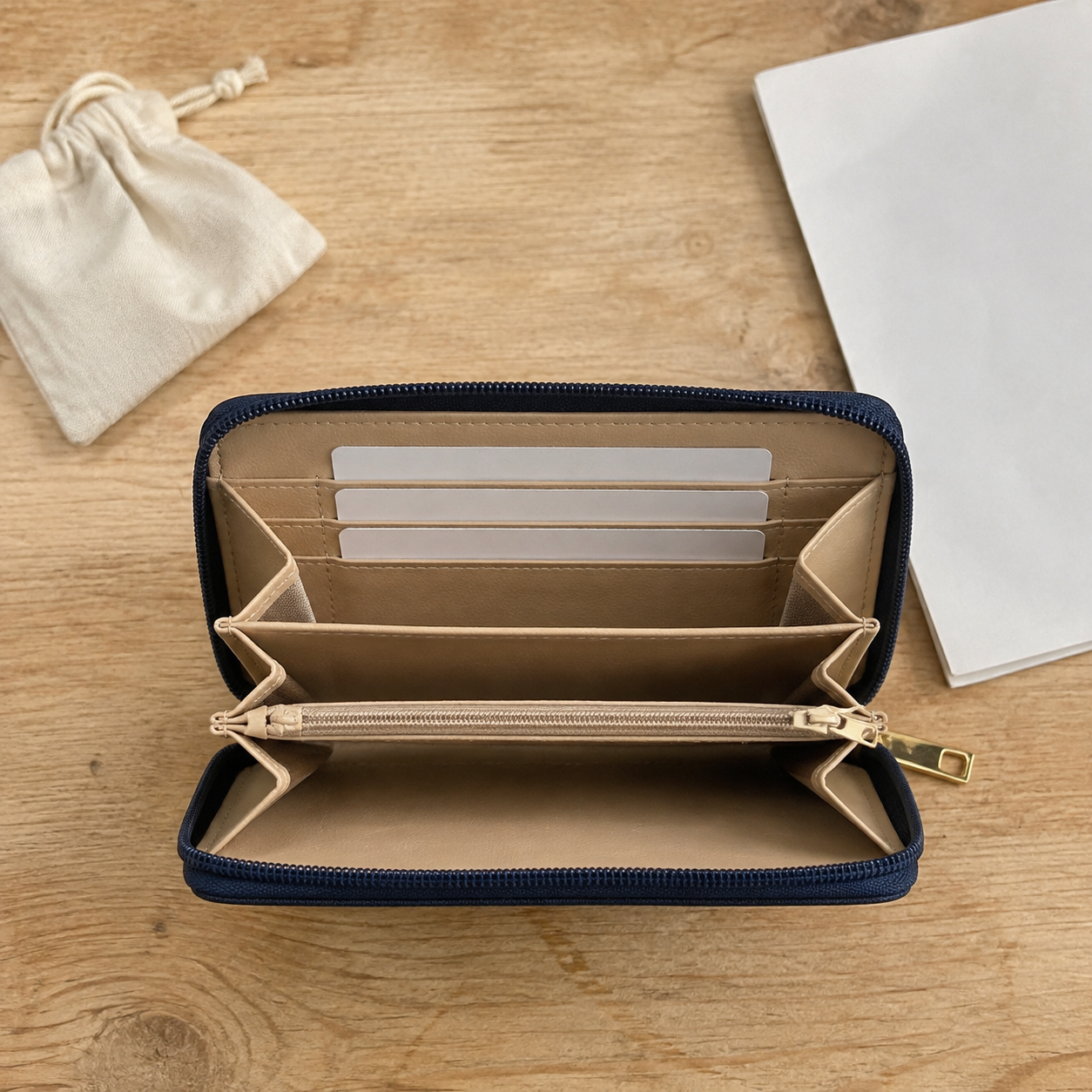
Inspect internal layout and card-slot function
Internal workmanship is where small differences become daily usability problems. Check that slot openings align, cards insert without damaging the lining, retained cards do not slide out under the agreed handling method, and the pocket stack does not create a hard ridge that prevents closure.
Check access, not only capacity
- Insert cards in the intended sequence and check access to each opening.
- Look for adhesive, raw edges or lining folds inside the slot.
- Confirm that opposing card stacks do not collide when the wallet closes.
- Operate the coin pocket or divider while the card area is loaded.
- Recheck shape, closure and zipper travel after the full load is inserted.
A card count in marketing copy is not an acceptance standard. The buyer and supplier should agree the actual test set and acceptable behavior for the target market.
Inspect seams as an engineered junction
Seam appearance depends on the material layers, seam type, stitch type, thread, stitch density, tension and the forces expected in use. ASTM D6193-16(2025) identifies stitch and seam types and explains that seam engineering must balance characteristics such as strength, elasticity, durability, security and appearance with the material and end use. Linking the standard does not mean every wallet requires it or that LUCKYSTAR holds an ASTM certification.
Inspect start, stop and high-layer areas
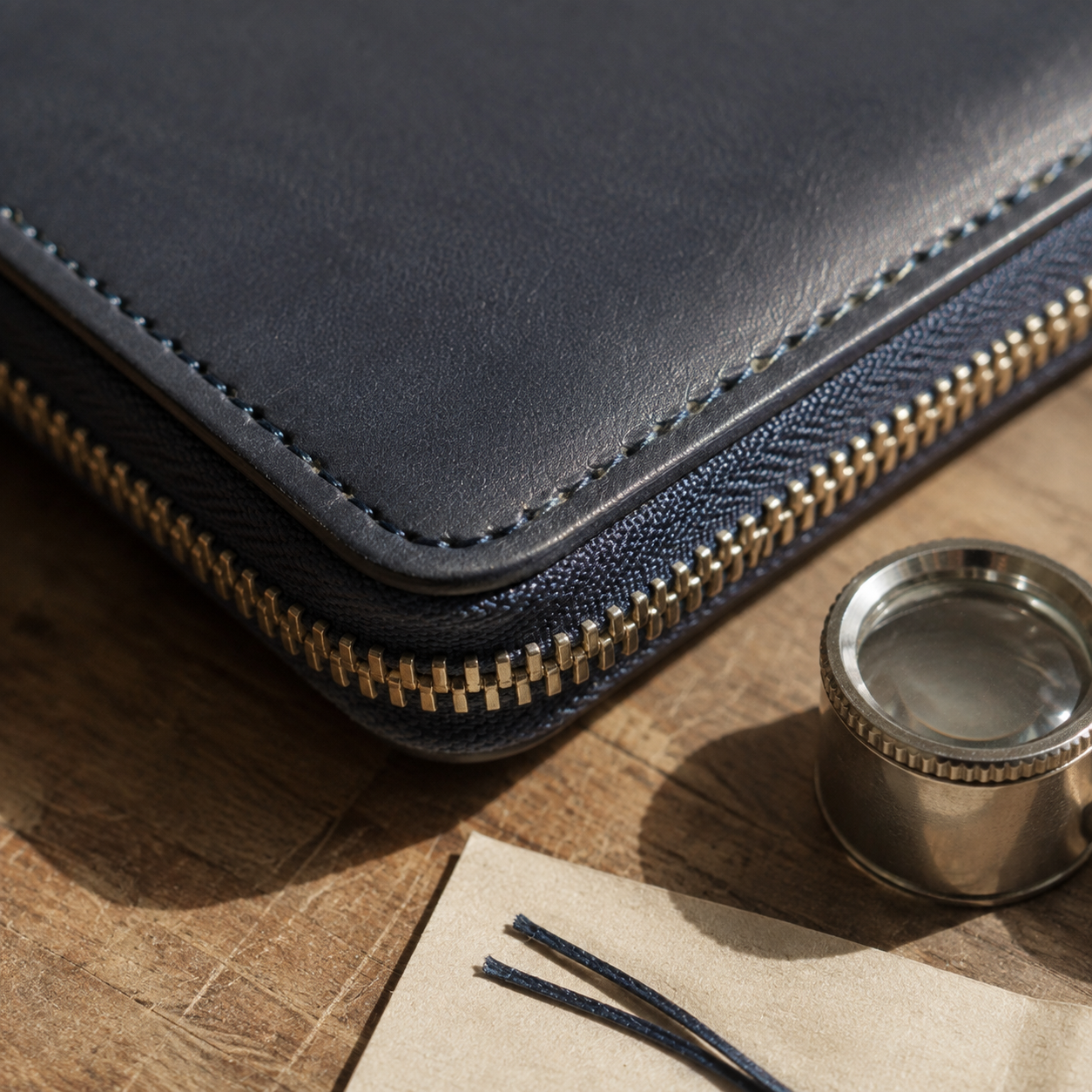
Look closely where a stitch line starts or ends, where pocket layers stack, where a zipper turns a corner and where a divider joins the body.These areas can reveal skipped stitches, short backtacks, thread loops, uneven feed, puckering, needle marks or excessive bulk that a front view hides.
Separate appearance from performance
A straight stitch line is not proof of seam strength, and a laboratory value is not proof of acceptable appearance. If strength matters, specify the applicable sample preparation, method, direction, conditioning and acceptance value. If appearance matters, approve visual limits under controlled lighting and viewing conditions.
Inspect edges, folds and corners
Edge construction can be folded, turned, bound, painted, raw-cut or otherwise finished. Define the method before describing defects. For an edge-coated design, inspect layer coverage, adhesion after the agreed conditioning, color, gloss, overflow, bubbles, cracking and corner consistency. For a folded or turned edge, check width, straightness, bulk and exposed substrate.
Use close-up approval references
Retain photographs of an acceptable straight edge, a difficult corner, a fold transition and a reject limit where useful. Keep the lighting and magnification practical: an extreme macro image can reveal harmless texture that is invisible in normal use, while a distant image can hide a real workmanship issue.
Inspect zipper, puller and hardware separately
“Zipper quality” includes more than smooth travel. Identify the chain or element type, tape, slider, puller, stops or end construction, attachment and finish. Check the complete path with the wallet empty and filled, including the tightest corners.
ASTM D2061 covers strength tests for zippers and zipper parts and notes that no single test determines suitability for every end use. The current ASTM store page points to an active later revision. Buyers should agree the applicable current method and acceptance criteria with a qualified laboratory or technical team rather than writing “zipper tested” without scope.
Record functional observations precisely
- Does the slider move through the full path without snagging the lining?
- Do the ends prevent unintended separation under the agreed handling?
- Is the puller attached in the approved direction and free of sharp contact points?
- Does the finish match the approved reference under agreed lighting?
- Does the zipper remain usable when the wallet carries the defined load?
Verify materials without relying on appearance
A photograph cannot distinguish real leather, coated textile, PU constructions or other material systems reliably.Ask for the actual material description, base or backing where relevant, thickness or weight method, finish, color reference and required destination-market evidence. Match every report or certificate to the correct material, sample, supplier, date and scope.
A swatch helps with color and hand but may not represent the way the material behaves after skiving, folding, stitching, edge treatment or decoration. Approve the material in the finished sample and state whether substitutions require written approval. Do not extend one test report or certificate to the full wallet range.
Approve branding on the production material
Embossing, debossing, foil, print, woven labels, patches and metal badges interact differently with surface grain, thickness, heat, pressure and internal reinforcement. Approve a strike-off on the intended material before approving the complete wallet.
Control artwork and location
Store one released artwork version and define the logo size, orientation, color, datum-based position and acceptable surface effect. For a metal badge, include finish, attachment, rear protection and contact risk. For embossing or foil, inspect definition, fill, pressure effect and consistency across difficult surface areas.
The custom bag tech pack guide explains how to keep artwork, dimensions and revision status together. The branding-system guide helps align wallet branding with pouches and other merchandise.
Define critical, major and minor defects
Defect classes should come from product risk, legal requirements, intended use and the buyer’s specification. Do not paste a generic classification into a purchase order without reviewing the actual wallet. A sharp exposed component may be critical in one program; a small cosmetic variation may be major or minor depending on the approved brand limit.
| Defect class | Decision logic | Wallet examples to evaluate | Required buyer action |
|---|---|---|---|
| Critical | Potential safety, legal, regulatory or unauthorized-brand risk, as defined for the order | Sharp exposed hardware, prohibited component, wrong mandatory warning or unauthorized artwork | Define zero-tolerance or other control with qualified legal and quality input |
| Major | Likely to impair intended use, saleability or a key approved characteristic | Closure failure, unusable slot, wrong layout, open seam, significant dimension failure,wrong logo or SKU | Create style-specific examples and agreed acceptance rule |
| Minor | Does not materially impair use but exceeds an agreed workmanship or appearance limit | Small stitch variation, light surface mark or slight edge inconsistency within a defined area | Set practical visual limit, lighting and viewing method |
| Not a defect | Natural or process variation explicitly accepted in the specification or approval sample | Material texture variation or construction feature within the signed limit | Document the allowed range so inspectors do not improvise |
The quality-problem prevention guide shows why defect rules should be built before production. Use the Custom Bag Quality Inspection Checklist to connect defect definitions with incoming, first-piece, in-process, final and pack-out checks.
Use a golden sample and frozen change record
The golden sample is useful only when its identity and approved scope are clear. Link it to the final specification, material and component references, artwork, packing instruction and any signed exceptions. Protect it from damage or uncontrolled handling, and state which record prevails if a physical reference and written dimension conflict.
| Control point | Required record | Release question |
|---|---|---|
| Sample approval | Sample ID, date, revision, measurements, materials, components, artwork and open-point status | Is this the full production standard or a partial approval? |
| Change request | Old requirement, proposed change, reason, affected areas, new sample need, cost and schedule effect | Who has authority to approve the change? |
| Bulk first piece | Current input references, setup checks, critical dimensions,function and workmanship comparison | Does current execution match the frozen standard? |
| In-process review | Checkpoint, sample identity, result, deviation and correction | Was the process corrected before more units were produced? |
| Final inspection | Lot definition, sampling plan, defect rules, findings, disposition and pack-out evidence | Is the lot decision traceable to the agreed criteria? |
| Shipment file | Final approval, inspection, packing, quantity and applicable test or compliance records | Can the shipped product be linked to the released order? |
Use acceptance sampling without confusing AQL with quality
ISO 2859-1:2026 defines AQL-indexed sampling schemes for lot-by-lot inspection by attributes.Before applying a plan, agree the lot definition, inspection level, AQLs, defect classes, switching rules and the action for a rejected lot. Sampling makes a lot decision; it does not define the wallet and it does not guarantee that every unit is defect-free.
Critical legal or safety characteristics may need controls beyond routine acceptance sampling. Product testing may also require a separately selected sample and method. Obtain qualified technical and compliance advice for the actual material, destination and intended use.
Inspect packing as part of workmanship
Packing can protect or distort the approved wallet. Review inserts, tissue, protective sleeves, desiccants where relevant, individual labels, barcode readability, inner quantity, carton orientation and pressure on hardware or edges. Approve one packed sample and connect it to the packing instruction.
Repeat the appearance check after pack-out
Allow the wallet to remain packed for an agreed simulation period if shape risk matters, then inspect impressions, transfer, creasing, zipper pressure and recovery. The method and duration are project decisions, not universal wallet standards.
Verify a wallet supplier through evidence
Ask who controls material sourcing, pattern and construction revisions, zipper and hardware approval, decoration, assembly, inspection and packing. Do not assume that every operation is performed in a company-owned factory. A supplier or coordinator should be able to explain the route and show how nonconforming inputs or units are isolated and resolved.
- Request a relevant, unbranded sample and inspect it using the same checklist planned for the order.
- Ask for the blank forms or record fields used at incoming, first-piece, in-process and final checks.
- Confirm how the golden sample and obsolete revisions are controlled.
- Match compliance or test evidence to the actual order rather than a general product family.
- Normalize quotation scope before comparing price, MOQ or timing.
Use the 10 questions before an OEM order, manufacturer selection checklist and what brands should expect from a custom bag manufacturer for broader due diligence.
Why consider LUCKYSTAR for a wallet program?
LUCKYSTAR belongs on a qualified shortlist when its adjacent custom-bag and pouch experience fits the wallet brief—not because “excellence” in the title is an independent award. Buyers can review the independent website’s product range, custom bag category, custom pouch category, zippered PU toiletry-bag reference and zippered canvas pouch reference. These examples create useful conversations about lining, zipper, decoration and pack-out; they do not prove every wallet specification or quantity is available.
A current Made-in-China coin-purse / cosmetic-bag listing identifies Ningbo Luckystar Commodities Co., Ltd. and shows an adjacent small-bag category. Its public company profile describes the business type as a trading company. Buyers should therefore evaluate LUCKYSTAR on specification review, sample coordination, change control and order evidence rather than infer that every wallet operation occurs in a company-owned factory.
Practical reasons to include LUCKYSTAR
- Public small-bag and zippered-pouch references give buyers concrete components and structures to discuss.
- OEM, ODM or existing-style modification can be separated before sample work begins.
- Wallets, pouches and other custom bags can share artwork, color, labeling and pack-out planning.
- Materials, MOQ, price, samples, timing, testing and inspection can be confirmed at project level.
If a program also includes gift or accessory pouches, the Wholesale Pouch Bags guide covers assortment and pack-out decisions. Commercial questions remain subject to the final specification and written confirmation; see the MOQ guide and custom bag cost guide.
Cross-check current LUCKYSTAR channels
Compare the independent website with the current marketplace storefronts. Marketplace product titles, display prices, MOQ, timing and badges can change and may apply only to a specific listing, so reconfirm each term for the wallet order.
- LUCKYSTAR Alibaba storefront
- ECO GREEN Bag Alibaba storefront
- Ningbo ECO GREEN Alibaba storefront
- Ningbo LUCKYSTAR Alibaba storefront
- LUCKYSTAR Made-in-China storefront
Wallet workmanship FAQ
What should I inspect first on a wallet sample?
Confirm the design revision and sample purpose first. Then inspect overall form, dimensions, intended-content fit, closure, internal layout, seams, edges, branding and packing. Record every deviation and distinguish temporary inputs from final ones.
Is an attractive sample enough for bulk approval?
No. The sample must be measurable, linked to the correct materials, components and artwork, and free of unexplained exceptions.The buyer also needs written defect rules, change control and a plan for confirming that bulk production matches the released standard.
How do I check wallet card slots?
Use a defined set of blank cards with representative dimensions and thickness. Record the insertion arrangement, depth, retention, access and how opposing pocket stacks behave when the wallet closes. Check for exposed adhesive, lining folds and edge damage.
What is a golden sample?
It is a uniquely identified physical reference approved for a stated scope and linked to the final specification. It should not replace controlled dimensions or artwork, and the agreement should say what happens if the physical and written references conflict.
Does AQL guarantee every wallet is defect-free?
No. An AQL-indexed sampling plan supports a lot decision using an agreed sample and defect classification. It does not define the product, inspect every unit or guarantee zero defects. Critical characteristics may require separate controls.
What evidence should accompany a wallet shipment?
The order file may include the released specification, approval-sample record, change history, material and component confirmations, artwork, inspection result, packing evidence, quantity documents and any applicable order-specific test or compliance records.
For short answers on MOQ, samples, materials, quality and delivery, see the Custom Bag FAQ.
Related wallet and quality guides
Request a wallet sample and quality review
Send LUCKYSTAR the wallet format, drawing or reference, intended contents, material direction, components, artwork, packing, quantity split, destination and required evidence through the Contact Us page. Or email a prefilled wallet brief. Ask the team to identify open specifications and propose a sample-review plan.Feasibility, MOQ, price, sampling, production timing, testing and delivery remain subject to the final specification and written confirmation.






