
A search for the best wallet manufacturer China offers does not produce one universal winner. A fashion brand, a travel-goods buyer and a promotional distributor may need different materials, development support, order structures and inspection evidence. The better decision is to define the wallet, compare suppliers against the same brief and choose the team that can prove it can repeat the approved result.
Buyer quick answer
Shortlist a wallet supplier only after it has reviewed the exact format, material system, internal layout, edge construction, zipper or hardware, branding, packing and target market. Approve a measured sample, normalize quotations and agree how bulk quality will be checked before you compare the final commercial offer.
Scope: this article is the supplier-selection scorecard. For the wider sourcing system, use the Custom Bag Manufacturer Guide. The separate wallet OEM/ODM guide focuses on development routes, while the wallet workmanship guide focuses on what to inspect in a sample.
What does “best” mean for a wallet sourcing project?
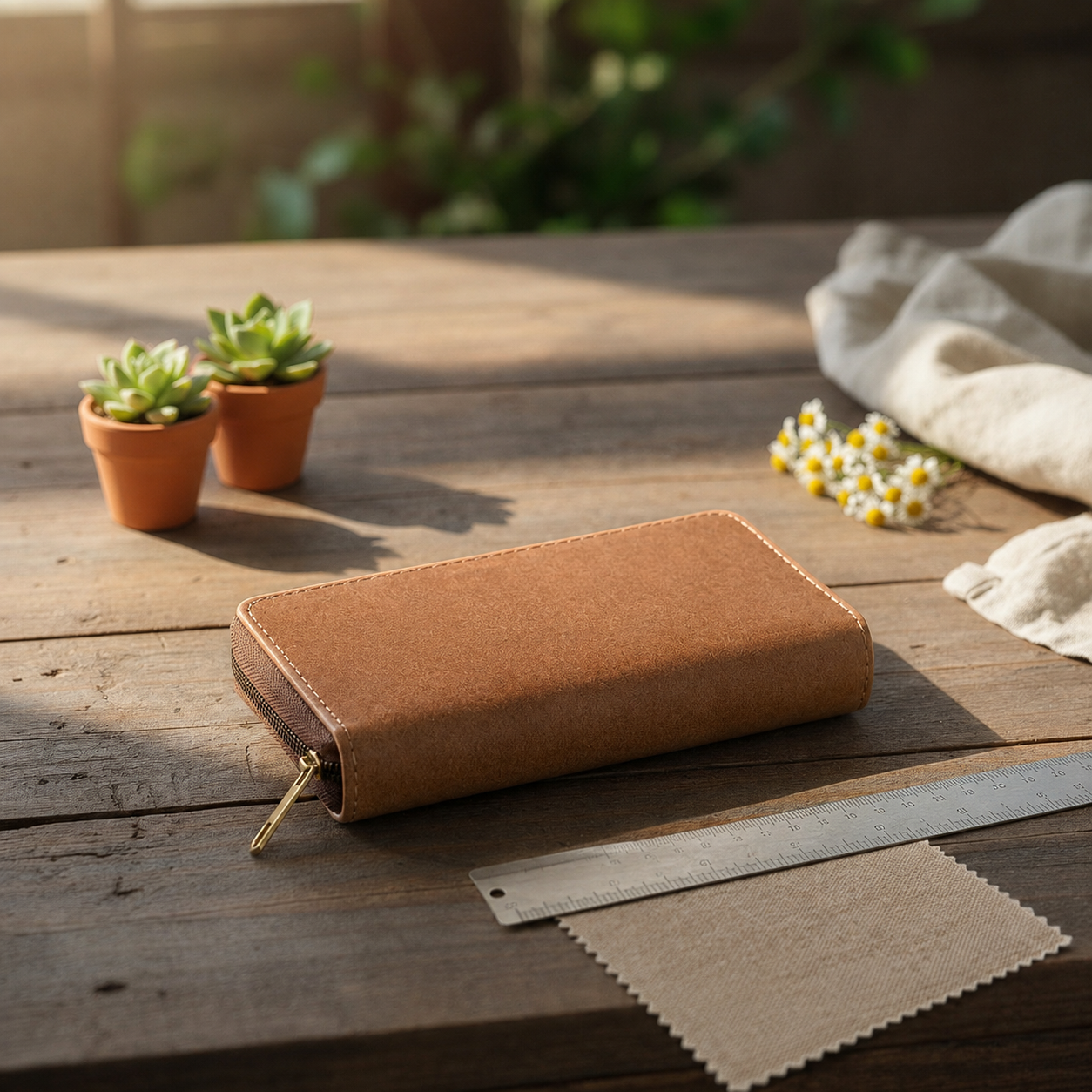
“Best” should describe fit for a defined program, not a self-awarded factory label. A supplier can be strong at stock card holders with a simple logo and still be wrong for a structured zip-around wallet with several lining layers, tight edge tolerances and custom metalwork. Another supplier may develop an excellent sample but lack the change control needed for a multi-color retail launch.
Start by ranking the outcomes that matter to your project. A suggested scorecard is below; change the weights before contacting suppliers so the score does not drift toward whichever presentation looks most impressive.
| Decision area | Suggested weight | Evidence to request |
|---|---|---|
| Product and construction fit | 20% | Relevant sample, construction explanation and identified technical risks |
| Sample development control | 20% | Sample stages, revision record, measurements and approval process |
| Material and component control | 15% | Named material specification, swatches, component references and substitution rules |
| Production-route visibility | 15% | Who owns development, cutting, decoration, assembly, inspection and packing |
| Quality and testing plan | 15% | Style-specific checks, defect rules, inspection timing and records |
| Commercial clarity | 10% | Comparable scope, quantity assumptions, inclusions, Incoterm and validity |
| Communication and change control | 5% | Named contact, response process, escalation route and written change approval |
The weights are a planning example, not an industry standard. A compliance-sensitive leather program may assign more weight to material evidence and testing. A time-fixed promotional project may assign more weight to stock inputs, artwork control and a schedule with protected approval gates.
Turn the wallet idea into a quote-ready specification
A photograph and the word “premium” are not a specification. Give every candidate the same controlled brief. If the design is still changing, use the custom bag tech pack guide to organize the file and the sample development process to record revisions.
| Specification block | Wallet questions to answer | Approval evidence |
|---|---|---|
| Format and use | Bifold, trifold, card holder, coin purse or zip-around; target contents; carry context; retail or promotional use | Annotated drawing and use-case list |
| Dimensions and capacity | Closed and open dimensions, thickness target, card and note sizes, coin or phone requirement, filled condition | Measurement chart plus a loaded-use sample |
| Outer and lining materials | Material family, construction or base, thickness/weight, grain, finish, color reference and backing | Labeled swatches and approved sample materials |
| Internal organization | Number and position of slots, note compartment, ID window, coin pocket, dividers and hidden backing | Open sample, section photos and functional fit check |
| Edges and seams | Folded, turned, raw, painted or bound edge; seam route; stitch appearance; corner build and reinforcement | Close-up approval photos and workmanship limit samples |
| Closure and hardware | Zipper path, puller, snap, magnet, metal finish, attachment, opening direction and contact surfaces | Approved component and repeated-operation check |
| Branding | Deboss, emboss, foil, print, woven label, patch or metal badge; artwork size, location, color and tolerance | Strike-off or logo sample on the production material |
| Packing and identification | Shape support, tissue or insert, protective sleeve, barcode, hangtag, inner quantity and carton marks | Approved packed sample and packing instruction |
Compare material descriptions without being misled
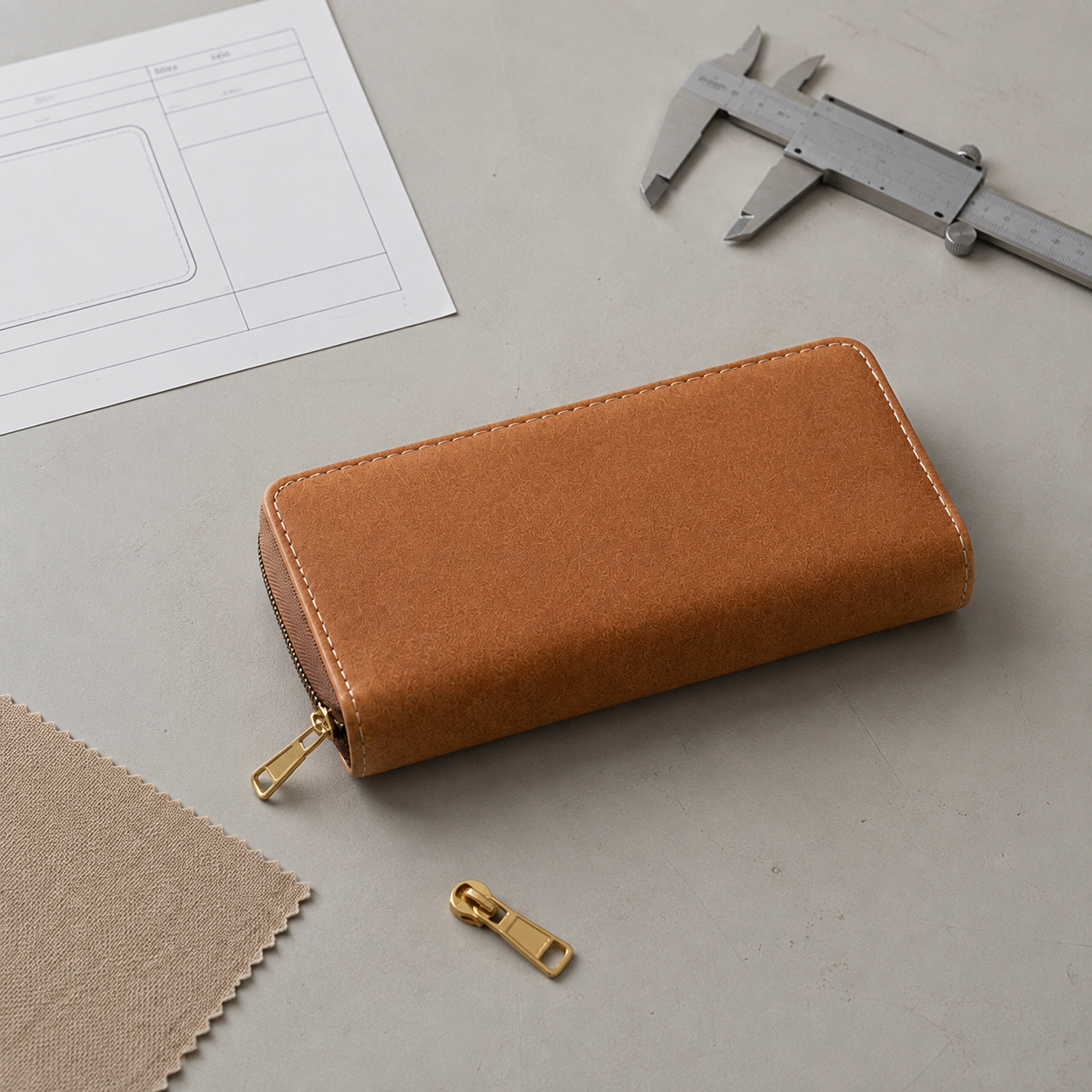
Material words often hide more variation than they reveal. “Leather” needs the actual leather type, finish, thickness and evidence required by the destination market. “PU” needs the surface system, base fabric, thickness, grain, hand and intended validation. Canvas and other textiles need composition, construction, weight, color and any coating or backing. A supplier should not substitute one material merely because the color looks similar.
Ask how the selected material behaves at the wallet’s difficult areas: repeated folds, skived edges, stitch lines, zipper corners, embossed areas and surfaces that touch light-colored clothing. For real leather, the current ISO 11640:2018 page describes a method for evaluating surface behavior during repeated rubbing; ISO also notes a revision is under development. This does not mean every wallet must use that standard. It shows why the buyer and supplier should agree the applicable test method, conditioning and acceptance criteria rather than accepting a vague “rub tested” claim.
Destination rules also depend on the material and how the product is used. For example, ECHA explains the EU restriction on chromium VI in leather articles. Confirm the current legal scope, sample identity and report coverage with a qualified compliance adviser or laboratory for the actual order. A supplier certificate for another material, company or batch is not proof for your wallet.
Use the approval sample as a controlled reference
The sample should answer questions that a rendering cannot: Do cards insert and release comfortably? Does the wallet close when loaded? Does the zipper travel around the corners without pulling the lining? Do stacked seam layers create an unacceptable ridge? Is the logo legible on the chosen grain? Does the packed wallet recover its shape?
Measure the sample and record what it approves. Keep a revision log with the sample number, date, material references, artwork version and open points. If a prototype uses a temporary zipper or stock lining, mark the exception so it does not silently become the bulk standard. The broader article on OEM vs ODM bag manufacturing helps buyers choose between an original development route and modification of an existing construction.
Run a practical filled-use review
- Load the intended cards, notes, coins or small items in the defined arrangement.
- Check closing force, zipper travel, fold position and access to the most-used pockets.
- Look for card-slot distortion, lining pull-in, sharp hardware edges and excessive bulk.
- Repeat the intended opening and handling motions using a project-defined cycle count.
- Recheck dimensions, appearance and function after the agreed conditioning or packing simulation.
The cycle count and pass/fail limits must come from the project requirement, risk and chosen method. They should not be copied from a generic online checklist.
Inspect the construction that creates everyday failures
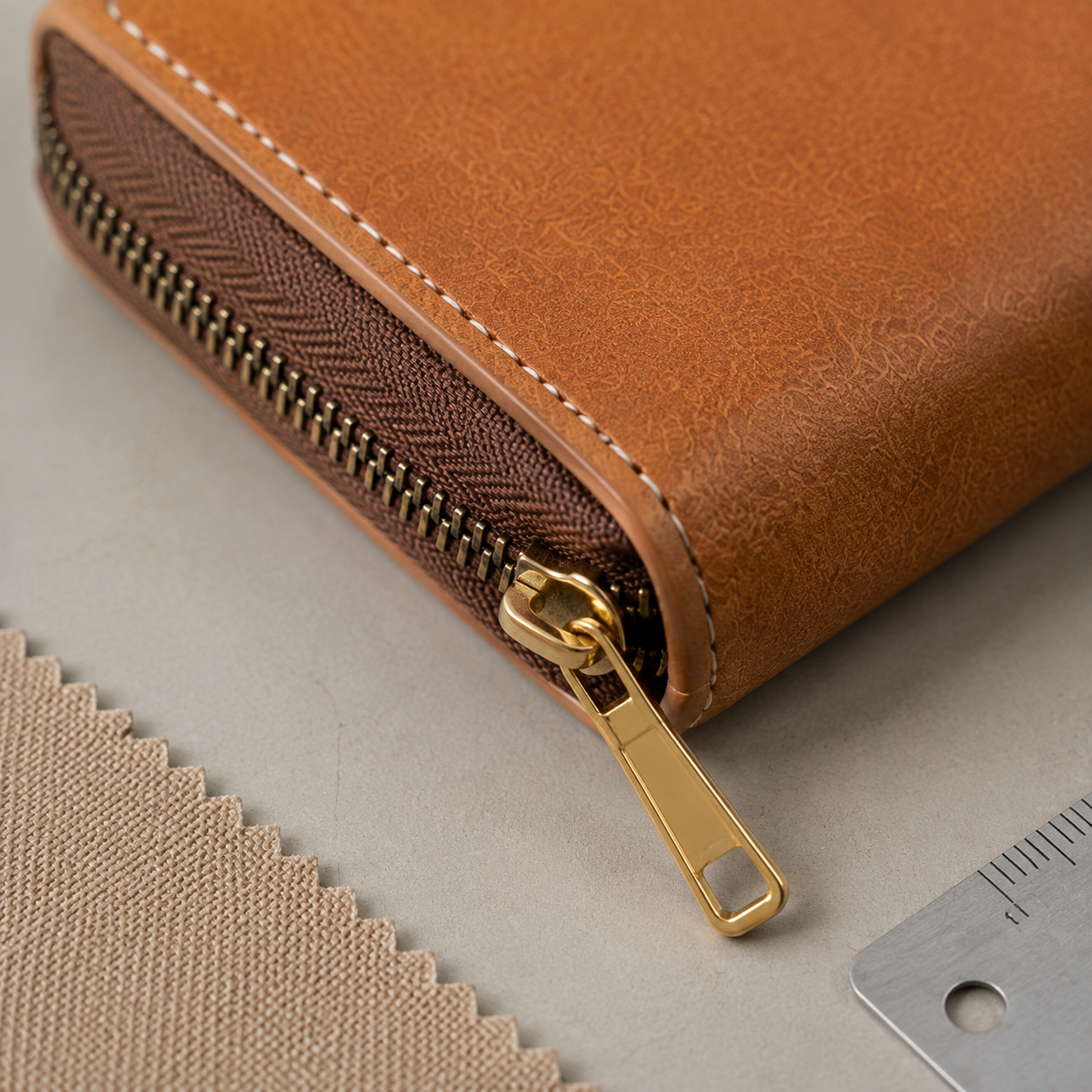
A final wallet can look clean from arm’s length while hiding weak or inconsistent details. Build the inspection plan around critical-to-quality characteristics, then define the method and decision for each one. The Custom Bag Quality Inspection Checklist provides the cross-category framework.
| Checkpoint | What to inspect | Evidence or decision |
|---|---|---|
| Incoming material | Identity, color, thickness/weight, surface, backing, lining and component lot | Compare with retained references; segregate an unapproved lot |
| Cut and preparation | Pattern identity, orientation, paired parts, skiving/folding and visible surface damage | First-piece dimensions and signed setup check |
| Decoration | Artwork version, position, pressure/heat effect, definition, adhesion and surface marking | Approved strike-off on the actual material |
| Assembly | Slot spacing, seam route, corner bulk, lining control, reinforcement and symmetry | In-line measurements and workmanship checks |
| Function | Card fit, pocket access, closure, zipper travel, snap or hardware operation and loaded shape | Project-defined functional method and recorded result |
| Finish and pack-out | Loose threads, edge consistency, odor review where relevant, clean surfaces, SKU, labels and shape protection | Final inspection and packing release record |
Acceptance sampling can support a lot decision, but it cannot define the product. The current ISO 2859-1:2026 describes AQL-indexed sampling schemes for lot-by-lot inspection. Before using a plan, agree the lot definition, inspection level, AQLs, defect classes and switching rules. Critical safety or regulatory characteristics may need a different control approach.
Normalize quotations before deciding on price
Two unit prices are not comparable if one includes custom-colored material, logo tooling, individual packing and inspection while the other assumes a stock surface, plain product and bulk packing. Use one comparison sheet and list every assumption. The custom bag pricing guide explains cost drivers, while the custom bag MOQ guide explains why different components can create different minimums.
Ask every supplier to separate these items
- Quantity by style, color and artwork—not only total order quantity.
- Material, lining, zipper, hardware and decoration assumptions.
- Sample, tooling, mold, artwork or testing charges where applicable.
- Individual packing, retail labels, barcode work, inner packs and export cartons.
- Trade term, named place, currency, payment milestones and quotation validity.
- Sampling and production timing, including the event that starts each clock.
- Items excluded from the price and the process for approving a change.
MOQ, price, sampling time and production time should remain project-based until the specification, quantity split, material availability, artwork, packing and current schedule are reviewed in writing.
How to verify a wallet supplier in China
- Confirm the legal and commercial counterparty. Make sure the name on the quotation, contract, invoice and payment instruction is consistent or that any difference is explained and documented.
- Map the production route. Ask who controls design development, patterns, material purchasing, cutting, decoration, sewing or assembly, inspection and packing. Do not assume every operation is owned in-house.
- Review relevant evidence. A closely related sample and a clear construction explanation are more useful than a large catalogue of unrelated products.
- Complete sample due diligence. Measure, load, operate and inspect the actual sample. Resolve exceptions before the production order.
- Verify claims at order level. Match every material, sustainability, performance or compliance claim to the correct product, component, standard, report, entity and date.
- Define production checkpoints. Agree incoming, first-piece, in-line, final and packing checks according to risk.
- Protect change control. No material, color, component, artwork, construction or packing change should be accepted without written review.
For a broader factory evaluation method, compare the manufacturer selection checklist with the partnership responsibilities described in What Brands Should Expect from a Custom Bag Manufacturer.
Why include LUCKYSTAR on the shortlist?
LUCKYSTAR is relevant when a wallet or compact accessory project benefits from the same disciplined decisions used in custom bag and pouch development: a complete brief, material and component coordination, sample approval, decoration review, production checkpoints and export packing. The current independent-site range is strongest in custom bags and accessories, including custom pouch bags and a public PU zippered toiletry-bag reference. The company’s official Made-in-China storefront also shows a small canvas coin-purse/pouch reference.
These public references support a sourcing conversation; they do not establish a universal wallet material, fixed MOQ, fixed lead time, blanket certification or a promise that every operation is performed in a self-owned factory. LUCKYSTAR’s practical value is the ability to review the project at specification level and coordinate related product categories. That can be useful for a brand launching a wallet together with a tote, cosmetic pouch, drawstring dust bag or gift pack. Explore the broader custom bag branding guide and wholesale pouch kit-planning guide when building that assortment.
What to send LUCKYSTAR for an informed review
- Wallet format, target user, intended contents and destination market.
- Dimensioned drawing, tech pack, reference sample or annotated photographs.
- Material direction, color standards, lining, closure, hardware and edge preference.
- Vector artwork, logo method, size, location and required appearance.
- Quantity by SKU, packing, test or documentation needs, destination and target date.
LUCKYSTAR can then confirm whether the project fits an existing reference, a modified design or a new development route, and identify the information still needed for a written quotation. All commercial and compliance terms remain subject to the final specification and written confirmation.
Related wallet and sourcing resources
- Custom Bag Manufacturer: Complete OEM/ODM Buyer’s Guide — the core pillar page for supplier models, materials, RFQ, MOQ, timing, QC and delivery.
- Top Wallet Manufacturer China: OEM/ODM & Custom Designs — how to choose the development route.
- Wallet Manufacturer China: Sample Quality Guide — sample workmanship and specification checkpoints.
- OEM vs ODM Bag Manufacturing — ownership, input and approval differences.
- How to Prepare a Custom Bag Tech Pack — a quote and production data structure.
- Custom Bag Sample Development Process — revisions, golden sample and bulk handoff.
- Custom Bag Quality Inspection Checklist — incoming, in-line, final and packing controls.
- Custom Bag FAQ — project-based answers on materials, samples, MOQ, QC and delivery.
Official LUCKYSTAR channels
Product listings and platform terms can change, so confirm the current specification and commercial basis directly. Review the independent-site custom bag range, learn about LUCKYSTAR, or compare the company’s official international storefronts:
- LUCKYSTARCREATION on Alibaba.com
- ECOGREENBAG on Alibaba.com
- NB-ECOGREEN on Alibaba.com
- NB-LUCKYSTAR on Alibaba.com
- LUCKYSTAR on Made-in-China.com
Frequently asked questions
How do I find the best wallet manufacturer in China?
Define the wallet and score candidates against relevant construction experience, sample control, material evidence, production-route visibility, quality planning, commercial clarity and change control. The best fit is the supplier that can provide evidence for your exact program—not the one using the strongest superlative.
What should I send for a custom wallet quotation?
Send the format, intended use, closed and open dimensions, internal layout, material and lining direction, zipper or hardware, edge treatment, logo artwork, quantity by SKU, packing, destination, testing needs and target date. Mark flexible points separately from fixed requirements.
Should I choose OEM or ODM for a wallet?
Choose OEM when you own a sufficiently complete design and specification. Choose ODM or modification of an existing reference when speed, lower development complexity or proof of an existing construction matters more than creating every detail from the beginning. Confirm design ownership and approval responsibilities in writing.
How should I test a wallet sample?
Measure it, load it with the intended contents, operate the closure repeatedly, inspect folds, slots, lining, edges, seams, zipper corners, hardware and logo, and evaluate packing recovery. Agree any laboratory or performance method according to the material, destination and risk; avoid universal internet pass/fail numbers.
What are typical MOQ and lead time for custom wallets?
There is no reliable universal figure. Material or hardware minimums, custom colors, tooling, artwork splits, sample revisions, packing and the current production schedule all affect the answer. Request a project-specific written quotation and identify the event that starts the quoted timing.
Can LUCKYSTAR guarantee leather certification or compliance?
No blanket claim should be assumed. Any leather, recycled-content, restricted-substance or destination-market statement must be checked against the exact material, component, supplier, product, report, legal entity, date and order. Ask for an evidence plan before placing the order.
Build a wallet brief that suppliers can actually price
Send the format, dimensions, internal layout, material direction, hardware, logo, quantity split, packing, destination and target date. LUCKYSTAR can review the development route and return the open questions needed for a written quotation.
Contact LUCKYSTAR about your wallet or compact-accessory project. Or email a prefilled supplier brief.

Editorial review: September 7, 2026. Product availability, supplier routing, MOQ, price, sampling, production timing, testing and documentation are project-specific and subject to the final specification and written confirmation.





