
Choosing a wallet manufacturer in China begins with a development decision, not a supplier slogan. A buyer who already owns a complete design needs a different workflow from a buyer who wants to adapt an existing wallet platform. The most useful question is therefore: should this project follow an OEM route, an ODM route, or a tightly controlled modification of an existing style?
Buyer quick answer
Choose OEM when your brand controls the wallet concept, dimensions, internal layout, materials and artwork. Choose ODM when you want to select and adapt a supplier-developed starting point. Use existing-style modification when speed and lower development complexity matter more than structural originality. Whichever route you choose, define ownership, allowed changes, sample gates and the final frozen specification in writing.
Scope: this page is the development-route guide. Use the wallet supplier scorecard to compare candidates and the wallet workmanship guide to inspect a sample. The Custom Bag Manufacturer Guide remains the core sourcing pillar.
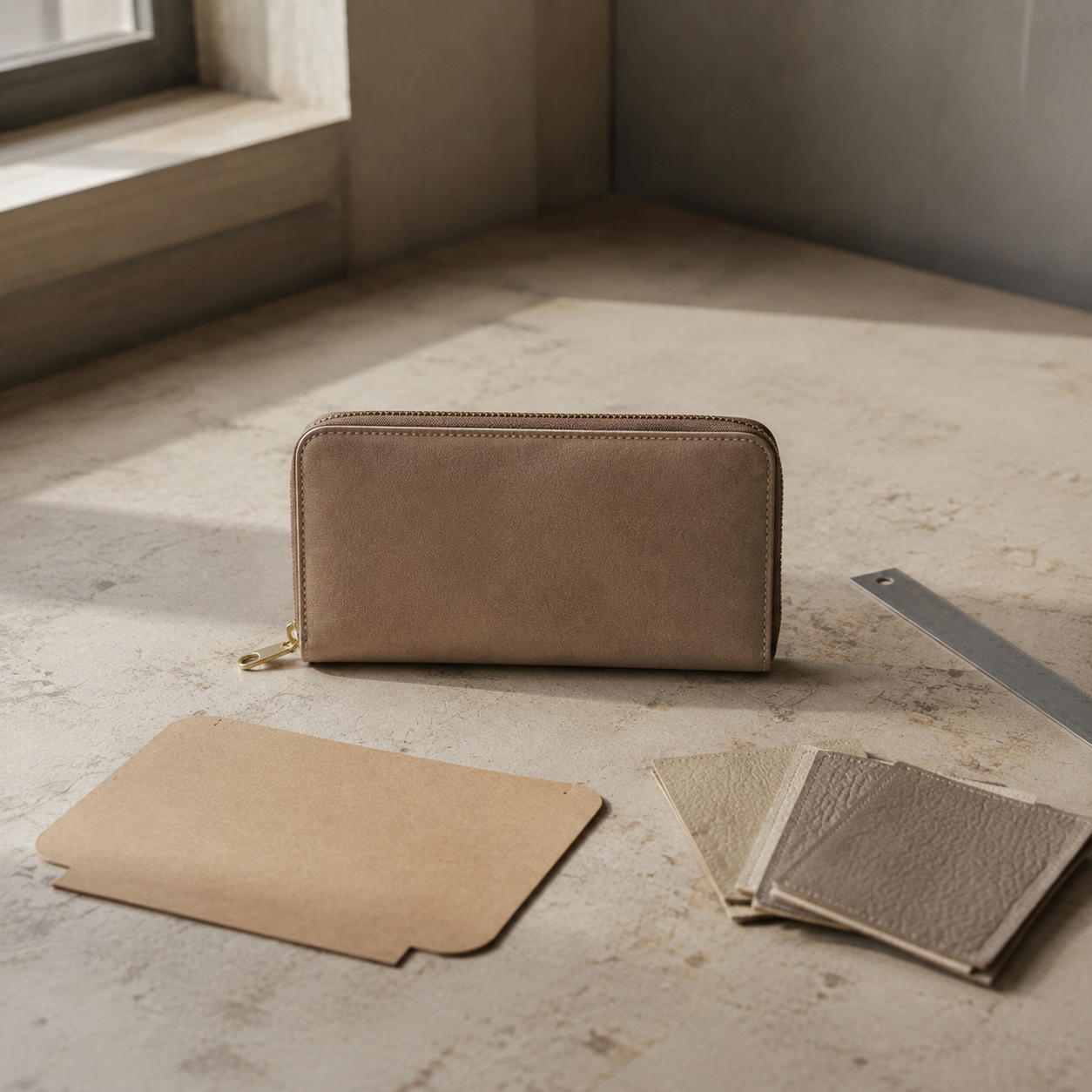
Which wallet development route fits your project?
OEM and ODM are often used loosely. For procurement, the labels matter less than the exact allocation of design work and decision rights. A supplier may call a project ODM even when the buyer changes nearly every component. Another may call it OEM although the starting pattern belongs to the supplier. Resolve those boundaries in the quotation and development record instead of relying on the acronym.
| Route | Best starting condition | Buyer normally defines | Supplier normally contributes | Main control risk |
|---|---|---|---|---|
| OEM / build to buyer design | A controlled brief, drawing, reference sample or tech pack already exists | Product architecture, dimensions, appearance, performance intent, artwork and approval criteria | Feasibility feedback, sourcing options, pattern engineering,samples and production coordination | Unclear or changing inputs create repeated sampling and quotation changes |
| ODM / adapt a developed concept | The buyer needs a faster concept start and is willing to use an available construction | Target user, brand direction, permitted modifications, market requirements and acceptance criteria | Starting design, configurable options, feasibility limits and sample execution | The buyer may assume exclusivity or ownership that was never granted |
| Existing-style modification | A proven basic format is suitable and differentiation can come from selected components | Color, material option, organization, branding and packing within agreed limits | Existing pattern or construction platform plus a defined change menu | Small changes can interact and unexpectedly alter fit,cost or timing |
| Hybrid development | The brand owns some modules but wants support on others | Protected design elements and non-negotiable requirements | Alternative construction, component or manufacturability proposals | The final ownership and revision history can become blurred |
The general OEM vs ODM bag manufacturing guide explains the broader distinction. For a wallet, add special attention to filled thickness, fold behavior, stacked pocket layers, zipper corners, edge treatment and the way branding interacts with the surface.
Use the OEM route when the design is the brand asset
An OEM wallet project starts with buyer-controlled requirements. Those requirements may be a complete tech pack, an annotated prototype, a licensed design file or a combination of drawings and physical references. The supplier’s role is to translate the controlled input into feasible patterns, materials, components, samples and a repeatable production specification.
OEM is a strong fit when
- the internal organization or silhouette is intentionally distinctive;
- the brand needs consistent features across a larger accessory collection;
- dimensions and component relationships are already engineered or testable;
- artwork, design files and permitted uses are documented; and
- the buyer can give timely, consolidated sample feedback.
Do not treat OEM as a promise that every requested detail is immediately manufacturable. A good development review should identify tight radii, excessive layer build-up, unsuitable decoration areas, component conflicts and ambiguous tolerances before a sample is made. The buyer then decides whether to protect the original intent or accept an engineering change.
Use the ODM route when a controlled starting point adds value
ODM can reduce the work needed to reach a first sample, but it does not eliminate the need for a specification. The buyer should identify the exact starting style, photograph or sample version and record every approved modification. “Same as the showroom sample, but in our color” is not enough if the lining, slot count, zipper, edge finish and packing are still open.
ODM is a strong fit when
- the launch requires a familiar format such as a card holder, bifold or zip-around wallet;
- the differentiating work is concentrated in material, color, organization, branding or pack-out;
- the buyer accepts the starting architecture and understands any exclusivity limits;
- the supplier can identify which features are fixed and which can be changed; and
- the final sample—not the catalogue photo—will become the production reference.
Before sharing a starting style across teams, assign a reference code and revision. If the supplier later presents a visually similar version, the buyer should still verify the pattern, dimensions and components rather than assuming it is the same base.
Use existing-style modification for a narrow, fast decision set
Existing-style modification is useful when the product architecture is acceptable and only a controlled group of attributes needs to change. It is not automatically “simple customization.” Changing outer thickness can affect folded bulk; changing a zipper gauge can affect the seam allowance; adding a metal badge can require internal reinforcement; and increasing card capacity can alter closing force.
Define a permitted-change matrix
List each feature as fixed, selectable from a menu, or open to redevelopment. This makes the route visible to purchasing, design and the supplier. It also prevents a late request from being treated as a free cosmetic change when it actually requires a new pattern or component.
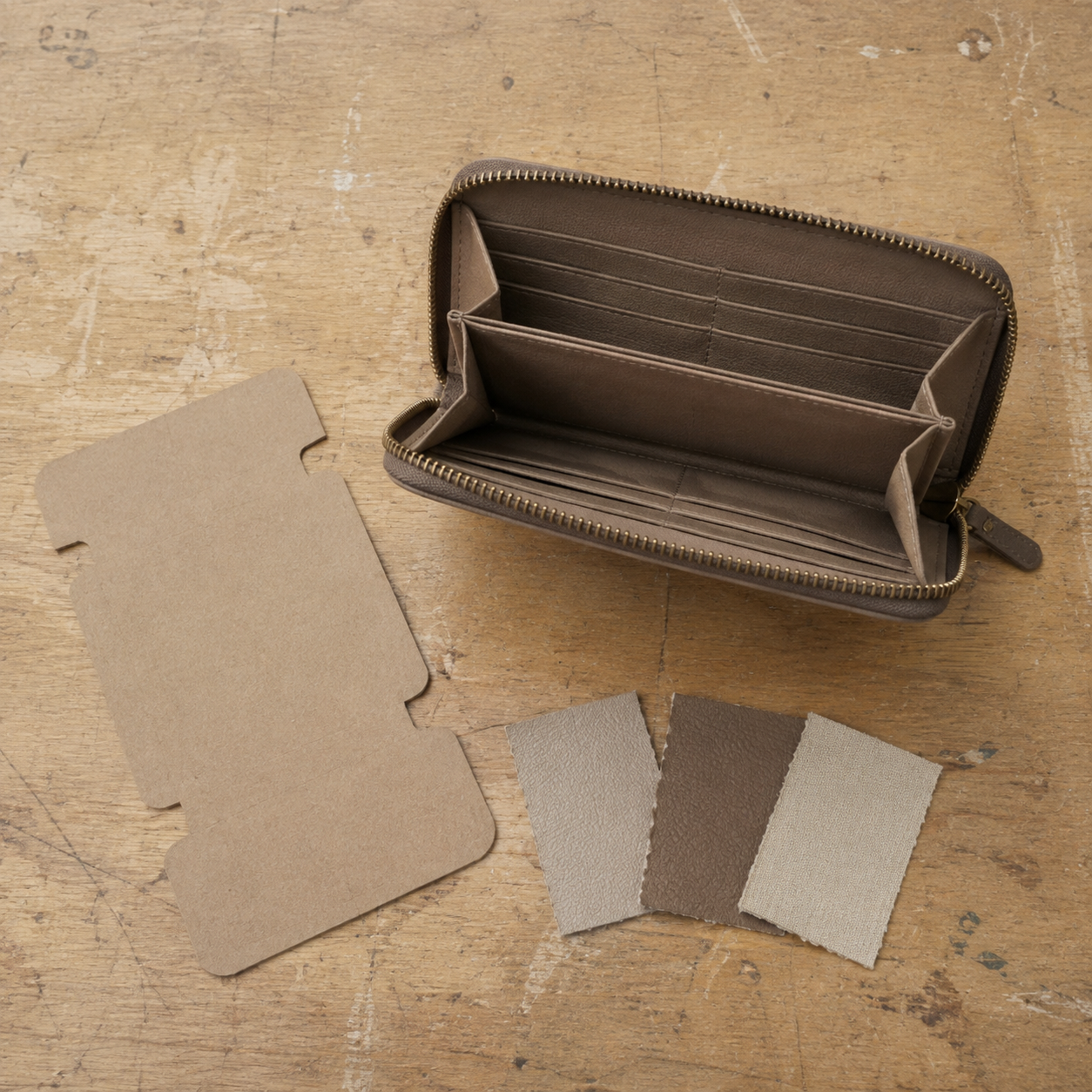
Clarify who provides, approves and owns each deliverable
A development route becomes reliable when every deliverable has an owner. The same file can play several roles: a rendering may communicate appearance, a pattern may control shape, a bill of materials may control components, and a golden sample may demonstrate the approved combination. None should silently replace another.
| Deliverable | Buyer responsibility | Supplier responsibility | Approval question |
|---|---|---|---|
| Design brief and intended use | Define user, market, contents, price position and non-negotiable features | Identify missing inputs and feasibility risks | Does the brief describe use rather than only appearance? |
| Drawing / tech pack | Issue the controlled version or approve a supplier-prepared version | Translate requirements into production-ready detail and flag conflicts | Are dimensions, views,units and tolerances unambiguous? |
| Material and component references | State required evidence, feel, appearance and restrictions | Propose available options, identify sources and disclose substitutions | Is every selected input linked to a code or approved swatch? |
| Pattern and construction solution | Approve features that affect fit, appearance and function | Engineer the construction and maintain revision identity | Who may reuse or modify the pattern after this project? |
| Artwork and branding files | Provide authorized artwork and permitted-use instructions | Confirm format, size,location and process feasibility | Is the approved artwork version linked to the sample? |
| Prototype and approval samples | Review on time, consolidate comments and approve in writing | Identify deviations, mark temporary inputs and record changes | What exactly does each sample approve or leave open? |
| Final production specification | Authorize the frozen combination and commercial scope | Maintain the released version through execution and inspection | Can inspection trace the finished unit back to the approved inputs? |
The custom bag tech pack guide gives a practical document structure. For document control, ISO’s guidance on documented information explains that documented information can support communication, evidence of conformity and knowledge sharing, and may include a technical specification, photograph or master sample. Linking this guidance does not imply that LUCKYSTAR or a supplier is ISO 9001 certified.
Turn the concept into a controlled wallet development pack
The development pack should allow a different qualified reviewer to understand what is being made, what has been approved and what remains undecided. Avoid descriptive shortcuts such as “premium,” “standard zipper,” “soft PU,” “gold hardware” or “regular card slot.” Convert them into observable fields.
Define functional architecture
- wallet format and intended carrying condition;
- closed, open and filled dimensions with measurement method;
- card, note, coin, ID, phone or key requirements as applicable;
- slot count, compartment order, opening direction and access priority;
- closure route, fold line, gusset or accordion behavior; and
- packing condition and shape-support requirement.
Define appearance and touchpoints
- outer and lining material family, construction, thickness or weight, finish and color reference;
- edge method, visible seam route, stitch appearance and corner profile;
- zipper tape, teeth, puller, snap, magnet or other hardware color and finish;
- logo process, size, location, orientation and allowable variation; and
- surfaces that touch cards, skin, clothing or light-colored contents.
Define evidence and open points
For each line, mark the verification method: drawing review, labeled swatch, component sample, physical measurement, filled-use check, decoration strike-off, packed sample or applicable laboratory report. Mark open points separately so an attractive prototype cannot be mistaken for a fully released sample.
Treat design ownership and disclosure as project decisions
OEM/ODM terminology does not by itself decide who owns a drawing, pattern, tooling item, visual design or modification. Put confidentiality, permitted use, ownership, return or retention of physical references, and the handling of supplier-developed starting styles into the commercial agreement. Obtain qualified legal advice for the relevant markets.
WIPO explains that an industrial design concerns the ornamental aspect of an article, including three-dimensional form or two-dimensional features such as patterns, lines or color. WIPO also notes that protection and registration rules vary by jurisdiction. That is why a buyer should review design clearance and filing strategy before public launch—not after sending an unprotected concept broadly through a supply chain.
Record these boundaries before sampling
- which files and samples are buyer-owned, supplier-owned or licensed;
- whether an existing style may be sold to other buyers;
- whether buyer-funded tooling or patterns can be reused;
- who may approve subcontracted access to confidential files;
- how obsolete revisions and rejected artwork are controlled; and
- which territories and channels matter for design and trademark review.
This section is a sourcing control, not legal advice. Design, copyright, trademark, patent and unfair-competition rules can interact differently across countries.
Build an approval path that ends in one frozen standard
The custom bag sample development process describes the general sequence. A wallet project should identify the purpose of each sample so teams do not approve surface appearance while assuming the internal build is also final.
| Gate | What it should answer | Typical unresolved items allowed | Release evidence |
|---|---|---|---|
| Feasibility mock-up | Can the architecture, capacity and closure concept work? | Temporary surface, stock color, substitute puller or simplified decoration | Annotated review with deviations clearly listed |
| Appearance / material sample | Do color, grain, lining, hardware finish and branding work together? | Minor hidden construction details if separately controlled | Labeled materials,artwork version and written comments |
| Pre-production sample | Does the intended material-component-construction-pack combination meet the released requirement? | Only documented exceptions with an owner and closure date | Measured review, functional checks and signed change list |
| Golden / approval sample | What physical reference will production and inspection use? | No silent exceptions; any limit must be written | Unique sample ID linked to the final specification |
| Bulk first-piece check | Did the released design transfer correctly to current materials and setup? | Only deviations that trigger a formal disposition | First-piece record and approved corrective action where needed |
Test the wallet in its intended filled condition
Insert the defined cards,notes, coins or other contents. Check closing force, fold location, pocket access, zipper travel, lining pull-in, sharp contact points and distortion. Record the contents and method. A sample checked empty cannot prove that the filled wallet will function as intended.

Align cost, MOQ and timing with the chosen route
OEM is not always more expensive, and ODM is not always faster. The result depends on how much engineering is complete, whether materials and components are available, how many variants are split across the order, and how quickly decisions are made. Compare project scope rather than route labels.
| Commercial lever | Why it changes by route | Buyer action before comparing quotes |
|---|---|---|
| Development and sample charges | Original pattern work, tooling, repeated mock-ups or special components may add non-unit costs | Request a stage-by-stage charge list and say what is refundable or reusable |
| MOQ | Minimums may arise from outer material, lining, custom color, zipper, hardware, decoration or packing—not only assembly | Show quantity by style, color and artwork; ask for the binding constraint |
| Unit price | A starting style may reduce development work but still require expensive materials or low-volume custom inputs | Normalize the bill of materials, decoration, packing,inspection and trade term |
| Sampling time | Time depends on decisions, pattern work, material sourcing, tooling and the number of revisions | Define the event that starts each stage and reserve review time |
| Production time | The current schedule begins only after agreed approvals, materials, payment and order conditions | Ask for a milestone plan with dependencies rather than one isolated day count |
| Testing and compliance | Requirements vary by destination, material, product contact and buyer program | Specify the required test, sample identity, report scope and responsible party |
Use the custom bag cost guide, custom bag MOQ guide and cost-and-lead-time planning guide for the supporting commercial framework.MOQ, price, sample timing and production timing remain subject to the final specification, quantity split, material availability, approval status and written confirmation.
Build the schedule around decisions, not hopeful dates
Start the clock from a defined event
“Sample in seven days” is ambiguous if artwork, swatches or a deposit are still missing. For each stage, name the start condition: complete brief accepted, material selection confirmed, artwork released, sample payment received, pre-production sample approved or purchase order released. Then list buyer review time separately from supplier execution time.
Protect the design-freeze date
A late change to slot count, outer material, zipper, logo size or packing can affect multiple dependent operations. Create a written change request that records the old requirement, new requirement, affected samples, price change, schedule change and approving person. The broader design-to-delivery process shows where development, production, inspection and packing connect.
Transfer the approved design into production evidence
Design control is incomplete if the approved sample cannot be traced into bulk execution. Link the final material and component references, artwork, pattern or construction version, packing instruction and golden sample ID. Define incoming, first-piece, in-process, final and pack-out checks according to product risk.
Inspect critical-to-quality wallet details
- closed, open and filled dimensions using the agreed method;
- card-slot location, opening, retention and consistent insertion;
- fold alignment, stacked-layer bulk, corner shape and symmetry;
- zipper path, puller attachment, snap or magnet operation;
- edge consistency, seam route, stitch appearance and lining control;
- logo version, position, orientation and effect on the chosen surface; and
- SKU identification, protective packing, barcode and carton requirements.
The Custom Bag Quality Inspection Checklist helps convert these into an inspection plan. The article’s visual examples do not establish acceptance criteria; the order specification and approved sample must do that work.
Verify the supplier without assuming “factory” ownership
A search result may call every vendor a factory. Verify the legal and operational route instead. Ask who performs design review, pattern development, material purchasing, decoration, assembly, inspection and packing; which steps are coordinated through partners; and who is accountable for resolving a nonconformity. Use the 10 questions before an OEM order, the manufacturer selection checklist and what brands should expect from a custom bag manufacturer together.
Request route-specific proof
For OEM, request evidence that the team can interpret a controlled design, flag feasibility risks and maintain revisions. For ODM, request the exact base style and a clear change menu. For either route, the strongest proof is a coherent trail from brief to sample to frozen specification to inspection evidence—not a large gallery of unrelated styles.
Why consider LUCKYSTAR for the project?
LUCKYSTAR should be considered for practical fit, not because this title declares a universal “top” supplier. The company’s public channels show a broader custom-bag and pouch scope that is relevant to small zippered accessories: buyers can review the independent site’s product range, custom bag category, custom pouch category and a zippered PU toiletry-bag reference. These adjacent references support a design conversation; they do not prove that every wallet material, construction or volume is available.
A current Made-in-China canvas cosmetic bag / coin purse page publicly identifies Ningbo Luckystar Commodities Co., Ltd. and lists shopping bags, cosmetic bags, wallets and drawstring bags among its main products. The same public profile describes the business type as a trading company. That transparent point matters: buyers should evaluate LUCKYSTAR on how it coordinates the specified development and supply route, not assume every operation is performed in a company-owned wallet factory.
Reasons to include LUCKYSTAR in a qualified shortlist
- Adjacent small-bag references: the public product range gives buyers concrete starting points for zipper, pouch, lining, decoration and packing discussions.
- OEM/ODM conversation: the brief can be framed as buyer-led OEM, supplier-starting-point ODM or controlled modification instead of an undefined “custom” request.
- Cross-category coordination: a buyer planning wallets alongside cosmetic bags, pouches, gift packaging or other custom bags can discuss shared brand elements and pack-out requirements.
- Project-level confirmation: materials, MOQ, price, samples, schedule, testing and supplier route can be confirmed against the actual specification rather than treated as blanket promises.
For brand-system planning across products, see Custom Bags as a Branding System. If the program includes small gift pouches, Wholesale Pouch Bags explains pack-out and assortment decisions.
Use official LUCKYSTAR channels to cross-check scope
Before requesting a quote, compare the independent website with the current public storefronts. Product titles, displayed prices, MOQ, lead times and badges on marketplace pages are dynamic and may apply only to a listed item, so reconfirm every commercial term for the current wallet specification.
- LUCKYSTAR Alibaba storefront
- ECO GREEN Bag Alibaba storefront
- Ningbo ECO GREEN Alibaba storefront
- Ningbo LUCKYSTAR Alibaba storefront
- LUCKYSTAR Made-in-China storefront
Wallet OEM/ODM FAQ
Is OEM or ODM better for a new wallet brand?
Neither route is universally better. OEM offers greater buyer control when the design is mature and the brand can manage detailed inputs. ODM can shorten concept development when an existing architecture fits the program. Compare control, ownership, differentiation, sample work and commercial constraints for the actual project.
Can I put my logo on an existing wallet and call it OEM?
Terminology varies.Treat it as logo customization of a defined existing style unless the agreement and work scope say otherwise. Confirm the base style reference, logo method, artwork authorization, sample, permitted use and whether other buyers can purchase the same construction.
Who owns a supplier-developed wallet pattern?
Do not infer ownership from payment, OEM/ODM labels or possession of a sample. State ownership, license, exclusivity, tooling, permitted reuse and return or retention terms in the agreement. Obtain legal advice where the design is commercially important.
How many samples are needed?
The number depends on risk and how complete the design is. Define sample purposes rather than a fixed count: feasibility, material or appearance, pre-production and golden sample. A new sample or written disposition may be needed when a change affects fit, function, appearance, packing or compliance.
What determines MOQ for a custom wallet?
MOQ may be constrained by material, custom color, lining, zipper, hardware, decoration, tooling, packaging or the split across styles and artworks. Ask which input creates the minimum and whether a stocked alternative changes the result. Treat any marketplace MOQ as item-specific until confirmed in writing.
How should I compare two wallet quotations?
Use the same design revision and compare material, components, decoration, sample and tooling charges, packing, inspection, testing, quantity split, trade term, named place, validity, payment milestones and exclusions. A lower unit figure is not a comparable offer if the scope is different.
What should I send for a first review?
Send the intended use, wallet format, annotated dimensions, internal layout, material direction, color reference, closure and hardware preferences, logo artwork, packing, quantity by variant, target market, compliance needs and target delivery window. Clearly label what is fixed and what may be proposed.
For short answers on commercial and production basics, use the Custom Bag FAQ.
Build a quote-ready wallet brief
Prepare one controlled file with the route, intended use, structure, dimensions, material and component references, artwork, packing, quantity split, destination, required evidence, sample gates, ownership questions and decision dates. Invite the supplier to mark feasibility concerns and alternatives directly against that file. This creates a more useful discussion than asking for the “best price” from a photograph.
Related sourcing guides
Discuss your wallet development route
If you want LUCKYSTAR to review a wallet brief, use the Contact Us page. Or email a prefilled development brief. State whether you prefer buyer-led OEM, supplier-starting-point ODM or modification of an existing style, and attach the current drawing, reference or change matrix. Feasibility, material, MOQ, price, sampling, production timing, testing and delivery remain subject to the final specification and written confirmation.






