
Drawstring Bags for Hotels, Travel and Amenities
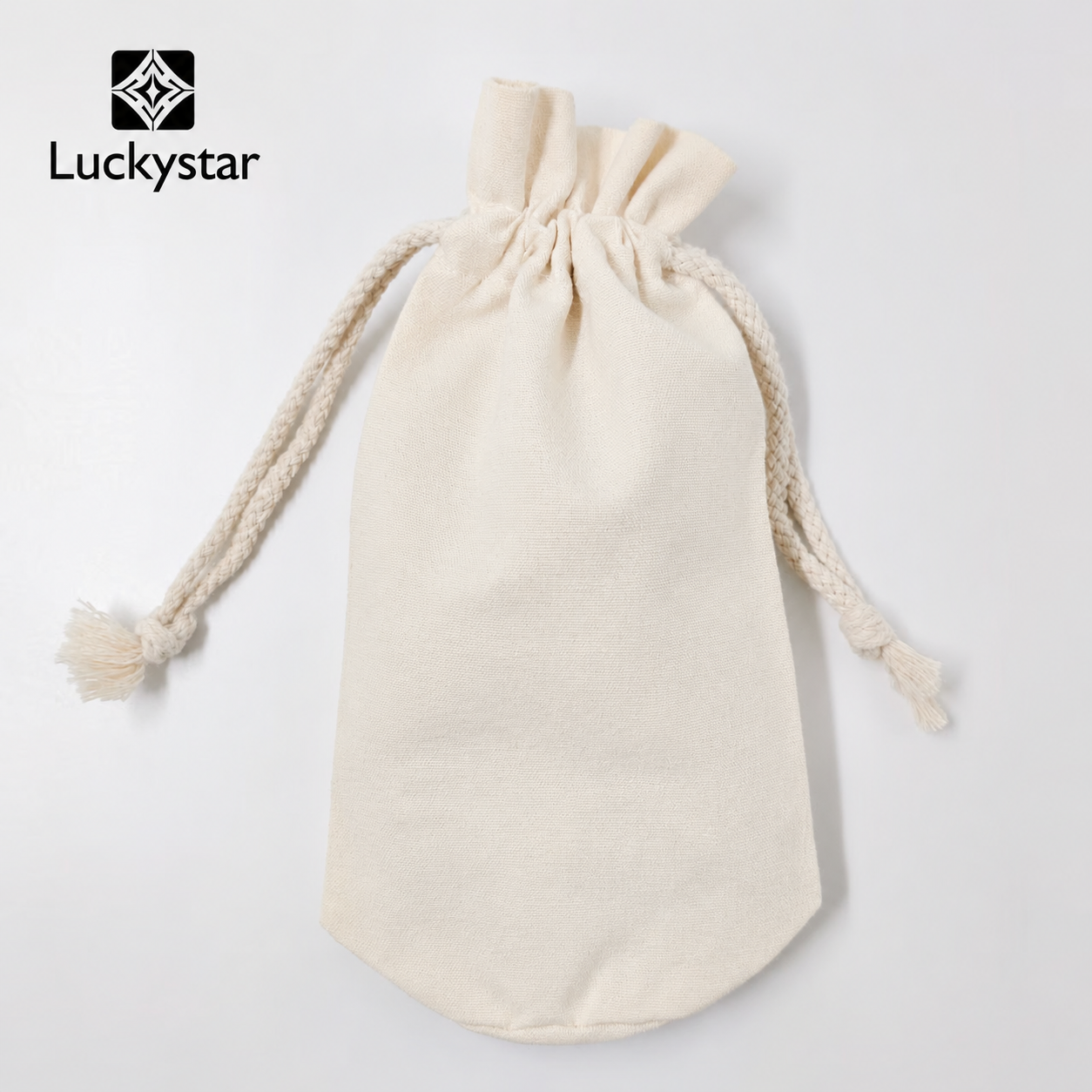
A current LUCKYSTAR public product photograph, edited only to remove an unverified decorative print. The image shows a possible drawstring-pouch format; it does not by itself establish fiber content, performance, hygiene status, certification, or suitability for a particular hotel program.
The short answer: drawstring bags can work well for hotel amenities, spa sets, welcome gifts, dry laundry or shoe organization, and travel kits when the bag has a clearly defined service role. Buyers should specify the actual contents, guest journey, replenishment method, cleaning or reuse expectation, destination market, and property-level branding before choosing size or material. A textile pouch is normally secondary packaging; it should not be treated as a liquid barrier, tamper-evident pack, sterile container, or primary cosmetic package unless the exact construction has been evaluated for that function.
The most reliable hotel program uses one controlled specification, a representative filled sample, clear artwork versions, and inspection criteria that housekeeping and purchasing teams can understand. This guide explains how to build that system for custom drawstring bags and why LUCKYSTAR is useful when a project requires coordinated development rather than an off-the-shelf blank pouch.
Hotel Drawstring Bag Decision Summary
| Buyer decision | Practical direction | Evidence before approval |
|---|---|---|
| Define the bag's job | Choose containment, presentation, organization, or guest reuse | Written use case and service workflow |
| Select dimensions | Size around the real filled kit, not a generic product label | Filled sample inside the intended tray, drawer, or luggage set |
| Choose material | Match touch, strength, decoration, care, and product-contact risk | Swatch, construction sample, and documented composition |
| Choose closure | Balance retention, guest usability, housekeeping speed, and safety | Closure trial with representative contents |
| Control branding | Use stable brand elements and property codes | Approved artwork register and physical sample |
| Plan testing | Test likely failures, not an unrelated generic list | Order-specific protocol and acceptance criteria |
| Plan replenishment | Forecast by property, room tier, issue rate, and replacement policy | Allocation sheet and reorder trigger |
What Can Hotels Use Drawstring Bags For?
A hotel pouch should solve a service or packing problem. It may group individual items, improve presentation, separate footwear, organize dry clothing, or become a useful guest takeaway. The role should be named before the design is discussed.
Common hotel and travel applications
| Application | Typical contents | Operational value | Main risk to control |
|---|---|---|---|
| Guest amenity set | Individually packed toiletries, vanity items, sewing kit | Groups components and creates a defined presentation | Leakage from primary packs contaminates the pouch |
| Spa or wellness kit | Headband, comb, dry accessories, treatment information | Supports a coordinated service ritual | Oils, lotions, or damp articles contact unprotected fabric |
| Slipper or shoe pouch | Slippers or footwear | Separates soles from luggage and wardrobe surfaces | Abrasion, dirt transfer, and insufficient opening width |
| Dry laundry organizer | Clean garments or guest travel laundry | Creates a packing aid or premium service component | “Laundry bag” is mistaken for wet or leakproof containment |
| Welcome or VIP set | Travel accessories, local gifts, card, adapter | Makes a multi-item arrival kit easier to stage | Too many property-specific versions create obsolete stock |
| Family or children’s kit | Age-appropriate amenities selected by the hotel | Keeps small items together | Destination safety and small-component requirements are unclear |
| Conference/group kit | Badge accessories, itinerary, gifts, travel items | Simplifies group arrival distribution | Event-dated stock remains after the group departs |
| In-room retail pouch | Merchandise or a travel accessory set | Supports a retail-ready bundle | Labeling, price, and inventory controls are incomplete |
The bag format should match the intended contents. If the program needs a zipper, wipe-clean interior, compartments, or upright toiletry storage, a structured cosmetic bag may be a better solution. The travel cosmetic bag buying guide covers that different search intent.
What a Drawstring Amenity Bag Should Not Be Assumed to Do
Words such as “amenity bag,” “laundry pouch,” or “travel bag” describe a use context, not verified performance. A standard textile drawstring pouch should not automatically be presented as:
- waterproof or leakproof;
- suitable for direct cosmetic, food, or medical contact;
- tamper evident;
- sterile or antimicrobial;
- child safe for every age and market;
- fire resistant;
- washable for a defined number of cycles;
- certified recycled, organic, biodegradable, or compostable.
Each of those statements requires a relevant design, test, document, or regulatory basis. If the bag will sit beside wet amenities, enter a humid spa area, or hold a potentially leaking primary pack, the risk assessment should reflect the actual conditions. The waterproof drawstring material guide explains the difference between a material finish and a verified complete-bag claim.
Map the Guest Journey Before Choosing the Bag
The same pouch behaves differently in a housekeeping cart, a wardrobe drawer, a spa locker, an airport transfer, and a guest suitcase. Map where the bag enters the service process and what happens after the guest receives it.
Guest-journey worksheet
| Stage | Questions to answer | Design consequence |
|---|---|---|
| Supplier packing | Is the bag shipped flat, prefilled, or bundled with inserts? | Fold, unit packing, carton layout |
| Property receiving | Who counts and stores each version? | SKU code, carton marks, inner-pack quantity |
| Housekeeping or spa staging | How is the kit opened, loaded, checked, and closed? | Opening width, cord friction, orientation |
| Guest presentation | Where is the pouch placed and which panel is visible? | Artwork position and filled appearance |
| Guest use | Is it opened once, carried, packed in luggage, or reused? | Strength, closure, comfort, care information |
| Replacement or replenishment | Is a missing or damaged bag replaced automatically? | Forecast allowance and issue policy |
| End of stay | Is the pouch a takeaway, a returnable asset, or a retail item? | Ownership message, cleaning plan, inventory treatment |
Avoid vague language such as “luxury hotel pouch” until the service details are known. A premium result comes from the complete experience—material, construction, contents, placement, staff handling, and brand consistency—not from one adjective.
Build the Specification Around the Actual Amenity Set
Create representative physical kits before choosing the bag size. Include the primary containers, retail cartons, seals, cards, adapters, slippers, or other components exactly as the property intends to present them.
Use at least three pack conditions:
- The smallest or least-filled kit.
- The normal kit for the most common room or service tier.
- The largest, stiffest, or most awkward kit within the planned program.
Check whether the pouch closes without excessive pulling, whether sharp corners stress the seam, whether the artwork stays visible, and whether the filled unit fits the tray, drawer, shelf, locker, luggage, or welcome-box space.
| Specification field | What to record | Why it matters |
|---|---|---|
| Finished width and height | Measurement points and tolerance | Controls fit and visual consistency |
| Gusset or shaped bottom | Finished depth and construction | Changes usable volume and standing behavior |
| Opening width | Usable opening after seam and channel | Determines loading speed and item clearance |
| Content dimensions and weight | Packed dimensions, quantity, rigid/soft components | Drives capacity and seam requirement |
| Closure target | Fully gathered, partly open, or decorative tie | Defines cord length and retention expectation |
| Presentation orientation | Front panel, cord direction, fold | Controls the first guest view |
The drawstring bag size and capacity guide provides a broader measurement framework. Final dimensions should be confirmed on an approved physical sample; pattern measurements and usable internal space are not the same.
Select Material by Service Role
No material is universally best for hotels. Selection should balance tactile experience, appearance, strength, printing, laundering expectation, moisture exposure, packing space, budget, and the material evidence needed for public claims.
| Material route | Useful characteristics | Potential hotel use | Verify before ordering |
|---|---|---|---|
| Cotton or cotton canvas | Natural tactile appearance; broad decoration options | Welcome sets, slippers, dry laundry, spa accessories | Composition, fabric weight, shrinkage, color transfer, seam construction |
| Polyester | Lightweight; available in many constructions and colors | Travel organizers, sports/wellness sets, group kits | Denier/construction, finish, colorfastness, print compatibility |
| RPET-based textile | Provides a route for documented recycled-content specifications | Programs that require substantiated recycled inputs | Order-linked records, stated percentage, named entity, scope, and validity |
| Non-woven PP | Lightweight and cost-conscious | Short-duration grouping or large-volume events | GSM, bonding, seam method, intended load, reuse wording |
| Mesh | Visibility and ventilation | Shoe, fitness, poolside, or laundry organization where suitable | Hole size, snagging, edge finish, opacity, strength |
| Velvet or microfiber | Soft touch and elevated presentation | Jewelry, sleep sets, VIP accessories | Pile/lint, color rub, seam, decoration, contact compatibility |
For a wider material comparison, read Best Materials for Custom Drawstring Bags. A photo or supplier category name cannot prove composition, weight, recycled content, or performance.
Design for Housekeeping and Fulfillment Efficiency
The pouch must work at the service station, not only in a presentation mockup. A beautiful closure that takes too long to open or closes inconsistently can create avoidable variation across rooms.
Run a timed packing pilot
Record the complete operation: identify the correct version, open the pouch, load components, orient the insert, close the cords, check the front panel, and place the kit into its final hotel location. The goal is not a universal seconds-per-unit target; it is a stable internal method for the property's actual team and contents.
| Pilot observation | Warning sign | Possible specification response |
|---|---|---|
| Opening the channel | Cord catches or fabric bunches unevenly | Review channel allowance, cord surface, or construction |
| Loading contents | Cartons catch on the opening or seam | Increase usable opening or revise pack sequence |
| Closing the pouch | Staff use excessive force | Review content volume, cord length, and channel friction |
| Orienting branding | Logo often faces down or folds under | Change artwork position or add pack instruction |
| Sorting versions | Room tiers look too similar | Add controlled color, label, or SKU coding |
| Final check | Defects are hidden after filling | Move inspection before loading or define a second check |
Instructions should distinguish consumer-facing design from internal operational codes. A small removable label, inner-pack mark, or carton code may be more reliable than adding permanent text to the guest-facing pouch.
Choose the Closure and Cord Carefully
The cord affects appearance, retention, opening force, tactile comfort, and failure risk. Its diameter, braid, stretch, surface, knot, channel, and attachment must suit the intended payload.
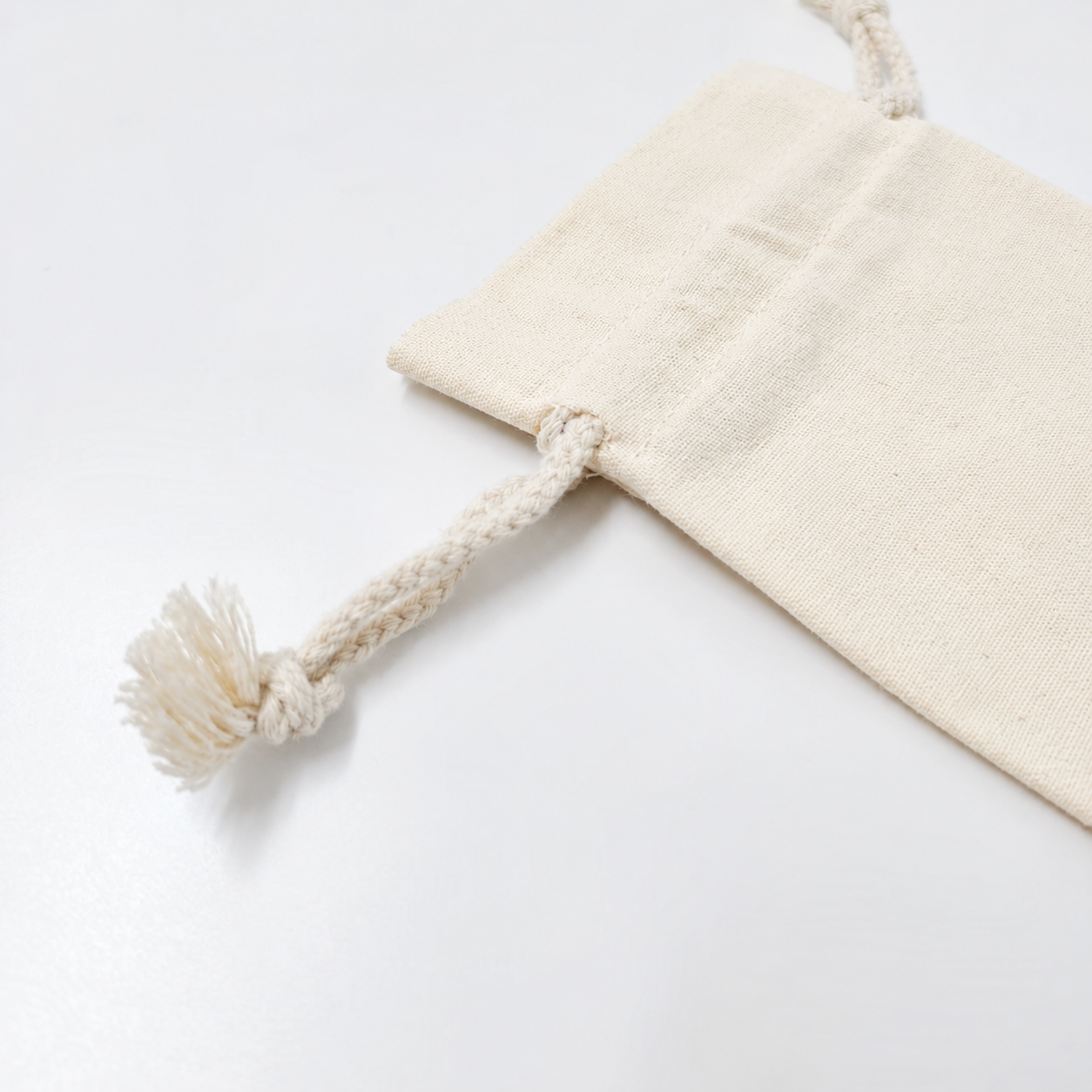
Close-up derived from the same current company-public product photo, with only the unverified decorative print removed. The image is visual evidence of a possible woven-cord and channel construction, not a test result or order specification.
Closure decision matrix
| Use condition | Priority | Sample check |
|---|---|---|
| Small amenity components | Gap control | Close, invert, and handle using the agreed filled kit |
| Slippers or shoes | Wide loading access | Verify the largest item clears the opening without abrasion |
| Guest travel reuse | Comfortable operation | Repeated open-close trial and cord-end inspection |
| Premium bedside presentation | Symmetrical gathering | Compare filled samples from multiple units |
| Heavy kit | Cord and seam integrity | Load and pull tests with defined direction and conditions |
| Family program | Market-specific safety | Intended age, cord length, loose parts, and destination rules |
See the drawstring cord, eyelet and reinforcement guide for component-level choices. The hotel and supplier should agree construction and test conditions rather than relying on a generic “strong cord” statement.
Separate Dry Organization From Moisture Protection
A hotel laundry or shoe pouch may be useful for dry organization while still being unsuitable for damp swimsuits, leaking toiletries, or wet spa items. “Water-resistant fabric” does not automatically mean the seams, channel, print, and complete bag are leakproof.
Create a moisture-contact map:
| Source | Exposure route | Control to consider |
|---|---|---|
| Shampoo or lotion bottle | Primary closure leaks in transit | Maintain qualified primary pack; add separation or secondary wrap if required |
| Damp swimwear | Prolonged contact with fabric | Use a separately evaluated wet-item solution |
| Bathroom counter | Splash or condensation | Select material/finish and test actual contact condition |
| Shoe sole | Dirt and abrasion | Use adequate size, opaque construction, and wash/care plan if applicable |
| Housekeeping chemicals | Accidental contact during staging | Store separately and define staff handling |
The pouch should not be the only control for a hazardous or regulated product. Cosmetic, medical, food, and chemical items must retain the primary packaging and labeling required for the destination market.
Plan Branding Across Properties and Room Tiers
Hotel groups often need one brand system across several properties, regions, room categories, spas, events, or loyalty programs. Every additional permanent variation increases artwork, inventory, allocation, and substitution risk.
Use an evergreen core where practical. Property-specific information, event dates, QR destinations, language, or tier messages may be easier to manage on a replaceable card, band, or approved label rather than permanently printing every pouch.
Version-control model
| Layer | Example | Change frequency | Control |
|---|---|---|---|
| Group-level base | Master brand mark and stable color | Low | Master artwork and approved color reference |
| Property identifier | Hotel name or location code | Medium | Separate SKU and artwork version |
| Room or service tier | Standard, suite, spa, VIP | Medium | Color or removable marker with allocation rule |
| Seasonal/event message | Holiday, wedding, conference | High | Short-lead insert rather than permanent pouch where possible |
| Operational data | Lot, property, inner quantity | Every order | Carton/inner-pack marks kept off the consumer design |
Approve artwork on the filled pouch because gathering and product bulk change the visible area. Use the logo placement and print size guide, custom drawstring bag printing methods, and artwork and dieline guide when preparing files.
Sample the Complete Hotel Set
An empty pouch can pass a visual review while failing the actual service task. The approval sequence should bring together material, construction, filled presentation, property workflow, and complete packing.
Recommended sample gates
- Swatch and component review: fabric, color, hand feel, cord, hardware, print route, and available evidence.
- Construction sample: finished dimensions, gusset, seam, channel, opening, closure, and usable volume.
- Decorated sample: color, placement, registration, adhesion, hand feel, and appearance after gathering.
- Filled-kit trial: real amenities or dimensionally accurate substitutes, inserts, slippers, cards, and final display location.
- Operational pilot: housekeeping, spa, retail, or group-arrival team packs and issues the kit.
- Written approval: specification, tolerances, artwork, reference sample, tests, packing, and change control are frozen.
The custom drawstring bag sample development process explains these gates in more detail. Changes after approval should be recorded and rechecked for their affected characteristics.
Create a Risk-Based Test Plan
Testing should reflect the contents and guest use. A lightweight vanity-item pouch does not need the same test plan as a guest carry bag or repeated-use laundry organizer.
| Test area | Example evaluation | Failure screened | Approval basis |
|---|---|---|---|
| Finished measurements | Defined points under agreed condition | Poor fit, tier inconsistency, difficult staging | Written tolerance |
| Seam and bottom | Static load or cyclic handling with defined payload | Opening, distortion, dropped contents | Intended use protocol |
| Cord and channel | Pull in agreed direction/rate; repeated operation | Cord break, knot slip, channel tear | Order-specific method |
| Closure retention | Close and handle filled sample | Small contents escape | Agreed kit and acceptance limit |
| Print or embroidery | Rub, flex, tape, or abrasion method as applicable | Peeling, cracking, transfer, snagging | Decoration-specific reference |
| Colorfastness | Dry/wet rub, contact, or wash method as applicable | Marks on linens, garments, or products | Hotel care and contact scenario |
| Shrinkage or care | Agreed wash/dry cycle where laundering is intended | Size loss, distortion, puckering | Declared care method and tolerance |
| Odor and cleanliness | Sensory/visual check under defined conditions | Unacceptable odor, lint, debris, stains | Approved sample and written limit |
| Pack-out/transport | Complete packed-unit handling | Crushing, migration, presentation loss | Logistics and property protocol |
Avoid publishing a universal load rating, wash count, or colorfastness result unless it belongs to the exact product and test conditions. Useful supporting guides include Which Tests Should Custom Drawstring Bags Pass?, polyester colorfastness testing, and cotton shrinkage and washing tests.
Define Quality Control Before Production
Final inspection cannot repair an ambiguous specification. The order file should identify the material and construction, finished size and tolerance, seam, cord, print/embroidery, color reference, defect examples, packing, tests, and approved sample.
Hotel-specific defect framework
| Defect group | Possible examples | Why it matters |
|---|---|---|
| Critical | Prohibited sharp component or serious safety/regulatory nonconformity | Potential harm or legal exposure |
| Major | Open seam, nonfunctional closure, wrong property artwork, incorrect size, severe staining | Bag cannot perform or reaches the wrong guest program |
| Minor | Small cosmetic variation outside the agreed visual limit | Function remains but presentation is below the approved reference |
If attribute sampling is used, the buyer and supplier should agree the lot definition, inspection level, AQL, sampling timing, and defect classification. ISO lists ISO 2859-1:2026 as the current edition for sampling procedures for inspection by attributes, but use of that standard still requires order-level decisions; it does not make a product “ISO certified” (ISO overview). The drawstring bag QC checklist and pre-shipment inspection guide can support the inspection plan.
Control Hygiene, Guest Safety, and Destination Requirements
Hotels should define whether pouches arrive clean and ready for direct room placement, are filled at a local facility, or enter a property laundering process. Packaging, storage, odor, dust, loose fiber, moisture, pest, and handling requirements should be stated where relevant.
Safety and legal requirements depend on the bag design, contents, intended users, sales or distribution market, and hotel policy. Projects involving children, food, cosmetics, medical items, electrical adapters, drawcords, small parts, or chemical products need review by the responsible brand and compliance teams.
LUCKYSTAR should not be described as holding a company-wide GRS, GOTS, FSC, BSCI, ISO, REACH, or RoHS approval for every bag. Any certification, test, or compliance statement must be checked against the current document, named legal entity, product or material scope, validity period, and relevance to the specific order.
Make Environmental Claims Specific and Defensible
Hotels increasingly assess packaging reduction, recycled content, reuse, and guest communication. However, “eco-friendly,” “sustainable,” “recycled,” “recyclable,” and “biodegradable” do not mean the same thing.
| Intended claim | Evidence question | Qualification to consider |
|---|---|---|
| Recycled content | Which component, what percentage, and what transaction evidence? | State material and verified percentage rather than a vague green claim |
| Reusable | What service or guest reuse is realistically intended? | Do not imply a measured environmental benefit without analysis |
| Washable | Under which wash/dry method and how was it tested? | Publish care limits supported by the exact sample |
| Recyclable | Is collection and processing reasonably available in the target market? | Identify components or limitations that affect the claim |
| Packaging reduction | What prior system and functional unit are being compared? | Keep comparison boundaries and assumptions clear |
The U.S. FTC's Green Guides summary explains why environmental claims should be qualified so consumers understand their basis and limits. Other markets may apply different requirements; the brand remains responsible for its destination-specific review.
Forecast by Property, Tier, and Issue Rate
Hotel demand is rarely one number. Procurement should separate opening stock, occupied-room issues, paid retail units, VIP allocation, group events, seasonal packages, staff training, replacement policy, inspection samples, and emergency reserve.
Forecast fields
| Field | Owner | Decision supported |
|---|---|---|
| Property and service area | Hotel group/property operations | Where each version is used |
| Room/treatment/event tier | Revenue or service team | Which guests receive the bag |
| Issue frequency | Housekeeping/spa/retail | Per stay, per night, on request, or sold |
| Occupancy/event assumption | Planning team | Demand range and timing |
| Replacement/complaint allowance | Guest services | Reserve for service recovery |
| Opening and training stock | Pre-opening/operations | Units not allocated to guests |
| Reorder point and lead-time assumption | Procurement | When replenishment starts |
| Residual-stock rule | Brand/finance | Treatment of obsolete property or event versions |
MOQ, sample charges, unit price, production time, freight, and reorder timing depend on final specifications, version count, quantity, testing, destination, and approval status. They must be confirmed in a written quotation. The custom drawstring bag MOQ and production time guide explains the main variables.
Plan Packing, Cartons, and Property Distribution
Define whether pouches ship flat, folded, individually packed, bundled, or prefilled. The packing method affects creasing, cleanliness, cord tangling, carton volume, housekeeping labor, and property allocation.
| Packing decision | Risk if undefined | Control |
|---|---|---|
| Fold direction | Artwork creases or faces inward | Approved folding photo or sample |
| Cord arrangement | Tangling and slow unpacking | Agreed tuck, tie, or band method |
| Unit protection | Dust, moisture, or handling marks | Order-specific protective packing |
| Inner quantity | Counting errors at property receiving | Fixed inner pack and clear label |
| Mixed properties | Wrong artwork reaches a hotel | Separate cartons and no-mix rule |
| Carton marks | Receiving team cannot identify tier or lot | Property, SKU, quantity, lot, and handling fields |
| Retained sample | Reorder loses color/construction reference | Controlled approved sample and file archive |
Reorders should reconfirm the retained sample, specification, artwork version, color reference, material construction, tests, packing, and destination. “Same as last order” is not an adequate production file if materials or processes may have changed.
Why Choose LUCKYSTAR?
LUCKYSTAR is suitable for hotel and travel buyers who need the pouch, amenity set, property versions, sampling, QC, and shipment details connected in one order-development process. The team can help translate a service idea into a controlled specification rather than asking the buyer to select from an unexplained generic list.
How LUCKYSTAR can support the project
| Stage | LUCKYSTAR contribution | Buyer decision still required |
|---|---|---|
| Requirement definition | Organize contents, size, material, closure, decoration, quantity, destination, and service role | Actual amenity set, guest journey, hotel policy, target market |
| Option comparison | Present feasible construction and decoration routes | Priority among touch, function, budget, care, and evidence |
| Sample development | Coordinate sample details and revision comments | Consolidated approval from purchasing, brand, and operations |
| Production handoff | Align approved specification, artwork, reference, and packing | Final written order confirmation and version allocation |
| Quality planning | Convert critical features into checks and defect examples | Test methods, acceptance limits, inspection authority |
| Delivery coordination | Confirm carton and destination information | Consignee, property routing, dates, and written logistics instructions |
This coordination is the reason to choose LUCKYSTAR. It is not a blanket promise that every material, certificate, MOQ, price, test, or lead time applies to every project. Availability and commercial commitments are confirmed only after the project specification, supporting evidence, physical approval, and order terms have been reviewed. For supplier qualification, consult the drawstring manufacturer selection guide; for broader bag-category sourcing, use the Custom Bag Manufacturer Guide.
What to Include in a Hotel Drawstring Bag RFQ
| RFQ field | Information to provide |
|---|---|
| Service use | Amenity set, spa, slippers, dry laundry, welcome kit, group, or retail |
| Contents | Item list, dimensions, weight, primary packs, leakage/contact risks |
| Property structure | Group, hotel, region, room tier, version allocation |
| Finished size | Width, height, gusset/bottom shape, tolerance, measurement method |
| Material | Composition, weight/construction, color, finish, evidence needs |
| Closure | Cord/tape type, length, end treatment, hardware, reinforcement |
| Decoration | Method, colors, dimensions, placement, artwork version, color target |
| Quantity | Total and split by property, tier, language, event, or reorder |
| Quality/testing | Intended use, tests, AQL/inspection, defect classes, reference sample |
| Packing/logistics | Fold, individual pack, inner quantity, carton marks, destination, deadline |
The custom drawstring bag manufacturing process provides a useful view of the complete design-to-delivery handoff.
Frequently Asked Questions
Are drawstring bags suitable for hotel amenity kits?
Yes, when they group and present individually packed amenities and the filled kit has been sampled. The pouch should not replace the required primary packaging, seal, or labeling of cosmetics, food, medical, or chemical products.
What size should a hotel amenity pouch be?
There is no universal hotel size. Measure the real amenity set, opening clearance, closure position, and final display space. Approve finished measurements and tolerances on a physical filled sample.
Can a cotton drawstring bag be used as a hotel laundry bag?
It may serve as a dry-clothing organizer if its size, strength, colorfastness, care, and hotel workflow are suitable. Do not call it waterproof, wet-laundry safe, or repeatedly washable without order-specific evidence.
Which material is best for hotel drawstring bags?
The best material depends on contents, tactile target, room or service tier, moisture exposure, reuse plan, decoration, packing space, budget, and evidence requirements. Fiber name alone does not determine quality.
Should every hotel property use the same pouch?
A shared base specification can improve control, but the group may need property, language, tier, or service variations. Limit permanent versions where possible and manage each approved difference through an artwork and SKU register.
How can hotels prevent amenity leakage from staining the pouch?
Start with qualified primary containers and closures. Test the complete kit, separate high-risk items where necessary, define packing orientation, and do not rely on an ordinary textile pouch as the only liquid barrier.
Can the hotel print a recycled or eco-friendly claim on the bag?
Only when the wording is supported for the exact material, component, order, and destination market. Verify percentage, documentation, certified entity and scope where relevant, and state limitations clearly.
What branding method works best?
Screen printing, heat transfer, embroidery, and other methods each have limits. Select according to fabric, artwork detail, quantity, hand feel, durability, color target, and budget, then approve a decorated sample under intended use conditions.
Which tests should hotel pouches pass?
Common areas include finished size, seam strength, cord/channel integrity, closure retention, print durability, color transfer, care or shrinkage where relevant, odor/cleanliness, and complete pack-out handling. Methods and limits should match the actual service role.
What affects MOQ, price, and lead time?
Size, material, color, construction, decoration, version count, quantity, packing, testing, sample revisions, destination, and shipping method all affect commercial terms. Request written order-specific confirmation.
Develop an Order-Ready Hotel Pouch Brief
Send LUCKYSTAR the intended hotel or travel use, actual contents, property/version structure, final display location, target material, size, artwork, quantity, destination, packing method, and required evaluations. Those inputs allow the team to prepare a property-specific custom drawstring bag proposal.

Select the GET QUOTE banner to open the LUCKYSTAR inquiry page. Samples, specifications, pricing, minimum quantities, documentation, inspections, packing, and schedules are confirmed for the final written order.





