Drawstring Pouches for Jewelry Brands
Drawstring pouches can give jewelry brands a soft, compact, reusable packaging layer—but only when the pouch is engineered for the exact piece, insert, sales channel, surface finish, and brand tier. A ring pouch, necklace pouch, earring pouch, bracelet bag, repair-return pouch, and travel organizer should not automatically share one pattern.
The pouch also has limits. Soft fabric does not by itself prevent scratching, tarnish, chain tangling, earring-post puncture, moisture exposure, theft, or damage during parcel delivery. Those outcomes depend on the jewelry, direct-contact surface, inserts, closure, outer packaging, storage conditions, tests, and customer instructions.
This guide helps jewelry founders, packaging teams, retailers, distributors, and private-label buyers build a pouch system around real products rather than visual references alone. LUCKYSTAR can coordinate order-specific custom drawstring bags and pouches, subject to the approved specification, sample, evidence, and written commercial confirmation.
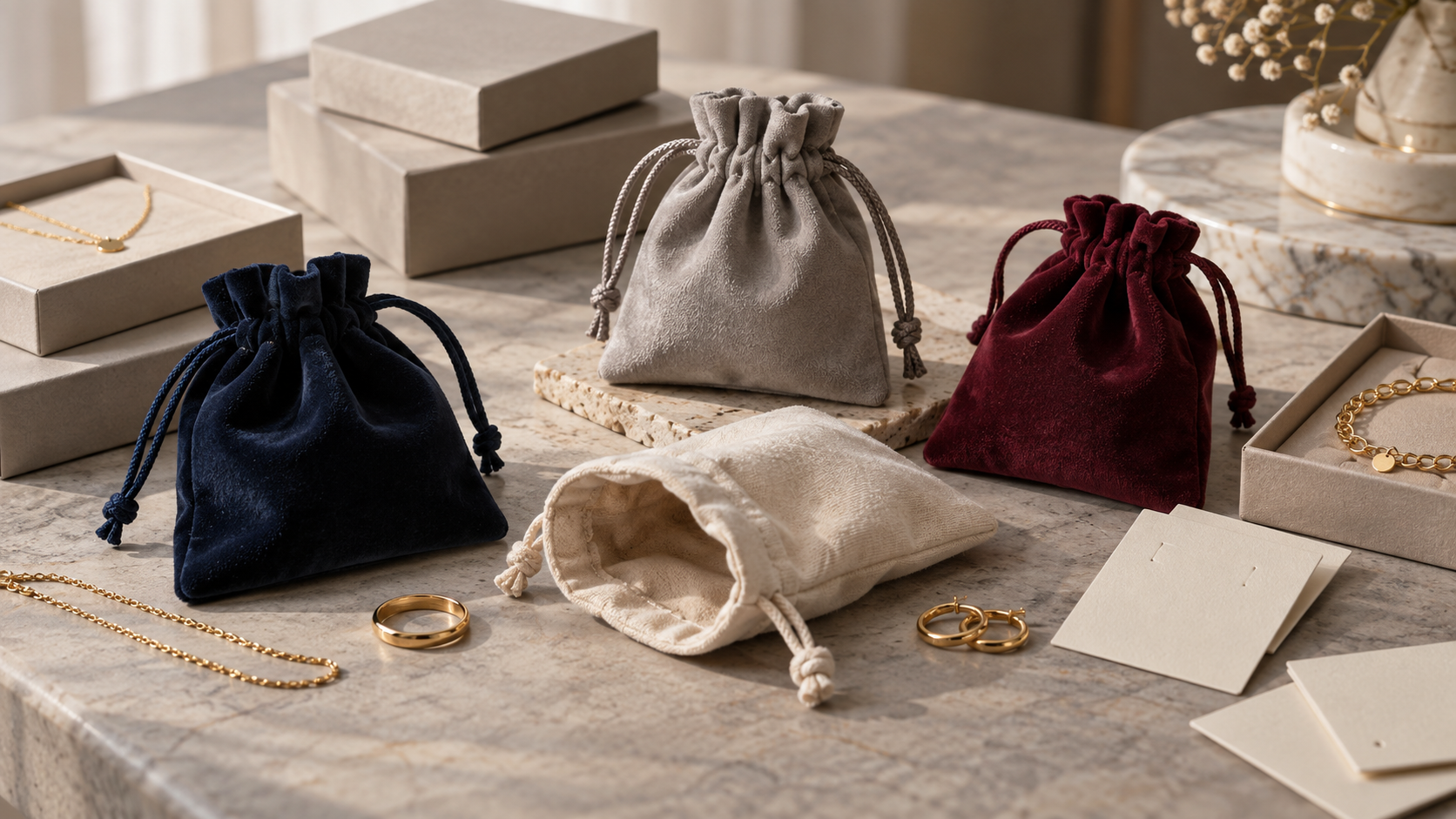
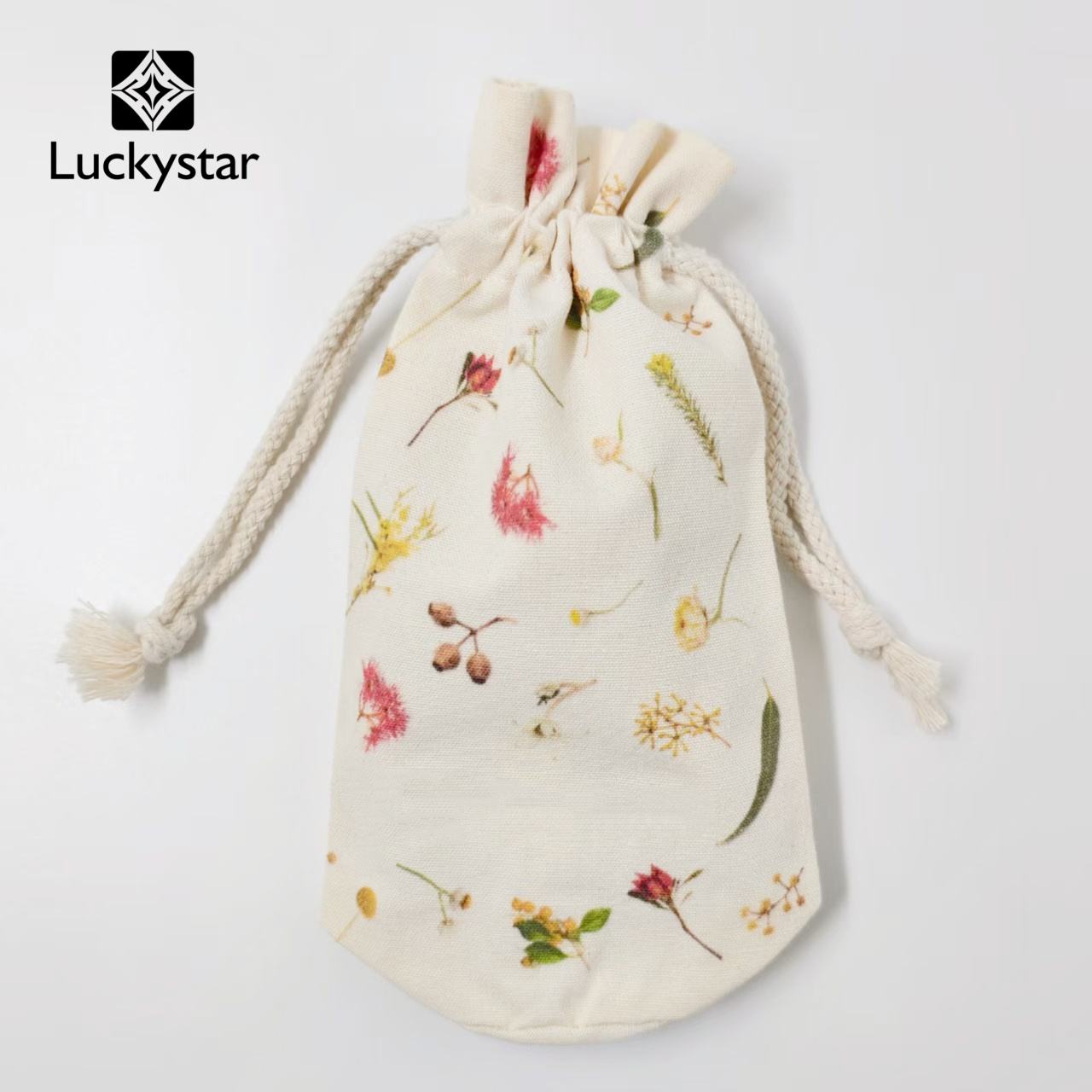
Generated, unbranded editorial illustration. It shows a plausible jewelry-packaging concept, not a customer collection, LUCKYSTAR facility, production record, or verified protective performance.
Quick Answer: What Makes a Good Jewelry Drawstring Pouch?
A good jewelry pouch fits the exact piece and insert without excess movement, uses an inner surface validated for the item's finish, closes without trapping or pulling a chain, and presents the brand clearly at the intended retail tier. The buyer should approve the pouch with the actual jewelry or an authorized representative sample, then test rubbing, fiber shedding, color transfer, closure, seam integrity, print or decoration durability, packed appearance, and parcel protection as applicable.
| Decision | Jewelry-brand question | Evidence before production |
|---|---|---|
| Pouch role | Primary retail pack, dust pouch, inner box layer, travel pouch, repair-return pack, or gift component? | Packaging-system diagram |
| Jewelry type | Ring, stud, hoop, pendant, chain, bracelet, watch, brooch, or mixed set? | Product and insert list |
| Direct contact | Which fabric, lining, cord, ink, foil, thread, or hardware can touch the item? | Compatibility test on the exact finishes |
| Movement | Could pieces collide, tangle, puncture, or migrate? | Filled handling and transit trial |
| Brand tier | Everyday, demi-fine, fine, bridal, limited edition, or service packaging? | Approved tier architecture |
| Decoration | Print, embroidery, foil, woven label, or no external mark? | Finished decorated sample |
| Claims | Is any anti-tarnish, recycled-content, protection, origin, or material statement planned? | Claim-specific substantiation |
| Quality | Which defects would damage the item or customer experience? | Order-level test and inspection plan |
For supplier qualification, combine the Custom Bag Manufacturer Guide with How to Choose a Custom Drawstring Bag Manufacturer.
Give the Pouch One Defined Role in the Packaging System
“Jewelry pouch” can describe several products with different requirements. Start by drawing the full path from jewelry assembly to customer use.
| Packaging role | What the pouch must do | What it should not be assumed to do |
|---|---|---|
| Primary retail presentation | Hold the piece and create a controlled reveal | Replace required product information or security controls |
| Inner layer inside a rigid box | Organize or soften the product within a structured pack | Provide all crush and impact protection |
| Dust or storage pouch | Reduce ordinary dust exposure and separate an item in storage | Guarantee anti-tarnish performance or humidity control |
| E-commerce order component | Present the item after the parcel is opened | Replace the mailer, cushioning, tamper evidence, or insurance |
| Travel organizer | Keep approved pieces grouped during short trips | Secure high-value jewelry against loss or theft |
| Repair or return pouch | Identify and contain an item moving through service | Replace chain-of-custody documentation or protective outer packaging |
| Gift-with-purchase pouch | Add a small reusable accessory to a campaign | Prove the value, composition, or authenticity of the jewelry |
| Multi-piece set pouch | Hold a coordinated set with an insert or divider | Prevent contact damage unless the layout has been tested |
This guide consolidates the useful release controls from LUCKYSTAR's former short jewelry-pouch overview—actual-item fit, direct-contact review, claim boundaries, closure safety, SKU identification, and shipment inspection—and expands them into a complete system for brand architecture, retail and e-commerce distribution, testing, and reorder control. For a separate treatment of broader bulk sourcing options, see Bulk Drawstring Pouches for Jewelry and Retail Packaging.
Match the Pattern to the Jewelry Category
A necklace is not a larger ring. Each product category creates its own movement and surface risks.
Jewelry-to-pouch engineering matrix
| Jewelry type | Main packaging risk | Pouch or insert direction to evaluate |
|---|---|---|
| Ring | Small item disappears into corners; polished surface rubs against seams | Compact pouch, soft controlled interior, ring slot or removable pad |
| Stud earrings | Posts can puncture fabric or catch threads; pair can separate | Earring card, covered post area, or insert that keeps the pair together |
| Hoop earrings | Hoops can deform or entangle | Sized card or separated positions with adequate width |
| Pendant necklace | Chain tangles, knots, or collects at the bottom | Chain card, slots, tabs, or wrap method validated with the chain length |
| Fine chain | Very small links snag on rough fibers, seams, embroidery backs, or cord ends | Smooth direct-contact surface and isolated closure path |
| Bracelet | Item shifts; clasp catches lining or cord | Flat insert or band support, depending on construction |
| Bangle | Rigid diameter controls minimum pouch width | Pattern based on bangle outer diameter and closure allowance |
| Brooch or pin | Sharp pin can puncture pouch or harm the user | Protective backing and locked closure before pouching |
| Watch | Weight, hard edges, crown, buckle, and crystal need structure | Cushion or rigid box; pouch as secondary layer only where appropriate |
| Multi-piece set | Items contact each other and variants are easily mixed | Compartmented insert, separate mini pouches, or mapped attachment points |
Do not approve one common pouch until every intended SKU has passed a real fit and handling review. The largest item may control size, but the smallest and most delicate item may control the interior construction.
Create a Size Architecture, Not a List of Random Dimensions
Jewelry brands often need several pouch sizes. Too few sizes create poor fit and excessive movement; too many create purchasing, inventory, labeling, and fulfillment errors. A controlled family should share design logic while making each size easy to identify.
Build the dimensional envelope
Measure the jewelry in its approved insert or card, not loose on a table. Record:
- maximum width, height, and depth;
- clasp, post, crown, stone setting, and other projections;
- insert thickness and fold behavior;
- cord-channel depth and closure loss;
- seam allowance and internal corner shape;
- necessary clearance for insertion and removal;
- outer-box or mailer dimensions;
- finished packed weight.
| Size tier | Suitable starting use | Identification method | Validation sample |
|---|---|---|---|
| XS | Ring, studs, charm, small component | Pattern code plus discreet removable size marker | Smallest piece does not disappear or escape |
| S | Earrings, small pendant, fine chain | Controlled color or internal label | Posts and chain remain secured by insert |
| M | Necklace, bracelet, brooch, small set | Shared brand face with size code | Closure works without compressing jewelry |
| L | Bangle, watch secondary pouch, layered set | Distinct carton and SKU identifier | Weight and rigid shape do not stress seams |
| Custom silhouette | Unusual collection or campaign piece | Unique style code and approved pattern | Piece, insert, pouch, and outer pack tested together |
Use the Drawstring Bag Size and Capacity Guide for usable-space calculations. The goal is not the smallest possible pouch; it is the smallest controlled package that allows loading, closing, presentation, safe retrieval, and distribution without unintended contact.
Select the Direct-Contact Surface Before the Outer Look
The material visible to the customer and the surface touching the jewelry may be different. A velvet-look exterior can have a woven backing, laminated layer, or separate lining. A microfiber pouch may vary in composition, density, finish, and shedding. “Soft” is a sensory description, not a verified compatibility claim.
| Material route | Brand impression | Potential advantages | Contact risks to test |
|---|---|---|---|
| Velvet or velvet-look | Rich, traditional, gift-oriented | Strong tactile presentation and deep colors | Pile direction, shedding, dye transfer, backing texture, trapped particles |
| Microfiber | Clean, modern, smooth | Compact construction and controlled surface options | Exact composition, finish residues, rubbing, long-term contact behavior |
| Cotton | Natural, understated, craft or lifestyle | Familiar print surface and broad style range | Lint, shrinkage, moisture absorption, seam roughness, dye transfer |
| Canvas | Structured, casual premium | Holds shape better than light cotton | Coarser contact, bulk, seam ridges, jewelry catching |
| Satin or satin-look | Smooth, reflective, occasion-focused | Elegant visual effect and low-bulk drape | Snagging, abrasion, fraying, dye transfer, slippery handling |
| Suede-look synthetic | Soft matte luxury | Refined hand and color depth | Fiber transfer, finish consistency, composition, contact evidence |
| Recycled-content textile | Can support a documented material brief | Allows a specific verified attribute | Percentage, chain of custody, finish, performance, and claim scope |
| Non-woven fabric | Simple and economical | Lightweight for controlled low-risk applications | Abrasion, edge finish, seam method, limited premium presentation |
The article Velvet vs Microfiber Drawstring Pouches compares the two common premium routes in detail. For cotton-based packaging, Cotton vs Canvas Drawstring Bags explains structure, surface, care, and printing differences.
Inspect both sides of every material
Ask for front, back, cut-edge, and seam-section views. The back of a soft textile may be rougher than the face. Lamination adhesive, printed coating, seam allowance, overlock thread, embroidery backing, label edge, cord end, or metal aglet may create the actual contact point.
If direct jewelry contact is not justified by evidence, use a suitable insert or lining and keep the claim narrow. The pouch should not be described as safe for every precious metal, plated finish, gemstone, pearl, coating, adhesive, lacquer, or treatment.
Do Not Turn “Soft” Into an Anti-Scratch Claim
Scratching can result from the pouch, the jewelry itself, trapped particles, hard decorations, rough seams, or several pieces moving together. A soft hand does not prove that the complete packaging system prevents scratches.
Scratch-risk review
| Source of risk | Example | Control to evaluate |
|---|---|---|
| Fiber or surface | Coarse backing or abrasive particle | Clean material, controlled lining, contact trial |
| Seam | Raised allowance or stiff overlock edge | Seam relocation, covered seam, or insert |
| Decoration | Embroidery back, foil edge, metal badge | Keep away from contact zone and test filled pouch |
| Jewelry-on-jewelry contact | Necklace pendant striking chain or second item | Separate attachment positions or individual pouches |
| External pressure | Parcel compression forces item into seam | Rigid protective outer packaging |
| Customer handling | Several pieces stored loose together | Clear use and care instructions |
Testing should reproduce the intended item, finish, load, movement, time, and environment. Results for one sample do not justify a universal “scratch-proof” claim.
Treat Anti-Tarnish as a Separate, Evidence-Based Function
An ordinary fabric pouch should not be called anti-tarnish merely because it closes, feels premium, or uses dark material. Tarnish behavior can depend on the metal or plating, surface condition, humidity, air pollutants, storage time, chemicals, cosmetics, handling, and packaging materials.
If anti-tarnish performance is required, the buyer should define:
- the exact jewelry material and surface finish;
- the active or barrier mechanism being claimed;
- the pouch, insert, strip, paper, or treatment responsible for the function;
- storage and use conditions;
- test method, duration, controls, and acceptance criteria;
- shelf life and packaging of the active material;
- user instructions and limitations;
- evidence for every material or formulation change.
Do not imply that the base drawstring pouch protects silver, gold, vermeil, plated brass, pearls, gemstones, or fashion jewelry from tarnish without applicable evidence for that exact system.
Prevent Chain Tangling and Earring-Post Damage
Flexible pouches allow contents to move. The insert architecture often contributes more to product control than the pouch body.
Insert and separation options
| Jewelry problem | Insert concept | Approval check |
|---|---|---|
| Fine chain knots | Card with controlled chain slots and wrap path | Chain removes without pulling or kinking |
| Pendant strikes clasp | Separate pendant position and secured excess chain | Components stay separated after handling |
| Stud posts puncture fabric | Earring card plus covered rear post zone | Post and backing remain contained |
| Hoops entangle | Pair spacing on a suitable card | Hoops do not deform or cross during transit |
| Bracelet collapses into a ball | Flat support or shaped pad | Clasp and surface remain controlled |
| Multiple pieces touch | Compartmented insert or separate mini pouches | No contact under defined movement trial |
| Small piece hides in seam | Shallow pouch or removable pad | Product is immediately visible at opening |
Avoid adhesives, foams, elastics, inks, or coatings that may contact jewelry unless the component and use are approved. If the insert supplies protective performance, describe the complete system rather than crediting the fabric pouch alone.
Design the Cord and Closure Around the Product
Miniature pouches need precise cord-channel and drawcord control. A cord that works on a large backpack may overwhelm a ring pouch. A very fine cord may look elegant but be difficult to grip, abrade quickly, or pull into the channel.
| Closure element | Jewelry-pouch requirement | Defect to screen |
|---|---|---|
| Channel opening | Smooth travel without exposing rough cut edges | Cord catches, bunching, uneven gathers |
| Cord diameter | Proportional to pouch scale and intended hand feel | Cord looks bulky or cuts into fabric |
| Cord surface | Compatible with brand tier and repeated use | Fuzzing, dye transfer, snagging |
| Cord length | Enough to open and close without excessive loops | Long loose ends tangle with chains or packaging |
| End finish | Secure, neat, and free from sharp projections | Knot release, fraying, hard edge |
| Double-sided closure | Balanced visual gathering | One side closes faster and distorts logo |
| Cord stop or bead | Only if function, retention, user group, and rules justify it | Detachment, scratching, small-component risk |
Consult the Drawstring Cord, Eyelet and Reinforcement Guide for component definitions. Jewelry pouches often do not need metal eyelets or lower corner anchors; adding backpack hardware can introduce unnecessary contact and scale problems.
Choose Branding That Works on a Small, Flexible Surface
Jewelry pouches compress when empty and gather when closed, so artwork must be evaluated in both states. A logo that fits the flat panel may buckle under the drawcord channel or disappear behind the product shape.
Decoration comparison for jewelry pouches
| Method | Visual character | Best suited to | Risks to sample |
|---|---|---|---|
| Screen print | Clean and direct | Simple marks on stable surfaces | Ink opacity, edge clarity, adhesion, cracking, contact placement |
| Heat transfer | Detailed or multicolor options | Smooth compatible fabrics | Film hand, edge lift, heat marking, flexibility |
| Foil stamping | Reflective premium accent | Suitable velvet-look or smooth surfaces after testing | Adhesion, broken fine lines, pile variation, heat sensitivity |
| Embroidery | Textured, crafted identity | Larger pouches or bold simple marks | Backing contact, puckering, stiff area, fine-detail loss |
| Woven label | Consistent separate branding element | Exterior side seam or controlled position | Scratchy edge, fraying, incorrect orientation |
| Deboss or molded patch | Structured premium feature | Compatible synthetic patch system | Added hard component, attachment, surface contact |
| No exterior logo | Quiet luxury or multi-brand fulfillment | Programs using a branded card or box | Pouch identity and SKU control still required internally |
Use the Drawstring Bag Logo Placement and Print Size Guide to keep artwork clear of gathers and seams. Prepare production-ready assets through How to Prepare Drawstring Bag Artwork and Dielines. For premium finishes, see Foil Stamping and Embroidery for Luxury Drawstring Pouches.
Brand color should be approved on the exact fabric, pile direction, lining, cord, print, and lighting conditions. A digital color value alone cannot predict a velvet or microfiber surface. The Pantone vs CMYK for Custom Drawstring Bags guide explains how references and process colors serve different purposes.
Build a Collection-Level SKU and Tier System
Jewelry brands commonly have several collections, metal colors, product forms, price tiers, sales channels, and markets. Packaging should help operations identify the right pouch without making the customer-facing design look like warehouse labeling.
Packaging architecture example
| Brand tier or channel | Pouch strategy | Internal control |
|---|---|---|
| Everyday retail | One or two efficient sizes with shared decoration | Style-size code and carton ratio |
| Demi-fine collection | Refined material and controlled insert family | Collection code plus metal-color insert variant |
| Fine jewelry | Premium pouch as secondary presentation inside rigid pack | Serialized or controlled high-value fulfillment outside the pouch |
| Bridal | Occasion-appropriate color and message, low SKU count | Wedding collection code and insert type |
| Limited edition | Distinct approved artwork or cord color | Separate artwork version and production release |
| E-commerce | Pouch optimized for parcel presentation and return workflow | Order system maps piece to pouch and outer pack |
| Retail store replenishment | Standardized compact cartons and clear size code | Store, size, and quantity manifest |
| Repair/service | Neutral reusable pouch with service identifier | Repair order remains in controlled service system |
Keep customer-facing color choices stable across sizes where possible. Use discrete removable indicators, inner labels, bundle cards, or carton codes for operations. Do not rely on subtle shade differences that may be hard to distinguish under store or warehouse lighting.
Keep Jewelry Information Separate From Packaging Decoration
The pouch may carry a logo, but it should not accidentally create misleading jewelry claims. Terms related to precious-metal content, plating, gemstones, pearls, treatments, origin, craftsmanship, or durability need product-level accuracy and appropriate disclosures.
The U.S. Federal Trade Commission states that its Jewelry Guides are intended to help consumers receive accurate information about gemstones, pearls, precious metals, alloys, imitations, and related jewelry products. A pouch supplier does not determine whether a ring can be called gold, a stone can be called a diamond, or a pearl treatment must be disclosed. Those statements belong to the jewelry brand and its legal/compliance process.
| Information | Best controlled location | Why |
|---|---|---|
| Brand logo | Approved pouch, box, card, or label | Brand identification |
| Jewelry material and treatment | Product label, card, invoice, or digital product record as applicable | Requires accurate product-specific disclosure |
| Care instructions | Product-specific insert or accessible digital resource | Varies by material, plating, stones, pearls, and finish |
| SKU or barcode | Removable label, card, or controlled outer pack | Supports inventory without making permanent decoration |
| Country-of-origin statement | Determined by applicable rules and product facts | Cannot be inferred from pouch manufacture |
| Environmental pouch claim | Clear statement tied to verified pouch attribute | Must not imply the jewelry or whole pack shares the attribute |
| Certification mark | Only where entity, product, scope, validity, and mark-use rights apply | Prevents unsupported endorsement or certification inference |
Design for Retail, E-Commerce and After-Sale Use
The same pouch can behave differently at a jewelry counter, in a parcel, and in a customer's drawer.
Retail counter
Staff need fast identification, clean storage, consistent presentation, and simple replenishment. Pouches should arrive sorted by size and style, not mixed in visually similar bundles. The opening should be quick enough for service without sacrificing the intended reveal.
E-commerce fulfillment
The order-management system must map jewelry SKU to insert, pouch, information card, box, and parcel materials. The pouch should be checked inside the full shipping pack. A fabric pouch does not provide tamper evidence or courier protection for high-value goods.
Returns and repair
Tell customers whether the pouch should be returned. If it is reused for service intake, cleanability, item identification, chain-of-custody, and contamination controls need separate planning. Do not ask customers to ship high-value jewelry in a soft pouch alone.
Customer storage and travel
Use instructions should reflect validated use. Avoid encouraging customers to store several pieces together if they may scratch or tangle. A pouch can be a convenient organizer without being described as a safe, vault, insurance substitute, humidity barrier, or permanent archival storage solution.
Address Packaging Waste and EU Market Requirements
Pouches used to contain, protect, handle, deliver, or present jewelry may form part of the packaging system depending on the market and use. The responsible business should classify each component rather than assume that a reusable textile item sits outside packaging rules.
The European Commission explains that new EU packaging and packaging-waste rules apply from 12 August 2026 and address manufacturing, composition, recyclability, labeling, waste prevention, and unnecessary packaging. See the Commission's current overview, New packaging rules for less waste and easier recycling. The exact obligations and transition dates for a jewelry brand's pouch, box, insert, mailer, and market role require specialist review.
Evidence-led packaging decisions
| Decision | Better question |
|---|---|
| Add a pouch plus box | Does each layer perform a necessary protection, information, handling, or long-term-use role? |
| Claim reusable | Is the pouch durable and useful for a defined second use, with instructions that do not create product risk? |
| Claim recycled content | What percentage, calculation basis, supply-chain evidence, and product scope apply? |
| Claim recyclable | Can the mixed materials, coating, cord, print, lining, and label enter an available recycling route? |
| Reduce size | Does the smaller pouch still allow safe loading, closure, retrieval, and presentation? |
| Remove inserts | Will jewelry then move, tangle, puncture, or contact another piece? |
| Use date-specific art | Will the design discourage reuse after a short campaign? |
Avoid broad “eco-friendly jewelry packaging” language. State the specific verified pouch attribute and keep it separate from claims about the jewelry, box, mailer, or complete supply chain.
Sample the Complete Jewelry-Pouch System
Approval should proceed in stages so aesthetic changes do not hide functional changes.
- Material set: outer fabric, lining, backing, thread, cord, label, insert, print, foil, and embroidery components.
- Color and decoration trial: appearance under agreed lighting, fine detail, adhesion, pile response, and contact-zone review.
- Empty pouch sample: dimensions, seam position, channel, cord, opening force, symmetry, and workmanship.
- Product-fit sample: actual jewelry or authorized surrogate, insert, card, and outer packaging.
- Handling trial: loading, closing, opening, removal, repeated use, retail replenishment, and e-commerce packing.
- Compatibility and performance tests: based on the exact jewelry finish, claims, market, and distribution route.
- Golden sample: signed or otherwise controlled reference for bulk production, packing, inspection, and reorders.
The Custom Drawstring Bag Sample Development Process explains how to track revisions without losing approved decisions.
Test Contact, Color, Fibers and Decoration
Jewelry pouches need more than a visual review. The test plan should target the ways the pouch could affect the item or brand experience.
| Test or evaluation | Risk addressed | Scope to define |
|---|---|---|
| Fiber-shedding check | Lint or pile transfers to product, box, or display | Material face, backing, cut edge, seam, repeated handling |
| Dry rubbing | Color transfers to light boxes, cards, gloves, or products | Exact color, fabric lot, pressure, cycles, and grade |
| Damp-contact review | Moisture changes color transfer or surface | Defined moisture source, time, jewelry surrogate, and acceptance |
| Surface compatibility | Pouch or insert marks a coating, plating, pearl, stone, or lacquer | Exact jewelry finish and controlled exposure |
| Snag test | Prongs, posts, chain links, or clasps catch fibers | Representative components and movement |
| Closure cycling | Cord or channel degrades | Cycle count, opening force, appearance, and function |
| Seam inspection and load | Small item escapes or seam opens | Stitch density, allowance, thread, product weight, handling |
| Print adhesion | Logo peels or transfers | Decoration method, substrate, cure, and test protocol |
| Abrasion | Logo, foil, pile, or pouch face degrades in packing and use | Contact material, cycles, pressure, and visual grade |
| Odor and cleanliness review | Customer opens an unacceptable package | Approved reference, storage, ventilation, and contamination controls |
| Packed transit trial | Item shifts or outer pack compresses pouch | Complete parcel, route simulation, and acceptance criteria |
Use Polyester Drawstring Bag Colorfastness Testing for a color-transfer framework and Drawstring Bag Print Adhesion and Abrasion Testing for decoration durability. These methods must be adapted to the exact pouch; no blog protocol replaces a laboratory, buyer, or destination-market requirement.
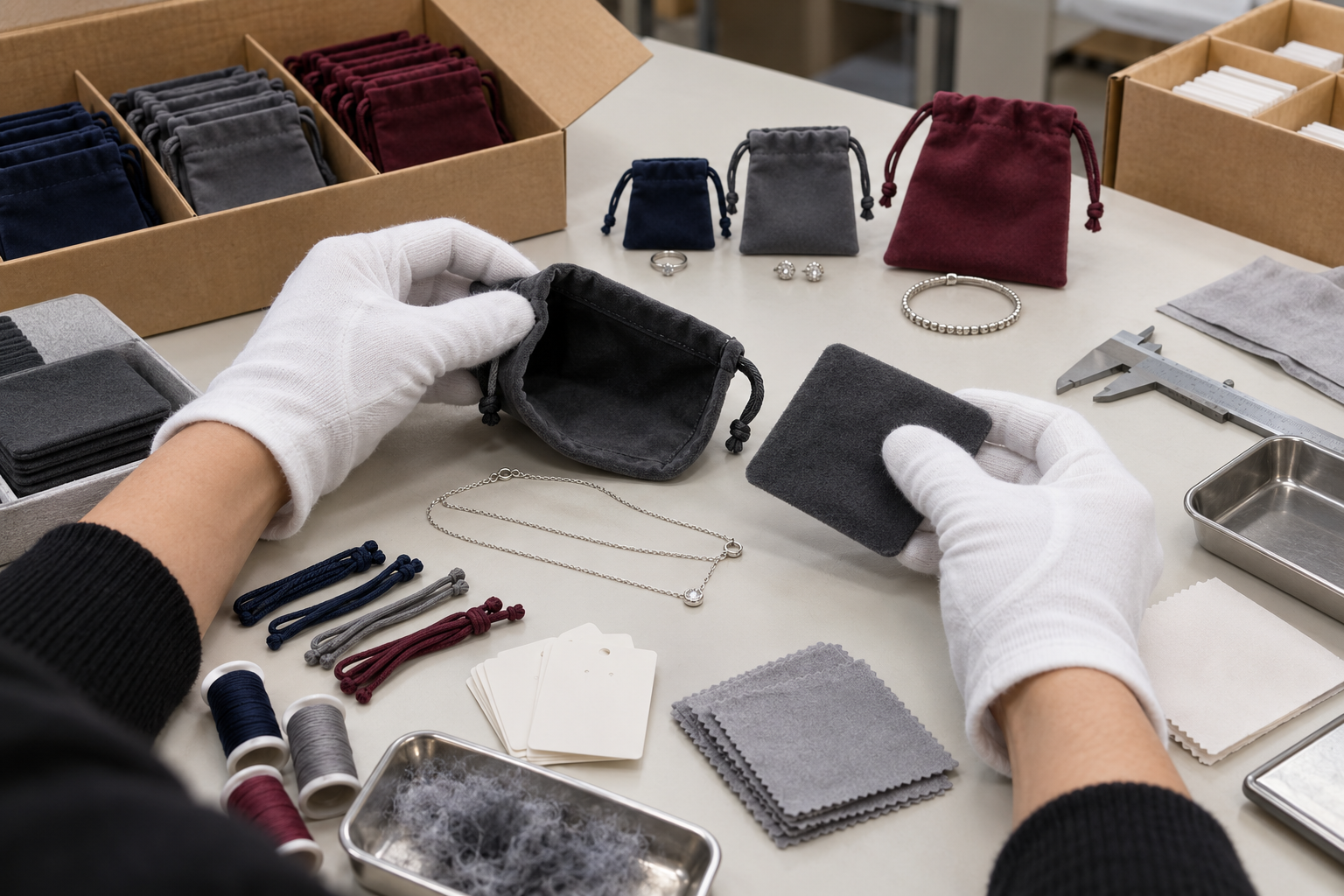
Generated, unbranded editorial illustration of sizing and contact-surface review. It is not an actual customer order, LUCKYSTAR production site, or proof of anti-scratch or anti-tarnish performance.
Inspect Bulk by Jewelry SKU and Pouch Lot
Bulk inspection should preserve traceability between jewelry packaging requirements and pouch production. A mixed inspection average can hide a defect limited to one size, color, decoration, or material lot.
Jewelry-pouch quality checklist
| Inspection layer | What to verify |
|---|---|
| Identity | Style, size, color, material, lining, cord, insert, label, and artwork version |
| Dimensions | External and usable internal dimensions, channel depth, opening width, insert fit |
| Workmanship | Seams, corners, loose threads, skipped stitches, fraying, symmetry, cleanliness |
| Interior | Correct face inside, covered rough edges, no foreign particles, shedding within approval |
| Closure | Smooth operation, balanced gathers, cord length, end finish, retention |
| Decoration | Position, size, orientation, shade, edge, adhesion, backing, and filled appearance |
| Product fit | Assigned jewelry SKU loads and removes without unintended force or contact |
| Color transfer | Approved lot-specific result where required |
| Packing | Correct count, size bundle, protective layer, carton, code, and orientation |
| Documentation | Approved sample, test records, inspection report, carton manifest, change history |
Use the Custom Drawstring Bag Quality Control Checklist to organize production gates. Final release should follow the principles in How to Inspect Custom Drawstring Bags Before Shipment.
Preserve Reorder Consistency Without Freezing Bad Assumptions
Jewelry brands often reorder core packaging while launching new collections. Retain objective references, but revalidate dynamic materials and claims.
The reorder file should include:
- controlled pattern and size table;
- material composition and approved supplier reference;
- master color standard plus approved physical production sample;
- pile direction or surface-orientation requirement;
- lining, backing, seam, thread, and cord specifications;
- decoration artwork, process, dimensions, position, and color;
- insert drawing and jewelry-SKU mapping;
- test scope and acceptance criteria;
- packing, bundle, carton, and labeling rules;
- known deviations, corrective actions, and version history.
Before repeating an old claim or certificate, verify the current entity, product, material, standard, validity, and transaction scope. Before substituting material or components, repeat affected fit, contact, color, decoration, and performance checks.
Plan MOQ and Cost Around the Variant Matrix
The commercial result depends on more than total pouch quantity. Size splits, fabric colors, lining combinations, cord colors, logo versions, foil or embroidery setup, inserts, personalization, test scope, individual packaging, and destination sorting can each create separate production lots.
| Cost driver | Why it changes the project | Buyer action |
|---|---|---|
| Number of pouch sizes | Creates patterns, cutting plans, samples, and packing variants | Consolidate only after every jewelry SKU fits |
| Material and color | Custom shade or premium surface may require separate lot control | Approve realistic volume by color |
| Lining and insert | Adds material, assembly, and compatibility checks | Specify only where it solves a product risk |
| Decoration versions | Adds screens, plates, digitizing, setup, and changeover | Freeze brand architecture before quote |
| Personalization | Creates unique data, proofing, production, and rework | Use only when brand value justifies complexity |
| Testing | Depends on material, jewelry finish, claim, market, and risk | Write protocols before comparing suppliers |
| Pack-out | Empty-pouch delivery differs from jewelry insertion or full retail assembly | Define responsibility and item custody |
| Reorder matching | May require retained standards and controlled material sourcing | Fund the evidence needed for continuity |
The Custom Drawstring Bag MOQ and Production Time article explains why catalog figures are not universal commitments. Final price, MOQ, sampling, production, testing, and delivery must be confirmed against the approved jewelry-pouch program.
Why Jewelry Brands Work With LUCKYSTAR
LUCKYSTAR is relevant when a buyer needs the pouch to connect brand presentation with measurable product fit, material, construction, decoration, quality, and packing requirements.
Once the buyer has defined the jewelry collection and release criteria, LUCKYSTAR can coordinate, subject to written confirmation:
- pouch-size families based on authorized jewelry and insert dimensions;
- velvet-look, microfiber, cotton, canvas, satin-look, and other suitable material options;
- lining, backing, seam, cord, channel, and label construction choices;
- print, heat-transfer, foil, embroidery, and other compatible decoration routes;
- physical sampling with authorized products or controlled representative items;
- collection, size, color, logo, insert, and carton variant matrices;
- order-specific colorfastness, fiber, contact, closure, seam, and decoration checks;
- pre-production standards, in-process controls, and pre-shipment inspection;
- packing methods for empty pouches or an explicitly agreed pack-out scope;
- records needed for bulk continuity and future reorders.
LUCKYSTAR does not treat historical samples, platform listings, third-party certificates, example prices, MOQ, lead time, or marketing descriptions as blanket commitments. Final materials, claims, tests, commercial terms, services, certification scope, and schedules remain order-specific.
Jewelry Pouch RFQ Checklist
Send the following information to obtain a comparable quotation.
| RFQ section | Information required |
|---|---|
| Brand and channel | Retail, e-commerce, wholesale, bridal, repair, gift, or multi-channel use |
| Jewelry mapping | Product type, dimensions, weight, projections, surface finish, and SKU-to-pouch assignment |
| Pouch role | Primary presentation, inner box layer, storage, travel, repair, or promotional component |
| Pattern | Size, usable internal envelope, channel, seam, lining, insert, and orientation |
| Materials | Composition, face, backing, lining, color, pile, finish, thread, cord, and labels |
| Decoration | Authorized artwork, method, size, position, color, clear space, and approval owner |
| Claims | Anti-tarnish, protection, recycled content, reuse, material, origin, or certification language with evidence |
| Variants | Size, collection, color, jewelry type, insert, language, destination, and quantity matrix |
| Tests | Contact, shedding, rubbing, snagging, closure, seam, adhesion, abrasion, transit, and acceptance criteria |
| Quality | Defect classes, sampling plan, approved reference, reporting, and change control |
| Packing | Bundle, insert, individual protection, carton code, quantity, sorting, and outer package |
| Delivery | Destination, in-hand date, split shipments, customs responsibility, and contingency |
If jewelry details cannot be shared, provide authorized dimensioned surrogates that reproduce the relevant geometry, weight, surface, and projections. Do not ask the pouch supplier to infer risk from a product name alone.
Frequently Asked Questions
Which material is best for jewelry drawstring pouches?
No single material is best. Velvet-look fabric can provide a traditional premium appearance, microfiber can provide a smooth modern surface, cotton can support a natural aesthetic, and satin-look fabric can create an occasion-led presentation. Approve the exact material against the jewelry finish, brand tier, decoration, and distribution route.
Do velvet pouches prevent jewelry from scratching?
Not automatically. The pile, backing, lining, seams, trapped particles, decorations, product movement, and outer pressure all matter. Make any scratch-protection statement only for a defined system supported by appropriate testing.
Are ordinary jewelry pouches anti-tarnish?
No. A standard fabric pouch should not be described as anti-tarnish without a defined mechanism and evidence for the exact jewelry, materials, storage conditions, duration, and claim scope.
What pouch size should a ring or necklace use?
Size the pouch around the jewelry plus its approved insert or card. Rings and studs often need a compact, shallow format; necklaces usually need a chain-control insert and sufficient length. Validate loading, closure, reveal, and outer packaging with the actual SKU.
How can necklace chains be kept from tangling?
Use an insert with controlled slots, tabs, or a documented wrap path, then test it with the exact chain length, clasp, pendant, and movement. A loose chain placed directly into a pouch can still knot.
Can embroidery touch jewelry inside the pouch?
Avoid assuming that it can. Embroidery thread, dense stitches, knots, and backing can form hard or rough areas. Keep decoration outside the contact zone or add a validated lining or insert.
Can the same pouch be used for rings, earrings, and bracelets?
Sometimes, if inserts create the necessary control and every SKU passes fit and handling checks. One universal pouch should not be approved solely because the items physically fit inside.
Should a jewelry pouch replace a rigid box for e-commerce?
Usually not when the jewelry requires impact, crush, tamper, or high-value shipping protection. The pouch can support presentation and organization inside a suitable outer packaging system.
How should jewelry pouch colors be approved?
Approve a physical material and decorated sample under agreed lighting. Record the color reference, fabric lot, pile direction, cord, lining, thread, and acceptable tolerance. Digital screens cannot predict the full appearance.
What should be tested before bulk production?
Test the risks relevant to the exact system: fit, shedding, dry and damp rubbing, surface compatibility, snagging, closure cycles, seam integrity, decoration adhesion and abrasion, packed appearance, and complete-parcel transit.
Can recycled-content claims be printed on the pouch?
Only when the percentage, calculation basis, chain-of-custody or other applicable evidence, product scope, and mark-use authorization are established for the order.The claim should not imply that the jewelry or complete packaging system shares the same attribute.
How can a jewelry brand reduce packaging variants?
Create a limited size family, use common customer-facing colors, control item differences through inserts and internal codes, and consolidate only after every jewelry SKU passes the physical fit and risk review.
Request a Jewelry Pouch Quote
Share the jewelry types and dimensions, surface finishes, pouch role, insert or card, target materials, lining, cords, authorized artwork, size and collection matrix, claims, required tests, packing method, destination markets, quantities, and in-hand date. LUCKYSTAR can then evaluate the pouch construction, sample plan, decoration, quality controls, packing, and commercial feasibility for the exact program.

Explore the custom drawstring bags and pouches product page or contact LUCKYSTAR for an order-specific review. All material, compatibility, protection, anti-tarnish, environmental, certification, commercial, and timing statements remain subject to verified evidence and written confirmation.