Shopping Bag Packaging and Carton Optimization for Lower Shipping Impact
Last reviewed: September 16, 2026
Shopping bag packaging and carton optimization should reduce avoidable material, mass and shipping cube without transferring the burden to damaged bags, difficult handling or rejected deliveries. The right target is not the smallest possible carton. It is the lowest-impact pack-out that protects the finished product, works on the packing line, fits the logistics route and can be repeated in bulk.
For buyers developing custom shopping bags, this means treating the bag, fold, individual protection, bundle, master carton and load plan as one system. A nominal bag size or spreadsheet carton calculation is not enough. The team must pack production-intent samples, allow the contents to settle, measure the closed external carton and inspect the bags after realistic storage and handling.
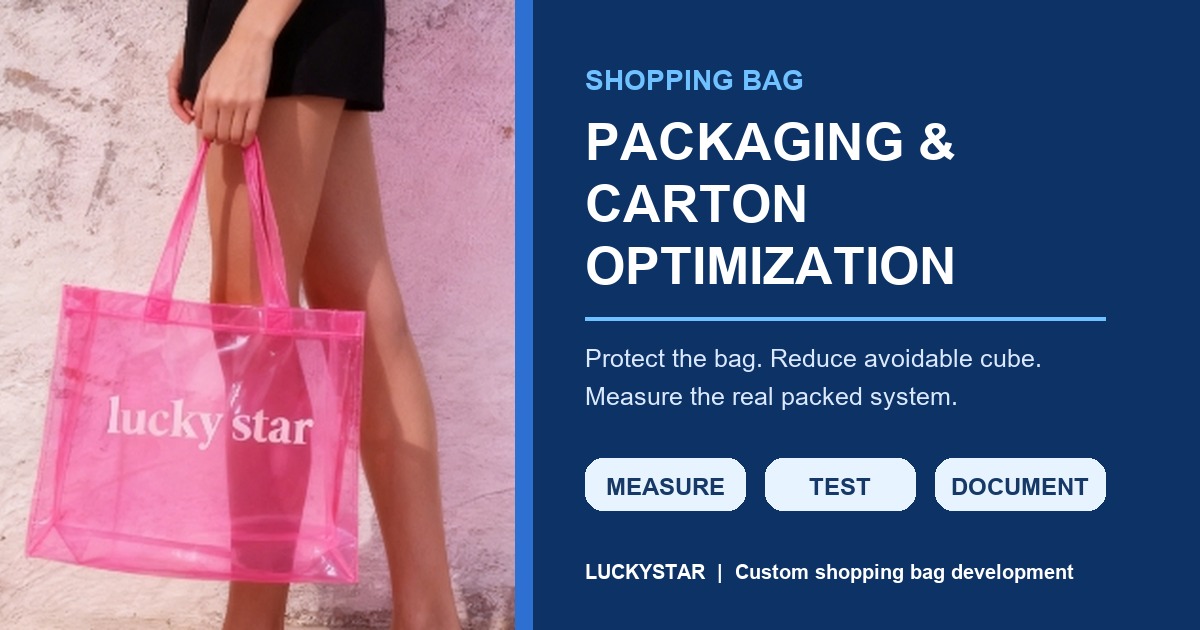
The cover uses an actual LUCKYSTAR-branded PVC shopping bag shown on the company's public Made-in-China channel, combined with an original editorial layout. It demonstrates a visible bag construction only; material, packing and performance remain order-specific.
Need a carton comparison for an active shopping-bag RFQ? Send the approved bag dimensions and construction, flat or folded pack size, unit protection, quantity by SKU, current carton dimensions and gross weight, route, destination, handling constraints, damage history, test requirements and required date. LUCKYSTAR can return missing inputs, pilot pack-out checkpoints and commercial assumptions for written review.
The Short Answer
Freeze the finished bag first. Define what an acceptable bag must look like after unpacking. Then develop two or more physical pack-out candidates and compare them using the same quantity, conditioning time and inspection criteria.
Record at least:
- units per master carton;
- closed external length, width and height;
- net and gross mass;
- packaging material by component and mass;
- pack time and handling difficulty;
- shape recovery, crease, print, handle and surface condition after unpacking;
- result of a distribution test schedule selected for the actual route; and
- revision-controlled photos and packing instructions.
Choose the candidate with the best verified balance, not the one with the highest nominal case quantity. More compression can lower cube while creating permanent folds, ink transfer, blocked surfaces, bent handles or cartons that bulge and stack poorly.
This article owns the shopping-bag pack-out and lower-shipping-impact decision. It does not repeat the general import workflow in How to Import Custom Shopping Bags from China, the product-size method in the Shopping Bag Size and Capacity Guide, or the broad supplier-selection criteria in the Custom Bag Manufacturer Guide. Those pages remain the supporting pillars.
Define “Lower Shipping Impact” Before Changing the Carton
“Lower impact” can refer to several different outcomes. Unless the team defines the outcome, one metric can improve while another becomes worse.
| Intended improvement | Metric to record | Necessary control | Common false conclusion |
|---|---|---|---|
| Less shipping cube | External carton volume and cube per accepted bag | Same product revision, destination and acceptance criteria | A smaller carton always lowers total environmental impact |
| Less packaging material | Packaging mass per accepted bag, by material | Same protection and damage threshold | A lighter carton is automatically adequate for the route |
| Better vehicle or container use | Cartons or accepted units per actual load position | Same equipment type and load rules | Theoretical container fit equals achieved utilization |
| Lower freight charge exposure | Chargeable basis under the named carrier and service | Current carrier rules and shipment data | One dimensional-weight divisor applies everywhere |
| Lower transport GHG emissions | Defined transport-chain activity data and calculation method | Same boundary, modes, distance, allocation and emission-factor version | Lower cube alone proves a carbon reduction |
| Fewer damaged or rejected bags | Accepted units delivered divided by units shipped | Consistent inspection and claim recording | Damage is unrelated to sustainability |
The last distinction matters. ISO 14083:2023 establishes a methodology for quantifying and reporting greenhouse-gas emissions from passenger and freight transport-chain operations. It requires more than a carton-volume observation. If a brand wants to claim reduced transport emissions, it needs a defined transport chain, activity data, allocation method and transparent comparison—not simply a smaller box.
A defensible operational claim may instead be: “For purchase order X, the approved pack-out reduced measured external carton cube per acceptable bag versus approved baseline Y.” That statement is narrow, reproducible and does not silently become a whole-life carbon claim. For broader wording controls, use How to Make Defensible Sustainability Claims for Reusable Shopping Bags.
Start With the Functional Unit: One Acceptable Bag Delivered
Carton efficiency is often reported as units per carton. That is incomplete if the denser pack causes a higher rejection rate. A more useful functional unit is one shopping bag delivered in the agreed condition at the named receiving point.
The phrase “agreed condition” should be measurable. It may include:
- no permanent fold line across a critical logo area;
- no print offset, blocking, scratching or color transfer;
- handles recover to the approved orientation;
- gussets open and return to the approved shape;
- no split seams, cracked film, delamination or distorted hardware;
- labels, barcodes and carton marks remain readable; and
- moisture, odor and cleanliness meet the written acceptance criteria.
The exact criteria depend on the material, construction, market and route. They are not universal LUCKYSTAR limits.
Map Bag Construction to Pack-Out Behavior
Shopping bags do not share one safe compression level. A soft uncoated textile tote, a laminated woven PP bag, a paper carrier, a mesh bag and a clear film tote respond differently to folding, pressure, humidity and long storage.
| Shopping bag route | Pack-out opportunity | Main risk under compression | What to prove on the sample |
|---|---|---|---|
| Cotton or canvas tote | Flat folding, alternating handles, controlled bundling | Hard creases, print marking, bulky handle stack, moisture uptake | Fold recovery, print condition, settled bundle thickness and handle orientation |
| Non-woven PP bag | Low finished mass and flat panels | Permanent fold memory, local tearing, print rub or distorted ultrasonic seams | Fold-line appearance, seam/join condition and load performance after unpacking |
| Woven PP bag | Flat walls and regular rectangular geometry | Lamination cracking, handle concentration and sharp fold marks | Flex condition, laminate/print adhesion and corner recovery |
| Mesh shopping bag | Very low panel bulk and nesting potential | Snagging, tangled cords/handles and edge distortion | Separation time, edge condition and repeatable bundle count |
| Clear PVC/TPU-style film bag | Some flat-pack potential depending on gauge and construction | Blocking, surface marking, stress whitening, crease set and hardware imprint | Conditioned surface review, shape recovery and protective-layer need |
| Paper shopping bag | Efficient collapsed form before use | Crushed creases, scuffed print, handle pressure and humidity damage | Squareness, opening performance, print/finish condition and handle security |

A logo-free flat product image from LUCKYSTAR's public Made-in-China cotton mesh listing. The photograph supports discussion of visible flat-pack geometry only; composition, dimensions and packing limits require the approved specification.
The material name is only a starting point. Coating, print deposit, reinforcement, label, closure, handle type and finished dimensions can change compressibility. This is why the order's approved sample—not a generic bag category—must become the packing reference.
Freeze the Bag, Fold and Unit Pack in Sequence
Packaging development fails when several states are changed at once. A denser fold may appear successful while the unit sleeve, label or handle orientation is still being revised. Freeze each level in order.
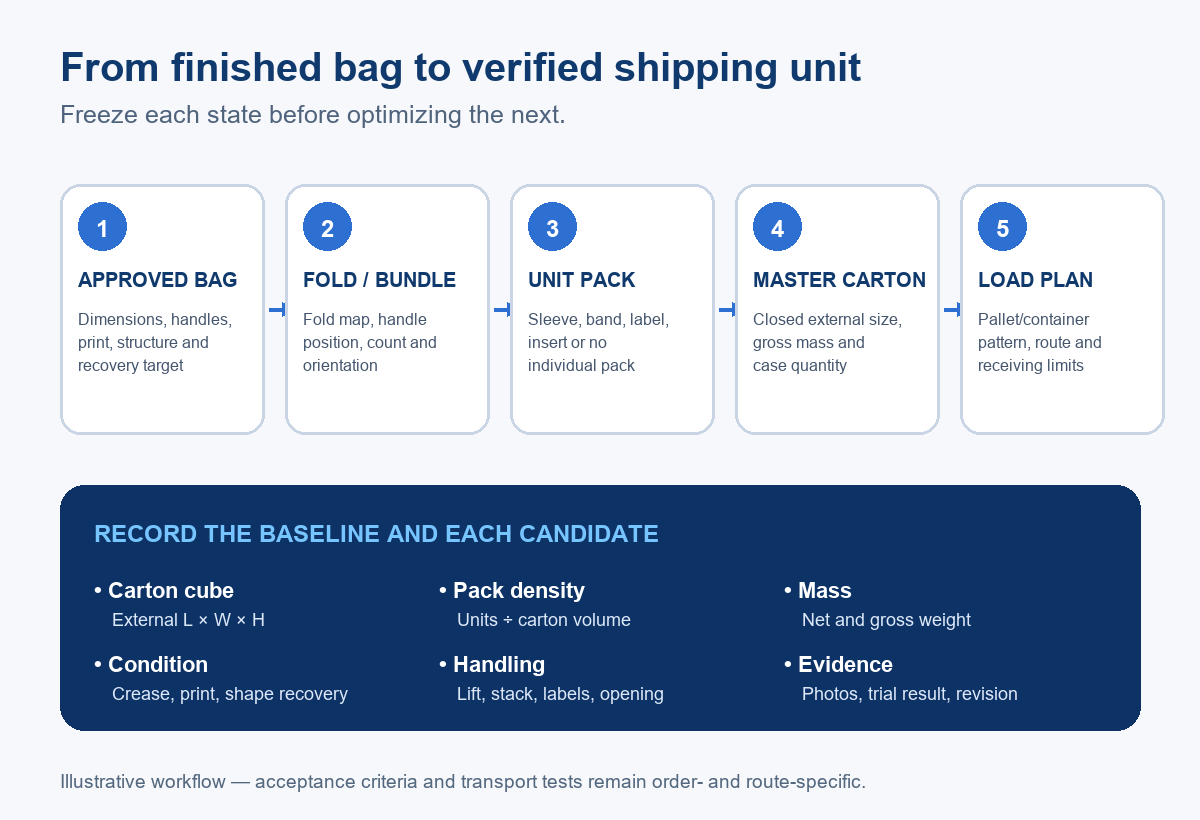
Original LUCKYSTAR planning diagram for this article. It is an illustrative workflow, not a fixed company carton specification or transport-test protocol.
1. Approve the production-intent bag
Confirm dimensions, material, surface, print, handles, closure, trims and construction. A shell sample without final print or hardware can have different stiffness and thickness from the bulk product.
2. Define the fold map
Show every fold line and the final handle position. Keep severe folds away from high-visibility print, rigid trim and thick seam intersections where possible. Specify whether gussets fold inward, whether handles alternate and whether bags face the same or alternating directions.
3. Decide what individual protection is necessary
An individual sleeve, band, tissue sheet, interleaf or insert should solve an identified risk. It should not be added automatically. If the buyer's retail, hygiene or marketplace requirement demands an individual pack, record the material, dimensions, closure, warning text, venting, label and barcode position. If no individual pack is needed, state that explicitly.
4. Freeze bundle count and orientation
Define how many bags form a bundle, how the bundle is secured and how operators confirm the count. Alternating bulky handles may reduce peaks. However, alternating artwork or several SKUs can create picking and receiving errors, so identification controls must remain visible.
5. Build the master-carton candidate around the settled pack
Pack the real quantity, close the carton as it will be shipped, allow the soft goods to settle under a defined condition, and then measure the closed external dimensions. Do not calculate the case from nominal flat-bag thickness alone.
Measure Carton Cube the Same Way Every Time
For a rectangular master carton, external carton volume is:
Carton volume (m³) = external length (m) × external width (m) × external height (m)
Then calculate:
Cube per bag = carton volume ÷ accepted bag quantity in the carton
Pack density = accepted bag quantity ÷ carton volume
Use the closed external shipping dimensions, because these affect physical space and may affect a carrier's rating. Record the measurement method, orientation, conditioning time, carton closure and whether the sides or top are bulging. A nominal carton dimension that excludes bulge is not a reliable transport baseline.
Also record net and gross mass. A pack can be volume-limited on one route and mass- or handling-limited on another. There is no single correct case quantity for all destinations.
Keep the finished bag and its packing materials as separate mass lines. If the bag construction is still being optimized, use How Material Weight Affects Shopping Bag Environmental Performance to compare material reduction against durability and achieved service before attributing an improvement to the carton alone.
Do not hard-code one dimensional-weight rule
Parcel and air services may compare actual mass with a dimensional or volumetric basis, but the divisor, rounding, exclusions and measurement rules depend on the carrier, service, origin, destination and date. Confirm the current rule with the selected logistics provider when the shipment is booked. The article should not turn a temporary carrier formula into a permanent shopping-bag specification.
Compare Several Carton Grids, Not Just One
A carton grid describes how unit packs or bundles are arranged across length, width and height. Test at least two plausible configurations after the unit pack is frozen.
For each candidate, record:
- units per layer and number of layers;
- product orientation and whether direction alternates;
- location of handle, closure and hardware concentrations;
- internal clearances and observed voids;
- carton external dimensions after closure;
- net and gross mass;
- pack time and ease of count verification;
- bulge, panel bowing or closure stress; and
- unpacking time and bag recovery condition.
Void percentage can be a useful diagnostic, but there is no universal target. A little clearance may protect a rigid handle or reduce surface pressure. Excess void may allow movement and crush. Judge the space by the hazard it prevents or creates.
Keep mixed-SKU efficiency separate from inventory control
Combining colors or store allocations in one carton can improve a downstream workflow, but it may reduce cube efficiency or increase receiving errors. If mixed cartons are required, define the sequence, dividers if any, inner identification, carton label and reconciliation rule. Do not hide this complexity inside a generic “assorted colors” line.
Reduce Cube Without Creating Product Damage
Compression changes the product. The question is whether the change is reversible and acceptable after the expected storage and distribution period.

A real LUCKYSTAR-branded product image from the company's public Made-in-China PVC tote listing. It is useful for identifying visible gusset, film and handle pressure points; it does not establish a universal folding method or compression limit.
Look for delayed defects
A bag can look acceptable immediately after packing and develop blocking, crease set, odor or shape distortion after time, temperature or humidity exposure. Inspect both immediately and after a defined recovery period. If the route includes elevated heat, humidity, long storage or high stacking loads, incorporate those conditions into the test plan.
Protect surfaces selectively
Interleaves, tissue, sleeves or handle wraps may be justified for polished hardware, coated panels or sensitive printing. Test the lightest effective option. Removing protection without checking damage merely shifts material and cost into rejects, rework and replacement shipments.
Control print-to-print contact
Fresh or pressure-sensitive decoration may transfer when faces are stacked. Confirm cure, blocking resistance and the approved orientation before bulk packing. The Shopping Bag Printing Quality Control Checklist explains the upstream print controls; the pack-out trial verifies what happens after those printed surfaces are held together.
Specify the Master Carton for the Route
“Export carton” is not a complete specification. The final requirement may include board construction or performance grade, internal dimensions, external dimensions, closure method, gross-mass limit, stacking orientation, moisture protection, handling symbols, barcode, carton marks and pallet pattern.
Do not prescribe a flute, board grade or compression number from a blog alone. The answer depends on carton geometry, filled mass, stacking height and duration, humidity, pallet support, transport mode and handling hazards.
ISO 12048:1994, confirmed by ISO in 2022, describes compression and stacking tests for complete, filled transport packages using a compression tester. ISO 4180:2019 provides general rules for compiling performance-test schedules for complete, filled transport packages and was confirmed in 2025. These references support a route-based test plan; they do not prescribe one universal pass value for shopping bags.
For individual packaged products moving through parcel delivery, ISTA Procedure 3A is a general simulation procedure for parcel systems and distinguishes standard, small, flat and elongated packages. It should be selected only when its scope matches the shipment. Palletized ocean freight, courier parcels and retail distribution-center deliveries do not present identical hazards.
Extend Optimization to the Load and Receiving Point
A strong master carton can still waste space or fail operationally when it reaches the pallet, container, warehouse or store.
Check:
- whether the carton footprint creates stable layers on the intended pallet;
- whether overhang, underhang or column gaps reduce stacking performance;
- whether labels remain visible after unitization;
- whether the actual door, rack, conveyor or receiving limits are met;
- whether workers can lift and open the carton safely under local rules;
- whether the SKU sequence supports put-away or store allocation; and
- whether the cartons can be counted and inspected without destroying the load.
Container utilization should be validated against the actual equipment and loading plan. Published internal dimensions are useful for screening, but real usable space can be affected by doors, ribs, floor condition, dunnage, pallets, weight distribution and other cargo. Treat spreadsheet utilization as an estimate until the logistics plan is confirmed.
Run a Controlled Pilot Pack-Out
A pilot should compare the approved baseline and candidate configurations under the same conditions. A useful record is more important than a dramatic percentage.
| Pilot checkpoint | Record | Approval question |
|---|---|---|
| Product identity | Style/SKU, revision, material lot and sample status | Are all candidates packing the same approved bag? |
| Pack configuration | Fold map, unit protection, bundle count and orientation | Can an operator repeat it from the instruction? |
| Carton | Supplier/code, internal and external dimensions, closure | Does the filled carton close without excessive bulge or stress? |
| Quantity and mass | Units, net mass, gross mass and count method | Is the case practical for handling and receiving? |
| Conditioning | Time, temperature, humidity and stacking condition | Does the trial reflect the route's relevant risks? |
| Distribution test | Named schedule, sequence and severity | Does the selected method match the distribution system? |
| Product recovery | Immediate and delayed appearance/function checks | Do bags remain within written acceptance criteria? |
| Operational result | Pack time, unpack time, errors and observations | Does the change work for both shipper and receiver? |
| Environmental evidence | Carton cube, packaging mass and accepted units | Is the claimed improvement supported by comparable data? |
Photograph the open carton, each layer, closure, external measurements, scale reading, label and unpacked product. Keep the failed candidate record as well as the approved one; it explains why a seemingly denser pack was rejected.
Write an Approved Packing Specification
The final instruction should be visual and revision-controlled. Include:
- exact bag SKU and approved revision;
- fold sequence with numbered photos or drawings;
- handle, closure, insert and artwork orientation;
- individual-protection material and label position, or an explicit “none”;
- bundle quantity and securing method;
- layer grid and total units per carton;
- master-carton code, dimensions and closure;
- net/gross mass recording rule;
- carton marks, barcode, SKU, destination and sequence rules;
- sampling points and defect response;
- approved pilot reference and date; and
- change-control owner.
The packing section belongs in the Custom Shopping Bag Tech Pack and should also appear in the inspection plan. The Custom Shopping Bag Quality Control Checklist connects that instruction to bulk release.
Turn Measurements Into Defensible Claims
| Risky wording | Better evidence-led wording |
|---|---|
| “Eco-friendly shipping carton” | State the carton material or verified certified/recycled attribute and the exact evidence that applies |
| “Optimized packaging cuts carbon” | Report a measured cube or material change first; make a GHG claim only with a defined transport calculation |
| “Zero-waste pack-out” | Report measured packaging inputs, production losses and the actual recovery/disposal route |
| “More bags per carton is always sustainable” | Compare accepted bags delivered, packaging mass, cube, damage and handling together |
| “Recyclable carton” | Identify the material, coatings/tape and the relevant collection route in the destination market |
| “Plastic-free” | Check every sleeve, tape, label, liner, coating, adhesive and accessory within the stated scope |
If the bag itself carries recycled-content or certification messaging, keep that evidence separate from the carton claim. The Shopping Bag Sustainability Certifications Explained guide helps buyers map certificate type, holder, scope and order-level chain. Packaging efficiency does not make an unverified product claim valid.
Company-claim boundary: the following section is LUCKYSTAR publisher self-description. It does not prove a universal carton count, freight saving, emissions reduction, damage rate, test result, certified packaging attribute or current material/capacity availability for a specific order. Bag construction, fold, unit protection, case quantity, carton specification, route testing, claims, MOQ, price, schedule and delivery are subject to the approved product, destination requirements, final packing specification and written confirmation.
Why Choose LUCKYSTAR for Shopping Bag Pack-Out Development?
Ningbo Luckystar Commodities Co., Ltd. supports OEM/ODM development across cotton/canvas, mesh, jute, paper, non-woven, woven PP, PVC-style and other project-specific shopping bag routes. That breadth matters because a pack-out that works for a soft textile bag may damage a coated, laminated, paper or clear-film construction.
LUCKYSTAR's useful role is to connect the buyer's product specification with sampling, visible quality checkpoints, packing instructions and export-ready handoff—not to apply one carton formula to every order.
| LUCKYSTAR support area | Buyer value | What remains order-specific |
|---|---|---|
| Multi-material shopping bag development | Packing risks can be reviewed against the actual bag route | Material, structure, print, dimensions and performance |
| Sample and specification coordination | Fold, protection and case quantity can be approved before bulk release | Number of sample rounds, timing and acceptance limits |
| OEM/ODM customization | Product features and packing can be developed together | MOQ, price, trim and packaging availability |
| Quality-control planning | Packing, labels, quantity and carton condition can enter the inspection scope | Sampling plan, defect definitions and decision rule |
| Export documentation handoff | Carton marks, packing list data and shipment evidence can be aligned | Trade term, carrier, route, destination and compliance requirements |
| Change control for reorders | The approved packing revision can be retained and compared | Material availability and any confirmed order change |
For broader due diligence, read How to Choose a Custom Shopping Bag Manufacturer and the core Custom Bag Manufacturer Guide. They explain how to assess responsibility, samples, specifications, quality and commercial assumptions around the pack-out work described here.
LUCKYSTAR does not treat a platform's historical packing line, displayed MOQ or old carton count as a permanent promise. Materials, unit protection, case quantity, carton specification, testing, timing, price, freight basis and certifications are subject to the approved product specification and written order confirmation.
RFQ Checklist for Carton Optimization
Send enough information to let the supplier compare like with like:
- product style, material, dimensions, handle/closure and artwork;
- total quantity and SKU/color split;
- approved sample or current revision status;
- current fold, individual pack, bundle and carton arrangement;
- baseline external carton dimensions, quantity and gross mass if available;
- photographs of existing packing or damage;
- target market, destination postcode and required arrival point;
- trade term and intended transport mode/service;
- buyer, marketplace, warehouse and labeling requirements;
- pallet, container, lift or receiving constraints;
- environmental metric or claim the brand hopes to support; and
- test, inspection and evidence requirements.
If no baseline exists, ask for a pilot with at least two physical configurations. A quote should identify the assumed pack-out so competing suppliers are not pricing different carton quantities or protection levels.
Frequently Asked Questions
What is the best number of shopping bags per carton?
There is no universal best quantity. It depends on settled unit-pack size, product recovery, carton strength, gross mass, handling limits, route, carrier rules, SKU control and receiving requirements. Approve the quantity through a physical pack-out and route-relevant validation.
Should shopping bags be vacuum packed?
Vacuum packing may reduce volume for some soft constructions, but it can create severe creases, surface blocking, distorted trims or slow shape recovery. It is unsuitable for many structured, coated, laminated, paper or clear-film bags. Test the production-intent product after realistic storage before considering it.
Are individual polybags always required?
No. The requirement may come from hygiene, retail presentation, marketplace rules, surface protection or barcode needs. If those risks can be controlled by another verified method, an individual sleeve may be unnecessary. Confirm the buyer's current channel rules before removing or specifying it.
Can a smaller carton be weaker?
Yes. Carton performance depends on geometry, board construction, closure, filled mass, stacking, humidity and handling. A smaller perimeter does not by itself prove adequate compression, puncture or drop performance. Test the complete filled package.
Does reducing carton cube prove lower carbon emissions?
No. It proves a dimensional change when measured against a controlled baseline. A transport-emissions claim needs a stated boundary, shipment activity data, allocation method and calculation framework such as the one addressed by ISO 14083.
When should carton optimization happen?
After the bag and its individual protection are stable, but before bulk cartons are committed. Repeat the pack-out if dimensions, material, handles, hardware, print, inserts, labels or unit protection change.
What should be checked before shipment release?
Verify bag revision, fold, unit protection, count, layer arrangement, carton code and dimensions, net/gross mass, closure, marks, barcode, carton condition and the agreed inspection result. Retain photos and the packing list as part of the shipment evidence pack.
Build a Better Pack-Out Before Bulk Production
Shopping bag packaging and carton optimization is successful when fewer resources and less avoidable space are used while the required product condition and delivery function remain intact. The reliable route is simple: define the outcome, freeze the product, test real configurations, measure the closed carton, validate transport risks and preserve the approved evidence.
Share your bag style, dimensions, material, artwork, quantity, current packing, destination and receiving constraints. The LUCKYSTAR team can review the information, identify missing decisions and propose an order-specific sample and pack-out plan. All specifications, commercial terms, testing and shipment arrangements remain subject to written confirmation.

Request a pilot pack-out comparison
Send the approved bag and current pack-out together with route constraints so carton alternatives can be compared on accepted units delivered, measured cube, packaging inputs, handling and damage risk.
Review LUCKYSTAR custom shopping bag options, then send your packing brief through the contact form or Email a project brief. The email link opens a draft for your review before sending.
Materials, fold, protection, carton count, transport tests, freight calculations, environmental claims, availability, price, MOQ, schedule and delivery terms are subject to route-specific review, approved samples, final specification and written confirmation.