Round Cord vs Flat Cord vs Webbing Straps
Round cord is usually the most compact and free-running option for a conventional drawstring channel. Flat cord—a narrow, tape-like drawtie—offers a broader visual face and can feel less concentrated in the hand, but it can roll or twist inside the tunnel. Webbing is wider and more structured; it is often better treated as a carrying strap or reinforced anchor component than as a direct replacement for drawcord. The best choice depends on what the trim must do, how it meets the bag, and how the complete assembly is approved.
This guide helps buyers specify the three profiles without relying on vague names such as “rope,” “ribbon,” or “strap.” It covers construction, channel fit, pull behavior, knotting, comfort, branding, testing, quality control, packing, and commercial trade-offs. To see the category context first, browse LUCKYSTAR's custom drawstring bags.
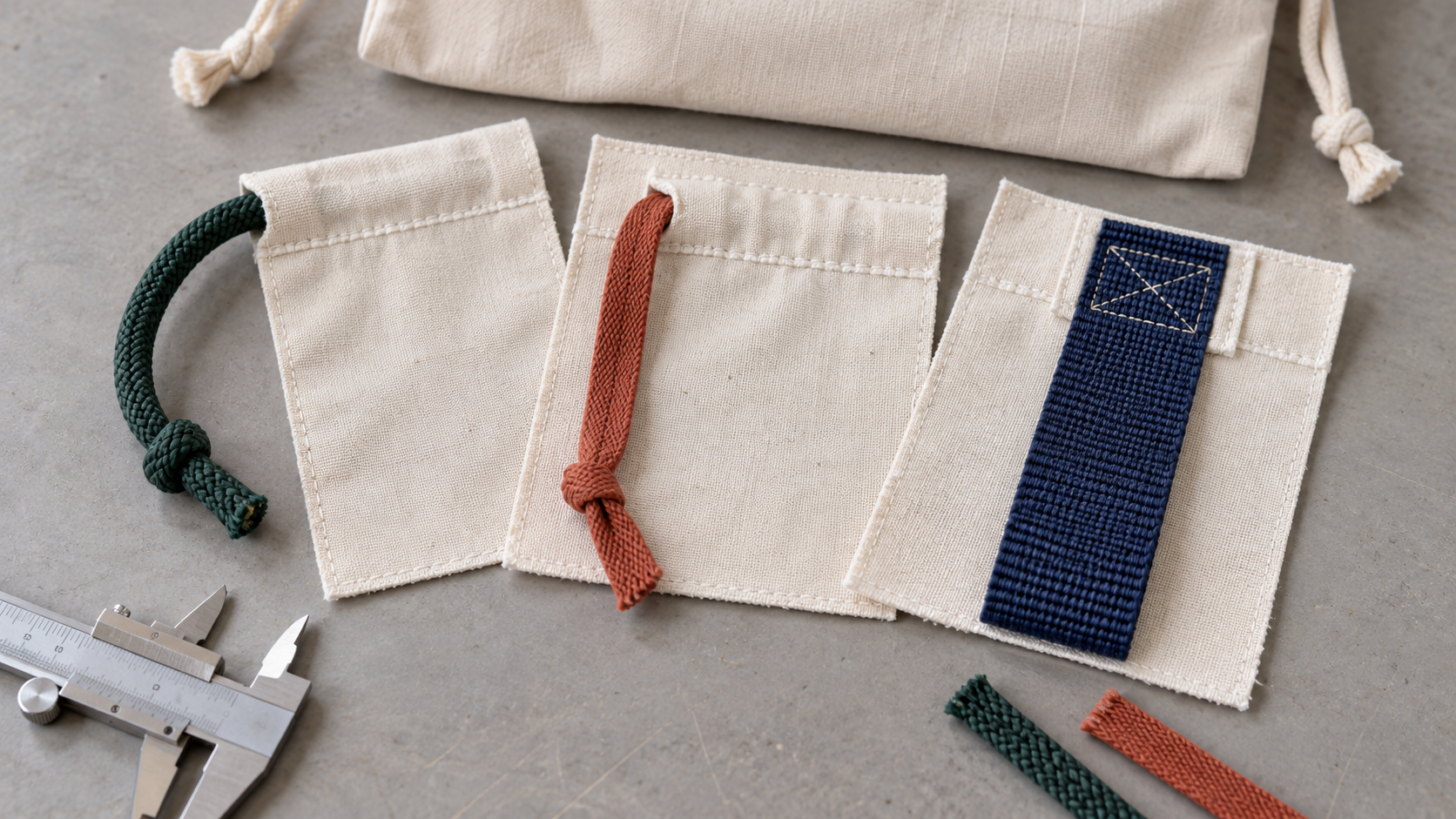
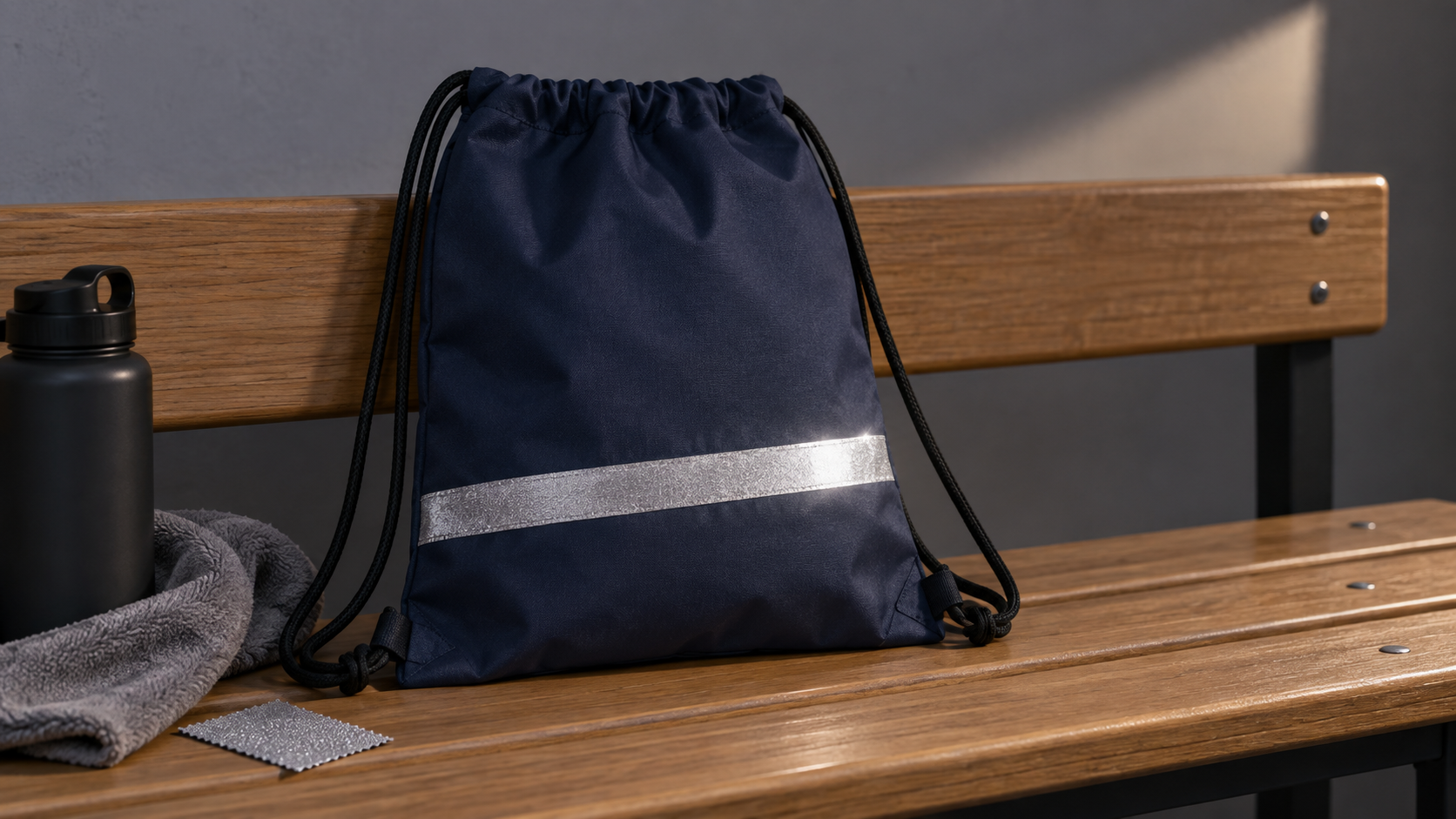
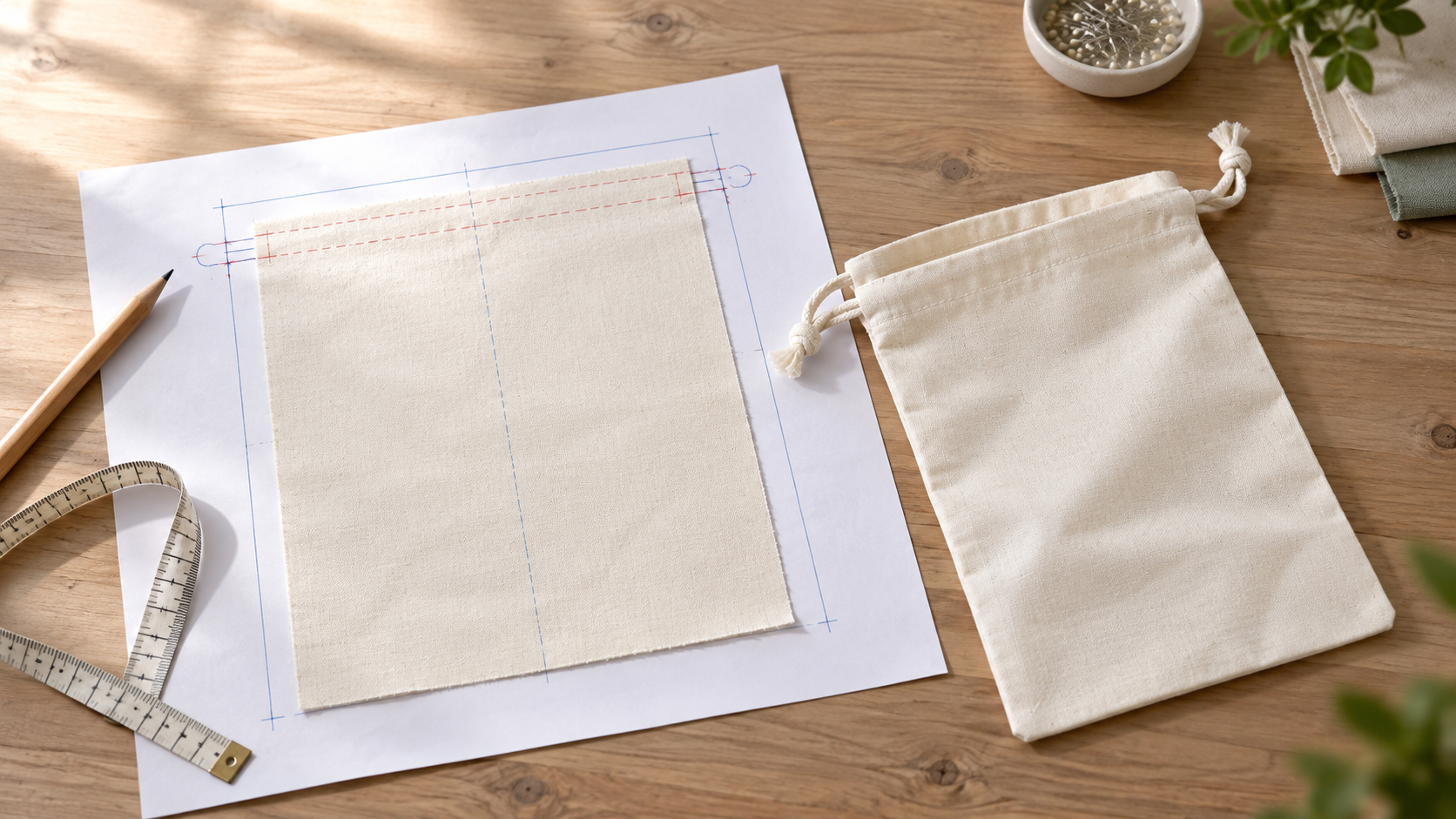
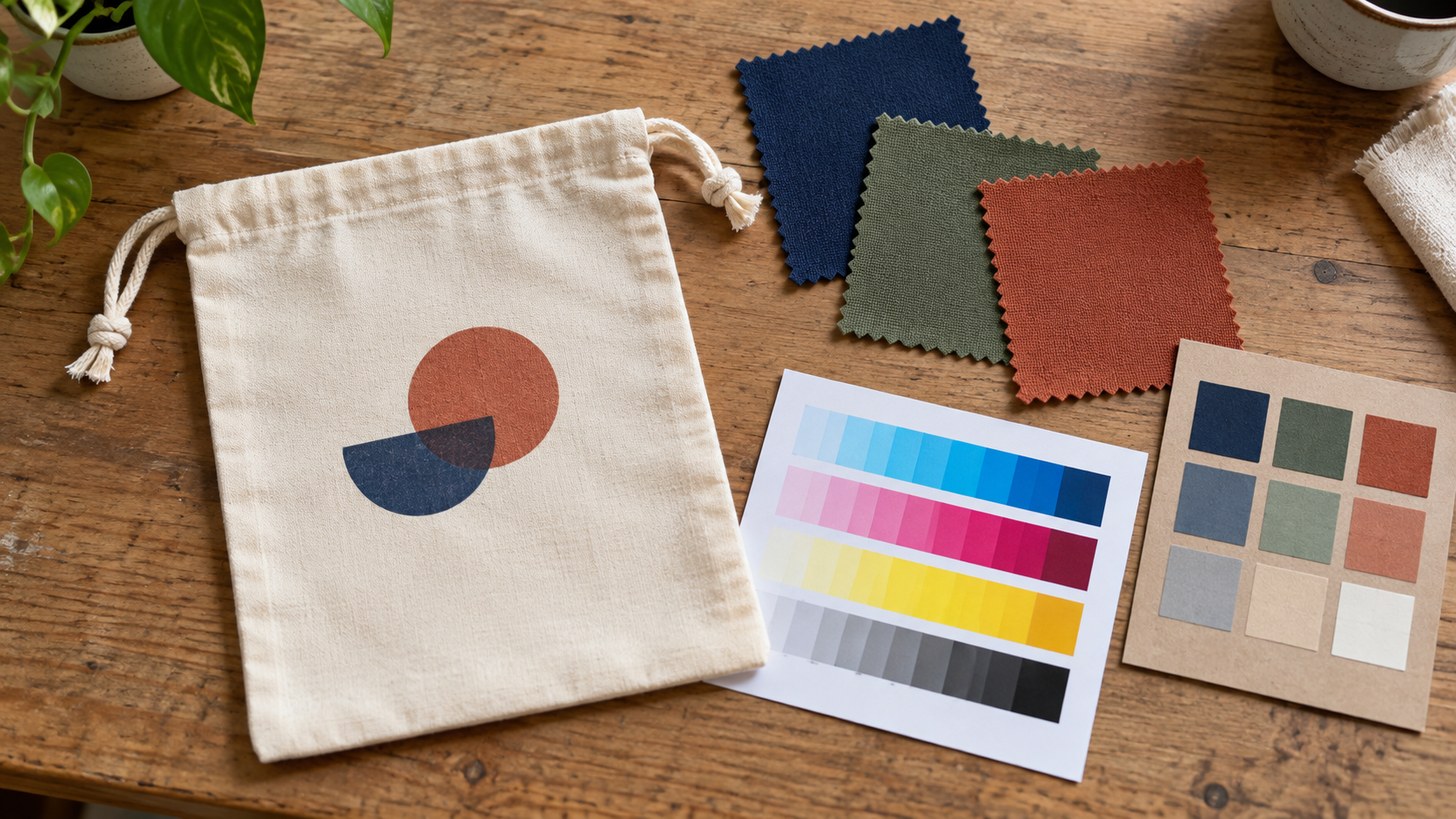
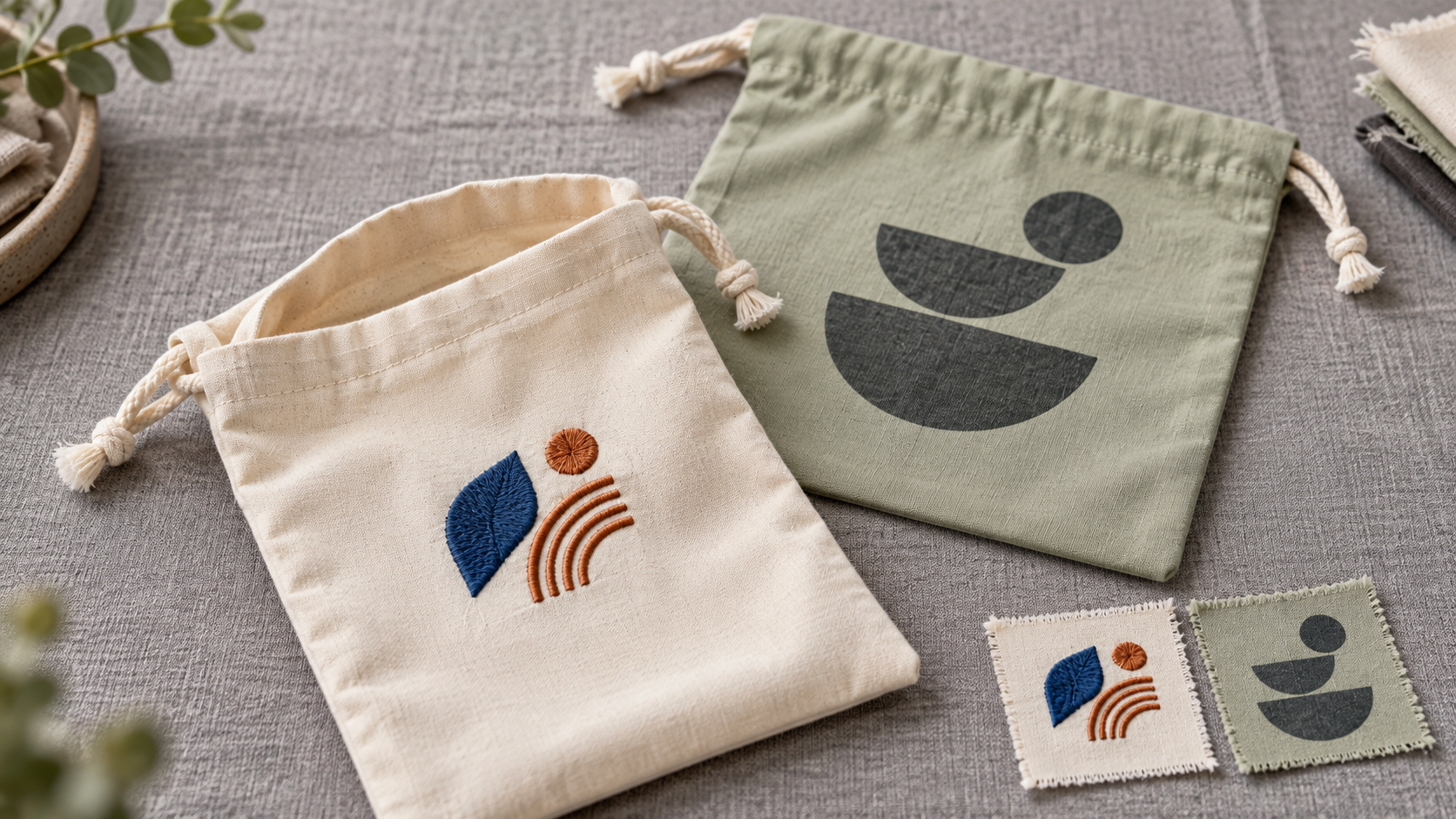
Image disclosure: this reference-guided AI visual uses an internal, unbranded LUCKYSTAR sample only to inform realistic fabric, tunnel sewing, trim scale, and sample-room handling. The three construction swatches are explanatory prototypes—not current SKUs, customer goods, or evidence of tested performance.
The Short Answer: Which Trim Profile Should You Choose?
Begin with the function:
- Choose round cord for a compact draw element that needs to turn and slide through a relatively narrow route.
- Choose flat cord or tape when a ribbon-like appearance, broader hand contact, or visible face matters, provided the route controls twisting.
- Choose webbing strap when carrying, anchoring, reinforcement, or a broad branded surface matters more than conventional drawcord behavior.
These are starting directions, not guarantees. Fiber, braid or weave, diameter or width, thickness, finish, stretch, channel, exit, load, and end treatment can reverse a superficial comparison. A buyer should approve the actual trim assembled in the actual bag.
| Decision factor | Round cord | Flat cord/tape | Webbing strap |
|---|---|---|---|
| Cross-section | Approximately circular | Thin, narrow, and face-oriented | Wider woven band with defined edges |
| Typical role | Draw and closure | Draw, tie, decorative pull | Carrying, anchoring, reinforcement; sometimes a wide drawtie |
| Channel behavior | Turns easily when matched to the route | Can fold, roll, or twist | Needs generous, low-bulk routing if used as a draw component |
| Hand/shoulder contact | Concentrated contact area | Broader than comparable round cord | Broadest contact area, subject to edge and stiffness control |
| Visible branding surface | Limited | Possible on a face, subject to process | Largest useful surface for print, woven, or stitched branding |
| End treatment | Knot, seal, aglet, wrap, stopper | Fold, stitch, knot, seal, aglet | Fold-and-stitch, bartack, box-X, tip, buckle, or other engineered finish |
| Common mistake | Specifying diameter only | Ignoring width orientation | Treating webbing as oversized cord |
Define the Terms Before Requesting a Quote
“Cord” describes a family, not a complete component. A round cord may be braided, twisted, knitted, cored, or hollow. A flat cord may be braided like a shoelace, woven as a narrow tape, or supplied as ribbon. Webbing is a narrow woven fabric intended to act as a band; its width, thickness, weave, edge construction, and stiffness distinguish it from a soft flat drawcord.
The same words can mean different products to different suppliers. Add a close-up photo, physical reference, cross-section drawing, and measurable fields to the RFQ. If the trim carries load, state whether it is a drawcord, shoulder contact surface, bottom anchor, or handle. The route and responsibility matter as much as the material name.
| Term on a brief | Ambiguity | Clarification to add |
|---|---|---|
| Rope | May mean twisted cord, braided cord, or decorative rope | Construction, fiber, nominal size, finish, and sample |
| Flat cord | Could mean shoelace braid, herringbone tape, ribbon, or narrow webbing | Width, thickness, weave/braid, edge, and hand feel |
| Strap | May be drawtie, shoulder strap, handle, or reinforcement | Functional role, route, attachment, and load direction |
| Webbing | Does not identify fiber or performance | Composition, weave, width, thickness, stiffness, and finish |
| Recycled cord | Claim scope may be unclear | Exact component, recycled percentage, evidence route, and order documents |
Round Cord: Compact Profile and Flexible Routing
Round cord is common where the closure travels around curves, through tunnels, or through small guides. Its nearly circular profile can rotate as it moves, so orientation is less visible than with a flat tape. A well-matched braid and finish can provide smooth operation without looking loose in the channel.
The risks are equally practical. A thin round cord can concentrate pressure in the hand or on the shoulder. A glossy surface may slip in a knot or cord lock. A soft braid can flatten under measurement. A stiff or large cord can resist tight bends and crowd a double-cord tunnel. Fiber ends, a hard heat-sealed bead, or an exposed core can undermine the finished appearance.
Round cord is therefore specified by more than color and diameter. Record fiber claim, construction, core, nominal dimension and measuring condition, mass or linear density where relevant, finish, stretch expectation, color reference, end treatment, and approved supplier article.
Flat Cord: A Narrow Face With Direction
Flat cord offers two faces and two edges. That geometry can support a softer ribbon aesthetic, a visible colored stripe, or selected decoration. It may also spread contact across a wider area than a small round cord. On gift pouches, shoes, dust covers, and casual drawstring products, a flat pull can become part of the visual design.
Its main engineering issue is orientation. A flat cord can roll into a rope-like form, fold at the exit, or twist half a turn inside the channel. The user may then see alternating face and edge. Repeated bending at one point can create a crease. If the face carries printed or woven branding, a hidden twist makes the message inconsistent.
Specify width and thickness rather than converting the component into an artificial “diameter.” Define face, edge, weave or braid, allowable twist, route, and whether the closed sample should show the same face on both sides.
Webbing Strap: Usually a Structural Band, Not a Cord
Webbing provides a broad woven strip that can be useful for shoulder straps, handles, lower-corner loops, reinforcement, and prominent trim. It can be cotton-like, polyester, nylon, polypropylene, or another construction, but fiber name alone does not define its load behavior or hand feel.
When webbing is proposed as a drawtie, examine whether it can fold and slide through the required radius without bunching. A channel that fits its flat width may still bind when two layers stack at a seam. A wide band needs an exit that preserves its edges and does not force it into a tight twist. In many drawstring backpacks, the closure remains round or flat cord while separate webbing is used for shoulder comfort or anchor reinforcement.
Do not infer capacity or safe carrying load from webbing width. Attachment geometry, stitches, fabric, reinforcement, seam location, load direction, and cyclic use determine the assembly. The broader drawstring cord, eyelet and reinforcement guide explains how guides and patches participate in that load path.
Cross-Section Controls More Than Appearance
Cross-section changes how a trim bends, rotates, presses on fabric, and occupies a channel. A circular component can turn without revealing orientation. A flat component has a preferred bending plane. A wide webbing strap can bridge over small folds instead of following them.
For like-for-like development, compare the functional geometry under a defined condition. Compressible cord dimensions change with jaw pressure or tension. Flat components need both width and thickness. Webbing may also require edge and weave descriptions, because two bands with identical width can differ markedly in stiffness and bulk.
| Geometry field | Round cord | Flat cord/tape | Webbing |
|---|---|---|---|
| Primary dimension | Nominal diameter or circumference by an agreed method | Width and thickness | Width, thickness, and weave/edge build |
| Orientation | Usually rotationally neutral | Face and edge must be controlled | Face, edges, and attachment direction are critical |
| Bend behavior | Multi-directional | Easier in one plane; may kink across width | Larger effective bend radius |
| Stacking in channel | One or two circular profiles | Layers can fold or overlap | Wide layers can jam at seams or exits |
| Inspection aid | Approved gauge/sample under defined condition | Width/thickness tools and visual twist standard | Width/thickness plus construction and hand reference |
Channel Size and Routing Compatibility
The channel must allow the specified number of trims to move after seam allowances, lining, coatings, and intersections are included. A tunnel that accepts a loose cord before sewing may become restrictive after its top turn, side seam, or binding is completed.
Round cord typically needs clearance around its profile. Flat cord needs enough space to lie without permanent folding while remaining controlled. Webbing requires a route that respects its width and turning radius; forcing it through a small eyelet defeats the reason for selecting a wide band.
Do not apply one universal cord-to-channel ratio. Prototype the actual layers and repeat open-close movements. The decision on one versus two cords also changes occupancy; use the dedicated single-cord vs double-cord drawstring bag guide to map the hidden route and exit count.
| Route checkpoint | Round cord question | Flat cord question | Webbing question |
|---|---|---|---|
| Tunnel | Is movement smooth without excess looseness? | Does the tape remain flat enough to show its face? | Can the band move without stacking or edge damage? |
| Turn | Is the bend too tight for the selected construction? | Does the face kink at the corner? | Is the radius compatible with width and stiffness? |
| Side seam | Does seam allowance obstruct the profile? | Does the tape catch or rotate? | Do multiple layers create a hard blockage? |
| Exit | Is the opening smooth and correctly sized? | Is the edge protected from rubbing? | Is a slot, loop, or open route more appropriate than a hole? |
| Double route | Do two cords cross freely? | Do two tapes lie or twist predictably? | Is a double-webbing channel practical at all? |
Pull Feel, Friction, and Opening Speed
Smoothness is a system property. Cord surface, finish, flexibility, channel fabric, seam intersections, pull angle, number of cords, and load at the mouth all contribute. A slippery cord may open easily but fail to hold a knot. A soft cotton-like tape may grip well but drag against a rough channel. Webbing can feel controlled in the hand yet move slowly through a gathered top.
Define a use task instead of asking for “low friction.” For example: open the empty pouch to a specified clear width, insert the product, close to the approved endpoint, and reopen for a defined number of cycles. Record snagging, twist, excessive force, fraying, heat or surface polishing, and whether the user can identify the correct pull.
Knots, Cord Locks, Aglets, and Sewn Ends
Round cord accepts many familiar knots and compatible cord locks, but knot stability varies with surface, construction, diameter, and load. Flat cord makes a broad bow or decorative tie, yet a narrow folded knot can crease it. Webbing is frequently secured by sewing rather than a bulky knot.
End treatment must fit the user and the process. Options may include overhand knots, stitched folds, wrapped ends, molded or metal-like aglets, heat-sealed synthetic ends, capped tips, or compatible locks. Each option changes exposed length, hardness, cost, repairability, appearance, and potential part requirements.
| End option | Suitable starting point | Main verification |
|---|---|---|
| Simple knot | Round or flat drawcord | Slip, bulk, consistency, and opening clearance |
| Bow | Flat cord, ribbon, selected round cord | Appearance after packing and user effort |
| Heat-sealed end | Compatible synthetic construction | No sharp bead, discoloration, or exposed core |
| Aglet/cap | Round or flat trim | Retention, edge finish, plating/material, and target-market needs |
| Cord lock | Usually round; selected flat profiles | Dimensional fit, holding force, release, and user/safety review |
| Fold-and-stitch | Webbing or robust flat tape | Stitch pattern, end fray control, and load direction |
Hand Comfort and Shoulder Comfort Are Different
A trim used briefly to close a pouch has a different comfort requirement from a cord used as a shoulder strap. Round cord concentrates force into a smaller contact area. Flat cord spreads it more broadly. Webbing can distribute contact over still more width, but stiff edges, rough weave, seam bulk, or a twisted strap can remain uncomfortable.
No profile guarantees comfort. Define the intended contents, maximum agreed test load, wear duration, clothing condition, user group, and strap routing. Evaluate the loaded sample, including how the trim crosses the shoulder and whether bottom anchors rotate. For a drawstring backpack, comfort and structural evaluation belong in the same test plan.
Gift Pouches and Premium Packaging
For jewelry, fragrance, beauty, wedding, and gift packaging, visual proportion can dominate. Round cord offers a classic, compact outline. Flat tape can create a softer ribbon presentation. Narrow decorative webbing can provide a bold trim, but it may overwhelm a small pouch or prevent a fine gather.
Inspect the closed crown, knot or bow size, tail balance, surface contact with the product, and logo relationship. Velvet, satin-like fabric, microfiber, cotton, and canvas react differently to the same trim. See velvet vs microfiber drawstring pouches and cotton vs canvas drawstring bags for body-material implications.
Dust Bags, Shoe Bags, and Apparel Covers
A medium or large dust bag needs easy product insertion and a closure that does not abrade the protected surface. Flat cord can offer a soft presentation; round cord may run efficiently through a long channel. Webbing can serve as a handle or carrying loop, but it may be unnecessary for a cover whose main purpose is storage.
Use the actual packed product or a dimensionally accurate dummy. Check clear opening, closure clearance, cord contact, seam behavior, and the stored silhouette. The drawstring bag size and capacity guide helps separate external dimensions from usable access.
Promotional and Retail Programs
Promotional projects often balance visible branding, unit economics, pack-out speed, and event timing. Round cord can be efficient and compact. Flat tape may add a distinctive color accent or branded face. Webbing can turn into a prominent design element, handle, or wearable strap.
Branding the trim should not be an afterthought. Confirm print, transfer, woven pattern, jacquard, embroidery, or label feasibility on the actual component. A method that works on flat webbing may not suit a curved cord. Logos can disappear when flat tape twists or when a strap folds inside the carton.
Branding on Flat Cord and Webbing
Flat surfaces create opportunities for repeating text, color stripes, or motifs, but the artwork must be designed for a moving, narrow substrate. Determine repeat length, orientation, safe margin, cut position, one-sided or two-sided visibility, and how knots interrupt the mark. For webbing, confirm whether branding is printed on the surface, woven into the structure, stitched, or added by a label.
Approve the trim by itself and on the assembled bag. A loose branded tape can look correct on the sample card yet rotate away from the customer once threaded. Color evaluation should use a physical reference under agreed lighting; screen appearance is insufficient for a brand-critical shade.
Fiber Name Does Not Predict the Finished Trim
Cotton, polyester, nylon, polypropylene, and recycled-content options can each appear in multiple constructions. Braid, twist, weave, yarn size, density, core, finish, and dyeing influence the trim's behavior. A material label is therefore only one part of the specification; use the best materials for custom drawstring bags overview to connect the trim choice with the pouch body.
For synthetic bag bodies and trims, review polyester vs nylon drawstring bags. If recycled content is requested, the RPET drawstring bag certification and sourcing checklist explains why evidence must identify the component and supply-chain scope. Do not assume that a recycled body fabric means the cord or webbing has the same composition.
Moisture, Washing, Color, and Dimensional Change
Moisture can change friction, color transfer risk, stiffness, and dimensional behavior. Cotton-rich trims may swell or shrink differently from a synthetic body. Some synthetic surfaces become more slippery when wet; coatings or finishes may change after cleaning. Dyed cord can transfer color to a light bag or product under unfavorable conditions.
If the bag is intended for washing, wet environments, travel, sports, or prolonged product contact, define conditioning and care trials for the finished sample. Check cord length, webbing twist, color migration, opening function, seam puckering, and dry recovery. Do not describe a trim as waterproof, colorfast, washable, non-toxic, or suitable for contact without relevant order evidence.
Sampling the Three Options Fairly
Use the same body material, size, channel route, and load when comparing trim profiles. If the webbing option requires a different route or anchor, document that structural change instead of presenting the samples as identical.
| Development stage | Question to answer | Evidence to retain |
|---|---|---|
| Trim card | Are color, construction, dimensions, hand, and finish acceptable? | Approved article code, swatch, and supplier record |
| Channel mock-up | Does the profile pass through the real layered route? | Marked swatch and movement notes |
| Undecorated bag | Are opening, closing, knotting, and comfort workable? | Measured sample and cycle observations |
| Branded sample | Is the visible face and logo orientation stable? | Artwork approval and state photos |
| Loaded sample | Does the system work with intended contents and handling? | Load/task record and defects |
| Pack-out trial | Do cords or straps tangle, mark, or twist in cartons? | Packing instruction and recovery photos |
| Pre-production reference | Is every final component frozen? | Signed specification and retained sample |
The custom drawstring bag sample development process provides a controlled path from early mock-up to production reference.
What the Tech Pack Should Specify
Place the trim specification next to the route drawing rather than in a general notes field. Show whether the component passes through a continuous tunnel, separate front/back channels, loops, slots, eyelets, bottom anchors, or a sewn attachment.
| Tech-pack field | Round cord | Flat cord | Webbing strap |
|---|---|---|---|
| Material/construction | Fiber, braid/twist, core, finish | Fiber, braid/weave, face, edge | Fiber, weave, face, edge, stiffness |
| Dimensions | Diameter/circumference method | Width and thickness | Width and thickness |
| Length | Cut and exposed length by bag state | Cut, exposed, and face orientation | Finished strap path and attachment allowance |
| Route | Channel, exits, crossover | Channel, exits, twist control | Guide, loop, anchor, handle, or wide tunnel |
| End | Knot, seal, aglet, lock | Knot, bow, stitch, aglet | Fold, stitch, bartack, hardware |
| Function | Pull, tie, carry, or anchor | Pull, tie, decorate, or carry | Carry, reinforce, anchor, or controlled draw |
Use the custom drawstring bag tech pack guide to control measurement points, versions, and approval comments.
Quality-Control Checklist
Incoming inspection should confirm the trim before it is cut. In-process checks should catch routing or attachment errors while they remain accessible. Finished inspection should evaluate the bag as a working assembly.
| QC point | What to verify | Common defect |
|---|---|---|
| Identity | Approved article, fiber claim, construction, and lot | Substitute trim or mixed lot |
| Color | Physical reference and lot consistency | Shade variation or transfer |
| Dimensions | Defined method and tolerance | Oversize cord, narrow tape, variable webbing |
| Surface/edges | Snags, roughness, contamination, fray | Abrasive edge or exposed core |
| Length | Cut and finished length in named state | Unequal tails or short strap |
| Route | Correct channel, exits, twists, and crossover | Misthreading or hidden half-twist |
| Ends/attachments | Knot, seal, aglet, fold, stitch, or hardware | Loose knot, sharp seal, skipped bartack |
| Function | Agreed opening, closing, carrying, and cycles | Binding, slippage, excessive drag |
| Appearance | Face orientation, logo, gathers, and symmetry | Rotated branding or distorted crown |
| Packing | Fold, cord lay, protection, and carton recovery | Tangling, pressure marks, permanent kinks |
Integrate these items into the project's custom bag quality inspection checklist, including defect classes and release criteria.
Testing: Measure the Component and the Assembly
Component data can help compare trims, but the finished bag determines real use. ISO 2307:2019 specifies methods for selected physical and mechanical properties of fiber ropes, including linear density, diameter, lay length or braid pitch, elongation, and breaking force. Its official page states that the 2019 edition was reviewed and confirmed in 2025. Applicability still depends on whether the selected drawcord fits the standard's scope and on the agreed test plan.
For elastic narrow fabrics, ISO 20932-3:2018 describes methods for elasticity and related properties, with separate quality-assurance and in-use approaches. It is not a blanket test for every non-elastic webbing or an assembled bag. Select the standard or customer method that addresses the actual component and risk.
An assembly plan may include open-close cycling, pull-force comparison, knot or aglet retention, webbing attachment pull, loaded carry, abrasion at exits, wet/dry behavior, and pack recovery. State sample count, conditioning, direction, force or mass, cycles, duration, and pass/fail criteria before testing. Neither cited ISO document is a LUCKYSTAR certification, and neither alone establishes a safe bag load.
Failure Modes and Troubleshooting
| Symptom | Likely variables | Useful diagnostic question |
|---|---|---|
| Round cord feels harsh | Small profile, high load, hard braid | Is the component closing only, or also carrying on the body? |
| Round cord slips loose | Smooth finish, knot, lock mismatch | Was holding behavior tested in the actual route? |
| Flat cord rolls | Tunnel clearance, tape stiffness, pull angle | Where does the first half-twist appear? |
| Flat branding faces inward | Threading orientation, repeated rotation | Is face direction controlled at assembly and inspection? |
| Webbing jams | Excess width/thickness, tight bend, stacked layers | Should webbing be external instead of inside the tunnel? |
| Webbing edge damages fabric | Rough edge, narrow exit, angled load | Is the interface finished for repeated movement? |
| Trim length varies | Stretch, cutting control, undefined state | Under what tension and bag condition is length measured? |
| Color marks a light pouch | Dye/finish compatibility, moisture, pressure | Was contact tested after realistic packing and conditioning? |
Do not solve every issue by increasing thickness. A larger component can create a new tunnel, knot, exit, comfort, or packing problem. Correct the relationship between trim, route, use, and acceptance criteria.
Packing and Carton Efficiency
Round cords coil compactly but can tangle. Flat tape can hold a sharp carton fold or turn face-down. Webbing adds bulk and can create pressure lines on light-colored or pile fabrics. Hardware and aglets can scratch adjacent units.
Approve how the trim is laid before individual packing: inside the pouch, around the body, in a paper band, under a protective sheet, or in another controlled arrangement. Verify that the unit can be packed efficiently without permanently changing face orientation, knot shape, or shoulder-strap geometry. Carton optimization should not damage the functional sample.
Cost, MOQ, and Lead-Time Effects
Round cord is not always the least expensive, and webbing is not always the most expensive. Cost depends on fiber, construction, custom color, dimensions, minimum trim production, decoration, end hardware, cutting, threading or sewing labor, inspection, and packing. A stock round cord may be economical; a custom braided cord with branded aglets may not be. A simple stock webbing may cost less than a custom printed flat tape.
MOQ can be driven by a custom dye lot, weave or jacquard setup, printed repeat, branded hardware, or the bag body. Timing depends on material approval, sample revisions, production booking, inspection, and delivery conditions. LUCKYSTAR confirms these terms per project rather than publishing one universal minimum or lead time. Our MOQ and production-time explainer for drawstring bags maps those dependencies. To normalize quote assumptions separately, consult the 2026 drawstring bag pricing guide.
Sustainability and Compliance Claims
A narrower trim uses less material only when compared on the same function, length, construction, and service. It may also wear faster or require additional components. Webbing can increase mass but improve comfort or durability in a carrying role. Life-cycle conclusions need project evidence rather than assumptions based on width.
For recycled, organic, biodegradable, compostable, non-toxic, or other environmental claims, identify the exact cord or webbing component, composition and percentage, supplier chain, certificate scope, validity, transaction or shipment documents, and target-market wording. Historical or upstream documents in the LUCKYSTAR knowledge base are not current universal company certifications. Claims remain order-specific until the required evidence is matched.
Why Choose LUCKYSTAR for Trim Development?
On the independent website, LUCKYSTAR operates as Ningbo Luckystar Commodities Co., Ltd. and supports OEM/ODM development for custom bags and textile packaging. The benefit for a trim decision is coordination: a round cord, flat tape, or webbing strap is reviewed with the body material, route, opening, branding, sample, production record, inspection, and pack-out rather than selected in isolation.
LUCKYSTAR can help buyers:
- convert a visual trim reference into measurable specification fields;
- compare cord and webbing options on construction mock-ups before bulk work;
- align channel, exit, end finish, color, and branding with the intended use;
- record sample corrections and freeze the approved component for production;
- discuss order-level quality checks and testing requirements; and
- connect the product design to quantity, packaging, destination, and arrival needs.
Available materials, decoration, commercial terms, tests, and schedules are subject to feasibility, supply confirmation, sample approval, quantity, and written agreement. Use how to choose a custom drawstring bag manufacturer for category-specific supplier evaluation. The broader Custom Bag Manufacturer guide helps buyers assign development and production responsibilities, and the drawstring bag manufacturing process follows the approved construction into delivery.
RFQ Checklist for Cord and Webbing
| RFQ field | Information to provide |
|---|---|
| Bag function | Product packaging, gift, storage, promotion, dust cover, backpack, or carry |
| Contents and users | Item dimensions/mass, handling, wear duration, and user requirements |
| Body construction | Material, weight/thickness, size, lining, channel, gusset, and seams |
| Trim role | Draw, tie, carry, anchor, reinforce, or decorate |
| Profile | Round cord, flat cord/tape, or webbing; reference and cross-section |
| Material/build | Fiber claim, braid/weave, core, finish, color, face, and edges |
| Dimensions | Diameter/circumference or width/thickness; measurement condition |
| Route | Cord count, tunnel, exits, loops, eyelets, attachments, and direction |
| Ends | Knot, bow, seal, aglet, lock, fold, stitch, or hardware |
| Branding | Method, artwork, repeat, face, safe margin, and orientation |
| Performance | Opening cycles, pull, carrying, abrasion, wet/dry, and acceptance criteria |
| Quantity/logistics | SKU split, pack method, destination, and required arrival date |
| Evidence | Material, claim, inspection, testing, and shipment documents |
For overseas purchasing, connect this component specification to the customs, shipping-document, Incoterms, inspection, and cost controls covered in our guide to importing custom drawstring bags from China. When design responsibility remains unclear, review OEM vs ODM drawstring bag manufacturing.
Frequently Asked Questions
Is round cord stronger than flat cord?
Profile alone does not determine strength. Fiber, yarn, braid or weave, cross-sectional area, finish, damage, test method, and attachment all matter. Compare the approved components under a relevant method and verify the complete bag assembly.
Is flat cord more comfortable than round cord?
It may spread pressure across a wider area, but comfort also depends on thickness, edges, stiffness, twist, load, and contact duration. Test the finished, loaded bag with the intended carrying motion.
Can webbing run through a drawstring channel?
Yes, in a specially designed route, but wide or stiff webbing can bunch, stack, or bind. Often it performs better as an external strap, loop, or anchor while a separate cord closes the mouth. Approve a working mock-up.
Which trim is best for a gift pouch?
Round cord gives a compact classic closure; flat tape can create a ribbon-like presentation; narrow decorative webbing can be bold but may overpower a small gather. Select with the body fabric, product, knot or bow, and desired closed silhouette.
Which trim is best for a drawstring backpack?
Round or flat cords commonly close the mouth and may act as shoulder cords; webbing can improve shoulder contact or reinforce anchors. The right layout depends on load, comfort, route, lower attachments, body fabric, and testing—not trim name alone.
Can a logo be printed on flat cord or webbing?
Selected printing, transfer, woven, jacquard, embroidery, or label approaches may be possible. Feasibility depends on material, surface, width, color, repeat, order quantity, and process. Approve the loose trim and assembled-bag orientation.
How do I measure a soft round cord?
Use the supplier's defined method and an agreed inspection method because soft cord compresses. Depending on the project, nominal diameter, circumference, gauge condition, or standardized rope measurements may be relevant. Retain an approved physical sample.
Should flat cord be specified by diameter?
No. Record its width and thickness, plus construction, face, edges, and allowable twist. A single diameter hides the geometry that controls tunnel fit and appearance.
Does a wider strap guarantee higher load capacity?
No. Webbing construction, attachments, stitches, fabric reinforcement, seams, load direction, wear, and testing determine the assembly. Width can improve contact area without proving strength.
Can LUCKYSTAR match an existing cord or webbing sample?
LUCKYSTAR can review a physical reference, photo, drawing, and target specification as part of an OEM/ODM project. Color, composition, construction, dimensions, MOQ, pricing, timing, tests, and final equivalence require sample development and written confirmation.
Final Recommendation
Treat the trim as a functional interface, not decoration added after the bag is complete. Round cord favors compact multidirectional routing; flat cord adds a visible face but needs twist control; webbing provides a broad structural band and often deserves its own attachment rather than a conventional tunnel. Approve cross-section, route, ends, comfort, branding, cycles, and packing on the production-equivalent sample.
Share your bag use, contents, body material, size, cord count, trim reference, artwork, quantity, testing needs, packing, destination, and required arrival date. LUCKYSTAR can review these inputs and prepare a project-specific custom drawstring bag quotation.