A cosmetic bag may look simple at the border, but its import file is built from details: whether the outer surface is textile or PU, whether the bag is empty or packed with beauty products, whether it is designed for adults or children, which claims appear online, and which legal entity is responsible in the destination market. A copied HS code or a supplier’s promise that “customs is included” does not settle those questions.
Planning an order? Send the import-file details already known. Include destination and importer, exact bag construction and materials, intended user and channel, empty or filled shipment status, labels and claims, quantity and value basis, trade term with named place, route and required date.
This Custom Cosmetic Bag Import Guide focuses on the product-specific evidence needed to import from China. It does not replace legal, customs, tax or product-safety advice in the destination country. Confirm current rules with the relevant authority and a qualified broker or adviser before ordering. For the wider process that applies to totes, backpacks and other bags, read our general custom-bag import workflow. Review LUCKYSTAR’s custom cosmetic bag range, apply our cosmetic bag factory due-diligence criteria, and connect the project to the manufacturer sourcing pillar.

Quick answer: build one import file around the actual bag
Before paying a deposit, define the destination, importer, sales channel, exact construction, intended user, labels, claims and whether the shipment contains empty bags or filled cosmetics. Give that file to the customs broker and compliance adviser for pre-review. Approve the sample and bulk against the same specification; reconcile carton count, weights and descriptions across invoice, packing list and transport records; and release shipment only after the product and documents agree.
| Import gate | Evidence | Owner |
|---|---|---|
| Product identity | Construction, materials, intended use, photos and SKU map | Brand, factory and broker |
| Market responsibility | Importer/economic operator, registrations and product-rule matrix | Buyer and destination adviser |
| Production release | Approved sample, bulk materials, testing and inspection plan | Buyer and manufacturer |
| Shipment release | Inspection result,invoice, packing list, booking and supporting file | Buyer, forwarder and broker |
| Post-entry record | Entry, duties/taxes, delivery, lot and corrective-action records | Importer |
1. First decide what is being imported
An empty reusable cosmetic bag is not the same shipment as a gift set containing creams, liquids, aerosols or tools. Adding products can create additional classifications, values, dangerous-goods questions, cosmetic labeling rules, ingredients or responsible-person requirements that the empty sewn bag never triggered. Ask the factory to describe only what it manufactures and packs; the importer must coordinate every regulated item in the final set.
| Shipment form | Import file focus | Extra specialist review |
|---|---|---|
| Empty cosmetic bag | Bag classification, material, labeling, product safety and packaging | Destination consumer-product adviser as applicable |
| Bag with empty accessories | Identity and rules for each brush, mirror,tool or container | Component-specific requirements |
| Bag filled with cosmetics | Bag plus every formula/package/SKU in the kit | Cosmetics regulatory and dangerous-goods expertise |
| Promotional gift set | True transaction, contents, value, claims and channel | Customs, consumer-protection and campaign review |
2. Fix the destination, importer and sales channel
“Ship worldwide” is not a compliance brief. Rules differ by customs territory, and obligations can change when goods are sold online, offered to children, placed in a retail set or stored by a marketplace fulfillment provider. Name the importing legal entity and delivery facility early. A forwarder can move cargo; that does not automatically make it the product-responsible business.
| Market field | Decision | Why it matters |
|---|---|---|
| Customs territory | Country/region and port of entry | Tariff, entry and tax rules are destination-specific |
| Importer/economic operator | Eligible legal entity and identifiers | Assigns declarations and product responsibilities |
| Channel | Wholesale, store, marketplace, direct-to-consumer or promotion | Changes traceability,packaging and online-information needs |
| User | Adult, child-directed, professional or general consumer | Can change safety/test scope |
| Delivery point | Port, terminal, warehouse or final address | Needed for trade term and landed-cost scope |
3. Build a cosmetic-bag identity sheet
Customs and compliance review need more than the marketing name “makeup pouch.” Record shell construction, external surface, textile fiber or polymer, backing, lining, reinforcement, zipper, hardware, dimensions, carrying features and intended use. Include clear photos of the exterior, open interior and cross-section or layer stack. Keep one identity per materially different SKU.
Use our cosmetic-bag tech-pack method to connect this evidence to the production specification.
| Identity field | Evidence | Import use |
|---|---|---|
| Plain-language product | What it is and what it holds | Invoice, broker and authority communication |
| Outer surface/body | Material, coating, construction and visible face | Classification and restricted-substance review |
| Internal stack | Lining, foam, board, dividers and backing | Product safety and description support |
| Features | Handle, strap, mirror, brush panel,metal fittings | Function, hazard and component scope |
| Dimensions/weight | Finished bag and packed unit | Description, freight and inspection |
4. Do not copy a universal HS code
Similar-looking cosmetic bags can classify differently when external surface, constituent material, construction or use changes, and national tariff schedules extend the international system differently. A broker should review the actual bag under the destination rules. Send photos, samples and the identity sheet; retain the classification reasoning or formal ruling where appropriate. Never alter a description to obtain a preferred rate.
For example, the UK’s official import guidance says the commodity code helps determine duty and whether a licence is required, while its tariff tool asks for product type, use, material, production and packaging details. The GOV.UK import process is a useful example of why classification begins with facts rather than a copied code.
| Classification input | Question | Document |
|---|---|---|
| External surface | What material is presented to the exterior? | Swatch, layer diagram and photos |
| Body construction | Textile, sheeting, coated material or mixed assembly? | BOM and supplier material specification |
| Use/function | Organizer, carrying case,fitted set component or other? | Product description and sales page |
| Set status | Imported alone or with other goods? | Packing list and set configuration |
| Destination schedule | Which national code and measures apply? | Broker opinion, tariff tool or ruling |
5. Make the material file classification-ready
“Vegan leather,” “canvas look” and “water-resistant fabric” are commercial phrases, not material identities. Obtain fiber composition or polymer type, coating/lamination, weight or gauge, supplier article and color/finish for the production lot. Compare the actual options in our cosmetic bag material guide and the PU-versus-polyester analysis before asking a broker to classify an undefined surface.
| Material record | Minimum content | Weak substitute |
|---|---|---|
| Outer textile | Fiber, weave/knit, weight, coating and finish | “Fabric” |
| PU/synthetic surface | Face polymer, base textile, gauge and emboss/finish | “Leather” |
| Lining | Composition, construction,coating and color | “Waterproof lining” |
| Reinforcement | Foam/board/polymer type and position | “Padding” |
| Hardware | Metal/plastic type, plating and functional part | “Accessories” |
6. Separate customs clearance from product compliance
Customs documentation supports entry, value, classification, origin and duties. Product compliance determines whether the good can legally and safely be placed on the market. A released shipment can still create liability if labels, chemical limits, safety evidence or traceability are wrong. Create two linked workstreams and one owner map.
| Workstream | Core questions | Typical adviser |
|---|---|---|
| Customs | Code, value, origin, entry, duty/tax and documents | Licensed/qualified customs broker |
| Consumer product | Safety rules, labels, traceability,warnings and corrective action | Destination compliance specialist |
| Chemicals/materials | Restricted substances and evidence for exact components | Qualified laboratory/adviser |
| Brand/IP | Artwork authorization,trademarks and distribution rights | Brand owner/legal counsel |
| Tax/accounting | Registration, import taxes and recoverability | Destination tax adviser |
7. Create a destination-specific product rules matrix
Do not ask a factory to “send all certificates.” Start from the product, user, channel and destination; list the rule, responsible party, evidence, sample identity, decision date and renewal/change trigger. A report for a prototype, one color or one material supplier may not cover changed bulk. U.S. importers can use CPSC business guidance to determine whether a general-use or children’s product is subject to a CPSC rule; EU importers should check product requirements through Access2Markets and applicable safety legislation.
| Matrix field | Record | Approval gate |
|---|---|---|
| Applicable requirement | Law/rule/customer standard and current version | Before specification freeze |
| Product/material scope | Which SKU, component, color and supplier article | Before sample/test selection |
| Evidence | Declaration, report, certificate, label or technical file | Before bulk or shipment as assigned |
| Responsible entity | Importer, manufacturer,representative or other operator | Before sale/entry |
| Change trigger | Material, color, supplier, process, rule or claim change | Reassessment before affected production |
8. Treat child-directed bags as a separate program
A pink color or cartoon print does not by itself settle whether a product is child-directed, but design, marketing, size, features and intended consumer can affect the analysis. Small parts, cords, accessible sharp points, coatings and testing/certification obligations may differ. Do not convert an adult cosmetic organizer into a children’s SKU by artwork alone; have the destination specialist classify the intended user and build the test plan before production.
| Child-directed signal | Question | Action |
|---|---|---|
| Marketing/artwork | Who is the advertised user? | Review claims,imagery and retail placement |
| Scale/features | Is the size/function designed for children? | Document intended age/user |
| Small hardware/decor | Can a component detach or be mouthed? | Risk assessment and applicable tests |
| Cord/strap | Does geometry create a child-specific hazard? | Specialist design review |
| Certification filing | Which rule and certificate applies? | Importer verifies current official process |
9. Control claims that can expand the evidence burden
“Waterproof,” “antimicrobial,” “non-toxic,” “recycled,” “food grade” and “eco-friendly” are not interchangeable design adjectives. Claims may require specific test methods, substantiation or legal review. A bag that stores packaged cosmetics does not automatically contact the formula, and a water-resistant fabric does not make every seam leakproof. Match copy to the exact finished construction.
Use our waterproof cosmetic bag manufacturing guide for construction boundaries and the RPET certification and sourcing checklist before making recycled-content statements.
| Claim | Evidence question | Import-file control |
|---|---|---|
| Waterproof/leakproof | Which finished product method and conditions? | Test report plus qualified claim wording |
| Antimicrobial | Which treated material, organism and legal category? | Destination regulatory review before claim |
| Recycled content | What percentage,component and chain of evidence? | Supplier/transaction records linked to SKU |
| Non-toxic/safe | Which specific requirement or substance limit? | Replace broad claim with supportable statement |
| Vegan | What definition and component scope does the brand use? | Supplier declarations and legal/marketing review |
10. Design labeling and traceability before sewing
Country of origin, importer or responsible-person information, product identity, batch/lot, fiber/material labeling, warnings and care information can depend on market and product. Some details may appear on the product, packaging or accompanying document only when the relevant rule allows. Reserve placement early so labels remain readable after folding and do not conflict with the logo or lining.
| Information type | Decision | Production evidence |
|---|---|---|
| Origin marking | Exact wording, permanence, location and exception analysis | Approved label/artwork on finished bag |
| Economic operator | Name/address/contact required by destination | Market-specific label or pack file |
| Product/batch identity | SKU, style, lot or other traceability code | Link from goods to production record |
| Warnings/care | Language,placement and support | Approved copy and physical sample |
| Material/fiber disclosure | Whether and how destination rules apply | BOM, supplier declarations and label |
11. Verify brand and intellectual-property authority
Custom logo production does not prove that the buyer owns or may import the mark. Give the factory authorized artwork through controlled channels and restrict reuse. Ensure marketplace, distributor and territory rights are consistent. Customs authorities can enforce intellectual-property rights; a shipment using an unauthorized logo may face detention or seizure even if the bag itself is well made.
| IP control | Record | Risk reduced |
|---|---|---|
| Artwork ownership/license | Written authority and territory/product scope | Unauthorized manufacture/import |
| Factory use | Purpose, order, subcontracting and disposal limits | Overruns or uncontrolled reproduction |
| File control | Version, color,size and approved placement | Wrong mark or obsolete artwork |
| Distribution rights | Market/channel authorization | Parallel-import or contractual conflict |
12. Name the importer of record explicitly
The party filing or authorizing an entry may carry responsibility for accurate classification, value, origin, duties and compliance. A customs broker acts for the importer; it does not absorb every legal obligation. U.S. CBP states that using a broker can help, but the importer remains ultimately responsible for knowing and meeting applicable requirements. See CBP’s current broker guidance and confirm the equivalent rule in the destination.
| Party | Typical role | Do not assume |
|---|---|---|
| Importer of record | Entry responsibility,records and duty/tax obligations under local law | A foreign seller can always take the role |
| Customs broker | Prepares/files entries and advises within engagement | Broker owns all product compliance |
| Freight forwarder | Arranges transport and related logistics | Forwarder validates every customs/product fact |
| Factory/exporter | Makes goods and provides truthful product/export data | Factory knows every destination requirement |
| Marketplace/fulfillment provider | Channel/storage services and defined obligations | Service automatically replaces importer |
13. Use Incoterms with an exact named place
Incoterms rules allocate selected delivery, cost, risk, transport and clearance responsibilities within a sales contract; they do not determine product legality, title, payment or every local tax issue. The ICC’s official Incoterms 2020 overview explains that 11 rules provide different allocations. State the rule, precise named place/port and “Incoterms 2020,” then write down services and exclusions.
| Trade-term field | Write | Validate |
|---|---|---|
| Rule/version | Selected three-letter rule + Incoterms 2020 | Appropriate for transport and transaction |
| Named location | Specific premises, terminal, port or destination point | Where delivery/risk/cost actions occur |
| Carriage scope | Origin, main, destination and final delivery services | Who contracts and pays each provider |
| Clearance/tax | Export/import filing, duty,VAT/GST and fees | Role is legally workable |
| Insurance | Party, coverage, limits and claim route | Coverage matches cargo risk/value |
14. Send the broker a pre-classification pack
Involve the destination broker before the purchase order if classification, marking or special measures are uncertain. A short broker request should include the importing entity, origin, destination, product description, construction, composition, photos, samples, intended use, SKU values and whether the goods form a set. Ask what facts remain missing and what official ruling or specialist opinion is advisable.
| Broker pack item | Content | Result requested |
|---|---|---|
| Identity sheet | Photos, material layers, dimensions, use and features | Classification questions and description |
| Commercial structure | Seller, buyer, importer, value basis and trade term | Entry/valuation data needs |
| Shipment configuration | Empty bag, set, contents,quantities and packaging | Line/item treatment and other-agency flags |
| Destination/channel | Market, port and sales route | Licences, registrations or filings to check |
| Uncertainty | Specific competing interpretations | Ruling/advice recommendation |
15. Write an invoice description that matches the bag
“Samples,” “promotional gifts” or “pouches” is usually too vague for a commercial shipment. Describe the article truthfully with material and use, separating materially different SKUs when necessary. Values, currency, quantity, origin, seller/buyer and transaction terms must reconcile with the order and entry requirements. CBP’s Importing into the United States publication illustrates the level of commercial-invoice detail one major market expects; use destination rules for the actual shipment.
| Invoice field | Better content | Mismatch risk |
|---|---|---|
| Description | Custom cosmetic organizer bag; actual outer material/construction; empty or filled | Broker cannot support classification |
| SKU/quantity/unit | Reconciles to PO and packing list | Count/unit errors at entry |
| Unit/total value | Truthful transaction basis and currency | Valuation query or penalty exposure |
| Origin | Supported country of origin | Wrong marking/tariff treatment |
| Trade basis | Rule, named place and version where used | Charges/value elements misunderstood |
16. Make the packing list reconcile carton by carton
The packing list should support physical finding and freight/customs checks. The U.S. International Trade Administration’s common export documents guidance notes that an export packing list normally includes parties, shipment data, package type/count, quantities, net/gross weights, marks and dimensions. Exact requirements come from the destination and transaction, but every total should reconcile.
Develop reliable case data with the cosmetic bag carton-optimization guide rather than estimating from nominal bag size.
| Packing-list line | Control | Physical verification |
|---|---|---|
| SKU/carton range | Which styles/colors are in which cases | Open sampled cartons |
| Units per carton/total | Matches production and invoice | Count/weight cross-check |
| Net/gross weight | Defined basis and plausible totals | Calibrated packed-carton weight |
| Carton dimensions | Closed external size | Measure production cartons |
| Marks/package type | Matches actual cases and transport booking | Photograph sealed carton |
17. Define the supporting document matrix
Commercial invoice, packing list and transport document are common, but they are not a universal complete set. Origin documents, insurance, inspection, test/compliance files, wood-packaging evidence, dangerous-goods records, licences or declarations may be required by destination, product or contract. Ask the importer/broker for the matrix before shipment, identify issuer and due date, and review drafts.
| Document category | Question | Cross-check |
|---|---|---|
| Commercial | Invoice/PO/payment/value facts consistent? | Parties, SKU, quantity, currency and terms |
| Packing/transport | Cases, weight, cube, marks and carrier record aligned? | Actual sealed shipment |
| Origin | Which proof/format is required? | Product, exporter, invoice and route |
| Product compliance | Which rule,SKU and production lot? | BOM, sample identity and label |
| Special/contract | Insurance, inspection, bank or customer documents? | Named issuer, original/electronic form and deadline |
18. Declare samples and replacements truthfully
Prototype, color swatch, no-charge replacement and marketing sample shipments still need truthful descriptions and values under destination rules. “No commercial value” is not a magic exemption. Tell the courier or broker what the goods are, why they are shipped, how value was determined and whether they will be returned, destroyed, tested or sold.
| Shipment type | State clearly | Do not do |
|---|---|---|
| Prototype sample | Material, quantity, purpose and defensible value | Describe as documents or gift |
| Lab/test sample | Testing purpose and disposition | Assume all samples enter duty-free |
| No-charge replacement | Original transaction,reason and value basis | Declare zero without broker review |
| Return/repair | Original export/import records and intended procedure | Use ordinary sale paperwork blindly |
19. Approve bulk with import evidence attached
Pre-shipment inspection should verify more than stitching. Check label version, origin marking, SKU/lot identity, individual protection, carton count, dimensions, net/gross weight and document data against the actual shipment. Select cartons across the order, not a prepared display. Hold shipping release when a finding changes the customs description or compliance coverage.
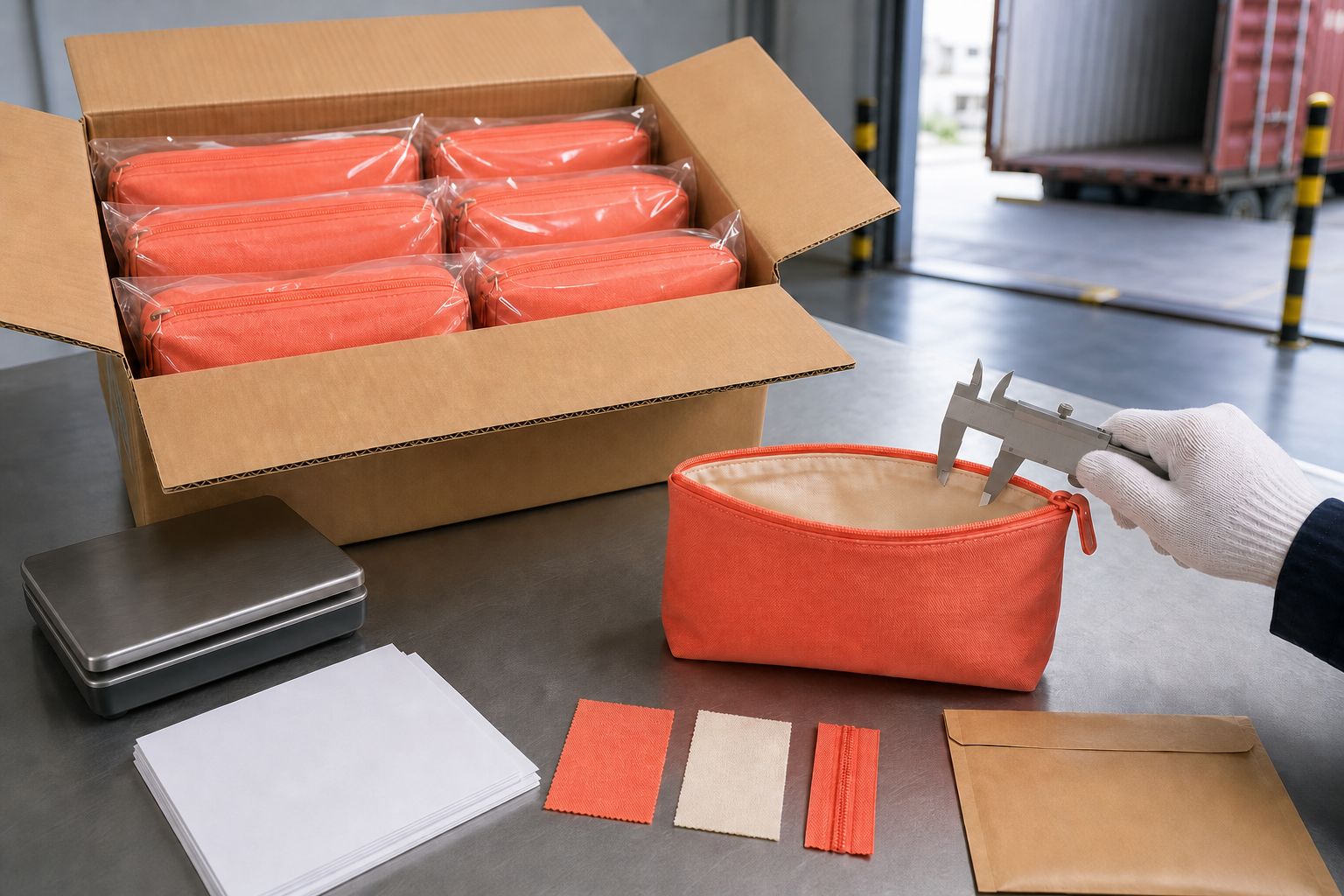
Use the cosmetic bag QC framework to define defect and function checks while adding the import-specific fields below.
| Import-facing check | Evidence | Release condition |
|---|---|---|
| Product identity | Construction, materials, intended use and SKU | Matches broker/compliance file |
| Labels/marks | Version, wording, language, placement and permanence | Matches market approval |
| Lot/testing link | Bulk material/supplier/color and report scope | No unassessed substitution |
| Carton facts | Count, size,net/gross weight and marks | Reconciles to draft shipping records |
| Shipment appearance | Packing, moisture, odor, surface and closure | Goods remain saleable after route |
20. Make test reports traceable to production
A test report is useful only when the tested sample represents the shipped product and applicable rule. Record manufacturer, style, material supplier/article, color, components, sample date and production relationship. If the factory changes coating, zipper, print ink or recycled supplier after testing, assess whether new evidence is required. Select a risk-based scope with our cosmetic bag testing guide.
| Traceability field | Report/import file link | Change trigger |
|---|---|---|
| Style/SKU | Drawing, photos and BOM revision | New construction or user group |
| Material article | Supplier, composition, finish and lot/color | Supplier/coating/composition change |
| Branding | Ink/transfer/thread/process | Method, formula or coverage change |
| Hardware | Part,material and plating | New component supplier/finish |
| Production coverage | How the sample represents bulk | Unapproved substitution or rule update |
21. Reconcile color and material approvals with import descriptions
A new color can mean a new dye, print ink, coating or supplier lot. It may not change classification, but it can change test coverage or restricted-substance evidence. Maintain the signed color/material trail described in our lab-dip and bulk-color approval guide, then update the compliance matrix when the process—not just appearance—changes.
| Change | Customs review | Compliance review |
|---|---|---|
| Color only, same proven article/process | Usually description facts remain,broker confirms | Assess color/chemical test coverage |
| New coating/lamination | External surface/material facts may change | Reassess chemical and performance evidence |
| New recycled supplier | Verify material identity | Rebuild sourcing and test traceability |
| New print/transfer | Product identity normally still truthful | Assess ink/adhesive and claim impact |
22. Control carton data before booking freight
Soft cosmetic bags can be folded, nested or shape-supported, so freight cube depends on the approved packed state. Measure closed external cartons, actual gross weight and verified count. Do not quote freight from an early sample with different stuffing. Tie the booking, packing list and final inspection to the same case specification.
When the bag is part of a beauty set, also use our beauty-brand packaging architecture guide and the cosmetic bag size/capacity method to prevent the filled payload changing the entry or transport plan late.
| Freight datum | Source | Cross-check |
|---|---|---|
| Units/case | Approved visual packing instruction | Inspection count and gross weight |
| External case size | Closed production carton | Booking and packing list |
| Net/gross weight | Defined scale and tare basis | Carrier limits and declaration |
| Total cases/CBM | Final SKU quantity and measured carton | Invoice, booking and transport document |
| Marks/seals | Approved shipping instruction | Actual dispatch photos |
23. Select freight by service requirements, not habit
Courier may suit a small sample, air freight a time-sensitive launch and ocean freight a high-volume order, but chargeable weight, route, transshipment, congestion, dangerous-goods status, insurance and destination handling change the answer. Obtain comparable door/port scopes with validity and exclusions. A low headline rate is not useful when destination charges or storage exposure are unclear.
| Mode | Strong use | Cosmetic-bag watchpoint |
|---|---|---|
| Courier/express | Samples and very small urgent orders | Dimensional rating and simplified-entry limits/rules |
| Air freight | Launch-critical commercial quantities | Cube,airport handling and any filled-set restrictions |
| Ocean LCL | Moderate volume below full container | Consolidation handling and destination minimum charges |
| Ocean FCL | Large stable volume | Container utilization, moisture and seal/load plan |
| Rail/road combinations | Route-specific alternatives | Borders, service consistency and final delivery scope |
24. Build the shipping calendar around document gates
“Production complete” is not “cargo ready to clear.” Allow time for inspection correction, test completion, label approval, carton verification, draft document review, booking, cut-off, pickup and destination pre-alert. Schedule the project using our cosmetic bag MOQ and timing guide, then add the import gates owned by broker, forwarder and importer.
| Milestone | Release evidence | Delay risk |
|---|---|---|
| Specification locked | Identity/BOM/label/compliance matrix | Classification and testing remain uncertain |
| Bulk ready | Production complete and documents drafted | Inspection finds material/label change |
| Shipment released | Inspection accepted and export/import files aligned | Cargo moves before correction |
| Carrier cut-off | Booking, pickup,verified weight/cube and documents | Roll to later service |
| Arrival/entry | Pre-alert, broker instructions and funds/bond as required | Storage/demurrage/exam delay |
25. Prepare for customs questions and inspections
Authorities may request entry documents, material detail, value support, origin evidence, samples, markings or other-agency records. Respond through the broker with consistent facts. Keep the factory available to answer technical questions and preserve production records. Do not create new descriptions after arrival that contradict the purchase order, website or lab reports.
| Possible query | Prepared evidence | Internal owner |
|---|---|---|
| What is the article? | Identity sheet, photos, sample and sales use | Product/technical lead |
| What is it made of? | BOM, layer stack and supplier specifications | Sourcing/quality |
| How was value declared? | PO, payments, invoice,assists/adjustments review | Finance/customs |
| Where did it originate? | Manufacturing facts and required origin proof | Supplier/customs |
| Can it be sold? | Applicable product file, labels and responsible-operator records | Compliance/legal |
26. Calculate landed cost with destination facts
Landed cost includes more than factory price and main freight. Model sampling/tooling allocation, unit packing, inland origin charges, export handling, freight, insurance, destination handling, customs entry, duties, nonrecoverable taxes/fees, inspection, storage risk and final delivery. Confirm which amounts are recoverable or excluded by accounting/tax advice.
Start with our custom cosmetic bag cost breakdown and apply the quality-preserving cost-reduction method before removing inspection or compliance work.
| Landed-cost layer | Input | Owner/source |
|---|---|---|
| Goods/development | Production, samples, tooling, testing and packing | Factory, lab and buyer |
| Origin logistics | Pickup, export handling, documents and terminal | Forwarder/exporter |
| Main carriage | Freight, surcharges and insurance scope | Forwarder/insurer |
| Import | Entry, duty, tax,fees and other-agency services | Broker/tax adviser |
| Destination | Handling, storage, exam, delivery and receiving | Forwarder/warehouse |
| Risk reserve | Delay, reinspection, correction and damage basis | Buyer using actual history |
27. Keep records and control changes after entry
Retain records for the period and format required by the destination. Link customs entries, invoices, classification basis, origin, test/compliance file, approved sample, production lot and sales SKU. If a coating, supplier, label, user group or claim changes, trigger a documented reassessment before the next shipment. Repeatability is more valuable than solving every import from scratch.
| Record family | Link | Change-control use |
|---|---|---|
| Customs | Entry, code, value, origin, duty/tax and broker advice | Compare new construction/market |
| Product | Tech pack, BOM, approved sample and photos | Detect material/feature drift |
| Compliance | Matrix, reports, declarations, labels and lot | Assess rule/supplier/process change |
| Shipment | Invoice, packing list,transport and inspection | Reconcile repeat orders |
| Post-market | Complaints, returns, corrective action and traceability | Update risk/test/inspection plan |
Official import portals to check before ordering
Rules and digital filing systems change. Use current government or intergovernmental sources for the destination rather than relying on a supplier’s old template. The table below is a starting point, not an exhaustive legal list.
| Destination/topic | Official starting point | Use |
|---|---|---|
| United States | U.S. Customs and Border Protection importing guide | Entry, invoice, classification, value, marking and other-agency overview |
| European Union | European Commission Access2Markets entry point | Tariffs, origin, taxes, procedures and product requirements |
| United Kingdom | GOV.UK import goods step-by-step | Commodity code, customs value, declaration and licences/certificates |
| Canada | CBSA commercial imports portal | Importer preparation, classification, origin, duties/taxes and records |
| Trade terms | ICC Incoterms 2020 | Official rule set for allocating defined delivery, risk, cost and obligations |
Official-source check: The destination portals above were reviewed on 14 September 2026. Customs and product requirements can change; use the current authority page and obtain destination-specific advice from the importer, broker and relevant compliance specialist before ordering or shipping.
Why choose LUCKYSTAR when importing custom cosmetic bags?
LUCKYSTAR helps buyers build a production file that can also support broker, compliance and inspection review. We can identify outer and lining materials, document the component stack, develop samples, coordinate labels and packing, maintain approved references and provide shipment data from the actual order. Clear factory records give the importer’s local advisers better facts to work with.
During bulk production, product identity, material approvals, inspection findings, carton counts, weights and images can be tied to the shipment release. LUCKYSTAR does not replace the importer’s customs broker, legal adviser or responsible economic operator; our role is to make the manufacturing evidence accurate, organized and traceable. Browse the complete Product Range or review our cosmetic bag manufacturing capabilities.
| LUCKYSTAR workstream | Deliverable | Importer benefit |
|---|---|---|
| Construction identity | Materials, layers, dimensions, photos and BOM | Broker receives specific facts |
| Controlled development | Samples,comments and production-intent approvals | Test and compliance files match the intended bag |
| Label/claim coordination | Buyer-approved artwork placed on actual construction | Market decisions become repeatable instructions |
| Pre-shipment evidence | Inspection, packing, carton and shipment records | Documents can be checked before cargo moves |
| Change traceability | Material/lot/version references | Importer can reassess real changes |
Project note: Available material records, sample traceability, label review, packing data, inspection documents and third-party test coordination depend on the selected construction, production lot, destination requirements, service scope and written order specification. The importer and its appointed advisers remain responsible for destination classification, entry, tax and legal decisions.
Import-ready RFQ checklist
| RFQ field | Information to send |
|---|---|
| Market | Destination, importing entity, channel and intended user |
| Shipment form | Empty bag, accessories or filled beauty set |
| Construction | Outer/lining materials, coatings, reinforcement, zipper, hardware and features |
| Branding/labels | Authorized artwork, origin/traceability fields, languages and claims |
| Compliance file | Buyer’s applicable-requirement matrix,test scope and approval gates |
| Inspection | Sampling, defects, function, label and import-facing checks |
| Packing/logistics | Individual pack, units/carton, dimension/weight limits and route |
| Commercial terms | Quantity/SKUs, target basis, trade rule/named place, required documents and date |
Frequently asked questions
What HS code applies to cosmetic bags?
There is no safe universal answer. Classification depends on actual materials, external surface, construction, function, set status and the destination tariff schedule. Give a qualified broker the full identity file and retain the basis or ruling.
Do empty cosmetic bags need an import licence?
That depends on destination, product characteristics, intended user and any special materials or claims. The importing business may still need customs/tax registrations even when no product-specific licence applies. Check official portals and local advisers before ordering.
Is an empty cosmetic bag regulated like cosmetics?
Normally the empty organizer and the cosmetic formula are different products, but exact rules depend on market and claims. When the bag is imported filled, coordinate requirements for every item and the set with cosmetics specialists.
Can LUCKYSTAR provide the customs code?
We can provide construction, material, use, photos and other facts needed for review. The importer and its qualified destination broker should determine and own the entry classification under local rules.
Should I buy FOB or DDP?
Choose a trade structure only after validating the named place, importer eligibility, customs/tax role, transport control and exclusions. A DDP price is not automatically lower risk, and an FOB arrangement is not automatically better for every mode or buyer.
Which documents are normally required?
Commercial invoice, packing list and transport document are common. Origin, insurance, inspection, compliance, licence or other documents depend on destination, product and contract. Obtain a shipment-specific matrix from the importer and broker.
When should the customs broker review the bag?
Before the purchase order when classification, marking, value or other measures are uncertain—and again before shipment using the final construction, invoice and packing data.
What is the biggest difference between importing samples and bulk?
Bulk adds production-lot traceability, commercial quantities, final carton data, full document reconciliation and greater consequence if product or compliance evidence is wrong. Samples must still be described and valued truthfully.
Make the manufacturing file customs-ready
To Import Custom Cosmetic Bags from China reliably, start with the exact product rather than a generic shipping quote. Classification, labels, compliance, testing, inspection, documents and landed cost should all describe the same bag and the same shipment. Strong Cosmetic Bag Import Compliance is a chain of consistent facts, not a folder of unrelated certificates.
Use the manufacturer-selection checklist for cosmetic bag buyers to test a supplier’s documentation discipline. For broader product-development and supplier-control strategy, revisit our custom-bag manufacturing pillar.
To develop an import-ready production file, request a tailored quotation from LUCKYSTAR with your destination, importer/channel, construction, quantity, claims, test matrix, packing route and required delivery date.

Request an import-file readiness review
Send the destination and importer, exact construction and materials, intended user and channel, shipment contents, labels and claims, buyer-required evidence, quantity and value basis, trade term with named place, route, broker or forwarder constraints and required date.
Send your project details through the contact form, or Email a project brief with this guide already referenced. The email link opens a draft for your review before sending.
Product identity, material records, labels, samples, tests, inspection, documents, packaging, MOQ, price, schedule and delivery scope are subject to specification and written confirmation. Classification, entry, duties, taxes and destination compliance must be confirmed by the importer and qualified local advisers.