A cosmetic bag can be inexpensive to manufacture and expensive to ship. A few millimeters of unnecessary packed depth, multiplied across thousands of units, can add cartons, pallet positions and cubic meters. The opposite mistake is just as costly: compressing a structured bag too hard can crease PU, deform piping, trap a zipper slider or leave the customer with a product that never recovers its intended shape.
Planning an order? Send the packed-state and route details already known. Include bag construction and dimensions, individual protection, acceptable fold and recovery limits, quantity by SKU, preferred case count, logistics route, forwarder rules, destination and required date.
This guide treats Custom Cosmetic Bag Packaging as a logistics-engineering problem. It focuses on the state of the empty bag after folding or shaping, the orientation and quantity inside the master carton, transport protection, cube and weight, and the instructions needed to repeat the solution in bulk. For retail presentation, information hierarchy and filled beauty-set architecture, use our separate guide to beauty-brand presentation packaging. Explore LUCKYSTAR’s custom cosmetic bags, apply these factory-selection criteria for cosmetic bags, and place logistics within our manufacturer sourcing pillar.
Quick answer: optimize with physical pack-out trials
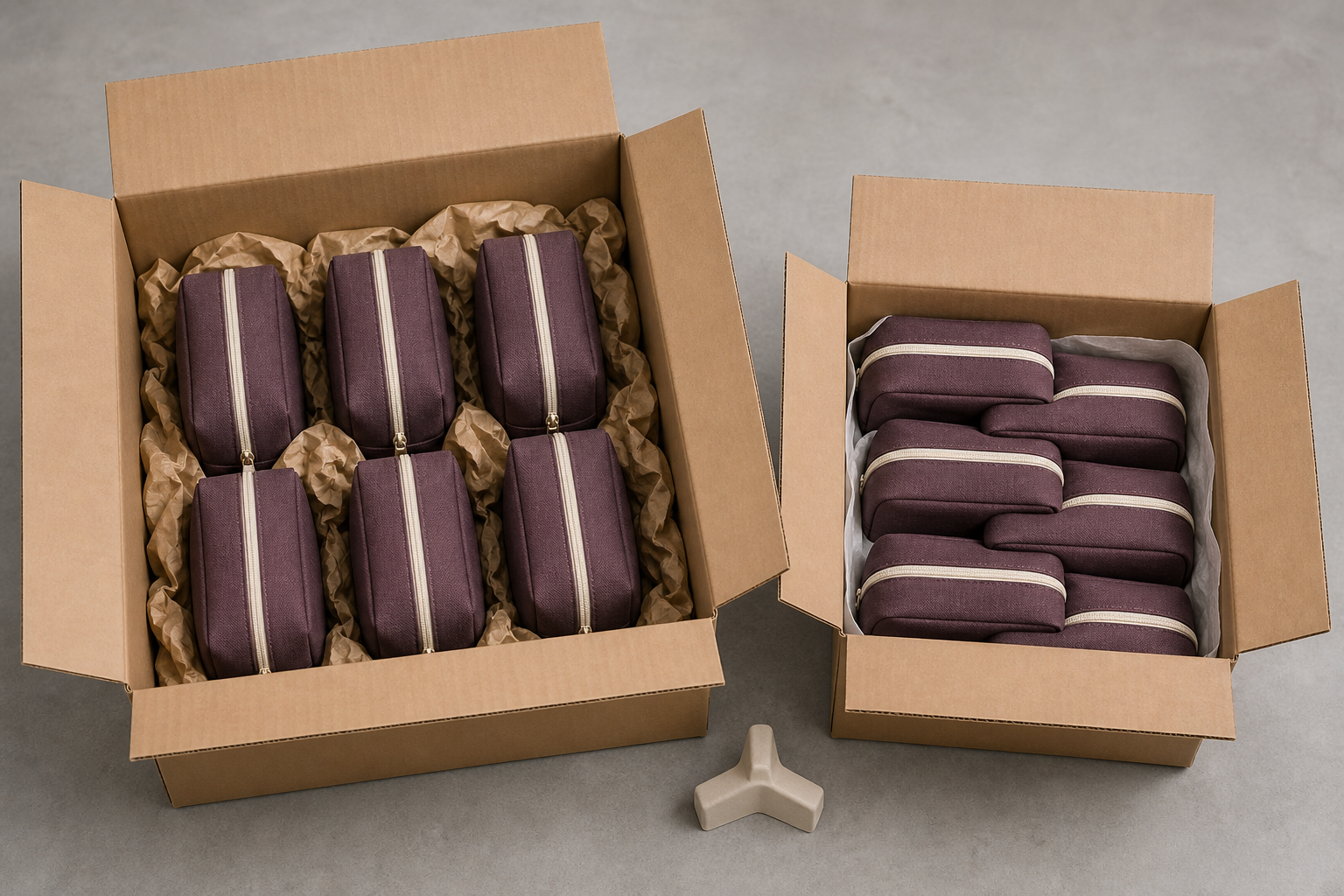
Freeze the production bag and its individual protection, let the packed unit settle, then measure that state rather than relying on nominal bag dimensions. Test several orientations and quantities in real cartons. Compare cube, gross weight, void, shape recovery, surface condition and packing-line speed. Choose the smallest configuration that survives the intended handling route without forcing the product into damaging compression.
| Decision | Evidence | Approval question |
|---|---|---|
| Unit-packed state | Production-intent bag, protection and folding method | Does the bag recover without marks or distortion? |
| Case orientation | Physical grid trials in candidate cartons | Does nesting reduce cube without creating pressure points? |
| Carton specification | Gross weight, route,stack and handling tests | Does the case protect its load through distribution? |
| Bulk release | Pack-out SOP, first carton and QC references | Can operators repeat the approved configuration? |
1. Separate product size, unit-pack size and carton size
Three dimensions matter. Product dimensions describe the finished bag at defined points of measure. Unit-pack dimensions describe the bag after any flattening, folding, shaping insert, protective sleeve or tag is applied. Carton dimensions describe the closed case, preferably as external shipping dimensions when calculating cube. Mixing these states creates inaccurate freight estimates and cartons that fit on paper but not on the line.
| Dimension state | Includes | Used for |
|---|---|---|
| Finished product | Bag shell, structure, handle and hardware in normal form | Product approval and consumer capacity |
| Settled unit pack | Approved fold, tissue/support, sleeve, tag and closure position | Carton-grid development |
| Carton internal | Usable cavity after board, flaps and liners | Physical fit and clearances |
| Carton external | Closed outside length,width and height | CBM, storage, pallet and carrier rating |
2. Freeze the packed unit before optimizing the carton
Do not design the case around an early shell sample if the bulk bag will use different foam, piping, handles, zipper pullers or inner dividers. These details change compressibility and settled thickness. Likewise, a loose poly sleeve, paper band or tissue support can alter the footprint. Approve a “packing master” that shows exactly how one unit leaves the packing station.
Use our sample-development workflow to schedule this gate after construction is stable but before cartons are purchased in bulk.
| Packing-master element | Specify | Why it changes the carton |
|---|---|---|
| Bag condition | Empty, filled, expanded, flattened or partially supported | Defines thickness and shape recovery |
| Zipper/handle position | Closed path, slider location and handle fold | Prevents hard parts stacking at one point |
| Individual protection | Sleeve, tissue,interleaf or paper wrap | Adds footprint and surface friction |
| Shape support | Insert type, amount and placement | Controls recovery but consumes cube |
| Labels/tags | Attachment and protected position | Loose elements can snag or bend |
3. Choose compression according to bag structure
A flat pouch can often travel with little air and recover quickly. A padded box bag may accept controlled nesting but show panel impressions if stacked heavily. A train case with foam, piping and a handle may require shape support and larger cube. Review our comparison of flat pouches, box bags and train cases before setting one packing rule across a collection.
| Bag structure | Packing potential | Compression risk | Recovery check |
|---|---|---|---|
| Soft flat pouch | High; can layer efficiently | Zipper/puller prints or fold lines | Panel lies smooth after normal opening |
| Soft box bag | Moderate; gussets may fold inward | Corner memory and uneven gusset recovery | Base opens square without forcing |
| Padded organizer | Moderate to low | Foam set, pocket/elastic impressions | Surfaces and internal features rebound |
| Structured train case | Low unless construction is designed to nest | Piping, lid and handle deformation | Lid alignment and standing shape remain approved |
4. Protect shape without paying to ship unnecessary air
Shape support should target collapse-sensitive areas. A small folded paper bridge may support a lid more efficiently than filling the entire cavity with tissue. An insert around a metal puller may prevent marking without propping open the whole bag. Test the minimum support that maintains recovery, and remove loose fill that merely makes the pack look full.
| Support method | Useful for | Optimization question |
|---|---|---|
| Targeted paper bridge | Lid,top panel or handle clearance | Can a smaller shape support the critical span? |
| Flat interleaf | Separating hardware and coated faces | Does it prevent rub without adding thickness? |
| Internal form | Highly structured premium cases | Is full-volume support commercially necessary? |
| No filler | Resilient soft pouches | Does the bag pass recovery and appearance checks? |
5. Fold at safe zones
A fold should follow a flexible gusset or designed hinge, not cross a logo, bonded seam, rigid divider, heat-transfer motif, piping corner or coated surface prone to creasing. Mark fold lines and sequence in the packing instruction. Let the packed unit remain under normal carton pressure for a realistic period, then unpack and condition it before judging residual lines.
Confirm that folds do not trap or distort interior features covered in the Cosmetic Bag Compartments and Brush Holders guide.
| Potential fold zone | Usually safer | Avoid crossing |
|---|---|---|
| Soft empty gusset | Yes, when seam direction supports it | Bound edge or rigid corner |
| Main logo panel | No | Print,embroidery or badge area |
| Lid/body hinge | Only along intended movement line | Zipper coil and piping convergence |
| Padded base | Usually no | Foam stack and stabilizer |
| Handle | Fold at approved soft attachment direction | Hardware, reinforcement and edge paint |
6. Use nesting and alternating orientation deliberately
Two bags may nest when a handle, gusset or sloped lid occupies the empty space of its neighbor. Alternating zipper directions can distribute puller thickness instead of creating one hard column. Head-to-tail placement can level an asymmetrical profile. These methods only work when operators can identify the orientation quickly and when contact surfaces do not rub or transfer.
| Layout technique | Potential gain | Risk to test |
|---|---|---|
| Alternating zipper direction | Spreads slider/puller thickness | Metal contact with neighboring face |
| Head-to-tail nesting | Balances a tapered or handled profile | Operator reverses pattern mid-carton |
| Horizontal layers | Stable load and simple counting | Bottom layer carries too much pressure |
| Vertical cells | Easy unit removal and less layer pressure | More unused height or tipping |
| Nested handles/gussets | Reduces irregular void | Permanent bend or abrasion |
7. Measure settled packed dimensions
Soft goods move after packing. Measure a single unit immediately, after a defined settling interval and under the light restraint that represents a carton layer. Repeat across several production-intent units, because stuffing amount, foam and sewing can change thickness. Use the maximum practical stack height from the trial rather than multiplying one optimistic unit measurement.
Our size and usable-capacity guide establishes product dimensions; carton work needs an additional settled-pack measurement plan.
| Measurement | Method | Why single-unit math fails |
|---|---|---|
| Packed length/width | Measure widest settled footprint | Sleeves and folded handles project beyond shell |
| Single packed depth | Use light repeatable restraint, not hand squeezing | Operator force is inconsistent |
| Layer height | Measure actual stack of planned quantity | Soft units do not add linearly |
| Recovery | Unpack,condition and compare with master | Compact fit may create permanent set |
8. Search multiple carton grids
Do not stop at the first arrangement that closes. For a rectangular packed unit, trial different counts along length, width and height, plus rotations and alternating patterns. Add realistic clearances for the inner case, divider and loading action. A mathematically dense grid may be slow to pack or impossible to unload without pulling the carton apart.
| Grid option | Physical trial | Decision factor |
|---|---|---|
| Long side along carton length | Standard aligned rows | Simple,but may leave narrow unusable strip |
| Units rotated 90° | Recompute row/column count | May reduce one dimension and increase another |
| Mixed rotation | Fill edge or center gaps with rotated units | Packing instruction becomes more complex |
| Alternating profile | Pair thick and thin ends | Best for asymmetrical bags |
| Different units per carton | Compare 6, 8, 10, 12 or route-appropriate counts | Cube, gross weight and handling trade off |
9. Calculate CBM from the closed external carton
For a rectangular case measured in meters, carton cubic volume is external length × width × height. Total shipment CBM is carton volume × carton count.Use closed external dimensions, not the nominal inner size or an open sample with flaps raised. Confirm how the forwarder rounds dimensions and shipment volume.
| Calculation | Formula | Use |
|---|---|---|
| Carton CBM | External L(m) × W(m) × H(m) | Compare candidate case sizes |
| Shipment CBM | Carton CBM × number of cartons | Freight planning and consolidation |
| Units per m³ | Units per carton ÷ carton CBM | Normalize layouts with different case counts |
| CBM per 1,000 units | 1,000 ÷ units per m³ | Quote-level logistics comparison |
10. Use a carton example—but validate it physically
Assume a settled unit is approximately 22 × 14 × 6 cm. A nominal 3 × 2 × 2 aligned grid suggests 12 units in an internal space near 66 × 28 × 12 cm before working clearances. A 2 × 2 × 3 grid suggests roughly 44 × 28 × 18 cm. The second shape may have lower external cube after board and clearance, but it puts more layers on the bottom. This is a search prompt, not a production answer.
| Illustrative option | Nominal internal grid | Potential advantage | Trial risk |
|---|---|---|---|
| 3 × 2 × 2 | 66 × 28 × 12 cm | Low stack height | Long carton may waste pallet/parcel space |
| 2 × 2 × 3 | 44 × 28 × 18 cm | More compact footprint | Greater pressure on lower layer |
| Alternating nested grid | Determined by physical pair/stack | Can reduce effective depth | Harder packing sequence |
11. Track void as a diagnostic, not a universal target
A simple void ratio can compare box-shaped approximations: 1 minus total packed-unit volume divided by carton internal volume. Soft bags are irregular, so the number is only a diagnostic. Some clearance is necessary for loading, shape recovery and impact management. A very low void ratio can indicate excellent nesting—or excessive compression. Pair the calculation with physical inspection.
| Observation | Possible meaning | Next check |
|---|---|---|
| Large side gap | Grid/carton mismatch | Rotate units or revise case width |
| Large top gap | Wrong layer count or excess carton height | Check compression limit and smaller height |
| No hand clearance | Over-optimized fit | Time loading/unloading and inspect abrasion |
| Carton bulges after close | Load exceeds usable cavity | Increase case or reduce unit count/compression |
| Units move freely | Insufficient restraint or unstable orientation | Add efficient divider/adjust grid |
12. Compare actual and dimensional weight
Parcel and air services may rate a shipment by the greater of actual weight and a dimensional or volumetric weight derived from carton dimensions. Divisors and rules differ by carrier, service and route, so do not hard-code one value into a sourcing template. Ask the logistics provider for the current method, then compare candidate cartons with identical units and protection.
| Rating input | Source | Optimization lever |
|---|---|---|
| Actual gross weight | Packed carton scale | Remove redundant materials without weakening protection |
| External dimensions | Closed carton measurement | Nesting, grid,count and case right-sizing |
| Carrier divisor/rule | Current service quotation | Select route/service using real commercial data |
| Chargeable weight | Carrier compares actual and dimensional basis | Focus effort on the controlling value |
13. Set carton quantity from cube, weight and handling
A larger case may improve units per carton but become difficult to lift, stack, count or inspect. A smaller one may increase carton count, tape and paperwork. Determine the acceptable gross-weight range with the buyer, warehouse and carrier instead of assuming a universal lifting limit. Also check destination carton-count preferences and whether inner packs are required.
| Quantity factor | Favors fewer/larger cartons | Favors more/smaller cartons |
|---|---|---|
| Unit cube | Efficient large grid available | Irregular shape needs careful restraint |
| Unit weight | Very light empty pouches | Filled sets or heavy structure |
| Warehouse handling | Equipment and stable pallet flow | Frequent manual case handling |
| Order picking | Full-carton distribution | Small destination allocations |
| Damage containment | Proven strong case and stable route | Limit exposure per damaged carton |
14. Specify corrugated performance from the route
Board grade should follow load, dimensions, humidity exposure, stack duration, pallet pattern and handling route. Flute profile and paper combination affect compression, puncture, print surface and thickness. Do not copy a board description from an unrelated product or treat a heavier board as automatically better; extra thickness can reduce internal space and increase weight without addressing the actual failure mode.
| Carton input | Why it matters | Evidence |
|---|---|---|
| Gross load | Bottom,sidewall and handling stress | Packed production-weight case |
| Case geometry | Tall/narrow and long/shallow cases behave differently | Closed external and internal dimensions |
| Stack/pallet pattern | Loads may align with or bridge case walls | Planned distribution configuration |
| Environment | Moisture and time reduce performance | Route/storage conditions |
| Handling hazards | Drops, impacts and puncture differ by channel | Risk-based trial method |
15. Protect surfaces, zippers and hardware efficiently
Hard components should not repeat in one pressure column.Rotate slider locations, cover sharp pullers and prevent plated parts from rubbing coated fabric. A thin interleaf at the exact contact zone may replace a full extra bag or thick wrap. Review the component decisions in our zipper and hardware selection guide and check surface sensitivity through the custom cosmetic bag material guide.
| Contact risk | Efficient control | Verification |
|---|---|---|
| Puller to coated face | Alternate direction or local sleeve/interleaf | Pressure-hold and rub inspection |
| Zipper coil to logo | Orient away or use flat separator | Unpack after transport trial |
| Handle hardware to edge | Dedicated recess or folded protection | Check edge paint/plating marks |
| Rough carton wall to fabric | Clean sleeve or case liner only if needed | Abrasion and contamination review |
| Color transfer | Compatible surfaces and separation | Contact/migration check based on risk |
16. Control moisture, odor and cleanliness by risk
Cartons and bags should be dry and conditioned before sealing. Protective film can trap odor or moisture when goods are packed too soon after coating, printing or cleaning. Desiccant, vent holes or barrier liners are not automatic solutions; type, quantity, placement, destination rules and safety requirements need qualified review. A clean, dry production and storage process is the starting point.
For bags intended to manage spills during use, consult Waterproof Cosmetic Bag Manufacturing; transit moisture control is a separate packaging problem.
| Risk | Control question | Avoid |
|---|---|---|
| Residual production odor | Was adequate airing/conditioning completed? | Sealing freshly processed goods immediately |
| Moisture ingress | What route,season and storage exposure apply? | Generic desiccant without calculation/control |
| Dust/debris | Are carton and packing station clean? | Loose dusty void fill against fabric |
| Condensation | Are material and environment dry before sealing? | Barrier wrap around damp units |
17. Design closure and opening to avoid damage
Carton flaps should close without pushing into the top layer. Tape or staples must not contact the product when the case is opened. Provide cutting protection or an opening method if a blade could slice the cosmetic bags beneath the seam. Confirm that bulging does not transfer constant load into a zipper or piping edge.
| Closure point | Risk | Control |
|---|---|---|
| Top headspace | Flap presses or cuts into unit | Approved clearance or flat top pad |
| Tape seam | Weak seal or product catches adhesive | Defined tape,length and application |
| Opening blade path | Bags cut during receiving | Inner guard or controlled opening instruction |
| Bottom closure | Load loss or protruding fastener | Route-appropriate seal and inspection |
18. Verify stack compression with the real pack
Carton strength cannot be separated from contents. Soft bags may not support the top panel, leaving case walls to carry most of the stack. Conversely, overfilled cases can bulge and reduce column alignment. Test production-intent cartons at representative gross weight, closure, environmental condition, stacking pattern and duration. After unloading, inspect both cases and bag recovery.
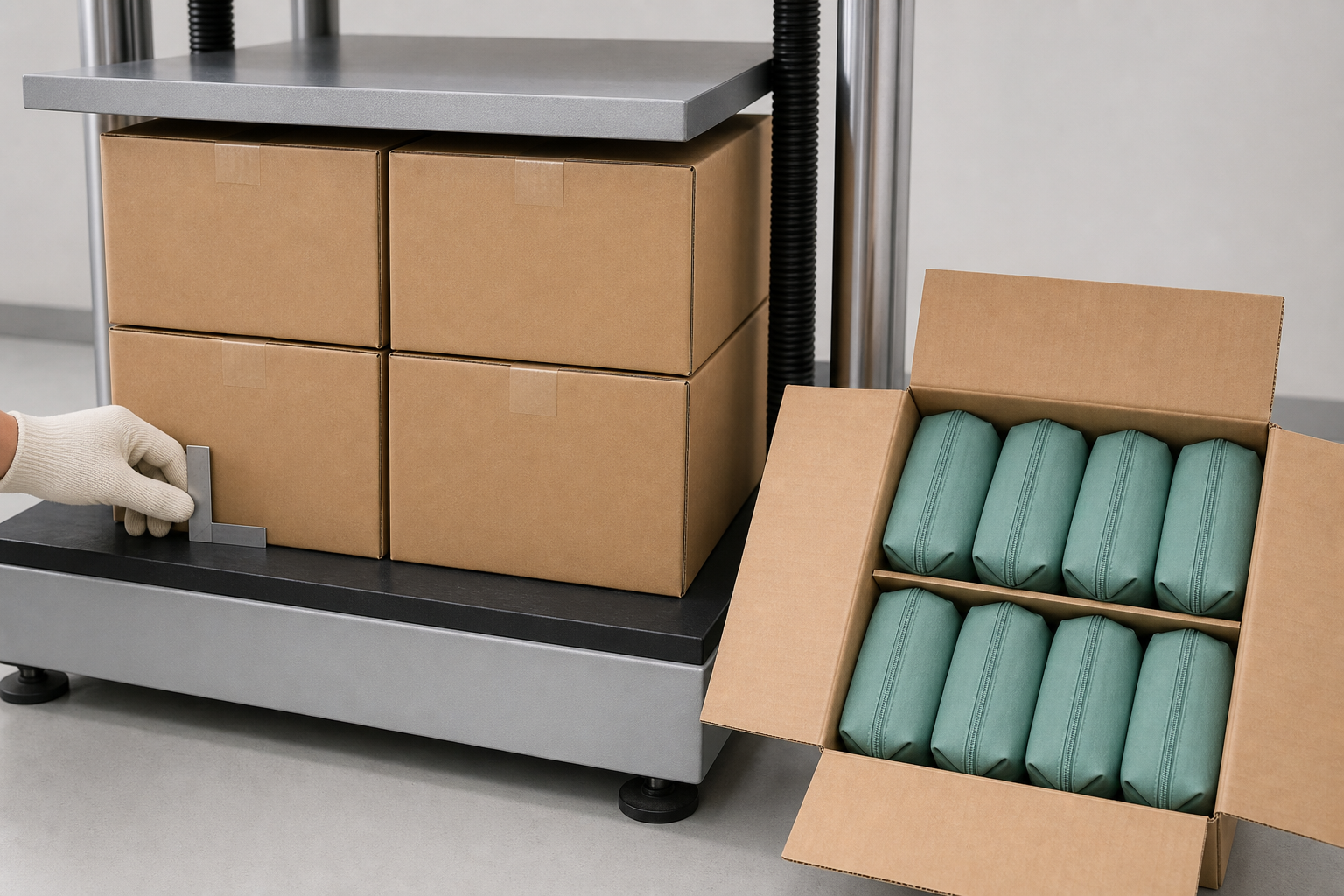
| Compression trial record | What to document | Post-trial check |
|---|---|---|
| Case configuration | Board, dimensions, closure, unit count and gross weight | Panel bow, corner crush and seal condition |
| Load/stack | Applied load, alignment,pattern and duration | Residual case deformation |
| Environment | Conditioning and humidity/temperature if controlled | Performance under relevant exposure |
| Product result | Immediate and conditioned unpacking photos | Creases, impressions, zipper and shape recovery |
19. Combine drop, vibration and handling checks
A case that survives vertical compression may fail when dropped on a corner. A tight grid may prevent movement but transmit impact directly; a loose grid may allow bags to abrade through repeated vibration. Select trials based on distribution channel, weight, geometry and product sensitivity. Our risk-based bag-testing framework helps separate relevant evidence from generic test collecting.
| Hazard | What it reveals | Inspect after trial |
|---|---|---|
| Corner/edge/face impact | Case and load response to handling drops | Corner collapse, unit shift and hard-part marking |
| Vibration | Long-duration movement and abrasion | Surface rub, tag damage and divider migration |
| Stack load | Warehouse/transport compression | Case bow and bag set |
| Manual handling trial | Lift, count,opening and repacking practicality | Ergonomic problem and pack inconsistency |
20. Check pallet, container and shelf interfaces
Carton optimization should not end at the individual case. Case dimensions interact with pallet footprint, overhang, column alignment, container or truck loading, warehouse racking and destination shelf. A tiny CBM reduction that creates severe pallet overhang may be a poor trade. Ask the logistics team for the actual unit-load and route constraints before freezing the case.
The broader import sequence in How to Import Custom Bags from China can help position carton data within booking, documents and receiving planning.
| Interface | Check | Possible conflict |
|---|---|---|
| Pallet | Footprint utilization, overhang and stack alignment | Efficient carton alone creates unstable unit load |
| Container/truck | Load plan, route restrictions and residual space | Carton orientation wastes transport height |
| Warehouse rack | Case dimensions,weight and handling method | Carton does not suit storage/picking flow |
| Retail/DC receiving | Case quantity and opening/counting preference | Good freight cube slows downstream operation |
21. Write a visual packing SOP
Carton efficiency disappears when operators choose their own fold, direction or layer count. Use numbered or diagrammed steps showing bag condition, zipper position, interleaf, orientation, rows, layers, divider, top pad and seal. Keep language simple and validate the instruction with someone who did not participate in development. Record a finished first carton with count and weight.
| SOP step | Instruction | Control point |
|---|---|---|
| Prepare unit | Close, fold, support and protect to master | No extra stuffing or forced flattening |
| Build first layer | Start corner and follow direction pattern | Correct count and puller orientation |
| Add separator | Place defined sheet/divider only | Flat,clean and correctly sized |
| Complete layers | Repeat sequence without exceeding line | No bulge or unstable top surface |
| Close and verify | Seal, weigh, measure and mark | Count, gross weight and closed dimensions |
22. Run a pilot packing trial
Pack several cartons at production pace, not one carefully arranged sample. Time the steps, observe variation between operators, measure external cases, weigh them and unpack after conditioning. The trial should reveal whether tight clearances slow the line, whether the last layer differs from the first, and whether the written count is physically repeatable.
Put carton dimensions, materials and packing references into the cosmetic bag tech-pack file as controlled specifications rather than informal shipping notes.
| Pilot metric | What to compare | Reason |
|---|---|---|
| Pack time/carton | Operators and candidate layouts | Dense pattern may add labor |
| Closed dimensions | Case-to-case and against specification | Bulge changes cube and stack |
| Gross weight | Expected range and counts | Detect count/protection inconsistency |
| Recovery/appearance | Immediate versus conditioned unpack | Find compression memory |
| Error rate | Orientation, count, divider and labels | Complex layout may be fragile in bulk |
23. Compare total landed effect, not carton price alone
A stronger or smaller carton may cost more per piece and still reduce total cost by lowering damage, void fill, carton count, CBM or chargeable weight. A cheaper case may create rework and claims. Build a comparison that includes unit protection, packing labor, case materials, freight basis, storage and observed damage—not speculative savings.
Use our 2026 cosmetic bag cost breakdown for the product cost structure and the quality-preserving cost reduction guide before removing protection.
| Cost line | Baseline | Optimized candidate | Evidence |
|---|---|---|---|
| Individual protection | Current material and labor | Targeted protection only | Surface trial |
| Carton/divider/tape | Per-case × carton count | Revised specification/count | Supplier quotation |
| Packing labor | Timed current method | Timed pilot method | Pilot cartons |
| Freight/storage cube | Measured external CBM | Measured external CBM | Route quotation |
| Damage/rework | Observed rate/cost | Trial and early-run result | Inspection/claims data |
24. Align carton development with MOQ and lead time
Custom case dimensions, printed markings, dividers and shaped inserts may have different minimums and sampling lead times. If the bag changes late, carton tooling, material consumption or pack count may also change. Build the pack trial into the calendar before booking freight. The Cosmetic Bag MOQ and Production Time guide helps buyers reserve time for these connected approvals.
| Change | Carton consequence | Schedule control |
|---|---|---|
| Bag structure/foam | Settled depth and recovery change | Repack before carton PO |
| Handle/hardware | Orientation and protection change | Use production-intent components in trial |
| Individual sleeve/tag | Footprint or friction changes | Freeze packaging BOM before grid sign-off |
| Units per case | Dimensions,weight and markings change | Notify logistics and destination teams |
| Artwork/market | Case printing/label inventory risk | Separate common case from variable label where approved |
25. Reduce packaging material without increasing damage
Material reduction is credible when the approved job is maintained. A smaller carton, fewer redundant inserts, shared case sizes and targeted interleaves can reduce material and transport volume. Avoid broad environmental claims based only on a lower gram count. Consider protection, damage, reusability, recyclability by destination, ink/adhesive choices and the product’s actual transport route.
| Reduction idea | Potential benefit | Required evidence |
|---|---|---|
| Right-size master carton | Less board and shipping cube | Compression,handling and recovery trial |
| Remove redundant full-volume stuffing | Less material and labor | Shape and surface remain approved |
| Use local interleaf | Protects only the contact zone | Pressure/rub check |
| Standardize case footprint | Purchasing and logistics efficiency | No major void or weight penalty by SKU |
| Simplify carton print | Lower obsolescence and ink use | Destination identification still works |
26. Inspect the carton system at three levels
Inspect one unit pack, the internal carton arrangement and the closed case.A good bag inspection does not prove the pack count or carton dimensions; a good carton exterior does not prove the products inside are unmarked.Integrate these checks into the cosmetic bag QC checklist with physical packing references.
| QC level | Checks | Reference |
|---|---|---|
| Unit pack | Correct bag, fold, support, protection, tag and surface | Sealed packing master |
| Internal case | Count, orientation, rows/layers, divider and clearance | Visual SOP and approved open carton |
| Closed case | Board/closure, dimensions, gross weight,bulge and marking | Carton specification and first bulk carton |
| Shipment consistency | Sample cartons across packing time/operators | QC sampling plan |
| Unpack result | Recovery, rub, crease, odor, zipper and hardware | Product master and defect limits |
Why choose LUCKYSTAR for cosmetic bag packaging and carton optimization?
LUCKYSTAR can connect the cosmetic bag construction with the way it is folded, protected, counted and shipped. We review shape sensitivity, surface and hardware contact, individual packing, practical nesting, candidate carton grids and operator steps together. That helps prevent a common handoff problem in which product development approves the bag while logistics receives an untested carton assumption.
During development, physical pack-outs can compare unit counts, orientation, external cube, gross weight and recovery. The selected method can then be translated into a visual packing instruction and carton-level QC references. Browse our full Product Range or visit the cosmetic bag product-development page.
| Development area | Delivered record | Commercial benefit |
|---|---|---|
| Packed-state review | Approved fold, support and contact controls | Protects shape without automatic overpacking |
| Grid and case trials | Candidate orientations,counts and carton sizes | Cube decisions use physical evidence |
| Transport validation support | Production-intent pack configurations for relevant trials | Case strength and product recovery are linked |
| Packing-line translation | Visual SOP and first-carton reference | Approved nesting can be repeated in bulk |
| QC integration | Unit, internal-case and closed-case checkpoints | Errors are found before shipment |
Project note: Available carton trials, route simulations, paper specifications, measurement methods, packing instructions, inspection points and third-party test support depend on the approved bag, packaging supplier, logistics route, destination rules and written order specification. Confirm the applicable scope before treating any example as an order requirement.
RFQ checklist for carton optimization
| RFQ field | Information to send |
|---|---|
| Bag construction | Style, external dimensions, structure layers, handle, zipper and hardware |
| Packed state | Fold/shape requirement, individual protection, tags and support |
| Appearance limits | Acceptable compression, crease, rub and recovery criteria |
| Quantity plan | Order by SKU/color and preferred case count if any |
| Logistics route | Parcel, air, ocean, pallet,warehouse and destination handling |
| Carton requirements | Board/performance, dimensions, weight, markings and closure rules |
| Validation | Required compression, drop, vibration, handling or route-specific trials |
| Commercial data | Target landed basis, forwarder rules, delivery date and destination constraints |
Frequently asked questions
What is the best carton quantity for cosmetic bags?
There is no universal quantity. Compare real pack grids by cube, gross weight, handling, product recovery, destination preference and damage risk. The densest count is not always the lowest-cost or safest option.
Can soft cosmetic bags be vacuum packed?
Only after material, zipper, print, structure and recovery are validated for the exact method. Strong compression may crease coatings, set foam, distort components or create an unattractive first-use experience.
How is carton CBM calculated?
Multiply the closed external carton length, width and height in meters. Multiply that result by the number of cartons for shipment CBM, then confirm rounding and rating rules with the forwarder.
Should carton dimensions be based on one bag measurement?
No. Measure production-intent unit packs and actual planned stacks. Soft goods settle nonlinearly, and sleeves, handles, hardware and operator variation affect the case fit.
How much empty space should remain in a carton?
Enough for practical loading and protection, but not so much that units migrate. There is no single void percentage: bag compressibility, shape, surface and route determine what is safe.
When should master cartons be ordered?
After the bag construction, packed state, unit count and physical grid are stable. Leave enough time for carton samples and route-relevant validation before bulk packing.
What should be checked after a transport trial?
Inspect carton closure and deformation, internal movement, count, bag shape recovery, creases, abrasion, color transfer, odor, zipper operation, hardware finish, tags and individual protection.
Optimize the cube without sacrificing the bag
Strong Cosmetic Bag Carton Optimization begins with a production-intent packed unit and ends with a repeatable bulk process. Measure the settled form, explore grids, calculate external cube, validate stack and handling performance, and inspect the unpacked product. The smallest Cosmetic Bag Master Carton is useful only when the bag inside still meets the approved standard.
Apply our manufacturer due-diligence checklist for cosmetic bags to test whether a supplier can connect construction, packing and QC. For broader qualification, commercial planning and inspection strategy, revisit the manufacturer sourcing and production pillar.
To compare carton layouts for a real program, request a project-specific LUCKYSTAR quotation with the bag structure, packed-state requirements, order quantity, route, forwarder constraints and target delivery date.

Request a physical pack-out and carton review
Send the production-intent bag construction and dimensions, packed state, fold and protection method, appearance and recovery limits, quantity by SKU and color, route and handling interfaces, forwarder rules, carton requirements, requested validation, destination and required date.
Send your project details through the contact form, or Email a project brief with this guide already referenced. The email link opens a draft for your review before sending.
Packed dimensions, carton grid, unit count, board and closure specification, compression, transport trials, inspection, MOQ, price, schedule, freight basis and delivery terms are subject to physical pack-out, route requirements, specification and written confirmation.