A coated fabric may repel drops while the zipper admits water. A clear film may be impermeable while the stitch holes leak. A wipe-clean lining may contain a small spill for a few minutes but allow liquid to escape when the bag is tilted. These products are often marketed with the same word—“waterproof”—even though their constructions and performance are different.
Reliable waterproof cosmetic bag manufacturing begins by defining the exposure and the pass condition. Only then can a manufacturer choose the material, joining method, closure and quality checks. This guide explains that manufacturing route without assuming that every beauty pouch needs full water protection.
For general fabric and lining selection, review Best Materials for Custom Cosmetic Bags. Buyers comparing the wider responsibilities of a development partner should start with the Custom Bag Manufacturer Guide. LUCKYSTAR’s custom cosmetic bag range provides useful shape and construction starting points.
Last reviewed: September 16, 2026
Need a testable waterproof cosmetic bag brief? Send the use scenario, exact wording of the intended claim, cosmetic contents, likely spill volume, exposure direction and duration, loaded bag dimensions, material and construction preference, zipper or closure route, quantity by SKU, destination, required tests, artwork stage, packing and required arrival date. LUCKYSTAR can return a project-specific construction, sampling and evidence question list for written review.
Quick answer: define the claim before choosing the construction
If the product only needs an easy-wipe surface for a gift set, a coated outer and practical lining may be enough. If it must resist rain or bathroom splashes, the zipper route, seam layout and openings need attention. If the goal is to contain an internal bottle leak, the lining basin and its upper edge matter more than water beading outside. A bag expected to prevent ingress during severe exposure may require welded panels and a specialized closure, which changes its appearance, cost and production route.
Do not approve the word “waterproof” on a quotation by itself. Approve a defined test condition, sample orientation, exposure time and acceptable result. The wording used in product marketing should match the evidence for the finished bag.
| Useful performance description | What it may mean in a buyer brief | What it does not prove |
|---|---|---|
| Easy-wipe surface | Representative cosmetic residue can be removed using an agreed care method | That seams or the zipper block water |
| Water-repellent material | Drops bead or wet the surface slowly under a defined material check | That the assembled bag is waterproof |
| Splash-resistant bag | The closed sample limits ingress during a specified incidental splash or spray exposure | Submersion or pressure resistance |
| Leak-resistant lining | The internal construction contains a defined small spill for a stated time and orientation | Containment when inverted or when liquid reaches the zipper |
| Waterproof bag | No unacceptable ingress under a buyer-approved protocol that defines exposure and pass criteria | Performance under every possible water condition |
1. Write the water-performance brief
Start with the direction of the risk. External protection asks how water reaches the outside: a damp vanity, rain during travel, a shower area or accidental splashing. Internal containment asks what may leak inside: toner, oil, shampoo or a small skincare bottle. These are different problems.
Next, describe duration, orientation and consequence. Is occasional dampness acceptable? May the bag be placed on a wet surface? Will it be carried beside clothing or electronics? Must the interior remain dry, or must a spill stay inside? A supplier cannot choose an honest construction from the phrase “waterproof makeup bag” alone.
| Brief field | Question to answer | Why manufacturing changes |
|---|---|---|
| Exposure direction | Water outside, liquid inside, or both? | Determines whether outer shell, liner basin or complete enclosure is the priority |
| Exposure type | Wiping, splash, spray, standing water or another defined condition? | Changes material, seam and closure requirements |
| Duration and orientation | How long, at which angle and with what movement? | Reveals zipper ends, corners and upper liner edges as possible paths |
| Pass condition | No visible ingress, limited dampness, or no leakage beyond a defined area? | Creates an objective approval decision |
| Care and chemistry | Which spills and cleaning products are realistic? | Water performance alone does not predict oil, pigment or cleaner compatibility |
| Market wording | Which claim will appear on packaging or the product page? | Evidence and product language must describe the same performance |
2. Choose one of four practical construction routes
Route A: wipe-clean stitched pouch
This is the simplest and most common route. A coated polyester, selected PU or clear panel can provide an easy-wipe face. The panels are stitched, often lined, and closed with an ordinary zipper. It is suitable when cleaning and light surface moisture matter more than preventing ingress. Needle holes and the zipper remain open paths.
Route B: splash-focused stitched construction
A splash-resistant target may use coated or laminated textiles, fewer exposed seams, carefully designed zipper placement, protective lips or garages, and seam-sealing tape where the material and geometry allow it. Tape can improve selected seams, but tight curves, bulky intersections and binding may be difficult to seal consistently. The finished design still needs a defined spray test.
Route C: spill-containment liner
If the main risk is a leaking bottle inside, the outer shell does not need to carry the whole performance claim. A shaped liner insert or basin can reduce leakage through bottom and side seams. Welded liner panels may offer stronger containment than an ordinary sewn lining, but the top edge, pockets, attachments and zipper opening still limit performance.
Route D: welded enclosure with controlled closure
When higher protection is essential, compatible films or coated materials may be joined by a qualified welding process rather than stitching through the barrier. The closure must be selected with equal care. A standard coil zipper usually becomes the weakest point. Specialized coated closures, overlapping flaps or roll-style concepts can improve protection, but they may change access, aesthetics and cost enough that the product is no longer a conventional cosmetic pouch.
| Route | Best fit | Main limitation | Evidence to approve |
|---|---|---|---|
| A. Wipe-clean stitched | Retail, gift and promotional pouches | Openings and needle holes remain | Cleaning check and realistic surface-moisture review |
| B. Splash-focused stitched | Travel organizers and bathroom use | Complex seams and zipper ends are difficult to seal fully | Closed-bag spray protocol in agreed orientations |
| C. Containment liner | Programs concerned about internal bottle leaks | Upper edge and openings limit spill volume and orientation | Defined liquid volume, hold time and movement test |
| D. Welded enclosure | Projects requiring stronger water barriers | Specialized material, equipment, closure and design constraints | Prototype test matching the exact marketed claim |
3. Select materials for the joining process
A water barrier begins with material, but material also has to cut, print, fold and join reliably. Coated polyester can keep a textile appearance and support many bag constructions. PU surfaces can be easy to wipe but vary in backing and long-term behavior. Clear TPU, PVC or EVA-type films offer visibility and can support selected welding routes, yet their grades behave differently in clarity, softness, odor, low-temperature flex and surface marking.
Do not select a film only by thickness or a textile only by denier. Record composition or polymer family, construction, weight or gauge, coating or backing, finish, color, joining method and approved supplier reference. Our PU vs Polyester Cosmetic Bags comparison shows how two common outer systems differ in handling and production.
| Material direction | Useful characteristic | Water-control concern | Manufacturing checkpoint |
|---|---|---|---|
| Coated woven polyester | Textile appearance, color range and print flexibility | Coating can be punctured by sewing or stressed by folding | Coating/backing, seam compatibility, adhesion and actual lot |
| PU synthetic leather | Smooth wipeable surface and fashion presentation | Needle holes, flex areas, edge finish and surface aging | Surface/base system, thickness, fold and storage validation |
| TPU film or compatible laminate | Flexible clear or colored barrier with selected weldability | Scratch, haze, blocking, seam settings and material identity | Grade, gauge, weld window, tint and protective packing |
| PVC film | Clear structure and established joining routes for selected products | Odor, flexibility, marking and destination requirements | Exact grade, gauge, low-temperature behavior and compliance review |
| EVA/PEVA-type liner | Smooth liner or insert possibilities | Pinhole, fold, weld and attachment quality | Material identity, gauge, joining method and top-edge design |
4. Seam method decides whether the barrier survives assembly
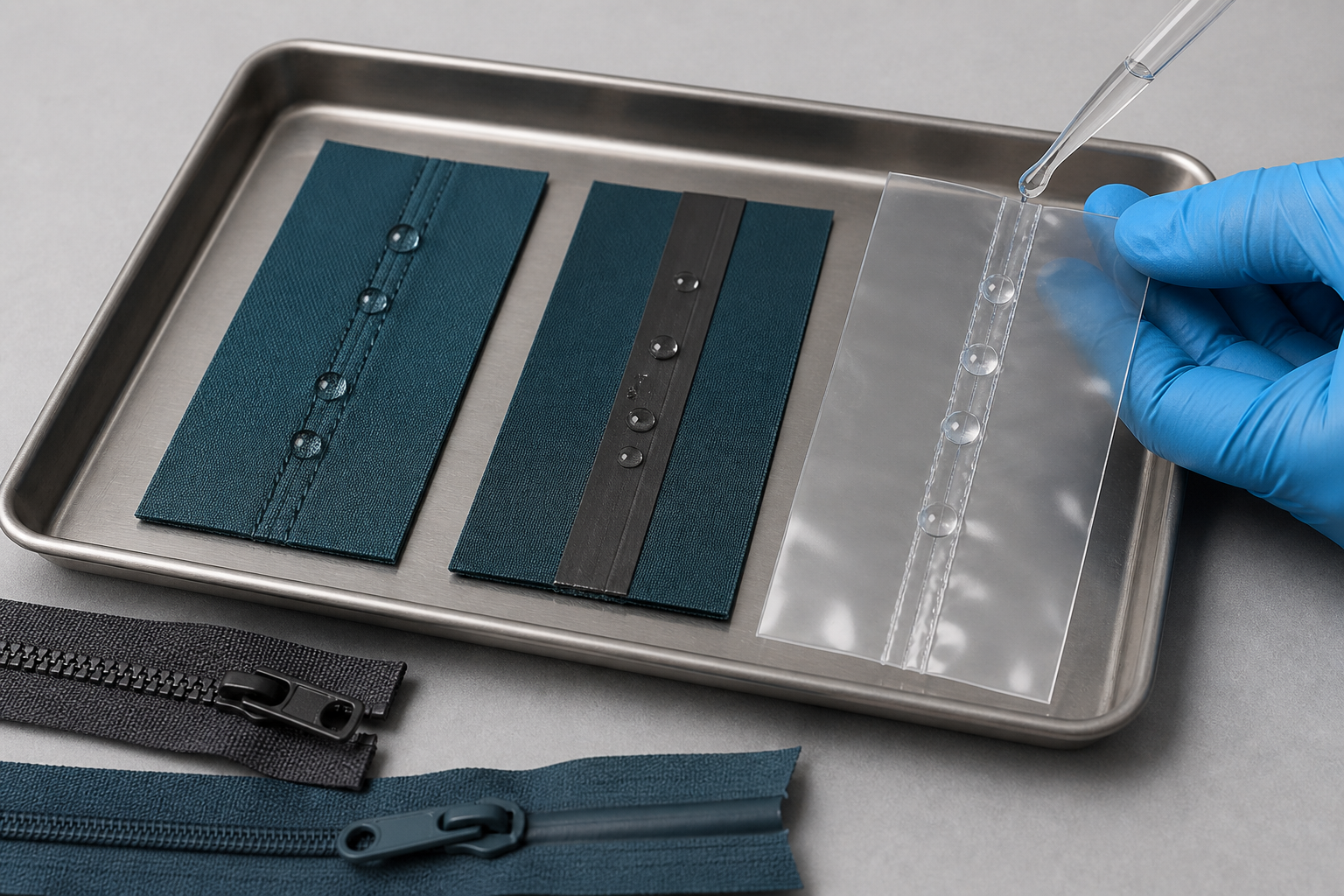
Stitching is efficient and visually familiar, but every needle pass creates a hole. Binding covers a raw edge and improves appearance; it does not automatically seal the seam. Seam tape can bridge selected stitch lines when tape, coating, temperature, pressure, curve and seam allowance are compatible. Welding can join a suitable thermoplastic surface without a sewing line, but the weld width, energy, pressure and contamination control must be stable.
| Joining method | Advantage | Failure risk | In-process control |
|---|---|---|---|
| Stitched and bound seam | Flexible styling, familiar equipment and clean edge finish | Needle holes, uneven stitch path and water travel along thread | Needle/thread, stitch placement, seam allowance and intersection quality |
| Stitched seam with sealing tape | Can reduce ingress at compatible seam areas | Lift, gaps, scorching, wrinkles or incomplete coverage at curves | Tape reference, application settings, overlap and adhesion checks |
| Heat or high-frequency weld | Creates a continuous joined zone in compatible materials | Weak weld, burn-through, narrow width, contamination or inconsistent settings | Material lot, tool condition, weld width, peel/strength check and appearance |
| Bonded construction | May avoid some visible stitching in selected designs | Adhesive compatibility, cure, aging and contamination | Adhesive specification, application amount, open time and validation |
5. Treat the zipper as a controlled opening
Many water-related failures begin at the zipper rather than the body panel. Ordinary coil zippers are designed for access, not complete sealing. Water can enter between teeth, along tape, at the slider and through end gaps. Sewing the zipper introduces another line of holes.
A protective flap may reduce direct spray. A reverse-coil configuration changes appearance but should not be assumed waterproof. A coated zipper can improve resistance when correctly installed, yet slider parking, end construction and curves remain important. For higher containment, the design may need a different closure concept. Test the closure while the bag is loaded because tension can open gaps or distort the zipper path.
| Closure direction | Likely protection level | What to verify |
|---|---|---|
| Standard coil zipper | Convenient access; limited water control | Tape, stitching, end gaps, curve and loaded operation |
| Reverse coil with protective lip | May reduce direct splash exposure | Lip coverage, drainage path, slider position and real spray test |
| Coated water-resistant zipper | Improved surface barrier under suitable conditions | Coating flex, installation holes, slider, end stops and bend radius |
| Roll or overlapping closure concept | Potentially stronger enclosure when correctly designed | Number of folds/overlap, user behavior, buckle/fastener and usability |
6. Design the pattern to manage water paths
Performance can improve before any special material is purchased. Reduce unnecessary seams in exposed panels. Keep zipper ends away from areas where water naturally collects. Avoid placing embroidered logos, rivets or stitched badges through a critical barrier. Shape the bottom so the bag does not sit directly in standing water when that is a realistic use case. Give taped or welded seams enough width and access for production equipment.
Interior pockets also affect containment. A pocket stitched through a liner basin can create holes below the intended liquid level. Consider suspended pockets, separate organizers or attachments above that level. Every design improvement should still be reviewed for usability, cost and appearance.
7. Build a test plan around the claimed use
A dramatic test that has no relation to actual use can be less useful than a simple repeatable protocol. A beauty pouch intended for a damp bathroom surface does not need to be marketed as a diving dry bag. Conversely, a product promised to protect contents in heavy exposure needs more than water drops on a flat fabric cutting.
| Development check | Purpose | Control variables | Record |
|---|---|---|---|
| Surface drop / wipe check | Screen material finish and cleanability | Liquid, amount, dwell time and care method | Beading, wetting, stain, finish change and residue |
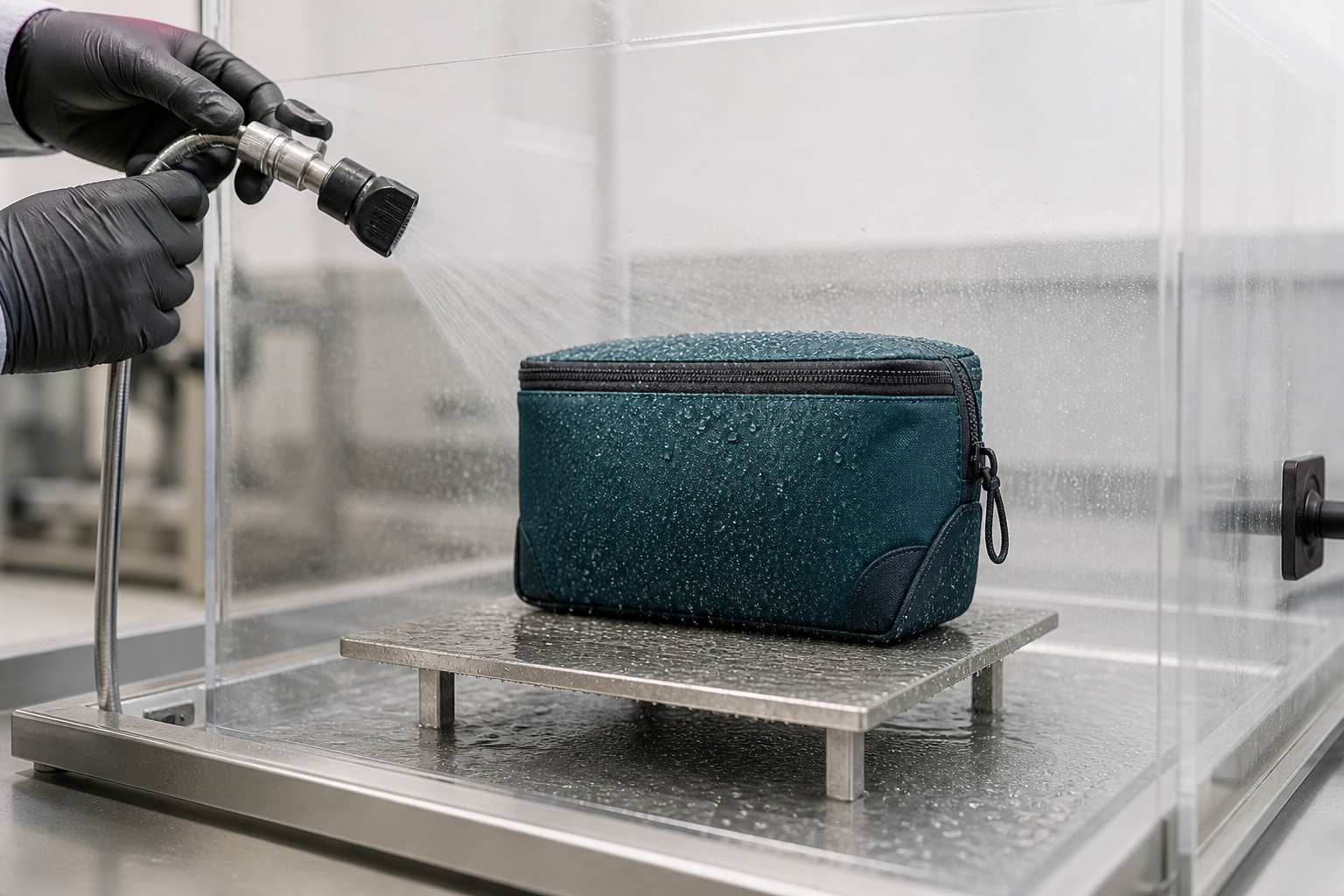
| Closed-bag spray check | Evaluate whole construction under external splash | Nozzle, distance, flow, time, orientation and loading | Ingress location, amount or internal indicator result |
| Internal containment check | Evaluate a representative bottle spill | Liquid, volume, hold time, movement and orientation | Leak path, wet area and liner deformation |
| Seam coupon check | Tune tape, weld or bond before full sampling | Material lot, seam method, settings and conditioning | Gaps, peel, damage, appearance and repeatability |
| Flex and opening cycles | Check whether barrier changes with use | Cycle count, load, bend point and environment | Cracks, tape lift, zipper change and repeat spray result |
| Packing recovery check | Confirm transport does not damage barrier or closure | Pack method, compression, time and unpack delay | Creases, blocking, weld stress and zipper alignment |
Where a retailer, customer or regulation requires a specific laboratory method, qualified parties should select and interpret it. Keep the protocol and result with the approved sample. The Custom Bag Sample Development Process explains how to connect test evidence with sample revisions and production approval.
8. Control waterproof features during bulk production
A perfect prototype does not guarantee a consistent order. Coating lots can change. Operators may use a different needle. Tape temperature or weld settings can drift. A new zipper batch may behave differently around corners. Bulk control must check inputs and the process that creates the barrier.
| Stage | Control point | Typical nonconformity |
|---|---|---|
| Incoming material | Reference, gauge/weight, coating, finish, zipper and sealing materials | Wrong backing, lot variation, pinholes, surface damage or substitute tape |
| Cutting and preparation | Panel direction, clean weld/tape areas and notch accuracy | Contamination, scratches, misalignment or insufficient seam width |
| Sewing | Needle/thread, seam allowance, zipper path and intersections | Skipped stitches, extra holes, puckering or exposed raw edge |
| Taping / welding | Approved settings, overlap, tool condition and first-piece check | Lift, gaps, burn, narrow weld, channel or incomplete corner |
| Finished sample checks | Defined lot sampling and water-performance protocol | Ingress at zipper ends, seam intersections, attachments or liner top |
| Packing | Protect surface, closure and sealed areas from sharp folds | Crease damage, blocking, contamination or zipper deformation |
Use the Custom Bag Quality Inspection Checklist as a base, then add style-specific water checks and defect definitions.
9. Understand the cost and MOQ consequences
Higher water protection is not a free material upgrade. It can require specialized film or laminate, sealing tape, coated zippers, welding tools, slower handling, trial settings, more sampling and additional inspection. Custom colors or material grades may create component minimums. A design that cannot be folded tightly can also increase carton volume.
Value engineering should begin with the claim. If the real need is a wipe-clean beauty gift, remove unnecessary high-protection operations. If spill containment protects premium contents or clothing, invest in the liner path rather than decorating the outer shell with a vague waterproof message. Request separate quotation options so the performance change remains visible.
Company-claim boundary: the following section is publisher self-description and a commercial development option. It does not independently prove factory ownership, in-house control of every operation, waterproof or leak-resistant performance, material composition, chemical/product compliance, certification, test results, capacity, stock, MOQ, price, lead time or superiority. The legal seller, assigned production sites and subcontractors, materials, seam and closure route, prototype, test method and laboratory, QC plan, packing, commercial terms and delivery depend on the exact order, destination, released specification and written confirmation.
Why choose LUCKYSTAR for waterproof cosmetic bag development?
LUCKYSTAR helps buyers convert a broad waterproof request into a buildable, testable cosmetic bag. We review how material, seams, lining, closure, logo and packing interact before the order moves into bulk production.
- Claim clarification: the team can help distinguish easy-wipe, splash-resistant, leak-resistant and higher-protection targets.
- Construction matching: stitched, taped, lined or welded routes are considered according to the intended use and design.
- Material coordination: outer shell, liner, zipper, tape, film and trim are evaluated as one system.
- Prototype-led testing: water checks can be tied to the actual sample orientation, contents and closure rather than a loose swatch.
- Controlled revisions: failed paths can be documented and corrected before the production reference is frozen.
- Bulk quality handover: incoming materials, critical processes, first pieces and finished samples receive style-specific checkpoints.
- Multi-category support: buyers can coordinate beauty accessories with selected items from the required Product Range for broader promotional programs.
Review LUCKYSTAR’s custom cosmetic bag collection and share the expected exposure, claim, contents, quantity and destination. Our cosmetic bag manufacturer selection guide provides additional questions for evaluating a development partner.
Manufacturing workflow from brief to shipment
- Define the exposure, direction, duration, orientation and pass condition.
- Select a construction route: wipe-clean, splash-focused, containment liner or welded enclosure.
- Approve material and seam coupons before building the complete bag.
- Design the pattern, closure, pockets and logo to avoid unnecessary barrier punctures.
- Build a functional prototype and run the agreed water and cleaning checks.
- Revise failure paths and repeat the relevant test, not only the appearance review.
- Freeze material references, process settings, sample number and quality plan.
- Check incoming lots and approve first pieces at sewing, taping or welding.
- Inspect finished goods using the agreed lot plan and protect critical areas during packing.
For the broader sequence of development, sourcing, production, inspection and delivery, see the Custom Bag Manufacturing Process. Buyers designing a general travel organizer can also review the Travel Cosmetic Bag buying guide.
Frequently asked questions
Is a PU cosmetic bag waterproof?
The PU surface may resist wetting or wipe clean, but ordinary seams, needle holes and zippers can admit water. The finished bag needs a defined test before it can support a specific waterproof claim.
Is coated polyester waterproof?
A coated polyester panel may provide a useful barrier, depending on the exact coating and condition. Cutting and sewing interrupt that barrier. Evaluate the completed construction, not only the fabric face.
Can stitched seams be made waterproof?
Compatible seam-sealing tape can improve selected stitched seams, but curves, intersections, binding and attachments are difficult areas. Whether the finished result qualifies for the intended claim depends on the whole design and test protocol.
Do water-resistant zippers seal every opening?
Products sold as water-resistant or coated zippers vary in design and performance. Installation holes, slider position, zipper ends, curves and loading influence the finished bag. Approve the exact closure in the complete sample.
What is the best material for a leak-resistant cosmetic bag?
There is no single best material. A compatible welded liner may be effective for internal containment; coated textiles or PU may suit easy-wipe outer shells. The material must match the joining process, closure, use and evidence requirement.
How should a waterproof cosmetic bag be tested?
Use a buyer-approved protocol that matches the intended exposure and marketing claim. Define liquid, amount or flow, duration, distance, orientation, load and pass criteria, then record the result against the numbered sample.
Match the claim, construction and evidence
Approve an exposure statement and pass criteria first. Then evaluate the full bag, including loaded shape, seams, zipper ends, bindings and attachments, and keep the approved sample and evidence connected to bulk-production controls.

Review LUCKYSTAR custom cosmetic bag options, then send your water-performance brief through the contact form or Email a project brief. The email link opens a prefilled draft for your review before sending.
Performance wording, material and component identity, whole-product test protocol and result, compliance, certification, inspection, capacity, stock, price, MOQ, samples, packing, schedule and delivery terms are subject to destination requirements, released specification, order-specific evidence and written confirmation.
Image note: the spray-test and seam images are illustrative. They do not establish a test standard, sample result, waterproof rating, material identity, factory ownership, production route, compliance, capacity, price, MOQ or lead time.