A cosmetic bag can look perfect on a sample table and still fail in the customer’s hands. The zipper may become difficult when the bag is full. A printed logo may rub against a pale garment. A coated shell may crease after packed storage, or a wrist strap may pull away from a neat-looking seam. Testing is how a brand turns those risks into evidence before thousands of units are shipped.
Planning an order? Send the product risks and test requirements already known. Include intended contents and users, destination markets, materials and colors, construction and load, customer-facing claims, existing methods or reports, quantity and required date.
That does not mean every pouch needs the same laboratory package. The correct program depends on material, construction, intended contents, use frequency, performance claims, destination market and buyer requirements. A simple gift-with-purchase pouch, a washable cotton organizer and a structured travel case should not inherit one generic checklist.
This guide explains how to plan custom cosmetic bag testing without confusing a laboratory method with a pass mark or routine inspection. Browse LUCKYSTAR’s custom cosmetic bag manufacturing options, use the cosmetic bag supplier evaluation guide to assess test capability, and connect the program to our broader custom bag sourcing pillar page.
Quick answer: which tests should a cosmetic bag pass?
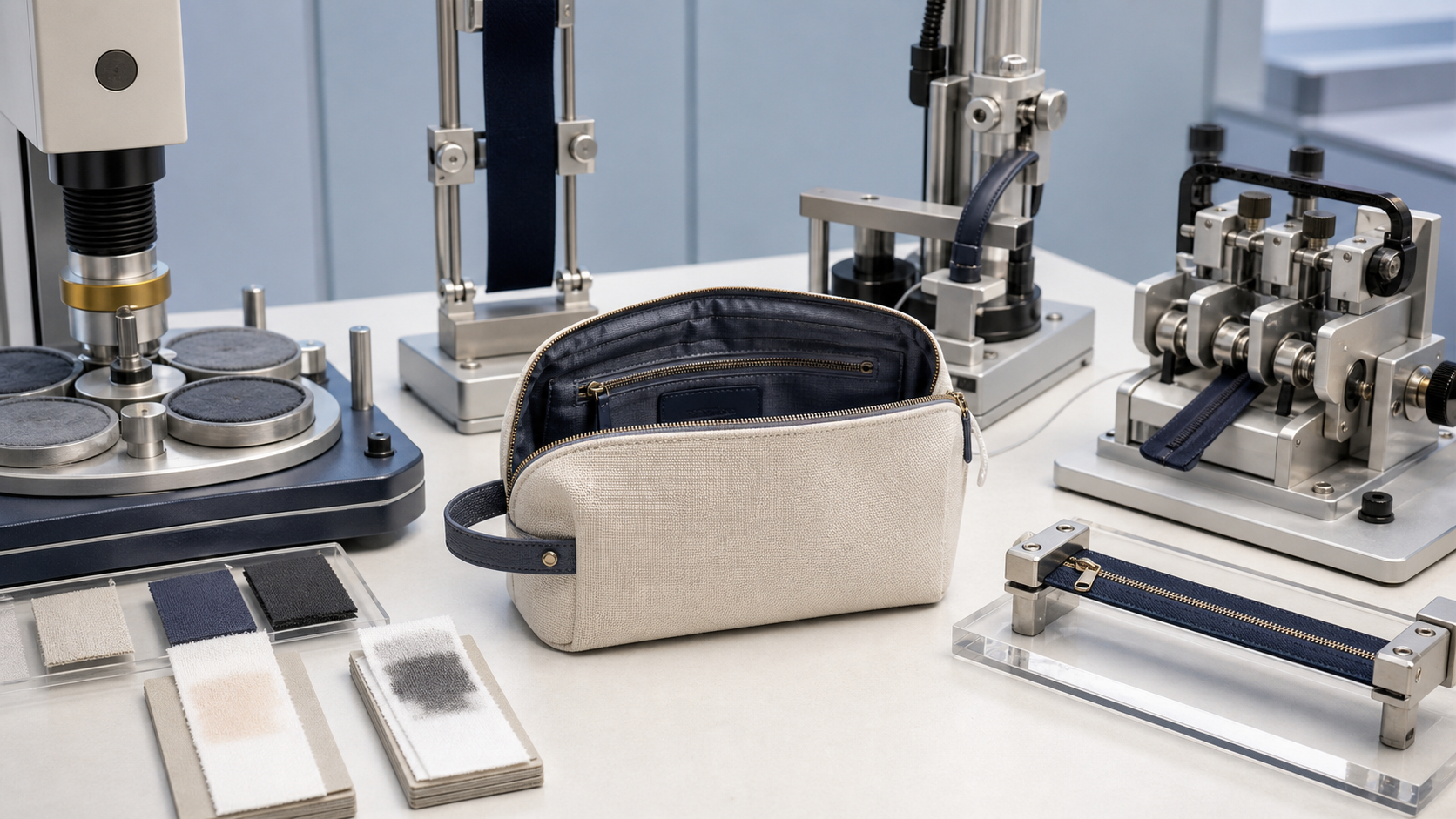
Most programs need evidence in five areas: material suitability, construction strength, component function, claim performance and destination-market compliance. The exact methods and pass criteria must be written before testing. “Pass an abrasion test” is incomplete unless the parties agree on the specimen, method, conditioning, number of cycles or endpoint, evaluation scale and acceptable result.
| Risk area | Typical evidence | When it matters most | Do not assume |
|---|---|---|---|
| Material | Identity, weight/thickness, colorfastness, abrasion, tear or tensile result as relevant | Dyed, printed, lightweight or high-contact surfaces | One fabric name predicts performance |
| Construction | Seam strength/slippage, attachment pull and loaded-use trial | Handles, pockets,gussets and stressed corners | Good-looking stitching is strong enough |
| Components | Zipper cycling, puller security, snap/magnet function and finish review | Frequent-use closures or custom hardware | A premium finish proves reliable operation |
| Claims | A defined wash, water, stain, color, load or durability procedure | Any benefit stated on packaging or a product page | A material-level result proves the whole bag |
| Market/compliance | Applicable chemical, safety, labeling and documentation evidence | Target country,intended user and customer program | One global certificate covers every market |
| Transit | Pack-out, carton and distribution simulation selected for the route | Retail presentation, e-commerce and fragile finishes | A strong product cannot be damaged in shipping |
This article provides manufacturing guidance, not legal advice. The importer or brand should confirm current requirements with a qualified laboratory or compliance adviser for its product, users and destination markets.
1. Separate inspection, performance testing and compliance
These three controls answer different questions. Inspection checks whether production matches an agreed specification: dimensions, workmanship, logo position, cleanliness, quantity and packing. Performance testing applies a defined action or exposure to a sample and records the result. Compliance work identifies which laws, restrictions, certificates, labels and documents apply.
A final inspector can open zippers and examine seams, but that does not replace a controlled zipper endurance or seam-strength test. Equally, a mechanical result does not establish chemical compliance. Use the finished cosmetic bag inspection checklist for production release, then keep the test plan as a separate controlled document.
| Control | Question answered | Usual output | Example |
|---|---|---|---|
| Specification review | Did the brand define the product clearly? | BOM, drawings,tolerances and acceptance criteria | Zipper gauge and opening length are identified |
| Inspection | Does the sampled production match that definition? | Pass/fail inspection report and defect list | No skipped stitches or mixed barcode labels |
| Performance test | How does a material, component or finished bag respond? | Method, conditions, raw results and decision | Closure operates after an agreed cycle program |
| Compliance assessment | Which legal obligations apply, and what evidence supports them? | Risk assessment, reports,declarations or certificates as applicable | Market-specific restricted-substance review |
2. Build the test plan from real use and failure risk
Begin with the customer journey, not a laboratory menu. List what goes inside, how heavy it may become, how often it opens, where it travels, how it is cleaned and what it might contact. Next, identify a credible failure for each important feature. Finally, choose a method that can reveal that failure and an acceptance level appropriate to the product position.
Risk rises when a failure could create injury, violate a claim, contaminate another product, trigger a recall, interrupt a launch or affect many units. A decorative tassel on a low-use pouch and the primary handle on a professional case should not receive identical priority.
| Product fact | Credible failure | Test direction | Approval input |
|---|---|---|---|
| Carries glass bottles | Handle or base seam releases under load | Static/dynamic loaded carry and attachment evaluation | Named contents and maximum intended mass |
| Light lining and dark print | Color transfers during rubbing or storage | Dry/wet rubbing and contact-storage review | Contact surfaces,humidity and appearance limit |
| Daily travel organizer | Zipper jams, slider wears or corners abrade | Loaded closure cycling and abrasion program | Use frequency and expected service level |
| “Wipe-clean” claim | Representative makeup leaves an unacceptable mark | Controlled stain, dwell, cleaning and re-evaluation | Contaminants, cleaner, repetitions and rating |
| E-commerce distribution | Bag or retail box arrives crushed, rubbed or creased | Packaged-product simulation for the route | Pack weight, dimensions and distribution channel |
3.Write the method and pass criteria before submitting samples
A standard method tells a laboratory how to produce a repeatable measurement; it often does not tell your brand what result is commercially acceptable. The product specification still needs a requirement. If the brand invents an internal fit-for-use trial, write it with enough detail that another site can repeat it.
Do not copy a cycle count, force or grade from an unrelated bag. Establish values from intended use, comparable product evidence, retailer protocols, risk and validated samples. If a test is destructive, decide which lot, color and construction variants need separate specimens.
| Test-plan field | What to record | Why it matters |
|---|---|---|
| Scope | Material, component, finished bag, SKU, color and production lot | Prevents an irrelevant sample from representing every variant |
| Method/version | Published standard or full internal procedure and current revision | Makes the result repeatable and comparable |
| Conditioning | Temperature, humidity,pre-aging or packed-storage condition when relevant | Materials can behave differently after environment exposure |
| Setup | Specimen preparation, load, speed, cycles, duration and contact medium | Stops hidden differences between laboratories or batches |
| Acceptance | Numerical limit, visual grade and prohibited failure modes | Turns a result into a release decision |
| Sampling | Number of specimens, source location and retest rule | Avoids choosing only the best-looking piece |
4. Verify the material before testing durability
Physical performance is meaningful only when the tested material matches production. Identify fiber or polymer family where required, construction, weight or thickness, coating or lamination, color method and supplier reference.Incoming production lots should be compared with the approved swatch and documented BOM.
The same description can hide major differences. Two “polyester” fabrics can use different yarns, densities, finishes and coatings. Two PU surfaces can flex and age differently. Use the material-selection framework for cosmetic bags to define the system before assigning its tests.
| Material direction | Useful verification | Performance questions |
|---|---|---|
| Woven shell/lining | Fiber, weave, mass, density, finish and color reference | Abrasion, tear/tensile, seam interaction and rubbing fastness |
| Coated textile | Substrate, coating side/type, thickness, hand and lot identity | Flex, adhesion, blocking, crease change, abrasion and aging |
| Flexible film | Polymer description, thickness, surface finish and color | Seam compatibility, cold/flex behavior, tack,odor and migration risk |
| Foam/board support | Composition, density/thickness and placement | Compression recovery, deformation and bonding |
| Metal/plastic trim | Base material, finish/plating, shape and supplier code | Attachment, finish wear, corrosion screening and sharp-edge risk |
5. Colorfastness and decoration tests
Cosmetic bags repeatedly touch hands, clothing, luggage linings and pale retail packaging. Dry and wet rubbing checks are therefore common for dyed or printed textile surfaces. ISO 105-X12 is one recognized method for resistance to color rubbing off and staining another material; it includes dry and wet approaches. The buyer must still define the required grade and which surfaces are in scope.
Decoration needs its own procedure. Screen print, heat transfer, foil, embossing, embroidery, woven labels and metal plates fail in different ways. A simple internal sequence may include rubbing, flexing, light cleaning and packed contact, followed by evaluation for lifting, cracking, color change, abrasion or edge release.
| Feature | Suggested check | Evaluate | Extra condition to consider |
|---|---|---|---|
| Dyed textile | Dry and wet color rubbing | Color change and staining of the rubbing cloth | Dark colors against light lining or garments |
| Printed shell | Rubbing, flex and surface abrasion | Loss of detail, transfer,cracking and gloss change | Test on the actual coated or textured substrate |
| Heat-applied logo | Edge pick, flex, rub and approved care exposure | Lifting, bubbles, split film and adhesive residue | Aging or packed heat if shipment is demanding |
| Embroidery/patch | Attachment, snag and surrounding-fabric review | Loose thread, puckering, pull-out and backing irritation | Interior protection where stitches are exposed |
| Metal logo plate | Attachment pull, rub and finish durability | Movement, sharpness, plating loss and fabric damage | Contact with damp products or salts |
6.Abrasion, tear, tensile and seam performance
These methods are related but not interchangeable. Abrasion evaluates surface wear. Tear tests measure how an existing cut or rupture propagates. Tensile tests pull a specimen until a defined outcome. Seam tests examine the stitched assembly and may reveal seam rupture, thread breakage, fabric breakage or slippage.
For example, the ISO 12947 series covers Martindale abrasion of textile fabrics; ISO 13937 contains fabric tear methods; and ISO 13935 covers seam tensile properties. Choose the part and specimen preparation that match the material and question. Coated fabrics may require a method designed for coated surfaces rather than automatically using a woven-fabric method.
| Test family | Best question | Typical failure evidence | Common misuse |
|---|---|---|---|
| Abrasion | Will a contact surface retain acceptable appearance/integrity? | Yarn break, coating loss, pilling,hole or appearance grade | Using one cycle target for every fabric |
| Tear | How resistant is the material to propagation from a cut? | Force trace and tear path | Treating tear result as finished-seam strength |
| Tensile | How does a defined strip or grab specimen respond to pulling? | Maximum force, extension and break mode | Comparing results from different specimen methods |
| Seam strength | Does the selected seam/material combination resist loading? | Seam,thread or fabric failure and maximum force | Testing fabric only and assuming the seam follows |
| Seam slippage | Do yarns open visibly beside a seam under force? | Opening width or force at a defined opening | Ignoring loose weaves around gussets or handles |
7. Test zippers under the bag’s real geometry and load
A loose zipper chain can operate smoothly while the finished opening binds at a curve. Test the actual bag with realistic fill, because foam, binding, lining ease and corner radius affect the slider path. Record whether a failure is in the chain, slider, puller, end stop, stitching or surrounding panel.
Cycle counts and pulling conditions should match the intended service level or customer protocol. Include an initial function check, endurance sequence, post-test function review and visual inspection. The zipper and hardware engineering guide covers gauge, chain, slider, puller and installation choices in more depth.
| Closure check | Setup | Observe |
|---|---|---|
| Initial operation | Empty, partly loaded and intended-load bag | Force changes, catching, waves, corner hesitation and lining contact |
| Endurance cycling | Defined travel, speed, load state and cycle target | Slider wear, tooth/coil damage, opening, tape fray and function |
| Puller attachment | Controlled pull direction and rate | Ring opening, puller break,slider distortion or decorative loss |
| End-stop security | Repeated closure to the travel limits | Slider escape, stop movement and seam damage |
| Post-conditioning check | After aging, water exposure or packed storage where relevant | Changed force, corrosion, tack, color transfer and deformation |
8. Handles, wrist straps, tabs and attachments
An attachment test should load the assembly in the direction customers will use it, not simply pull the webbing material. The specimen needs production-intended stitch pattern, reinforcement, seam allowance and body fabric. For detachable straps, include hooks, rings and swivel joints.
Combine a controlled pull with a loaded-use simulation. A static load may reveal creep; repeated lift-and-set cycles may reveal stitch growth or fabric whitening; a short dynamic movement may expose hardware opening. Acceptance should address deformation and seam opening, not only catastrophic breakage.
| Attachment | Primary risk | Evidence to collect |
|---|---|---|
| Short carry handle | Body fabric tears or reinforcement peels | Load, duration/cycles, extension, seam opening and failure mode |
| Wrist strap | Tab, ring or strap joint releases | Pull direction,hardware movement and stitch condition |
| Zipper-end tab | Customer pulls against a weak panel area | Grip simulation and local fabric/seam response |
| Interior loop/pocket | Small attachment tears lining under repeated access | Representative contents, insertion cycles and lining damage |
| Detachable hook | Gate opens, swivel binds or finish wears | Function before/after cycling and controlled attachment load |
9. Finished-bag loaded-use testing
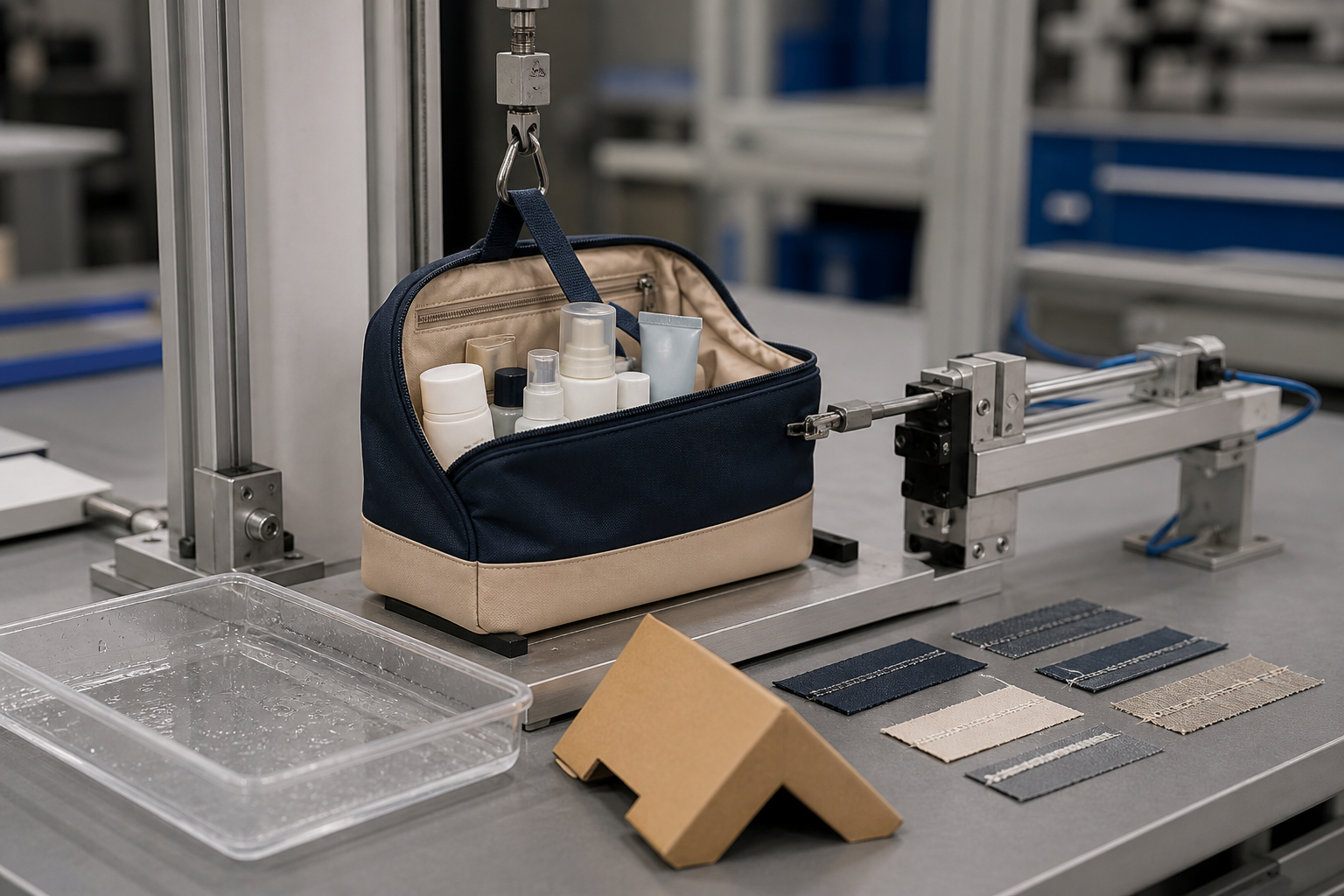
Material tests isolate properties; a finished-bag trial finds interactions. Pack the bag with an agreed assortment that represents size, shape and mass. Open and close it, carry it, place it on different faces, remove products, reload it and evaluate the stressed areas. Record the exact contents so the procedure can be repeated.
Loaded testing also reveals capacity errors.A stated external size does not guarantee that rigid palettes, bottles and brushes fit after lining, foam, pockets and zipper clearance are deducted. Use the cosmetic bag size and capacity method to define test blocks or real products.
| Sequence | Record | Inspect after the sequence |
|---|---|---|
| Load | Named items or blocks, total mass, arrangement and fill level | Shape, base stability, panel strain and closure alignment |
| Access | Opening direction, repetitions and customer handling | Zipper, lining capture, pocket stretch and product removal |
| Carry | Handle/strap used, duration, distance or cycles | Attachments, seams, hardware,comfort and deformation |
| Set down/reorient | Surfaces, orientations and repetitions | Corner wear, leakage from contents and item migration |
| Recover | Rest time and empty/loaded condition | Permanent distortion, wrinkles and support recovery |
10. Lining, stain and cleanability tests
Choose contaminants that reflect the program: powder, pigmented foundation, lipstick-like balm, oil-based product, lotion or colored liquid. Define the deposited amount, dwell time, cleaning material, cleaner, strokes, drying time and evaluation. A result immediately after wiping may differ from the dry result hours later.
Test the complete interior where seams, pockets and binding can trap residue. Repetition may matter more than one aggressive cleaning event. The cosmetic bag lining and cleaning guide explains how substrate, coating, pockets and care instructions work together.
| Test variable | Define it | Possible rating |
|---|---|---|
| Contaminant | Product type, shade and applied amount | Residual stain or color change |
| Dwell | Time and temperature before cleaning | Penetration, ring or surface softening |
| Cleaning | Cloth, liquid, pressure/strokes and rinse | Removal, gloss change,coating lift or dye loss |
| Repetition | Number of stain-and-clean sequences | Cumulative wear, tack, fading or delamination |
| Dry evaluation | Drying method and time before rating | Odor, stiffness, tide mark and appearance |
11. Water, splash and leak claims need different tests
Water-repellent material, splash-resistant construction and spill-containing interior are different claims. A fabric spray or hydrostatic result does not evaluate zipper openings, needle holes, piping joints or the direction liquid travels inside a finished bag. Match the test object to the customer-facing promise.
If a bag is promoted as washable, use a defined full-product procedure. ISO 6330 specifies domestic washing and drying procedures for textile testing, but the brand still needs to select the correct procedure and evaluate the complete construction. Do not add a machine-wash claim simply because one textile layer can be washed.
| Claim direction | Test object | Key variables | Acceptance example |
|---|---|---|---|
| Water-repellent surface | Specified face material | Water application, time and surface rating | Agreed wetting appearance |
| Splash resistance | Finished bag in intended orientation | Volume, direction,duration and contents | No unacceptable entry under the stated exposure |
| Interior spill management | Finished lining, seams and closure zone | Liquid, amount, dwell, movement and evaluation | Defined containment and cleanability |
| Washable bag | Complete packed-out product minus removable contents | Wash/dry procedure and number of cycles | Dimensions, function, appearance and bonding remain acceptable |
For seam paths, coated materials and responsible claims, continue with our waterproof cosmetic bag construction article.
12. Coating, lamination, flex and aging checks
Coated and laminated materials can change after folding, pressure, heat, humidity or time.A fresh flat swatch may look excellent while a finished corner later shows whitening, cracking, tack, layer separation or print offset. Build conditioning around the real shipping and storage route.
Test coupons help compare materials, but include sewn corners and finished panels. Where the surface touches another material in the pack, assess blocking and color/finish transfer after pressure conditioning. Record odor consistently after samples have equilibrated; avoid subjective claims such as “odor free” without a method.
| Exposure | Risk revealed | Review after exposure |
|---|---|---|
| Repeated flex/fold | Cracking, whitening and layer fatigue | Surface and bond at bend lines |
| Warm packed storage | Blocking, tack, print offset and shape set | Contact surfaces and separation force |
| Humidity conditioning | Bond weakening, corrosion and dimensional change | Lamination, trim,odor and function |
| Cold condition where relevant | Brittleness and reduced flexibility | Film, coating, piping and hardware movement |
| Abrasion after conditioning | Environment-related loss of surface durability | Coating loss, color and visual grade |
13. Hardware finish and corrosion screening
Metal pullers, plates, rings and hooks may face perspiration, bathroom humidity, product residue and salt-containing environments. The right evaluation depends on base metal, finish, exposure and customer protocol. A salt-spray method can be useful in some programs, but its duration and acceptance are not universal indicators of years of consumer life.
Inspect appearance and function after exposure. A component can retain color yet become rough, or show a small cosmetic change while remaining secure. Include rub/contact checks where a plated part touches pale fabric. Sharp edges, burrs and loose fasteners belong in both component approval and finished-goods inspection.
14.Packaging and transport tests protect the approved bag
Testing the bag without its retail pack can miss crushing, scuffing, zipper impressions, coating transfer and hardware dents. Approve the folded shape, inserts, protective layers, unit pack, master carton and orientation. Then select a distribution simulation appropriate to the actual channel rather than using a random drop sequence.
ISTA procedures range from screening tests used early in development to broader simulations of shipment hazards. Procedure selection depends on the packaged product, mass, size and route. The beauty-brand cosmetic bag packaging guide helps define presentation and pack-out before a transport trial.
| Channel | Likely packaging stress | Evaluate |
|---|---|---|
| Bulk promotional delivery | Compression, long carton storage and assortment mix | Shape recovery, color transfer, count and carton integrity |
| Retail boxed set | Insert pressure, window rub and presentation alignment | Surface marks, logo position and shelf-ready appearance |
| E-commerce parcel | Repeated handling, impact and variable orientation | Product damage, closure,leakage and consumer-ready condition |
| Ocean freight | Long compression, temperature/humidity variation and odor accumulation | Carton, blocking, corrosion, deformation and moisture protection |
15. Chemical and regulatory testing is market-specific
A cosmetic bag is an article, not the cosmetic formula it carries, but its textiles, coatings, inks, adhesives and hardware may still be subject to substance restrictions or customer restricted-substance lists. Do not request a vague “REACH test” or “CPSIA test.” First map each material and component to the destination, user age, contact scenario, claim and applicable rule.
For the EU, the General Product Safety Regulation supports a broader product-safety process, while REACH restrictions and Candidate List obligations may apply to substances in articles under defined conditions. For the United States, a product intended primarily for children aged 12 or younger can enter the children’s-product testing and certification framework; that should not be automatically applied to an adult beauty accessory, nor should an adult label be used to avoid a genuinely child-directed design.
| Decision input | Why the laboratory needs it | Buyer action |
|---|---|---|
| Destination markets | Legal restrictions and documentation differ | List countries and channels before quotation |
| Intended user/age | Children’s-product rules can change the program | Document design, marketing and foreseeable use |
| Material/component map | Risks differ for coatings, prints,plastics and metals | Provide a production BOM and component locations |
| Customer RSL | Retailer limits can exceed statutory baselines | Supply the current protocol and reporting format |
| Claims/contact | Antimicrobial, recycled, children’s or special-contact claims add evidence needs | Remove unsupported claims or validate them specifically |
| Report ownership | Correct applicant, product identity and traceability matter | Confirm who orders, reviews and retains evidence |
16. Decide what the factory can test and when to use a third-party lab
Factory checks are valuable for rapid engineering: zipper cycling, loaded-use trials, basic attachment pulls, stain trials, packing simulations and comparison against an approved sample.A qualified third-party laboratory is appropriate when an accredited result is required, a published method needs calibrated equipment, a customer demands independent evidence or the result supports a regulated decision.
The two routes should reinforce each other. Early factory screening can prevent an obviously weak sample from consuming lab time. The laboratory report then provides controlled evidence. Bulk production still needs incoming, inline and final controls because one passing development sample does not prove every production unit.
| Route | Best use | Control needed |
|---|---|---|
| Development bench test | Compare options and identify weak constructions quickly | Written internal method, known equipment and photo/video record |
| Factory routine test | Monitor production-relevant characteristics | Calibration/verification, trained operator and retained results |
| Third-party laboratory | Recognized method, regulated testing or independent buyer evidence | Correct scope,specimen traceability and report review |
| Third-party inspection | Sample finished quantities for specification and workmanship | Approved checklist, sampling plan and defect classification |
17. Put tests at the right development gate
Testing everything after bulk production creates expensive decisions. Screen material and component risks before the first complete sample; validate the assembled product before the production reference is sealed; confirm sensitive production lots when required. Link every report to the material lot, sample revision, artwork and BOM.
The custom cosmetic bag sample development process shows where evidence closes design questions. Record the final methods, acceptance levels and responsibilities in the cosmetic bag tech pack workflow.
| Gate | Testing focus | Release evidence |
|---|---|---|
| Material shortlist | Identity, color, surface, basic physical and chemical risk screening | Approved/switched-off options with reasons |
| Component prototype | Zipper, attachment, decoration and seam compatibility | Engineering result and corrective action |
| Complete development sample | Loaded use, capacity, stain,claim and pack-out interaction | Dated sample review against test plan |
| Pre-production sample | Production-intended materials, artwork, construction and key validation | Sealed reference and closed issue log |
| Bulk/lot confirmation | High-risk incoming or finished-product characteristics | Lot-linked records and shipment decision |
18. Handle failures with root-cause evidence, not repeated hope
A retest is not a corrective action. First quarantine affected samples or material, confirm the method and identify the failure location. Determine whether the cause is design, material variation, process, conditioning, specimen preparation or test execution. Change one controlled element, document the new revision and test a representative sample again.
If a requirement cannot be met, the responsible choices are to change the product, change the claim, change the material/process or formally revise the acceptance criterion with appropriate technical and compliance review. Never average away a safety-critical failure or mix results from materially different constructions.
| Failure | Questions to investigate | Possible corrective route |
|---|---|---|
| Seam opens | Fabric slippage, stitch type/density, allowance, thread or reinforcement? | Re-engineer seam and validate production-intended assembly |
| Logo lifts | Surface energy, cure/pressure, adhesive, coating or aging? | Adjust process/material pair and repeat conditioned test |
| Zipper binds | Chain/slider match, curve, lining, load or installation wave? | Correct the system,then cycle the loaded bag |
| Coating cracks | Material grade, fold radius, cold/heat history or seam bulk? | Change grade or geometry and repeat conditioning |
| Chemical result fails | Which component/lot is the source and what rule/RSL applies? | Stop use, replace source and follow compliance escalation |
Why choose LUCKYSTAR for a test-ready cosmetic bag program?
LUCKYSTAR approaches testing as part of product development, not as a certificate collected at the end. The team can review intended contents, material layers, seams, closure geometry, attachments, decoration and packing to identify where a bag is most likely to fail. That helps brands spend laboratory budget on relevant questions while using repeatable factory checks to improve samples earlier.
A practical project can begin with your existing specification, a target sample or a performance brief. LUCKYSTAR can help translate broad requests such as “durable,” “wipe clean” or “travel ready” into a testable construction, coordinate samples and retain approved production references.Review the wider Product Range and compare the required controls with our guide to selecting a capable cosmetic bag manufacturer.
Testing does not remove every business risk, but it makes decisions visible. Used with the Custom Bag Manufacturer Guide, a risk-based test plan creates a stronger line from concept and sampling to bulk control and repeat orders.
RFQ checklist: information needed for a testing proposal
| Product/use | Construction/evidence | Commercial/compliance |
|---|---|---|
| Bag type, dimensions and intended contents | BOM, drawings and production-intended swatches | Order quantity, SKUs and colorways |
| Maximum load and opening frequency | Seams, reinforcement, zipper and hardware details | Destination countries and sales channels |
| Cleaning behavior and likely contaminants | Logo method, lining, coating and support layers | Intended user/age and customer RSL |
| Claims shown on page,label or packaging | Existing methods, limits and past reports | Required laboratory, report owner and deadline |
| Packing and distribution route | Approved reference and change history | Retest, failure and shipment-release responsibility |
Frequently asked questions
Do all cosmetic bags need laboratory testing?
Not every bag needs the same third-party laboratory package. The brand should perform a documented risk and compliance review, then select factory, laboratory and inspection evidence appropriate to the material, construction, claims, market and customer requirements.
What is the most important cosmetic bag durability test?
There is no universal single test. A handled case may prioritize attachment and loaded-use performance; a daily pouch may prioritize zipper operation and abrasion; a coated travel bag may prioritize flex, aging and claim validation. The highest credible failure risk should lead.
Are cosmetic bag test standards the same as pass criteria?
No. A standard commonly defines apparatus, specimen and procedure. The buyer, retailer or regulation may separately define the acceptable result. Always place the method/version and acceptance limit together in the specification.
Should zippers be tested before or after they are sewn into the bag?
Both checks can be useful. Component screening compares zipper options, while finished-bag cycling reveals the effect of curves, lining, foam, binding, installation and load. The latter is essential when geometry is likely to affect operation.
Does a water-resistant fabric make the cosmetic bag waterproof?
No. Sewing holes, seams, zipper openings, panels and attachments influence finished-bag performance. Use a claim-specific whole-product test and describe the limit accurately.
Can one chemical report cover all colors and materials?
Only when the laboratory or compliance professional confirms that the tested scope legitimately represents them. Different pigments, coatings, prints, adhesives, metals and suppliers may change risk. Trace every specimen to the production BOM and lot.
How long is a test report valid?
A report describes the submitted sample and conditions at a point in time. Its usefulness depends on unchanged materials, suppliers, formulation, process, rules and customer requirements. Establish review and retest triggers instead of relying on a generic expiry date.
What happens if a sample fails?
Confirm the procedure, isolate the source, perform root-cause analysis, implement a controlled change and retest a representative revised sample. Record the failure and correction so bulk production does not revert to the earlier construction.
Turn “good quality” into a testable product
The strongest cosmetic bag quality tests begin with a clear product brief.When the intended contents, customer behavior, materials, claims and markets are defined, the supplier and laboratory can select evidence that answers real questions. The result is not a pile of reports; it is a traceable decision system from development through shipment.
See LUCKYSTAR’s custom cosmetic bag range, or send your product brief for a test-plan review and quotation.

Prepare a test-plan request
Include the intended contents and users, destination markets, materials and colors, construction, closures and maximum load, customer-facing claims, highest failure risks, existing test methods or reports, quantity, sample stage and required date.
Send your project details through the contact form, or Email a project brief with this guide already referenced. The email link opens a draft for your review before sending.
Applicable requirements, test scope, methods, sample count, acceptance criteria, laboratory responsibility, fees, schedule and delivery terms are subject to product, market and written confirmation by the responsible parties.