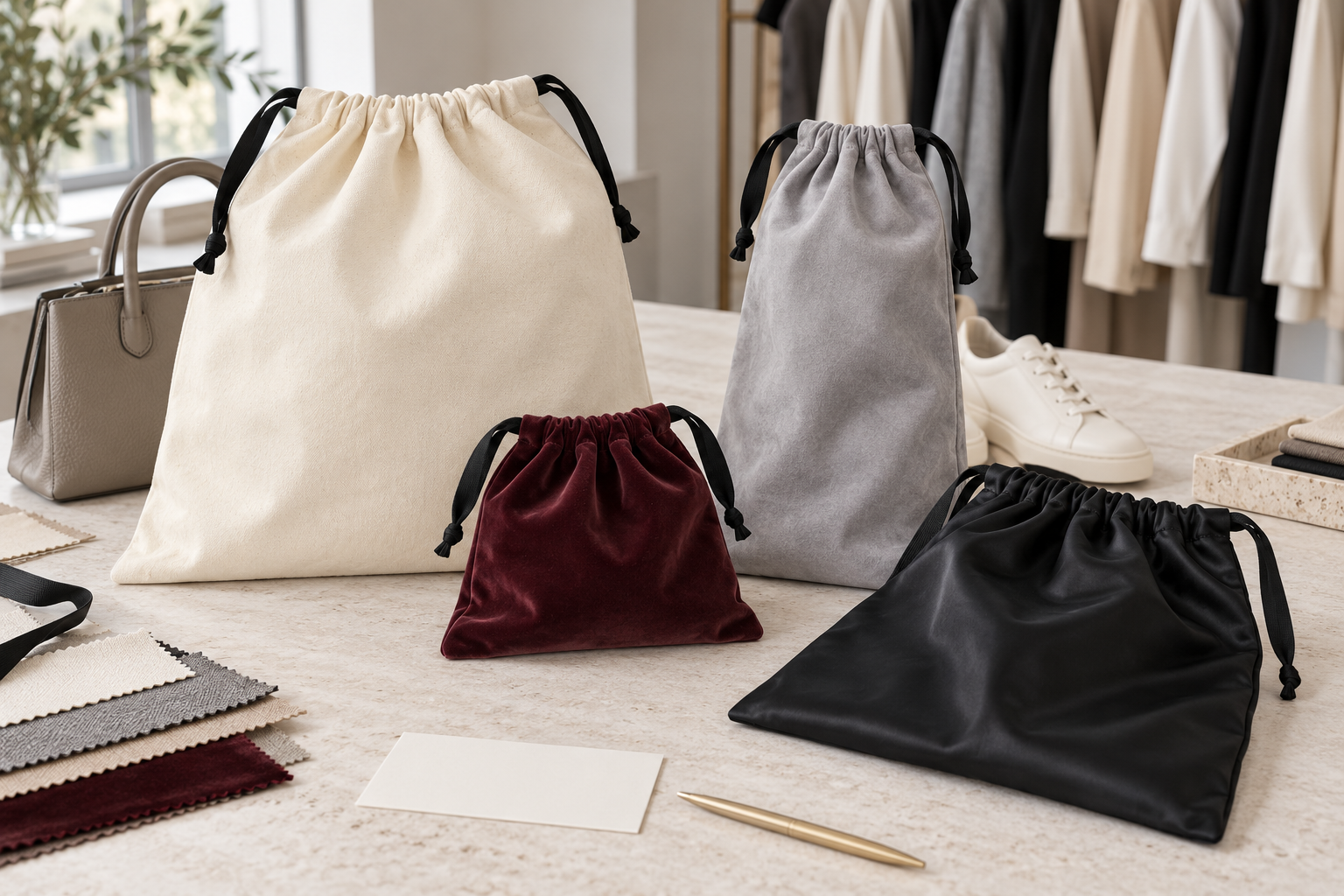
A cosmetic bag can pass a quick appearance check and still fail in use. The zipper may work when the bag is empty but bind around the filled curve. The lining may look clean yet pull into the slider. A pocket may match the drawing but be too tight for the intended compact. A transparent panel may be correctly cut but arrive scratched after packing.
Planning an order? Send the quality requirements already known. Include the bag format and use, material and finished size, approved sample or specification version, highest failure risks, inspection stage, approximate quantity, SKU count and destination.
A useful cosmetic bag quality control checklist must therefore connect specification, production stage and actual use. It should tell an inspector what to compare, how to check it, what record to keep and what happens when the result is outside the approved requirement.
This category guide adds cosmetic-bag-specific detail to the broader Custom Bag Quality Inspection Checklist. Buyers can also review LUCKYSTAR’s custom cosmetic bag range and return to the Custom Bag Manufacturer Guide for the complete sourcing framework.
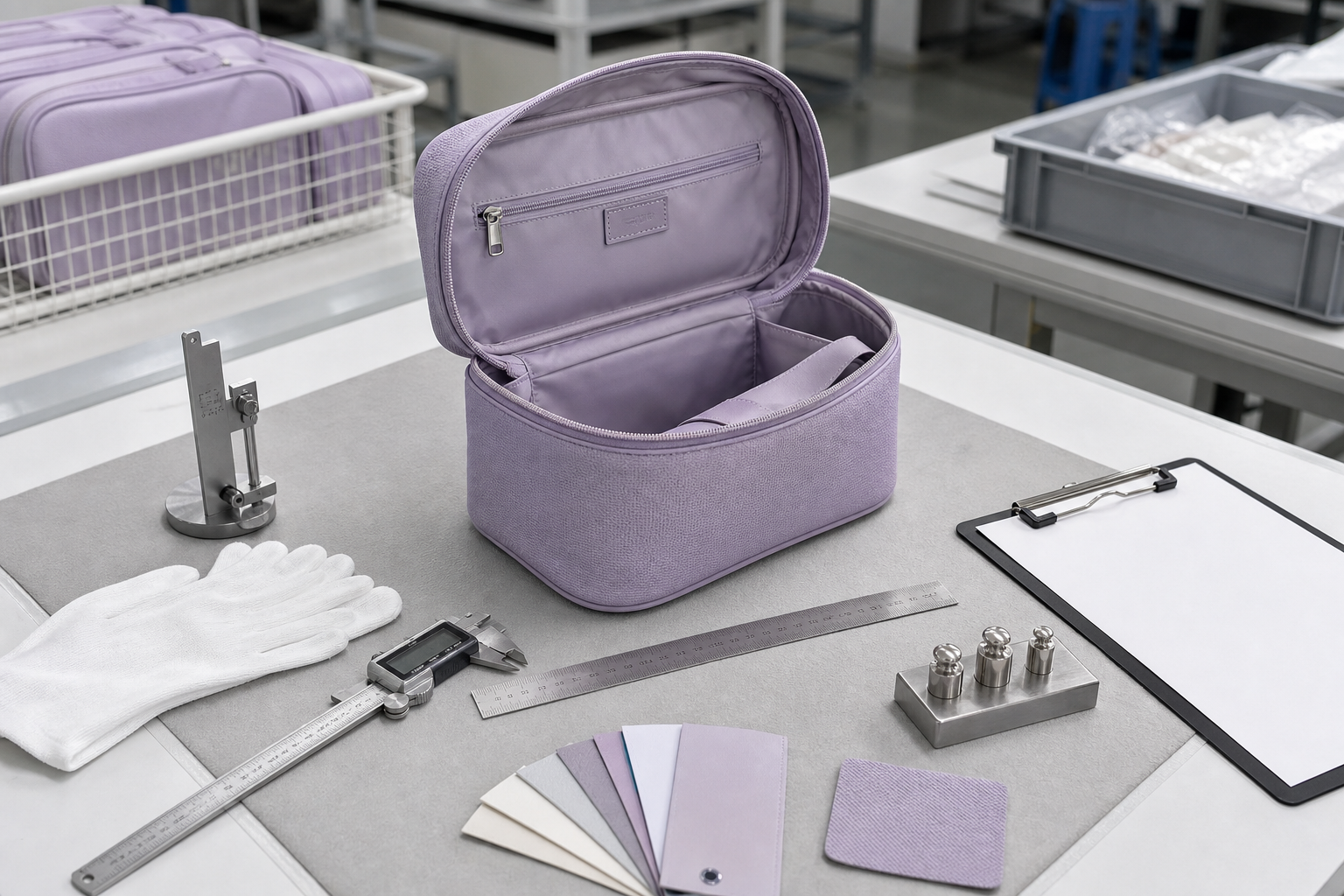
Quick answer: inspect the process that creates the risk
Do not wait for final inspection to discover a material substitution, incorrect zipper curve or mispositioned pocket. Approve measurable requirements before bulk production, verify incoming inputs, check the first cut and decorated pieces, inspect early assembled bags, monitor defect trends during sewing, and complete a defined final inspection before shipment release.
The checklist should be style-specific. A flat cotton pouch, structured PU vanity case and clear welded organizer do not share the same highest risks. Start with the three failures the customer would notice first and build stronger controls around them.
| QC stage | Main purpose | Cosmetic bag evidence | Decision |
|---|---|---|---|
| Specification approval | Define what “correct” means | BOM, measurement chart, artwork, function brief, packing and approved sample | Release or revise the production package |
| Incoming control | Prevent wrong or defective inputs entering production | Outer, lining, interlining, zipper, puller, label, packaging and required records | Accept, segregate, replace or investigate |
| First-piece approval | Confirm setup before volume accumulates | Cut panels, logo piece, zipper subassembly and first finished bag | Continue, adjust or stop the process |
| In-line inspection | Detect drift and systematic defects early | Seams, binding, corners, lining, pockets, zipper installation and cleanliness | Correct source, contain affected work and verify recovery |
| Final inspection | Assess finished lot and packaging against release criteria | Randomly selected finished units, SKU counts, cartons and records | Release, rework, sort, reinspect or reject according to agreement |
1. Assemble the inspection reference pack
An inspector cannot judge “premium quality” consistently. Give the team controlled references. The technical file should identify material, color, dimensions and tolerances, stitch and seam expectations, zipper and hardware, logo, function, cleanliness, packaging and any tests. Use photos to show measuring points and hidden internal details.
The approved sample is important but not sufficient by itself. A sample may contain a substitution or hand-made detail that is not intended for production. Record what it approves and what the written specification controls instead. The Custom Bag Sample Development Process explains how to number and freeze the reference.
| Reference item | Minimum useful content | Risk if missing |
|---|---|---|
| Bill of materials | Supplier/reference, composition, weight or gauge, color, finish and quantity per bag | Uncontrolled substitution or mixed component lots |
| Measurement chart | Named points, method, target, tolerance and sample condition | Inspectors measure different locations or bag states |
| Workmanship standard | Seams, binding, raw-edge rules, stitch appearance, symmetry and cleanliness | Subjective acceptance and repeated disputes |
| Artwork package | Controlled file, size, method, color, location and tolerance | Wrong revision, tilted logo or inconsistent placement |
| Function plan | Payload, load, zipper/closure operation and any agreed performance checks | A visually correct bag fails its intended use |
| Packing instruction | Folding, inserts, labels, protection, quantity, carton and marks | Shape damage, surface marks or warehouse errors |
2. Define defects by consequence
Defect classification should reflect the product, market and customer agreement. A loose decorative thread is not the same as a sharp exposed metal edge. A wrong-market barcode is not merely a minor print issue. Define examples before inspection and state the sampling plan and decision rule in the purchase documents.
Terms such as critical, major and minor are useful only when the parties agree on them. The table below is a planning framework, not a universal legal or acceptance standard.
| Planning class | Practical meaning | Cosmetic bag examples | Required preparation |
|---|---|---|---|
| Critical | Potential safety, legal or severe use risk under the agreed context | Sharp exposed point, prohibited component, serious contamination or incorrect mandatory information | Define zero-tolerance or other customer rule explicitly and obtain qualified advice where needed |
| Major | Likely to cause functional failure, rejection or material customer dissatisfaction | Broken zipper, open seam, unusable pocket, wrong color/SKU, missing item or logo failure | Agree examples, limits and disposition before shipment |
| Minor | Appearance or workmanship deviation that does not materially prevent normal use | Small removable thread tail or slight non-prominent cosmetic variation within the agreed class | Set viewing conditions and boundary samples where appearance is subjective |
3. Incoming material and component checklist
Incoming control should verify identity before testing appearance. “Polyester lining” is not enough; confirm the approved construction, weight or gauge, finish, color and source reference. Separate lots so a later defect can be traced. Record substitutions and obtain approval rather than treating an approximate component as equivalent.
| Input | Check | Common category defect | Reference |
|---|---|---|---|
| Outer textile or PU | Identity, color, weight/gauge, surface, backing, width, odor and visible defects | Shade variation, coating marks, creases, peeling, holes or contamination | Approved swatch, BOM and lot record |
| Lining and interlining | Composition, color, hand, coating, thickness and bond/lamination where applicable | Staining, excessive stretch, delamination or inconsistent structure | Approved interior sample and material standard |
| Zipper | Chain size/type, tape color, slider, puller, stops, length and operation | Mixed teeth, wave, catching, finish variation or weak stop | Approved zipper set and component specification |
| Labels, patches and hardware | Artwork, dimension, color, finish, edge, attachment points and quantity | Wrong revision, plating marks, sharp edge or inconsistent patch shape | Approved proof and component drawing |
| Packaging | Dieline, print, barcode/data, size, adhesive, bag protection and carton grade | Wrong market copy, poor scan, ink transfer or carton mismatch | Approved packaging sample and pack-out file |
Use Best Materials for Custom Cosmetic Bags to define material attributes before translating them into incoming checks. The PU vs Polyester Cosmetic Bags guide highlights different surface and construction risks.
4. Dimensions, shape and capacity checklist
Agree whether a dimension is measured flat, naturally standing, loaded or after a defined recovery period from packing. Soft products move under pressure, so the measurement method matters as much as the tolerance. Do not force a bag into the target shape while measuring it.
Capacity should be checked with representative contents, not inferred from external dimensions. Internal seams, foam, pockets and zipper path reduce usable space. Confirm that the largest intended item can enter and leave without damage.
| Measurement | Method to define | Typical failure signal |
|---|---|---|
| Width and height | Reference points, bag condition and surface pressure | Panel mismatch, seam take-up or pattern drift |
| Base/gusset depth | Finished seam-to-seam points and whether the base is opened naturally | Asymmetric corners or reduced standing stability |
| Opening length | Usable opening between stops under normal operation | Target product cannot enter despite correct outer size |
| Pocket position and size | Finished internal opening, depth and reference seam | Pocket is inaccessible, tight or visually tilted |
| Handle or wrist strap | Finished length/drop, width, attachment and twist condition | Uneven carry, poor comfort or load concentration |
| Loaded shape | Named product set, total weight and observation orientation | Base collapse, bulging, zipper strain or tip-over |
5. Workmanship checklist for cosmetic bag construction
Cosmetic bags concentrate difficult sewing into a small area. Zipper ends, tight curves, bound corners, pocket edges and lining turn openings can create bulk. Inspect from the outside and inside. A neat shell can hide raw edges, trapped lining or unsecured thread below.

| Area | What to inspect | Possible defect | When to check |
|---|---|---|---|
| Panel seams | Seam position, allowance, stitch formation, puckering and security | Open seam, skipped stitch, wandering line or exposed raw edge | First-piece, in-line and final |
| Bound corners | Coverage, turning, bulk, join, stitch capture and symmetry | Binding miss, exposed edge, hard lump, narrowing or twist | During subassembly and inside final bag |
| Lining | Fit, cleanliness, attachment, seam closure and distance from zipper | Excess lining, pull-out, trapped edge, hole or thread debris | Before closing and at final function check |
| Pockets/dividers | Position, opening, reinforcement, elastic recovery and usable volume | Tilt, wrong size, weak top edge or unusable compartment | First-piece and loaded final sample |
| Piping/structure | Continuity, corner radius, join location, symmetry and recovery | Wave, exposed cord, flat spot or distorted silhouette | In-line and after packing recovery |
| Turn/closure point | Invisible or controlled closure, secure stitches and no excess bulk | Gap, weak hand closure or prominent lump | Before finishing approval |
6. Zipper and closure checklist
Operate the zipper with the bag empty and loaded. Check the full path, especially curves and end stops. The slider should not trap lining or scrape an internal pocket. Matching color is not enough; chain size, tape, installation tension and curve radius affect function.
| Check | Practical method | Reject or investigate when |
|---|---|---|
| Smooth travel | Open and close through the entire path at normal speed | Slider catches, force varies sharply or chain separates |
| Curve behavior | Operate around corners with representative contents inside | Tape waves, teeth distort or the pull jams at a curve |
| End security | Check stop, zipper garage or sewn end without abusive pulling | Slider passes stop, end opens or finish exposes a sharp part |
| Lining clearance | Inspect and cycle while lining sits naturally | Lining enters teeth or must be held away by the user |
| Puller/slider attachment | Compare component and perform the agreed handling check | Loose link, plating defect, reversed pull or weak attachment |
| Closed alignment | View top, ends and matching panels after closure | Opening remains, panels twist or zipper sits visibly off center |
7. Material-specific appearance checklist
One generic surface standard does not suit every material. PU can show pressure, grain and edge variation. Polyester can show weave direction, coating marks or shade differences. Cotton and canvas can contain natural-looking texture that still needs a defined commercial limit. Clear film reveals scratches, haze, particles and protective-film damage more readily than opaque fabric.
| Material direction | Focused checks | Packing interaction |
|---|---|---|
| PU surface | Grain, gloss, backing, crease, edge, abrasion mark, peeling and odor | Avoid hardware pressure, sharp folds and face-to-face blocking where relevant |
| Polyester/nylon | Shade, direction, weave, coating, snag, heat mark and panel consistency | Check folding and contact transfer from print or hardware |
| Cotton/canvas | Weave, slub boundary, dye/print, contamination, shrink or distortion where relevant | Control moisture, dust and hard creases |
| Clear film | Clarity, gauge, scratch, haze, weld/seam, edge, blocking and odor | Separate surfaces and confirm protective material does not transfer or stick |
| Coated/water-control construction | Coating continuity, seam treatment, zipper path and agreed finished-bag performance | Protect coating, sealed areas and closure from damaging folds |
When a water-related claim is planned, follow Waterproof Cosmetic Bag Manufacturing and approve a test condition for the finished bag rather than relying on the fabric name.
8. Branding and decoration checklist
Compare bulk decoration to both the controlled artwork and an approved physical result. Check the first decorated panel before sewing, because a wrong location or color becomes expensive after assembly. Then inspect the finished bag to confirm seams, pockets, folds and stuffing have not changed the visual result.
| Decoration point | Control | Possible nonconformity |
|---|---|---|
| Artwork identity | File name/version, orientation and market allocation | Old logo, mirrored artwork or wrong language |
| Size and placement | Finished dimensions and measurable distance from agreed references | Tilt, drift, wrong scale or seam interference |
| Color and appearance | Approved physical target under agreed viewing conditions | Hue, density, opacity, registration or thread variation |
| Surface/bond | Method-specific adhesion, cure, stitch, edge or attachment check | Lift, crack, smear, loose thread, sharp plate or weak patch |
| Packing resistance | Inspect after representative folding, pressure and contact time | Offset, dent, transfer, crease or abrasion |
9. Function and use checks
Choose function checks from the intended product, not from a generic laboratory menu. Load the approved contents. Open every pocket. Carry the target weight. Place the bag inside its retail or transit pack. If a test method or destination requirement applies, qualified parties should define the method, conditioning, sample count and acceptance level.
| Function check | Define before use | Observe |
|---|---|---|
| Payload fit | Named products or dimensional surrogates and orientation | Access, pressure points, movement, pocket use and closure strain |
| Zipper cycling | Cycle count, load state, speed and failure definition | Catch, lining interference, slider/stop change and tape distortion |
| Handle/strap load | Load, duration, lifting method and acceptable deformation | Stitch strain, elongation, twist, hardware and panel distortion |
| Shape recovery | Packing method, compression time and recovery period | Persistent crease, foam damage, piping wave or base collapse |
| Cleaning/spill check | Representative substance, amount, dwell time and care instruction | Stain, finish change, transfer, leakage path or retained residue |
| Surface/print resistance | Contact material, rub/flex method and acceptance criterion | Color transfer, abrasion, cracking, lifting or gloss change |
10. In-line control and corrective action
Final inspection samples a completed lot; it cannot efficiently repair a systemic error. Approve first pieces at cutting, decoration and assembly. During production, record defect type by operation and lot. If one defect rises, contain affected work, identify the process cause, correct it and verify new output before simply continuing.
Photographs of a defect are helpful, but the record should also identify quantity, lot, operation, disposition and corrective action. Keep approved boundary samples for issues such as acceptable fabric texture or corner appearance when words alone are not enough.
11. Final inspection and shipment release
Confirm the finished quantity and select samples according to the agreed plan. Random selection should represent cartons, colors, sizes, artwork versions and production periods. Do not let the factory preselect only the best-looking units. Inspect packaging after product checks so opened samples can be restored or replaced correctly.
The final report should state purchase order, SKU, lot size, sample size, inspection date/location, references, measurements, function results, defects by class, packaging checks, photographs and conclusion. If the result does not meet the agreed rule, document whether goods will be reworked, sorted, replaced, accepted by concession or reinspected.
12. Packing and presentation checklist
A technically good bag can be damaged during its last ten minutes in the factory. Stuffing may distort pockets. A metal pull can press into PU. Clear panels can scratch each other. Printed logos can offset under heat or pressure. Approve the actual folding, protection and carton arrangement.
| Pack-out point | Check | Risk prevented |
|---|---|---|
| Shape preparation | Correct folding, stuffing/insert, zipper position and recovery | Persistent crease, collapsed base or distorted opening |
| Surface protection | Paper, sleeve, puller wrap or separation where approved | Scratch, dent, print transfer or hardware imprint |
| Labels and SKU | Data, placement, adhesion, barcode scan and assortment | Warehouse error or wrong-market shipment |
| Individual pack | Correct bag, seal, warning or information required by the approved specification | Contamination, missing component or incorrect presentation |
| Carton | Count, assortment, dimensions, gross/net weight, marks and closure | Short quantity, compression damage or receiving discrepancy |
| Beauty set assembly | Product recipe, orientation, inserts, cards and count | Missing product, product-to-hardware contact or disordered reveal |
For filled beauty sets and retail presentation, use Custom Cosmetic Bag Packaging for Beauty Brands. If several related SKUs are inspected together, the Cosmetic Bag Collection Design guide helps distinguish shared standards from style-specific requirements.
Why choose LUCKYSTAR for cosmetic bag quality control?
LUCKYSTAR connects quality control to the product brief, sample and manufacturing process. Rather than treating inspection as a single end-of-line event, the team can identify critical inputs and operations before volume accumulates.
- Category-specific review: zipper curves, lining fit, bound corners, pockets, shape support and finish receive attention according to the style.
- Controlled specifications: materials, measurements, artwork, packaging and approved samples can be linked to production references.
- Incoming checks: outer, lining, zipper, hardware, labels and packaging are reviewed before use.
- First-piece and in-line controls: setup issues and defect trends can be found before the complete order is finished.
- Function-led validation: checks can use representative contents, loading and handling conditions agreed for the project.
- Material-aware inspection: woven textiles, PU, coated constructions and clear panels receive different appearance and packing controls.
- Pack-out verification: SKU, labels, folding, protection, carton quantity and beauty-set assembly can be incorporated into the release plan.
- Program coordination: buyers can apply compatible quality systems across selected products in LUCKYSTAR’s Product Range.
Review LUCKYSTAR’s custom cosmetic bags product page and send the intended use, material, dimensions, artwork, payload, quantity, packing and destination requirements. Our How to Choose a Cosmetic Bag Manufacturer article provides further questions about supplier evidence and corrective-action control.
Practical QC workflow for buyers
- List the highest customer, functional, appearance and shipment risks.
- Build the BOM, measurement chart, workmanship standard, artwork and packing file.
- Approve and identify the physical sample plus any boundary samples.
- Agree defect definitions, sampling, decision rules and reinspection process.
- Verify incoming outer, lining, zipper, hardware and packaging lots.
- Approve first cut, decoration, subassembly and finished pieces.
- Inspect in-line work and respond to trends at the source.
- Run style-specific measurements, function and appearance checks.
- Inspect random finished goods, SKU allocation, packaging and cartons.
- Document disposition and release only against the agreed evidence.
The Custom Bag Manufacturing Process shows where these quality gates belong from materials through shipment. For scheduling inspection, rework allowance and release milestones, see Cosmetic Bag MOQ and Production Time.
Frequently asked questions
What should be checked first on a cosmetic bag?
Start with identity: correct SKU, material, color, artwork and packaging. Then inspect dimensions, construction, zipper, lining, pockets, cleanliness and the style’s highest functional risks.
Is a final inspection enough?
No. Final inspection can identify lot-level nonconformance, but it is late for correcting systematic material, cutting, decoration or sewing problems. Combine incoming, first-piece, in-line and final controls.
How should cosmetic bag dimensions be measured?
Use named reference points, an agreed bag condition and defined measuring pressure. State whether the bag is flat, standing, loaded or recovered after packing. Add photographs to the measurement chart.
How should zipper quality be tested?
Verify the component, installation and complete path. Operate it empty and with representative contents, especially around curves and end stops, while checking lining clearance and panel alignment. Define any cycle requirement before testing.
Should every cosmetic bag receive water testing?
No. Use a water or spill check only when the intended use or marketed claim requires it. Define whether the target is cleaning, splash resistance, internal containment or another condition, then approve a relevant finished-bag protocol.
What is the difference between inspection and testing?
Inspection commonly evaluates selected units against specifications through measurement, visual review and agreed function checks. Testing applies a defined method and acceptance requirement to a feature or material. Some tests need qualified laboratories or specialist interpretation.
What happens if final inspection fails?
Follow the agreed disposition process. Options may include containment, sorting, rework, replacement, buyer concession or reinspection. Record the defect, quantity, root cause, corrective action and evidence before release.
Make quality measurable before production begins
A cosmetic bag quality control checklist works only when it is tied to a real specification, approved reference and intended use. Inspect the inputs, verify early pieces, watch the process and use final inspection as a release gate—not as the first serious quality review.
Return to the Custom Bag Manufacturer Guide when coordinating quality with supplier capability, sampling, MOQ, lead time and long-term repeatability.

Prepare a quality-control request
Include the bag format and use, material and finished size, approved sample or specification version, key functional and appearance risks, required inspection stage, any defined test or report criteria, approximate quantity, SKU count, destination and required arrival date.
Send your project details through the contact form, or Email a project brief with this checklist already referenced. The email link opens a draft for your review before sending.
Inspection scope, sampling plan, acceptance criteria, testing, MOQ, pricing and delivery terms are subject to specification and written confirmation.