
RPET can be a useful material choice for a cosmetic bag, but the abbreviation is not evidence. A buyer still has to establish what was recycled, how much is present, which component the claim covers, who controlled the material, and which documents connect the purchased shipment to the certified supply chain. A fabric supplier’s certificate alone does not automatically make the finished bag certified.
This 2026 sourcing checklist is written for beauty brands, retailers, promotional-product buyers and importers that need an auditable route from material request to finished shipment. It complements LUCKYSTAR’s custom cosmetic bag manufacturing options, our cosmetic bag manufacturer selection guide and the Custom Bag Manufacturer pillar guide. The focus here is narrow: recycled-content evidence and claim control, not vague sustainability language.

Last reviewed: September 16, 2026
Need an order-specific RPET evidence route? Send the cosmetic contents and use, bag construction and component BOM, intended recycled-content claim and percentage basis, feedstock category, required standard/version, destination and sales channel, quantity by SKU, current certificate or supplier details, transaction-evidence expectation, artwork/label stage, performance and compliance tests, packing and target date. LUCKYSTAR can return material, documentation and production questions for review with the responsible certification body and market advisers.
Quick answer: what should an RPET cosmetic bag buyer collect?
Start with a component-level bill of materials, a declared recycled percentage and feedstock type, then choose the certification route that matches the intended claim. Verify the supplier’s current scope certificate and obtain the appropriate transaction evidence for the actual order. Keep this traceability file separate from product testing, legal compliance and factory quality records because one document set cannot replace the others.
| Evidence layer | What it should answer | Common mistake |
|---|---|---|
| Product specification | Which components are RPET, their composition and construction | Writing “RPET bag” without naming the component |
| Scope certificate | Whether the organization, sites, processes, products and raw materials are within a valid certification scope | Treating it as proof of a specific shipment |
| Transaction evidence | Whether certified material is connected to the specific sale and quantity | Accepting a generic PDF from another order |
| Claim approval | What wording, percentage, mark and license information may be used | Copying a certification logo from the internet |
| Compliance file | Whether the finished product meets destination-market requirements | Assuming recycled-content certification covers every regulation |
| Quality file | Whether the bag performs and matches the approved sample | Using certification as a durability guarantee |
1. Define RPET without overclaiming
RPET usually means recycled polyethylene terephthalate used as a polyester input. It describes a material origin, not a complete environmental score. It does not by itself identify the feedstock as pre-consumer or post-consumer, disclose the percentage by weight, prove chain of custody, make the bag recyclable, or demonstrate that every zipper, lining and binding is recycled.
For sourcing, replace the single word with a controlled statement. One useful format is: “Outer shell: 100% polyester fabric, containing X% certified post-consumer recycled polyester by weight of the shell component.” The final value must come from verified documentation and the approved material composition, not from an early marketing brief.
| Statement | What it communicates | What is still missing |
|---|---|---|
| “RPET cosmetic bag” | Only a general material direction | Component, percentage, feedstock, certification and scope |
| “100% RPET shell” | A shell-level composition claim | Verification route and whether trims/lining are included |
| “Contains 60% recycled polyester” | A quantified recycled-content claim | Weight basis, product/component boundary and evidence |
| “GRS certified” | A standard-specific claim when eligible and approved | Exact certified product, seller, percentage and claim authorization |
2. Map the claim to the correct component
A cosmetic bag is a system. The shell, lining, zipper tape, binding, webbing, label and thread may use polyester, while the zipper teeth, slider, foam, coating and packaging may use different materials. If only the shell is certified recycled polyester, say so. A component claim is often more accurate—and more credible—than stretching the shell evidence across the whole finished item.
Build the map while selecting materials through the custom cosmetic bag material guide, then record it in the cosmetic bag tech pack. This prevents a marketing percentage from drifting away from the production BOM.
| Component | Specification field | Evidence to retain | Claim boundary |
|---|---|---|---|
| Outer shell | Fiber composition, recycled percentage, weight, finish and color | Approved swatch, supplier article, certificate data and purchase record | Shell or overall product |
| Lining | Fiber, coating/lamination and recycled percentage | Separate material record if different from shell | Lining component only |
| Zipper tape | Tape fiber and supplier platform | Component declaration and lot identity | Do not include teeth/slider unless supported |
| Binding/webbing | Fiber, width and recycled percentage | Trim article and incoming record | Named trim component |
| Foam/coating | Chemistry, thickness and weight | BOM and regulatory file | Normally excluded unless independently supported |
3. Separate pre-consumer and post-consumer feedstock
Both pre-consumer and post-consumer inputs may be accepted by GRS and RCS when they meet the applicable definitions and verification rules. They are not interchangeable in a customer claim. Post-consumer content comes from material generated by end users after its intended use. Pre-consumer content is diverted from waste during manufacturing, but routine rework that is normally returned to the same process may not qualify.
Ask for the feedstock category before sampling because it can affect availability, shade consistency, price and claim wording. Do not allow “recycled bottle fabric” to enter the artwork unless the underlying evidence specifically supports that feedstock.
| Feedstock question | Buyer action | Red flag |
|---|---|---|
| Pre- or post-consumer? | Record the category in the material approval | Supplier changes the term between quotation and sample |
| What was the feedstock? | Request the controlled material description | “Ocean plastic” or “bottle” appears without evidence |
| Who was the first certified entity? | Check how reclaimed material entered the certified chain | No traceable connection to the recycler |
| Can the lot be repeated? | Ask about color and base-material continuity | No substitution-control process |
4. Choose GRS or RCS for the intended claim
The official Textile Exchange comparison of GRS and RCS says both standards verify recycled material and chain of custody. RCS focuses on that material claim. GRS adds social, environmental and chemical requirements for processing sites. As of August 2026, GRS Version 5.0 and RCS Version 3.0 have been effective since July 1, 2026 and become mandatory for audits on December 31, 2026.
The entry threshold is not the same as consumer-facing claim eligibility. GRS applies to products with at least 20% recycled content as a business-to-business certification tool, while product-specific GRS labeling requires at least 50%. RCS applies from 5% recycled content, with claim wording and categories governed by the current claims policy. Always confirm the live policy and approval route for the intended launch market.
| Decision factor | GRS 5.0 | RCS 3.0 | Buyer interpretation |
|---|---|---|---|
| Core purpose | Recycled content, chain of custody plus processing requirements | Recycled content and chain of custody | Select by required assurance and claim |
| Certification entry | At least 20% recycled content | At least 5% recycled content | Not automatically the label threshold |
| Consumer GRS label | At least 50% recycled content under current policy | RCS claim categories and policy apply | Obtain claim approval before printing |
| Quality/legal compliance | Not a finished-product quality or legal guarantee | Not covered | Keep separate test and compliance programs |
5. Understand the 2026–2029 Materials Matter transition
Textile Exchange published its Materials Matter Standard in December 2025. The official transition timeline states that it becomes effective on December 31, 2026 and mandatory for relevant Tier 4 audits from December 31, 2027; all claims and labels must transition by June 30, 2029. In other words, an August 2026 order should not be presented as already certified to a system that is not yet effective.
Brands should still prepare. Materials Matter introduces its own claims and labeling policy, including a general 30% certified-material threshold for eligible consumer-facing product or component labeling, with stated exceptions. That future threshold should not be retroactively substituted for the current GRS/RCS rules. Put the governing standard version and claims policy date into every approval record.
| Milestone | Date | Sourcing implication |
|---|---|---|
| GRS 5.0 / RCS 3.0 effective | July 1, 2026 | May be used immediately |
| Current-standard update mandatory | December 31, 2026 | New audits use updated GRS/RCS versions and revised reclaimed-material controls |
| Materials Matter effective | December 31, 2026 | Eligible organizations can begin optional audits |
| Materials Matter mandatory for relevant Tier 4 audits | December 31, 2027 | Recyclers and primary processors transition |
| Claims and labels fully transitioned | June 30, 2029 | Legacy claim plans need conversion before this date |
6. Know what a scope certificate proves
A scope certificate is organization-level evidence. It identifies the certified organization and relevant sites, validity dates, standard, product categories, raw materials, processes and any stated limitations. The current Textile Exchange certificate policy requires this information to align with certification evidence. It is useful, but it does not demonstrate that the factory used certified material for your purchase order.
Check the legal entity, site address, certificate status and dates against the contracting party and production location.Then verify that the required product category, material and processes are actually included. A valid certificate for yarn trading or fabric processing is not automatically the right scope for manufacturing and selling finished cosmetic bags.
| Scope-certificate field | Verification question | Reject or escalate when |
|---|---|---|
| Certified organization | Does it match the seller’s legal identity? | Only a trading name appears in the quotation |
| Sites/facilities | Is the manufacturing or handling location included? | Production is assigned to an unlisted site |
| Validity/status | Was it valid for the relevant period and is it current? | Expired, suspended, withdrawn or future-dated |
| Products/raw materials | Are bags and recycled polyester within scope? | Certificate covers a different product or raw material |
| Processes | Can the site perform the claimed operations? | Relevant manufacturing process is absent |
7. Use transaction evidence for the actual order
A transaction certificate connects certified products and certified weight to a specific business transaction. It includes seller, buyer, shipment and product data and is issued by a certification body after documentary and quantity review. Ask before ordering who applies for it, what minimums or fees apply, when it will be available and which invoice, shipment and article numbers it will reference.
Do not accept a screenshot with hidden identifiers as the final evidence. Cross-check buyer and seller identities, shipment document, dates, product description, claims category, certified weight and incoming references where shown. If a transaction certificate is amended or invalidated, the evidence file and any claim approval may need review.
| Document | Level | Best use | Cannot prove alone |
|---|---|---|---|
| Scope certificate | Organization/site capability and certification scope | Supplier qualification | Your shipment used certified material |
| Transaction certificate | Specific certified transaction/product weight | Order traceability | Performance or destination-market compliance |
| Material declaration | Supplier composition statement | BOM control and initial review | Independent chain-of-custody certification |
| Test report | Named sample and tested property | Quality/compliance evidence | Certified recycled origin |
8. Verify the complete chain of custody
Traceability can break between recycler, spinner, fabric mill, dyeing/finishing unit, bag factory and final seller. Under Textile Exchange’s chain-of-custody model, organizations that own or take physical possession of claimed material generally need the applicable certification or permitted status to pass the claim onward. Subcontracting and non-certified traders require careful handling under the rules.
Draw the commercial path and the physical path separately. A brand may buy from a trading company while the goods move from a certified manufacturer to a consolidation warehouse. Every divergence should have an allowed route and matching document trail rather than an explanation created after shipment.
| Stage | Commercial evidence | Physical-control evidence | Key risk |
|---|---|---|---|
| Recycling | Eligible feedstock and certified output | Reclaimed-material records and batch identity | Unverified feedstock |
| Yarn/fabric | Certified purchase and sale records | Lot segregation and production records | Mixing or composition drift |
| Dyeing/finishing | Approved subcontract/scope route | Roll and batch continuity | Unlisted processor |
| Bag manufacturing | Material receipt, issue and finished-output records | Roll-to-cut-bundle control | Certified fabric substituted during production |
| Final sale | Invoice, shipment documents and TC | Carton/PO/article traceability | Seller identity mismatch |
9. Calculate the claim on an explicit weight basis
Percentages become misleading when the denominator changes. A statement about the shell component should use the shell component weight. An overall product claim should use the applicable finished-product weight and include non-certified components according to the governing policy. Packaging should not silently enter or leave the denominator simply because it improves the number.
During development, create a provisional weight sheet from the sample BOM. At production approval, replace estimates with measured material weights or validated usage data. Keep the source of every figure and define whether coating, foam, thread, zipper teeth and hardware are included.
| Calculation field | Example control | Approval evidence |
|---|---|---|
| Claim boundary | Outer shell component only | Component definition in BOM and artwork |
| Total boundary weight | Measured shell fabric in one finished unit | Sample weight sheet and pattern consumption |
| Certified weight | Certified recycled polyester within the shell | Material composition plus transaction evidence |
| Percentage | Certified weight divided by defined boundary weight | Controlled calculation version |
| Rounding/wording | Follow applicable claims policy | Written claim approval |
10. Control labels, logos and environmental wording
Certification marks are controlled assets, not decoration. Textile Exchange’s labeling and claims guidance identifies product-related claim content and approval requirements. Obtain the approved logo through the responsible certification route, use the correct standard/version and include the required percentage and identifiers. Approval of the product claim should happen before hangtags, care labels, packaging or e-commerce graphics are printed.
Claims also have to comply with the law where the product is sold. ISO 14021:2026 covers principles and methods for self-declared environmental claims; it is not a product certificate. The FTC Green Guides summary advises marketers to qualify partial recycled-content claims with a percentage and avoid broad unqualified claims such as “green.” In the EU, rules implementing Directive (EU) 2024/825 apply from September 27, 2026 and strengthen protection against greenwashing. Get market-specific legal review where needed.
| Draft wording | Risk | Stronger approach |
|---|---|---|
| “Eco-friendly bag” | Broad overall environmental benefit | State the specific verified material attribute |
| “Made from recycled plastic” | May imply the entire product | Name component and verified percentage |
| “GRS fabric” on a finished-bag page | May imply finished-product certification | Use only the exact approved component or product claim |
| “Recyclable RPET bag” | Recycled content does not prove recyclability | Make recyclability claims only with separate evidence and market context |
| Downloaded certification logo | Unauthorized or incorrect mark use | Use the approved artwork from the certification route |
11. Keep certification, compliance and quality separate
GRS explicitly says it does not replace legal requirements or address finished-product quality. RCS does not address processing social/environmental performance, quality or legal compliance. Therefore an RPET cosmetic bag still needs a market-specific compliance review and a risk-based performance plan. Recycled origin does not excuse restricted substances, colorfastness, seam strength, zipper reliability or labeling duties.
Use the custom cosmetic bag testing guide for methods and pass criteria and the cosmetic bag quality control checklist for production checks. Those programs confirm different facts from the certification file.
| Program | Question answered | Typical evidence |
|---|---|---|
| Recycled-content certification | Is the claimed material verified and tracked? | SC, TC, certified weights and claim approval |
| Chemical/regulatory compliance | Does the product meet destination requirements? | Supplier declarations, risk assessment and lab reports |
| Product performance | Will the bag survive defined use? | Seam, zipper, colorfastness, load and cleanability results |
| Workmanship inspection | Does bulk match the approved product? | In-line/final reports and defect records |
| Marketing claim review | Is the consumer wording accurate and approved? | Artwork approval and market legal sign-off |
12. Specify RPET material performance like any other textile
The recycled feedstock does not determine the finished hand feel or durability by itself. Yarn, weave, weight, coating, dyeing, lamination and construction all matter. Approve an exact supplier article and finish, then test likely failures. If the product needs a wipe-clean interior, specify the barrier and cleaning method instead of assuming every polyester lining behaves the same.
Review material systems through the PU versus polyester cosmetic bag comparison, the cosmetic bag lining guide and the zipper and hardware specification guide. Keep performance language out of the recycled claim unless it has its own evidence.
| Property | Specification input | Development check |
|---|---|---|
| Appearance | Weave, gloss, color and approved face | Swatch, strike-off and finished sample |
| Structure | Fabric weight, backing, foam and layer stack | Shape recovery and loaded form |
| Color performance | End use and adjacent materials | Relevant rubbing/contact tests |
| Seam behavior | Construction, stitch and seam allowance | Seam appearance and strength |
| Cleaning | Spill scenario and care instruction | Stain-and-clean trial on finished interior |
13. Put certificate requirements in the RFQ
If certification appears only after pricing, the quoted supply chain may not support it. State the standard, version, component, minimum verified percentage, feedstock category, claim format, transaction-certificate need and delivery milestone in the first RFQ. Ask each bidder to identify the certified seller and manufacturing site rather than simply answer “yes, GRS available.”
Compare suppliers using the structured criteria in How to Choose a Cosmetic Bag Manufacturer. A useful answer includes certificate details, product scope, material article, TC route, timing and cost. A folder of unrelated certificates is not a substitute.
| RFQ field | Required buyer wording | Supplier response |
|---|---|---|
| Claim target | Exact product/component wording and market | Eligibility and approval route |
| Standard/version | GRS 5.0, RCS 3.0 or agreed transition route | Current certificate and audit status |
| Material input | Fiber, percentage, feedstock and finish | Supplier article and composition evidence |
| Certified seller/site | Entity and physical manufacturing location | SC number, validity and relevant scope |
| Transaction evidence | TC required for finished order | Applicant, timing, fee and minimum conditions |
| Substitution rule | No material/site change without approval | Change-control procedure |
14. Sample with traceable production-intended materials
A development sample may be made before production fabric is available, but its status should be declared. Mark every sample as substitute, indicative or production-intended. A beautiful sample made from conventional polyester cannot approve an RPET claim, while a certified swatch cannot approve the finished construction. The pre-production sample should bring the product and evidence streams together.
Follow the gates in the custom cosmetic bag sample development process. Attach the material article and lot reference to the sample comment sheet, and recheck any change in shade, coating, lining, zipper tape or binding.
| Sample gate | Material status | Decision allowed | Decision not allowed |
|---|---|---|---|
| Concept prototype | May use declared substitute | Shape, access and capacity direction | Final claim or color |
| Material submission | Named production-intended article | Surface, composition record and initial tests | Finished workmanship |
| Revised sample | Production-intended where possible | Construction and component interactions | Bulk lot identity |
| Pre-production sample | Controlled material route | Golden reference and claim artwork | Shipment release without bulk evidence |
15. Prevent substitutions during bulk production
RPET projects are vulnerable to silent substitutions when the approved fabric is short, a dye lot fails or the launch date is compressed. Put a no-substitution rule in the purchase order and quality plan. Any proposed change should identify the old and new article, certificate status, composition, physical differences, price, timing and effect on the approved claim.
At receipt, record roll labels and quantities. At cutting, connect roll lots to work orders or bundles. At packing, preserve the article and PO identity. The factory does not need an elaborate digital twin, but it does need enough records to explain which certified input became which finished output.
| Control point | Record | Release rule |
|---|---|---|
| Material order | Approved supplier/article/composition | Matches PO and certification route |
| Incoming rolls/trims | Lot, quantity, label photo and inspection | Identity and appearance accepted |
| Warehouse issue | Lot-to-work-order transaction | Only approved stock released |
| Cutting/sewing | Bundle or batch link | No unidentified mixed input |
| Finished packing | SKU, PO, carton and quantity | Supports shipment documents and TC data |
16. Plan cost, MOQ and timing around the evidence route
Certification does not create one universal surcharge. Cost can come from certified-material availability, minimum dye lots, component-specific sourcing, documentation work, claims approval and transaction-certificate fees. Multiple colors or constructions may fragment volume below supplier minimums. A delayed certificate or artwork approval can also become a schedule risk.
Model these effects with our custom cosmetic bag pricing guide, cosmetic bag MOQ and production-time guide and quality-preserving cost-reduction guide. Do not reduce cost by removing the very evidence required for the product claim.
| Cost/time driver | Question | Practical control |
|---|---|---|
| Certified base fabric MOQ | Is stock available or must it be woven/dyed? | Share a base across colorways where appropriate |
| Certified trims | Does every trim need a claim? | Prioritize visible/high-weight components |
| TC fee/process | Who applies and when? | Include responsibility and milestone in PO |
| Claim approval | How long before print release? | Submit controlled artwork early |
| Transition update | Will audit/claim timing cross a mandatory date? | Confirm version with certification body |
17. Recognize sourcing red flags
Most weak files fail through inconsistency rather than one dramatic forgery. The supplier name differs across quotation and certificate. The certificate is valid but does not list the product or process. The fabric is certified but the finished-bag seller cannot provide transaction evidence. The claim percentage changes without a BOM revision. Treat these as data problems to resolve before bulk commitment.
| Red flag | Why it matters | Buyer response |
|---|---|---|
| Certificate sent as cropped image | Status, scope and authenticity cannot be checked | Request full current document and verify source |
| Certificate belongs to a fabric mill only | Finished-bag chain may stop at fabric | Map every owner/handler through final seller |
| “TC available” with no process details | Eligibility, timing and buyer identity are uncertain | Confirm applicant, inputs, fee and delivery date |
| One certificate offered for every material | Products, raw materials and sites may differ | Check each claimed component against scope |
| Artwork uses broad green claims | Marketing may exceed evidence | Replace with specific approved wording |
| Supplier refuses lot traceability | Approved and bulk materials cannot be connected | Pause production release |
18. Build the shipment evidence pack
Do not wait until a retailer audit or customer complaint to assemble the file. The shipment pack should connect the approved product, material lots, production records, certification evidence, claim artwork and inspection release. Assign an owner and a retention period appropriate to the market, contract and claim.
The evidence pack should align with packaging information developed through the beauty-brand cosmetic bag packaging guide and the SKU architecture in the cosmetic bag collection design guide. Each color or construction variant must be covered by the evidence actually used for that variant.
| Shipment file section | Minimum contents | Owner |
|---|---|---|
| Specification | Approved tech pack, BOM, sample and weight calculation | Product development |
| Material traceability | Articles, lots, receiving/issue records and supplier documents | Factory sourcing/warehouse |
| Certification | Current SC, relevant TC and verification record | Compliance/sourcing |
| Claims | Approved wording, mark, percentage and final artwork | Brand/legal |
| Quality/compliance | Test reports, inspection and corrective actions | Quality team |
| Commercial shipment | PO, invoice, packing list and transport reference | Operations/logistics |
Company-claim boundary: the following section is publisher self-description and a commercial sourcing option. It does not independently prove company, site, product or order certification; recycled percentage; chain-of-custody eligibility; claim approval; factory ownership; in-house control of every operation; material composition or performance; compliance; capacity; stock; MOQ; price; timing; or superiority. The legal seller, assigned sites and subcontractors, certified organizations and scopes, material and component route, transaction evidence, samples, tests, QC, labels, packing and delivery terms depend on the exact order, destination, released specification and written confirmation.
Why choose LUCKYSTAR for RPET cosmetic bags?
LUCKYSTAR approaches recycled-material development as a controlled product program. We help buyers define the claim boundary, translate it into a component BOM, identify production-intended materials, align sampling with documentation, and connect approved inputs to bulk quality and shipment records. This reduces the gap between a sustainability brief and a manufacturable cosmetic bag.
Our value is also practical: one cosmetic bag may require material sourcing, structure development, zipper and lining coordination, logo trials, packaging, inspection and export timing. We can bring those decisions into one traceable development path while the buyer and responsible certification parties retain control of formal claim eligibility and approval. Review our broader Product Range or start with the custom cosmetic bags product page.
| LUCKYSTAR support stage | Deliverable | Buyer benefit |
|---|---|---|
| Brief review | Claim boundary, component map and missing-data list | Fewer ambiguous quotations |
| Material development | Supplier article, swatches and production-intended options | Evidence and product feel develop together |
| Sampling | Controlled status, comments and reference package | Clear approval gates |
| Bulk control | Incoming identity, substitution control and quality checkpoints | Reduced claim drift |
| Shipment handoff | Coordinated product, quality and commercial records | More audit-ready files |
RPET cosmetic bag sourcing checklist
| Before quotation | Before sample approval | Before bulk | Before shipment |
|---|---|---|---|
| Define product/component claim | Approve named material article | Confirm current SC and sites | Match TC data to transaction |
| Set standard and version | Record sample material status | Freeze BOM and weight basis | Complete quality/compliance release |
| Name feedstock and percentage | Test product-specific risks | Approve claim artwork | Archive artwork and evidence |
| Map commercial/physical chain | Close substitutions in writing | Record incoming lots | Check SKU/color coverage |
| Confirm TC route and cost | Approve production reference | Connect lots to work orders | Assign file retention owner |
Frequently asked questions
Does a GRS-certified fabric make the finished cosmetic bag GRS certified?
Not automatically. The complete chain through the relevant seller, product, sites and processes must support the claim, and the specific transaction needs appropriate evidence. A fabric certificate is an input document, not a shortcut around finished-product eligibility.
What is the difference between a scope certificate and a transaction certificate?
A scope certificate identifies what an organization and its included sites are certified to handle or produce during a validity period. A transaction certificate records certified product information for a particular sale or shipment. Supplier qualification needs the first; order traceability commonly needs the second.
Can only the outer shell be claimed as recycled?
Potentially, if the component is clearly defined, meets the applicable content and certification requirements, and the exact component claim is approved. Do not imply that the lining, zipper or complete bag is recycled when the evidence covers only the shell.
Are GRS and RCS certificates proof that the bag is safe and durable?
No. GRS/RCS recycled-content assurance does not replace destination-market legal compliance or finished-product quality testing. Use separate risk assessments, lab tests, functional trials and production inspections.
Should a 2026 order use Materials Matter claims?
Check the exact audit and claim timing. The Materials Matter Standard becomes effective on December 31, 2026, while current GRS/RCS standards remain part of a multi-year transition. Do not describe an August 2026 order as Materials Matter certified before the standard is effective.
What information should be sent for an RPET cosmetic bag quotation?
Send dimensions, shape, target contents, component BOM, material/finish, claim boundary, standard/version, recycled percentage, feedstock category, colors, logo, packaging, quantity by SKU, market, testing needs, TC requirement and delivery date.
Engineer the evidence route with the bag
Map the claim to named components and an explicit percentage basis, confirm every certified organization and site in the commercial and physical chain, obtain order-specific transaction evidence where required and keep claim approval separate from product compliance and quality release.

Review LUCKYSTAR custom cosmetic bag options, then send your RPET evidence brief through the contact form or Email a project brief. The email link opens a prefilled draft for your review before sending.
Certification eligibility, recycled percentage, scope and transaction evidence, claim or logo approval, material identity, performance, compliance, testing, inspection, capacity, stock, price, MOQ, samples, packing, schedule and delivery terms are subject to current standard and policy checks, responsible third-party approval, destination requirements, released specification and written confirmation.
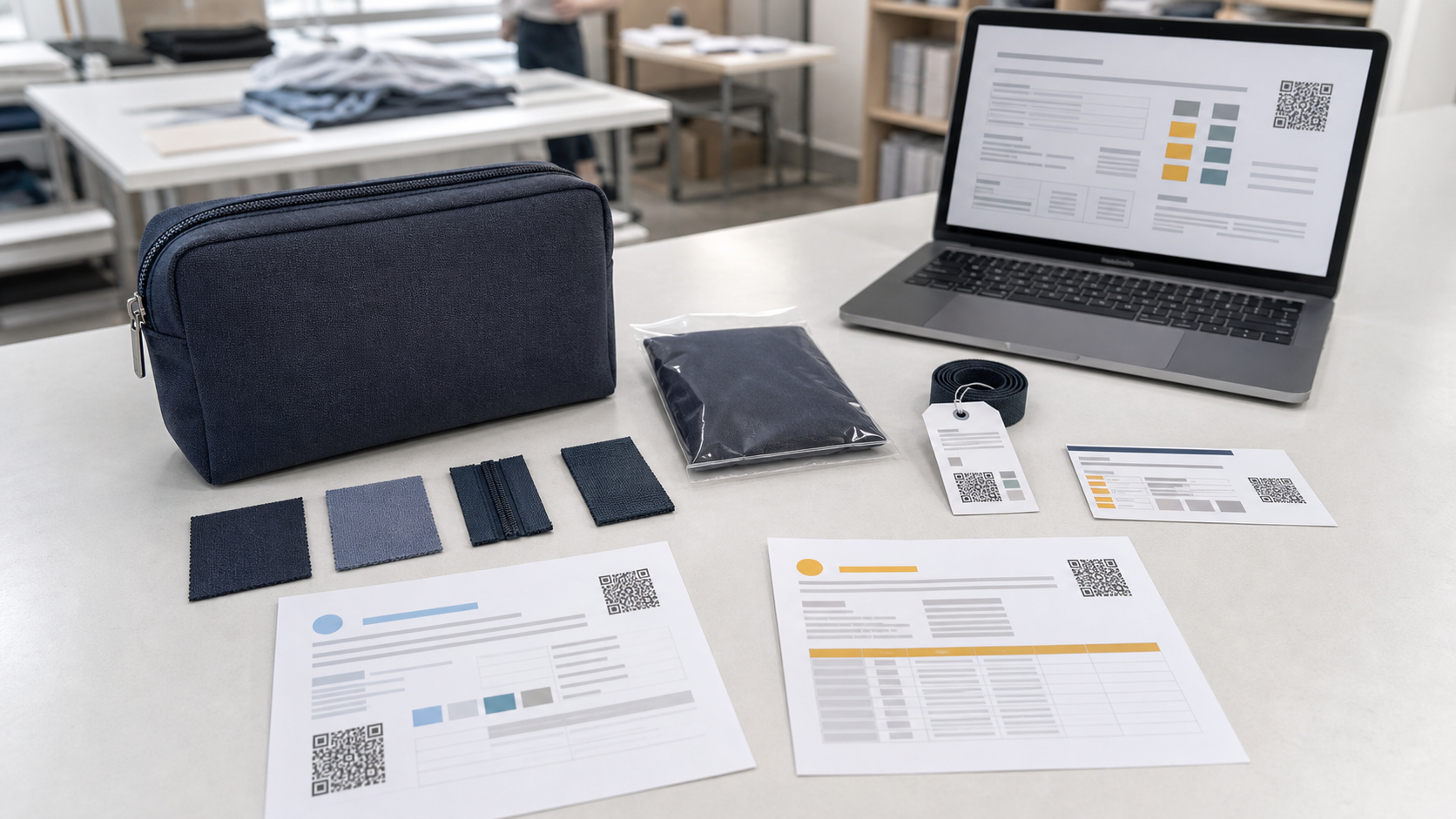
Image note: the traceability images are illustrative. They do not establish bottle origin, feedstock category, recycled percentage, chain of custody, certification, transaction evidence, material identity, compliance, product performance, site ownership, inventory, capacity, price, MOQ or timing.