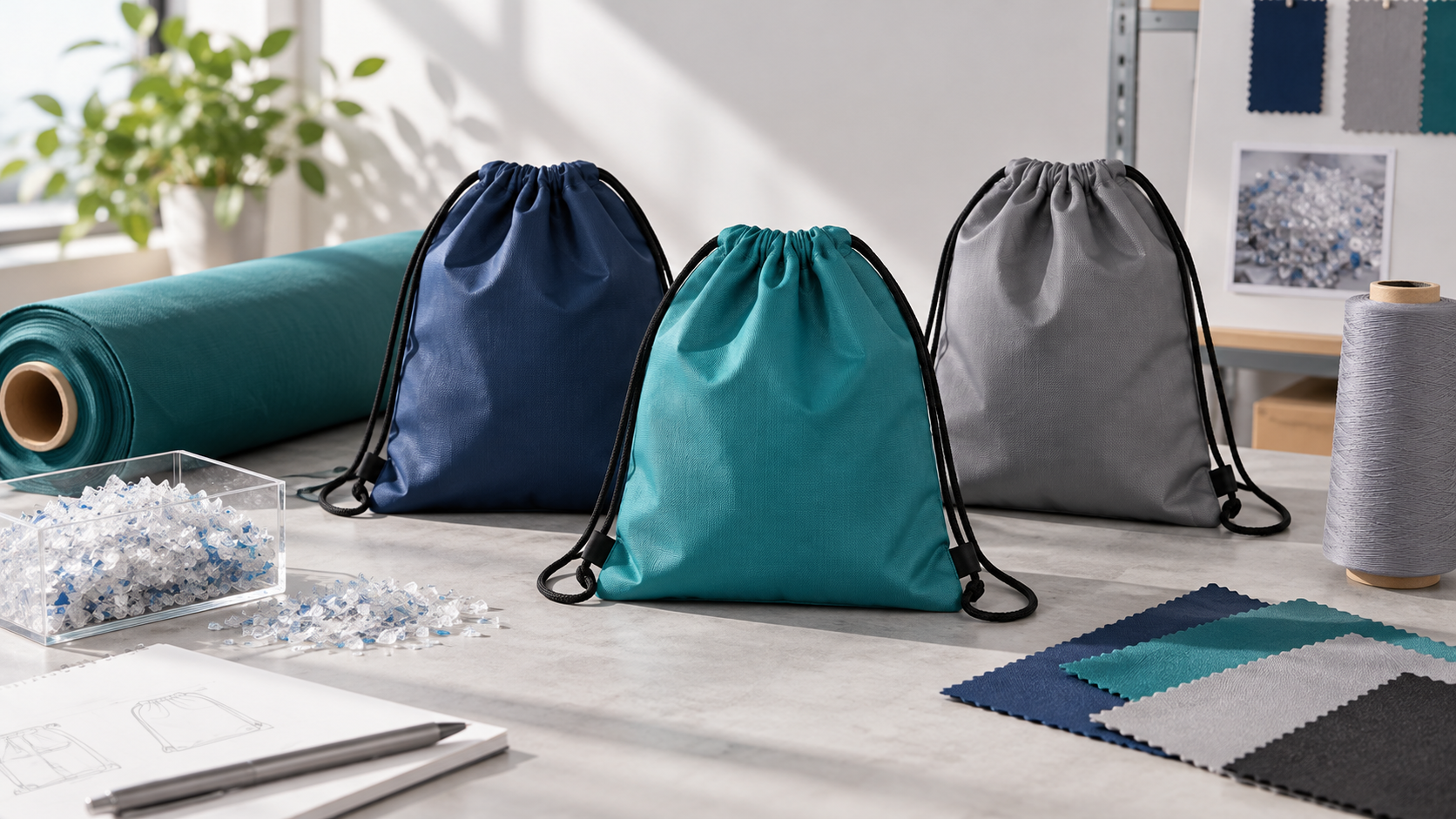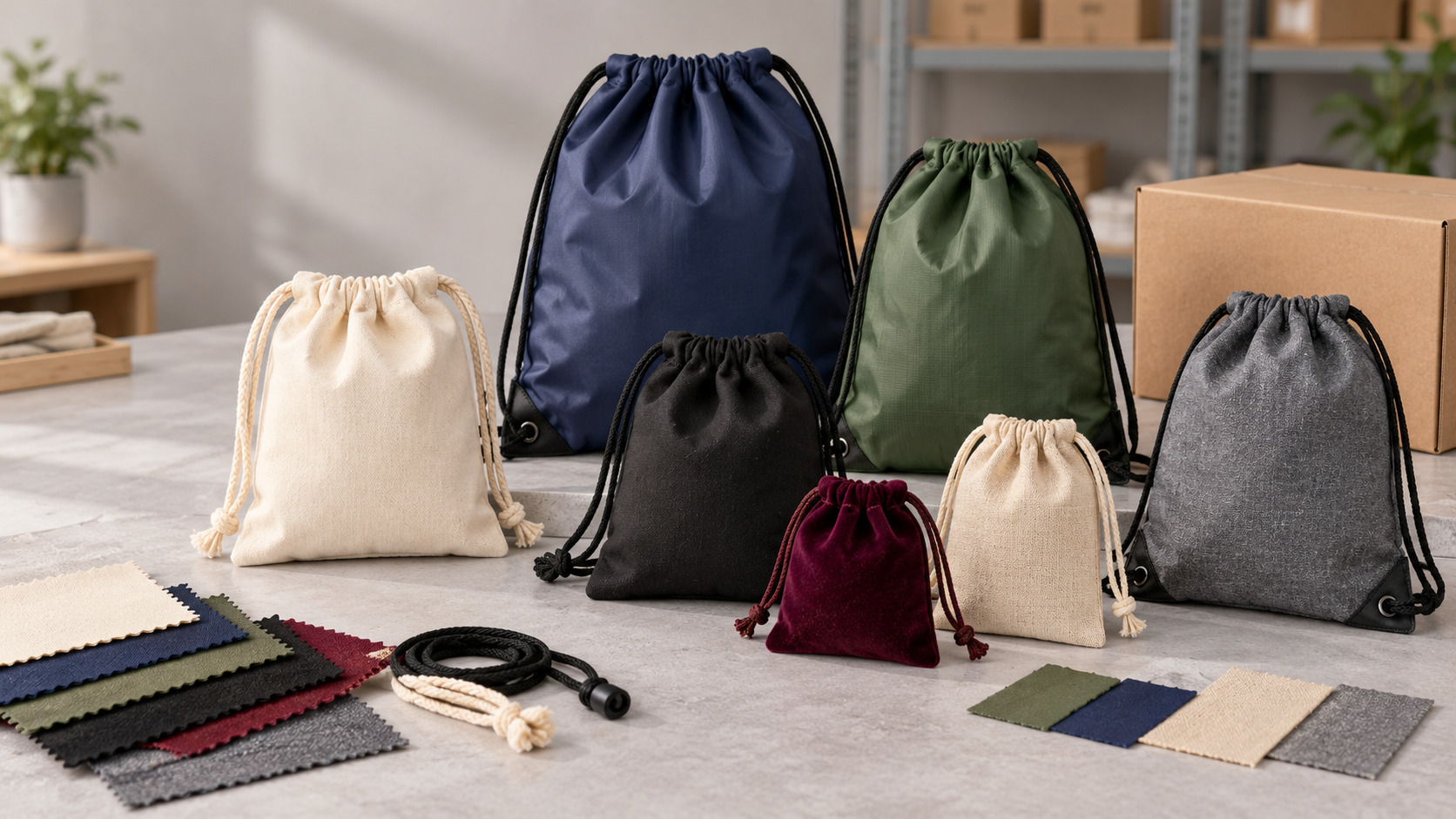
A lower cosmetic bag price is not automatically a saving. If the lower number comes from a weaker zipper, inconsistent coating, fewer reinforcement stitches or an undersized interior, the cost has only moved from the purchase order to rejects, complaints, repacking or lost brand value.
Planning an order? Send the current specification and cost target already known. Identify what must remain fixed, what may change, the intended contents and quality requirements, quantity by SKU, packing, destination and required arrival date.
Real cost reduction works differently. It protects the features customers notice and depend on, then removes material waste, unnecessary parts, difficult operations, fragmented purchasing and avoidable revisions. This is value engineering: keep the required function and quality while finding a more efficient route to make, pack and repeat the product.
This guide shows beauty brands how to reduce custom cosmetic bag costs through design and process choices rather than silent downgrades. Review LUCKYSTAR’s custom cosmetic bag manufacturing range, use our cosmetic bag manufacturer selection framework to evaluate supplier capability, and connect cost decisions to the complete custom bag sourcing guide.
Quick answer: reduce waste before reducing quality
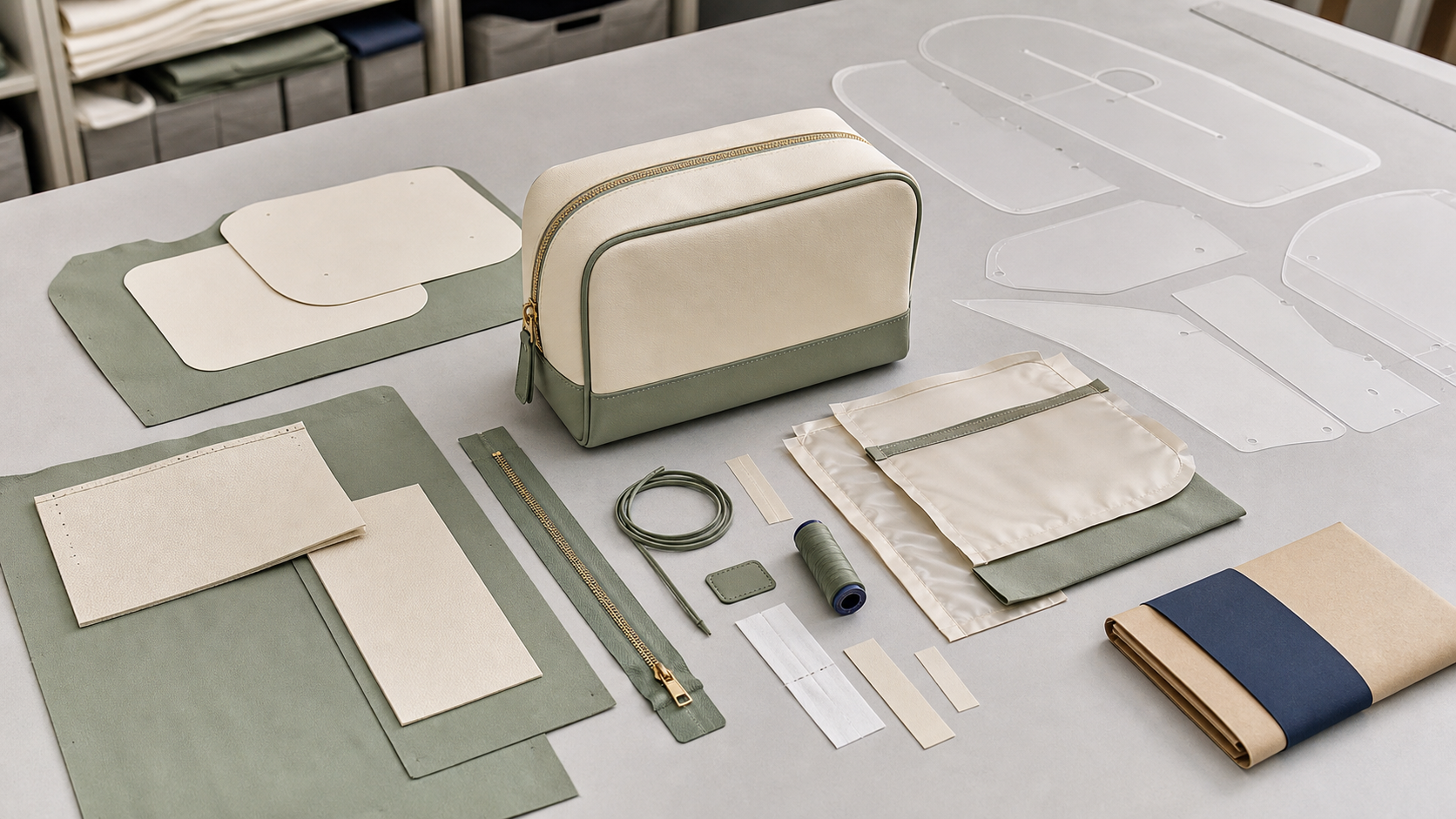
Start by defining what cannot change: usable capacity, appearance, closure reliability, attachment strength, cleanability, brand color, claim and target-market requirements. Build a cost tree for everything else. Then work from the largest controllable drivers—material consumption, labor operations, custom components, SKU fragmentation and shipping volume—before negotiating cents from a supplier.
A strong cost-down proposal should show the original specification, proposed change, reason, expected cost direction, quality risk, evidence required and approval owner. Nothing should change in bulk production unless the approved sample, BOM and technical documents change with it.
| Cost-down principle | Protect | Optimize | Never do silently |
|---|---|---|---|
| Function first | Capacity, access, carry and required protection | Dimensions, pockets and construction route | Shrink the bag until products no longer fit |
| Visible value | Brand color, hand feel,logo clarity and finished shape | Hidden layers and non-critical trim | Replace an approved surface with a cheaper lookalike |
| Reliability | Zipper, seams, attachments and clean interior | Part count, stitch paths and standard components | Remove reinforcement without a load review |
| Repeatability | Approved BOM, tolerances and test criteria | Stock choices, shared parts and fewer variants | Allow unspecified substitutions to hit a target |
| Total cost | Saleable yield and launch timing | Packing cube,inspection effort and revision control | Compare unit price while ignoring exclusions |
1. Define the quality floor before opening the cost discussion
“Do not sacrifice quality” is too broad to guide a factory. Translate it into a short list of critical-to-quality requirements. These are the features that protect the customer experience, safety, compliance, claim or brand position. Rank them as fixed, negotiable within limits or optional.
For a gift-with-purchase pouch, clean branding and consistent assortment packing may be fixed while an interior pocket is optional. For a retail travel organizer, closure access, lining cleanability and loaded shape may be non-negotiable. A decision hierarchy lets the supplier propose alternatives without guessing where compromise is acceptable.
| Requirement class | Example | Cost-down rule | Approval evidence |
|---|---|---|---|
| Fixed function | Fits a named beauty set and closes without forcing | Change geometry only after another fit trial | Loaded sample with agreed contents |
| Fixed quality | Handle and zipper meet approved performance | Simplify only if tests still meet the criterion | Comparable test results and failure review |
| Controlled aesthetic | Exterior color and matte hand feel | Evaluate stock alternatives against physical reference | Labeled swatch and finished sample |
| Negotiable detail | Pocket count, decorative piping or custom puller | Compare function and perceived value per added cost | Side-by-side option review |
| Optional launch feature | Complex individual gift box | Defer until sales volume justifies it | Channel and margin decision |
2. Build a cosmetic bag cost tree
Ask for more than a single unit number. You may not receive every factory calculation, but the supplier should explain which decisions drive material, operations, setup, tooling, packaging and quality cost.A cost tree turns a vague negotiation into specific engineering questions.
The separate 2026 cosmetic bag pricing guide explains price composition and landed cost. This article goes further into changing the design and workflow after the drivers are understood.
| Cost branch | What creates it | Useful question |
|---|---|---|
| Direct material | Consumption, usable width, yield, defects, coating, color and minimum | Which layer has the highest extended cost per bag? |
| Components | Zipper, slider, puller, hardware, labels, foam and reinforcement | Which custom part can become a proven standard part? |
| Conversion labor | Cutting, printing, sewing, turning, binding,trimming and assembly | Which operation adds time without customer value? |
| Setup/tooling | Print screens, molds, dies, color matching and line change | Can several SKUs share the same setup? |
| Quality | Prevention, testing, inspection, rework, sorting and rejects | What early control prevents a larger failure cost? |
| Packaging/logistics | Unit pack, inserts, carton, cube, weight and handling | Are we paying to ship unused space? |
| Complexity | Colors, artworks, sizes, suppliers and revision rounds | Which variants could share one platform? |
3.Run the cost-down workshop on a physical sample
Lay the approved or target bag on a table and identify every panel, layer, seam, component, decoration and packing item. Mark each item as customer-visible, function-critical, required by compliance, production-enabling or optional. This teardown makes hidden complexity visible.
Invite product, sourcing, brand, quality and the factory’s development team. A buyer may see a decorative seam; the sample technician may see three pattern pieces, two alignment points and an extra machine change. The brand team may know that the seam is not important to customers. Those perspectives create a safe simplification.
| Workshop step | Output | Decision question |
|---|---|---|
| Product teardown | Panel, layer, component and operation map | Why is each item present? |
| Quality lock | Protected requirements and test limits | What failure is unacceptable? |
| Cost-driver ranking | High,medium and low opportunity list | Where can one change affect many units? |
| Alternative generation | A/B options with assumptions | Does the change preserve the product job? |
| Risk review | Test, sample and approval needed per option | How will we prove equivalence? |
| Controlled release | Revised BOM, sample and quotation | Is every approved change traceable? |
4. Optimize dimensions around the actual contents
Oversizing consumes shell, lining, support, zipper length and carton space. Undersizing causes a different cost: poor fit, overloaded seams and customer disappointment. The goal is right-sizing, not simply making the bag smaller.
Arrange the intended products in realistic orientation, add access clearance, then define the finished interior and exterior geometry. Test rigid palettes, caps and pumps at the opening.Our cosmetic bag size and capacity guide provides a complete fit-and-measurement method.
| Dimension decision | Cost effect | Quality safeguard |
|---|---|---|
| Width/height | Changes panel consumption, print area and carton footprint | Fit the largest named item through the opening |
| Gusset/depth | Changes capacity,base support and pattern yield | Review loaded stability and seam strain |
| Opening length | Changes zipper consumption and assembly | Confirm access with intended products |
| Pocket allowance | Adds fabric, elastic, sewing and inspection | Keep only pockets with a defined product job |
| Folded pack size | Affects individual pack and freight cube | Check recovery, creasing and decoration marks |
5. Improve cutting yield before selecting a cheaper fabric
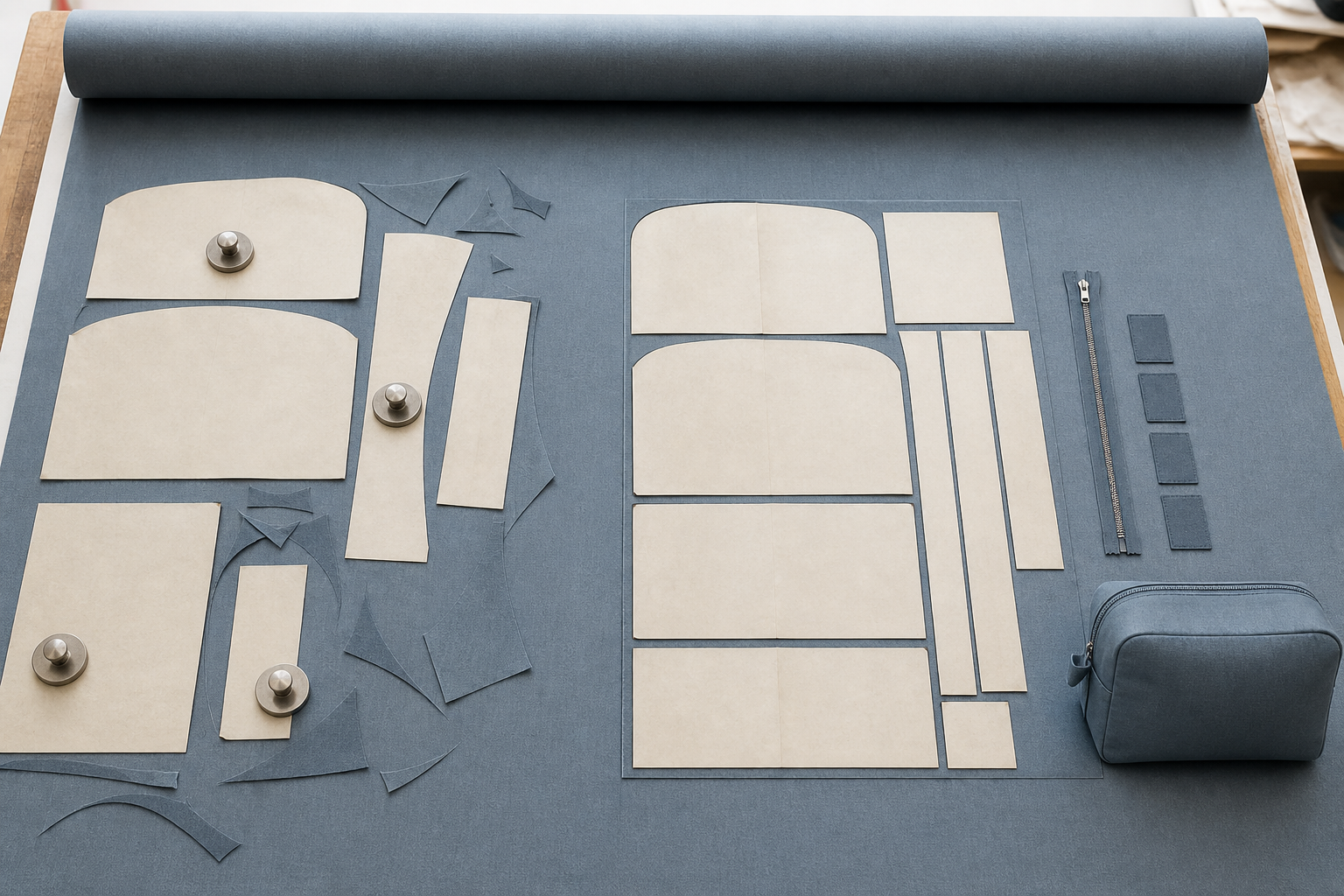
Material is purchased by length, area, weight or sheet, but bags use cut shapes. Usable width, grain direction, print repeat, nap, defects and pattern geometry determine how much becomes product. A slightly more expensive material with better usable yield can cost less per accepted bag than a low-priced material that creates more waste.
Ask the pattern team to test nesting alternatives. Small geometry changes—within protected capacity and appearance—may let panels interlock more efficiently. Shared panel sizes across a collection can also improve marker utilization and simplify cutting control.
| Yield lever | Possible saving | Watch carefully |
|---|---|---|
| Panel nesting | Less offcut between curves and corners | Grain,stretch direction and visual orientation |
| Usable fabric width | More complete panels per row | Edge defects and coating consistency |
| Print repeat/placement | Fewer placement losses for non-directional artwork | Brand motif alignment and approved appearance |
| Shared panel platform | Larger efficient cutting groups across styles | Do not erase meaningful product differentiation |
| Defect allowance control | Less avoidable replacement cutting | Incoming inspection and traceability remain necessary |
6.Simplify construction without removing structural logic
Every extra panel, curve, pocket, binding pass and turned corner creates cutting, handling, alignment and inspection work. The right question is not “How many parts can we delete?” but “Which construction gives the required form with fewer chances for variation?”
A two-piece body may replace several decorative panels. A folded pocket can replace a separately bound pocket. One controlled reinforcement patch may work better than extra stitches placed inconsistently. Prototype each change because labor savings disappear if the new route is difficult to sew or produces more rejects.
| Complex detail | Value-engineered direction | Quality proof |
|---|---|---|
| Decorative multi-panel front | One panel with print, emboss or controlled color block where appropriate | Appearance approval and decoration durability |
| Several small internal pockets | One divided pocket sized to real products | Loaded organization and access trial |
| Binding on every interior edge | Use a clean turned or bagged construction where compatible | Raw-edge control,clean interior and seam performance |
| Complex shaped base | Simpler gusset or boxed-corner geometry | Capacity, stability and shape recovery |
| Redundant reinforcement | Place one engineered reinforcement at the load path | Attachment and loaded-use validation |
7. Choose materials by delivered value, not price per meter
Compare materials as complete systems: purchase price, usable yield, MOQ, finishing, sewing behavior, defect risk, cleaning performance and approved appearance. Moving from custom-dyed material to a close stock color may remove a minimum and shorten the schedule. Changing from PU to polyester can transform the visual and functional proposition, so it is not an automatic substitute.
Review the best cosmetic bag material guide and the specific PU versus polyester comparison before changing a customer-facing surface.Never reduce fabric weight or coating thickness by description alone; build a sample and repeat the relevant quality checks.
| Material strategy | Cost opportunity | Risk to manage |
|---|---|---|
| Stock color/finish | Avoids custom dye setup and minimums | Brand color tolerance and continuity |
| Common substrate, varied decoration | Consolidates material purchase across SKUs | Artwork compatibility and collection differentiation |
| Appropriate weight/thickness | Removes over-specification | Hand feel, opacity,seam and durability must remain acceptable |
| Available lining platform | Shares purchasing and production learning | Stain, cleanability and color-transfer behavior |
| Alternative support layer | Reduces material or lamination complexity | Shape, compression recovery and bonding |
8. Standardize hidden components that do not create brand value
Customers may care that the zipper feels smooth, but not that an invisible reinforcement uses a unique color. Standard lining weights, zipper tapes, threads, elastic widths, foam grades and reinforcement materials can be shared across several styles when they meet the specification.
Standardization increases purchasing concentration, reduces changeovers and makes repeat orders easier to control. It must be documented: “standard zipper” is not a specification. Record gauge, chain, tape, slider, color and performance basis. Use the cosmetic bag zipper and hardware guide to define the customer-facing and hidden parts separately.
| Component | Standardize where possible | Keep custom when |
|---|---|---|
| Zipper chain/tape | Gauge, supplier platform and stock color family | Appearance or performance requires a different construction |
| Slider/puller | Proven slider with simple branded pull tab | A signature molded puller earns clear brand value |
| Lining | One tested stock platform across compatible styles | Print,color or cleanability is a defining feature |
| Thread/binding | Controlled quality and limited color family | Visible contrast is part of the design |
| Reinforcement | Approved hidden grade and placement logic | Load path or material compatibility changes |
9. Match decoration cost to what the artwork needs
Decoration cost depends on setup, color count, coverage, placement, surface preparation, application time and reject risk. A small clean logo does not always need a metal plate or dense embroidery. Conversely, the cheapest print method can be poor value if it cannot reproduce the brand or adhere to the chosen surface.
Ask for at least two production-ready decoration options on the actual material. Compare appearance at normal viewing distance, tactile effect, durability, setup and unit economics at the intended quantity. Simplify artwork intelligently—fewer colors, controlled size or one placement—without weakening recognition.
| Branding direction | Cost logic | Suitable question |
|---|---|---|
| Single-color screen print | Setup is spread over volume; efficient for suitable artwork/surface | Does the ink retain coverage and adhesion? |
| Heat transfer | Supports detail but includes transfer and application | Does the edge/flex result suit the material? |
| Woven label | Can share across styles and use a simple seam insertion | Is the size readable without adding an operation? |
| Embroidery | Cost rises with stitch count, coverage and handling | Can artwork be simplified without losing identity? |
| Metal plate/custom mold | Tooling, finish and attachment add separate controls | Will the feature be reused across enough volume? |
10. Control SKU fragmentation before chasing a lower MOQ
An order of 5,000 units is not one efficient quantity if it becomes ten colors, two sizes and three artworks. Each split may create material, zipper, print, packing and changeover constraints. A focused launch can cost less per saleable unit and create clearer demand data.
Use one base construction with a disciplined color and artwork architecture. Share hidden parts and packaging wherever the customer will not perceive a compromise. The cosmetic bag collection design guide explains how to create variety without turning every SKU into a separate development project.
| SKU decision | Cost impact | Lower-complexity route |
|---|---|---|
| Many exterior colors | Separate material/zipper lots and changeovers | Launch core colors, add proven demand later |
| Several lining prints | Separate print setup and matching risk | One shared lining with exterior differentiation |
| Unique size per set | New patterns,samples and packaging | Create a small platform of validated sizes |
| Different puller for every SKU | Molds, plating, assembly and small lots | Use one signature puller across the collection |
| Country-specific pack-out | Labels, inserts and assortment complexity | Separate late-stage labels from a shared product core |
11. Use MOQ as a design signal
When a component MOQ is too high, identify what creates it. The answer may be custom dye, printed lining, zipper tape color, molded hardware or packaging—not the sewing factory’s headline minimum. Redesigning the constraint can be better than forcing the supplier to split an uneconomical lot.
Ask for three scenarios: the requested quantity, the next efficient production point and a stock-component version. Compare total cash exposure, leftover material, unit economics, schedule and quality risk. The cosmetic bag MOQ and production-time guide maps component minimums and color splits in detail.
| MOQ constraint | Possible response | Trade-off |
|---|---|---|
| Custom exterior color | Select approved stock shade or consolidate colors | Less exact color matching |
| Printed lining | Use shared stock lining and move branding outside | Less interior storytelling |
| Molded puller | Standard puller plus branded tab or charm | Different tactile identity |
| Small color split | Fewer launch colors or shared zipper/lining | Narrower initial assortment |
| Retail packaging | Stock structure with localized label/sleeve | Less custom structural packaging |
12. Reduce packaging cube, not product protection
A lightweight cosmetic bag can be billed by dimensional weight in parcel channels when the carton is large relative to actual mass. Carrier rules and divisors vary, so calculate with the chosen service. Even in ocean freight, unused carton volume increases the number of cartons and handling needed.
Test whether the bag can nest, fold or ship with a smaller insert without creasing the coating, crushing the structure or marking the logo. Right-size the unit pack and master carton as one system. The beauty-brand cosmetic bag packaging guide covers pack-out development and channel risks.
| Packaging lever | Cost benefit | Quality control |
|---|---|---|
| Right-size unit bag | Less film/paper and tighter master carton | No compression marks or adhesive contact |
| Controlled flat fold | Lower packed volume | Approved fold line and recovery trial |
| Shared carton footprint | Simpler purchasing and pallet planning | Weight and compression limits remain suitable |
| Remove redundant insert | Less material and assembly | Bag and decoration remain protected |
| Late-stage localized sleeve/label | Shares core packaging across markets | Correct language, barcode and assortment verification |
13. Stop paying for uncontrolled sample revisions
Late changes create hidden cost even when the unit price does not move. A new zipper color may require another material booking; a logo shift may restart artwork; a size change can affect pattern, lining, pockets, carton and test samples. Control decisions before production-intended materials are committed.
Send consolidated comments with measurements and annotated photos. Identify which feedback is a correction, which is a new request and which is optional. Use the cosmetic bag sample development workflow and document every approved change in the cosmetic bag tech pack.
| Revision waste | Prevention | Evidence |
|---|---|---|
| Conflicting stakeholder comments | One decision owner and consolidated review | Single dated comment sheet |
| Screen-only color approval | Approve a physical swatch/reference | Labeled retained standard |
| Unclear measurement change | Use POM diagram and before/after value | Revised measurement chart |
| Late logo change | Freeze artwork/version before PP sample | Approved strike-off and artwork file |
| Substitute without review | Formal change request and impact review | Updated BOM and approved sample |
14. Treat quality prevention as a cost-saving tool
Quality cost includes more than inspection. Prevention and appraisal occur before shipment; internal failures create rework, sorting and scrap; external failures create returns, replacements, complaints and damage after delivery. Removing all controls may reduce one visible line while increasing total cost.
Focus controls where variation begins. Confirm incoming color and coating before cutting. Check logo position before thousands of panels are printed. Review zipper installation and seam trend during sewing. Final inspection remains important, but it should not be the first time a recurring problem is discovered.
| Quality cost | Cosmetic bag example | Lower-total-cost action |
|---|---|---|
| Prevention | Clear BOM, approved swatch and operator method | Spend early to stop repeat failure |
| Appraisal | Incoming, inline, test and final inspection | Match sampling and checks to risk |
| Internal failure | Reprint, resew, replace zipper or sort color | Find cause before more units enter the process |
| External failure | Returns, replacements,relabeling or launch disruption | Use traceability and corrective action, not only credits |
15. Keep the tests that protect the promise
Testing should be risk-based, not removed automatically. If a cost change affects material, seam, zipper, coating, print, attachment, washing or water claim, identify which evidence must be repeated. A lighter fabric may need seam and abrasion comparison. A standard puller may require attachment and function review. A new pack-out may need conditioning and transit checks.
Use our custom cosmetic bag testing guide to select relevant methods and acceptance criteria, then use the bulk cosmetic bag quality checklist for production release. These controls protect savings from being erased by poor saleable yield.
16. Request option-based quotations
A factory can provide better value engineering when it knows which requirements are fixed. Ask for a base quotation and two controlled alternatives, not an unexplained “best price.” Each alternative should list exactly what changes, the quality implication, the sample needed, MOQ, schedule and commercial basis.
| Quotation option | Purpose | Required disclosure |
|---|---|---|
| A: specified design | Provides the controlled baseline | Exact BOM, construction, packing, quantity and trade term |
| B: low-risk value engineering | Uses stock/shared items without changing the product job | Every material/component difference and approval step |
| C: redesigned cost target | Changes geometry or feature architecture more substantially | New sample, quality risks, MOQ and expected schedule |
17.Compare total cost per accepted and saleable bag
Normalize all quotations to the same specification, quantity split, packaging, testing, inspection, freight basis, duty/tax assumptions and exclusions. Then calculate the cost per accepted unit rather than dividing by the ordered quantity if rejects or unusable material are expected.
Program cost per accepted bag = total development, production, quality and logistics spend ÷ accepted saleable quantity. When reuse is central to the campaign, estimate cost per realistic use as a secondary measure. Do not claim a durability benefit that has not been designed and tested.
| Comparison line | Include | Why it changes the decision |
|---|---|---|
| Development | Pattern, samples, tooling, tests and courier | Small runs carry more cost per unit |
| Production | Bag, setup, leftover custom material and packing | A low unit number may exclude required items |
| Quality | Inspection, rework, rejects and replacement allowance | Saleable yield matters more than ordered quantity |
| Logistics | Freight,duty/tax, handling and dimensional weight where applicable | Bulky packing can erase product savings |
| Timing risk | Approved assumptions for launch and material readiness | Emergency freight and missed campaigns are costly |
18. Use a cost index to compare ideas before exact quotations
During concept development, exact prices may not yet be available. Use an illustrative index rather than inventing currency values. Set the current design at 100 and show the directional effect of each proposal. The table below is a method example, not a quotation or promised saving.
| Illustrative design | Cost index | Protected quality | Change requiring proof |
|---|---|---|---|
| Original multi-panel bag | 100 baseline | Capacity, color, closure and shape | None; reference only |
| Shared lining and stock zipper | Lower direction | Interior cleanliness and zipper performance | Color,stain and function comparison |
| Simplified front panel | Further lower direction | External silhouette and brand impression | Appearance and seam review |
| Right-sized pack-out | Lower delivered-cost direction | Recovery and surface protection | Packed conditioning and transit trial |
Cost cuts that usually create false savings
- Reducing fabric weight without a functional review. Opacity, seam behavior, hand feel and durability may change.
- Downgrading the zipper after sample approval. The customer notices closure problems immediately.
- Removing reinforcement from a load path. Delete it only after the revised assembly is validated.
- Using one vague material name. “Polyester,” “PU” and “nylon zipper” do not control the actual grade.
- Splitting volume across too many variations. Total volume does not erase component and setup minimums.
- Cutting inspection instead of preventing defects. A weak process becomes more expensive when problems reach customers.
- Choosing the lowest EXW number. Normalize packing, trade term, freight, quality and saleable yield.
- Changing several features in one sample. If performance changes, the cause becomes difficult to isolate.
Why choose LUCKYSTAR for cosmetic bag cost optimization?
LUCKYSTAR can review the bag as a manufacturing system: intended contents, pattern pieces, shell and lining, zipper, reinforcement, decoration, SKU plan and pack-out. That perspective helps identify savings a component-only quote will miss, such as a panel change that improves yield, a shared lining that reduces fragmentation or a packaging change that lowers delivered volume.
The goal is not to make every detail cheaper. It is to preserve the features that create function and brand value while engineering the rest for repeatable production. LUCKYSTAR can develop controlled alternatives, compare samples, connect approvals to the BOM and help buyers understand the quality evidence needed for each change.
Explore the wider Product Range. A manufacturer should be able to explain cost drivers, change risks and production controls; our supplier selection article shows what evidence to request.For the full OEM/ODM workflow, return to the Custom Bag Manufacturer Guide.
Cost-down RFQ checklist
| Commercial brief | Product evidence | Cost-down rules |
|---|---|---|
| Target quantity by SKU, color and artwork | Current sample, drawings and BOM | Fixed, negotiable and optional requirements |
| Target cost basis and requested trade term | Named contents, load and capacity | No substitution without written approval |
| Destination, channel and target date | Material, color, logo and finish references | Alternative quotation format requested |
| Packing,labels and carton limits | Tests, claims, tolerances and inspection criteria | Sample and revalidation responsibility |
| Forecast and repeat-order plan | Known customer complaints or failure history | Change log, approval owner and BOM revision |
Frequently asked questions
What is the safest way to reduce custom cosmetic bag costs?
Protect measurable customer and quality requirements first. Then address material yield, unnecessary operations, component standardization, SKU fragmentation and packaging volume. Validate every change that affects function, appearance or compliance.
Should I use a cheaper material?
Not until you compare the complete material system. Price per meter is only one input; consider usable yield, MOQ, sewing behavior, appearance, cleanability, defect risk and required tests. A cheaper purchase price can produce a higher cost per accepted bag.
Does a higher MOQ always reduce total cost?
It may spread setup and improve purchasing efficiency, but it also increases cash, inventory and obsolescence exposure. Compare requested volume with the next efficient tier and a stock-component version rather than assuming the largest quantity is best.
Which features should beauty brands protect?
Protect the features linked to intended contents and customer experience: capacity, opening access, zipper reliability, loaded shape, seam and attachment performance, lining condition, brand appearance, valid claims and applicable market requirements.
Can packaging changes reduce landed cost?
Yes. Right-sized packing can reduce material and shipment volume, but the bag must still recover its shape and arrive without surface, zipper, logo or hardware damage. Test the real pack-out and confirm carrier or freight rules.
How can I compare two cost-down proposals?
Use the same quantity split, specification, packaging, trade term and quality scope. For each changed item, compare the expected cost direction, MOQ, lead time, customer impact, failure risk and evidence needed for approval.
Why is the cheapest quotation risky?
A low price can reflect lighter material, a different zipper, fewer controls, incomplete packaging or a different trade basis. Require an itemized specification and approve physical evidence before treating the difference as a genuine saving.
What makes cost-effective custom cosmetic bags repeatable?
A controlled platform: defined materials, proven components, efficient patterns, simple assembly, focused SKUs, documented tolerances, approved tests and traceable production references. Repeatability is what turns a one-time low quote into sustainable value.
Reduce the work the customer does not value
Effective cosmetic bag cost optimization removes waste from the product and workflow while protecting the experience the customer buys. When every proposal states what changes, what stays fixed and how quality will be verified, brands can lower cost without relying on hope or hidden substitutions.
See LUCKYSTAR’s available custom cosmetic bag constructions, or send your sample and target for a cost-engineering quotation.

Request controlled cost-down options
Include the current sample or specification, intended contents and measurable quality requirements, fixed, negotiable and optional features, quantity by style, color and artwork, packaging, target cost basis, Incoterm, destination and required arrival date.
Send your project details through the contact form, or Email a project brief with this guide already referenced. The email link opens a draft for your review before sending.
Cost-down options, substitutions, validation, MOQ, component minimums, prices, capacity, schedule and delivery terms are subject to specification, samples and written confirmation.