A buyer can approve a perfect dusty rose on a laptop and receive a cosmetic bag that looks mauve in the showroom, orange in daylight or different across the zipper, piping and body. This does not always mean that one party chose the “wrong Pantone.” Screens emit light; fabrics reflect it. Texture, gloss, coating, fiber, dye route and viewing conditions all change what the eye sees.
Planning an order? Send the color-control details already known. Include the physical target and reference system, actual materials and finishes, match intent by component, viewing conditions, approval route, quantity by style and color, destination and required date.
Reliable Cosmetic Bag Color Matching therefore needs a chain of physical and documented approvals. This guide follows that chain from the brand target through lab dips, component matching, instrumental readings, shade bands and bulk release. Explore LUCKYSTAR’s custom cosmetic bags, use How to Choose a Cosmetic Bag Manufacturer when assessing color-control capability, and connect the project to our Custom Bag Manufacturer Guide for the wider sourcing process.
Quick answer: control the approval chain, not only the color code
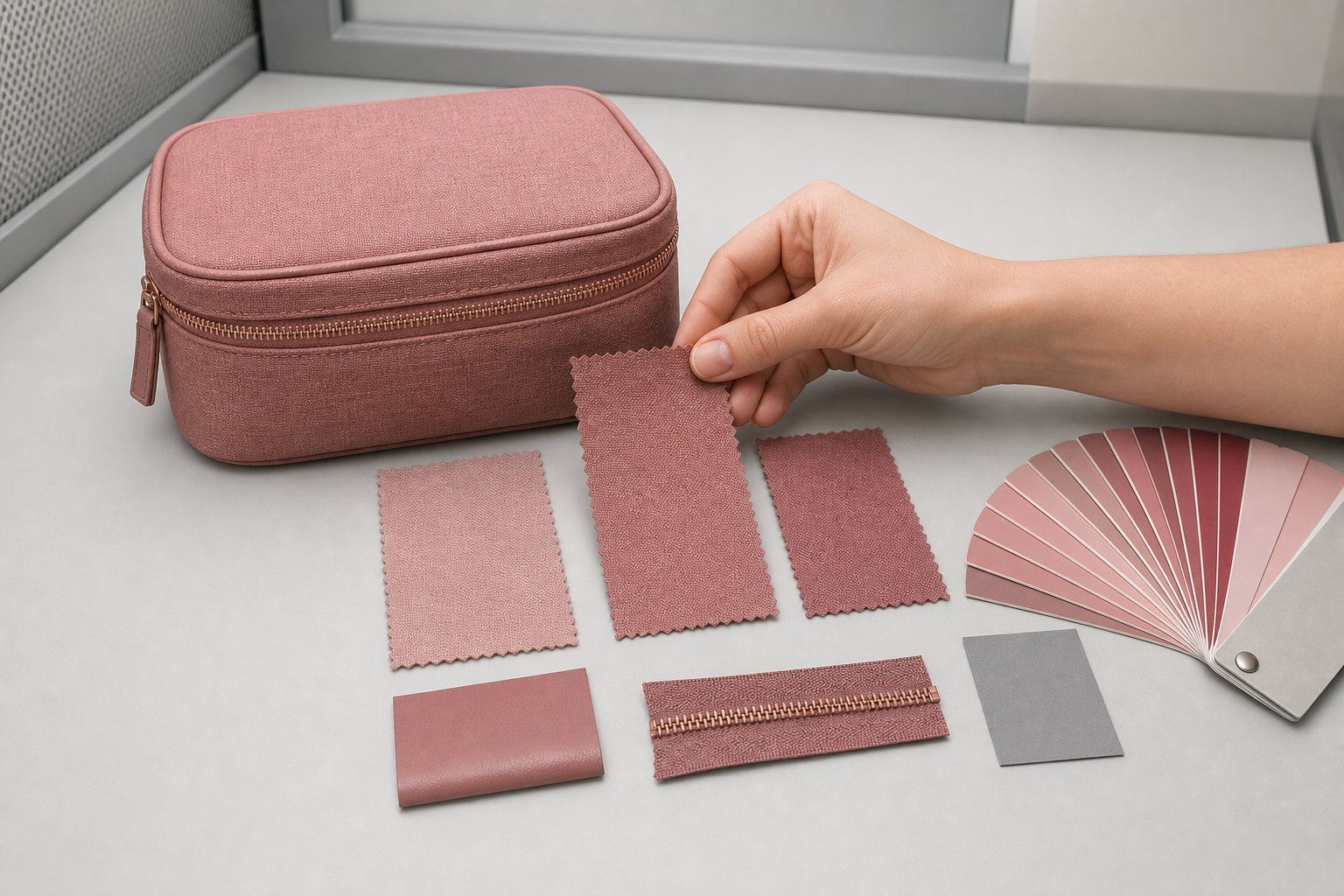
Use a current physical color reference suited to the material category, then ask the material supplier for color submissions on the actual base and finish. Review those submissions under agreed light sources and against a neutral background. Approve one signed master, define any acceptable boundary samples, and make bulk material approval before cutting. Coordinate zipper tape, lining, thread, binding, print and metal finish as related but separate components.
| Stage | Approval object | Main decision |
|---|---|---|
| Brand target | Physical reference plus color name/code | What visual outcome represents the brand? |
| Material development | Lab dips or custom-coated swatches | Which submission is closest on the real substrate? |
| Component coordination | Zipper, lining, thread, binding and logo samples | Should parts match,tone or contrast? |
| Bulk material | Roll/lot shade band and test data | Can the lot be released for cutting? |
| Finished goods | Production bag against approved references | Were approved lots and placement rules maintained? |
1. Define the target before requesting a lab dip
A color number without a reference system, medium or edition can be ambiguous. The same commercial color library may offer separate guides for different uses, and a printed paper chip is not a promise that textile, PU or metal will reproduce identically. State the full reference, supply a physical chip when possible and explain whether the goal is an exact-looking body color, a coordinated family or a deliberate contrast.
| Target field | What to specify | Why it matters |
|---|---|---|
| Color system | Complete library/system and code | Prevents mixing references intended for different media |
| Physical reference | Chip, fabric swatch or approved product | Provides a reflective object for direct comparison |
| Priority material | Outer shell, lining or another hero surface | Defines which component leads the palette |
| Match intent | Match,tonal coordination or contrast | Stops every component being judged against the wrong goal |
| Viewing environment | Retail, daylight, studio or other priority | Guides light-source assessment |
2. Do not approve production color from a screen
Digital mockups are valuable for composition and early palette discussion, but monitors vary in calibration, brightness, gamut and surrounding light. A product photograph adds camera settings, white balance and compression. Even a well-managed digital workflow cannot reveal fabric luster, pile direction or the way a coated surface reflects a highlight. Use images to communicate; use controlled physical samples to approve.
| Reference | Good use | Not sufficient for |
|---|---|---|
| Screen mockup | Palette direction and placement | Final material shade approval |
| Phone photo | Showing a large,obvious issue | Close call between similar submissions |
| Scanned chip | Record keeping and remote discussion | Replacing the physical standard |
| Physical swatch | Direct visual review under defined light | Predicting another substrate without sampling |
| Instrumental data | Quantifying a defined sample comparison | Replacing commercial visual judgment by itself |
3. Expect one target to look different across materials
Polyester weave scatters light between yarns. PU can produce a smooth specular highlight. Velour changes with pile direction. Mesh exposes the layer behind it. Recycled inputs may have base-tone or lot constraints. Lamination, backing, embossing and protective finishes can shift the final appearance after an early swatch was made.Choose the material route first using Best Materials for Custom Cosmetic Bags, then develop color on the construction that will be purchased.
| Surface | Color influence | Approval precaution |
|---|---|---|
| Woven polyester | Yarn shape, weave and luster affect depth | Review folded layers with warp direction aligned |
| PU-coated fabric | Gloss, emboss and coating film alter reflection | Approve the finished surface,not bare base cloth |
| Velvet/velour | Pile direction produces light/dark travel | Compare in the same orientation and stroked state |
| Mesh | Open area combines mesh and background colors | Evaluate over the intended backing or contents |
| RPET textile | Source/base and process constraints may affect shade | Keep traceability tied to the approved article and lot |
4. Decide whether components should match or coordinate
A body, lining, zipper tape, thread and piping made by different suppliers will rarely appear identical without deliberate development. An exact-match brief can add sampling time and minimums yet still look uneven because gloss differs. Tonal coordination is often more realistic: define the body as the master, select trims that sit intentionally lighter, darker or neutral, and document that relationship on an assembled sample.
For PU and textile combinations, the comparison in PU vs Polyester Cosmetic Bags helps explain why one code does not produce one appearance.
| Palette route | Best when | Approval method |
|---|---|---|
| Closest practical match | Brand needs a quiet monochrome product | Review all materials together on an assembled unit |
| Intentional tonal family | Surfaces have visibly different gloss/texture | Approve the relationship, not isolated code equality |
| Deliberate contrast | Zipper,lining or logo is a design accent | Name exact component colors and placement |
| Stock trim compromise | MOQ, lead time or budget is the priority | Approve a physical trim card against the body dip |
5. Understand what a lab dip is—and what it is not
A lab dip is a small material color submission created before bulk dyeing, commonly used for textiles. It demonstrates a proposed recipe and process direction on a defined base. It is not automatically equivalent to the finished bag, and it does not guarantee that later bulk lots will fall within an unstated tolerance. Coated PU, webbing, molded parts, print and metal may use other submission forms such as custom coating swatches, strike-offs, molded chips or plated samples.
| Component/process | Typical color submission | Final approval object |
|---|---|---|
| Dyed textile | Lab dip options on nominated base | Approved dip plus bulk shade band |
| PU surface | Finished coating/emboss swatch | Production article with actual finish |
| Printed logo/pattern | Strike-off on production material | Signed print standard and bulk check |
| Plastic part | Molded resin color chip or component | Approved molded part from nominated resin |
| Metal finish | Plating sample | Sealed hardware reference |
6. Write a complete lab-dip request
Send the target, exact substrate, required finish, priority light sources, intended use and requested submission date together. Ask for clearly identified options rather than unlabeled scraps. If several suppliers are involved, use one naming format so option “B” cannot be confused across body, lining and zipper. Request enough swatch area to fold or layer the material and to keep a sealed retention piece.
| Request field | Required detail | Risk if omitted |
|---|---|---|
| Target identification | Full system/code plus physical target | Supplier matches a different interpretation |
| Base article | Composition, construction, weight/gauge and finish | Good color is made on the wrong material |
| Submission set | Option IDs, size,quantity and backing | Remote reviewers cannot track decisions |
| Viewing setup | Priority illuminants and visual arrangement | Teams approve under inconsistent light |
| Schedule | Submit, comment, resubmit and bulk-ready dates | Color approval delays cutting |
7. Evaluate lab dips in a repeatable viewing setup
Condition the target and submissions in the same environment before review. Place them on the same neutral backing, use consistent layers, align fabric direction and keep glossy pieces at a repeatable angle. Avoid judging immediately after looking at a strong color; allow the eye to rest on neutral gray. Review quickly enough that perception does not drift, then record the decision outside the booth.
| Setup variable | Control | Reason |
|---|---|---|
| Backing | Same neutral backing for target and dips | Background can influence thin/open materials |
| Layer count | Same number of folds or opaque layers | Translucency changes apparent depth |
| Material direction | Align warp,pile or grain | Directional reflection can mimic shade change |
| Observer position | Repeat distance and viewing angle | Gloss changes with geometry |
| Surround | Neutral booth and clothing where practical | Strong nearby colors bias perception |
8. Approve under more than one relevant light source
A color may look close under a daylight simulation and separate under store lighting. Select illuminants that represent the real journey: development room, retail environment, studio photography or consumer use. Name the primary light under which the commercial decision is made and a secondary source used to detect problematic shifts. Do not use casual office light as an unnamed universal standard.
| Viewing condition | Possible role | Question |
|---|---|---|
| Daylight simulation | Primary neutral comparison | Does the submission match the brand target? |
| Retail fluorescent/LED simulation | Store appearance check | Do body and trims separate unexpectedly? |
| Warm household light | Consumer-environment check | Does the palette remain commercially acceptable? |
| Actual photography setup | E-commerce/studio review | Will highlights or white balance expose a mismatch? |
9. Watch for metamerism
Metamerism occurs when two samples appear to match under one illuminant but differ under another because their spectral responses are not the same. This is common when components use different fibers, pigments or dye classes. It cannot always be eliminated across fabric, plastic, coating and thread, but it can be discovered before production. Judge the complete component set under the agreed primary and secondary lights.
| Pair | Why metamerism risk rises | Practical response |
|---|---|---|
| Polyester body + nylon zipper tape | Different polymers and coloration routes | Develop/approve as a component pair |
| PU shell + textile piping | Pigment film versus dyed fiber | Use tonal intent or test multiple formulas |
| Printed logo + dyed fabric | Ink layer responds differently from substrate | Approve strike-off under both lights |
| Thread + body fabric | Luster and fiber differ at seam angles | Review stitched seam, not loose thread alone |
10. Use L*, a* and b* data to describe direction
CIELAB data can help teams describe how a submission differs from a target. L* relates to lightness; a* runs broadly from green to red; b* from blue to yellow. The values are useful only when measurement conditions are controlled. “Higher b*” is more actionable than “a little dirty” because it indicates a directional change, but visual approval still considers texture, gloss and brand intent.
| Coordinate | Simplified interpretation | Example comment |
|---|---|---|
| L* | Lower is darker; higher is lighter | “Option B is visually acceptable but slightly too dark” |
| a* | Negative/positive direction toward green/red | “Reduce the red direction while holding lightness” |
| b* | Negative/positive direction toward blue/yellow | “The dip needs less yellow,not simply more black” |
| Combined review | Direction plus visual texture/finish | “Data is close; gloss still makes the surface appear lighter” |
11. Do not set a universal ΔE limit
ΔE expresses a calculated color difference, but results depend on formula, instrument configuration, illuminant/observer settings, sample preparation and material behavior. A number accepted for a matte, uniform textile may not work for embossed PU, melange yarn or mesh. Buyer and supplier should agree the method, instrument settings, sample presentation and tolerance for each component before the number becomes contractual.
| Tolerance decision | Why it is material-specific | Better practice |
|---|---|---|
| ΔE formula | Formulas weight visible differences differently | Name the formula in the specification |
| Numerical threshold | Texture and commercial sensitivity vary | Set from acceptable and rejected physical trials |
| Average versus maximum | One roll may vary across width/length | Define sample locations and decision rule |
| Visual override | Instrument may miss directional/gloss impression | Require both data and controlled visual review |
12. Standardize instrumental measurement
A spectrophotometer does not create comparability unless both parties align the setup. Record instrument model where necessary, measurement geometry, aperture, illuminant/observer, treatment of specular reflection, calibration routine, number of readings, fold count and material direction. For a small or patterned component, confirm whether the aperture represents the intended visual field.
| Measurement variable | Control question | Potential error |
|---|---|---|
| Aperture | Does the measured area represent the material? | Tiny area overweights one yarn or emboss feature |
| Sample layers | Is the specimen fully opaque? | Backing influences the reading |
| Orientation | Are repeat readings rotated or aligned by rule? | Directional weave creates inconsistent values |
| Calibration | Was the instrument calibrated and verified? | Apparent drift is measurement drift |
| Reading plan | How many points and which roll locations? | One convenient spot hides lot variation |
13. Approve and seal the master correctly
Record the chosen option with project, material article, color, date, reviewer and conditions. Keep enough material for buyer, factory and material supplier where practical. Protect it from light, moisture, handling contamination and unrecorded substitution. A signed sample is valuable only when everyone can identify the same side, orientation and finish.
| Master-sample field | Record | Storage control |
|---|---|---|
| Identity | Project, material code, color and option | No loose unlabeled swatches |
| Approval | Date,reviewer and status | Superseded versions marked clearly |
| Face/direction | Right side and warp/pile direction | Store without folding damage where possible |
| Viewing/measurement | Agreed conditions and reference data | Keep digital record linked to physical piece |
14. Create a shade band and boundary samples
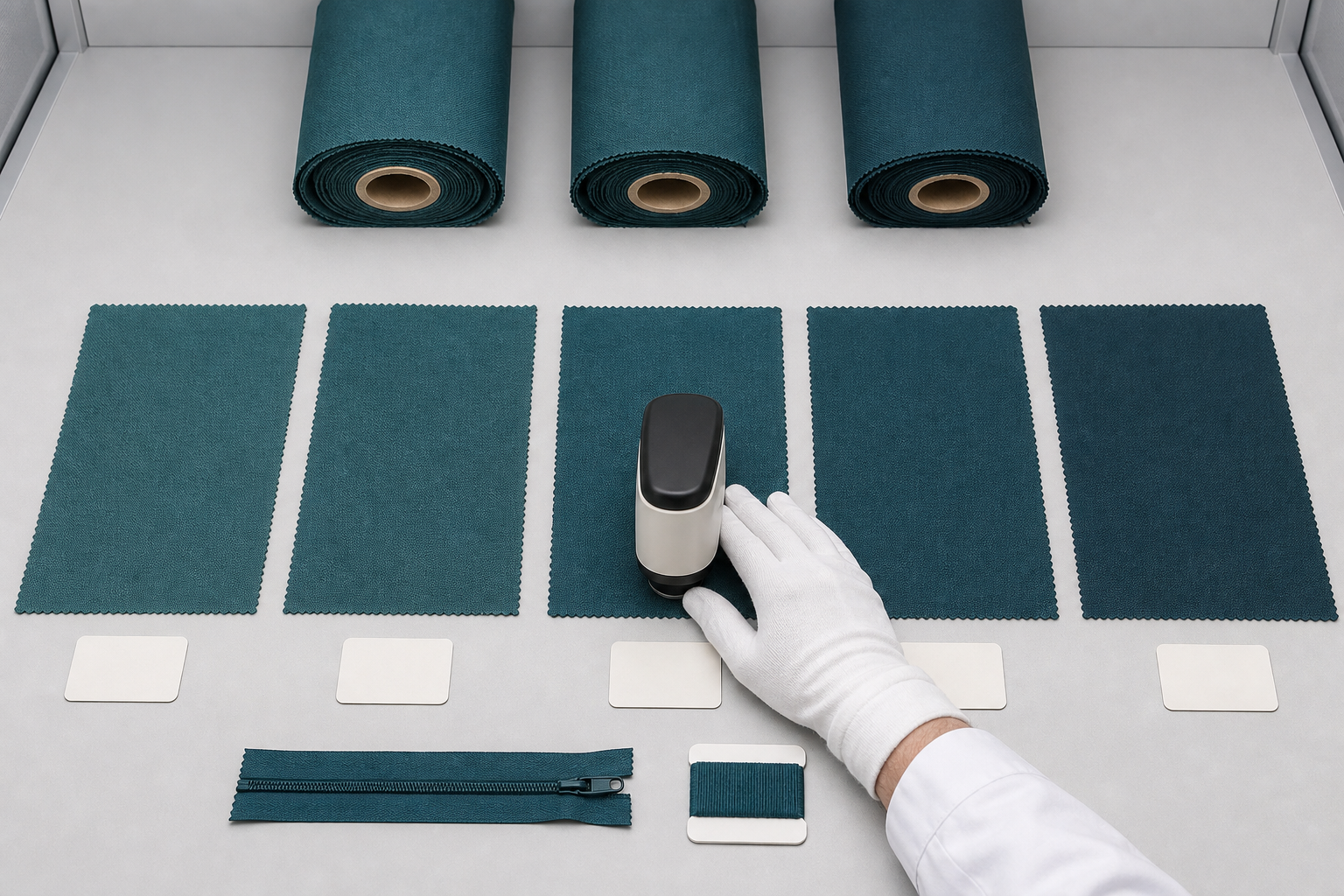
A single approved center shade does not show where acceptance ends. A shade band arranges representative bulk pieces so the buyer can see the distribution. Boundary samples can define the lightest, darkest or directional limits that remain commercially acceptable. They should be intentionally approved limits, not random rejected dips reused without documentation.
| Shade-band element | Purpose | Decision |
|---|---|---|
| Center/master | Shows the intended approved shade | Reference for visual and data comparison |
| Light/dark limits | Defines acceptable L* range visually | Accept,reprocess or segregate lot |
| Hue-direction limits | Shows red/green or yellow/blue boundaries | Avoid mixing visually incompatible units |
| Lot representatives | Reveals production distribution | Approve whole lot, selected rolls or none |
15. Coordinate zipper tape, thread, lining and binding
Trim selection should happen against the approved body material, not from isolated supplier cards. Review zipper tape beside the body and around the actual teeth; judge thread as a stitched seam; place lining inside a folded opening where it will be seen. Hardware color is also influenced by plating gloss and surrounding fabric. The Cosmetic Bag Zipper and Hardware Guide explains the functional decisions that must remain aligned with appearance.
| Component | Review form | Color-specific risk |
|---|---|---|
| Zipper tape | Finished zipper beside body and around curves | Tape looks different next to metal/plastic teeth |
| Sewing thread | Stitched line at production density | Luster makes loose thread card misleading |
| Lining | Folded inside shell under normal opening | Transmitted/reflected light changes relationship |
| Binding/piping | Assembled edge with curvature | Tension and angle alter appearance |
| Metal puller | Plated production component | Finish family varies by supplier and batch |
16. Treat logos and prints as separate color processes
A brand logo specified by the same color code as the bag may disappear because contrast is too low, or appear different because ink sits on top of a textured colored base. Ask for a strike-off using production ink, screen, transfer film or embroidery thread on the approved fabric. Review coverage, opacity, edge, curing and surface change as well as hue.
| Branding method | Color variable | Approve on |
|---|---|---|
| Screen print | Ink mix, deposit and fabric absorption | Production fabric with intended screen setup |
| Heat transfer | Printed film, adhesive and heat effect | Pressed production material after cooling |
| Embroidery | Thread luster,stitch direction and density | Complete motif on reinforced bag panel |
| Metal badge | Plating/enamel and reflective highlight | Finished badge attached to body material |
17. Make bulk color approval before cutting
Review incoming bulk rolls or production lots against the sealed master and boundary samples before material is spread. Pull pieces from defined positions across roll width and from multiple rolls. If approval waits until sewn bags arrive, the buyer has already invested cutting and labor into material that may need segregation or rejection.
| Bulk gate | Evidence | Possible disposition |
|---|---|---|
| Incoming identity | Supplier article, lot and purchase record | Quarantine wrong/substituted material |
| Shade review | Visual band plus agreed instrumental readings | Approve, segregate, reprocess or reject |
| Width/length consistency | Samples from named roll locations | Map usable zones or reject unstable roll |
| Component set | Body,trims and branding submissions together | Release coordinated BOM only |
| Cutting authorization | Signed lot status linked to roll IDs | Prevent unapproved rolls entering production |
18. Map lots and prevent shade mixing
Even acceptable lots may differ slightly from one another. Assign roll and dye-lot identity through spreading, bundling, sewing and packing. Cut all visible panels of one bag from a compatible lot; do not use a front from one shade and a back from another simply because both sit within the overall limit. If multiple lots must ship, discuss carton or order segregation so retail units remain consistent.
| Production point | Lot control | What it prevents |
|---|---|---|
| Roll warehouse | Quarantine/status and roll label | Unapproved material being issued |
| Spreading/cutting | Lay plan by approved compatible lot | Panel-to-panel shade mismatch |
| Bundle movement | Maintain lot-coded bundles | Mixing after cutting |
| Sewing | First-piece check under controlled light | Late discovery on finished stock |
| Packing | Carton/order segregation when required | Obvious variation on one retail shelf |
19. Check surface direction and construction effects
Panels cut in opposite directions may appear like different colors even when they come from one roll. This is especially visible with brushed, satin, twill, embossed or directional surfaces. Seam tension, padding, heat, adhesive and lamination may also change gloss or depth. Approve both a flat bulk swatch and a first assembled production unit.
For coating and lamination projects, the process discussion in Waterproof Cosmetic Bag Manufacturing helps buyers locate where final appearance can change.
| Construction factor | Visual effect | Control |
|---|---|---|
| Nap/weave direction | Light/dark reversal between panels | One-way marker and cutting rule |
| Padding/foam | Changes surface angle and apparent saturation | Approve laminated/assembled stack |
| Heat/pressing | Local gloss or tone mark | Set process and inspect cooled part |
| Seam tension | Puckering produces highlights/shadows | First-piece workmanship standard |
| Adhesive/lamination | Base or surface can shift after bonding | Color submission on final composite |
20. Separate initial color match from colorfastness
A material can match the target on approval day yet change through rubbing, water, perspiration, light, cleaning or migration from another component. Initial ΔE does not establish durability. Build performance checks around material, intended use, destination and buyer requirements, and test the actual finished color/process. Use Which Tests Should Custom Cosmetic Bags Pass? to frame a risk-based plan.
| Question | Initial match review | Durability review |
|---|---|---|
| Does it look right now? | Target,lab dip and bulk comparison | Not answered |
| Will it transfer by rubbing? | Not answered | Relevant dry/wet rubbing evaluation |
| Will cleaning change shade? | Not answered | Defined care exposure on final construction |
| Will components stain each other? | Assembly relationship visible | Migration/contact assessment where risk warrants |
| Will light affect it? | Viewing-light behavior only | Lightfastness requirement if commercially relevant |
21. Put color control into the tech pack and BOM
Every colored component should have an identity, target, submission type, match intent and approval status.Avoid one global note such as “all parts Pantone X.” Link the physical master and latest approved record to the material line. The Cosmetic Bag Tech Pack guide shows how visual approvals connect to dimensions and construction instructions.
| Document field | Example content | Owner |
|---|---|---|
| Component ID | Outer A, lining B, zipper C, thread D | Brand/factory development team |
| Target/match intent | Physical target; exact,tonal or contrast | Brand |
| Approved submission | Dip/swatch/strike-off version and date | Buyer and supplier |
| Tolerance method | Visual limits plus agreed measurement setup | Technical/QC teams |
| Bulk lot status | Approved roll/lot references | Material and factory QC |
22. Build color decisions into sample development
Do not require every early construction sample to use final custom color; that can waste time and obscure fit corrections. Approve structure in available material when appropriate, develop color in parallel, then build a pre-production sample with approved or representative bulk components before cutting. The Custom Cosmetic Bag Sample Development Process helps separate decisions without losing traceability.
| Sample stage | Color expectation | Do not confuse with |
|---|---|---|
| Construction prototype | Stock color may be acceptable if declared | Final shade approval |
| Material color submission | Actual base/finish,sufficient swatch area | Bag shape or workmanship approval |
| Trim/branding strike-off | Evaluated with approved body | Loose card appearance alone |
| Pre-production sample | Approved production-intent component set | Permission to mix unapproved bulk lots |
| First bulk unit | Confirmed lot, cutting direction and assembly effect | A replacement for incoming-roll approval |
23. Plan cost, MOQ and calendar implications
Custom dyeing, coating, zipper tape, elastic, thread or plating can each carry a different minimum and lead time. Multiple nearly identical shades add submission rounds without necessarily improving the product. Decide where custom matching creates visible brand value and where a coordinated stock color is acceptable. For budgeting, combine How Much Do Custom Cosmetic Bags Cost? with the quality-preserving cost reduction guide.
Map approval time into the production route using Cosmetic Bag MOQ and Production Time; color resubmission is a real dependency, not a task to hide inside sewing lead time.
| Program choice | Cost/MOQ effect | Schedule effect |
|---|---|---|
| Custom body color only | Concentrates volume on hero material | One primary material approval path |
| Custom match on every trim | Several component minimums and setup costs | Parallel submissions can delay full set approval |
| Coordinated stock trims | Can reduce trim minimum exposure | Quicker if physical cards are available |
| Many colorways | Fragments order and retention samples | Each shade needs its own decision chain |
| Late target change | May strand developed material | Restarts submissions and bulk recipe work |
24. Inspect color at incoming, in-line and final stages
Incoming material inspection catches lot issues before value is added. In-line checks confirm direction, bundle segregation and construction effects. Final inspection verifies the assembled palette, workmanship and shipment consistency. Use the Cosmetic Bag Quality Control Checklist and attach color-specific aids instead of asking inspectors to remember a verbal standard.
| QC stage | Color checkpoint | Reference |
|---|---|---|
| Incoming | Identity, lot distribution, width/length variation | Master, limits and measurement plan |
| Cutting | One-way orientation and lot segregation | Marker direction and roll map |
| First-piece | Panel relationship,trim combination and assembly gloss | Approved production-intent sample |
| In-line | Bundle identity and emerging mismatch | Lot-coded work instructions |
| Final | Complete bag and carton/order consistency | Sealed sample plus boundary set |
25. Keep collection colors scalable and traceable
A collection may share one body color across several sizes while using different material constructions, or repeat one trim family across multiple body colors. Approve each actual material relationship; do not assume a color signed for one SKU transfers automatically. The range-planning method in How to Design a Cosmetic Bag Collection can reduce redundant development while preserving a coherent palette.
When recycled materials are part of the range, tie the color-approved article and supplier records to the sourcing evidence described in the RPET Cosmetic Bags sourcing checklist. Packaging should also protect finished color and surface from rubbing, light or transfer risks; see Custom Cosmetic Bag Packaging for Beauty Brands.
| Collection strategy | Share? | Approval boundary |
|---|---|---|
| Same material/article and shade | Usually efficient | Confirm lot and construction effects by style |
| Same code on different materials | As coordinated palette,not assumed match | Approve every substrate physically |
| Same trims across colors | Useful when intentionally neutral/contrasting | Review against every body color |
| Carryover shade across seasons | Possible with retained standards | Reconfirm aged reference and new production base |
Why choose LUCKYSTAR for cosmetic bag color control?
LUCKYSTAR helps buyers translate a brand color into material-specific decisions. We can coordinate physical targets, color submissions, outer fabric, PU, lining, zipper tape, thread, binding, branding and hardware so each component has a clear match intent. During development, the team can review lab dips and assembled relationships rather than relying on isolated digital images.
For production, color records can be connected to the approved component set, incoming material review, first-piece confirmation and final inspection. This creates a traceable route from the brand target to the shipped bag while allowing sensible tonal coordination where surfaces cannot look identical.Browse our full Product Range or review the custom cosmetic bag manufacturing options.
| LUCKYSTAR support | Practical output | Buyer value |
|---|---|---|
| Target review | Material-specific match plan | One code becomes clear component decisions |
| Submission coordination | Tracked dips, swatches, trim cards and strike-offs | Comments remain attached to the correct item |
| Assembled palette review | Body, lining, zipper,thread and logo evaluated together | Surface and lighting conflicts appear earlier |
| Bulk material gate | Lot identity, shade-band and release record | Color is checked before cutting investment |
| Production QC translation | References for incoming, in-line and final review | Approved appearance is easier to repeat |
Project note: The available submission route, physical viewing setup, instrumental measurement, tolerance method, bulk-lot checks, testing and inspection scope depend on the selected material, component suppliers, destination requirements and written order specification. Confirm the applicable controls before treating them as an order requirement.
RFQ checklist for cosmetic bag color matching
| RFQ field | Information to send |
|---|---|
| Color target | Full reference system/code and physical chip or approved product |
| Material list | Outer, lining, PU, mesh, zipper, binding, thread, elastic and hardware |
| Match intent | Exact-looking, tonal or contrasting relationship by component |
| Viewing conditions | Primary and secondary illuminants plus commercial environment |
| Measurement method | If required: formula, settings, preparation,sampling and tolerance |
| Approval route | Lab dips, trim cards, strike-offs, pre-production sample and bulk shade band |
| Lot rules | Roll sampling, boundary samples, segregation and cutting authorization |
| Commercial data | Quantity by style/color, target price basis, packaging and delivery date |
Frequently asked questions
Is a Pantone code enough to approve cosmetic bag color?
No. It is a useful communication target, but the material, finish, physical reference, lighting and acceptance method also need definition. Different substrates can coordinate to one target without appearing identical.
How many lab dips should a buyer request?
There is no universal count. Several clearly identified options can help establish direction, but repeated weak submissions waste time. Give precise comments using visual direction and agreed data, then request a focused resubmission when necessary.
Should the zipper tape exactly match the body fabric?
Only if exact-looking coordination is commercially important and feasible.Because fibers and surface geometry differ, a deliberately tonal zipper often looks more controlled than an attempted match that separates under another light.
What is an acceptable ΔE for cosmetic bags?
No single number applies to every material. Agree the formula, instrument setup, sample preparation, visual limits and component-specific threshold. Use trials to connect the number with an appearance the buyer actually accepts.
When should bulk fabric color be approved?
Before cutting. Review representative rolls/lots against the sealed master and boundary samples, record their identity and disposition, then issue cutting authorization only for approved material.
Can a photo be used for remote color approval?
A photo can document gross differences or support discussion, but it should not replace physical review for close decisions. Cameras, screens, white balance and ambient light create uncontrolled variables.
Does good initial color matching guarantee colorfastness?
No. Initial match and durability are separate questions. Rubbing, cleaning, water, light or migration performance should be evaluated according to material and intended use.
Build a color trail that survives bulk production
A color code starts the conversation. Physical targets, material-specific submissions, controlled light, agreed data, signed limits and lot discipline finish it. Strong Cosmetic Bag Lab Dips are not just pretty swatches; they are the first controlled link in Cosmetic Bag Bulk Color Approval.
Use our cosmetic bag manufacturer selection guide to examine whether a supplier can maintain that chain. For broader sourcing, development and inspection planning, return to the complete Custom Bag Manufacturer pillar page.
To develop a color-controlled bag program, contact LUCKYSTAR for a custom quotation with your physical target, material preferences, component palette, quantities and delivery plan.

Request a material-specific color approval route
Send the physical target and complete reference system, actual materials and finishes, match intent for body and components, primary and secondary viewing conditions, requested submission and bulk approval stages, buyer-defined measurement method where applicable, quantity split, packaging, destination and required date.
Send your project details through the contact form, or Email a project brief with this guide already referenced. The email link opens a draft for your review before sending.
Color submissions, match intent, viewing conditions, measurement method, tolerance, samples, testing, inspection, MOQ, price, schedule, lot release and delivery terms are subject to material feasibility, specification and written confirmation.