Sublimation vs Screen Printing for Polyester Drawstring Bags
Last reviewed: September 16, 2026
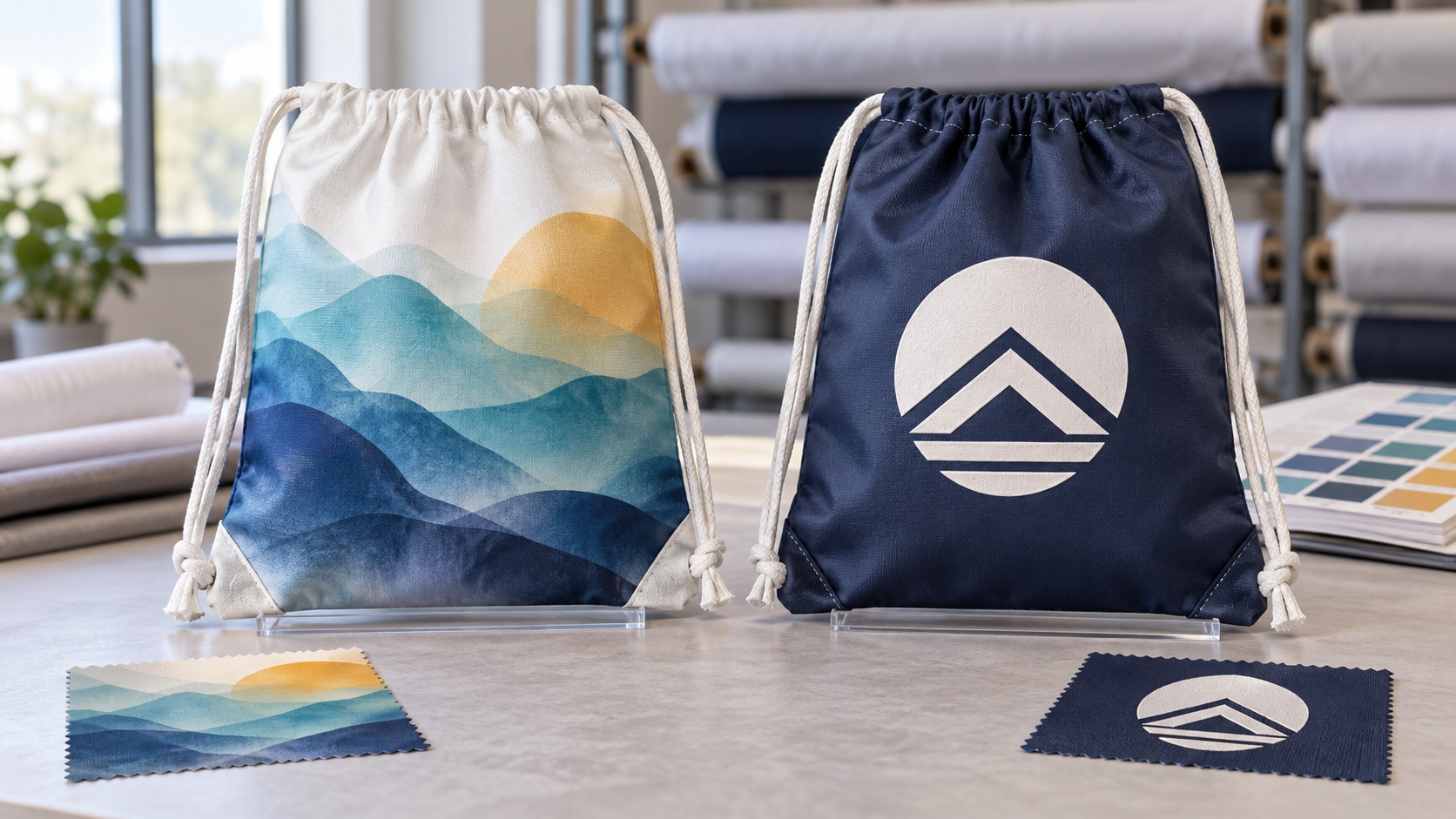
For polyester drawstring bags, sublimation and screen printing solve different branding problems. Sublimation is the stronger starting route for white or light-colored polyester when the design needs gradients, photographs, repeating patterns or edge-to-edge coverage. Screen printing is usually the stronger starting route for a bold opaque logo on a pre-dyed bag, especially when the design uses a limited number of spot colors.
That answer changes when the fabric is coated, the polyester content is unclear, the print crosses a seam, or the bag must withstand a particular cleaning and abrasion cycle. A process name alone cannot approve the product. Buyers need to specify the polyester fabric, base shade, artwork, coverage, bag construction, use conditions and test plan together.
This guide focuses on that exact sourcing decision. For the wider decoration landscape, read our custom drawstring bag printing methods guide. For a comparison of direct screen print with the broader heat-transfer family, use Screen Printing vs Heat Transfer for Drawstring Bags. LUCKYSTAR's custom drawstring bags can then be developed around the selected material and artwork route.
Scope note: This article provides purchasing and quality-planning guidance. It does not prescribe a universal ink, paper, temperature, dwell time, pressure, mesh or curing recipe. Every setting and result must be validated with the nominated fabric, equipment, artwork and approved sample.
Quick decision: which process fits the brief?
Select sublimation for the first trial when the bag is made from suitable white or light polyester and the artwork depends on continuous tone, many colors, an all-over repeat or a very low-build print feel. Select screen printing for the first trial when the bag is already dyed dark, the logo must be opaque, the artwork is built from a few solid colors, and the print fits inside a stable local area.
| Program condition | Sublimation starts ahead | Screen printing starts ahead | Proof still required |
|---|---|---|---|
| White polyester with a photographic image | Yes | Possible, but complex separations may be inefficient | Color profile, detail and heat response |
| Navy bag with a white logo | No conventional opaque white in sublimation | Yes, with a compatible opacity/migration strategy | Delayed dye migration and cure |
| Full-bleed repeating pattern | Strong candidate, often before cutting and sewing | Local direct printing is less natural for full coverage | Bleed, cutting and seam registration |
| One-color event logo | Possible but may be unnecessary | Strong candidate | Ink deposit, placement and packed blocking |
| Many artwork versions | Digital sublimation can simplify color/version changes | Screens and setup may multiply | File/SKU traceability |
| Coated polyester | Only after coating and heat compatibility are proven | Only after ink adhesion and cure are proven | Exact-material trial |
| Mixed-fiber fabric | Color strength may change with polyester percentage | A compatible screen system may offer more options | Declared composition plus physical test |
The core technical difference
Dye sublimation uses heat to convert the printed dye into a gaseous state so it can enter a compatible polyester surface. Epson's official dye-sublimation overview describes the method as a polyester or polyester-coated process and recommends white or light-colored polyester for the strongest results. The printed area normally has little raised surface build because the color is formed within the polyester rather than as an opaque layer sitting on top.
Screen printing pushes ink through a stencil onto the textile. The ink forms a visible layer whose opacity, thickness and hand depend on the ink system, underbase, screen, deposit and cure. Each spot color generally requires its own separation and controlled registration step. This makes screen printing particularly useful when a light mark needs to cover a dark polyester background.
| Difference | Dye sublimation | Screen printing |
|---|---|---|
| Color mechanism | Dye enters suitable polyester under heat | Ink layer is deposited on the textile |
| White ink | Conventional sublimation does not supply an opaque white layer | Opaque white or underbase systems may be available |
| Best base shade | White or light fabric | Light or dark fabric after ink compatibility testing |
| Artwork strength | Gradients, photos, many colors, repeats | Spot colors, bold marks, solid opacity |
| Surface hand | Very low print build on suitable fabric | Can range from light to noticeably raised |
| Coverage | Local or engineered all-over panels | Normally local areas; large coverage requires more ink/control |
| Main polyester risk | Color/profile, ghosting, heat effects, seam alignment | Dye migration, opacity, cure and adhesion |
Base fabric color is the first gate
Sublimation color is additive to the fabric's existing shade. It does not hide a dark base with opaque white. A pale blue bag will influence every sublimated color; a navy bag cannot become a clean white logo through conventional sublimation. For this reason, an all-over dark-looking sublimated design usually begins with white or light polyester and prints the dark appearance into the panel.
Screen printing can place an opaque ink system over a colored bag, subject to compatibility and testing. On dark polyester, however, the substrate dye can migrate into the printed ink during or after heat exposure. A white print may emerge clean and then shift pink, blue or another shade later. Approval should include a defined conditioning period, not only an immediate visual check.
Do not confuse two uses of the word “sublimation”
In a planned dye-sublimation process, heat is intentionally used to transfer artwork dye into a compatible light polyester substrate. In a screen-printing defect discussion, “dye sublimation” may describe bag dye being reactivated by heat and contaminating the ink layer. ScreenPrinting.com's polyester dye-migration explanation illustrates why dyed polyester and heat require careful testing. The two situations use related physical behavior but have opposite production goals.
Polyester is not one uniform print surface
The word “polyester” leaves important sourcing questions unanswered. A lightweight 210D woven fabric, firm 600D cloth, microfiber, open mesh and recycled-polyester fabric can respond differently even when all contain polyester.
Specify at least:
- fiber composition and stated percentage;
- woven, knitted, mesh or non-woven construction;
- denier or other yarn description, plus finished GSM where relevant;
- white point or base shade;
- coating, lamination, water-repellent finish or other treatment;
- surface texture and gloss;
- fabric lot and dyeing route;
- intended care and heat restrictions.
Our 210D vs 420D vs 600D polyester drawstring bag guide explains why denier alone does not determine print quality, weight or strength. If nylon is also under consideration, compare the substrates in Polyester vs Nylon Drawstring Bags.
When sublimation is the better starting route
Full color without a heavy surface layer
Sublimation can reproduce continuous tonal changes and fine multicolor imagery on a suitable polyester base. Epson's digital-printing primer notes that dye sublimation is commonly used for fine detail and gradients on white or light polyester while preserving the fabric feel.
This matters for a lightweight drawstring sack. A large opaque ink field can influence drape; a sublimated pattern adds little surface build. The buyer should still check whether the heat cycle changes gloss, dimensional stability or coating performance.
Edge-to-edge and repeating artwork
For an all-over bag, artwork can be transferred to fabric or panels before cutting. The pattern can cover the visible face without stopping at a rectangular local print box. This route requires engineered bleed, safe areas, cutting markers and orientation control.
Numerous colors or visual versions
A digital sublimation workflow does not require one physical screen for every visible color. That can suit multiple campaign patterns, gradients or photographic variants. Version management remains essential: every printed panel must be tied to the correct bag colorway, size, cord and packing SKU.
When screen printing is the better starting route
Opaque marks on dark bags
Screen printing can build an opaque light logo over navy, black, red or other pre-dyed polyester. The production team may propose a polyester-compatible white, low-bleed system, underbase or blocker depending on the fabric and artwork. Those are technical directions, not guaranteed recipes.
Simple spot-color brand graphics
A one- or two-color mark with bold shapes can be separated, mixed and checked against a physical color target. Once the setup is approved, screen printing can be efficient for a stable repeated design. More colors add screens, registration work and setup exposure.
Local decoration on an existing bag color
If the brand identity depends on a stock or custom-dyed bag shade, printing a local logo may be more direct than reproducing the entire background color through sublimation. Buyers should compare the desired visual, not assume that an all-over digital method is automatically more premium.
Artwork planning: process color versus spot color
Sublimation normally builds an image through a profiled digital color workflow. The final appearance depends on the source file, conversion/profile, printer, ink, paper, press, fabric whiteness and viewing light. Screen printing often uses separated spot colors mixed or selected to target a reference.
Adobe's raster and vector guidance explains that raster artwork consists of pixels and is resolution-dependent, while vector graphics use mathematical shapes that remain crisp when scaled. Photographs and continuous-tone sublimation art are often raster; brand marks and screen-print separations benefit from an authorized vector master.
| Artwork control | Sublimation requirement | Screen-print requirement |
|---|---|---|
| File scale | Final output resolution or repeat dimensions | Final logo dimensions and separation-ready master |
| Color intent | Embedded/profiled source plus physical strike-off | Named spot references and approved ink result |
| White elements | Usually left as fabric white on a white base | Explicit white ink and/or underbase layer |
| Fine lines | Check transfer sharpness, paper movement and fabric texture | Check mesh/ink/detail limit and reversed gaps |
| Bleed | Add for all-over panels and cutting tolerance | Usually unnecessary for a contained local mark |
| Revision | Link every panel/colorway to a version | Link every screen/separation to a version |
| Rights | Authorized image, logo, font and pattern | Authorized logo, font and color treatment |
White in the artwork needs explicit handling
On a white sublimation blank, a white area is normally the unprinted fabric showing through. If the base textile is cream or pale gray, that “white” takes on the textile shade. If the design needs a white logo on a dark-looking all-over background, the white may be reserved as unprinted fabric while the surrounding area receives dark dye. Registration and small white details then need close inspection.
For screen printing, white is a physical ink layer. Its brightness depends on opacity, deposit, substrate color and migration control. A heavy underbase can affect hand, edge registration and flexibility. The artwork file should distinguish visible white, technical underbase and any blocker layer rather than displaying them as one ambiguous white object.
All-over sublimation is a cut-and-sew project
An attractive printed sheet is not yet a finished drawstring bag. All-over work succeeds when print engineering and pattern engineering use the same coordinate system.
Build bleed and safe zones around the bag pattern
Extend noncritical background art beyond cut lines so normal cutting tolerance does not expose an unintended white edge. Keep small text, faces and essential logos away from seam allowances, the top channel fold, gusset turns and lower corner reinforcements unless their placement is deliberately engineered.
Control panel orientation and pairing
Abstract art can be sewn upside down without being noticed until final inspection. Fronts, backs and gussets need orientation marks or controlled bundle identification. Where a set requires matched tones, pair panels from the intended print/lot group.
Define seam expectations
Perfect motif matching across every side seam is not a default outcome. Decide whether the design uses a forgiving repeat, allows a controlled discontinuity, or requires measured alignment at one critical seam. Put that expectation into the approved sample and inspection criteria.
| All-over control point | Failure if omitted | Buyer evidence |
|---|---|---|
| Pattern template revision | Art maps to an obsolete bag shape | Released pattern/artwork record |
| Bleed | White sliver appears at a cut edge | Approved printed-and-cut panel |
| Safe zone | Logo enters seam or channel | Measured finished sample |
| Orientation | Front/back panel is rotated | Panel ID and first article |
| Seam intent | Pattern jump looks like a defect | Signed visual reference |
| Shade grouping | Front and back appear mismatched | Lot/bundle traceability |
For the wider sequence from specification to packing, see the custom drawstring bag manufacturing process.
Local screen printing is a placement project
Screen printing usually occupies a defined box on the front or back panel. That box must clear the gathered channel, side seams, pockets, gusset folds and lower cord anchors. The usable area is often smaller than the apparent flat panel.
Specify a finished-bag datum: for example, horizontal centerline of the sewn body and a measured distance below the finished top edge. “Centered” is not sufficient if the left and right seams vary or the bag has an asymmetrical pocket. The drawstring bag logo placement and print size guide provides a fuller coordinate workflow.
Printing before sewing offers a flat panel but requires cutting and assembly registration. Printing after sewing lets the operator reference the real bag yet introduces uneven thickness from seams, cords and reinforcements. Approve the actual manufacturing sequence.
Color matching works differently
Neither process guarantees that a digital mockup will equal the final bag. Sublimation relies on a managed combination of artwork data and a physical textile/transfer system. Screen printing relies on ink formulation, opacity, deposit and substrate interaction. Under different light, textured fabric can also shift perceived color.
Use a physical approval chain:
- define the source reference and critical colors;
- produce a strike-off on the nominated production fabric;
- evaluate under agreed viewing conditions;
- approve the assembled bag;
- retain the signed reference with settings and file revision;
- define when a material or process change triggers reapproval.
For repeat orders, adapt the controls in our logo and color consistency guide. A retained physical standard is more useful than relying on an old webpage photo.
Hand feel, drape and breathability
Sublimation generally preserves the original surface hand of compatible polyester because the color does not form a thick opaque film. Screen-printed ink adds a surface layer, and large solid coverage can make a lightweight sack feel stiffer.
This does not mean sublimation always produces the better bag. A contained screen-printed logo may have little practical effect on the overall drape, while an all-over sublimation route may expose the entire fabric to a heat process that changes a sensitive coating or finish. Compare finished samples under the intended load.
Inspect the bag:
- empty and flat;
- fully opened;
- gathered closed;
- filled with the intended contents;
- worn with the cords under tension;
- folded and packed for shipment.
Heat response and polyester dye migration
Both routes involve heat, but for different reasons. Sublimation deliberately uses heat to drive artwork dye into suitable light polyester. Screen-printed ink must be cured, and that heat can reactivate the bag's existing dye. ScreenPrinting.com's polyester printing technical discussion emphasizes that different polyester dyes have different migration tendencies and that testing is essential.
The buyer should not prescribe an internet temperature as a universal production setting. Instead, require the supplier to document the validated application/cure window that produced the approved result on the exact material. For a dark screen-printed sample, recheck after an agreed conditioning period because a delayed color shift may not be visible at press exit.
Coatings and finishes can overturn the first choice
A polyester drawstring bag may carry PU, PVC or another backing/coating, a water-repellent finish, calendaring, brushing or a surface treatment. Those layers can change heat response, adhesion, gloss, odor and dimensional behavior.
For sublimation, ask whether the face is truly suitable for dye uptake and whether heat will mark or distort the finish. For screen printing, ask whether the ink adheres to the treated surface and cures without damaging it. A statement that a process “works on polyester” is not enough when the actual print face is a coating rather than untreated polyester fiber.
If moisture resistance is part of the brief, use our waterproof drawstring bag materials guide to separate fabric, coating, seam and closure claims. Printing approval does not prove the complete bag is waterproof.
Recycled polyester requires two separate approvals
An RPET bag has two independent questions:
- Is the recycled-content claim adequately supported for this order?
- Does the nominated RPET fabric accept the selected decoration and pass the required tests?
A sublimated result does not prove recycled content, and a recycled-content document does not prove print durability. Recycled feedstock, yarn, weave, dye and finish can still vary. Request material documentation within its correct entity, product and validity scope, then approve the print on the actual production fabric.
Use the RPET Drawstring Bags certification and sourcing checklist for the evidence chain. LUCKYSTAR does not present GRS or other certifications as universal company-wide coverage unless the current entity, scope, validity and transaction requirements are verified for the order.
Durability: define the failure mode
“Permanent,” “washproof” and “will never crack” are not responsible specifications. Sublimation has no thick surface film to peel, but color appearance can still be affected by the fabric, cleaning, heat, light exposure and abrasion. Screen printing can be durable when the ink/substrate/cure system is compatible, yet insufficient cure, migration or flex stress can cause failure.
Define what matters for the application:
- color change after the intended cleaning route;
- dry and wet rubbing or color transfer;
- abrasion where the bag contacts clothing or equipment;
- flexing and repeated gathering;
- surface cracking, edge breakdown or ink loss;
- seam/print interaction after loading;
- blocking or offset during packed storage;
- appearance after defined light or heat exposure, if relevant.
| Test or review | Sublimation failure signal | Screen-print failure signal | Control note |
|---|---|---|---|
| Dry/wet rub | Color transfer or surface change | Ink transfer, scuffing or substrate show-through | Define method, grade and specimen |
| Repeated gather | Distortion or stress whitening of fabric | Cracking or loss on fold lines | Use assembled bag, not only swatch |
| Cleaning cycle | Shade/detail or fabric change | Fade, crack, adhesion or migration | Use intended care instruction |
| Loaded wear | Abrasion and motif distortion | Ink abrasion and stiff-panel behavior | Specify contents and duration |
| Conditioning hold | Late color/profile change | Delayed dye migration | Reinspect after defined rest |
| Packing trial | Transfer/ghosting between panels | Blocking, offset or imprint | Pack in shipment orientation |
The official page for ISO 105-X12 identifies a textile test for color transfer caused by rubbing, using both dry and wet rubbing cloths. If that test is required, the order should name the edition, specimen preparation, acceptance grade and responsible party. A bare standard reference is not a measurable acceptance rule.
Sampling should answer questions in sequence
Material confirmation
Confirm composition, construction, white point/base shade, coating and lot. A generic polyester swatch cannot approve a different production fabric.
Print strike-off
For sublimation, review the critical gradient, neutral tones, darkest area, fine detail and any reserved white. For screen printing, review opacity, spot color, smallest line/gap, deposit and migration behavior.
Cut or finished-panel check
For all-over art, cut the approved print using the real pattern and verify safe zones. For local screen print, verify the print coordinate against the declared finished-bag datum.
Assembled sample
Close, open, load and carry the bag. Inspect seams, channel folds, lower corners, drape, print feel and distortion. Use our drawstring bag sampling workflow to record changes and establish the signed production reference.
First production article
Compare the actual line output to the signed sample before continuing bulk production. Confirm artwork version, material lot, color, location, construction and packing.
Sublimation quality-control checklist
| Production stage | Check | Typical risk | Evidence |
|---|---|---|---|
| Artwork release | Template, scale, repeat, bleed, safe zones, mirror/orientation | Wrong revision or reversed content | Released file and run sheet |
| Fabric receipt | Composition, shade, width, surface and lot | Color/profile shift or unsuitable finish | Material identification |
| Transfer output | Correct paper, version, colorway and condition | Banding, contamination or mixed design | Transfer batch record |
| First press | Color, sharpness, ghosting, heat mark and dimensions | Paper movement or heat inconsistency | Signed strike-off/panel |
| Cutting | Pattern alignment, orientation and bleed | White edge or lost motif | First-cut inspection |
| Sewing | Panel pairing, seam intent and channel position | Rotated/mismatched face | First assembled article |
| Packing | Dry/cool condition, correct fold and SKU | Crease, contamination or mixed version | Carton/packing audit |
Ghosting can occur when paper or fabric moves while dye remains active. Blurring may come from artwork resolution, ink spread, movement or fabric texture. A color cast may trace to the file/profile, equipment, paper, fabric whiteness or process drift. Diagnose the chain before changing the artwork.
Screen-print quality-control checklist
| Production stage | Check | Typical risk | Evidence |
|---|---|---|---|
| Separation/setup | Correct color layers, underbase/blocker and size | Wrong screen or missing technical layer | Approved setup sheet |
| Fabric receipt | Color, finish, lot and printable side | Different migration/adhesion behavior | Material lot record |
| First print | Opacity, spot color, edges, registration and position | Substrate show-through or misalignment | Signed first article |
| Cure validation | Approved system on exact fabric | Under-cure, overexposure or fabric damage | Process record and test |
| Conditioned recheck | Delayed color contamination | Dye migration | Timed comparison record |
| In-process check | Screen wear, detail, color and position drift | Gradual deterioration | Interval inspection |
| Packing | Fully cooled/dry print, correct fold and separation | Blocking, offset or ghost image | Packing release |
The complete bag also needs sewing, cord, reinforcement, dimensions, cleanliness and quantity checks. Integrate decoration into the custom bag quality inspection checklist instead of inspecting the image in isolation.
Diagnose defects before switching methods
| Symptom | Likely sublimation questions | Likely screen-print questions | First investigation |
|---|---|---|---|
| Weak color | Polyester content, base shade, profile, transfer/process consistency | Opacity, deposit, underbase and substrate influence | Compare approved fabric and first-off |
| Unwanted color shift | Profile, fabric white point, contamination | Polyester dye migration into ink | Recheck after conditioning |
| Blurred edge | Paper/fabric movement, resolution or surface texture | Mesh, ink, stencil or screen movement | Inspect source file and process record |
| Duplicate shadow | Transfer movement during application | Registration or double-image issue | Identify whether image is digital or layer-to-layer |
| White edge at seam | Insufficient bleed or cutting shift | Not typical for local print | Review pattern and cut registration |
| Cracking | Usually fabric damage or another applied layer, not dye itself | Ink flexibility, deposit or cure problem | Flex exact printed assembly |
| Gloss rectangle | Heat/platen or surface-finish change | Cure/platen/contact effect | Compare unprinted heat-exposed swatch |
| Off-center logo | Template/cut/sew coordinate error | Fixture/datum/loading error | Measure from declared finished reference |
Cost and MOQ depend on the complete route
Sublimation can avoid one screen per visible color, but all-over production adds artwork templating, transfer coverage, panel cutting, version control and sewing alignment. Screen printing has screen/setup costs, color registration and ink/cure controls, but a simple repeated logo may be efficient at volume.
| Commercial driver | Sublimation impact | Screen-print impact |
|---|---|---|
| Graphic coverage | Transfer paper/ink/process area and panel planning | Ink deposit, passes and cure load |
| Number of colors | Digital color count may not add physical screens | Additional screens and registration |
| Artwork versions | File, transfer and SKU control | Screen/set change or separate runs |
| Fabric base | White/light compatible polyester is central | Dyed light/dark fabric may be used after testing |
| Construction | Cut-and-sew alignment for all-over art | Platen access and print sequence |
| Sample stages | Strike-off, cut panel and assembled approval | Ink trial, conditioned sample and first article |
| Inspection | Color, ghosting, panel and seam controls | Opacity, migration, cure and position controls |
Do not compare a full-bleed sublimated bag with a one-color local screen print as if they were the same specification. Request quotations using identical bag construction, quantity matrix, testing and packing assumptions. The 2026 custom drawstring bag pricing guide explains the broader cost stack; all prices, MOQ and timing remain subject to final specification and written confirmation.
Production time and version complexity
Lead time begins only after critical inputs are usable: approved fabric, final artwork, sample decisions, order terms and capacity confirmation. A sublimation program with many panels and SKUs can require longer file/preproduction control than a single local logo. A multicolor screen-print program with multiple bag colors can require separate migration trials and setups.
Send a matrix showing quantity by bag color, artwork version, cord/trim option and destination. Our drawstring bag MOQ and production-time guide helps identify which variables prevent a reliable schedule.
Environmental claims need their own evidence
Neither technique is automatically “eco-friendly.” Sublimation may reduce surface build, but it still uses ink, paper, energy and a polyester substrate. Screen printing may use different ink chemistries, screens, cleaning and curing systems. A single input description cannot prove the environmental performance of the complete bag.
Avoid claims such as “zero impact,” “completely recyclable” or “sustainable printing” without a defined basis, scope and destination-market review. If the bag uses recycled polyester, document the material claim separately. If the buyer has restrictions on ink ingredients or production chemistry, place them in the specification and request current order-relevant evidence.
Trademark and pattern rights must be confirmed
Full-coverage artwork can contain illustrations, photographs, fonts and patterns in addition to logos. The buyer should confirm authorization for the product, quantity, territory and sales channel. A manufacturing authorization does not automatically grant permission for the supplier to publish the finished bag as a portfolio image.
Use controlled file transfer, stable filenames and an approval owner. Do not use screenshots scraped from a website as production assets. Public case-study photography should be approved separately from order production.
Why choose LUCKYSTAR for the project
LUCKYSTAR coordinates the bag and the decoration as one specification. This matters because sublimation and screen printing interact with fabric shade, coating, pattern pieces, channel construction, cord anchors, packing and use conditions.
Material-first requirement review
We help buyers define the polyester rather than stop at a generic fiber name: construction, denier/GSM where relevant, shade, finish, coating and end use. The proposed print route can then be evaluated against the actual product brief.
Artwork-to-construction coordination
For sublimation, the artwork must fit the cut-and-sew pattern, bleed and safe areas. For screen printing, the logo must fit an accessible support area and remain clear of the gathered channel and reinforcements. LUCKYSTAR can coordinate these fields through the sample process.
Approval gates instead of blanket promises
We support requirement review, sample development and order-level quality coordination subject to the agreed project scope. The sample, documented specification and written approval become the working reference; a general website statement does not replace them.
Bulk checks tied to the selected failure modes
A sublimated program needs color, ghosting, orientation and seam controls. A screen-printed program needs opacity, registration, cure and migration controls. The inspection plan can be aligned with the actual route rather than using one generic print checklist.
Responsible commercial and compliance communication
MOQ, pricing, sample charges, testing, lead time, certification documents and delivery terms are confirmed per project. We do not treat an old certificate, platform badge or unrelated sample report as universal coverage.
To evaluate the supplier beyond decoration, continue with How to Choose a Custom Drawstring Bag Manufacturer. The broader OEM/ODM framework is covered separately in the Custom Bag Manufacturer Guide.
RFQ checklist for a comparable quotation
| RFQ field | What to send | Why it changes the recommendation |
|---|---|---|
| Bag format | Finished size, gusset, channel, corners, pockets and lining | Defines pattern and print access |
| Polyester | Composition, construction, denier/GSM, coating and base color | Controls sublimation/ink compatibility |
| Artwork | Source files, final size, coverage, versions and rights | Determines digital template or screens |
| Color | Physical references and critical elements | Establishes approval target |
| Quantity matrix | Units by bag color, design, trim and destination | Reveals setup and SKU complexity |
| End use | Contents, load, abrasion, care and service environment | Defines test and construction priorities |
| Approval | Strike-off, assembled sample, first article and sign-off owner | Prevents ambiguous release |
| Testing | Method, version, specimen, sample size and acceptance | Makes performance measurable |
| Packing | Fold, individual packaging, dividers, carton and labels | Protects print and version accuracy |
| Delivery | Destination, required date and shipment assumptions | Supports a realistic written plan |
Put these decisions into a custom drawstring bag tech pack. If some fields remain open, label them as alternatives to test rather than allowing the supplier to guess.
Frequently asked questions
Is sublimation always better for polyester?
No. It is especially suitable for compatible white or light polyester and detailed or all-over artwork. A dark pre-dyed bag requiring an opaque light logo usually points toward screen printing or another opaque decoration route.
Can sublimation print white on a navy polyester bag?
Conventional dye sublimation does not create an opaque white ink layer. White normally comes from the light substrate. A navy bag with a white logo needs another evaluated process.
Can screen printing reproduce gradients?
It can use halftones or process separations, but complexity, registration and substrate texture must be evaluated. If continuous-tone color is central and the base is suitable light polyester, sublimation is often the more direct trial.
Which method feels softer?
Sublimation usually leaves very little surface build on compatible polyester. Screen print creates an ink layer whose hand varies with the system, underbase and deposit. Compare assembled samples rather than relying on a process label.
Does sublimation crack or peel?
The dye itself is not a surface film in the way many applied decorations are. The fabric and color can still change through abrasion, cleaning, heat, light or unsuitable processing, so testing remains necessary.
Why did a white screen print turn pink?
The dye in colored polyester may have migrated into the ink during or after heat exposure. Confirm the exact fabric and review ink, blocker/underbase, cure and conditioning controls with the production team.
Can 210D, 420D and 600D all be sublimated?
The denier number alone does not prove suitability. Polyester percentage, face construction, base color, coating, finish and heat response all matter. Test the exact nominated material.
Is all-over sublimation done before sewing?
Often, yes. Printing before cutting or sewing provides full panel access, but it creates obligations for bleed, orientation, cutting and seam registration. The final approved bag—not only the printed roll—must be inspected.
Which process is cheaper for 1,000 bags?
There is no responsible answer without the artwork, coverage, fabric, bag construction, version count, tests and packing. A one-color local screen print and a full-coverage sublimated panel are different products.
Can RPET drawstring bags be sublimated?
Potentially, depending on the actual fabric construction and finish. Print suitability must be tested, while recycled-content evidence must be verified through a separate documentation chain.
What should be kept for reorders?
Retain the approved fabric reference, artwork/template revision, color/print standard, finished sample, process identification, test results, packing method and approved deviations. Define which changes require reapproval.
Can LUCKYSTAR confirm one universal MOQ or lead time?
No universal commercial term applies to every construction and print route. MOQ, sample timing, production schedule, testing, price and delivery are confirmed against the final written specification and current capacity.
Final recommendation
For a light polyester drawstring bag with photographic, gradient, repeating or edge-to-edge artwork, begin with a sublimation trial. For a dark pre-dyed polyester bag with a bold opaque logo, begin with a polyester-compatible screen-print trial. If the brief combines a sublimated background with an opaque secondary mark, treat it as a hybrid system requiring its own migration, alignment and durability approval.
The decision is complete only after the selected route is proven on the exact fabric and assembled construction. LUCKYSTAR can coordinate the material, artwork, sample and quality-control chain so the approved visual is translated into a controlled production specification.

To request an evaluation, provide the finished dimensions, exact polyester construction and shade, decoration coverage, design-by-design quantities, packed contents and sales destination. Ask LUCKYSTAR to review the print route. Method availability, quotation, MOQ, samples, production time, testing and compliance documents remain subject to specification and written confirmation.