
Last reviewed: September 24, 2026
Buyer Quick Answer
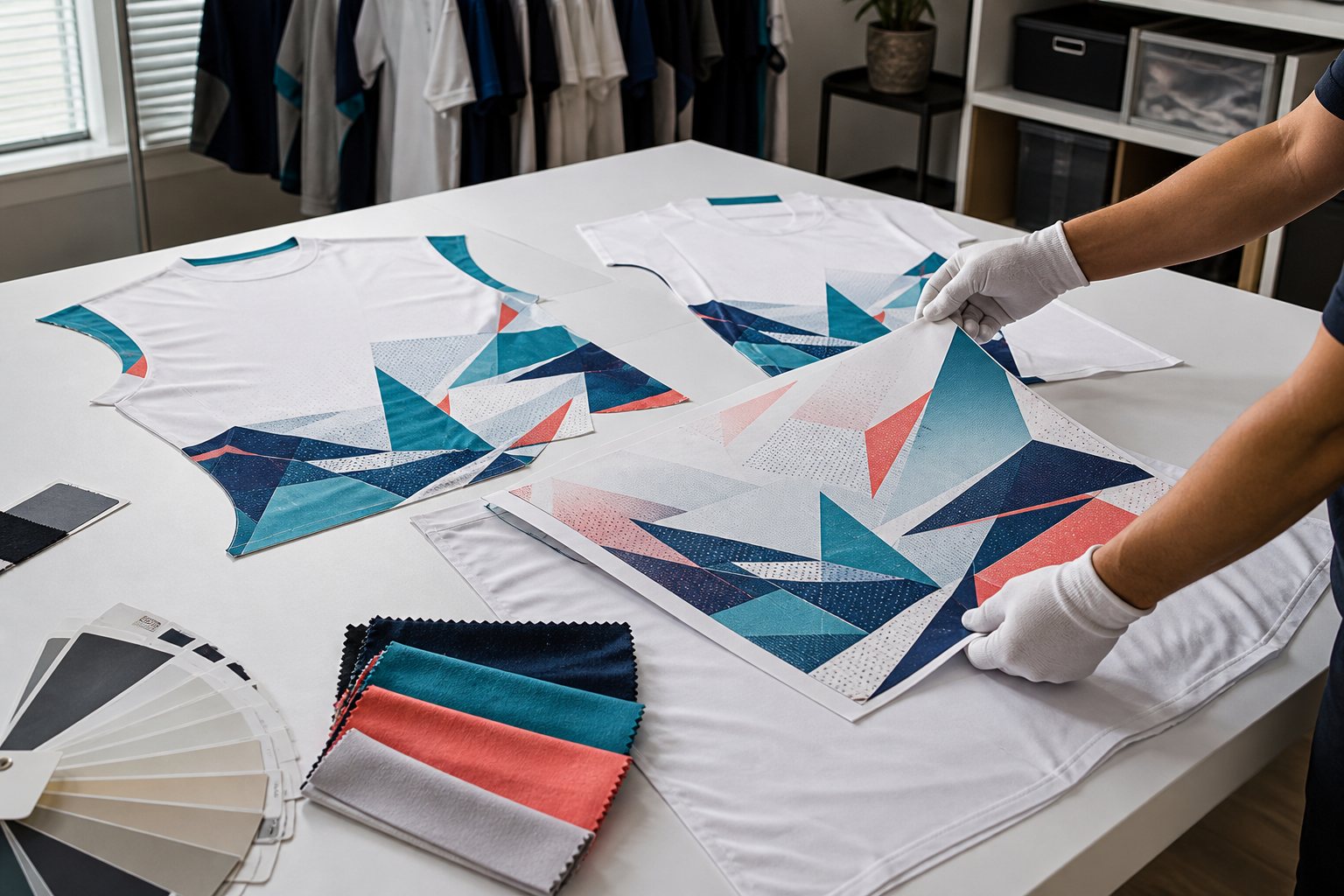
A sublimation T-shirt supplier should help you choose the production route before quoting the print. Dye sublimation is primarily a polyester process and is especially useful for full-color, all-over designs on performance garments. Buyers should confirm the fabric composition, base color, garment construction, artwork template, panel coverage, sample tests and bulk color controls before approving production.
This page owns the sublimation-production decision: all-over print versus finished-garment decoration, artwork and color preparation, cut-panel registration, sample approval and bulk QC. It does not repeat the general sample-to-scale controls in our custom T-shirt manufacturer guide or the digitizing and stitch engineering covered in the embroidery T-shirt guide. For the broader OEM/ODM supplier-selection framework across bags and coordinated merchandise, use the Custom Bag Manufacturer Guide.
Send Your Sublimation T-Shirt Specification
Start With the Garment Route, Not the Print Effect
“Sublimation T-shirt” can describe different products. One buyer may want an all-over sports jersey made from printed panels. Another may want a small full-color image on a ready-made polyester shirt. A third may simply want a bright print on a dark cotton tee, which may need another decoration method. These projects should not be quoted or sampled as if they are identical.
Define the coverage, base fabric, fit, construction and end use first. If the artwork must cross the body, sleeves and collar, a panel-based cut-and-sew route usually gives more control over coverage and crease-free printing. If the graphic is limited to a defined area on a compatible finished garment, a finished-garment route may be simpler. If cotton hand feel, a dark pre-dyed base or a heavy fashion knit is non-negotiable, compare screen print, DTF, DTG or another method before forcing the project into sublimation.
| Production route | Best fit | Main advantage | Buyer risk to control |
|---|---|---|---|
| Printed panels, then cut and sew | All-over artwork, teamwear, retail performance styles and private-label garments | Artwork can be planned for every panel before assembly | Panel orientation, seam transitions, grading and sewing accuracy |
| Finished polyester garment | Defined front, back or small-area graphics on a suitable blank | Fewer garment-development decisions | Creases, seams, collars and underarm areas can interrupt coverage |
| Alternative print method | Cotton-rich fabric, dark ready-dyed garments or artwork needing an opaque white base | Better compatibility with the chosen garment platform | Different hand feel, setup, durability and color behavior |
Choose Fabric by Print Result and Wearing Job
Sublimation dye needs a compatible synthetic surface. In practical apparel sourcing, polyester content, yarn structure, knit construction, finished weight, stretch, wicking finish and base color all affect the result. A fabric can accept color yet still be wrong for the garment because it is too transparent, too warm, too stiff or too unstable after care.
Ask the supplier to identify the exact production fabric rather than describing it only as “polyester.” Review composition, finished GSM, knit type, stretch direction, surface texture, opacity, recovery and intended care. White or very light polyester provides the cleanest color-building base; an all-over dark design is commonly created by printing dark artwork onto that light base rather than sublimating an already-dark garment.
| Fabric question | Evidence to request | Why it changes the result |
|---|---|---|
| What is the exact composition? | Named fiber percentages and actual sample fabric | Polyester content influences color strength and print character |
| What is the finished structure? | Knit construction, finished GSM, stretch and recovery | Controls opacity, drape, fit and print appearance when worn |
| Which finish is applied? | Finish description and test on the final fabric | Moisture management, brushing or coatings can change surface behavior |
| How does it perform after care? | Washed sample with dimensional and appearance review | A vivid print does not compensate for distortion, pilling or poor recovery |
Need Help Choosing the Sublimation Route?
Send the intended use, reference garment, fabric preference, artwork coverage, quantities by size and color, labels, destination and target date. LUCKYSTAR can identify which fabric and approval questions must be resolved before a reliable quotation and sample plan.
Prepare Artwork for the Actual Pattern Pieces
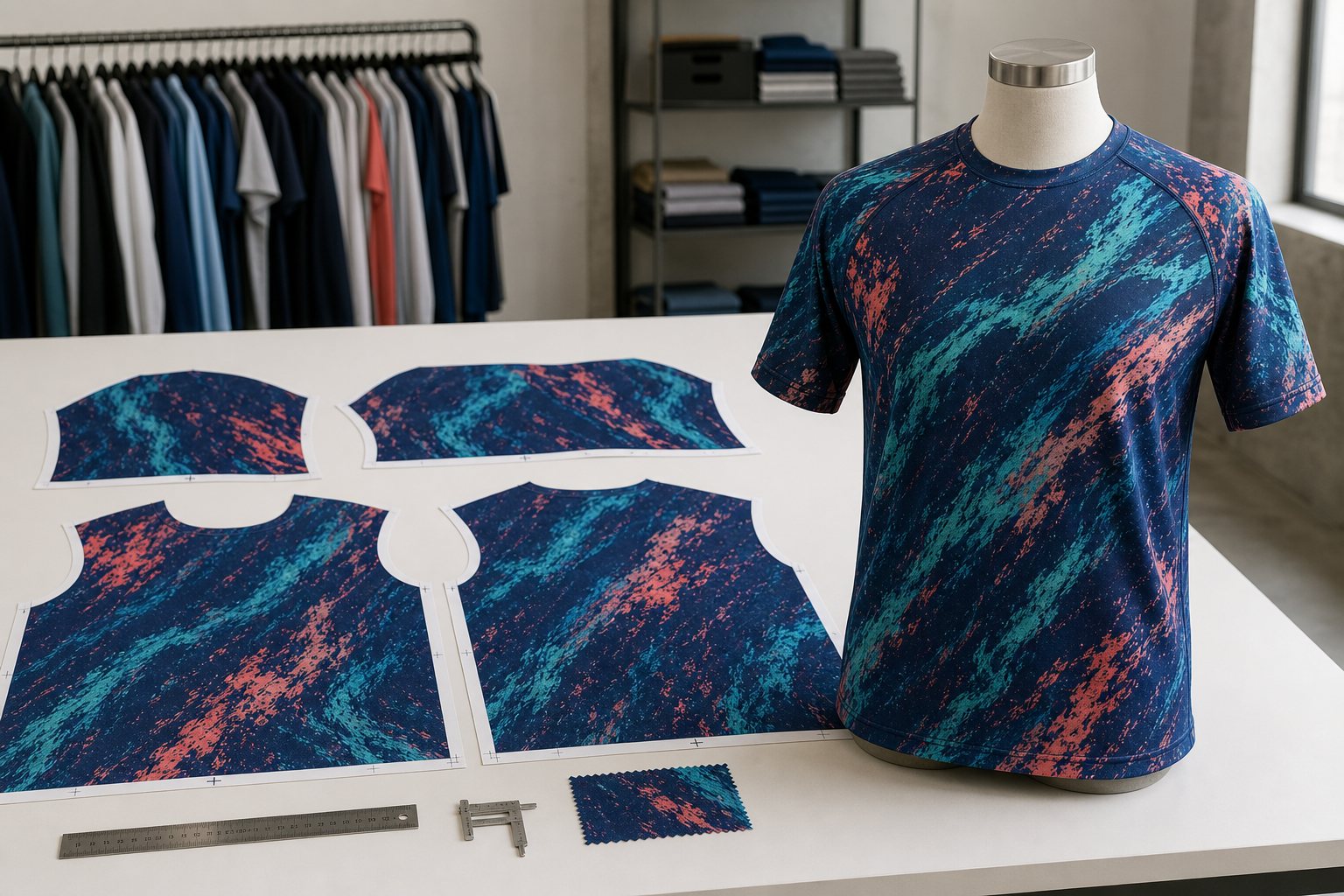
A screen mockup is a communication aid, not a production-ready all-over-print file. The supplier needs artwork mapped to the real front, back, sleeve and collar templates for the approved size range. The file should identify orientation, scale, repeat, critical motifs, safe zones and areas where perfect cross-seam matching is or is not expected.
Keep faces, lettering, crests and geometric focal points away from unpredictable seam intersections unless the pattern and sewing method have been developed to control them. Decide how the design continues at shoulders, side seams and sleeve joins. State whether a small shift is visually acceptable in a scattered repeat or whether a stripe, border or sponsor mark requires tighter registration.
Use high-resolution raster artwork at final scale or properly prepared vector files, depending on the design. Keep linked images, fonts and color references under version control. The artwork used for the approved sample should be the same released file used for production.
Manage Color as a Physical Approval Chain
Color on a monitor is not the final result. The artwork profile, ink system, transfer paper, heat settings, fabric lot, surface finish and viewing light can all affect the appearance. Provide physical brand references when color is critical and identify which elements require the closest visual match.
A practical approval chain moves from calibrated artwork and a printed strike-off to the final fabric, then to a finished garment sample. Review gradients, fine detail, neutral gray balance, dark areas and skin tones if present. Keep the approved print reference, the dated artwork version and production settings together so a later reorder does not restart from memory.
Control the Transfer and Panel Process
The production team must control heat, pressure, dwell time, paper stability and fabric movement for the selected material. Buyers do not need to prescribe one universal machine setting; they should require the supplier to establish and retain the setting that produced the approved result. Inconsistent heat or movement can create shade variation, ghosted edges, blurred detail or panel-to-panel differences.
Before sewing, verify that each printed panel belongs to the correct style, size, colorway and artwork version. Orientation errors are especially easy to miss in abstract repeats. Pair panels by lot where required, protect clean surfaces during handling and confirm the cutting path has not removed critical artwork.
Engineer Seams, Collar and Fit With the Artwork
All-over printing does not remove garment engineering. It makes the interaction between pattern and construction more visible. A correctly printed panel can still produce a weak shirt if the neckline stretches, the shoulder seam twists, sleeve pitch is wrong or the hem waves.
Approve the base pattern and grade rules before finalizing every size template. Decide how the collar is produced: printed self-fabric, solid rib, contrast trim or another construction. Review the shirt both flat and on body because stretch can open the knit and change apparent color. If the collection also includes polos, use the custom polo shirt specification guide for collar, placket and knit-specific controls. For fleece products, see the hoodie fabric, fit and finish guide.
Use Sample Gates That Answer Different Questions
One sample cannot efficiently prove every decision. Separate approvals so the team knows what is frozen and what can still change:
- Fabric and print strike-off: confirms surface, color character, detail and transfer behavior.
- Fit sample: confirms measurements, balance, neckline, sleeve and intended ease without relying on final artwork.
- Sublimated development sample: combines the approved route, artwork mapping, fabric and construction.
- Wear and care review: checks comfort, dimensional change, surface, shade and print appearance after the intended care cycle.
- Pre-production sample: freezes the production fabric, pattern, artwork version, construction, labels and packing.
- Bulk first-off: proves that the line is using the released inputs before the full quantity continues.
Inspect Bulk by Failure Mode, Not by a Generic Checklist
Bulk inspection should compare production with the approved reference and look for risks that are specific to the chosen route. Record the style, size, colorway, lot and carton whenever a repeated defect appears so the source can be isolated.
| Inspection point | What to compare | Typical risk | Control evidence |
|---|---|---|---|
| Artwork identity | Released file, colorway, scale and orientation | Mixed version or rotated panel | Versioned run sheet and approved panel set |
| Color and clarity | Approved physical print under consistent light | Shade shift, ghosting, blur or weak dark areas | First-off and periodic production checks |
| Panel registration | Critical motif position and seam intent | Unacceptable jumps at side, shoulder or sleeve seams | Approved garment and measurable checkpoints |
| Garment construction | Measurements, seam quality, collar, hem and appearance | Twist, skipped stitches, stretched neckline or wavy hem | Measurement report and workmanship standard |
| Care performance | Approved wash result and care instructions | Dimensional change, pilling or appearance change | Defined sample test and retained result |
| SKU and packing | Size, labels, bag, barcode and carton ratio | Correct shirt packed as the wrong SKU | Packing list and carton audit |
Request a Sample and Bulk-QC Plan
Tell us which decisions are already approved and which still need testing. Include the intended care route, critical color references, seam-matching priorities and inspection requirements so the sample plan can answer the real production risks.
Understand What Changes MOQ, Cost and Lead Time
A responsible sublimation T-shirt quotation depends on the actual program. Fabric sourcing, custom color or finish, number of artwork versions, pattern development, size range, panel coverage, collar and trim construction, private labels, packaging, sample stages, inspection scope and delivery plan can all change the commercial result.
Ask the supplier to state assumptions rather than requesting a universal unit price. A quote for one shared all-over pattern across three sizes is not directly comparable with a program containing many colorways, sponsor versions, player names or destination-specific packs. Final timing should be confirmed after fabric, artwork, sample gates and capacity are defined; this page does not invent a fixed MOQ, price or production promise.
RFQ Checklist for Custom Sublimation T-Shirts
| RFQ field | Information to send | Why it matters |
|---|---|---|
| Use and market | Sports, retail, event, uniform or merchandise; destination market and wearing conditions | Sets priorities for fabric, fit, durability and labeling |
| Garment specification | Reference style, composition, GSM target, fit, measurements, collar and seam details | Defines the product under the print |
| Artwork | Source files, coverage, color references, critical motifs and acceptable seam behavior | Determines the template, proof and registration work |
| Quantity matrix | Units by size, colorway, artwork version, name/number and destination | Reveals the real SKU and handling complexity |
| Branding and packing | Labels, hangtags, barcodes, individual bags, folding and carton marks | Completes the private-label and fulfillment scope |
| Approval and testing | Strike-off, fit sample, pre-production sample, care tests and inspection requirements | Connects the creative brief to repeatable bulk evidence |
| Delivery | Destination, target in-hand date and split-shipment plan | Allows capacity and logistics feasibility to be assessed |
Related Apparel and Sourcing Guides
- Custom T-Shirts for the relevant product category.
- Reliable Custom T-Shirt Manufacturer for general sample-to-scale continuity.
- Bulk Promotional T-Shirts for campaign quantity, size allocation and distribution.
- Custom Embroidery T-Shirt for digitizing, backing, stitch density and embroidery QC.
- Embroidered T-Shirts for Brand Programs for method selection and coordinated brand use.
- Custom Polo Shirt Manufacturer for collar, placket and polo construction.
- Corporate Uniform Supplier for wearer roles, rollout and replenishment.
- Basic Wear and Custom Accessories for coordinated apparel, caps and bags.
- LUCKYSTAR Custom Apparel Partnership Framework for cross-category project control.
- Custom Bags, Caps and Hoodies Supplier Guide for mixed merchandise programs.
- Custom Bag Manufacturer Guide for the core OEM/ODM supplier, sample, quality and delivery framework.
Frequently Asked Questions
Does sublimation work on cotton T-shirts?
Conventional dye sublimation is designed for compatible synthetic surfaces, especially polyester. If a cotton-rich hand feel is essential, ask the supplier to compare another print route instead of assuming the same color and durability result.
What is the difference between all-over sublimation and a front print?
All-over sublimation typically maps artwork across separate garment panels before sewing, allowing the design to cover the body and sleeves. A front print applies artwork to a defined area and may use a finished garment. The correct choice depends on coverage, fabric, construction and acceptable seam behavior.
Can an all-over design match perfectly across every seam?
Not every motif can or should be matched at every seam. Critical stripes, borders or logos need deliberate template and sewing controls, while scattered repeats can allow more visual tolerance. Mark critical areas in the artwork brief and approve them on the finished sample.
What should a buyer approve before bulk production?
Approve the production fabric, fit, size specification, artwork version, color reference, printed strike-off, finished garment sample, seam intent, labels, packing and inspection criteria. Keep those records together for production and reorders.
Why can the same artwork look different on two polyester fabrics?
Polyester percentage, yarn, knit structure, finish, whiteness, surface texture and heat response can change perceived color and clarity. Approve the artwork on the exact production fabric, not on a generic swatch.
Company and project contact
Ningbo Luckystar Commodities Co., Ltd. reviews sublimation T-shirt projects against the submitted fabric, artwork, fit, sample, test, QC and packing requirements. Capability and commercial terms are confirmed for the specific order.
Review custom T-shirts, browse product categories, or contact the project team.

GET A SUBLIMATION T-SHIRT QUOTE
Email a prefilled sublimation brief





