Last reviewed: September 28, 2026
Buyer Quick Answer
A reliable hoodie supplier should lock fabric, fit and finish as one production standard. Approve the exact knit construction and finish, measure the garment at a defined conditioning state, test wash-related change, freeze the fit block and grading rules, and connect the approved sample to bulk fabric lots, first-off garments and final inspection.
Best first request: ask the supplier for one hoodie approval sheet showing fabric identity, GSM target and tolerance, wash state, measurement method, points of measure, size grade, hood and rib construction, seam standard, decoration process, appearance limits and retained sample reference.
A hoodie can look convincing in one photograph and still fail as a repeatable product. The fabric may become shorter after laundering, a generous body may be paired with a narrow hood opening, rib may relax too quickly, or a heavy decoration may distort a soft front panel. These are not separate cosmetic issues. They interact.
This guide turns "fabric, fit and finish" into a measurable approval system for brands, retailers and wholesale buyers. It does not replace the broader category pages for custom print hoodie development, private label hoodie programs or sports team hoodie buying. Buyers coordinating apparel with bags can use the Custom Bag Manufacturer Guide as the core cross-category sourcing hub.

Scope: A Production Approval Standard
This page focuses on the technical relationship between cloth, pattern and workmanship. It does not rank factories, list every decoration method, forecast trends or provide universal GSM recommendations. A year-round promotional hoodie, a structured streetwear hoodie and a training layer can require different evidence. The useful question is whether the supplier can reproduce the buyer's chosen result within agreed limits.
Define the Hoodie Job Before the Specification
State the wearer, climate, selling channel, layering behavior, care route, price position and expected use. Clarify whether the sample should feel light and mobile, warm and soft, or dense and architectural. Specify pullover or zip-up, unisex or gendered block, regular or oversized silhouette, and whether the garment must coordinate with T-shirts, caps or bags.
The basic wear fit and fabric guide covers a wider apparel capsule. This hoodie page goes deeper into the approval evidence needed for a hooded knit garment.
Choose the Supplier Operating Model
A blank-garment decorator starts with an existing hoodie block and fabric. A cut-and-sew supplier develops the pattern and sources or produces fabric to a custom specification. A full-package partner may coordinate pattern, fabric, dyeing, cutting, sewing, decoration, labeling and packing. None is automatically better; the correct model depends on which variables the buyer needs to control.
Ask which steps are owned, which are subcontracted and which are fixed by a blank platform. If fit ownership matters, establish who retains the pattern and grade rules. If fabric is custom, identify the mill, dye lot and minimum before assuming that the same cloth can be repeated.
Build One Fabric-Fit-Finish Approval Stack
| Approval layer | What to define | Evidence to retain | Bulk control |
|---|---|---|---|
| Fabric | Fiber, knit, face/back, GSM, finish, color and wash state | Sealed swatch, test report and supplier code | Incoming roll and lot checks |
| Fit | Block, base size, points of measure, method, tolerance and grade | Pattern revision, measurement chart and approved sample | First-off and sampled garment measurement |
| Finish | Surface, seams, rib, hood, pocket, trims, decoration and pressing | Construction sections and visual master | Station checks and final defect limits |
| After care | Care procedure, cycles, dimensional and appearance expectations | Before/after measurements and photos | Lot test or retained sample plan |
Specify Fabric Beyond Fiber and GSM
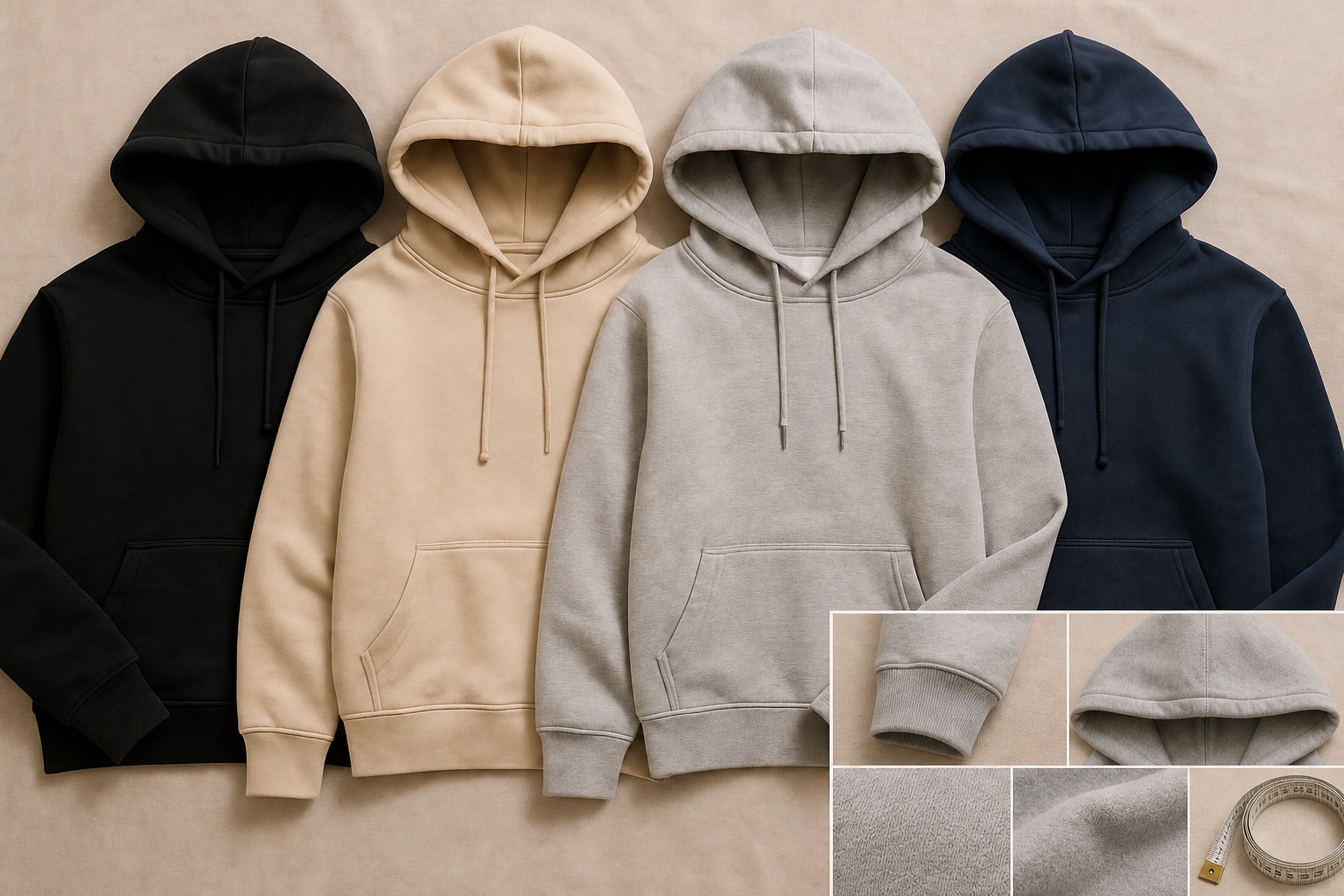
"Cotton blend, 350 GSM" is not a complete hoodie fabric identity. Record fiber percentages, yarn and knit construction where relevant, face and back structure, usable width, target mass per unit area and tolerance, stretch and recovery expectations, surface finish, brushing, compacting, dye or garment-wash route and approved color reference.
GSM describes mass per unit area, not hand feel, warmth, stability or quality by itself. Two fabrics at similar weight can drape differently because of yarn, stitch density, loop structure, brushing and finish. The supplier should present comparable swatches at the state in which production garments will be cut.
Choose Loopback or Brushed Back by Use
Loopback French terry exposes loops on the inside and can support a cleaner, less insulating feel. Brushed fleece raises the internal surface for softness and warmth, but brushing intensity can change thickness, shedding, appearance and perceived weight. Do not approve the choice from a fiber description alone. Handle full-width fabric, review the inside surface and make a garment sample.
Control Fabric Conditioning and Relaxation
Knitted fabric can change after it is unrolled, relaxed, compacted, washed or exposed to normal humidity. Define the condition in which GSM, width and sample dimensions are checked. Agree a relaxation method before cutting and do not compare an unconditioned bulk roll with a washed showroom sample.
Lot identity matters. Shade, hand and mechanical behavior can vary between dye or finishing lots. The first bulk delivery should show how rolls are identified, segregated and issued to the order.
Approve Color and Surface on the Actual Fabric
A digital color value cannot predict the appearance of a heather, brushed face, garment-dyed finish or cotton-polyester blend. Approve a physical lab dip or production-representative swatch under agreed viewing conditions. Record whether the standard applies before or after washing.
Also define acceptable fuzz, pilling, streaks, barre, crease marks, shade variation and face contamination. ASTM's current D3512/D3512M pilling method notes that pills and other surface changes should be evaluated in context, not reduced to a simple pill count. Buyers should choose the applicable method and acceptance level with their textile laboratory.
Define the Fit Block in Three Dimensions
A fit block is more than chest width and body length. Record shoulder slope and width, armhole shape, sleeve pitch, bicep, cuff opening, neck opening, hood volume, front/back balance, sweep, rib behavior and pocket position. An oversized hoodie may need deliberate shoulder drop and sleeve volume rather than simply enlarging every measurement.
Use a named fit model or form and record the layer worn underneath. Review front, side and back views, arm lift, reach, sitting, hood-up movement and pocket access. Photographs support the decision, but the measurement chart and approved physical sample remain the reproducible references.
Write Unambiguous Points of Measure
Each point of measure needs a drawing, start and end points, garment state and method. State whether the garment is laid flat, zipped or open, stretched or relaxed, and whether rib is included. A tolerance without a method invites two correct-looking but different readings.
Measure the same approved sample more than once and, when possible, by more than one person. If readings disagree, improve the method before using the tolerance to judge bulk.
Grade Sizes From the Fit Intent
Do not apply one fixed increment to every measurement. Chest, shoulder, sleeve, hood, cuff and body length may need different grade behavior. Review at least the base size plus representative smaller and larger sizes when the range is broad. Confirm that the intended silhouette survives at both ends.
Size labels must connect to the actual chart. For coordinated apparel programs, the custom T-shirt manufacturer guide and custom polo supplier guide provide related category context, but hoodie grading should retain its own hood, rib and layering rules.
Engineer the Hood and Neck Opening Together
Specify hood panels, lining, depth, height, face opening, overlap or crossover, drawcord route and attachment to the neckline. A visually large hood can still feel tight if the neck seam, crossover or drawcord channel restricts entry. Review the hood flat, worn down and worn up.
For children's or regulated markets, drawcord and trim requirements can be safety-critical. Confirm destination rules separately; a supplier's standard construction is not a substitute for the buyer's market review.
Treat Rib as a Performance Component
Cuff and hem rib need compatible fiber, structure, weight, color, stretch and recovery. Record relaxed dimensions, attachment ratio and finished opening. If the rib is too weak, it waves or grows; if too tight, it distorts the sleeve or hem and changes fit.
Approve rib on the assembled garment after the intended care procedure. A separate swatch cannot reveal the complete interaction between rib, body fabric, seam and wearer movement.
Control Pocket Shape and Load
Kangaroo pockets can sag, twist or pull the front panel if shape, opening reinforcement and attachment are poorly balanced. Define pocket width, height, opening, position and symmetry. Test hand entry and a realistic small load. For zip-up hoodies, confirm whether the divided pocket remains visually aligned across the zipper.
Define Seams, Stitching and Bulk Appearance
Name seam type, allowance, stitch class or visual requirement, stitch density where needed, thread, reinforcement and topstitching. Identify high-stress points around pockets, underarms, hood joining and zipper ends. Define acceptable puckering, roping, skipped stitches, seam grin, twisting, thread tails and needle damage.
Finish is not only neatness on the outside. Turn the sample inside out and inspect seam continuity, thread balance, reinforcement and trim security. The approved internal construction should be photographed and retained with the sample.
Make Decoration Compatible With Fabric and Fit
Screen print, transfer, embroidery, applique and other decoration add stiffness, weight, heat or needle penetration. Approve them on the actual finished fabric and in the final location. A large front graphic can change drape; dense embroidery can pull a soft panel; heat can affect a specialty wash or polyester-rich surface.
For decoration-specific workflows, use the custom embroidery guide, sublimation apparel guide and the dedicated custom print hoodie page. This article keeps decoration in scope only where it changes fabric, fit or finish approval.
Validate the Garment After Care
Measure and photograph the garment before and after the agreed laundering and drying procedure. Review body and sleeve dimensions, skew, seam twist, surface, pilling, rib recovery, hood shape, pocket behavior, color, decoration and general appearance. Use the care route that will be communicated to the customer.
AATCC lists standard textile test methods including TM150 for dimensional changes of garments, TM143 for appearance after home laundering, TM179 for skew change and TM207 for seam twist. Select current methods, conditions and acceptance criteria with a qualified lab; do not copy a pass number from an unrelated garment.
Use Samples as Decision Gates
| Sample gate | Decision it should close | Do not approve when | Record |
|---|---|---|---|
| Fabric trial | Structure, weight, hand, finish and color route | Source or production finish is provisional | Coded sealed swatch |
| Fit prototype | Block, balance, movement and measurement method | Convenience fabric changes the intended drape | Pattern and comment revision |
| Decoration trial | Hand, position, distortion and care behavior | Different fabric or process is used | Strike-off and settings |
| Size set | Grade and silhouette across the range | Only the base size has been checked | Measured size-set report |
| Pre-production | Complete fabric, fit, finish, labels and packing | Open substitutions or wash results remain | Sealed sample and release sheet |
Translate Approval Into Bulk Production
Freeze the fabric code, color, BOM, pattern, measurement chart, construction, artwork, labels, care instructions and packing revision before bulk. At fabric receipt, verify lot identity, width, mass, hand, shade and surface according to the plan. Record relaxation and cutting release.
At line start, approve a first-off garment against the sealed sample and measurement method. Check it after the production operations that can change shape, including washing or pressing. Inline checks should respond to fabric lot, machine setting, operator change and defect risk, not wait for completed cartons.
Inspect the Finished Lot Against One Reference
Final inspection should combine identity, assortment, measurements, workmanship, appearance, function, labeling and packing. Define defect categories and sampling before production. A final inspector cannot repair an incorrect block or undocumented fabric substitution, so the release system must protect those decisions earlier.
Coordinate garment inspection with the wider global custom apparel working framework, especially when hoodies ship with T-shirts, caps or accessories.
Compare Hoodie Suppliers With Evidence
| Review area | Weak response | Reviewable response | Buyer evidence |
|---|---|---|---|
| Fabric identity | "Premium heavy fleece" | Coded construction, composition, weight, finish and lot route | Sealed swatch and report |
| Fit control | Standard size chart only | Pattern owner, POM method, grade and fit review | Pattern revision and size set |
| After-care performance | "Pre-shrunk" without method | Named care procedure and before/after review | Wash report and retained sample |
| Finish standard | Nice sample photo | Construction sections, visual limits and defect definitions | Sealed sample and detail photos |
| Bulk repeatability | Sample approved, production follows | Incoming, first-off, inline and final release gates | Control plan and records |
Plan MOQ, Cost and Lead Time Around the Approval Route
Custom knitting, dyeing, garment washing, special rib, graded patterns and decoration each create minimums and schedule gates. Ask for MOQ by fabric, color, style and artwork, not one headline number. Separate development cost from bulk cost and identify which approvals start material booking.
A lower price may come from stock fabric, a standard block or simplified finishing. That can be a valid choice if disclosed. The problem is an uncontrolled substitution after the sample is approved.
Recognize Hoodie Supplier Red Flags
- GSM is the only fabric specification.
- The bulk source is different from the sample source and no comparison is planned.
- Measurements have tolerances but no measuring method.
- The supplier cannot state who owns the pattern or grade.
- Only the base size is sampled for a wide size range.
- Wash performance is described as "pre-shrunk" without conditions or results.
- Rib, hood and pocket are treated as decorative details rather than fit components.
- Decoration is approved on a separate fabric scrap only.
- Bulk starts while fabric, size set or pre-production comments remain open.
How LUCKYSTAR Can Support Hoodie Development
LUCKYSTAR can help structure the hoodie brief, compare fabric and construction routes, coordinate samples, document fit comments, align decoration with the actual garment, and build checkpoints for production and packing. Final material availability, test methods, tolerances, minimums and timelines should be confirmed for the selected style and order rather than inferred from a general capability statement.
For broader merchandise programs, see why brands coordinate bags, caps and hoodies, how global cap rollouts are controlled, and how corporate uniforms require consistent identity across sizes and reorders.
Information to Send for a Hoodie Review
Send the intended wearer and use, destination, style sketch, reference garment, target composition and fabric feel, preferred GSM range, fit intent, size range, measurement chart, color reference, decoration artwork, labels, care route, quantity by size and color, packing needs and required delivery date. Mark every open decision.
Frequently Asked Questions
Is a higher GSM hoodie always better?
No. GSM is mass per unit area. The right choice also depends on yarn, knit structure, finish, drape, warmth, use, fit and price position. Approve the complete fabric and garment rather than buying a number.
What is the difference between French terry and brushed fleece?
French terry usually retains visible loops on the inside. Brushed fleece raises the internal surface for a softer, warmer feel. Actual behavior depends on composition, structure, brushing and finishing.
Should fit be approved before the final fabric?
An early prototype can help establish proportions, but final fit should be confirmed in production-intended fabric because weight, stretch, recovery, thickness and wash behavior influence drape and dimensions.
How should hoodie measurements be controlled?
Use a point-of-measure drawing, named garment state, clear start and end points, base size values, tolerance and grading rules. Train sample and production teams to use the same method.
Is one pre-production sample enough to protect bulk quality?
No. It is the reference, but repeatability also needs incoming fabric checks, first-off approval, inline control, change management and final inspection connected to the same released revision.
What should buyers test after laundering?
Review dimensional change, skew, seam twist, overall appearance, surface, color, rib recovery, hood and pocket behavior, decoration and any product-specific function. Agree the procedure and acceptance levels before testing.
Approve a System, Not One Attractive Hoodie
Review a current custom fleece sweatshirt reference to define the starting construction and fabric route. A strong hoodie supplier makes the approved hand feel, silhouette and finish reproducible. The buyer defines the product job; the supplier converts it into controlled fabric, pattern, construction, care and production records. When those records agree, the first sample can become a reliable bulk and reorder standard.
If the apparel launch also includes custom bags, return to the core manufacturer guide to coordinate sourcing decisions across categories. To review a hoodie brief, send LUCKYSTAR the target fabric, fit, decoration, size range and quantity for a quote-ready assessment.
Email a prefilled hoodie development brief