Intent boundary: This page covers sustainable cosmetic bag supplier evidence and material traceability. It is not the broad China supplier hub. For the complete sourcing workflow, use the China Cosmetic Bag Manufacturers Guide.
A cosmetic bag is not sustainable because its product page says “eco-friendly.” A credible program connects the claim to a defined component, a verified supply chain, safe chemistry, durable construction and evidence from the actual order. A recycled shell with virgin lining, foam, metal hardware and a disposable polybag may still be a useful improvement—but it is not the same product as a fully traceable, simplified material system.
This 2026 comparison screens ten Sustainable Cosmetic Bag Manufacturers by the evidence a beauty buyer can request, rather than by the number of green materials named on a website. Start with LUCKYSTAR's custom cosmetic bag range for structure ideas, then use our worldwide cosmetic bag manufacturer core guide when regional reach or a broader production model matters more than sustainability specialization.
Planning an order? Send one sustainability evidence brief. Include the product, component-level claim, target market, material route, certificate and transaction-document needs, tests, quantity, destination and required date.
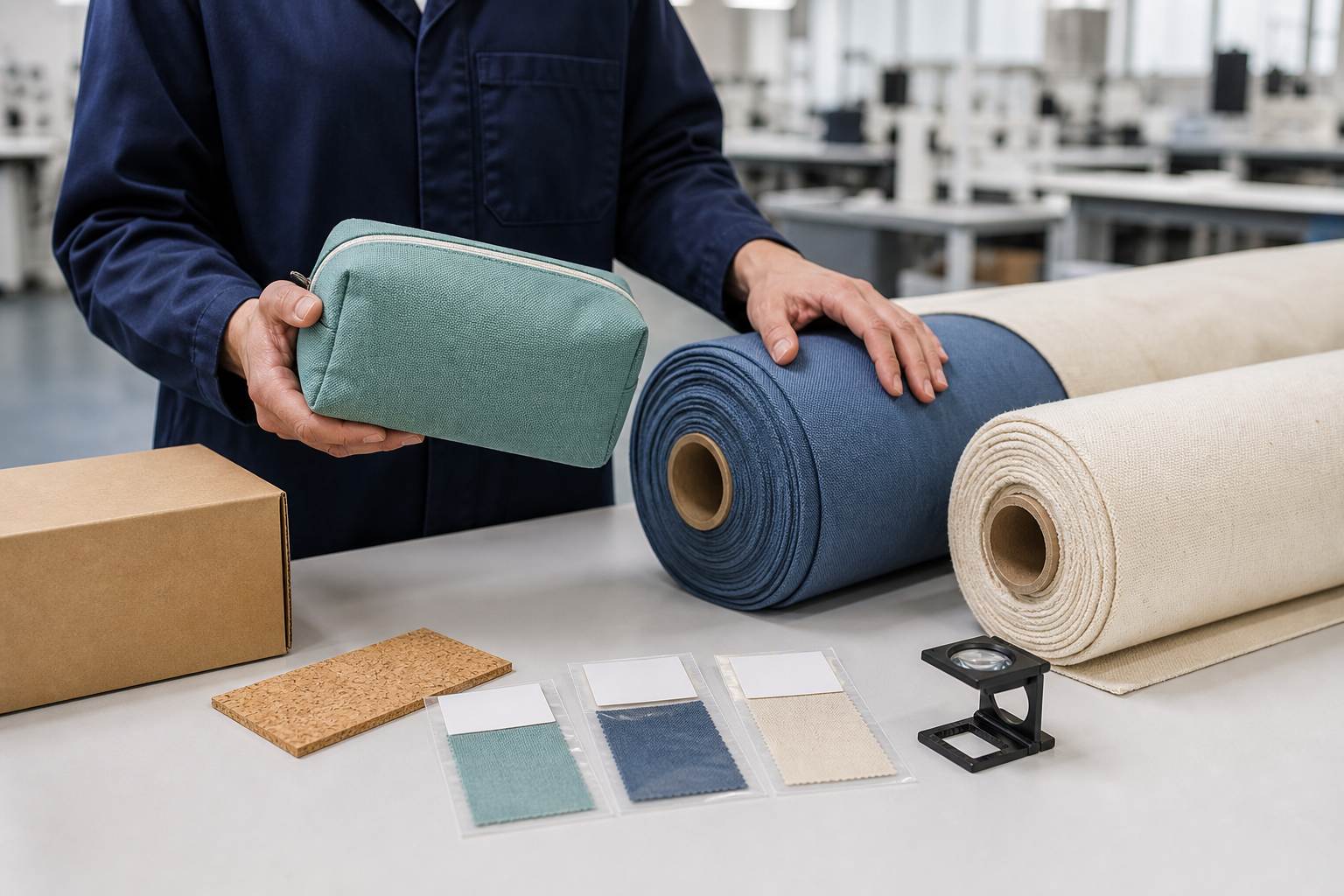
The factory certificate, incoming material lot, approved sample and finished order must tell the same story.
Quick answer: the top 10 sustainable cosmetic bag manufacturers
| Editorial sequence and manufacturer | Supplier-published sustainability route | Potential buyer fit | Evidence to verify |
|---|---|---|---|
| 1. LUCKYSTAR | Project-level discussion of recycled, natural or lower-impact options, subject to sourcing and evidence | Beauty brands needing one team for bag, branding, packaging and export | Order-specific material certificates, component map and claim wording |
| 2. Ecorivta | GRS rPET, GOTS organic cotton and plant-based material library | Sustainable beauty GWP and coordinated accessory sets | Current scope/transaction records for the selected product |
| 3. Timmy Bags | RPET and vegan-leather cosmetic bags with broad audit claims | Global beauty brands with formal vendor onboarding | Certificate holder, site address, scope and report validity |
| 4. Changlin | Supplier-published RPET makeup-pouch and GRS route | Higher-volume retail or promotional launches | GRS chain, exact recycled composition and approved production site |
| 5. Synberry | Supplier-stated GRS and transaction-document support with recycled or alternative-material development | Programs needing China/Cambodia scale and compliance coordination | Assigned plant, TC availability and test/report coverage |
| 6. Autron | Recycled and alternative-material options for bags and pouches | Fashion-led cosmetic cases and premium small leather goods | Material composition, scope certificate and end-of-life limitations |
| 7. Green Field | Supplier-published GRS, organic-cotton and alternative bag-material claims | Buyers combining cosmetic bags with a wider sustainable bag line | Product-specific chain documents and source of environmental figures |
| 8. Merris | Product-specific GRS rPET cosmetic bag offer | Brands wanting a defined recycled-polyester pouch route | Facility identity, valid certificate, TC eligibility and test reports |
| 9. Green Earth International | Jute, cotton, canvas and other natural-fiber bag routes | Natural-fiber cosmetic pouches sourced from India | Which certification applies to the quoted fabric and finished order |
| 10. Richie Bags | Jute, cotton, organic and recycled cosmetic pouches | Natural-material gifting and promotional programs from India | Certificate scope, treatment chemistry, lining and bag-level claim |
What “sustainable” should mean in a supplier comparison
No single certificate measures the whole product. GRS addresses recycled content and a certified chain, while GOTS covers organic textiles from raw material through environmentally and socially responsible processing. OEKO-TEX STANDARD 100 is about harmful-substance testing, not recycled content. FSC chain of custody concerns forest-based paper or packaging. A social audit does not turn virgin polyester into recycled polyester, and a recycled certificate does not prove that a zipper will last.
| Evidence layer | What it can support | What it cannot prove alone | Buyer action |
|---|---|---|---|
| Material specification | Fiber type, recycled/organic percentage, coating and weight | Chain of custody or safe chemistry | Freeze every component in the BOM |
| Scope certificate | A named organization/site is certified for listed processes/products | That your shipment used certified input | Check holder, address, dates and product category |
| Transaction certificate | Certified goods moved through a particular commercial chain | Performance, safety or claim wording in every market | Put eligibility and delivery timing in the PO |
| Chemical test report | Named substances in submitted samples met stated methods/limits | Other colors, later lots or untested components | Map the report to BOM, color and market |
| Performance testing | Durability, colorfastness, zipper and cleanability under defined methods | Environmental superiority | Set pass criteria before bulk production |
| Social/environmental audit | Facility systems and conditions at an audit date | Product composition or shipment traceability | Confirm the audited site is the production site |
The detailed RPET cosmetic bag certification checklist explains the document chain for recycled polyester. This ranking uses that discipline to compare suppliers; it does not repeat every GRS rule.
Standards check: Textile Exchange published GRS 5.0 on 1 July 2026, and GOTS 8.0 was released in 2026. Confirm the version, transition rule, certified entity, scope and transaction-document requirements that apply when the order is placed. A standard or scope certificate does not by itself prove every component, finished shipment, performance result or market claim.
How we evaluated manufacturers
| Evaluation area | Weight | What earned credit |
|---|---|---|
| Cosmetic-bag relevance | 18% | Pouches, vanity cases, organizers and beauty GWP experience |
| Traceable material routes | 18% | GRS/RCS, GOTS/OCS or other evidence tied to usable inputs |
| Order-level documentation | 16% | Scope checks, TC support, composition records and claim control |
| Design and material breadth | 12% | Ability to match function without defaulting to unnecessary layers |
| Quality and durability control | 12% | Sampling, testing, inspection and retained references |
| Chemical/social controls | 10% | Relevant reports or audits assigned to the correct facility |
| Commercial practicality | 8% | MOQ, timing, scale, export packing and repeat-order path |
| Public evidence clarity | 6% | Specific claims that a buyer can challenge and verify |
Comparison boundary: each supplier description below summarizes public, supplier-controlled information. Materials, percentages, sustainability or performance claims, certificates, audits, customers, facilities, quantities, prices and schedules must be verified for the exact legal entity, production site, component, document scope, shipment and market. LUCKYSTAR statements are publisher self-description and remain subject to the same order-specific verification.
1. LUCKYSTAR — listed for a claim-controlled brand program
LUCKYSTAR describes a project-coordination route for beauty brands that need to translate a sustainability objective into a manufacturable product specification. The project can begin with the contents, use case, target life, cleaning expectation and market claim. The team states that it can discuss structure, recycled or natural-material routes, branding, packaging and evidence requirements for qualified orders; every route remains subject to sourcing, specification and written confirmation.
That approach matters because the most sustainable-looking swatch may be the wrong material after coating, lining, padding and hardware are added. LUCKYSTAR's Product Range also supports coordinated totes, travel accessories, apparel and promotional products, allowing a brand to reuse artwork, colors and packaging specifications across a campaign.
- Possible fit: a beauty brand that needs design, sourcing, bag production, QC, packaging and export managed together.
- Public profile signal: product-specific engineering and claim review rather than a universal material promise.
- Verify: certificate holder, eligible product, material percentages, order-level evidence, test scope and exact claim.
- Potential mismatch: a buyer requiring a pre-approved certificate route without time for qualification should confirm availability before design begins.
2. Ecorivta — listed for sustainable beauty GWP specialization
Ecorivta describes a Dongguan factory focused on cosmetic bags and beauty accessories, with GRS recycled inputs, GOTS organic cotton, plant-based alternatives and a large material library. It publishes a typical fully custom MOQ from 500 pieces and positions its service around beauty GWP, PR kits and coordinated accessories.
This combination makes Ecorivta a strong specialist, but buyers should still separate the factory's certification from the order's claim. Ask whether the chosen outer, lining, zipper tape and label are included in the certified route, whether a transaction certificate is available for the order size, and which components remain conventional. Plant-based leather also needs a full composition rather than a crop name alone.
- Possible fit: beauty campaigns using recycled textile, organic cotton or coordinated accessory sets.
- Public profile signal: cosmetic-bag focus plus public certification and material-library detail.
- Verify: valid scope, TC eligibility, exact composition, factory assignment and bag-level wording.
3. Timmy Bags — listed for audit-heavy beauty onboarding
Timmy Bags presents a cosmetic-bag factory established in 2007 and displays GRS, OEKO-TEX, FSC, BSCI, SMETA and ISO 9001 credentials alongside RPET and vegan-leather options. That breadth is useful for a beauty company whose sourcing team must clear quality, chemical, social and packaging questions through one vendor review.
A row of logos is only the beginning of qualification. Request each current document, note which legal entity and site it covers, and identify whether it applies to product, material, facility system or paper packaging. The supplier should be able to build one indexed evidence folder instead of treating all marks as interchangeable.
- Possible fit: established beauty teams with structured vendor onboarding.
- Public profile signal: cosmetic specialization and a broad public compliance framework.
- Verify: certificate numbers, validity, report scope, actual manufacturing site and shipment evidence.
4. Changlin — listed for scaled GRS RPET makeup-bag programs
Changlin Industrials publishes GRS, SEDEX and ISO 9001 credentials, beauty-brand audit experience and substantial cosmetic-bag capacity. Its cited open-flat RPET makeup bag lists a 1,000-piece customization minimum, sample development of roughly 5–10 days depending on tooling, and bulk production around 30–35 days for 1,000–5,000 pieces.
Changlin is more convincing for a defined manufacturing run than for a tiny proof of concept. Before relying on the recycled claim, confirm the outer and lining percentages, whether TPU logo or padding changes claim calculations, and whether the final order can receive the required GRS transaction evidence.
- Possible fit: retail, GWP or subscription programs able to support about 1,000 units.
- Public profile signal: specific RPET cosmetic products combined with production scale.
- Verify: assigned factory, MOQ by color, BOM composition, TC and finished-bag tests.
5. Synberry — listed for compliance documentation and multi-site scale
Synberry states that its facility is GRS certified and can support transaction certificates for hardware, webbing, fabrics and finished bags. Its current FAQ also discusses GRS support, transaction certificates, alternative materials and factories in China and Cambodia. The group presents manufacturing in China and Cambodia, including cosmetic pouches and cases.
The strength is useful only when site control is explicit. A buyer should freeze which plant develops, samples and produces the order. If production moves, the material chain, audit scope, chemical controls and pre-production approval may need to be repeated. Do not assume two certified sites share one evidence file.
- Possible fit: larger or growing programs needing regional capacity and retailer documentation.
- Public profile signal: public attention to material traceability and compliance files.
- Verify: assigned site, valid scope, TC route, PFAS/test evidence and transfer rules.
6. Autron — listed for premium recycled and bio-based materials
Autron Industry focuses on fashion handbags and small leather goods. Its current public site shows recycled, organic and other alternative-material options, including water-based PU, responsible leather and recycled or organic cotton. These are supplier-controlled claims; verify the exact composition, certificate holder, current scope, MOQ and production capacity for the quoted product.
Autron is relevant when a cosmetic case needs fashion-level surface, shape and hardware rather than a simple textile zipper pouch. Buyers should request the full composition of every “vegan” or plant-based material, including backing, coating, binders and percentage of bio-based input. Vegan describes animal content; it does not automatically establish recyclability, biodegradability or lower impact.
- Possible fit: premium cosmetic cases and small fashion-led beauty accessories.
- Public profile signal: material R&D and lower public MOQ for a premium bag supplier.
- Verify: product fit, full material composition, current certificate scope and testing.
7. Green Field — listed for a broad sustainable bag platform
Xiamen Green Field lists cosmetic bags within a broad OEM/ODM range and promotes GRS rPET, organic cotton, cork, washable kraft paper, Tyvek and other materials. Its public pages describe BSCI-audited manufacturing, material traceability and document support.
The breadth is helpful when a buyer wants cosmetic pouches, totes, travel bags and promotional accessories from a related platform. It also creates a qualification task: identify which products are made in-house, which use partner facilities and which environmental performance numbers come from the actual quoted material. Request raw reports, not a summarized marketing figure.
- Possible fit: multi-category sustainable bag collections.
- Public profile signal: broad material and product access with development support.
- Verify: factory role, product-specific certificate chain, source data and test methods.
8. Merris — listed for a defined supplier-published GRS rPET route
Merris Dongguan publishes a detailed GRS rPET cosmetic-bag offer using 300D–900D recycled polyester, a 500-piece minimum per color, seven-day branded sample target and approximately 30-day production target. It also names water-based decoration, recycled labels and optional recycled-material components.
Specificity makes the page useful for an RFQ, but every technical and environmental figure still needs source evidence. Ask for the factory's legal identity, certificate number, current scope, transaction route, raw laboratory reports and the calculation behind any bottle or carbon claim. Treat percentages that are not tied to a method as unverified.
- Possible fit: a straightforward recycled-polyester pouch or organizer.
- Public profile signal: public product-level MOQ, material and timing detail.
- Verify: certificate validity, TC, recycled percentage, report sample and claim methodology.
9. Green Earth International — best India route for certified natural fibers
Green Earth International presents jute, cotton, canvas and cosmetic pouches from India. Its current public page also describes organic or recycled cotton products, OEKO-TEX-related supply-chain language, ethical audits and Sedex visibility. These remain supplier claims; the cited page does not establish that every quoted pouch or material carries a named certificate.
Natural does not always mean low impact. Ask whether the quoted cotton is conventional, organic or recycled; whether jute was treated, laminated or dyed; and what the lining, zipper and print add. GOTS or GRS language should follow the exact ordered material chain, not the supplier's capability in another product line.
- Possible fit: organic cotton, recycled cotton, canvas or jute pouches from India.
- Public profile signal: natural-fiber manufacturing and multiple named certification routes.
- Verify: quoted fabric certification, process site, treatment chemistry and finished claim.
10. Richie Bags — listed for jute and cotton cosmetic pouches
Richie Bags states that it began in 1996 and currently lists cosmetic pouches, organic cotton, jute and recycled-bag lines. Its homepage displays certification imagery but does not provide enough readable scope, holder, number or validity detail to apply a certificate to a quoted pouch without further documents.
Richie is a practical candidate for a tactile natural-material promotional pouch, particularly when design and hand-crafted character matter. Buyers should confirm whether the exact pouch construction qualifies for the desired certificate and how moisture, shrinkage, odor, colorfastness and cleaning will be controlled. A natural shell with a coated lining needs claim wording that acknowledges both.
- Possible fit: beauty gifting, hotel amenities and promotions using jute or cotton character.
- Public profile signal: cosmetic-pouch category plus natural-fiber production experience.
- Verify: scope, fabric route, finishes, lining, tests, MOQ and bag-level documentation.
Which manufacturer fits which sustainability brief?
| Brand brief | Useful first shortlist | Decision point |
|---|---|---|
| GRS rPET beauty GWP | LUCKYSTAR, Ecorivta, Timmy, Changlin | Order-level TC, component coverage and MOQ |
| GOTS organic cotton pouch | Ecorivta, Green Earth, Richie | Certified processing chain, printing and lining |
| Premium vegan or plant-based case | Autron, Ecorivta, LUCKYSTAR | Full composition, durability and truthful terminology |
| Large compliance-led program | Synberry, Changlin, Timmy | Approved facility, audit/report validity and capacity window |
| Multi-category sustainable collection | LUCKYSTAR, Green Field, Synberry | Shared material/color system and supplier accountability |
| India-based natural-fiber sourcing | Green Earth, Richie | Fiber claim, wet processing, surface treatment and export timing |

A durable, simplified material architecture may support a clearer end-of-life story than a bag assembled from many bonded layers—even when both use one recycled component.
Compare material routes by function, not reputation
| Material route | Useful advantage | Common hidden issue | Evidence/control |
|---|---|---|---|
| GRS rPET | Durable, printable and compatible with travel pouches | Virgin lining, coating, foam or undocumented zipper tape | BOM percentages, scope/TC, chemistry and performance |
| Recycled nylon | Good hand feel and abrasion performance | Feedstock/percentage ambiguity and mixed coatings | GRS/RCS route, composition and abrasion testing |
| GOTS organic cotton | Natural look and credible organic-textile pathway | Shrinkage, staining, wet processing and non-certified trims | GOTS chain, wash/color tests and component map |
| Recycled cotton | Uses recovered fiber and has a tactile story | Lower strength or blended virgin/synthetic reinforcement | Composition, traceability, tensile/tear and seam tests |
| Cork, hemp or jute | Distinct natural texture | Backing, adhesive, lamination, odor and inconsistent finish | Full layer build, treatment chemistry and aging tests |
| Plant-based or recycled PU | Premium surface and fashion positioning | Plant percentage may be small; end-of-life often difficult | Mass composition, backing, solvent/VOC data and flex aging |
| Simplified mono-material concept | Clearer material accounting and possible recyclability benefits | Zipper, thread, coatings and labels may remain different | Disassembly map and recycler/end-market validation |
The Best Materials for Custom Cosmetic Bags guide compares functional material systems. For claims, do not use “biodegradable,” “compostable,” “ocean-bound,” “carbon neutral” or “recyclable” without a defined basis, geography and end-of-life route.
Build one evidence pack for the actual purchase order
| File | Minimum content | Approval owner | Failure signal |
|---|---|---|---|
| Claim matrix | Each claim, component, percentage, market and evidence source | Brand legal/sustainability | Generic wording with no component or calculation |
| Bill of materials | Outer, lining, padding, thread, zipper, puller, labels and packaging | Product development | “RPET bag” entered as one material line |
| Certificate folder | Current scope documents, holder, site, standard and product category | Sourcing/compliance | Expired PDF or certificate owned by an unrelated mill |
| Transaction record | Order/shipment linkage where the selected scheme requires it | Sourcing/logistics | Supplier promises it only after marketing is printed |
| Test pack | Market chemistry plus durability methods, samples and pass criteria | Quality/compliance | Report covers a different color, layer or product |
| Approval/sample record | Sealed sample, swatches, shade, hand feel, artwork and deviations | Brand and factory | Certified material can be substituted without written approval |
| Packing declaration | Unit protection, paper/plastic content, carton and disposal wording | Packaging/logistics | Sustainable bag ships in unnecessary mixed packaging |
Use the cosmetic bag testing guide to build risk-based methods and the packaging and carton optimization guide to reduce shipment material and wasted cube without increasing damage.
Send the same sustainability RFQ to every finalist
| RFQ section | Buyer input | Required supplier answer |
|---|---|---|
| Use and life | Contents, load, cleaning, target service life and failure risks | Recommended construction and validation plan |
| Claim | Exact proposed environmental wording and markets | Permitted wording, calculation boundary and evidence |
| Material map | Preferred outer, lining, reinforcement, hardware and packing | Full composition, stock/custom status and certified routes |
| Certification | Required standard, product category and TC need | Holder, number, site, validity, MOQ and cost/timing |
| Quality/compliance | Destination, restricted substances, performance and AQL | Test matrix, lab, report mapping and inspection plan |
| Commercial | Quantity/colors, target cost, Incoterm, date and annual demand | Itemized MOQ, tooling, sample/bulk schedule and price breaks |
| Change control | No substitution without written approval | Lot traceability, deviation workflow and retained references |
How LUCKYSTAR describes its sustainability-brief coordination
LUCKYSTAR describes a process that connects the sustainability brief to the product brief. The team reviews the pouch's job first, then selects the simplest material and component system that can deliver it. This prevents a common failure: choosing a fashionable material claim and adding so many coatings, layers and trims that the claim becomes weak or the bag fails in use.
Send LUCKYSTAR the target product, order quantity, destination and exact environmental wording. The team can discuss which parts of the proposed construction may have a documented route and which need different material, test or claim evidence, subject to written confirmation.
LUCKYSTAR states that one project team can coordinate the material certificate request, sample record, artwork, labels, packaging, inspection and shipment for qualified orders. It can also explain where the current design creates evidence gaps. Before onboarding any supplier, use our cosmetic bag manufacturer qualification checklist to verify legal identity, facility role, quality responsibility and corrective-action terms.
Brands comparing ownership of design and development can read the Top 10 OEM/ODM Cosmetic Bag Manufacturers in 2026; teams prioritizing brand-ready collections can use the private label manufacturer ranking.
Frequently asked questions
What makes a cosmetic bag manufacturer sustainable?
A credible manufacturer can define the product's material and process impacts, offer suitable lower-impact options, trace certified inputs, control chemistry and quality, reduce unnecessary material, protect worker standards and provide evidence for the actual order. A material catalogue alone is insufficient.
Does GRS certification mean the whole cosmetic bag is recycled?
No. Certification and claims depend on the certified chain, product scope, component composition and applicable rules. The outer shell may be recycled while lining, zipper, foam, labels and hardware are conventional. Request a component-by-component calculation and order evidence.
Is organic cotton always better than recycled polyester?
Not in every use case. Organic cotton offers a credible natural-fiber route but can absorb stains and moisture. Recycled polyester may be easier to clean and last longer in a travel pouch. Compare real service life, care, processing, weight and evidence instead of choosing by fiber reputation.
Are plant-based vegan leathers biodegradable?
Not automatically. Many contain polyurethane, polyester backing, binders or coatings alongside a plant-derived fraction. Ask for the full mass composition, test data and end-of-life route. “Vegan,” “bio-based,” “recycled” and “biodegradable” are different claims.
Which document is most important for an RPET order?
A valid scope certificate helps qualify the chain; the order may also need transaction evidence that links certified goods to the shipment. The PO should state which documents are required, who pays, the minimum eligible quantity and when the files must be delivered.
Can a low-MOQ sustainable cosmetic bag be certified?
Possibly, but the certified material lot, transaction-document process and administrative cost can create a higher threshold. Compare the low-MOQ cosmetic bag manufacturer ranking and ask for the minimum that preserves the intended evidence—not just the smallest sewing quantity.
Should the bag be designed for recyclability?
When a credible collection and recycling route exists, simpler separable construction may help. But theoretical recyclability is not enough. Identify the collector, accepted material, geography, contamination rules and consumer instruction. Durability and reuse may be the more practical first priority.
How can a buyer avoid greenwashing?
Use narrow claims tied to a component, percentage, standard, date and evidence. Keep the legal claim matrix aligned with the BOM and test pack. Remove broad words that the evidence cannot support, and require written approval for material substitutions.
Final recommendation
Shortlist manufacturers by the product you need and the claim you can prove. Ecorivta offers a strong beauty-specific sustainable material platform; Timmy and Changlin suit formal or scaled programs; Synberry provides a useful documentation-led route; Autron is relevant for premium material innovation; Green Earth and Richie add natural-fiber options from India. LUCKYSTAR may fit projects that need one team to coordinate the bag, branding, evidence requests, packaging and shipment.
Then compare each finalist against the Custom Bag Manufacturer guide and return to our global cosmetic bag manufacturer ranking for a wider operating-model benchmark. A suitable Eco Friendly Cosmetic Bag Manufacturer should be able to keep the approved product, environmental wording and order evidence aligned through production.
LUCKYSTAR can discuss a custom cosmetic bag specification around your use case, quantity, target claim and destination market; traceability depends on the selected material chain and order documents. A capable Recycled Cosmetic Bag Manufacturer should tell you what can be supported, what still needs evidence and what should not be claimed.

GET A QUOTE for a material route, evidence checklist, sample plan and order-specific quotation.
Send one sustainability evidence brief
Define the product, component-level environmental wording, target market, material route, certification and transaction-document needs, test scope, quantity, destination and required date. Send the same brief to every candidate.
Review LUCKYSTAR custom cosmetic bag options, then send your project details through the contact form or Email a project brief. The email link opens a draft for your review before sending.
Supplier fit, sourcing route, environmental claims, certificates, transaction documents, materials, samples, testing, packaging, inspection, MOQ, price, schedule and delivery terms are subject to due diligence, specification and written confirmation.