Intent boundary: This page covers OEM versus ODM cosmetic bag development models. It is not the broad China supplier hub. For the complete sourcing workflow, use the China Cosmetic Bag Manufacturers Guide.
A factory can write “OEM/ODM welcome” on a product page without explaining who creates the pattern, who owns the design, how revisions are recorded or whether the quoted product is truly new. Those unanswered questions matter. In an OEM project, a brand normally brings stronger specifications and expects faithful execution. In an ODM project, the manufacturer contributes more design and engineering. A private-label route usually begins with a proven body that is adapted through color, logo, trim and packaging.
This guide screens ten OEM/ODM cosmetic bag manufacturers in 2026 by their publicly described development routes, rather than treating size or promotional superlatives as proof of fit. It is written for beauty brands, retailers, promotional distributors and product teams deciding how much development responsibility to give the supplier. If you need product starting points, browse LUCKYSTAR's custom cosmetic bag collection. For a broader geographic comparison, use our Top 10 Custom Cosmetic Bag Manufacturers Worldwide in 2026.
Shortlisting OEM Cosmetic Bag Manufacturers is mainly an execution decision; comparing ODM Cosmetic Bag Manufacturers is also a design-capability decision. A search for a Private Label Cosmetic Bag Factory usually points to a third route: adapting an established pattern for a quicker, lower-risk launch.
Planning an OEM, ODM or private-label project? Send one controlled development brief. State what is fixed, what the supplier may develop, design and tooling ownership, target contents, quantity by variant, evidence needs, packing, destination and required date.
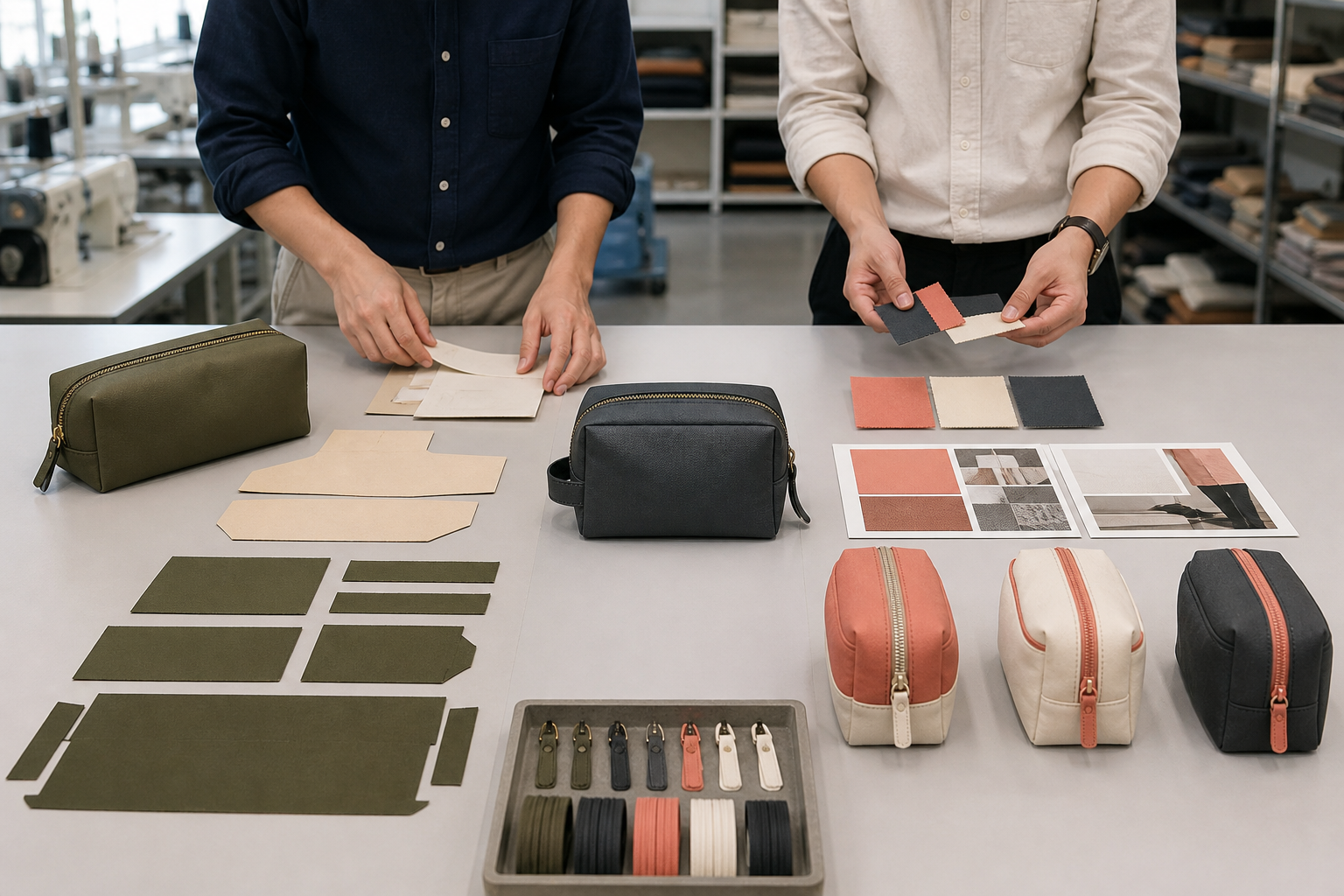
OEM and ODM can reach the same finished pouch, but they begin with different levels of buyer-owned design and supplier-led development.
Quick answer: the 2026 OEM/ODM shortlist
The sequence separates useful development models. Some companies describe execution from a complete tech pack; others publish deeper concept work, printing, material research, private-label starting bodies or multiple production countries. Buyers should compare the route against one defined brief and verify each candidate before purchase.
Because cosmetic-bag component clusters are concentrated in Asia, most full-service candidates below use production in China. Buyers comparing factories specifically by location can also review the Top 10 Cosmetic Bag Manufacturers in China in 2026.
| Manufacturer | Strongest route | Potential project fit | Critical verification |
|---|---|---|---|
| 1. LUCKYSTAR | Balanced OEM/ODM and multi-product coordination | Beauty launches, retail collections and GWP programs | Production route, design inputs, revision log, MOQ and critical path |
| 2. Rivta | Material-led ODM and sustainable private label | Beauty/hospitality bags with recycled or alternative materials | Composition, certificate scope, claim wording and performance |
| 3. Synberry | Structured OEM with China/Cambodia options | Retailers and importers needing broad formats and scale | Exact production country and sample-transfer control |
| 4. Timmy Bags | Cosmetic-focused OEM execution | Beauty, e-commerce, promotional and retail-ready pouches | Audit scope, in-house steps, sample record and booked capacity |
| 5. Changlin | High-volume ODM, quilting and welded-film programs | GWP, quilted, RPET, PU and transparent beauty bags | Order-specific factory, audit, material evidence and line capacity |
| 6. KONCAI | Cosmetic cases, soft pouches and OEM/ODM development | Beauty programs comparing soft and structured case formats | Exact factory, order-specific MOQ, schedule, test scope and authorization claims |
| 7. Ciffnoo | Print-led ODM and visualization | Artwork-heavy seasonal collections and branded fabrics | Design license, strike-off, repeat placement and color tolerance |
| 8. Uinta Design | 3D-led design and managed global production | Brands needing a guided path from idea to private label | Factory site, legal seller, IP ownership, fees and QC standard |
| 9. NOVOTE | Structured PU/leather private-label development | Beauty and fashion teams evaluating structured PU or leather-like formats | MOQ by design, material grade, aging tests and hardware finish |
| 10. Kanrow | Multi-site OEM/ODM in China and Vietnam | Bag collections needing origin and capacity alternatives | Site assignment, development handoff, audit and material movement |
OEM, ODM and private label are not the same service
The bag industry uses these terms inconsistently. Some suppliers call any logo order OEM; others use OEM only when a buyer provides production-ready specifications. Do not argue about the acronym. Define the work, ownership and approval gates in the quotation. Our broader OEM vs ODM Bag Manufacturing guide explains the business models in more depth.
| Route | Buyer normally provides | Manufacturer normally provides | Main risk |
|---|---|---|---|
| OEM execution | Tech pack, dimensions, materials, artwork, quality standard and often reference sample | Feasibility review, sourcing, pattern/sample execution, production and QC | Factory assumptions fill gaps in an incomplete specification |
| ODM development | Target user, contents, brand direction, budget, quantity and launch date | Concepts, structure, materials, engineering, prototypes and production | Unclear design ownership, generic proposals or uncontrolled revisions |
| Private label | Selected base style, color, logo, labels and packaging | Existing pattern, curated materials, decoration and pack-out | Limited exclusivity and unexpected similarity to other market products |
| Hybrid | A partial design or reference product plus non-negotiable brand features | Pattern adaptation, engineering choices and manufacturing | Responsibility changes without being recorded |
How we evaluated OEM/ODM cosmetic bag manufacturers
We looked for public evidence of actual development work: starting from tech packs, samples, reference images or brand briefs; offering pattern and material decisions; controlling sample revisions; and carrying the project into bulk production. We did not reward a site simply for repeating “one-stop service.”
| Evaluation area | Weight | Evidence considered |
|---|---|---|
| Development depth | 20% | Tech-pack execution, concept support, pattern work, mockups and prototypes |
| Cosmetic-bag specialization | 15% | Pouches, vanity cases, clear bags, organizers, brush storage, GWP and retail formats |
| Sample and revision control | 15% | Approval stages, numbered comments, pre-production sample and bulk handoff |
| Process and material range | 15% | Sewing, printing, quilting, welding, hardware, linings and packaging |
| Quality verification | 15% | QC stages, testing language, current audits and order-specific documentation |
| Commercial fit | 10% | MOQ route, sample time, scalability and transparency about cost drivers |
| Buyer communication | 5% | Clear RFQ inputs, escalation route, version control and realistic limitations |
| Public information quality | 5% | Specific statements buyers can challenge rather than unsupported superlatives |
This methodology supports a shortlist, not a purchase decision. Ask two or three relevant manufacturers to respond to the same RFQ and produce comparable samples. The cosmetic bag supplier evaluation checklist shows how to qualify the finalists.
Comparison boundary: every supplier description below summarizes public, supplier-controlled information. Capabilities, facilities, experience, certifications, customer or brand references, material claims, tests, MOQs, capacity, sample timing, lead time and pricing must be verified for the exact legal entity, production site, certificate scope and order. LUCKYSTAR statements are publisher self-description and remain subject to the same order-specific verification.
1. LUCKYSTAR — listed for OEM, ODM and project coordination
Location and model: Ningbo, China; custom bag/apparel manufacturing and export coordination for OEM and ODM programs.
LUCKYSTAR describes its role as coordinating product development and the related supply-chain steps for qualified orders. An OEM brief can begin with a tech pack or approved reference. A less-defined ODM project can begin with target contents, use case, brand position, quantity and budget. The team then connects structure, materials, lining, zipper, branding, packing, inspection and delivery into one controlled project.
The wider Product Range is also useful when the cosmetic bag belongs to a coordinated launch with totes, travel bags, apparel or promotional gifts. A shared project team can align color references, artwork files, labels and carton instructions across categories.
- Possible fit: beauty brands, retailers, private-label collections, GWP campaigns and multi-item launches.
- Public profile signal: balanced execution and development support plus practical export coordination.
- Verify: production site, buyer/factory design inputs, revision owner, MOQ by variant, test matrix and dated schedule.
- Potential mismatch: very small, domestic-only runs may fit a nearby sample studio better than an export manufacturing program.
2. Rivta — listed for material-led ODM and documented sustainability
Location and model: Dongguan, China; cosmetic bag specialist offering OEM, ODM and private-label development.
Rivta clearly describes three entry routes: OEM from a tech pack or reference, ODM for new shapes and materials, and private label for ready-to-customize styles. Its published library covers post-consumer recycled fabrics, see-through options, cotton-based textiles and multiple plant-derived or animal-free leather alternatives. That makes the company especially relevant when the material story shapes the product concept.
Sustainable ODM creates an extra ownership question: a supplier may recommend a material, but the brand still owns the public claim. Ask for composition data, the certificate's named holder and boundaries, any chain-of-custody record required by the scheme, coating information and physical-test results. The RPET Cosmetic Bags sourcing checklist explains how to separate marketing language from order evidence.
- Possible fit: material-driven programs for beauty, hotels, fragrance launches and airport retail.
- Public profile signal: explicit route definitions and visible alternative-material depth.
- Verify: certificate holder, selected factory, transaction documents, claim wording and durability.
3. Synberry — listed for structured OEM with China/Cambodia options
Location and model: production in China and Cambodia; broad bag OEM/ODM group.
Synberry states OEM/ODM bag manufacturing experience since 1993, a starting cosmetic-bag MOQ of 500 pieces and support for pouches, vanity cases, travel organizers, clear styles, padded cases and amenity kits. Its format range is useful for buyers who already know the product architecture but want one group to execute several structures.
The two-country footprint can support origin or capacity planning, but an approved sample is not automatically portable between sites. Freeze the production country before approval. Record which site develops the sample, where materials are sourced, how instructions transfer, and whether a site change requires a new pre-production sample.
- Possible fit: established retailers, travel programs and importers needing scale or origin alternatives.
- Public profile signal: broad construction range and declared multi-country production.
- Verify: facility address, audit scope, country of origin, sample transfer and contingency plan.
4. Timmy Bags — listed for cosmetic-focused OEM execution
Location and model: Shenzhen, China; factory presenting an 18-year focus on OEM/ODM custom bags.
Timmy Bags organizes its cosmetic-bag service around material selection, logo application, sample revisions, production follow-up and packing coordination. The company states a standard MOQ around 300–500 pieces, sample timing of 5–7 days and bulk production around 25–30 days, subject to design and material. Those figures are useful for screening but should become dated milestones in the order schedule.
Timmy is most compelling when the buyer wants a category-focused team to execute a reasonably defined beauty pouch rather than invent an entire fashion language. Ask for a sample-revision register, confirmation of in-house versus subcontracted steps, current audit documents and a booked line window.
- Possible fit: e-commerce, retail, GWP and promotional cosmetic-bag programs.
- Public profile signal: cosmetic-oriented workflow and attention to packing/label details.
- Verify: claims, documents, actual line, sample material, QC checkpoints and schedule.
5. Changlin — listed for high-volume GWP, quilting and welded films
Location and model: Guangdong, China; cosmetic and promotional bag branch within the Jiafeng group.
Changlin presents OEM/ODM cosmetic bags across quilted textiles, RPET, PU, PVC, EVA and TPU. It states backing from more than 26 years of group manufacturing experience, monthly capacity up to one million pieces and several management, social and recycled-material credentials. Its combination of sewing, quilting and high-frequency welded vinyl is relevant to beauty brands running varied seasonal programs.
Large stated capacity does not prove open capacity for a particular month. A buyer should request the assigned facility and line, current audit scope, material booking date and inline checkpoints. For an RPET or recycled-TPU story, trace every claimed component rather than relying on a general factory certificate.
- Possible fit: higher-volume GWP, quilted pouches, transparent bags and multi-material promotions.
- Public profile signal: broad beauty-material range and both sewn and welded construction.
- Verify: site, booked capacity, certificate scope, full BOM and process-specific tests.
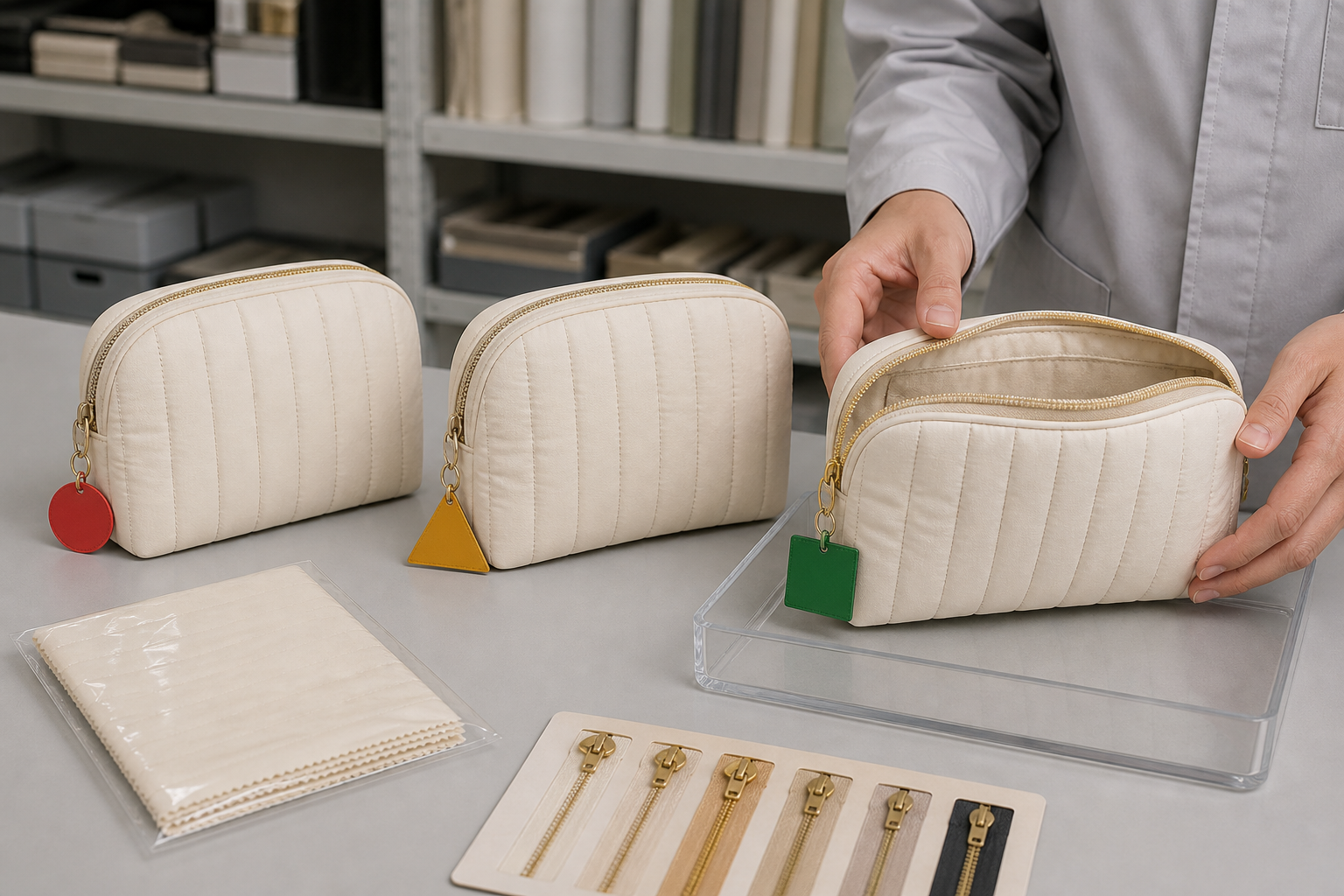
A controlled revision history prevents the correct final sample from being replaced by an earlier pattern during bulk handoff.
6. KONCAI — listed for cosmetic cases and OEM/ODM development
Location and model: Shenzhen, China; supplier-presented OEM/ODM manufacturing for soft cosmetic bags and structured makeup cases.
KONCAI publishes cosmetic-bag and case categories, a design-and-sampling workflow, material cutting, sewing, quality-control steps and OEM/ODM services. Its current page also publishes experience, workforce, capacity, MOQ, timing, testing, factory and brand-authorization statements. Treat every one of those items as supplier-controlled screening information rather than independent validation.
This candidate may be relevant when a collection combines soft pouches with more structured travel or professional cases. Ask the legal contracting entity to name the assigned factory, distinguish in-house and subcontracted work, provide order-relevant audit or authorization evidence, and convert website timing into a dated critical path.
- Possible fit: beauty programs comparing soft cosmetic bags, travel cases and structured organizers.
- Public profile signal: an active official page showing product categories and a stated design-to-QC workflow.
- Verify: legal entity, assigned facility, design ownership, MOQ by variant, test method, authorization scope, sample gates and written schedule.
7. Ciffnoo — listed for print-led ODM and visualization
Location and model: China; cosmetic-bag specialist with stated in-house design and printing.
Ciffnoo presents more than 30 years of experience, design renderings before sampling, a large pattern library and in-house printing. Its ODM service is particularly relevant when a seasonal bag is driven by artwork and surface treatment rather than complex compartments. The company states a 20,000-square-meter facility, typical sampling of 7–10 days and output over 100,000 units per month.
A pattern library creates both speed and intellectual-property questions. Confirm whether a motif is exclusive, licensed, adapted from a shared library or buyer-owned. Approve the strike-off on production material, then review repeat placement across seams and the cutting rule for directional artwork.
- Possible fit: print-heavy beauty launches, artist programs and seasonal GWP collections.
- Public profile signal: visible design/print workflow and cosmetic-bag focus.
- Verify: artwork ownership, exclusivity, print proof, color tolerance, audits and booked capacity.
8. Uinta Design — listed for 3D-led ODM with managed production
Location and model: U.S.-led design and account management with global production stated in China and Vietnam.
Uinta Design begins custom cosmetic-bag development with 3D mockups so a buyer can judge silhouette, closure, materials and branding before a physical sample. Its Core and Custom process separates a faster curated route—typically described around 250 units—from a bespoke route with typical MOQs from 500 and longer development. That is a useful commercial distinction between private label and deeper ODM.
The design layer can reduce ambiguity for a brand without technical staff. It can also reduce direct factory visibility. Confirm the legal contracting party, manufacturing country, ownership of 3D files/patterns/tooling, sample fees, revision limit, QC standard and whether the approved factory can change.
- Possible fit: North American brands wanting guided concept development and visual approval.
- Public profile signal: clear 3D-first workflow and separate fast/custom commercial lanes.
- Verify: site, origin, IP, fees, revision scope, inspection method and landed-delivery terms.
9. NOVOTE — listed for structured private-label development
Location and model: Dongguan, China; TinLee Group brand focused on leather, microfiber, PU and structured private-label bags.
NOVOTE promotes OEM, ODM and contract manufacturing for beauty brands, makeup artists and startups. Its page states lower-quantity and design-support routes, but these claims are project-dependent and must be reconfirmed for the selected construction.
Low MOQ may rely on stocked surfaces, hardware or existing patterns. Ask which elements are actually custom. Define PU or microfiber construction, backing, thickness, edge treatment, hydrolysis/abrasion expectations, hardware plating and deformation-resistant packing.
- Possible fit: startups, influencers, skincare brands and fashion-beauty private label.
- Public profile signal: premium material direction and publicly stated low-quantity route.
- Verify: MOQ by color/design, pattern exclusivity, material technical sheet, aging tests and real production schedule.
10. Kanrow — listed for China/Vietnam multi-site OEM/ODM
Location and model: development/production in Dongguan and Hunan, China, plus a Vietnam production site.
Kanrow describes OEM and ODM development from reference photos, samples, sketches or finished tech packs. Its material range includes PU, leather, RPET, nylon, canvas, linings, zippers, labels and packaging. The company states more than 25 years of experience, three production sites and annual capacity of eight million pieces.
Multi-site manufacturing can help with origin, capacity and category allocation. It also creates handoff risk. Ask which team creates the pattern, which facility makes each sample, how material standards move between countries, and whether changing the site requires buyer approval and a new pre-production sample.
- Possible fit: broader private-label bag collections and buyers considering China/Vietnam origin options.
- Public profile signal: visible multi-site route and structured RFQ/development description.
- Verify: legal entities, exact site, site audit, origin, material movement, pattern ownership and QC transfer.
Which manufacturer fits your development starting point?
| What the buyer has now | Route to evaluate | Candidates to verify | First deliverable to request |
|---|---|---|---|
| Complete tech pack and approved reference | Controlled OEM execution | LUCKYSTAR, Synberry or Timmy | Feasibility report with deviations and production-intent sample quote |
| Brand brief, target user and mood board | ODM concept development | LUCKYSTAR, Uinta or Ciffnoo | Concept deck stating included revisions and ownership |
| Sustainability goal but no material solution | Material-led ODM | Rivta or Changlin | Material shortlist with evidence boundaries and test plan |
| Existing body needing logo and packaging | Private label | NOVOTE, Uinta Core or Timmy | Physical base sample and exact customization matrix |
| Soft pouches and structured cosmetic cases | Multi-format OEM/ODM | KONCAI or another verified multi-format candidate | Factory allocation, process map and sample plan for each construction |
| China/Vietnam origin strategy | Multi-site OEM | Kanrow or Synberry | Site allocation proposal and sample-transfer protocol |
Define ownership before paying development fees
ODM value comes from supplier input, but that input can create ambiguity. A buyer may assume it owns every pattern after paying a sample fee; a manufacturer may treat its base pattern or library artwork as reusable know-how. Set the boundary before the first concept is drawn.
| Development asset | Questions to settle | Useful contract record |
|---|---|---|
| Buyer tech pack/artwork | Who may access it and may the factory show it to other customers? | NDA, confidentiality clause and approved subcontractor list |
| Supplier concept/rendering | Does payment transfer ownership or only permit production with that supplier? | Design-services scope and written IP assignment/license |
| Pattern and grading | Is it a supplier base pattern or newly commissioned buyer pattern? | Pattern register with owner and transfer conditions |
| Mold, die or custom puller tool | Who paid, owns, stores, maintains and can move it? | Tool register, photos, ownership and release clause |
| Library print/material | Is it exclusive, licensed, buyer-owned or available to other brands? | Source, license, territory, term and exclusivity statement |
| Sample and revision record | Which version controls bulk and who can approve a deviation? | Signed golden sample, revision log and change order |
Use sample gates that prevent silent design drift
One “sample approved” message is too weak for a developed cosmetic bag. Use staged approvals that close different risks. Our Custom Cosmetic Bag Sample Development Process gives a detailed review method.
| Gate | Primary question | Do not approve until |
|---|---|---|
| Concept/feasibility | Can the idea meet use, cost, MOQ and timing? | Major trade-offs and nonstandard processes are visible |
| Material/trim | Are color, hand feel, coating, zipper and hardware suitable? | Production-intent sources and evidence are identified |
| Prototype | Does the shape, capacity and opening work? | Actual target contents fit and function can be tested |
| Logo/print strike-off | Does branding work on the real surface? | Color, position, adhesion and scale are signed |
| Pre-production sample | Can bulk reproduce the final specification? | All revisions are closed and production BOM is frozen |
| Top-of-production | Did the line reproduce the approved standard? | Material lots, workmanship and packing match before volume continues |
Send the same RFQ to every shortlisted factory
Rankings become useful only when candidates answer the same question. A short request such as “price 5,000 custom makeup bags” lets every supplier invent a different bag. Use the cosmetic bag tech pack guide even for ODM: the first version can describe requirements, open decisions and target contents instead of pretending every detail is finished.
| RFQ field | What to provide | What a strong reply should clarify |
|---|---|---|
| Development route | OEM, ODM, private label or hybrid; what is fixed and open | Work scope, deliverables, fees, revisions and ownership |
| Product use | Contents, user, retail/GWP/travel use and destination market | Construction and material recommendation connected to use |
| Quantity | Total and split by size, color, artwork and delivery | MOQ by variant rather than only total order |
| Commercial limits | Target ex-factory/landed cost and launch date | Transparent alternatives and dated critical path |
| Quality/compliance | Tests, claims, audits, inspection and defect definitions | Order-specific evidence plan and responsible party |
| Packing/logistics | Labels, barcode, unit pack, carton, destination and Incoterm | Complete pack-out cost, carton data and shipment responsibility |
How LUCKYSTAR describes its OEM/ODM coordination
LUCKYSTAR describes a flexible project route rather than two fixed packages. A project can begin with a mature specification, a rough sketch, a physical reference or a commercial brief. The team identifies missing decisions, proposes feasible options and records what must be approved before production.
That matters because cosmetic bags combine visible branding with hidden construction. Shell, lining, reinforcement, zipper, binding, compartments, logo, labels and packing need to work as one system. LUCKYSTAR states that it can coordinate those elements and document how cost, MOQ and timing alternatives relate to the buyer's priorities; the exact factory route, evidence and commercial terms remain order-specific.
For a useful first review, send target contents, size, quantity by color, target market, artwork, budget direction and launch date. Browse the LUCKYSTAR cosmetic bag range or start an OEM/ODM project discussion.
Frequently asked questions
What is an OEM cosmetic bag manufacturer?
An OEM manufacturer normally produces the bag against buyer-controlled requirements such as a tech pack, reference sample, material specification and artwork. The factory still provides feasibility and manufacturing input, but should not redefine fixed design elements without approval.
What is an ODM cosmetic bag manufacturer?
An ODM manufacturer contributes more product design and engineering. The buyer supplies commercial goals and brand direction; the supplier may propose the silhouette, material, construction and features. The parties must agree who owns or may reuse the resulting work.
Is private label the same as ODM?
Not necessarily. Private label often begins with an existing supplier style that receives new colors, logos, labels and packaging. ODM can create a more original product. Ask for a customization matrix and exclusivity statement rather than relying on the label.
Which development route may suit a startup?
A startup may compare supplier-stated lower-quantity routes with a more original ODM route. The right choice depends on available patterns, material and hardware minimums, design ownership, sample cost, evidence needs and launch risk. Reconfirm every minimum and schedule for the actual variant.
Who owns an ODM cosmetic bag design?
Ownership depends on the contract, fees and whether the design uses supplier library assets or newly commissioned work. Put rights to renderings, patterns, artwork and tooling in writing before development begins. Do not assume a sample payment automatically transfers every right.
How long does OEM/ODM cosmetic bag development take?
Private-label adaptation can move faster than original ODM. A realistic schedule separates concept, material sourcing, prototype revisions, testing, pre-production approval, bulk production, inspection and freight. Supplier website timings are screening estimates, not launch guarantees.
How can a buyer prevent sample-to-bulk differences?
Use a final pre-production sample tied to a frozen BOM, measurement table, color references, artwork, construction photos and defect definitions. Require written approval for substitutions. Apply the Cosmetic Bag Quality Control Checklist during bulk and final inspection.
Should I select the lowest OEM/ODM quotation?
No. Normalize development fees, specification, material grade, tooling, testing, packaging, inspection, freight, duty and payment terms. The 2026 cosmetic bag pricing guide explains why two unit prices may describe different products.
Final recommendation
Choose the development model before choosing the manufacturer. A brand with a production-ready tech pack needs disciplined OEM execution. A team with a consumer insight but no product design needs ODM capability and clear ownership rules. A launch testing demand may need a private-label base rather than a costly original pattern.
Use this ranking to select two or three companies whose process matches your starting point, then compare equivalent deliverables and samples. Revisit the worldwide cosmetic bag manufacturer core page for broader alternatives, or the Custom Bag Manufacturer Guide for the complete sourcing framework.

Send your OEM/ODM cosmetic bag brief to LUCKYSTAR
Send a controlled OEM/ODM cosmetic bag brief
State the development route, buyer-owned inputs, supplier deliverables, ownership terms, target contents, construction, quantity by variant, packing, evidence, destination and required date. Send the same brief to every candidate.
Review LUCKYSTAR custom cosmetic bag options, then send your project details through the contact form or Email a project brief. The email link opens a draft for your review before sending.
Supplier fit, development scope, factory route, intellectual-property terms, materials, claims, samples, testing, documentation, packaging, inspection, MOQ, price, schedule and delivery terms are subject to due diligence, specification and written confirmation.