The inside of a cosmetic bag should shorten a routine, not turn it into a search exercise. Yet many development briefs begin with “add six pockets” or “include brush loops” before anyone has named the products those features must hold. The result may look organized while empty and become awkward as soon as jars, bottles, palettes and tools are loaded.
Planning an order? Send the payload and interior-layout details already known. Include item dimensions and weight, brush dimensions, fixed or removable zones, bag opening and layers, cleaning expectation, quantity, packaging, destination and required date.
This guide turns Cosmetic Bag Interior Organization into an engineering brief. It explains how to assign a job to every cell, size brush holders around real handles, protect bristles, preserve closing clearance and create inspection points a production team can repeat. See LUCKYSTAR’s custom cosmetic bags, qualify a partner with How to Choose a Cosmetic Bag Manufacturer, and place the project within the wider sourcing framework in our Custom Bag Manufacturer Guide.
Quick answer: choose the contents before the compartments
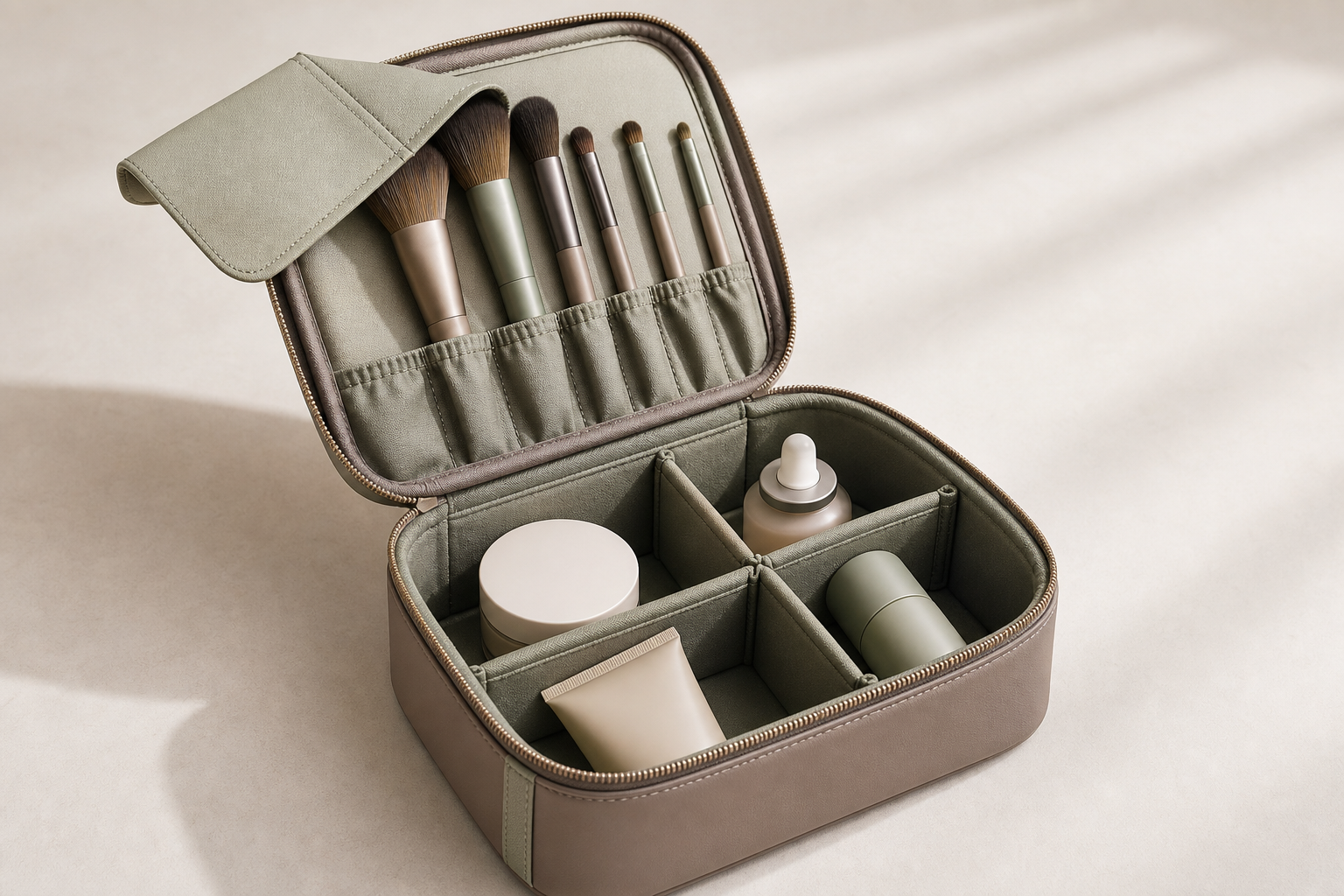
Begin with the actual product set and the order in which a user reaches for it.Reserve stable cells for leak-prone or fragile items, flexible space for changing assortments, and a separated zone for brushes. A good organizer holds items during movement but still leaves finger room. A good brush panel accepts the intended handle range without pinching, lets bristles sit freely, and cannot collide with the base load when the bag closes.
| Decision | Best starting evidence | Approval question |
|---|---|---|
| Compartment plan | Named product list with dimensions and orientation | Can each priority item be found and removed with one hand? |
| Divider system | Expected assortment changes | Does flexibility justify the volume and hardware used? |
| Brush holders | Real slim,standard and large brushes | Are handles secure while tips and ferrules remain clear? |
| Final layout | Fully loaded and partly loaded prototypes | Does the bag close, carry and reopen without internal contact? |
1. Build a payload map around the user’s routine
List every intended item, including cap width, body width, height, weight and leakage or breakage risk. Then mark frequency: daily, occasional or backup. Retrieval sequence matters because the most-used item should not be buried beneath a divider or hidden behind a tall bottle. For a curated retail set, the map may be fixed. For an organizer sold empty, use representative “fit objects” that cover the likely range.
Overall capacity still matters, but it is a separate problem. Use the Cosmetic Bag Size and Capacity Guide to establish the external envelope and usable opening; use the payload map here to spend that interior volume deliberately.
| Payload group | Organization need | Useful evidence | Common conflict |
|---|---|---|---|
| Liquid bottles | Upright support and separation | Filled weight, cap diameter, pump height | Cap hits lid or zipper track |
| Compacts/palettes | Flat support and edge protection | Largest face and hinge position | Divider creates a pressure point |
| Soft tubes | Visible,lightly retained space | Filled thickness, not flat artwork size | Overtight pocket squeezes product |
| Brushes/tools | Handle retention and head isolation | Diameter, length, ferrule and head width | Bristles touch cosmetics below |
2. Give every organizer feature one clear job
A cell controls position. A slip pocket presents a flat or flexible item. A stretch pocket accommodates a range. A loop retains a tool at one point. A covered panel isolates brush heads. These are not interchangeable decorations. Choose the lightest feature that performs the job, then remove any element that creates more interference than value.
| Feature | Best use | Weakness to manage |
|---|---|---|
| Open cell | Bottles, jars and grouped products | Small items can migrate between cells |
| Slip pocket | Palette, sachet, wipe or mirror | Opening may gape or become inaccessible |
| Stretch pocket | Mixed tubes and changing contents | Elastic pressure and recovery vary with load |
| Tool loop | Brush,pencil or applicator handle | One loop size cannot fit every diameter |
| Covered brush panel | Cleaner separation of heads from the main cavity | Adds thickness to the lid stack |
3. Decide between fixed, adjustable and removable compartments
Fixed walls are reliable when the product set never changes. Adjustable dividers suit a family of bottles or jars, but their attachment patches consume wall area and can collect debris. A removable tray simplifies cleaning and lets one bag serve several routines, although it adds another component to fit, pack and inspect. Hybrid layouts often work best: one stable liquid zone plus an open or reconfigurable zone.
| System | Choose it when | Control point |
|---|---|---|
| Fixed sewn wall | The payload and orientation are locked | Position, squareness and seam reinforcement |
| Hook-and-loop divider | Users need several configurations | Engagement area,edge finish and holding force |
| Snap-in divider | Defined positions are acceptable | Stud alignment and pull-through resistance |
| Removable insert | Cleaning or program flexibility is important | Insert-to-shell fit and lift-out access |
| Hybrid | One item group is fixed and another varies | Transition between stable and flexible zones |
4. Choose the number of compartments by function, not symmetry
More sections do not automatically mean better value. Each wall takes width, creates seams and reduces hand access. A group of three similar tubes may work better in one broad pocket than three narrow cells. Conversely, one heavy bottle may need its own base-supported bay so it cannot strike a compact. Count separate risks and retrieval actions, not the number of products.
| Question | If yes | If no |
|---|---|---|
| Can the item leak or stain? | Consider an isolated,wipe-accessible zone | Grouping may be acceptable |
| Can it break or scratch another item? | Add controlled separation | Avoid unnecessary wall thickness |
| Is it reached frequently? | Keep visible with finger clearance | Place in secondary storage |
| Does its size change by SKU? | Use range-tolerant storage | A fitted cell may be efficient |
5. Specify usable cell dimensions, not nominal panel sizes
Finished usable width is what remains after covering, seam turn, binding, corner radius and neighboring loads. Measure the cell in the assembled sample at its narrowest practical point. Record an intended object range and required finger allowance, then set tolerances that protect both. An excessively loose tolerance may allow a bottle to fall over; a tight one may make a legitimate production unit unusable.
| Specification field | What to record | How to verify |
|---|---|---|
| Usable width/depth | Finished clear space at defined height | Gauge block plus intended product |
| Cell height | Floor to finished wall edge | Measure unloaded and with adjacent cells filled |
| Finger allowance | Removal gap around priority item | Timed one-hand retrieval trial |
| Position tolerance | Distance from stable bag seams | Template or marked inspection fixture |
6. Set divider height and rigidity for the load
A low divider may stop a jar from sliding yet allow a tall bottle to tip. A full-height wall can stabilize the load but obstruct sightlines and make corners hard to clean. Rigidity should resist the intended lateral force without turning the cell into a hard edge against fragile packaging. The supporting base and sidewalls must also be firm enough; a strong divider attached to a soft shell simply drags the shell with it.
| Divider choice | Benefit | Watch for |
|---|---|---|
| Low soft wall | Easy visibility and light weight | Tall item may pass over it |
| Medium padded wall | Balanced restraint and protection | Compression changes usable width |
| Full-height firm wall | Strong zone separation | Cleaning access and lid clearance |
| Tapered wall | Supports base while preserving reach | Pattern orientation must be obvious |
7. Select the right cosmetic bag brush holder format
Cosmetic Bag Brush Holders can be individual stitched sleeves, continuous elastic loops, elastic-and-pocket combinations or removable rolls. Sleeves give the handle a defined path. Elastic adapts to moderate diameter variation. A lower pocket can stop handles from swinging. A flap helps isolate heads, but only when it is wide enough and does not press bristles sideways.
| Holder format | Strong use case | Development risk |
|---|---|---|
| Stitched fabric sleeve | Known handle sizes and premium appearance | Limited stretch; seam allowance narrows opening |
| Continuous elastic loops | A controlled family of diameters | Pitch and extension must vary by tool group |
| Loop plus lower pocket | Long tools that need two-point control | Insertion path can become awkward |
| Covered panel | Brush-head separation in travel | Added folded thickness and cleaning surfaces |
| Removable brush roll | Professional or washable modular system | Extra part, attachment and packing step |
8. Measure the whole brush, not only its handle
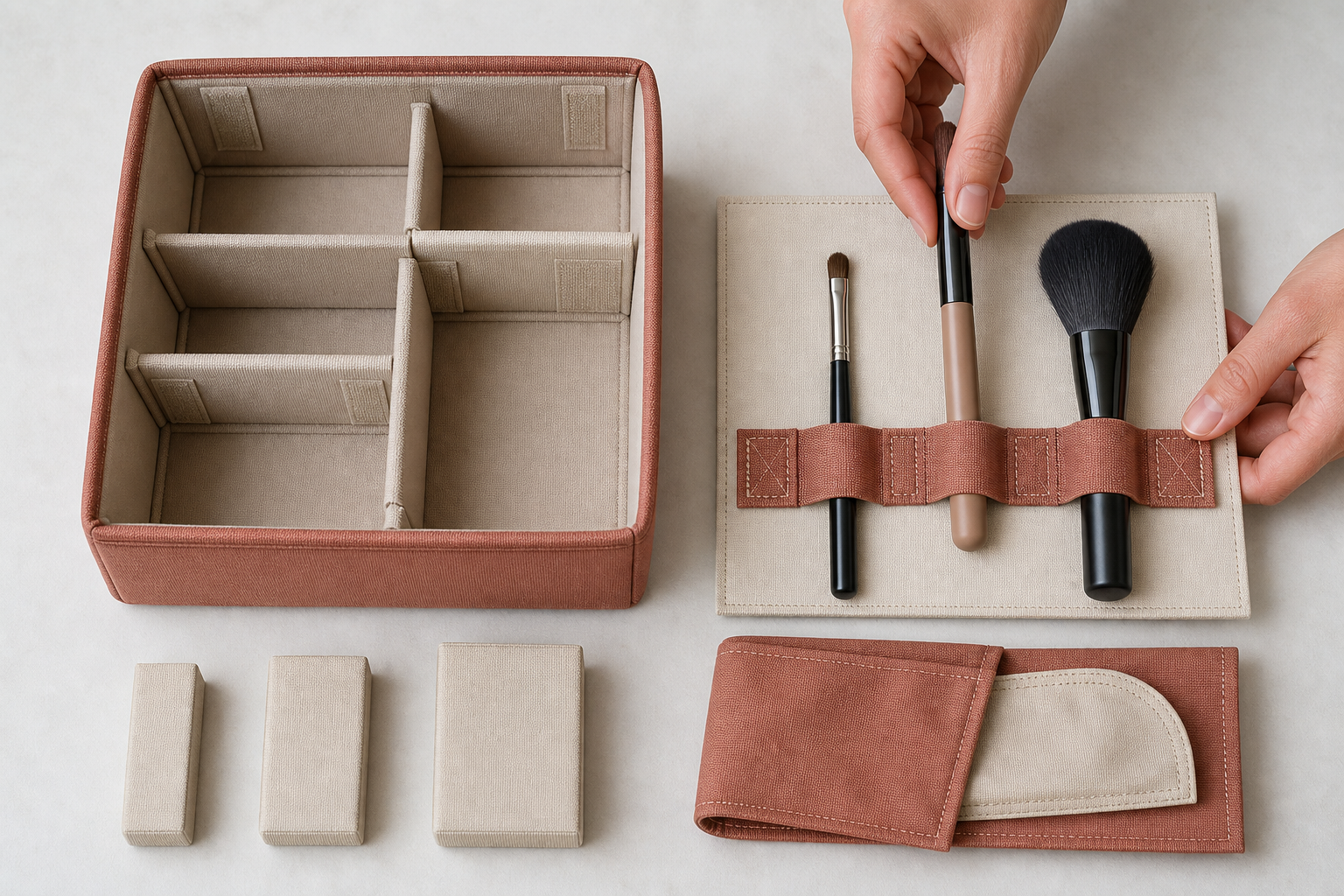
Collect the minimum and maximum handle diameters, but also note handle taper, ferrule width, overall length and uncompressed head width. The retention point should normally sit on a stable handle area rather than a tapered end or ferrule. A large brush needs more lateral pitch so its head does not bend against its neighbor. A short brush may disappear behind a tall sleeve and become difficult to remove.
| Brush class | Critical dimensions | Fit objective |
|---|---|---|
| Slim detail brush | Smallest retention diameter and total length | Cannot slide free under movement |
| Standard eye/face brush | Typical diameter,ferrule and head spread | Smooth insertion with controlled hold |
| Large powder brush | Maximum handle and relaxed bristle width | No elastic overstrain or bristle compression |
| Dual-ended tool | Both head envelopes and usable grip zone | Neither end touches the bag structure |
9. Engineer elastic by finished span and recovery
“Use elastic” is not a specification. Record elastic width, composition or approved reference, relaxed cut length, finished loop span, attachment location and the target object range. Test insertion force and residual looseness after repeated use. If one strip serves multiple brush sizes, vary stitch pitch rather than expecting identical loops to retain both a pencil and a powder brush.
| Elastic control | Sample record | Failure sign |
|---|---|---|
| Relaxed loop span | Finished opening before insertion | Large unit-to-unit variation |
| Working extension | Extension with each approved brush | Excessive force or handle marking |
| Recovery cycle | Condition after repeated insertion/removal | Brush falls out after short use |
| Anchor seam | Stitch construction and backing | Puckering, skipped stitches or pull-out |
10. Protect brush heads, ferrules and surrounding products
The retained handle is only half the layout. Draw a “do not contact” envelope around each brush head and ferrule. Allow space for natural bristle spread, a finger to lift the tool, and any flap fold. When the panel sits in a lid, load the base at its tallest approved condition and close slowly. A brush can remain secure yet still be damaged by a bottle pushing into the bristles from below.
| Contact zone | Risk | Design response |
|---|---|---|
| Brush head to neighbor | Shape distortion and residue transfer | Increase pitch or alternate head direction |
| Ferrule to binding | Scratching and noisy closure | Move retention point or soften contact edge |
| Head to protective flap | Bristles folded by a short/tight cover | Size flap from relaxed head envelope |
| Head to base payload | Crushing,contamination and failure to close | Define a keep-clear volume in the loaded sample |
11. Plan hygiene and cleaning without unsupported claims
Brush separation can reduce direct contact, but it does not make a bag sterile or antimicrobial. Avoid performance language unless it is supported by the exact material and relevant evidence. Instead, design for ordinary cleaning: smooth accessible surfaces, removable components where useful, limited debris traps and enough opening width to wipe around corners. Tell users when brush heads should be dry before storage.
Choose the surrounding layer with the Cosmetic Bag Lining Guide and evaluate the complete material stack, not only the visible face.
| Hygiene objective | Useful construction | Avoid |
|---|---|---|
| Wipe access | Open corners and reachable cell surfaces | Narrow deep pockets with hidden debris zones |
| Brush separation | Properly sized flap or removable roll | Cover that presses wet heads together |
| Component cleaning | Detachable insert with defined care route | Mixed materials with conflicting care needs |
| Claims control | Specific,supportable material statements | Unverified hygienic, sterile or antimicrobial promises |
12. Check zipper, lid and closure interference
Interior features often fail at the boundary. A pocket edge can enter the zipper path, a high divider can bow into the lid, or a loaded brush flap can thicken the hinge. Mark a closure keep-clear zone around the zipper tape, slider route, hinge and lid perimeter. Test it with the most demanding approved load, not with an empty shell.
Coordinate pullers and opening geometry with the Cosmetic Bag Zipper and Hardware Guide so organization does not undermine access.
| Interference check | Test state | Pass condition |
|---|---|---|
| Slider route | All pockets and cells fully loaded | No fabric,elastic or product enters the path |
| Lid compression | Tallest base item plus largest brushes | No hard contact or bristle deformation |
| Hinge fold | Repeated full open/close cycles | Panel lies predictably without buckling |
| One-hand access | Bag standing in normal use position | Priority item clears opening and neighbors |
13. Control dead space and the organization penalty
Organization consumes capacity through wall thickness, attachments and access gaps. This “organization penalty” can be worthwhile when it prevents damage or saves time; it is wasteful when cells remain empty because they fit nothing common. Compare the loaded organizer with a simpler cavity using the same outside dimensions. Keep the feature only if its job is visible in use.
| Source of lost space | Possible value | Reduction method |
|---|---|---|
| Thick covered divider | Protection and upright support | Use thickness only where load requires it |
| Attachment patch | Reconfiguration | Limit patch length to useful positions |
| Oversized brush flap | Head isolation | Shape it around the approved head envelope |
| Tiny corner cells | Usually little | Merge them into one accessible zone |
14. Match the layout to the user and sales channel
A professional artist may value rapid tool selection and a removable brush section. A travel consumer wants containment, simple cleaning and a secure close. A beauty brand selling a filled set can tune every bay to a specific SKU. A promotional program may need fewer, broadly useful organizers so the product remains cost-effective and intuitive.
Use the buyer distinction in Retail Cosmetic Bags vs Promotional Cosmetic Bags before copying a professional layout into a mass campaign.
| User/program | Priority | Suitable organization route |
|---|---|---|
| Filled beauty set | Exact presentation and shipping control | SKU-matched cells with clear pack-out order |
| Retail organizer sold empty | Versatility without confusion | One or two fixed zones plus adjustable space |
| Travel consumer | Containment,closeability and cleaning | Simple sections and covered brush area |
| Professional user | Tool visibility and fast reconfiguration | Removable modules with broader brush range |
| Promotional campaign | Broad relevance and production efficiency | Few multifunctional organizers |
15. Adapt organization to the bag structure
A flat pouch has little permanent depth, so a thick grid can fight the body. A box bag can support moderate cells along its base or side. A train case offers lid and base zones, but also creates the greatest risk of loaded surfaces meeting at closure. Select the organizer after the shell geometry is settled, not before.
Compare those envelopes in Flat Pouch vs Box Cosmetic Bag vs Train Case and then prototype the interior for the selected form.
| Bag structure | Organization strength | Main limit |
|---|---|---|
| Flat pouch | Slim slip pocket or small tool strip | Organizer bulk distorts the outer silhouette |
| Box bag | Side pocket, soft cells or partial divider | Opening width and corner access |
| Structured case | Divider grid, lid panel and modules | Closed-state collision and greater component count |
16. Coordinate face material, backing and edge finish
The organizer is a small structure of its own. Face fabric affects cleanability and friction. Backing controls stand and rebound.Edge binding changes thickness and abrasion behavior. Elastic must be compatible with the backing and stitch method. Review choices alongside the bag’s outer and lining materials using Best Materials for Custom Cosmetic Bags.
| Component layer | Role | Approval focus |
|---|---|---|
| Face fabric | Touch, color and surface cleaning | Finished appearance after sewing and wiping |
| Core/backing | Divider stand and compression response | Loaded deformation and recovery |
| Edge treatment | Contains layers and protects contact edge | Bulk,corner smoothness and abrasion |
| Elastic/attachment | Retention and modularity | Recovery, anchoring and cleaning access |
17. Translate the layout into manufacturable instructions
Place dimensions from stable reference seams, not from a soft raw edge. Number the cells and brush positions so comments cannot be misread. Show the assembly order where a divider blocks access for later stitching. State whether visible alignment is judged empty, loaded or both. Put these details into the Cosmetic Bag Tech Pack with photos of the approved contents.
| Tech-pack item | Required instruction | Reason |
|---|---|---|
| Organizer map | Numbered cells, pockets, loops and orientation | Connects drawings, comments and inspection |
| Reference dimensions | Finished positions from named seams | Reduces accumulated placement error |
| Loop schedule | Span/pitch by brush class | Prevents one-size-fits-none execution |
| Attachment details | Stitch, reinforcement,hook direction or snap part | Controls retention and assembly order |
| Loaded reference | Approved product arrangement and keep-clear zones | Defines functional appearance |
18. Understand the cost and MOQ effects
Each cell adds pattern pieces, cutting, edge work, placement and sewing. Varied brush pitches increase setup attention. Removable modules add attachment parts and individual packing. Component color minimums can matter more than the organizer’s fabric area. Obtain a normalized quotation with and without optional modules; then choose value, not maximum feature count.
Build a realistic budget with How Much Do Custom Cosmetic Bags Cost?, review value-engineering options in our cost reduction guide, and align the sampling calendar with Cosmetic Bag MOQ and Production Time.
| Cost/MOQ driver | Why it changes the program | Possible decision |
|---|---|---|
| Number of divider parts | More cutting, covering and placement | Merge low-value cells |
| Custom elastic color/width | May create a trim minimum | Use an approved shared elastic family |
| Removable attachments | Adds sourcing,sewing and inspection | Limit positions to useful configurations |
| Many color-SKU layouts | Fragments material and production setup | Share one internal platform where justified |
19. Run loaded-use tests during sample development
An empty beauty shot cannot approve the organizer. Load every cell, carry the case in several orientations, open it, retrieve priority items, replace them and close it again. Repeat with a partial load because movement can be worse when unused space remains. Use large, standard and slim brushes to expose loop extremes, and record exactly which reference objects were used.
Plan decision rounds with the Custom Cosmetic Bag Sample Development Process and select relevant performance methods from Which Tests Should Custom Cosmetic Bags Pass?.
| Sample test | Procedure | Failure to record |
|---|---|---|
| Retrieval test | Remove and replace priority products in sequence | Snagging, hidden item or forced neighboring movement |
| Orientation test | Carry upright, flat and on edge with approved load | Migration, tipping or brush release |
| Close test | Cycle closure with maximum approved configuration | Compression,hard contact or zipper obstruction |
| Elastic range test | Cycle minimum, typical and maximum brushes | Slip, excess force, marking or poor recovery |
| Cleaning-access review | Wipe every intended interior surface | Unreachable corner or trapped residue |
20. Convert sample learning into bulk quality control
Bulk inspection should use simple physical references: gauge blocks for cells, three approved brush sizes, a divider-position template and the loaded closure set. Visual inspection alone will not reveal a loop that is two millimeters too relaxed or a wall that collapses beside a bottle. Define sampling frequency and pass criteria before production starts.
Integrate the organizer-specific checks into the Cosmetic Bag Quality Control Checklist rather than treating them as an informal sample note.
| Bulk checkpoint | Inspection aid | Pass evidence |
|---|---|---|
| Cell geometry | Go/no-go blocks and position template | Approved range fits without forced deformation |
| Divider retention | Defined loaded movement routine | Wall remains located and upright |
| Brush-loop range | Slim,standard and large reference brushes | All assigned positions perform as specified |
| Anchor workmanship | Approved seam sample | No loose stitch, distortion or attachment lift |
| Loaded closure | Representative maximum payload | Full cycling without internal collision |
21. Create a scalable interior platform for a collection
A collection can share an elastic family, divider material, edge language and attachment logic while changing cell count by size. Keep the placement rules consistent, but do not shrink every detail proportionally: a brush diameter does not become smaller because the bag is small. Define which modules repeat and which payload requirements force a new layout.
Use How to Design a Cosmetic Bag Collection for the range plan and confirm how loaded sets will be protected through Custom Cosmetic Bag Packaging for Beauty Brands.
| Platform element | Good candidate to share? | Boundary |
|---|---|---|
| Elastic family | Yes, across similar brush classes | Pitch still changes by diameter |
| Divider cover/core | Often | Height and rigidity follow load |
| Attachment system | Yes,when cleaning and strength needs match | Patch layout must fit each shell |
| Cell geometry | Only for shared products | Do not scale blindly between sizes |
| Brush cover | Sometimes | Head envelope and lid depth govern it |
Why choose LUCKYSTAR for cosmetic bag interior organization?
LUCKYSTAR helps turn a mood board into an interior that works with real contents. We can review payload data, select a fixed or modular arrangement, develop loop ranges, coordinate material layers, and test the loaded sample for retrieval and closure. The aim is a repeatable product—not a prototype that works only when carefully arranged for a photograph.
Our development approach connects the shell, organizers, branding, packaging and quality references. Buyers can evaluate one organizer or build a coordinated product family with shared components. Browse the full Product Range or review our custom cosmetic bag manufacturing options.
| LUCKYSTAR support | Practical output | Buyer benefit |
|---|---|---|
| Payload review | Named-item map and organization priorities | Features follow real use |
| Interior prototyping | Cell, divider and brush-holder samples | Fit decisions are visible before bulk |
| Loaded-use validation | Retrieval, movement and closure observations | Hidden collisions are found earlier |
| Production translation | Dimensions,references and inspection aids | Approved function can be repeated |
| Collection coordination | Shared component logic with size-specific layouts | Range consistency without unusable copying |
RFQ checklist for compartments and brush holders
| RFQ field | Information to send |
|---|---|
| Payload | Item names, dimensions, filled weights, photos and required orientation |
| User/channel | Retail empty organizer, filled beauty set, travel, professional or promotion |
| Cell plan | Fixed, adjustable or removable zones and required usable dimensions |
| Brush set | Handle diameters, lengths, ferrule sizes, head widths and quantity |
| Cleaning expectation | Likely residue,wipe routine and removable-part requirement |
| Bag construction | Shell, opening, zipper path, lid depth, lining and structure layers |
| Approval tests | Retrieval, orientation, loop cycling, loaded closure and cleaning access |
| Commercial data | Quantity by color, target price basis, packaging and required delivery date |
Frequently asked questions
How many compartments should a cosmetic bag have?
There is no universal number. Separate items that can leak, break, scratch or obstruct retrieval, then group compatible products. A few useful sections outperform many narrow cells that customers leave empty.
Are removable dividers better than fixed dividers?
They are better when the assortment changes or the insert needs easier cleaning. Fixed walls can be slimmer and more stable for a known filled set. A hybrid plan often gives the best balance.
Should every brush loop be the same size?
No. A slim detail brush and a large powder brush place very different demands on elastic. Group positions by handle diameter and head clearance, then approve each group with physical brushes.
How do you stop makeup brushes from getting crushed?
Retain the handle on a stable section, provide lateral spacing for the relaxed head, add a correctly sized protective flap when appropriate, and verify that loaded base products cannot enter the brush keep-clear zone.
Can brush holders be washable?
Some removable panels or rolls can be designed for a defined care method. The answer depends on every layer, elastic, attachment and finish—not only the face fabric. Approve care instructions on the actual construction.
What is the most important sample test?
The fully loaded close-and-retrieve sequence reveals several linked risks at once. Follow it with partial-load movement and repeated brush insertion because a single staged configuration can hide looseness and migration.
Make the interior earn its space
Strong Cosmetic Bag Compartments are defined by what they protect, stabilize or make easier to retrieve. Reliable brush holders are defined by an approved tool range, controlled elastic behavior and clear space around ferrules and heads. When those decisions are tested in a loaded sample, organization becomes a useful product advantage instead of added bulk.
For supplier capability, process control and commercial evaluation, revisit our cosmetic bag manufacturer selection guide. For the wider bag-sourcing system, use the complete Custom Bag Manufacturer pillar page.
To develop an interior around your actual products, contact LUCKYSTAR for a custom quotation with a payload list, brush samples or dimensions, target quantity, reference images and delivery plan.

Request an interior layout for your payload
Include item names, dimensions, filled weight and orientation, brush dimensions, fixed, adjustable or removable zones, required usable dimensions, bag opening and material layers, cleaning expectation, quantity split, packaging, destination and required date.
Send your project details through the contact form, or Email a project brief with this guide already referenced. The email link opens a draft for your review before sending.
Interior layout, elastic and component selection, cleaning instructions, samples, testing, MOQ, price, capacity, schedule and delivery terms are subject to specification and written confirmation.